



Abstract
Objective
To explore the relationship between maternal shared reading quality (verbal interactivity and engagement) and brain function during story listening in at-risk, preschool-age children, in the context of behavioral evidence and American Academy of Pediatrics recommendations.
Study design
In this cross-sectional study, 22 healthy, 4-year-old girls from low-socioeconomic status (SES) households completed functional MRI using an established story listening task, followed by videotaped observation of un-coached mother-daughter reading of the same, age-appropriate picture book. Shared reading quality was independently scored applying dialogic reading and other evidence-based criteria reflecting interactivity and engagement, and applied as a predictor of neural activation during the fMRI task, controlling for income and maternal education.
Results
Shared reading quality scores were generally low, and negatively correlated with maternal distraction by smartphones (P < .05). Scores were positively correlated with activation in left-sided brain areas supporting expressive and complex language, social-emotional integration and working memory (p < 0.05, false discovery rate corrected).
Conclusion
Maternal shared reading quality is positively correlated with brain activation supporting complex language, executive function, and social-emotional processing in at-risk, preschool-age children. These findings represent novel neural biomarkers of how this modifiable aspect of home reading environment may influence foundational emergent literacy skills, reinforce behavioral evidence and AAP recommendations, and underscore the potential of dialogic reading interventions to promote healthy brain development, especially in at-risk households.
Keywords: shared reading, dialogic reading, emergent literacy, parent-child engagement, early brain development, functional MRI, language networks, social-emotional processing, home reading environment, story listening
The American Academy of Pediatrics (AAP) recommends shared reading beginning as soon as possible after birth, citing enduring cognitive, social-emotional, and neurobiological benefits.1 Interventions target home reading environment, a composite of quantitative and qualitative factors.2 Positive association between quantitative factors (access to books and reading frequency) and brain activation supporting imagery and comprehension in preschool-age children was recently described, complementing behavioral evidence.3 However, the influence of shared reading quality (verbal interactivity and engagement) on the developing brain has not been investigated.
Originally developed as an intervention to promote language development in low-socioeconomic status (SES) children,4 dialogic reading is a construct reflecting verbal interactivity and engagement during shared reading.4 Through the use of specific types of prompts and responses, the caregiver encourages the child to participate in a reciprocal dialogue catalyzed by the story.4, 5 Behavioral evidence suggests that dialogic reading may confer moderate to large benefits,6 including expressive language,7, 8 narrative comprehension,5 and attention,9 all foundational emergent literacy skills.10 Social-emotional benefits are also cited, including increased parent-child bonding and enjoyment of reading.11, 12 Nurturing behaviors such as child-directed speech and lap sitting can also enhance shared reading quality and improve outcomes.13 However, although highly variable, shared reading quality “dialogic-ness” tends to be low in low-socioeconomic status (SES) households.7, 14, 15 Thus, programs such as Reach Out and Read targeted to low-SES, at-risk families encourage providers to model dialogic reading during pediatric well-child visits.2
As reading is an evolutionarily new, invented skill, there is no hardwired reading network in the brain. Instead, beginning in infancy, brain areas and networks adapted for other functions such as vision, language, and working memory are gradually integrated in response to reading exposure and practice.16 This neurobiological process underlies emergent literacy, the skills, Knowledge, and attitudes required to learn to read and write,10 its foundation laid during the span of rapid brain growth between birth and age 5.17 It is clear that neurobiological differences during this span predate18 and can often predict behavioral differences, such as phonological awareness and vocabulary,19, 20 and long-term outcomes such as reading ability.21 Less clear are questions regarding the potential to influence this neurobiological process via home reading practices, specific types of interventions, and dose-response thresholds thereof, during critical developmental stages. Neuroimaging is increasingly applied to provide mechanistic insights into such questions in the context of early home environment and child health outcomes.3, 22, 23
The purpose of this study was to apply neuroimaging to explore the association between maternal shared reading quality, which behavioral evidence suggests can convey substantial benefits, and brain function supporting emergent literacy skills in A sample of 4-year-old girls from low-SES households. We hypothesized that children whose mothers exhibited higher-quality shared reading behaviors would show greater activation in brain areas supporting expressive language,26 social-emotional processing,12 and attention.27
METHODS
All participants in this cross-sectional study were enrolled in a longitudinal home injury prevention trial. That cohort consists of 650 mother-child dyads recruited in infancy from a home visiting program serving low-SES, first-time mothers.28 Inclusion criteria for the present study were: female sex, approximately 4 years old, full-term gestation, native English speaking household, no history of brain injury or developmental delay, and no contraindications to MRI. Girls were exclusively sampled due to time/budget constraints, higher previous MRI success rates (67% versus 41% for boys),29 and negligible sex differences in brain activation patterns for our story listening task at this age.30 We identified 105 girls who would be approximately 4 years old during our study window (oldest in the cohort). Of these, 55 were unable to be contacted, 5 were excluded due to developmental delay, and 4 did not participate because of concerns about MRI. Of the 41 agreeing to participate, 32 arrived for their visit at which informed consent was obtained, including for video observation. Of these, 22 successfully completed the MRI and video tasks (69%). Families were compensated for time and travel, and our study was approved by our medical center Institutional Review Board.
MRI was performed via a 3T Philips scanner equipped with an Avotec audiovisual system. Details of play-based MRI acclimatization techniques are described by Vannest et al,31 MRI acquisition specifications detailed in Schmithorst et al.32 For fMRI, BOLD (blood oxygenation level dependent)-weighted scans covering the entire brain with voxel size 3x3x4 mm were acquired at 2-second intervals (TR=2). Data pre-processing was performed using FSL software (fMRI-Brain Software Library, Oxford, UK), as described by Sroka et al.20 All children were awake and non-sedated during MRI.
Our fMRI story listening task consists of 10 alternating blocks of active and control conditions (5 each) of 32 seconds duration, for a total functional scanning time of 5 minutes 20 seconds. During the active condition, a series of 5 stories of 9–10 sentences each read in a female voice was presented via headphones. The stories were created by a speech pathologist with vocabulary, syntax, and content appropriate for preschool-age children (download: https://www.irc.cchmc.org/software/pedaudio.php).3, 33 The control condition consisted of tones in a range of frequencies simulating human speech. No visual stimulus was presented other than a blank screen.
Following MRI, the mother and child were directed to a private waiting room and encouraged to relax. A high-definition webcam was unobtrusively mounted, and arranged on a table were: popular magazines, a sign with a WiFi password, and a children’s picture book (The Little Engine That Could, Philomel, New York). If the mother or child did not spontaneously choose the book within 3 minutes, a research coordinator advised them that it was theirs to take home and encouraged them to read it together, with no further coaching. After approximately 15 minutes or when finished reading, the research coordinator entered to complete the visit.
Scoring for video reading observations was adapted from a standardized form developed for dialogic reading training.34 Categories were: 1) introducing the book to build interest (1 point), 2) CROWD prompts (1 point per instance): sentence Completion, Recall of parts of the story, Open-ended questions, “Wh-” questions, and Distancing to relate the story to the child’s life, 3) PEER responses to what the child says after the Prompt (1 point per instance): Evaluate, Expand, and/or Repeat, and 4) discussing the book after reading (1 point). Additional evidence-based behaviors13 were also scored: proximity (0–2 points for distant, side-close, or on lap), child page turning (0–2 points for never, sometimes, often), and use of child-adjusted voice such as sound effects (0–2 points, for never, sometimes, often).
The principal investigator and 2 additional scorers (medical student and research coordinator) independently scored all videos, which were entered into a secure REDCap® database.35 Scoring training lasted 4 hours, including a dialogic reading online module34 and interactive role play sessions.2
fMRI Group Mean Analysis and Linear Regression with Maternal Reading Quality Scores
A biostatistician uninvolved with video scoring performed all fMRI analyses. Group mean analysis was conducted via the FEAT (fMRI Expert Analysis Tool) modality of FSL software, generating contrast maps reflecting stories>tones activation across all 22 subjects (p < 0.05, FDR corrected), as described in Hutton et al.3 General linear regression was then performed applying z-score maps representing (stories>tones) activation as the dependent variable and reading quality score as the predictor variable, across all subjects. Child age, household income and maternal education were considered as covariates and excluded, given lack of significant correlation with BOLD activation during the story task for these variables (all p > 0.05, FDR corrected). Activation maps showing areas of correlation between observed reading quality scores and BOLD activation (stories>tones), along with summary statistics for size, intensity, and location of activation clusters were generated (p < 0.05, FDR corrected). Group-level statistical inference was carried out using FSL’s randomise function,36 a nonparametric permutation test function providing robust control over false-positive results.37 The FSLView38 package was used to identify brain areas corresponding to active clusters in normalized, 3-dimensional, Montreal Neurological Institute (MNI) coordinate space,39 using the Harvard-Oxford Cortical Structural Atlas. Cluster coordinates were translated into neurological Brodmann Areas via the Talairach Client tool.40
RESULTS
Mean maternal age was 21.4 +/− 3.8 years. Seventy-seven percent reported household income under $15,000/year, 9% between $15,000–$30,000/year, and 14% between $30,000– $50,000/year. Fifty-four percent were high school graduates or less, 41% had some college, and 1 (5%) was a college graduate. All children were girls, mean age 4.1 +/− 0.2 years. Wechsler Preschool and Primary Scale of Intelligence (WPPSI) full-scale IQ for the children was within the normal range (mean 92+/−12; range 74–120), as was verbal IQ (mean 97+/−14; 77–136).
A summary of maternal reading quality scores is shown in the Table and Figure 1.
Figure 1. Observed maternal reading quality scores.
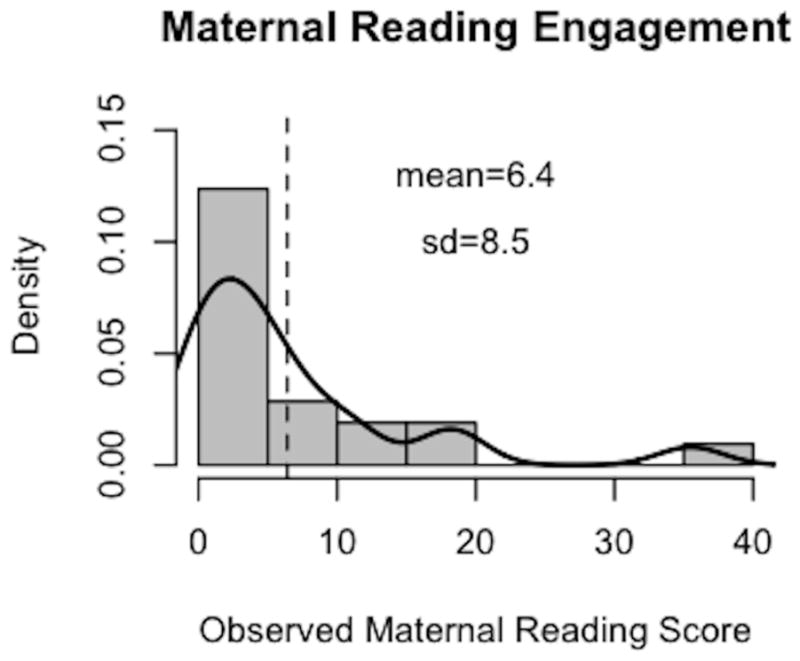
Histogram and density curve for observed maternal reading quality scores, including mean (dashed line) and standard deviation (SD). Mothers who did not read despite encouragement received a score of 0. Points were awarded for CROWD prompts, PEER expansions, opening/closing questions, spontaneous book sharing, proximity, child page turning and use of child-adjusted language.
Six mother-child dyads initiated shared reading spontaneously (27%; 3 prompted via the child and 3 via the mother), 10 prompted by a research coordinator (46%), and 6 did not read despite prompts (27%). Of mothers who read, 12 read the book in its entirety (75%) and 4 partially (25%). Of the 4 that stopped reading, 3 were due to the child losing interest (75%), and 1 due to the mother losing interest. Of the six who did not read, all were due to maternal distraction (5 by smartphone), 3 despite multiple entreaties from the child.
Inter-rater reliability for maternal reading quality scores was high (intra-class correlation coefficient=0.96). Mothers who did not read despite prompts (n=6) received a 0 score. No mothers who read at least some of the book received this score. Mean reading quality score was 6.4 (SD 8.5, range 0 – 35.5). Neither household income nor maternal education was significantly correlated with reading quality scores (all p > 0.05). Reading quality scores were positively correlated with child full-scale and verbal IQ, controlled for maternal education and income (p < 0.05). Reading quality scores were negatively correlated with maternal smartphone use (R2=0.25; p < 0.05), and marginally positively correlated with scores of child engagement during story sharing (p=0.07), the latter applied as a predictor in a separate MRI-based analysis.41
Group mean activation for (stories > tones) involved bilateral, left-lateralized brain regions involved with acoustic, phonological, and semantic processing (p < 0.05, FDR correction; Figure 2; available at www.jpeds.com), similar to prior studies applying this task in young children.3, 33
Figure 2. Group mean activation map for the story listening task.

Group mean BOLD fMRI activation map for our story listening task (stories>tones) in 4-year-old girls (n=22). All voxels significant at P < .05 (FDR corrected), slice thickness 5 mm for contiguous slices. Slices range from z=−28 to z=74 in MNI coordinate space. Color scale from t=1.25 (cooler) to 4 (hotter). Radiological orientation, left=right, right=left.
Maternal reading quality scores were positively correlated with higher BOLD activation during the story task in exclusively left-sided, anterior brain areas (Figures 3, 4, and 5; Figure 3 available at www.jpeds.com).
Figure 3. Regression map for the story listening task (stories>tones activation) applying maternal reading quality score as a predictor variable.

Regression map for the story listening task (stories>tones; n=22), applying maternal reading quality score as the predictor variable. Total cluster size 1374 voxels (P < .05, FDR corrected), with center of gravity at (x=−41, y=12, z=−17; left temporal pole) in MNI coordinate space and z-score local maxima 3.11–4.24. Shown as 5 mm axial slices from z=−28 to z=74 in MNI coordinate space. Color scale t=1.25 (cooler) to 4 (hotter). Radiological orientation, left=right, right=left.
Figure 4. Tri-planar view of neural activation (stories>tones) for the story listening task applying maternal reading quality score as a predictor variable.

Orthogonal tri-planar view (origin x=−44, y=18, z=−12, MNI coordinate space; left inferior frontal gyrus) of BOLD activation for the story listening task (stories>tones; n=22), applying maternal reading quality score as the predictor variable. Total cluster size 1374 voxels (P < .05, FDR corrected). Color scale t=1.25 (cooler) to 4 (hotter). Radiological orientation, left=right, right=left, sagittal plane viewed from the right.
Figure 5. Three-dimensional rendering of neural activation (stories>tones) for the story listening task applying maternal reading quality score as a predictor variable.

Three-dimensional rendering of BOLD activation for the story listening task (stories>tones; n=22), applying maternal reading quality score as the predictor variable. Major areas of activation (p < 0.05, FDR corrected) include: A) inferior frontal gyrus (BA 44, 45; Broca’s Area), B) frontal pole (BA 10), C) anterior insula, and D) temporal pole (BA 38). Cutout is in the left hemisphere, with anterior=left, posterior=right. Color scale t=1.25 (cooler) to 4 (hotter).
Anatomical areas of activation involved: 1) temporal pole, supporting semantic memory42 and sensory-emotional association for language43; 2) anterior insula, a multi-sensory attention hub44 supporting social-emotional processing45 and emotional salience; 3) inferior frontal gyrus pars orbitalis, supporting complex language processing46–49; 4) inferior frontal gyrus, pars triangularis (Broca’s Area), an expressive language hub supporting integration, coordination and semantic processing50, 51; and 5) lateral frontal pole, supporting working memory.52 Smaller areas of activation included anterior middle temporal gyrus, supporting multi-modal (especially audio-visual) semantic processing53; inferior temporal gyrus pars opercularis (Broca’s Area), supporting phonological and syntactic processing54; parahippocampus, a hub for episodic memory encoding and retrieval52, 55; and putamen, supporting instrumental learning56 and language initiation.50, 57 Areas of activation are shown in Figure 3 and Figure 4, a 3-dimensional rendering identifying neurological Brodmann Areas (BA) provided in Figure 5.
DISCUSSION
Although 5–17% of reading difficulty has an organic etiology (eg, dyslexia),58 the majority is environmental, a consequence of inadequate resources, motivation, and/or stimulation required to learn to read.59 Low-SES populations bear disproportionate risk, fueling cycles of academic failure, poverty and poor health outcomes.59, 60 Contributing factors include deficient reading role models and routines in the home,61, 62 especially during the span of rapid brain development from birth through age 5, when children often enter kindergarten.17 As reading is an evolutionarily new skill requiring the integration of brain networks adapted for language, visual imagery, and executive functions (e.g. attention),63 the greatest potential to encourage this process is in early childhood, when neuroplasticity is maximal.17 Similarly, each component network, particularly for language, must be adequately stimulated through constructive experiences such as shared reading, to maximize function.
A positive association between quantitative aspects of home reading environment (access to books and shared reading frequency) and brain function supporting semantic processing and visual imagery in preschool-age children was recently described.3 Our study builds on these findings by providing novel evidence that, despite low levels observed in this low-SES sample, even modest increases in shared reading quality are positively associated with differences in brain function in distinct brain areas supporting other foundational emergent literacy skills. This finding is notable, as it suggests that modifiable aspects of home reading environment influence the developing brain differently, and although targeting one aspect is helpful, combined approaches may be necessary to optimize the integration of brain networks underlying emergent literacy and reading “readiness.”
Expressive language is the most well-described benefit of shared reading quality, particularly dialogic reading.5 Our finding of positive correlation between maternal reading quality scores and child activation in the left inferior frontal gyrus (IFG; Broca’s Area) suggests a neural correlate that is remarkably consistent with this evidence. Although counter-intuitive that IFG activation was found during a story listening task where children do not verbally express themselves, recent evidence has refined the role of Broca’s Area to that of an expressive language coordination hub,50 including semantic and syntactic processing, which is later “recycled” into the reading network.64 Such activation may also reflect the engagement of a putative mirror-neuron system for language (i.e. silent rehearsal),65, 66 though this notion is controversial. Regardless, our finding suggests that encouraging children to participate actively during shared reading, as advocated by the dialogic approach,67 may help them develop neural infrastructure to process and verbally express what they hear or read.
Shared reading quality has also been found to enhance narrative comprehension, most likely via greater interactive participation.68 Although IFG activation is consistent with this effect, increased activation in the left temporal pole during our story task for children whose mothers exhibited higher-quality shared reading suggests an additional biomarker. As a node in the semantic network,55 the left temporal pole facilitates integration of internal and external, multi-sensory stimuli with language,43 and plays a key role in semantic memory (concepts and facts).42 This integrative role is mediated by a major white matter tract69 connecting the temporal pole and limbic areas43 including the orbitofrontal cortex and insula, which were also active in our analysis. It is intriguing to speculate that children with more immersive, nurturing shared reading exposure may more efficiently recruit these multi-modal semantic/integrative circuits during story listening, and later reading, facilitating deeper connection and understanding.
Social-emotional benefits of nurturing shared reading routines are intuitive and widely cited.1, 45, 70 Our finding of positive correlation between maternal reading quality scores and activation in the left anterior insula is consistent with this evidence.1, 45, 70 Although not generally included in the reading network, the anterior insula is a key node in the “salience network,” which helps coordinate attentional shifts based on perceived significance, modulated by input from limbic and episodic memory circuits.44 During our story listening task, anterior insula activation may reflect determination of the emotional weight of the narrative from the child’s perspective, in turn modulating attention. In this context, it is reasonable to speculate that children with greater experience reciprocally engaging in shared reading may be better equipped to form stronger social-emotional connections between stories and their own life, and with caregivers who read with them.1 Conversely, those with less practice, especially during the critical span of social-emotional development between 2 and 5 years old,71 may lack such depth of neural processing and reading interest.
A related study involving these dyads found a positive correlation between child engagement during shared reading, which was also positively correlated with maternal reading quality, and activation in cerebellar association cortex, with increased connectivity between this cluster and language and executive function areas.41 Our finding of positive correlation between maternal shared reading quality and child IQ (full-scale and verbal) is consistent with these MRI results. We feel that this should be interpreted with caution, as our intent for IQ testing was primarily to establish that these children were within a normal range, administered by research coordinators with sub-optimal training. It is also commonly understood that IQ becomes more stable with age, and that the older the child is when tested, the more predictive IQ is of later abilities.74 Thus, these results may have reduced validity due to insufficient examiner training and the age of the children. However, these results do indicate that such potential associations merit further study. IQ is a multifactorial construct, and although it is reasonable to speculate that shared reading practices may exert substantial benefits via a neurobiological, likely reciprocal process, this complex issue is best addressed via a larger, longitudinal sample.
Our study has several important strengths. Our sample of 4-year-old girls is younger than most MRI-based studies of cognitive development, with an adequate sample size75 drawn from a well-defined cohort, applying an established fMRI paradigm. Our shared reading assessment involved direct observation, addressing concerns regarding reliability of parental report.76 Scoring was adapted from a standardized instrument and evidence-based conceptual model,13, 25 with high inter-rater reliability and independent statistical analysis. Our analyses were hypothesis-driven, and our findings highly consistent with cognitive testing results (notably verbal IQ), behavioral evidence,5 and in terms of functional brain networks,44, 77 including the emerging reading network,63 accounting for potential confounders. Our results build on recent MRI-based evidence of benefits of early home reading environment on brain function,3, 41 informing an innovative, eco-bio-developmental model78, 79 that is highly applicable for further research. Intriguingly, these combined results suggest that quantitative factors, such as access to books, may more directly influence posterior, visual-association brain circuits supporting “seeing and understanding,”3 while qualitative factors may more directly influence anterior executive, language and social-emotional circuits, supporting “attending, relating, and expressing.” Although highly simplistic, such a construct is useful to help guide interventions (e.g. book distribution, dialogic reading training) in programs such as home visitation, Imagination Library, and Reach Out and Read,2 ideally explored via longitudinal studies. Our study also has limitations. Our low-SES sample limits generalizability, though this demographic is most often cited in dialogic reading literature,5 and low-SES populations stand to benefit most from improved interventions. Our study involved only girls, though this sampling strategy was guided by historical success rates and negligible sex differences in activation during our story listening task,30 allowing us to collect high-quality data efficiently and cost-effectively in very young children. Our shared reading observation was conducted in a non-natural setting. However, the room was comfortably arranged via a scripted protocol with prompts provided, highly conducive compared with oft-chaotic home environments experienced by low-SES families.80 Our reading score reflected a single snapshot, and may not be representative of longer-term behavior, though household reading behaviors tend to be stable during the preschool period81 and discrete observations are reliably used in assessment of the home environment,82 including reading.83, 84 Applying dialogic scoring criteria to mothers showing low mastery may be unrealistic. However, although developed for intervention,85 the dialogic construct is a well-defined means to assess nurturing behaviors during shared reading – questioning, responding, closeness - that do not require explicit teaching, and other basic, evidence-based items were included.13 Our finding of generally low scores is concerning, highlighting the difficulty of remediating shared reading quality compared with book distribution, given limited resources86, 87 and provider training.7 That said, our findings suggest that even modest improvement in shared reading quality may provide meaningful benefits for brain development supporting emergent skills in at-risk children. Determining the relative impact of qualitative behaviors - from lap sitting, to dialogic prompts, to reducing maternal distraction by smartphones, a major observed barrier worthy of emphasis - warrants further study. Finally, whereas our results show compelling correlation between maternal shared reading quality and brain function during a foundational developmental stage, our cross-sectional design cannot establish causation. Longitudinal studies are needed to better understand how a child’s developing brain responds to various modifiable aspects of home reading environment, to optimize literacy and health outcomes.
Our work provides novel preliminary evidence of positive association between maternal shared reading quality and brain function in preschool-age children listening to stories. These findings are highly consistent with behavioral evidence, reinforce AAP recommendations, expand recent MRI-based work exploring home reading environment, and underscore the potential of interventions such as dialogic reading to promote healthy brain development, especially in low-SES households. We hope that this early study reinforces the perspective of shared reading as a critical health issue for parents, pediatricians and policymakers.
Table 1. Maternal reading observation scores and frequencies.
Summary of maternal reading quality scores (n=22) and frequencies of behaviors. Total score includes mean, standard deviation (SD), minimum and maximum. Frequencies of behaviors reflect use at least once in mothers who read (n=16). For total score, 1 point was awarded for each CROWD/PEER instance, and 0–2 points for additional items.
| Item | ||||||
|---|---|---|---|---|---|---|
| n | % | Mean | SD | Min | Max | |
| Total observed score | 22 | 100 | 6.4 | 8.5 | 0 | 35.5 |
| 0 (did not read) | 6 | 27 | ||||
| 1–3 | 4 | 18 | ||||
| 4–11 | 9 | 41 | ||||
| 12–19 | 2 | 9 | ||||
| 20 or more | 1 | 5 | ||||
| Number of mothers (n=16) using CROWD Prompts | ||||||
| Completion | 1 | 6 | ||||
| Recall | 2 | 13 | ||||
| Open-ended questions | 6 | 38 | ||||
| Wh- questions | 9 | 56 | ||||
| Distancing | 5 | 31 | ||||
| PEER sequence | ||||||
| Evaluation | 5 | 31 | ||||
| Expansion | 4 | 25 | ||||
| Repetition | 2 | 13 | ||||
| Additional items | ||||||
| Spontaneous reading | 6 | 27 | ||||
| Discussion before reading | 2 | 13 | ||||
| Discussion after reading | 7 | 44 | ||||
| Proximity - lap | 2 | 13 | ||||
| Proximity – side close | 6 | 38 | ||||
| Proximity – distant | 8 | 50 | ||||
| Page turning - never | 9 | 56 | ||||
| Page turning - sometimes | 4 | 25 | ||||
| Page turning - often | 3 | 19 | ||||
| Child-adjusted voice - never | 5 | 31 | ||||
| Child-adjusted voice - sometimes | 11 | 69 | ||||
| Child-adjusted voice - often | 0 | 0 | ||||
Acknowledgments
The clinical trial was supported by the Eunice Kennedy Schriver National Institutes for Child Health and Human Development (#1R01HD066115-01A1 [to K.P.]). Support for neuroimaging, reading observations, and related analyses was provided via a Ruth L Kirschstein National Research Service Award (to J.H.) and an Academic Pediatric Association Young Investigator Award for Primary Care Strategies for the Promotion of Early Literacy and School Readiness Supported by Reach Out and Read (to J.H.). T.W. is a Chairman of the Board of Directors of the Reach out and Read program, but receives no financial compensation.
We thank Akila Rajagopal for invaluable support with imaging-based analyses, Kim Yolton, PhD for consultation regarding cognitive-behavioral measures, Rachel Gruber and Jonathan Vidovich for scoring reading observations and organizing behavioral data, and Stacey Woeste for coordination of CHIP subjects, implementation of our reading observation protocol, and data management.
Abbreviations
- AAP
American Academy of Pediatrics
- BOLD
blood oxygen level dependent
- CHIP
Cincinnati Home Injury Prevention (study)
- CROWD (prompts)
Completion, Recall, Open-ended questions, Wh-questions, Distancing
- FDR
false discovery rate
- fMRI
functional magnetic resonance imaging
- IFG
inferior frontal gyrus
- MNI
Montreal Neurological Institute
- PEER
Prompt, Evaluation, Expansion, Repetition
- SES
socioeconomic status
Footnotes
The authors declare no conflicts of interest.
Publisher's Disclaimer: This is a PDF file of an unedited manuscript that has been accepted for publication. As a service to our customers we are providing this early version of the manuscript. The manuscript will undergo copyediting, typesetting, and review of the resulting proof before it is published in its final citable form. Please note that during the production process errors may be discovered which could affect the content, and all legal disclaimers that apply to the journal pertain.
References
- 1.High PC, Klass P. Literacy promotion: an essential component of primary care pediatric practice. Pediatrics. 2014;134:404–9. doi: 10.1542/peds.2014-1384. [DOI] [PubMed] [Google Scholar]
- 2.Zuckerman B, Khandekar A. Reach Out and Read: evidence based approach to promoting early child development. Current Opinions in Pediatrics. 2010;22:539–44. doi: 10.1097/MOP.0b013e32833a4673. [DOI] [PubMed] [Google Scholar]
- 3.Hutton J, Horowitz-Kraus T, Mendelsohn A, DeWitt T, Holland S. Home Reading Environment and Brain Activation in Preschool Children Listening to Stories. Pediatrics. 2015;136:466–78. doi: 10.1542/peds.2015-0359. [DOI] [PMC free article] [PubMed] [Google Scholar]
- 4.Whitehurst G, Falco F, Lonigan C, Fischel J, DeBaryshe B, Valdez-Menchaca M, et al. Accelerating Language Development Through Picture Book Reading. Developmental Psychology. 1988;24:552–9. [Google Scholar]
- 5.U.S. Department of Education. Dialogic Reading. Washington, DC: Institute of Education Sciences; 2007. [Google Scholar]
- 6.Mol S, Bus A, de Jong M, DS Added Value of Dialogic Parent–Child Book Readings: A Meta-Analysis. Early Education and Development. 2008;19:7–26. [Google Scholar]
- 7.Whitehurst GJ, Epstein JN, Angell AL, Payne AC, Crone DA, Fischel JE. Outcomes of an emergent literacy intervention in Head Start. Journal of Educational Psychology. 1994;86:542–55. [Google Scholar]
- 8.Lonigan C, Anthony J, Bloomfield B, Dyer S, Samwel C. Effects of Two Shared-Reading Interventions on Emergent Literacy Skills of At-Risk Preschoolers. Journal of Early Intervention. 1999;22:306–22. [Google Scholar]
- 9.Vally Z, Murray L, Tomlinson M, Cooper PJ. The impact of dialogic book-sharing training on infant language and attention: a randomized controlled trial in a deprived South African community. Journal of Child Psychology and Psychiatry, and Allied Disciplines. 2014 doi: 10.1111/jcpp.12352. [DOI] [PMC free article] [PubMed] [Google Scholar]
- 10.Whitehurst GJ, Lonigan CJ. Child development and emergent literacy. Child Dev. 1998;69:848–72. [PubMed] [Google Scholar]
- 11.Crain-Thoreson C, Dale P. Enhancing linguistic performance: Parents and teachers as book reading partners for children with language delays. Topics in Early Childhood Special Education. 1999;19:28–39. [Google Scholar]
- 12.Doyle BG, Bramwell W. Promoting emergent literacy and social–emotional learning through dialogic reading. The Reading Teacher. 2006:59. [Google Scholar]
- 13.DeBruin-Parecki A. Let’s read together: Improving literacy outcomes with the Adult-Child Interactive Reading Inventory (ACIRI) Baltimore, MD: 2007. [Google Scholar]
- 14.Payne A, Whitehurst G, Angell A. The role of literacy environment in the language development of children from low-income families. Early Child Res Q. 1994;9:427–40. [Google Scholar]
- 15.Lonigan C, Whitehurst GJ. Relative efficacy of parent and teacher involvement in a shared-reading intervention for preschool children from low-income backgrounds. Early Childhood Research Quarterly. 1998;13:263–90. [Google Scholar]
- 16.Dehaene S, Cohen L. Cultural recycling of cortical maps. Neuron. 2007;56:384–98. doi: 10.1016/j.neuron.2007.10.004. [DOI] [PubMed] [Google Scholar]
- 17.Knudsen EI. Sensitive periods in the development of the brain and behavior. Journal of Cognitive Neuroscience. 2004;16:1412–25. doi: 10.1162/0898929042304796. [DOI] [PubMed] [Google Scholar]
- 18.Kuhl PK. Early Language Learning and Literacy: Neuroscience Implications for Education. Mind, brain and education: the official journal of the International Mind, Brain, and Education Society. 2011;5:128–42. doi: 10.1111/j.1751-228X.2011.01121.x. [DOI] [PMC free article] [PubMed] [Google Scholar]
- 19.Leppanen PH, Hamalainen JA, Guttorm TK, Eklund KM, Salminen H, Tanskanen A, et al. Infant brain responses associated with reading-related skills before school and at school age. Neurophysiologie clinique = Clinical neurophysiology. 2012;42:35–41. doi: 10.1016/j.neucli.2011.08.005. [DOI] [PubMed] [Google Scholar]
- 20.Sroka M, Vannest J, Maloney T, Horowitz-Kraus T, Byars A, Holland S. Relationship between receptive vocabulary and the neural substrates for story processing in preschoolers. Brain Imaging and Behavior. 2015 doi: 10.1007/s11682-014-9342-8. In Press. [DOI] [PubMed] [Google Scholar]
- 21.Cardillo-Lebdeva G, Kuhl P. Individual differences in infant speech perception predict language and pre-reading skills through age 5. Annnual Meeting of the Society for Developmental and Behavioral Pediatrics; Portland, OR. 2009. [Google Scholar]
- 22.Boyce WT. Differential Susceptibility of the Developing Brain to Contextual Adversity and Stress. Neuropsychopharmacology: official publication of the American College of Neuropsychopharmacology. 2015 doi: 10.1038/npp.2015.294. [DOI] [PMC free article] [PubMed] [Google Scholar]
- 23.Powers SJ, Wang Y, Beach SD, Sideridis GD, Gaab N. Examining the relationship between home literacy environment and neural correlates of phonological processing in beginning readers with and without a familial risk for dyslexia: an fMRI study. Annals of dyslexia. 2016 doi: 10.1007/s11881-016-0134-2. [DOI] [PMC free article] [PubMed] [Google Scholar]
- 24.Vannest JJ, Karunanayaka PR, Altaye M, Schmithorst VJ, Plante EM, Eaton KJ, et al. Comparison of fMRI data from passive listening and active-response story processing tasks in children. J Magn Reson Imaging. 2009;29:971–6. doi: 10.1002/jmri.21694. [DOI] [PMC free article] [PubMed] [Google Scholar]
- 25.University of North Carolina FPG Child Development Institute. CONNECT Dialogic Reading Observation Form. Chapel Hill, NC: Center to Mobilize Early Childhood Knowledge; 2011. [Google Scholar]
- 26.Catani M, Jones DK, ffytche DH. Perisylvian language networks of the human brain. Ann Neurol. 2005;57:8–16. doi: 10.1002/ana.20319. [DOI] [PubMed] [Google Scholar]
- 27.Knudsen EI. Fundamental components of attention. Annual review of neuroscience. 2007;30:57–78. doi: 10.1146/annurev.neuro.30.051606.094256. [DOI] [PubMed] [Google Scholar]
- 28.Every Child Succeeds. Every Child Succeeds Home Visitation Program. Cincinnati, OH: 2016. Available from: http://www.everychildsucceeds.org/Our-Mission.aspx. [Google Scholar]
- 29.Rajagopal A, Byars A, Schapiro M, Lee GR, Holland SK. Success rates for functional MR imaging in children. AJNR Am J Neuroradiol. 2014;35:2319–25. doi: 10.3174/ajnr.A4062. [DOI] [PMC free article] [PubMed] [Google Scholar]
- 30.Plante E, Schmithorst VJ, Holland SK, Byars AW. Sex differences in the activation of language cortex during childhood. Neuropsychologia. 2006;44:1210–21. doi: 10.1016/j.neuropsychologia.2005.08.016. [DOI] [PubMed] [Google Scholar]
- 31.Vannest J, Rajagopal A, Cicchino ND, Franks-Henry J, Simpson SM, Lee G, et al. Factors Determining Success of Awake and Asleep Magnetic Resonance Imaging Scans in Nonsedated Children. Neuropediatrics. 2014 doi: 10.1055/s-0034-1387816. [DOI] [PubMed] [Google Scholar]
- 32.Schmithorst VJ, Vannest J, Lee G, Hernandez-Garcia L, Plante E, Rajagopal A, et al. Evidence that neurovascular coupling underlying the BOLD effect increases with age during childhood. Hum Brain Mapp. 2015;36:1–15. doi: 10.1002/hbm.22608. [DOI] [PMC free article] [PubMed] [Google Scholar]
- 33.Schmithorst V, Holland S, Plante E. Cognitive modules utilized for narrative comprehension in children: a functional magnetic resonance imaging study. Neuroimage. 2006;29:254–66. doi: 10.1016/j.neuroimage.2005.07.020. [DOI] [PMC free article] [PubMed] [Google Scholar]
- 34.Buysse V, Winton P, Rous B, Epstein D, Cavanaugh C. CONNECT Module 6: Dialogic Reading Practices [Web-based professional development curriculum] Chapel Hill: University of North Carolina, FPG Child Development Institute, CONNECT: The Center to Mobilize Early Childhood Knowledge; 2011. [Google Scholar]
- 35.Harris P, Taylor R, Thielke R, Payne J, Gonzalez N, Conde J. Research electronic data capture (REDCap) - A metadata-driven methodology and workflow process for providing translational research informatics support. Journal of Biomedical Informatics. 2009;42:377–81. doi: 10.1016/j.jbi.2008.08.010. [DOI] [PMC free article] [PubMed] [Google Scholar]
- 36.Winkler AM, Ridgway GR, Webster MA, Smith SM, Nichols TE. Permutation inference for the general linear model. Neuroimage. 2014;92:381–97. doi: 10.1016/j.neuroimage.2014.01.060. [DOI] [PMC free article] [PubMed] [Google Scholar]
- 37.Eklund A, Nichols TE, Knutsson H. Cluster failure: Why fMRI inferences for spatial extent have inflated false-positive rates. Proc Natl Acad Sci U S A. 2016;113:7900–5. doi: 10.1073/pnas.1602413113. [DOI] [PMC free article] [PubMed] [Google Scholar]
- 38.Smith S, Jenkinson M, Woolrich M, Beckmann C, Behrens T, Johansen-Berg H, et al. Advances in functional and structural MR image analysis and implementation as FSL. NeuroImage. 2004;23:208–19. doi: 10.1016/j.neuroimage.2004.07.051. [DOI] [PubMed] [Google Scholar]
- 39.Brett M, Christoff K, Cusack R, Lancaster J. Using the Talairach atlas with the MNI template. Neuroimage. 2001;13:85. [Google Scholar]
- 40.Lancaster JL, Woldorff MG, Parsons LM, Liotti M, Freitas CS, Rainey L, et al. Automated Talairach atlas labels for functional brain mapping. Hum Brain Mapp. 2000;10:120–31. doi: 10.1002/1097-0193(200007)10:3<120::AID-HBM30>3.0.CO;2-8. [DOI] [PMC free article] [PubMed] [Google Scholar]
- 41.Hutton JS, Phelan K, Horowitz-Kraus T, Dudley J, Altaye M, DeWitt T, et al. Story time turbocharger? Child engagement during shared reading and cerebellar activation and connectivity in preschool-age children listening to stories. PLoS One. 2017;12:e0177398. doi: 10.1371/journal.pone.0177398. [DOI] [PMC free article] [PubMed] [Google Scholar]
- 42.Binder JR, Desai RH. The neurobiology of semantic memory. Trends in cognitive sciences. 2011;15:527–36. doi: 10.1016/j.tics.2011.10.001. [DOI] [PMC free article] [PubMed] [Google Scholar]
- 43.Olson IR, Plotzker A, Ezzyat Y. The Enigmatic temporal pole: a review of findings on social and emotional processing. Brain. 2007;130:1718–31. doi: 10.1093/brain/awm052. [DOI] [PubMed] [Google Scholar]
- 44.Menon V, Uddin LQ. Saliency, switching, attention and control: a network model of insula function. Brain structure & function. 2010;214:655–67. doi: 10.1007/s00429-010-0262-0. [DOI] [PMC free article] [PubMed] [Google Scholar]
- 45.Gasquoine PG. Contributions of the insula to cognition and emotion. Neuropsychology review. 2014;24:77–87. doi: 10.1007/s11065-014-9246-9. [DOI] [PubMed] [Google Scholar]
- 46.Park H, Iverson GK, Park HJ. Neural correlates in the processing of phoneme-level complexity in vowel production. Brain Lang. 2011;119:158–66. doi: 10.1016/j.bandl.2011.05.010. [DOI] [PubMed] [Google Scholar]
- 47.Kringelbach ML, Rolls ET. The functional neuroanatomy of the human orbitofrontal cortex: evidence from neuroimaging and neuropsychology. Progress in neurobiology. 2004;72:341–72. doi: 10.1016/j.pneurobio.2004.03.006. [DOI] [PubMed] [Google Scholar]
- 48.Vuust P, Roepstorff A, Wallentin M, Mouridsen K, Ostergaard L. It don’t mean a thing... Keeping the rhythm during polyrhythmic tension, activates language areas (BA47) Neuroimage. 2006;31:832–41. doi: 10.1016/j.neuroimage.2005.12.037. [DOI] [PubMed] [Google Scholar]
- 49.Chou TL, Booth JR, Bitan T, Burman DD, Bigio JD, Cone NE, et al. Developmental and skill effects on the neural correlates of semantic processing to visually presented words. Hum Brain Mapp. 2006;27:915–24. doi: 10.1002/hbm.20231. [DOI] [PMC free article] [PubMed] [Google Scholar]
- 50.Flinker A, Korzeniewska A, Shestyuk AY, Franaszczuk PJ, Dronkers NF, Knight RT, et al. Redefining the role of Broca’s area in speech. Proc Natl Acad Sci U S A. 2015;112:2871–5. doi: 10.1073/pnas.1414491112. [DOI] [PMC free article] [PubMed] [Google Scholar]
- 51.Goucha T, Friederici AD. The language skeleton after dissecting meaning: A functional segregation within Broca’s Area. Neuroimage. 2015;114:294–302. doi: 10.1016/j.neuroimage.2015.04.011. [DOI] [PubMed] [Google Scholar]
- 52.Barredo J, Oztekin I, Badre D. Ventral fronto-temporal pathway supporting cognitive control of episodic memory retrieval. Cereb Cortex. 2015;25:1004–19. doi: 10.1093/cercor/bht291. [DOI] [PMC free article] [PubMed] [Google Scholar]
- 53.Jackson RL, Hoffman P, Pobric G. The Semantic Network at Work and Rest: Differential Connectivity of Anterior Temporal Lobe Subregions. 2016;36:1490–501. doi: 10.1523/JNEUROSCI.2999-15.2016. [DOI] [PMC free article] [PubMed] [Google Scholar]
- 54.Zaccarella E, Friederici AD. Merge in the Human Brain: A Sub-Region Based Functional Investigation in the Left Pars Opercularis. Frontiers in psychology. 2015;6:1818. doi: 10.3389/fpsyg.2015.01818. [DOI] [PMC free article] [PubMed] [Google Scholar]
- 55.Binder JR, Desai RH, Graves WW, Conant LL. Where is the semantic system? A critical review and meta-analysis of 120 functional neuroimaging studies. Cereb Cortex. 2009;19:2767–96. doi: 10.1093/cercor/bhp055. [DOI] [PMC free article] [PubMed] [Google Scholar]
- 56.Brovelli A, Nazarian B, Meunier M, Boussaoud D. Differential roles of caudate nucleus and putamen during instrumental learning. Neuroimage. 2011;57:1580–90. doi: 10.1016/j.neuroimage.2011.05.059. [DOI] [PubMed] [Google Scholar]
- 57.Teichmann M, Rosso C, Martini JB, Bloch I, Brugieres P, Duffau H, et al. A cortical-subcortical syntax pathway linking Broca’s area and the striatum. Hum Brain Mapp. 2015;36:2270–83. doi: 10.1002/hbm.22769. [DOI] [PMC free article] [PubMed] [Google Scholar]
- 58.Ozernov-Palchik O, Norton ES, Sideridis G, Beach SD, Wolf M, Gabrieli JD, et al. Longitudinal stability of pre-reading skill profiles of kindergarten children: implications for early screening and theories of reading. Dev Sci. 2016 doi: 10.1111/desc.12471. [DOI] [PMC free article] [PubMed] [Google Scholar]
- 59.Cree A. The Economic and Social Cost of Illiteracy: A Snapshot of Illiteracy in a Global Context. World Literacy Foundation; 2012. Apr, Report No. [Google Scholar]
- 60.National Center for Education Statistics; Sciences. IfE, editor. A First Look at the Literacy of America’s Adults in the 21st Century. Washington, DC: National Center for Education Statistics; 2005. [Google Scholar]
- 61.Green CM, Berkule SB, Dreyer BP, Fierman AH, Huberman HS, Klass PE, et al. Maternal literacy and associations between education and the cognitive home environment in low-income families. Archives of Pediatrics and Adolescent Medicine. 2009;163:832–7. doi: 10.1001/archpediatrics.2009.136. [DOI] [PMC free article] [PubMed] [Google Scholar]
- 62.Weigel DJ, Martin SS, Bennett KK. Pathways to literacy: connections between family assets and preschool children’s emergent literacy skills. Journal of Early Childhood Research. 2010;8:5–22. [Google Scholar]
- 63.Dehaene S, Cohen L, Morais J, Kolinsky R. Illiterate to literate: behavioural and cerebral changes induced by reading acquisition. Nat Rev Neurosci. 2015;16:234–44. doi: 10.1038/nrn3924. [DOI] [PubMed] [Google Scholar]
- 64.Monzalvo K, Dehaene-Lambertz G. How reading acquisition changes children’s spoken language network. Brain Lang. 2013;127:356–65. doi: 10.1016/j.bandl.2013.10.009. [DOI] [PubMed] [Google Scholar]
- 65.Fadiga L, Craighero L, D’Ausilio A. Broca’s area in language, action, and music. Ann N Y Acad Sci. 2009;1169:448–58. doi: 10.1111/j.1749-6632.2009.04582.x. [DOI] [PubMed] [Google Scholar]
- 66.Imada T, Zhang Y, Cheour M, Taulu S, Ahonen A, Kuhl PK. Infant speech perception activates Broca’s area: a developmental magnetoencephalography study. Neuroreport. 2006;17:957–62. doi: 10.1097/01.wnr.0000223387.51704.89. [DOI] [PubMed] [Google Scholar]
- 67.Whitehurst G. Dialogic Reading: An Effective Way to Read to Preschoolers. Washington, DC: Reading Rockets: US Department of Education; 2013. Available from: http://www.readingrockets.org/article/400/ [Google Scholar]
- 68.Dooley CM. The emergence of comprehension: A decade of research 2000–2010. International Electronic Journal of Elementary Education. 2011;4:169–84. [Google Scholar]
- 69.Von Der Heide RJ, Skipper LM, Klobusicky E, Olson IR. Dissecting the uncinate fasciculus: disorders, controversies and a hypothesis. Brain. 2013;136:1692–707. doi: 10.1093/brain/awt094. [DOI] [PMC free article] [PubMed] [Google Scholar]
- 70.Murray L, De Pascalis L, Tomlinson M, Vally Z, Dadomo H, MacLachlan B, et al. Randomized controlled trial of a book-sharing intervention in a deprived South African community: effects on carer-infant interactions, and their relation to infant cognitive and socioemotional outcome. Journal of Child Psychology and Psychiatry, and Allied Disciplines. 2016;57:1370–9. doi: 10.1111/jcpp.12605. [DOI] [PMC free article] [PubMed] [Google Scholar]
- 71.Duncan PMF, Shaw JRME. FAAP JFHJM, editor. Bright Futures: Guidelines for Health Supervision of Infants, Children, and Adolescents. 3. American Academy of Pediatrics; 2007. [Google Scholar]
- 72.Lara AH, Wallis JD. The Role of Prefrontal Cortex in Working Memory: A Mini Review. Frontiers in systems neuroscience. 2015;9:173. doi: 10.3389/fnsys.2015.00173. [DOI] [PMC free article] [PubMed] [Google Scholar]
- 73.Samuelsson S, Lundberg I, Herkner B. ADHD and reading disability in male adults: is there a connection? Journal of learning disabilities. 2004;37:155–68. doi: 10.1177/00222194040370020601. [DOI] [PubMed] [Google Scholar]
- 74.Sattler Jerome M. Assessment of Children. 3. San Diego, CA: Jerome M. Sattler, Inc; 1992. [Google Scholar]
- 75.Desmond J, Glover G. Estimating sample size in functional MRI (fMRI) neuroimaging studies: statistical power analyses. J Neurosci Methods. 2002;118:115–28. doi: 10.1016/s0165-0270(02)00121-8. [DOI] [PubMed] [Google Scholar]
- 76.Hofferth SL. Workshop on the National Children’s Study. Crystal City, VA: University of Maryland; 2004. Response Bias in a Popular Indicator of Reading to Children. [Google Scholar]
- 77.Weiss-Croft LJ, Baldeweg T. Maturation of language networks in children: A systematic review of 22 years of functional MRI. Neuroimage. 2015;123:269–81. doi: 10.1016/j.neuroimage.2015.07.046. [DOI] [PubMed] [Google Scholar]
- 78.American Academy of Pediatrics Council on Early Brain and Child Development. Eco-Bio-Developmental Model of Human Health and Disease. American Academy of Pediatrics; 2014. [cited 2014]. Available from: http://www.aap.org/en-us/advocacy-and-policy/aap-health-initiatives/EBCD/Pages/Eco-Bio-Developmental.aspx. [Google Scholar]
- 79.Hutton JS, DeWitt T, Horowitz-Kraus T, Mendelsohn AL, Holland SK. Association Between Home Reading Environment Domains and an Expanded Emergent Literacy Model. 2016 In Submission. [Google Scholar]
- 80.Johnson AD, Martin A, Brooks-Gunn J, Petrill SA. Order in the House! Associations among Household Chaos, the Home Literacy Environment, Maternal Reading Ability, and Children’s Early Reading. Merrill-Palmer quarterly (Wayne State University Press) 2008;54:445–72. doi: 10.1353/mpq.0.0009. [DOI] [PMC free article] [PubMed] [Google Scholar]
- 81.National Household Education Survey. Children’s School Readiness Skills: 1993 and 2007. Washington, DC: US Census Bureau Statistical Abstract of the United States; 2012. [Google Scholar]
- 82.Phelan KJ, Khoury J, Xu Y, Lanphear B. Validation of a HOME Injury Survey. Injury prevention: journal of the International Society for Child and Adolescent Injury Prevention. 2009;15:300–6. doi: 10.1136/ip.2008.020958. [DOI] [PMC free article] [PubMed] [Google Scholar]
- 83.Weitzman CC, Roy L, Walls T, Tomlin R. More evidence for reach out and read: a home-based study. Pediatrics. 2004;113:1248–53. doi: 10.1542/peds.113.5.1248. [DOI] [PubMed] [Google Scholar]
- 84.Rasheed MA, Yousafzai AK. The development and reliability of an observational tool for assessing mother-child interactions in field studies-experience from Pakistan. Child: care, health and development. 2015;41:1161–71. doi: 10.1111/cch.12287. [DOI] [PubMed] [Google Scholar]
- 85.Whitehurst G, Arnold D, Epstein J, Angell A, Smith M, Fischel J. A picture book reading intervention in day care and home for children from low-income families. Developmental Psychology. 1994;30:679–89. [Google Scholar]
- 86.Norkin Goldstein EN, Dworkin PH, Bernstein B. Time devoted to anticipatory guidance during child health supervision visits: how are we doing? Amb Child Health. 1999;5:113–20. [Google Scholar]
- 87.Cheng TL, DeWitt TG, Savageau JA, O’Connor KG. Determinants of counseling in primary care pediatric practice: physician attitudes about time, money, and health issues. Archives of Pediatrics and Adolescent Medicine. 1999;153:629–35. doi: 10.1001/archpedi.153.6.629. [DOI] [PubMed] [Google Scholar]