



Abstract
Background
Developed countries, such as the USA, have achieved significant decreases in cervical cancer burden since the introduction of Pap smear-based programs in the 1960s. Due to implementation barriers and limited resources, many countries in sub-Saharan Africa (SSA) have been unable to attain such reductions. The purpose of this review is to evaluate implementation strategies used to improve the uptake and sustainability of cervical cancer prevention programs in SSA.
Methods
A reviewer (LJ) independently searched PubMed, Ovid/MEDLINE, Scopus, and Web of Science databases for relevant articles with the following search limits: English language, peer reviewed, and published between 1996 and 2017. The 4575 search results were screened for eligibility (CJ, LJ) to identify original research that empirically evaluated or tested implementation strategies to improve cervical cancer prevention in SSA. Fifty-three articles met criteria for inclusion in the final review. AA, CJ, and LJ abstracted the included articles for implementation-related content and evaluated them for risk of bias according to study design with the National Heart, Lung, and Blood Institute’s (NHLBI) Quality Assessment Tools. Results were reported according to PRISMA guidelines.
Results
The 53 included studies are well represented among all sub-Saharan regions: South (n = 16, 30.2%), West (n = 16, 30.2%), East (n = 14, 26.4%), and Middle (n = 7, 13.2%). There are 34 cross-sectional studies (64.2%), 10 pre-posttests (18.9%), 8 randomized control trials (15.1%), and one nonrandomized control trial (1.9%). Most studies are “fair” quality (n = 22, 41.5%). Visual inspection with acetic acid (VIA) (n = 19, 35.8%) was used as the main prevention method more frequently than HPV DNA/mRNA testing (n = 15, 28.3%), Pap smear (n = 13, 24.5%), and HPV vaccine (n = 9, 17.0%). Effectiveness of strategies to improve program implementation was measured using implementation outcomes of penetration (n = 33, 62.3%), acceptability (n = 15, 28.3%), fidelity (n = 14, 26.4%), feasibility (n = 8, 15.1%), adoption (n = 6, 11.3%), sustainability (n = 2, 3.8%), and cost (n = 1, 1.9%). Education strategies (n = 38, 71.7%) were used most often but have shown limited effectiveness.
Conclusion
This systematic review highlights the need to diversify strategies that are used to improve implementation for cervical cancer prevention programs. While education is important, implementation science literature reveals that education is not as effective in generating change. There is a need for additional organizational support to further incentivize and sustain improvements in implementation.
Electronic supplementary material
The online version of this article (10.1186/s13012-018-0718-9) contains supplementary material, which is available to authorized users.
Keywords: Cervical cancer, Prevention, Program implementation, Implementation strategies, Sub-Saharan Africa
Background
Cervical cancer is a high-burden global health issue, with an estimated 528,000 new cases and 266,000 deaths in 2012 for women across the world [1]. Most of the global burden (85%) lies in less developed countries, with regions in sub-Saharan Africa (SSA) having the largest age-standardized incidence and mortality rates [1]. Developed countries, such as the USA, have achieved significant decreases in cervical cancer burden since the introduction of organized Pap smear programs in the 1960s [2, 3]. However, many countries in SSA have been unable to attain such reductions due to implementation barriers and resource limitations [4–8]. In fact, cervical cancer rates are expected to continue rising despite efforts to implement national screening and treatment programs [9]. Cervical cancer remains the most commonly diagnosed cancer and leading cause of cancer-related death in African women south of the Sahara [1].
Untangling the causes for high cervical cancer burden in SSA is difficult due to a complex interplay of many biological, organizational, economic, and sociocultural factors. For example, HIV has been correlated with an increased risk for developing cervical cancer [10]. HIV infection causes the body to become immunocompromised and more susceptible to contracting HPV, which is a significant precursor to cervical cancer [10]. SSA incidentally carries a high HIV/AIDS burden, accounting for 71% of the global population living with HIV [11]. Furthermore, young women bear a disproportionate HIV burden compared to their male peers [11]. Other contributory factors include the aging and growth of the population, limited access to medical facilities, poor nutrition, severity of disease at presentation, and insufficient facilities for treatment [12–15]. While these factors contribute to the rise in cervical cancer for this region, this paper focuses on the need for improved implementation of existing prevention programs and the promise that increased access to preventive services has on decreasing burden.
Prevention is key. With adequate resources, precancerous cervical lesions are easily prevented and treatable [16, 17]. The incubation period between HPV infections developing into cervical cancer is 10 to 20 years, which allows ample opportunities to screen, track, and treat across the disease progression [18]. In addition, numerous technologies have been developed to detect and treat precancerous lesions including Pap smear, colposcopy, visual inspection with acetic acid or Lugol’s iodine (VIA/VILI), HPV DNA testing, cone biopsy, cryotherapy, and loop electrosurgical incision procedure (LEEP) [2, 19]. Although these tools have been proven safe and effective [20], there are still significant challenges in implementing them into comprehensive national screening and treatment programs.
For decades, developed countries have used cytology-based programs with Pap smear as the standard screening protocol [2, 3, 8]. However, these programs require lab infrastructure that is not readily available in many SSA countries and is often prohibitively expensive to sustain on a large scale [21]. Alternative screening methods have been developed with the hope of being more sustainable in resource-limited settings [8]. Visual inspection with acetic acid and Lugol’s iodine (VIA/VILI) are visual tests that are used to identify precancerous lesions with the naked eye. VIA and VILI are advantageous because they can be performed by non-physician providers (addressing provider shortages) and provide immediate results (reducing loss to follow-up) [22–24]. VIA and VILI have similar sensitivity when compared to Pap smear and can provide screening at a much lower cost and with fewer staff needed [20, 24, 25]. However, these visual tests are less specific and can lead to overtreatment [20, 24]. HPV DNA testing is another alternative screening method that is used to identify high risk, carcinogenic HPV (typically types 16 and 18). The test can be performed at home with self-sampling kits and has been acceptable for many surveyed women [26–31]. It can also be used as a preliminary triage to save time and resources on women that screen HPV negative and do not require follow-up testing [32, 33]. HPV DNA testing does not require the same level of lab infrastructure as Pap smear, but it involves lab processing nonetheless and wait times to receive results [8].
Despite development of alternatives to Pap smear, a significant research-to-practice gap still exists. Lack of trained providers, overburdened health facilities, insufficient supplies, inadequate lab infrastructure, loss to treatment follow-up, high costs, and cultural beliefs are some of the implementation barriers experienced in SSA [4–8]. In addition to seeking alternative screening methods, SSA countries can further improve their prevention efforts by developing and employing implementation strategies to overcome these barriers. An implementation strategy is defined as “a systematic intervention process to adopt and integrate evidence-based health innovations into usual care” [34]. The purpose of this systematic review is to uncover the breadth and diversity of implementation strategies used to improve the uptake and sustainability of cervical cancer prevention programs in SSA. Through highlighting different strategies, we aim to assist researchers, practitioners, managers, and policy makers in scaling up and evaluating new and existing programs.
Methods
Search strategy
Figure 1 outlines the search strategy, which has been reported according to Preferred Reporting Items for Systematic Reviews and Meta-Analyses (PRISMA) guidelines [35, 36]. A reviewer (LJ) independently searched PubMed, Ovid/MEDLINE, Scopus, and Web of Science databases with the following approximate search terms: (cervical cancer OR HPV) AND (prevention OR screening OR program OR implementation OR scale-up OR Pap smear OR VIA OR VILI OR see-and-treat OR HPV vaccine OR HPV DNA test OR self-sampling OR colposcopy OR cryotherapy OR LEEP) AND (sub-Saharan Africa OR country-specific terms for each SSA country). Search strategies with specific terminology for each database are included as Additional file 1.
Fig. 1.
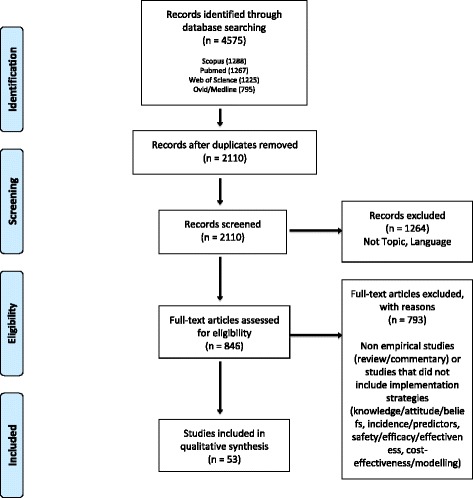
Search strategy. The following search strategy is reported according to PRISMA guidelines
Eligibility criteria
Inclusion and exclusion criteria were developed to identify original research that empirically evaluated or tested implementation strategies to improve cervical cancer prevention in SSA. Articles were eligible for inclusion if written in English, peer reviewed, and published between 1996 and 2017. Non-empirical studies (reviews, commentaries, editorials, etc.) and studies that did not explicitly assess implementation strategies (knowledge, attitudes, and beliefs; incidence and prevalence; safety and efficacy; cost effectiveness and modeling) were excluded from the review.
Study selection
The initial database search yielded 4575 results. Two reviewers (CJ, LJ) conducted the study selection process. Titles and abstracts of the identified articles were screened to exclude duplicates (n = 2465) and studies not relevant to the topic (n = 1264). The remaining articles (n = 846) were reviewed in full text. Fifty-three studies met the eligibility criteria and an additional 793 articles were excluded.
Data extraction
The 53 articles that fit the inclusion criteria were extracted for the following implementation-related content: title, author, publication year, purpose, country, study design, prevention tools, implementation strategies, implementation outcomes, and results. The primary reviewer (LJ) and two additional reviewers (AA, CJ) completed data extraction for a sample of initial articles (n = 11, 20%) to ensure accuracy. Inconsistencies were resolved through consensus before the primary reviewer proceeded with the remaining articles. Results were summarized in frequency tables.
Two seminal articles from implementation science, Proctor et al. [37] and Powell et al. [34], were used to define and categorize implementation outcomes and strategies, respectively. Based on the Conceptual Model of Implementation Research [38], Proctor et al. developed a taxonomy of implementation outcomes that are conceptually distinct from service system outcomes and clinical treatment outcomes. Implementation outcomes were defined as “the effects of deliberate and purposive actions to implement new treatments, practices, and services.” Using an iterative process of reading and discussing relevant literature in behavioral and health science, the working group of implementation researchers defined eight implementation outcomes: acceptability, adoption, appropriateness, costs, feasibility, fidelity, penetration, and sustainability. Powell et al. used the Consolidated Framework for Implementation Research [39] to compile a list of implementation strategies, or “systematic intervention processes to adopt and integrate evidence-based health innovations into usual care.” A working group of researchers and clinicians from health and mental services used narrative review to develop six categories: educate, restructure, quality, finance, plan, and attend to policy context. A complete list of categories and their definitions for implementation outcomes and strategies can be found in Table 1.
Table 1.
Implementation outcomes and strategies
| Implementation outcome | Definitiona |
| Acceptability | Perception among implementation stakeholders that a given treatment, service, practice, or innovation is agreeable, palatable, or satisfactory |
| Adoption | Intention, initial decision, or action to try or employ an innovation or evidence-based practice |
| Appropriateness | Perceived fit, relevance, or compatibility of the innovation or evidence based practice setting, provider, or consumer; and/or perceived fit of innovation to address a particular issue |
| Penetration | Integration of a practice within a service setting and its subsystems; number of eligible persons who use a service, divided by the total number of persons eligible for the service; number of providers who deliver a given service or treatment, divided by the total number of providers trained in or expected to deliver the service |
| Feasibility | Extent to which a new treatment, or an innovation, can be successfully used or carried out within a given agency or setting |
| Fidelity | Degree to which an intervention was implemented as it was prescribed in the original protocol or as it was intended by the program developers |
| Sustainability | Extent to which a newly implemented treatment is maintained or institutionalized within a service setting’s ongoing, stable operations |
| Implementation cost | Cost impact of an implementation effort |
| Implementation strategy | Definitiona |
| Plan • Gather information • Build buy-in • Initiate leadership • Develop relationships |
Help stakeholders gather data, select strategies, build buy-in, initiate leadership, and develop the relationships necessary for successful implementation |
| Educate • Develop materials • Inform and influence stakeholders |
Inform a range of stakeholders about the innovation and/or implementation effort |
| Finance • Modify incentives • Facilitate financial support |
Incentivize the use of clinical innovations and provide resources for training and ongoing support. |
| Restructure | Facilitate implementation by altering staffing, professional roles, physical structures, equipment, and data systems |
| Quality management | Put data systems and support networks in place to continually evaluate and enhance quality of care, and ensure that clinical innovations are delivered with fidelity |
| Attend to policy context | Encourage the promotion of clinical innovations through accrediting bodies, licensing boards, and legal system |
Quality screening
Quality assessment tools from the National Heart, Lung, and Blood Institute (NHLBI) were used to assess each study for internal validity [40]. There are separate NHLBI Quality Assessment Tools for each study type (controlled trials, pre-posttest, and cross-sectional). Each tool includes specific questions to assess bias, confounding, power, and strength of association between intervention and outcomes. The answer to each question can be “yes,” “no,” “cannot determine,” “not reported,” or “not applicable.” Instead of using a numeric scoring system, the rater is asked to consider potential risk for bias in the study design whenever a “no” is selected. Overall quality ratings are scored as “good” (low risk of bias, valid results), “fair” (some risk of bias, does not invalidate results), or “poor” (significant risk for bias, may invalidate results). One reviewer (LJ) independently screened all studies, and two additional reviewers (AA, CJ) screened a 20% sample (n = 11) to double check for accuracy.
Results
Of the initial 4575 articles (2110 after duplicates removed), 53 met inclusion criteria and were included in the following synthesis of results. Study characteristics are summarized in Table 2. The table of evidence is included as Table 3. Most studies were published within the last 7 years. Studies were well represented in all regions of sub-Saharan Africa with 16 of the total studies (30.2%) conducted in Southern Africa, 16 (30.2%) in Western, 14 (26.4%) in Eastern, and 7 (13.2%) in Middle.
Table 2.
Study characteristics
| Number of studies (n) | Percentage of total studies (%) | |
|---|---|---|
| Sub-Saharan region | ||
| South | 16 | 30.2 |
| West | 16 | 30.2 |
| East | 14 | 26.4 |
| Middle | 7 | 13.2 |
| Country | ||
| South Africa | 14 | 26.4 |
| Nigeria | 10 | 18.9 |
| Cameroon | 7 | 13.2 |
| Kenya | 5 | 9.4 |
| Uganda | 4 | 7.5 |
| Ghana | 3 | 5.7 |
| Botswana | 2 | 3.8 |
| Tanzania | 1 | 1.9 |
| Cote d’Ivoire | 1 | 1.9 |
| Zambia | 1 | 1.9 |
| Gambia | 1 | 1.9 |
| Mozambique | 1 | 1.9 |
| Malawi | 1 | 1.9 |
| Madagascar | 1 | 1.9 |
| Mali | 1 | 1.9 |
| Publication date | ||
| 1996–2000 | 1 | 1.9 |
| 2001–2005 | 2 | 3.8 |
| 2006–2010 | 8 | 15.1 |
| 2011–2017 | 42 | 79.2 |
| Study design | ||
| Cross-sectional | 34 | 64.2 |
| Pre-post test | 10 | 18.9 |
| Randomized control trial | 8 | 15.1 |
| Nonrandomized control trial | 1 | 1.9 |
| Prevention tool | ||
| VIA | 19 | 35.8 |
| HPV DNA or RNA test | 15 | 28.3 |
| Pap smear | 13 | 24.5 |
| HPV vaccine | 9 | 17.0 |
| Digital imaging | 9 | 17.0 |
| VILI | 9 | 17.0 |
| Colposcopy | 7 | 13.2 |
| Cryotherapy | 5 | 9.4 |
| LEEP | 5 | 9.4 |
| Biopsy | 5 | 9.4 |
| Unspecified screening | 5 | 9.4 |
| Implementation strategy | ||
| Educate | 38 | 71.7 |
| Restructure | 26 | 49.1 |
| Quality | 13 | 24.5 |
| Finance | 5 | 9.4 |
| Plan | 1 | 1.9 |
| Attend to policy context | 0 | 0.0 |
| Implementation outcome | ||
| Penetration | 33 | 62.3 |
| Acceptability | 15 | 28.3 |
| Fidelity | 14 | 26.4 |
| Feasibility | 8 | 15.1 |
| Adoption | 6 | 11.3 |
| Sustainability | 2 | 3.8 |
| Cost | 1 | 1.9 |
| Appropriateness | 0 | 0.0 |
| Quality assessment | ||
| Poor | 20 | 37.7 |
| Fair | 22 | 41.5 |
| Good | 11 | 20.8 |
Table 3.
Table of evidence
| First author, year | Purpose | Country | Program | Strategy | Outcome | Results | Quality |
|---|---|---|---|---|---|---|---|
| Randomized control trials | |||||||
| Adonis 2017 [79] | To evaluate what type of framed email messaging has the best impact on Pap smear uptake among health-insured females | South Africa | Pap smear | Educate: educational email | Penetration: Pap smear screening coverage | Screening rate in the control group was 9.58%, 5.71% in the gain-framed group, and 8.53% in the loss-framed group. Statistically, there was no difference between groups. | Fair |
| Modibbo 2017 [82] | To investigate whether self-collection of cervicovaginal samples for HPV DNA tests would be associated with increased uptake and quality of screening compared with clinic-based collection of samples | Nigeria | HPV DNA test | Restructure: remote self-collection vs. clinic-based physician collection | Fidelity: sensitivity and specificity between clinician- and self- collected samples | Most participants in the self-collection arm (93%) submitted their samples while only 56% of those invited to the hospital for sample collection attended and were screened during the study period (p < 0.001) | Fair |
| Okeke 2013 [80] | Determine the effect of cost on screening uptake by providing randomly priced subsidies to eligible women | Nigeria | VIA | Finance: lottery for varied prices of screening and treatment subsidies (0, 50, and 100 Naira) | Penetration: VIA screening coverage | Price of screening had a significant effect on the demand for screening: reducing the price by 10 cents increased uptake by 1%. | Fair |
| Risi 2004 [77] | Evaluate the effectiveness of two media interventions—a photo-comic and a radio-drama—in increasing cervical screening uptake | South Africa | Pap smear | Educate: educational photo-comic and radio-drama | Penetration: Pap smear screening coverage | 7% (18 of 269) of women who received the intervention photo-comic reported cervical screening during the 6-month follow-up, compared with 6% (25 of 389) of controls (p = 0.89). Women who recalled hearing the radio-drama were more likely to report attending screening (9 of 53, 17%) than those who did not (19 of 429, 4%; p < 0.001). | Good |
| Rosser 2015 [78] | Evaluate a health talk’s impact on cervical cancer knowledge, attitudes, and screening rates in a rural setting | Kenya | Unspecified screening | Educate: 30-min didactic lecture | Acceptability: reasons for refusal Adoption: willingness to screen Penetration: screening coverage |
Mean knowledge scores increased by 26.4% in the intervention arm compared to only 17.6% in the control arm (p < 0.01). Screening uptake was moderate in both the intervention and control arms, with no difference between the groups (58.9 vs. 60.9%, p = 0.60). | Fair |
| Sossaeuer 2014 [26] | Evaluate whether an educational intervention would improve women’s knowledge and confidence in the Self-HPV method | Cameroon | HPV DNA test | Educate: individual counseling (all), educational video (intervention group | Acceptability: confidence, embarrassment, pain, anxiety, discomfort, degree of relaxation and confidence | Participants who received the educational intervention had significantly higher knowledge about HPV and cervical cancer than the control group but no significant difference on self-HPV acceptability and confidence in the method. | Fair |
| Van Wijgert 2006 [29] | Assess the validity, feasibility, and acceptability of two methods of self-sampling (tampon or vaginal swab) compared to clinician sampling during a speculum examination | South Africa | HPV DNA test | Restructure: self-administration with tampon or vaginal swab vs. clinician collected swabs | Acceptability: perceived pain, satisfaction Feasibility: proportion of invalid labs Fidelity: sensitivity and specificity between clinician-and self-collected samples |
Sensitivity for high-risk HPV was good for vaginal swabs (79.8%) and moderate for tampons (59.5%). Self- and clinician- sampling were rated as good or okay by the majority of women | Poor |
| Watson-Jones 2012 [81] | Compare coverage achieved by two different delivery strategies (class-based vs. age-based) for HPV vaccine among schoolgirls | Tanzania | HPV vaccine | Educate: community outreach with lectures, pamphlets, posters, radio messages, and dramas Restructure: change delivery models class-based vs. age-based |
Acceptability: reasons for refusal Penetration: HPV vaccine coverage and 3 dose adherence |
For each dose, coverage was higher in class-based schools than in age-based schools (dose 1: 86.4 vs 82.0% [p = .30]; dose 2: 83.8 vs 77.8% [p = .05]; and dose 3: 78.7 vs 72.1% [p = .04]). | Poor |
| Nonrandomized control trials | |||||||
| Mutyaba 2009 [83] | Evaluate the efficacy of male partner involvement in reducing loss to follow-up among women in Uganda referred for colposcopy after a positive cervical cancer screening test | Uganda | VIA,VILI, colposcopy | Educate: group lecture, incentivize follow-up with inclusion of male partner by sending educational pamphlet home for partners | Penetration: screening coverage, loss to follow-up | Intervention group was significantly more likely to return for colposcopy than the control group, with 16 and 34%, respectively, lost to follow-up. | Poor |
| Pre-post tests | |||||||
| Abiodun 2014 [67] | Determine the effect of health education on the awareness, knowledge and perception of cervical cancer and screening among women in rural communities | Nigeria | Unspecified screening | Educate: 1-day health education intervention with group didactic lectures and an educational movie | Penetration: screening coverage | There was a statistically significant difference in cervical cancer awareness, perception, knowledge and screening uptake between intervention and control groups. Proportion of women in the intervention group who had undertaken screening rose from 4.3 to 8.3% (p = .038). | Good |
| Adamu 2012 [70] | Assess the effect of health education on the knowledge, attitude, and uptake of Pap smear among female teachers | Nigeria | Pap smear | Educate: individual counseling on cervical cancer, complications, cost, importance of screening Finance: free coupon for pap test |
Penetration: Pap smear screening coverage | The proportion of respondents with a reported practice of Pap smear was low and similar in both groups (1.1 in the intervention group and 4.9% in the control group, p = 0.16). Uptake was poor at post-intervention phase for both groups (p = .45). | Good |
| Caster 2017 [71] | Assess the acceptability, feasibility and effectiveness of a tablet-based cervical cancer educational intervention | Malawi | Unspecified screening | Educate: 30-min tablet-based education | Acceptability: participants’ preference for tablet vs. in-person education Feasibility: ease of tablet use, number of times participants need assistance with tablet Adoption: intention to screen |
The median pretest score was 11 out of 20 and the median posttest score was 18 (p < 0.001). 226 participants (93%) stated that they would like to obtain cervical cancer screening | Fair |
| Chigbu 2017 [72] | Determine the impact of trained community health educators on the uptake of cervical and breast cancer screening and HPV vaccine in rural communities | Nigeria | HPV vaccine | Educate: house-to-house education given on a one-on-one basis by community health workers on cervical and breast cancer prevention | Penetration: screening and HPV vaccination coverage | Of the 1327 enrolled women, 42 (3.2%) had undergone screening pre-intervention and 897 (67.6%) received screening afterwards (p < .0001). Only 2 (0.9%) of 214 children eligible for HPV vaccination had received the vaccine before versus 71 (33.2%) after the intervention (p < .001). | Fair |
| De Groot 2017 [73] | Provide information on STI knowledge and vaccine acceptance after an educational session | Mali | HPV vaccine | Educate: educational session to inform adults and adolescents about HPV and cervical cancer, symptoms and causes, benefits and availability of the HPV vaccine | Adoption: parent and child reported willingness to accept the HPV vaccine | The education session increased the HPV vaccine acceptance in all groups, especially among adolescents (from 75.3 to 91.8%, p < .01). | Fair |
| Dreyer 2015 [68] | Measure changes in knowledge and screening behavior after an educational intervention provided to mothers of adolescent HPV vaccine recipients | South Africa | Pap smear, HPV DNA test | Educate: 15 min didactic lecture and educational pamphlets Restructure: integrate screening of mothers into child HPV vaccination program |
Penetration: screening coverage | Knowledge about symptoms (p < .005), screening (p < .005), and vaccination (p < .05) improved significantly at 6 month retesting. Improvement for reported screening in the past 12 months was more favorable in Gauteng (41%) with self-sample than in Western Cape with Pap smear (26%). | Fair |
| Levine 2011 [75] | Determine the effectiveness of an educational program in VIA knowledge and skills retention among healthcare providers in 2 countries | Uganda | VIA | Educate: 5 day educational program for providers with didactic lectures and procedural training in VIA | Acceptability: provider reported comfort with skills Sustainability: skill assessment at 6-month follow-up |
Mean test scores increased significantly after participation in the training session (62% vs. 81%, p < .001). Self-reported comfort level for identifying cellular abnormalities also increased (2.1 vs. 3.3; p < 0.001 There was no significant difference between initial and 6-month follow-up test scores (80 vs. 79%). | Poor |
| Mbachu 2017 [74] | Assess the effectiveness of peer health education on perception, willingness to screen and uptake of cervical cancer screening of women during Anglican church meetings | Nigeria | Pap Smear, VIA, VILI | Educate: three 45–60 min sessions repeated monthly of peer health education on cervical cancer burden, risk factors, symptoms and prevention | Penetration: Pap smear and VIA/ VILI screening coverage Adoption: willingness to screen |
Screening rate increased by 6.8% and the observed difference was statistically significant (p = 0.02). | Fair |
| Miller 2007 [76] | Evaluate a train the trainer program for cervical screening implementation and assess pre-post knowledge of the implementation process | Nigeria | VIA, VILI, Pap smear, Cryotherapy | Educate: train the trainer in implementation | None | Of the 41 evaluable exams, 9 saw no change, 31 showed improvement, 1 scored worse. | Poor |
| Wright 2010 [69] | Evaluate the effect of a health education program on knowledge of cervical cancer among market women in an urban area | Nigeria | Pap smear | Educate: develop pamphlets, community outreach | None | Significant increase in proportions were found in the intervention/experimental group on awareness of cervical cancer (61.7%), associated symptoms and risk factors such as early sexual debut, promiscuity and smoking. | Fair |
| Cross-sectional studies | |||||||
| Adamson 2015 [42] | Determine the acceptability and accuracy of tampon-based self-collection for hrHPV mRNA testing in HIV-infected women | South Africa | HPV RNA test | Restructure: self- vs. physician-HPV RNA sampling | Acceptability: care, privacy, embarrassment, discomfort, pain, preference Fidelity: concordance between physician- and self- collected samples |
There was no difference in test positivity between clinician-collection, 36.7%, and tampon- collection, 43.5% (p value = 0.08). Using clinician-collection as the reference, the sensitivity and specificity for hrHPV mRNA of tampon-collection were 77.4 and 77.8%, respectively. | Good |
| Adepoju 2016 [59] | Determine sociodemographic characteristics, awareness and uptake of a free cancer screening program | Nigeria | Pap smear | Educate: public sensitization with women groups and mass media campaign Finance: free screening |
Penetration: Pap smear screening coverage | 287 women were screened but uptake of cervical cancer screening was low since most women did not come for the program despite the public sensitization. | Poor |
| Asgary 2016 [22] | Evaluate the feasibility and efficacy of ongoing, smartphone-based support in sustaining VIA skills for community health nurses | Ghana | VIA, digital imaging | Educate: 2-week didactic and procedural training for VIA and digital imaging, ongoing consultation Quality: audit and feedback for digital images via smartphone messaging within 24 h |
Fidelity: inter-rater agreement for VIA between nurses and expert physician Feasibility: VIA picture quality |
Agreement rate between all VIA diagnoses made by all CHNs and the expert reviewer was 95%. Cohen κ statistic was 0.67 (95% CI = 0.45–0.88). Images for 9 patients, taken by 6 CHNs, were unclear. | Fair |
| Awua 2017 [49] | Compare the uptake of screening between a community-based vs. hospital-based strategies for collecting HPV DNA samples | Ghana | HPV DNA test | Educate: community lectures at churches Restructure: community-based vs. hospital-based specimen collection Quality: patient phone reminders |
Penetration: HPV DNA testing coverage | Response rates were higher for community-based (95.1%) than short-term (46.6%) or long-term (38.5%) hospital-based appointments | Fair |
| Catarino 2015 [48] | Evaluate the use of smartphone telemedicine for off-site diagnosis of cervical intraepithelial neoplasia | Madagascar | VIA, VILI, HPV DNA test, Digital imaging | Restructure: on-site vs. off-site evaluation of VIA digital images | Fidelity: sensitivity and specificity between on-site physician diagnosis and off-site assessment via digital images | The on-site physician had a sensitivity of 66.7% and a specificity of 85.7%; the off-site physician consensus sensitivity was 66.7% with a specificity of 82.3%. | Good |
| Crofts 2015 [61] | Report on women’s acceptance of HPV self-sampling following an education intervention on cervical cancer and HPV | Cameroon | HPV DNA test | Educate: 20 min didactic lecture and educational pamphlet with instructions for HPV self-samplings | Acceptability: embarrassment, pain, anxiety, confidence, discomfort, relaxation, complexity | Overall, participants showed high acceptability scores for HPV self-testing (6.986 of 24), with lower scores being more favorable. However, there was no difference in acceptability between participants with good vs. poor knowledge scores. | Fair |
| DeGregorio 2017 [57] | Evaluate a nurse-led, fee-for-service cervical cancer screening program using visual inspection with acetic acid-enhanced by digital cervicography in the setting of a large faith-based health care system | Cameroon | VIA, VILI, Digital imaging, Cryotherapy, LEEP, Biopsy | Quality: quarterly meeting to review cervicographs with expert clinician Educate: peer educators with group lectures in the community Finance: fee-for-service sliding scale based on community demographics Restructure: integrate with family planning, breast exams, STI testing |
Penetration: VIA screening coverage | In 8 years, 44,979 women were screened for cervical cancer. | Poor |
| Dim 2015 [62] | Assess willingness to pay out-of-pocket for Pap smear among HIV positive women after provided information about cervical cancer and screening | Nigeria | Pap smear | Educate: individual counseling on increased risk for cervical cancer, Pap smear protocol, and costs | Adoption: willingness to pay for Pap smear | 378 (94.5%) respondents were willing to pay for Pap smear, irrespective of the cost. Willingness to pay showed no trend across age groups (p = . 148), marital status groups (p = . 890), educational status groups (p = . 337), and parity groups (p = . .611). | Fair |
| Firnhaber 2015 [41] | Determine whether a quality assurance program using digital cervicography improved the performance of VIA to detect cervical intraepithelial neoplasia grade 2 or worse (CIN 2+) in HIV-infected women | South Africa | VIA, digital imaging | Educate: 2-week VIA training Quality: audit and feedback of VIA cervical images by expert gynecologist in weekly QA meetings |
Fidelity: sensitivity and specificity of VIA compared between nurses’ visual assessment and physician digital image assessment | There was substantial agreement between the VIA real-time readings of the nurse and that of the physician with digital cervicography (k statistic = 0.69). There was no statistical difference between the ability of nurses to detect CIN 2+ at the beginning and at the end of the study. | Poor |
| Goldhaber-Fiebert 2009 [65] | Determine the relationship between investment in community health worker (CHW) home visits and increased attendance at cervical cancer screening appointments | South Africa | Unspecified screening, colposcopy, biopsy | Quality: patient reminder system with community health worker (CHW) home visits to encourage attendance to follow-up appointments | Costs: total CHW program cost, average cost per women screened Penetration: screening coverage, total CHW home visits completed, patient adherence to appointments |
Adherence increased from 74 to 90%; 55 to 87%; 48 to 77%; and 56 to 80% for 6-, 12-, 24-, and 36-month appointments. The CHW program cost R194,018 with 1576 additional appointments attended. Average per-woman costs increased by R14–R47. | Good |
| Horo 2012 [23] | Determine effect of a phone based tracking system on follow-up rates | Cote d’Ivoire | VIA, VILI, colposcopy, biopsy | Educate: individual counseling, group patient teaching, and educational pamphlets Quality: phone based patient reminder system with maximum of 3 calls (one per week) |
Acceptability: patient reasons for loss to follow-up Penetration: colposcopy loss to follow-up rates |
The use of a phone-based tracking enabled a significant reduction of women not attending medical consultation after initial positive screening from 36.5 to 19.8% (p < 10–4). Reasons for not following up include cost, transportation, fear and time | Poor |
| Huchko 2011 [50] | Assess the impact of a cervical cancer screening prevention pilot project implemented into an established AIDS program | Kenya | VIA, colposcopy, biopsy, LEEP | Educate: 1-week training for providers in VIA, colposcopy, and lab specimen processing, individual patient counseling and community outreach Restructure: increase lab capacity, embed in HIV program Quality: ongoing for consultation for program protocol through CCSP |
Acceptability: reasons for patients refusing screening, provider satisfaction with training and program implementation Penetration: VIA screening coverage, provider training coverage Feasibility: challenges to implementing the program |
High coverage (87%). Reasons for declining screening included partner support, menstruation, and fear. 28 (90%) clinical officers underwent training in VIA and colposcopy. The main challenges reported were related to infrastructure limitations (lack of water, electricity and supplies; and long waits in the clinic) and perceived patient barriers |
Poor |
| Kapambwe 2013 [60] | To evaluate knowledge transfer after training of traditional marriage counselors (alangizi) to integrate cervical cancer lessons into their routine counseling | Zambia | VIA, Digital imaging | Plan: develop trust between alangizi and research team Educate: one-day training on basic cervical cancer knowledge for traditional marriage counselors Restructure: integrate cervical cancer messaging into marriage counseling |
Feasibility: perceived barriers and facilitators of integrating screening | A majority of the trainees correctly associated cervical cancer with HPV (35.6%) and multiple sexual partnerships (28.9%). |
Poor |
| Khozaim 2014 [51] | Determine the challenges and successes of integrating a public-sector cervical screening program into a large HIV care system | Kenya | VIA, VILI, digital imaging, colposcopy, biopsy, cryotherapy, LEEP | Educate: community outreach, mass media Restructure: embed in HIV care Quality: patient reminder system with calls and text messages for upcoming appointments |
Penetration: loss to follow-up rates | 31.5% lost to follow-up (27.9% colposcopy to biopsy, 49.3% biopsy to LEEP, 59.6% colposcopy to chemo or hysterectomy) | Poor |
| Lack 2005 [31] | Compare two self-administered techniques for detecting HPV (tampons and swabs) with a clinician directed technique (cervical cytobrush) |
Gambia | HPV DNA test | Restructure: self-administration- vs. physician-collected swabs | Fidelity: sensitivity and specificity compared between self- and physician collected cervical swabs Penetration: screening coverage |
Self-administered swabs showed a sensitivity of 63.9% and tampons showed a sensitivity of 72.4% compared to the cervical cytobrush as the gold standard. The acceptability of these two tests was 97.1 and 84.6%, respectively. | Poor |
| Ladner 2012 [44] | Assess the effectiveness of school vs. clinic based delivery models on HPV vaccine coverage in 7 different countries | Cameroon | HPV vaccine | Restructure: change service sites of HPV vaccination (school, clinic, and mixed models) | Penetration: Vaccine coverage and adherence | High coverage (88%) and adherence (91%) across programs. Mixed model in both school and clinic settings was most effective. | Fair |
| LaMontagne 2011 [45] | Assess the effectiveness of school vs. clinic based delivery models on HPV vaccine coverage in 4 different countries | Uganda | HPV vaccine | Educate: community outreach and educational pamphlets Restructure: change service sites of HPV vaccination (health center, school, and integrated with other health program) |
Acceptability: reasons for vaccine acceptance or refusal Penetration: HPV vaccination coverage |
High school coverage (88.9%) but low health center coverage. Reasons for accepting the HPV vaccine that: (i) it protects against cervical cancer; (ii) it prevents disease, or (iii) vaccines are good. Refusal was more often driven by programmatic considerations (e.g., school absenteeism) than by opposition to the vaccine. | Poor |
| Maree 2012 [53] | Determine whether cervical screening uptake could be improved when breast and cervical screening are combined | South Africa | VIA | Educate: one-on-one patient counseling Restructure: combine cervical cancer and breast cancer screenings |
Acceptability: patient reasons for screening refusal Penetration: VIA screening coverage |
Moderate coverage (65.4). Major reason for refusal was menstruation. | Good |
| Megevand 1996 [46] | Determine the feasibility of providing a cervical screening facility to the underprivileged communities through an educational program and mobile clinic | South Africa | Pap smear, colposcopy, LEEP | Educate: community outreach Restructure: change service site to mobile clinic with same day Pap smear results and treatment if indicated Quality: audit and feedback for 100 of every 300 cytology slides |
Penetration: loss to follow-up rates | Loss to follow-up rates were much lower for minimal delay, mobile delivery (3%) compared to longer delay, clinic delivery (66%) | Poor |
| Mehotra 2014 [58] | Assess the impact of enrollment in an incentive program on receipt of eight preventive care services including Pap smear | South Africa | Pap smear | Finance: insurance incentive program | Penetration: Pap smear screening coverage | 65.5% (2,742,268) of health plan members enrolled in the incentive program at some point. Odds ratio for receipt of Pap test is 2.17 | Good |
| Michelow 2006 [66] | Determine if rapid review of reportedly negative cervical smears is a useful internal quality assurance modality in an unscreened population with very high rates of cervical carcinoma | South Africa | Pap smear | Quality: quality monitoring system for randomly selected Pap smear slides by a senior cytotechnologist | Fidelity: sensitivity and specificity | An amended report was sent out in 373 (0.59%) of the 62,866 cervical smears. The false-negative proportion for HSIL and ASC-H (combined) in this study was 5.76%. | Fair |
| Moodley 2013 [52] | Demonstrate the capacity of school health teams to carry out vaccinations within a school environment | South Africa | HPV vaccine | Restructure: integrated with cervical cancer screening program for mothers Educate: staff training in program policy, sensitize school leadership, community outreach |
Penetration: HPV vaccine coverage and 3 dose adherence | High coverage and adherence of the vaccine was found to be high: 99.7, 97.9, and 97.8% for the first, second, and third doses, respectively. | Poor |
| Moon 2013 [54] | Assess the feasibility, successes and challenges of integrating a VIA program into an existing HIV program | Mozambique | VIA, Cryotherapy, LEEP, Colposcopy | Educate: 1-week didactic and procedural training in VIA and cryotherapy Restructure: change service sites—embed in HIV care | Feasibility: reasons for delay in treatment provision Penetration: cryotherapy and LEEP follow-up rates Sustainability: percentage of providers still performing VIA in 1 year |
High and improved follow-up rates between first (53%) and the last quarter (96%) cryotherapy same day coverage rates. High (88%) referral follow-up rates. 0% physicians and 50% nurses continued VIA screening 1 year after training. Delays in treatment include equipment theft and malfunction. |
Poor |
| Obiri-Yeboah 2017 [43] | Determine the acceptability, feasibility and performance of alternative self-collected vaginal samples for HPV detection | Ghana | HPV DNA test | Restructure: self- vs. physician-HPV DNA sampling | Acceptability: ease of use, preference Fidelity: concordance between physician- and self- collected samples |
The overall HPV detection concordance was 94.2% and kappa value of 0.88 (p < 0. 0001), showing excellent agreement. 57.7% preferred self- to physician collection. | Fair |
| Ogembo 2014 [47] | Inform the Cameroon Ministry of Health of the acceptability, feasibility, and optimal delivery strategies for HPV vaccine | Cameroon | HPV vaccine | Educate: community awareness campaign using mass media, pamphlets, and posters Restructure: change delivery sites (clinic, school, community/mobile), integrate with screening of mothers Quality: patient reminder system with peer tracking (school) |
Feasibility: vaccines lost/damaged/expired, adverse events Penetration: vaccine coverage, refusal rate, 3 dose adherence |
Total of 6851, 6517 and 5796 girls were immunized with the first, second and third doses of HPV vaccine, respectively, achieving 84.6% full dosage coverage of the adolescents who received the first dose. Only 63 of the 19,200 doses received were lost, damaged or expired. CBCHS charged a fee of US$8 per 3-dose series only to those who were able to pay. Despite the fee, 84.6% of the 6851 girls who received the first dose received all three doses. | Poor |
| Quinley 2011 [25] | Examine the diagnostic agreement between off-site expert diagnosis using photographs of the cervix (photographic inspection with acetic acid, PIA) and in-person VIA | Botswana | HPV DNA test, VIA, digital imaging | Quality: quality assurance for digital cervical images | Feasibility: rate of equipment malfunction Fidelity: inter-rater reliability with expert, concordance between VIA and PIA |
Moderate to high agreement (69–100%) with expert, varied for each nurse High concordance (70%) between PIA and VIA results 31 images were insufficient for reading. |
Fair |
| Ramogola-Masire 2012 [24] | Determine the feasibility and efficiency of the “see and treat” approach using visual inspection acetic acid (VIA) and enhanced digital imaging (EDI) for cervical cancer prevention in HIV-infected women | Botswana | VIA, VILI, cryotherapy, digital imaging | Educate: 3-day didactic teaching and 8 weeks of procedural training in VIA, digital imaging, and cryotherapy Restructure: embed in HIV care Quality: audit and feedback of cervical images by expert gynecologist in weekly quality control meetings |
Fidelity: sensitivity, specificity, inter-rater reliability of VIA assessments between nurses and expert gynecologist Penetration: cryotherapy follow-up rates |
High agreement between nurses and the gynecologist in the evaluation of digital pictures (83.3%) Overall follow-up 709 of 842 (84.2%) |
Fair |
| Safaeian 2007 [28] | Compare human papillomavirus (HPV) DNA testing between self-administered vaginal swabs and physician-administered cervical swabs | Uganda | HPV DNA test | Restructure: self-administration vs. physician collected swabs | Fidelity: sensitivity and specificity between self- and physician- collected samples Penetration: screening coverage |
Compliance with self-collected swabs was > 86%; however, only 51% accepted a pelvic examination. Agreement among paired observations was 92% with a kappa statistic of 0.75. | Good |
| Synman 2015 [55] | Investigate the feasibility of linking HPV self-testing for mothers with a two-dose HPV vaccination schedule of their daughters | South Africa | HPV DNA test, HPV vaccine | Educate: educational pamphlets sent home with children for mothers Restructure: integrate HPV DNA self-sample kit for mothers into vaccination program for daughters |
Penetration: HPV DNA self-testing coverage | Of the 1135 self-screen kits handed out to eligible girls to be passed on to their female guardians, 160 women participated in the self-screening (14.1%). | Poor |
| Ting 2013 [27] | Compare the performance of hrHPV mRNA testing of physician- and self-collected specimens for detecting cytological high-grade squamous intraepithelial lesions or more severe (QHSIL) and examined risk factors for hrHPV mRNA positivity in female sex workers | Kenya | HPV RNA test, Pap smear | Restructure: self-administration vs. physician-collected swabs | Fidelity: sensitivity and specificity compared between self- and physician collected cervical swabs | Overall sensitivity of hrHPV testing for detecting QHSIL was similar in physician-collected (86%) and self-collected specimens (79%). Overall specificity of hrHPV mRNA for QHSIL was similar in both physician-collected (73%) and self-collected (75%) specimens. | Good |
| Tum 2013 [64] | Determine if a community health worker and education intervention could increase screening uptake | South Africa | Unspecified screening | Educate: health worker training, community education | Acceptability: patient perceived value of community health worker Penetration: screening coverage |
Low coverage (3%). All found value in health worker through informing, teaching, and motivating. | Fair |
| Untiet 2014 [30] | Test differences in performance between self-HPV versus physician-HPV and their ability to detect abnormal cytology results | Cameroon | HPV DNA test | Restructure: self-administration vs. physician collected swabs | Fidelity: sensitivity and specificity compared between self- and physician collected cervical swabs | HPV prevalence was 14.6 and 12.7% for self-HPV and physician-HPV, respectively (Cohen’s kappa = 0.74). HPV positivity by cytological diagnosis for ASC-US+ was similar with the two tests | Good |
| Wamai 2012 [63] | Evaluate the effectiveness of a campaign in sensitizing parents to HPV vaccination and influencing uptake of vaccine for their children | Cameroon | HPV vaccine, VIA, digital imaging | Educate: Community outreach, mass media, education program | Acceptability: reasons to vaccinate or not Adoption: willingness to vaccinate Penetration: VIA screening coverage, sensitization campaign coverage |
High willingness to vaccinate among parents. Low coverage (35.3%) of VIA screening among parents. Low education program coverage with 5.9% surveyed parents learning about cervical cancer from program. Top reasons not to vaccinate include effectiveness (31.8%), safety (18.4%), provider recommendations (17.8%) and cost (16.6%). | Fair |
| Were 2010 [56] | Pilot test and assess the feasibility of integrating VIA screening into an existing maternal child health and family planning program | Kenya | VIA, VILI | Educate: VIA/VILI training Restructure: change service- embed in maternal child health and family planning |
Penetration: VIA/VILI screening coverage and loss to follow-up | Moderate coverage and follow-up. 435 invited—216 declined 219 accepted. 24 of 40 went for colposcopy. | Poor |
Study design
The majority of studies included in the review are cross-sectional (n = 34, 64.2%). Ten of the cross-sectional studies similarly evaluated the impact of changing service providers on how well the screening test is performed. Using specificity and sensitivity rates, some studies compared VIA assessments between nurses and an expert physician [22, 24, 25, 41] while others compared self- vs. physician-collected samples for HPV DNA testing [27, 28, 30, 31, 42, 43]. Sixteen studies examined if screening coverage increases when changing service sites [44–49], combining screening with an already established program (i.e., HIV/STI screening) [50–57], or providing financial incentives [58, 59]. Four studies evaluated the effect of educational interventions on knowledge, attitudes, and screening behaviors for patients [60] and providers [61–63]. Three studies examined if reminder systems can help to decrease lost to follow-up rates through community health workers [64, 65] or phone-based tracking [23]. One study, Michelow et al. [66], used rapid review of reportedly negative cervical smears as an internal quality assurance modality.
Ten studies (18.9%) were conducted with a pre-posttest design. All of the pre-post studies evaluated the effectiveness of educational interventions in improving awareness and screening behaviors for patients [67–74] or knowledge and skills retention for providers [75, 76]. Only three studies included a control group [67, 69, 70].
There are eight randomized control trials (15.1%). Six trials tested strategies to increase screening uptake through educational interventions [26, 77–79], financial incentivizes [80], or changing service sites [81]. Two trials compared HPV DNA self-sampling to the current standard of physician collection via speculum exam [29, 82].
Only one study is a non-randomized control trial (1.9%). Mutyaba et al. [83] evaluated if male partner involvement is effective in reducing loss to follow-up after a positive VIA screening test.
Prevention tools
Primary prevention with HPV vaccine was included in 9 studies (17.0%). VIA was the most frequently used secondary screening method (n = 19, 35.8%). Less commonly, secondary screening was completed with HPV DNA/mRNA testing (n = 15, 28.3%), Pap smear (n = 13, 24.5%), VILI (n = 9, 17.0%), colposcopy (n = 7, 13.2%), biopsy (n = 5, 9.4%), and unspecified screening (n = 5, 9.4%). Digital imaging to supplement visual screening methods (VIA/VILI) was used in 9 studies (17.0%). If follow-up treatment of precancerous lesions was conducted, it was either performed with LEEP (n = 5, 9.4%) or cryotherapy (n = 5, 9.4%).
Implementation strategies
Researchers used educate (n = 38, 71.7%), restructure (n = 26, 49.1%), and quality (n = 13, 24.5%) strategies most frequently in their studies. For patients and their families, education strategies aimed to increase cervical cancer awareness and the importance of prevention. For providers, education strategies were used to improve knowledge and skills retention in conducting screening and treatment services such as VIA, cryotherapy, and LEEP. Example educate strategies include community outreach, individual patient teaching and counseling, provider training, mass media campaigns, and development of educational materials. Restructure strategies were used to facilitate implementation by changing service sites (established vs. mobile clinic for Pap smear), changing delivery models (age- vs. class-based for HPV vaccine), or changing providers (nurse vs. physician for VIA, patient vs. physician for HPV DNA test). Several studies also used the restructure strategy to combine cervical cancer prevention with other services (i.e., HIV/STI testing, marriage counseling, family planning) to improve the financial and infrastructural support provided through already established programs. The quality strategies included in these studies were ongoing consultation, patient reminder systems, and audit-feedback mechanisms. Five studies (9.4%) included a finance strategy to incentivize patients to uptake screening services. Only one study (1.9%) utilized the plan strategy. Kapambwe et al. [60] spent time developing trust with alangizi (traditional marriage counselors) to encourage them to integrate cervical cancer screening messaging into their counseling sessions with women. There were no policy strategies (0%) in the included studies.
Implementation outcomes
The most studied implementation outcomes were penetration (n = 33, 62.3%), acceptability (n = 15, 28.3%), and fidelity (n = 14, 26.4%). Penetration was often measured as vaccine or screening coverage, which is calculated by dividing the number of women who participated by the total eligible or targeted population. Additional measures of penetration included rates of loss to follow-up for cryotherapy or LEEP treatment and three-dose adherence for HPV vaccination. Acceptability was most commonly measured by surveying patients to determine reasons why they accepted or refused participation. Among providers, acceptability was measured as comfort with performing newly learned skills and reported satisfaction with training and program implementation. Fidelity was measured in studies that compared either nurses’ VIA assessments or self-collected HPV DNA samples to that of expert physicians. These comparisons indicated whether patients and nurses could perform these tests with reasonable reliability and help to address physician shortages by alternatively implementing the screenings.
Other less frequently studied outcomes included feasibility (n = 8, 15.1%), adoption (n = 6, 11.3%), sustainability (n = 2, 3.8%), and cost (n = 1, 1.9%). To measure feasibility, many researchers determined providers’ perceived barriers and facilitators to implementation. Other studies quantified circumstances that impeded successful operation of the program such as rates of equipment malfunction, poor picture quality for digital images, invalid lab results, and expired vaccines. Adoption was measured as the willingness or intent of patients to participate in screening or HPV vaccination. Only two studies included measures of sustainability. Moon et al. [54] quantified sustainability by the number of providers that were still performing VIA 1 year after initial training. Levine et al. [75] determined VIA skill and knowledge retention with a 6-month follow-up assessment. One study, Goldhaber-Fiebert et al. [65], measured costs associated with cervical cancer screening, i.e., community health worker home visits.
There were no studies that measured appropriateness (0).
Quality assessment
Few studies (n = 11, 20.8%) were determined to be of “good” quality using the NHLBI Quality Assessment Tools. The remaining studies were “fair” (n = 22, 41.5%) or “poor” (n = 20, 37.7%). Overall, many studies did not sufficiently describe their methodology, which made it difficult to make determinations for items on the NHLBI tools. Items were often marked as “not specified” or “cannot be determined.” A common weakness specifically for controlled intervention studies was a lack of adequate randomization. Some randomized control trials (RCTs) used a preset plan for allocating patients to intervention or control groups (i.e., even vs. odd ID numbers) instead of using computer-generated lists. Other RCTs did not provide any description for how participants were allocated. Adequate randomization is important as it provides confidence that results are attributable to the intervention rather than a difference in groups at baseline. For pre-posttests, only 3 of the 10 studies included a control group [67, 69, 70]. Without a control group for comparison, there is less confidence that an improvement between pre- and post-assessments is due to the intervention rather than mere chance. The cross-sectional studies were mainly descriptive. Limited cross-sectional studies used statistical analyses to determine associations between intervention and outcomes. Confounders were rarely measured and included in the analyses. Outcome measures frequently lacked validity and reliability.
Discussion
The challenges of establishing and sustaining cervical cancer prevention programs in SSA have been identified in several recent reviews [4–7]. However, the authors have found no review to date that addresses implementation strategies to overcome these identified barriers. Safe and effective prevention tools exist but are not reaching the women that need these services most. This review is an attempt to enter cervical cancer prevention into the implementation science conversation to propel the state of the science forward. Finocchario-Kessler et al. [84] conducted a systematic review of the literature between 2004 and 2014 to characterize the cervical cancer research in SSA according to four public health categories (primary prevention, secondary prevention, tertiary prevention, and quality of life). They determined that most studies focused on secondary prevention and concluded that there is a need for “implementation science research to inform feasible and sustainable strategies to maximize the number of women reached with services” [84].
Implementation science is an emerging field that aims to bridge research and practice in order to ultimately achieve desired patient and population health outcomes [85]. Historically, a significant amount of efficacy and effectiveness research conducted in controlled settings has not translated into “real-world” impact. The traditional, passive methods of dissemination (i.e., journal publishing) have not proven effective. Estimates show that it takes an average of 17 years for 14% of original research to effect practice [86]. Implementation science seeks to address this “quality chasm” by explicitly studying the processes of implementing evidence-based programs in clinical and public health settings [87]. Implementation strategies are instrumental in bridging the gap and improving the speed and rigor of research translation. The results from this review have provided insight into how study design, strategies, and outcomes have been used to study implementation of cervical cancer prevention in SSA. Since sub-Saharan Africa faces some of the highest cervical cancer rates worldwide, it is important to evaluate what has been done so far to address these challenges and contemplate how these efforts can be improved through use of implementation strategies.
Study design
While randomized control trials are the “gold standard” in efficacy and effectiveness research, these study designs are difficult to feasibly conduct in implementation research due to the use of multi-level, multi-strategy interventions [85]. It is more difficult to conduct random assignment when the level of analysis is at the organization, community, and/or country level rather than the individual level. It is also difficult to produce large enough sample sizes to create adequate statistical power. For these reasons, Brownson et al. [85] conclude in Dissemination and Implementation Research in Health, one of the seminal works to progress the field of implementation science, that quasi-experimental designs without randomization are reasonable for implementation research. However, they argue that rigorous quasi-experimental design is essential to achieving quality data that has practical use. While quasi-experimental studies may be more feasible to conduct, these designs do not produce the same level of confidence in causation as randomized control trials and make it more difficult to compare effectiveness between different studies.
In the absence of randomization, researchers can incorporate control groups, confounders, and statistical comparison of baseline group characteristics to greatly increase rigor of implementation study designs. In their assessment of 66 Cochrane reviews on implementation research, Brownson et al. [85] concluded that “many publications in the literature are still merely descriptive in nature or have weak designs without comparison or control conditions to answer critical research questions.” This systematic review has produced similar results. The majority of studies are cross-sectional, descriptive studies and assessed as “poor” or "fair" quality. This review echoes the argument that there is a need for more rigorous research designs that meet the needs of implementation science questions.
Implementation strategies
Evaluating effectiveness for the various implementation strategies is difficult due to the descriptive nature of most studies, overall poor quality in study designs, and variation in outcomes measured. While educate strategies were the most popular method leveraged in attempt to improve implementation, implementation science suggests that dissemination of information is not the most effective method for creating sustainable change [88]. Within this literature review, education has also failed to produce intended outcomes. Many studies employing educate strategies have shown improvements in awareness. However, these strategies in isolation have not always catalyzed better uptake, acceptability, and/or confidence [61, 63, 64, 78]. If a significant difference was observed, uptake still remained low [67, 77, 83]. These results suggest a need to diversify implementation strategies used to improve cervical cancer prevention in this context. Restructure, finance, and attend to policy context strategies can provide the organizational support required to improve implementation and overcome barriers particular to resource-limited settings.
Implementation outcomes
While there were implementation outcomes included in these studies, the overwhelming majority were patient-level outcomes, such as symptomatology, cancer rates, cervical lesion typology, etc. For implementation studies, it is crucial to measure implementation outcomes specifically [37]. If the desired health outcomes are not achieved after an evidence-based program is implemented, the failure is typically attributed to the evidence-based program without consideration of how well the practice was or was not implemented in that particular setting [86, 88]. If we do not measure implementation outcomes, there is no way to deduce what is ultimately influencing the patient or population health outcomes. Additionally, there is a need for continued effort in operationalizing and measuring implementation outcomes. One of the eight outcomes (appropriateness) was not measured in the review and should be considered for inclusion in future studies.
Limitations
A major limitation of this systematic review is the overall quality of evidence. “Poor” and "fair" quality ratings for the majority of studies make it difficult to make conclusions about implementation strategies and their effectiveness. Risk of bias in the study design and implementation greatly decreases confidence in the validity of results. Another limitation is that only a sample of initial articles, rather than the entire dataset, were abstracted and quality assessed by a second reviewer. However, inconsistencies were resolved through consensus before the primary reviewer proceeded with the remaining articles to ensure accuracy.
Conclusions
This systematic review elicits the need to diversify strategies that are used to improve implementation for cervical cancer prevention programs. While education is important, implementation science literature reveals that dissemination of information in isolation is not as effective in generating change [88]. There is a need for additional organizational support to further incentivize and sustain change [85, 89]. Implementation research is difficult because interventions are multifaceted and conducted at different levels of analysis [85]. Many studies in this review included patient level outcomes but did not include implementation-specific outcomes to assess the success of implementation strategies. This review calls for an increased use of implementation science frameworks to inform the design of studies that aim to improve cervical cancer prevention in SSA. This review also calls for increased use of common terminology from implementation science for outcomes and strategies. Implementation science can help to communicate results between researchers and increase rigor of research design to better isolate impact of implementation strategies on intended outcomes.
Additional file
Database-Specific Search Strategies. (DOCX 2827 kb)
Acknowledgements
We would like to acknowledge Penn Libraries Open Access Publication Fund for supporting this article.
Funding
At the time of this review, LJ was supported with a Hillman Scholars Program in Nursing Innovation Predoctoral Fellowship, National Cancer Institute Diversity Supplement (U54CA190158—Parent Grant), and American Cancer Society Doctoral Degree Scholarship in Cancer Nursing (DSCN-16-112-01).
Availability of data and materials
All data generated or analyzed during this study are included in this published article [and its supplementary information files].
Abbreviations
- HPV
Human papillomavirus
- LEEP
Loop electrosurgical excision procedure
- NHLBI
National Heart, Lung, and Blood Institute
- PRISMA
Preferred Reporting Items for Systematic Reviews and Meta-Analyses
- RCT
Randomized control trial
- SSA
Sub-Saharan Africa
- VIA
Visual inspection with acetic acid
- VILI
Visual inspection with Lugol’s iodine
Authors’ contributions
LJ, AB, and AT made substantial contributions to the conception and design of this systematic review. LJ and CJ completed the literature search and title/abstract review. LJ, CJ, and AA abstracted and quality assessed the included articles. All authors contributed to writing and revising the final manuscript. All authors read and approved the final manuscript.
Ethics approval and consent to participate
Not applicable
Consent for publication
Not applicable
Competing interests
The authors declare that they have no competing interests.
Publisher’s Note
Springer Nature remains neutral with regard to jurisdictional claims in published maps and institutional affiliations.
Footnotes
Electronic supplementary material
The online version of this article (10.1186/s13012-018-0718-9) contains supplementary material, which is available to authorized users.
Contributor Information
Lauren G. Johnson, Email: lgjohnson14@gmail.com
Allison Armstrong, Email: alarms@nursing.upenn.edu.
Caroline M. Joyce, Email: cme.joyce@gmail.com
Anne M. Teitelman, Email: teitelm@nursing.upenn.edu
Alison M. Buttenheim, Email: abutt@nursing.upenn.edu
References
- 1.GLOBOCAN 2012: Estimated cancer incidence, mortality, and prevalence worldwide in 2012. http://globocan.iarc.fr/Default.aspx (2017). Accessed 27 Apr 2017.
- 2.Safaeian M, Solomon D, Castle PE. Cervical cancer prevention—cervical screening: science in evolution. Obstet Gynecol Clin N Am. 2007;34(4):739–760. doi: 10.1016/j.ogc.2007.09.004. [DOI] [PMC free article] [PubMed] [Google Scholar]
- 3.Jemal A, Bray F, Forman D, O'Brien M, Ferlay J, Center M, et al. Cancer burden in Africa and opportunities for prevention. Cancer. 2012;118(18):4372–4384. doi: 10.1002/cncr.27410. [DOI] [PubMed] [Google Scholar]
- 4.Lim JN, Ojo AA. Barriers to utilisation of cervical cancer screening in sub Sahara Africa: a systematic review. Eur J Cancer Care (Engl). 2017;26(1) 10.1111/ecc.12444. Epub 2016 Feb 7 [DOI] [PubMed]
- 5.McFarland DM, Gueldner SM, Mogobe KD. Integrated review of barriers to cervical cancer screening in sub-Saharan Africa. J Nurs Scholarsh. 2016;48(5):490–498. doi: 10.1111/jnu.12232. [DOI] [PubMed] [Google Scholar]
- 6.Randall TC, Ghebre R. Challenges in prevention and care delivery for women with cervical cancer in sub-Saharan Africa. Front Oncol. 2016;6:160. doi: 10.3389/fonc.2016.00160. [DOI] [PMC free article] [PubMed] [Google Scholar]
- 7.Chidyaonga-Maseko F, Chirwa ML, Muula AS. Underutilization of cervical cancer prevention services in low and middle income countries: a review of contributing factors. Pan Afr Med J. 2015;21:231. doi: 10.11604/pamj.2015.21.231.6350. [DOI] [PMC free article] [PubMed] [Google Scholar]
- 8.Denny L, Quinn M, Sankaranarayanan R. Chapter 8: screening for cervical cancer in developing countries. Vaccine. 2006;24(Suppl 3):S3/71–S3/77. doi: 10.1016/j.vaccine.2006.05.121. [DOI] [PubMed] [Google Scholar]
- 9.De Vuyst H, Alemany L, Lacey C, Chibwesha CJ, Sahasrabuddhe V, Banura C, et al. The burden of human papillomavirus infections and related diseases in sub-saharan Africa. Vaccine. 2013;31(Suppl 5):F32–F46. doi: 10.1016/j.vaccine.2012.07.092. [DOI] [PMC free article] [PubMed] [Google Scholar]
- 10.Mapanga W, Elhakeem A, Feresu SA, Maseko F, Chipato T. Prevention of cervical cancer in HIV-seropositive women from developing countries: a systematic review protocol. Syst Rev. 2017;6(1):91. doi: 10.1186/s13643-017-0484-9. [DOI] [PMC free article] [PubMed] [Google Scholar]
- 11.Kharsany AB, Karim QA. HIV infection and AIDS in sub-Saharan Africa: current status, challenges and opportunities. Open AIDS J. 2016;10:34–48. doi: 10.2174/1874613601610010034. [DOI] [PMC free article] [PubMed] [Google Scholar]
- 12.Anorlu RI. Cervical cancer: the sub-Saharan African perspective. Reprod Health Matters. 2008;16(32):41–49. doi: 10.1016/S0968-8080(08)32415-X. [DOI] [PubMed] [Google Scholar]
- 13.Louie KS, de Sanjose S, Mayaud P. Epidemiology and prevention of human papillomavirus and cervical cancer in sub-Saharan Africa: a comprehensive review. Tropical Med Int Health. 2009;14(10):1287–1302. doi: 10.1111/j.1365-3156.2009.02372.x. [DOI] [PubMed] [Google Scholar]
- 14.Ntekim A. Cervical cancer in sub Sahara Africa. In: Rajkumar R, editor. Topics on cervical cancer with an advocacy for prevention. Intech; 2012. p. 51. 10.5772/27200. ISBN:978-953-51-0183-3.
- 15.Denny L, Anorlu R. Cervical cancer in Africa. Cancer Epidemiol Biomark Prev. 2012;21(9):1434–1438. doi: 10.1158/1055-9965.EPI-12-0334. [DOI] [PubMed] [Google Scholar]
- 16.Denny L, Wright T. Strategies for overcoming the barriers to cervical cancer screening in low-resource settings. Glob libr Women’s Med. 2009. 10.3843/GLOWM.10022.
- 17.Fiander AN. The prevention of cervical cancer in Africa. Womens Health (Lond) 2011;7(1):121–132. doi: 10.2217/WHE.10.74. [DOI] [PubMed] [Google Scholar]
- 18.Cancers of the female reproductive organs. In: Stewart B, Wild C, editors. World cancer report 2014 Lyon: International Agency for Research on Cancer; 2014. p. 465.
- 19.Mishra GA, Pimple SA, Shastri SS. An overview of prevention and early detection of cervical cancers. Indian J Med Paediatr Oncol. 2011;32(3):125–132. doi: 10.4103/0971-5851.92808. [DOI] [PMC free article] [PubMed] [Google Scholar]
- 20.Adefuye PO, Broutet NJ, de Sanjose S, Denny LA. Trials and projects on cervical cancer and human papillomavirus prevention in sub-Saharan Africa. Vaccine. 2013;31(Suppl 5):F53–F59. doi: 10.1016/j.vaccine.2012.06.070. [DOI] [PubMed] [Google Scholar]
- 21.Sankaranarayanan R, Anorlu R, Sangwa-Lugoma G, Denny LA. Infrastructure requirements for human papillomavirus vaccination and cervical cancer screening in sub-Saharan Africa. Vaccine. 2013;31(Suppl 5):F47–F52. doi: 10.1016/j.vaccine.2012.06.066. [DOI] [PubMed] [Google Scholar]
- 22.Asgary R, Adongo PB, Nwameme A, Cole HVS, Maya E, Liu M, et al. mHealth to train community health nurses in visual inspection with acetic acid for cervical cancer screening in Ghana. J Low Genit Tract Dis. 2016;20(3):239–242. doi: 10.1097/LGT.0000000000000207. [DOI] [PMC free article] [PubMed] [Google Scholar]
- 23.Horo A, Jaquet A, Ekouevi DK, Toure B, Coffie PA, Effi B, et al. Cervical cancer screening by visual inspection in Cote d’Ivoire, operational and clinical aspects according to HIV status. BMC Public Health. 2012;12:237. doi: 10.1186/1471-2458-12-237. [DOI] [PMC free article] [PubMed] [Google Scholar]
- 24.Ramogola-Masire D, de Klerk R, Monare B, Ratshaa B, Friedman HM, Zetola NM. Cervical cancer prevention in HIV-infected women using the “see and treat” approach in Botswana. J Acquir Immune Defic Syndr. 2012;59(3):308–313. doi: 10.1097/QAI.0b013e3182426227. [DOI] [PMC free article] [PubMed] [Google Scholar]
- 25.Quinley KE, Gormley RH, Ratcliffe SJ, Shih T, Szep Z, Steiner A, et al. Use of mobile telemedicine for cervical cancer screening. J Telemed Telecare. 2011;17(4):203–209. doi: 10.1258/jtt.2011.101008. [DOI] [PMC free article] [PubMed] [Google Scholar]
- 26.Sossauer G, Zbinden M, Tebeu PM, Fosso GK, Untiet S, Vassilakos P, et al. Impact of an educational intervention on women’s knowledge and acceptability of human papillomavirus self-sampling: a randomized controlled trial in Cameroon. PLoS One. 2014;9(10):e109788. doi: 10.1371/journal.pone.0109788. [DOI] [PMC free article] [PubMed] [Google Scholar]
- 27.Ting J, Mugo N, Kwatampora J, Hill C, Chitwa M, Patel S, et al. High-risk human papillomavirus messenger RNA testing in physician- and self-collected specimens for cervical lesion detection in high-risk women, Kenya. Sex Transm Dis. 2013;40(7):584–589. doi: 10.1097/OLQ.0b013e31828e5a91. [DOI] [PubMed] [Google Scholar]
- 28.Safaeian M, Kiddugavu M, Gravitt PE, Ssekasanvu J, Murokora D, Sklar M, et al. Comparability of self-collected vaginal swabs and physician-collected cervical swabs for detection of human papillomavirus infections in Rakai, Uganda. Sex Transm Dis. 2007;34(7):429–436. doi: 10.1097/01.olq.0000243623.67673.22. [DOI] [PubMed] [Google Scholar]
- 29.van de Wijgert J, Altini L, Jones H, de Kock A, Young T, Williamson A, et al. Two methods of self-sampling compared to clinician sampling to detect reproductive tract infections in Gugulethu, South Africa. Sex Transm Dis. 2006;33(8):516–523. doi: 10.1097/01.olq.0000204671.62529.1f. [DOI] [PubMed] [Google Scholar]
- 30.Untiet S, Vassilakos P, McCarey C, Tebeu P, Kengne-Fosso G, Menoud P, et al. HPV self-sampling as primary screening test in sub-Saharan Africa: implication for a triaging strategy. Int J Cancer. 2014;135(8):1911–1917. doi: 10.1002/ijc.28834. [DOI] [PubMed] [Google Scholar]
- 31.Lack N, West B, Jeffries D, Ekpo G, Morison L, Soutter WP, et al. Comparison of non-invasive sampling methods for detection of HPV in rural African women. Sex Transm Infect. 2005;81(3):239–241. doi: 10.1136/sti.2004.010413. [DOI] [PMC free article] [PubMed] [Google Scholar]
- 32.Catarino R, Petignat P, Dongui G, Vassilakos P. Cervical cancer screening in developing countries at a crossroad: emerging technologies and policy choices. World J Clin Oncol. 2015;6(6):281–290. doi: 10.5306/wjco.v6.i6.281. [DOI] [PMC free article] [PubMed] [Google Scholar]
- 33.Lorincz A, Castanon A, Lim A, Sasieni P. New strategies for HPV-based cervical screening. Women's Health (Lond Engl). 2013;9(5):443–52. [DOI] [PMC free article] [PubMed]
- 34.Powell BJ, McMillen JC, Proctor EK, Carpenter CR, Griffey RT, Bunger AC, et al. A compilation of strategies for implementing clinical innovations in health and mental health. Med Care Res Rev. 2012;69(2):123–157. doi: 10.1177/1077558711430690. [DOI] [PMC free article] [PubMed] [Google Scholar]
- 35.Liberati A, Altman DG, Tetzlaff J, Mulrow C, Gotzsche PC, Ioannidis JP, et al. The PRISMA statement for reporting systematic reviews and meta-analyses of studies that evaluate health care interventions: explanation and elaboration. J Clin Epidemiol. 2009;62(10):e1–34. doi: 10.1016/j.jclinepi.2009.06.006. [DOI] [PubMed] [Google Scholar]
- 36.Moher D, Liberati A, Tetzlaff J, Altman DG, PRISMA Group. Preferred reporting items for systematic reviews and meta-analyses: the PRISMA statement. J Clin Epidemiol 2009;62(10):1006-1012. [DOI] [PubMed]
- 37.Proctor E, Silmere H, Raghavan R, Hovmand P, Aarons G, Bunger A, et al. Outcomes for implementation research: conceptual distinctions, measurement challenges, and research agenda. Admin Pol Ment Health. 2011;38(2):65–76. doi: 10.1007/s10488-010-0319-7. [DOI] [PMC free article] [PubMed] [Google Scholar]
- 38.Proctor EK, Landsverk J, Aarons G, Chambers D, Glisson C, Mittman B. Implementation research in mental health services: an emerging science with conceptual, methodological, and training challenges. Admin Pol Ment Health. 2009;36(1):24–34. doi: 10.1007/s10488-008-0197-4. [DOI] [PMC free article] [PubMed] [Google Scholar]
- 39.Damschroder LJ, Aron DC, Keith RE, Kirsh SR, Alexander JA, Lowery JC. Fostering implementation of health services research findings into practice: a consolidated framework for advancing implementation science. Implement Sci. 2009;4:50-5908-4-50. doi: 10.1186/1748-5908-4-50. [DOI] [PMC free article] [PubMed] [Google Scholar]
- 40.National Heart, Lung, and Blood Institute: Study quality assessment tools. https://www.nhlbi.nih.gov/healthtopics/study-quality-assessment-tools. 2014. Accessed Jan 2017.
- 41.Firnhaber C, Mao L, Levin S, Faesen M, Lewis DA, Goeieman BJ, et al. Evaluation of a cervicography-based program to ensure quality of visual inspection of the cervix in HIV-infected women in Johannesburg, South Africa. J Low Genit Tract Dis. 2015;19(1):7–11. doi: 10.1097/LGT.0000000000000040. [DOI] [PMC free article] [PubMed] [Google Scholar]
- 42.Adamson PC, Huchko MJ, Moss AM, Kinkel HF, Medina-Marino A. Acceptability and accuracy of cervical cancer screening using a self-collected tampon for HPV messenger-RNA testing among HIV-infected women in South Africa. PLoS One. 2015;10(9):e0137299. doi: 10.1371/journal.pone.0137299. [DOI] [PMC free article] [PubMed] [Google Scholar]
- 43.Obiri-Yeboah D, Adu-Sarkodie Y, Djigma F, Hayfron-Benjamin A, Abdul L, Simpore J, et al. Self-collected vaginal sampling for the detection of genital human papillomavirus (HPV) using careHPV among Ghanaian women. BMC Womens Health. 2017. 10.1186/s12905-017-0448-1. [DOI] [PMC free article] [PubMed]
- 44.Ladner J, Besson MH, Hampshire R, Tapert L, Chirenje M, Saba J. Assessment of eight HPV vaccination programs implemented in lowest income countries. BMC Public Health. 2012;12:370-2458-12-370. doi: 10.1186/1471-2458-12-370. [DOI] [PMC free article] [PubMed] [Google Scholar]
- 45.LaMontagne DS, Barge S, Le NT, Mugisha E, Penny ME, Gandhi S, et al. Human papillomavirus vaccine delivery strategies that achieved high coverage in low- and middle-income countries. Bull World Health Organ. 2011;89(11):821–830B. doi: 10.2471/BLT.11.089862. [DOI] [PMC free article] [PubMed] [Google Scholar]
- 46.Megevand E, Van Wyk W, Knight B, Bloch B. Can cervical cancer be prevented by a see, screen, and treat program? A pilot study. Am J Obstet Gynecol. 1996;174(3):923–928. doi: 10.1016/S0002-9378(96)70327-7. [DOI] [PubMed] [Google Scholar]
- 47.Ogembo JG, Manga S, Nulah K, Foglabenchi LH, Perlman S, Wamai RG, et al. Achieving high uptake of human papillomavirus vaccine in Cameroon: lessons learned in overcoming challenges. Vaccine. 2014;32(35):4399–4403. doi: 10.1016/j.vaccine.2014.06.064. [DOI] [PubMed] [Google Scholar]
- 48.Catarino R, Vassilakos P, Scaringella S, Undurraga-Malinverno M, Meyer-Hamme U, Ricard-Gauthier D, et al. Smartphone use for cervical cancer screening in low-resource countries: a pilot study conducted in Madagascar. PLoS One. 2015;10(7):e0134309. [DOI] [PMC free article] [PubMed]
- 49.Awua AK, Wiredu EK, Afari EA, Tijani AS, Djanmah G, Adanu RMK. A tailored within-community specimen collection strategy increased uptake of cervical cancer screening in a cross-sectional study in Ghana. BMC Public Health. 2017;18(1):80. [DOI] [PMC free article] [PubMed]
- 50.Huchko MJ, Bukusi EA, Cohen CR. Building capacity for cervical cancer screening in outpatient HIV clinics in the Nyanza province of western Kenya. Int J Gynaecol Obstet. 2011;114(2):106–110. doi: 10.1016/j.ijgo.2011.02.009. [DOI] [PMC free article] [PubMed] [Google Scholar]
- 51.Khozaim K, Orang'o E, Christoffersen-Deb A, Itsura P, Oguda J, Muliro H, et al. Successes and challenges of establishing a cervical cancer screening and treatment program in western Kenya. Int J Gynecol Obstet. 2014;124(1):12–18. doi: 10.1016/j.ijgo.2013.06.035. [DOI] [PubMed] [Google Scholar]
- 52.Moodley I, Tathiah N, Mubaiwa V, Denny L. High uptake of Gardasil vaccine among 9-12-year-old schoolgirls participating in an HPV vaccination demonstration project in KwaZulu-Natal, South Africa. S Afr Med J. 2013;103(5):318–321. doi: 10.7196/SAMJ.6414. [DOI] [PubMed] [Google Scholar]
- 53.Maree JE, Lu XM, Wright SC. Combining breast and cervical screening in an attempt to increase cervical screening uptake. An intervention study in a South African context. Eur J Cancer Care (Engl). 2012;21(1):78–86. doi: 10.1111/j.1365-2354.2011.01292.x. [DOI] [PubMed] [Google Scholar]
- 54.Moon TD, Silva-Matos C, Cordoso A, Baptista AJ, Sidat M, Vermund SH. Implementation of cervical cancer screening using visual inspection with acetic acid in rural Mozambique: successes and challenges using HIV care and treatment programme investments in Zambézia Province. J Int AIDS Soc. 2013;15(2):17406. [DOI] [PMC free article] [PubMed]
- 55.Snyman LC, Dreyer G, Visser C, Botha MH, van der Merwe FH. The Vaccine and Cervical Cancer Screen project 2 (VACCS 2): linking cervical cancer screening to a two-dose HPV vaccination schedule in the South-West District of Tshwane, Gauteng, South Africa. S Afr Med J. 2015;105(3):191–194. doi: 10.7196/SAMJ.8888. [DOI] [PubMed] [Google Scholar]
- 56.Were E, Nyaberi Z, Buziba N. Integrating cervical cancer and genital tract infection screening into mother, child health and family planning clinics in Eldoret, Kenya. Afr Health Sci. 2010;10(1):58–65. [PMC free article] [PubMed] [Google Scholar]
- 57.Degregorio G, Manga S, Kiyang E, Manjuh F, Bradford L, Cholli P, et al. Implementing a fee-for-service cervical cancer screening and treatment program in Cameroon: challenges and opportunities. Oncologist. 2017;22(7):850–859. doi: 10.1634/theoncologist.2016-0383. [DOI] [PMC free article] [PubMed] [Google Scholar]
- 58.Mehrotra A, An R, Patel DN, Sturm R. Impact of a patient incentive program on receipt of preventive care. Am J Manag Care. 2014;20(6):494–501. [PMC free article] [PubMed] [Google Scholar]
- 59.Adepoju EG, Ilori T, Olowookere SA, Idowu A. Targeting women with free cervical cancer screening: challenges and lessons learnt from Osun state, southwest Nigeria. Pan Afr Med J. 2016;24:319. doi: 10.11604/pamj.2016.24.319.9300. [DOI] [PMC free article] [PubMed] [Google Scholar]
- 60.Kapambwe S, Parham G, Mwanahamuntu M, Chirwa S, Mwanza J, Amuyunzu-Nyamongo M. Innovative approaches to promoting cervical health and raising cervical cancer awareness by use of existing cultural structures in resource-limited countries: experiences with traditional marriage counseling in Zambia. Glob Health Promot. 2013;20(4 Suppl):57–64. doi: 10.1177/1757975913502689. [DOI] [PubMed] [Google Scholar]
- 61.Crofts V, Flahault E, Tebeu P, Untiet S, Fosso GK, Boulvain M, et al. Education efforts may contribute to wider acceptance of human papillomavirus self-sampling. Int J Womens Health. 2015;7:149–154. doi: 10.2147/IJWH.S56307. [DOI] [PMC free article] [PubMed] [Google Scholar]
- 62.Dim CC, Onyedum CC, Dim NR, Chukwuka JC. Cervical cancer screening among HIV-positive women in Nigeria: an assessment of use and willingness to pay in the absence of donor support. J Int Assoc Provid AIDS Care. 2015;14(3):241–244. doi: 10.1177/2325957413488191. [DOI] [PubMed] [Google Scholar]
- 63.Wamai RG, Ayissi CA, Oduwo GO, Perlman S, Welty E, Manga S, et al. Assessing the effectiveness of a community-based sensitization strategy in creating awareness about HPV, cervical cancer and HPV vaccine among parents in North West Cameroon. J Community Health. 2012;37(5):917–926. doi: 10.1007/s10900-012-9540-5. [DOI] [PubMed] [Google Scholar]
- 64.Tum SJ, Maree JE, Clarke M. Creating awareness and facilitating cervical and breast cancer screening uptake through the use of a community health worker: a pilot intervention study. Eur J Cancer Care (Engl) 2013;22(1):107–116. doi: 10.1111/ecc.12005. [DOI] [PubMed] [Google Scholar]
- 65.Goldhaber-Fiebert JD, Denny LA, De Souza M, Kuhn L, Goldie SJ. Program spending to increase adherence: South African cervical cancer screening. PLoS One. 2009;4(5):e5691. doi: 10.1371/journal.pone.0005691. [DOI] [PMC free article] [PubMed] [Google Scholar]
- 66.Michelow P, McKee G, Hlongwane F. Rapid rescreening of cervical smears as a quality control method in a high-risk population. Cytopathology. 2006;17(3):110–115. doi: 10.1111/j.1365-2303.2006.00366.x. [DOI] [PubMed] [Google Scholar]
- 67.Abiodun OA, Olu-Abiodun OO, Sotunsa JO, Oluwole FA. Impact of health education intervention on knowledge and perception of cervical cancer and cervical screening uptake among adult women in rural communities in Nigeria. BMC Public Health. 2014;14:814-2458-14-814. doi: 10.1186/1471-2458-14-814. [DOI] [PMC free article] [PubMed] [Google Scholar]
- 68.Dreyer G, van der Merwe FH, Botha MH, Snyman LC, Constant D, Visser C, et al. School-based human papillomavirus vaccination: an opportunity to increase knowledge about cervical cancer and improve uptake of screening. S Afr Med J. 2015;105(11):912–916. doi: 10.7196/SAMJ.2015.v105i11.9814. [DOI] [PubMed] [Google Scholar]
- 69.Wright KO, Kuyinu YA, Faduyile FA. Community education on cervical cancer amongst market women in an urban area of Lagos, Nigeria. Asian Pac J Cancer Prev. 2010;11(1):137–140. [PubMed] [Google Scholar]
- 70.Adamu AN, Abiola AO, Ibrahim M. The effect of health education on the knowledge, attitude, and uptake of free Pap smear among female teachers in Birnin-Kebbi, North-Western Nigeria. Niger J Clin Pract. 2012;15(3):326–332. doi: 10.4103/1119-3077.100632. [DOI] [PubMed] [Google Scholar]
- 71.Caster MM, Norris AH, Butao C, Carr Reese P, Chemey E, Phuka J, et al. Assessing the acceptability, feasibility, and effectiveness of a tablet-based cervical cancer educational intervention. J Cancer Educ. 2017;32(1):35–42. doi: 10.1007/s13187-015-0953-6. [DOI] [PMC free article] [PubMed] [Google Scholar]
- 72.Chigbu CO, Onyebuchi AK, Onyeka TC, Odugu BU, Dim CC. The impact of community health educators on uptake of cervical and breast cancer prevention services in Nigeria. Int J Gynecol Obstet. 2017;137(3):319–324. doi: 10.1002/ijgo.12150. [DOI] [PubMed] [Google Scholar]
- 73.De Groot AS, Tounkara K, Rochas M, Beseme S, Yekta S, Diallo FS, et al. Knowledge, attitudes, practices and willingness to vaccinate in preparation for the introduction of HPV vaccines in Bamako, Mali. PLoS One. 2017;12(2):e0171631. [DOI] [PMC free article] [PubMed]
- 74.Mbachu C, Dim C, Ezeoke U. Effects of peer health education on perception and practice of screening for cervical cancer among urban residential women in south-east Nigeria: a before and after study. BMC Womens Health. 2017;17(1):41. [DOI] [PMC free article] [PubMed]
- 75.Levine LD, Chudnoff SG, Taylor K, Baganizi M, Banks E. A 5-day educational program for teaching cervical cancer screening using visual inspection with acetic acid in low-resource settings. Int J Gynaecol Obstet. 2011;115(2):171–174. doi: 10.1016/j.ijgo.2011.06.013. [DOI] [PubMed] [Google Scholar]
- 76.Miller D, Okolo CA, Mirabal Y, Guillaud M, Arulogun OS, Oladepo O, et al. Knowledge dissemination and evaluation in a cervical cancer screening implementation program in Nigeria. Gynecol Oncol. 2007;107(1 Suppl 1):S196–S207. doi: 10.1016/j.ygyno.2007.07.014. [DOI] [PubMed] [Google Scholar]
- 77.Risi L, Bindman JP, Campbell OM, Imrie J, Everett K, Bradley J, et al. Media interventions to increase cervical screening uptake in South Africa: an evaluation study of effectiveness. Health Educ Res. 2004;19(4):457–468. doi: 10.1093/her/cyg044. [DOI] [PubMed] [Google Scholar]
- 78.Rosser JI, Njoroge B, Huchko MJ. Changing knowledge, attitudes, and behaviors regarding cervical cancer screening: the effects of an educational intervention in rural Kenya. Patient Educ Couns. 2015;98(7):884–889. doi: 10.1016/j.pec.2015.03.017. [DOI] [PMC free article] [PubMed] [Google Scholar]
- 79.Adonis L, Paramanund J, Basu D, Luiz J. Framing preventive care messaging and cervical cancer screening in a health-insured population in South Africa: implications for population-based communication? J Health Psychol. 2017;22(11):1365–1375. doi: 10.1177/1359105316628735. [DOI] [PubMed] [Google Scholar]
- 80.Okeke EN, Adepiti CA, Ajenifuja KO. What is the price of prevention? New evidence from a field experiment. J Health Econ. 2013;32(1):207–218. doi: 10.1016/j.jhealeco.2012.10.001. [DOI] [PubMed] [Google Scholar]
- 81.Watson-Jones D, Baisley K, Ponsiano R, Lemme F, Remes P, Ross D, et al. Human papillomavirus vaccination in Tanzanian schoolgirls: cluster-randomized trial comparing 2 vaccine-delivery strategies. J Infect Dis. 2012;206(5):678–686. doi: 10.1093/infdis/jis407. [DOI] [PMC free article] [PubMed] [Google Scholar]
- 82.Modibbo F, Iregbu KC, Okuma J, Leeman A, Kasius A, De Koning M, et al. Randomized trial evaluating self-sampling for HPV DNA based tests for cervical cancer screening in Nigeria. Infect Agents Cancer. 2017;12(1):1–9. doi: 10.1186/s13027-017-0123-z. [DOI] [PMC free article] [PubMed] [Google Scholar]
- 83.Mutyaba T, Mirembe F, Sandin S, Weiderpass E. Male partner involvement in reducing loss to follow-up after cervical cancer screening in Uganda. Int J Gynaecol Obstet. 2009;107(2):103–106. doi: 10.1016/j.ijgo.2009.07.019. [DOI] [PubMed] [Google Scholar]
- 84.Finocchario-Kessler S, Wexler C, Maloba M, Mabachi N, Ndikum-Moffor F, Bukusi E. Cervical cancer prevention and treatment research in Africa: a systematic review from a public health perspective. BMC Womens Health. 2016;16:29-016-0306-6. doi: 10.1186/s12905-016-0306-6. [DOI] [PMC free article] [PubMed] [Google Scholar]
- 85.Brownson R, Colditz G, Proctor E. Dissemination and implementation research in health: translating science to practice. New York: Oxford University Press, Inc.; 2012. [Google Scholar]
- 86.Green LW, Ottoson JM, Garcia C, Hiatt RA. Diffusion theory and knowledge dissemination, utilization, and integration in public health. Annu Rev Public Health. 2009;30:151–174. doi: 10.1146/annurev.publhealth.031308.100049. [DOI] [PubMed] [Google Scholar]
- 87.Institute of Medicine (US) Committee on Quality of Health Care in America. Crossing the Quality Chasm: A New Health System for the 21st Century. Washington D.C.: National Academies Press; 2001. [PubMed]
- 88.Fixsen D, Naaom S, Blase K, Friedman R, Wallace F. Chapter 3: a conceptual view of implementation. Implementation research: a synthesis of the literature. Tampa: National Implementation Research Network, Louis de la Parte Florida Mental Health Institute; 2005. p. 11. [Google Scholar]
- 89.Helfrich CD, Weiner BJ, McKinney MM, Minasian L. Determinants of implementation effectiveness: adapting a framework for complex innovations. Med Care Res Rev. 2007;64(3):279–303. doi: 10.1177/1077558707299887. [DOI] [PubMed] [Google Scholar]
Associated Data
This section collects any data citations, data availability statements, or supplementary materials included in this article.
Supplementary Materials
Database-Specific Search Strategies. (DOCX 2827 kb)
Data Availability Statement
All data generated or analyzed during this study are included in this published article [and its supplementary information files].