


Fig 2.
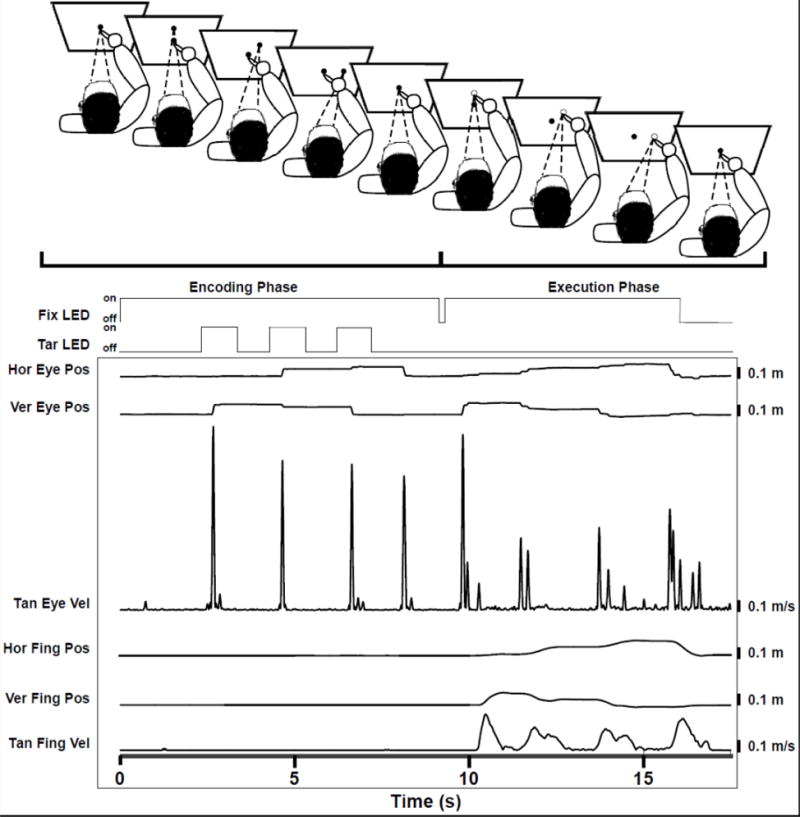
Shows the sequential reaching task divided into the encoding and executing phase. The subject starts the encoding phase with the eyes fixated on the fixation LED (solid central circle) and the finger immediately below the fixation LED. The subject then moves his/her eyes to the target LED (solid peripheral circle) as it is presented thereby visually encoding target location and sequence. This is followed by the execution phase where the subject looks and points to the remembered targets (unfilled circles) and then returns to the central fixation LED. Below that, the timing of the fixation LED (Fix LED)and Target LED (Tar LED) onsets are shown with an example horizontal and vertical eye position (Hor Eye Pos, Ver Eye Pos), tangential eye velocity (Tan Eye Vel), horizontal and vertical finger position (Hor Fing Pos, Ver Fing Pos), and tangential finger velocity (Tan Fing Vel).