


Figure 4. Docetaxel-Resistant Prostate Cancer Cells Are Dependent on Notch and Hedgehog Signaling.
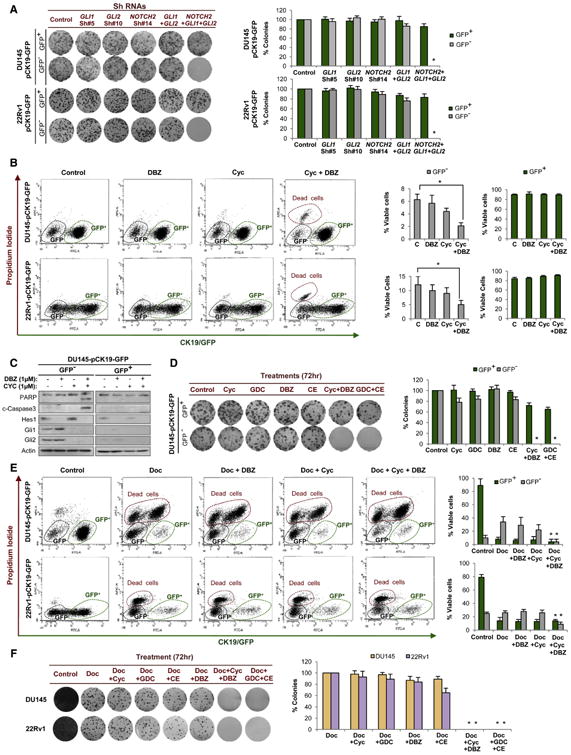
(A) Colony formation assay and quantification of DU145-pCK19-GFP- and 22Rv1-pCK19-GFP-sorted cells expressing shRNAs against GLI1, GLI2, and NOTCH2 alone, as well as double (GLI1 and GLI2) and triple knockdowns.
(B) Flow cytometry analysis of DU145-pCK19-GFP and 22Rv1-pCK19-GFP treated with Cyclopamine (1 μM) and/or DBZ (1 μM, both 48 hr).
(C) Immunoblots of indicated proteins in DU145-pCK19-GFP cells treated with the same conditions as (B).
(D) Colony formation assay and quantification of DU145-pCK19-GFP-sorted cells exposed for 72 hr to Cyclopamine, GDC-0449, DBZ, and Compound E (all 1 μM), alone or in combination (Cyc+DBZ or GDC+CE).
(E) Flow cytometry analysis after Docetaxel (48 hr) alone or in combination with Cyclopamine and/or DBZ (both 1 μM). DU145-pCK19-GFP and 22Rv1-pCK19-GFP cells were treated with 10 and 50 nM Docetaxel, respectively.
(F) Colony formation assay and quantification of parental DU145 and 22Rv1 cells exposed for 72 hr to Docetaxel (10 and 50 nM, respectively) alone or in combination with Notch inhibitors (CE or DBZ, both 1 μM) and/or Hedgehog inhibitors (Cyclopamine or GDC-0449, both 1 μM). Data are represented as means ±SD of triplicate experiments. *p < 0.05.
See also Figure S4.