


Fig. 1.
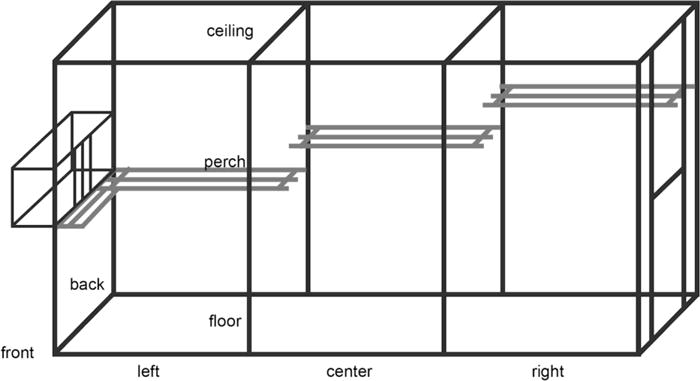
Schematic representation of the novel environment, in which monkeys spent 15 minutes in order to trigger the activation of brain regions involved in spatial learning. The cage was 4.27 m long, 1.52 wide and 2.13 m high. The front and back panels were made of solid stainless steel panels, whereas the two sides and the ceiling were made of stainless steel wire mesh. Three 25 cm deep perches (in grey) made of PVC plastic bars were placed at different heights (0.91 m, 1.22 m, 1.52 m) against the back stainless steel panel. Attached to the left side wire mesh wall was a wire mesh chute with a remote controlled door, through which monkeys entered and exited the cage when prompted by the experimenter. The black lines represent stainless steel bars forming the structural frame of the room. They also served to delimitate the virtual zones used to score the monkeys’ locomotor activity while exploring the environment (see main text for details).