


Figure 3. The c-Met and Trk pathways transactivate each other.
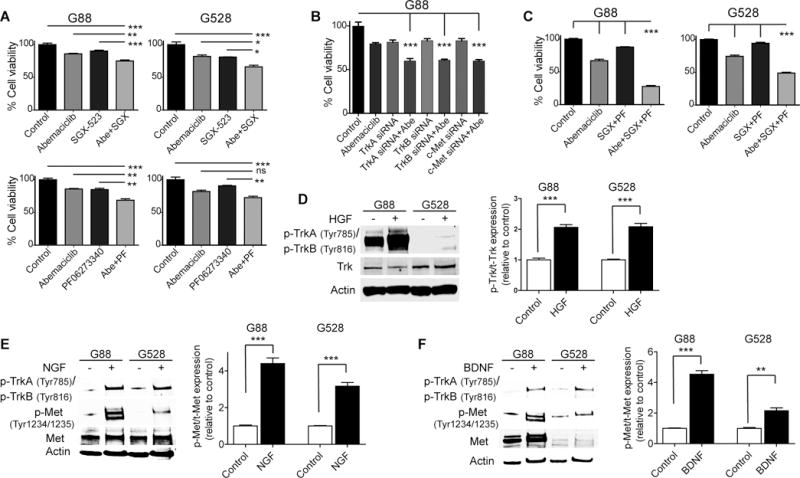
(A) The combination of abemaciclib (1.25 μM) and a specific c-Met inhibitor, SGX-523 (10 μM), or a pan-Trk inhibitor, PF-06273340 (10 μM), exhibits mild synergy against GICs (*P < 0.05; **P < 0.01; ***P < 0.001; ANOVA with post-hoc Tukey analysis). (B) The combination of abemaciclib (1.25 μM) and a specific siRNA for c-Met, TrkA, or TrkB exhibits mild synergy against G88 (***P < 0.001; ANOVA with post-hoc Tukey analysis). (C) Combining abemaciclib (1.25 μM) with both SGX-523 (5 μM) and PF-06273340 (5 μM) exhibits significant synergy, comparable to altiratinib (***P < 0.001; ANOVA with post-hoc Tukey analysis). (D) Exogenous HGF stimulates the Trk pathway, detected with an immunoblot using specific antibodies for Trk. (E–F) Both NGF and BDNF stimulate the c-Met pathway. Shown are immunoblots using specific antibodies for Trk and Met. (PF: PF-06273340, SGX: SGX-523). Protein expressions were quantitated and plotted (D–F) (**P < 0.01; ***P < 0.0001; two-tailed t-test). All values are mean ± SEM and from three biologically independent samples.