


Figure 4. The Dominant Mechanisms of miRNA-guided Repression in Bilaterian Animals.
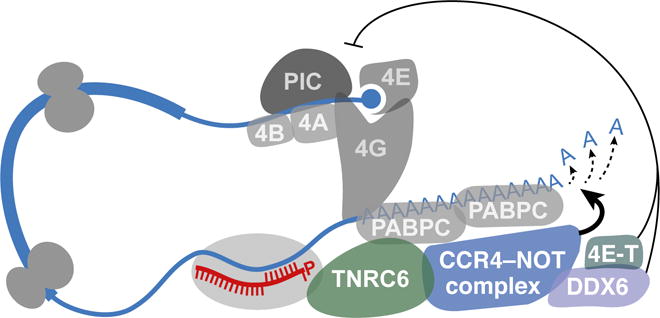
Guided by the miRNA, the silencing complex associates with the mRNA and recruits TNRC6, which interacts with PABPC and recruits either the PAN2–PAN3 deadenylase complex (not shown) or the CCR4–NOT deadenylase complex, either of which shortens the mRNA poly(A) tail. Alternative downstream consequences of poly(A)-tail shortening, which are not depicted in this figure, consummate this major mode of TNRC6-mediated repression; in early embryos tail shortening reduces translation initiation with little effect on mRNA stability, whereas in most other developmental contexts tail shortening hastens decapping and degradation of the mRNA with relatively little effect on translation initiation. Although not through tail shortening, recruitment of TNRC6 can nonetheless repress translation initiation in postembryonic cells through a parallel mechanism that involves CCR4–NOT-mediated recruitment of DDX6 and 4E-T. This translation initiation normally involves the recruitment of the 43S preinitiation complex (PIC) through the action of initiation factors (4A, 4B, 4E, 4G).