


Fig. 1.
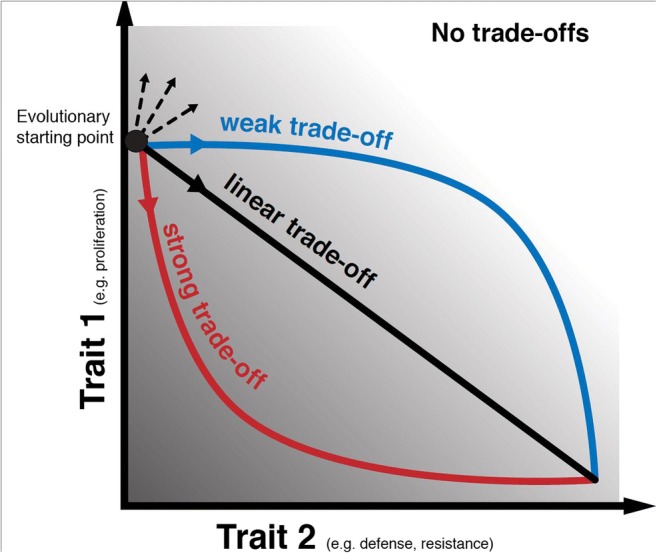
Dynamical trade-offs between two traits of cells under evolutionary processes. When two traits of tumor cells, e.g., growth (y-axis) and resistance to drug or ability to escape immune cell attack (x-axis) have a trade-off, the tumor cells evolve inside the gray area in the trait space. The improvement of resistance (trait 2) will lead to a cost of growth (trait 1). The shape of the trade-offs can be classified as linear, concave (initially weak and cheap trade-off), or convex (initially strong and costly trade-off) compared to the linear shape. It is critical for the diversity level of a tumor population. Tumor cells do not necessarily evolve along a trade-off curve with one specific shape. Instead, it is a dynamical process. For example, if the immune cells improve their ability to attack the tumor cells, the cost of the tumor cells to escape immune cells can increase over time, i.e., the tumor cells jump from an initially weaker (cheaper) trade-off curve to a stronger (more costly) one. This kind of dynamical trade-offs has been observed in bacteria populations when the bacteria cells evolve to escape the predation of ciliates