


FIGURE 3.
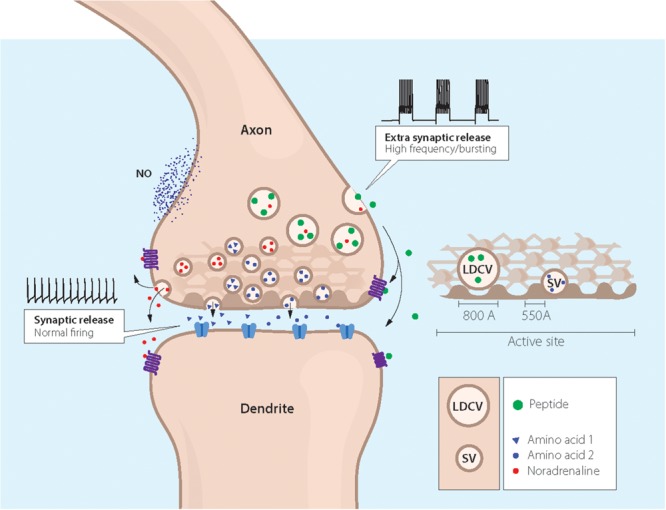
Cartoon showing coexistence of a neuropeptide with classic and ‘unconventional’ neurotransmitters in a nerve ending synapsing on a dendrite. Two types of storage vesicles are shown: synaptic vesicles (diameter 500 Å) storing classic transmitters (e.g., 5-HT, NA, GABA or glutamate), mainly released at synapses; large dense core vesicles (LDCVs) storing neuropeptides and, in amine neurons NA or 5-HT. The peptides are in general released extrasynaptically (“volume transmission”), when neurons fire with high frequency or in bursts. Peptide receptors are essentially extrasynaptic or presynaptic, whereas ligand-gated receptors are mostly localized in the postsynaptic membrane. ‘Gaseous’ (e.g., nitric oxide, NO) and other non-conventional transmitters are not stored in vesicles, but are generated upon demand (Snyder and Ferris, 2000). The presynaptic grid, an egg basket-like structure, originally described by Pfenninger et al. (1969), is indicated in the nerve ending and high-lighted to the right. Note that the LDCV does not fit into the grid and thus cannot attach to the presynaptic membrane for release. In contrast, there is room for the synaptic vesicle. This supports the concept that peptides are mostly not released into the synaptic cleft. Drawing by Mattias Karlen. Modified from Pfenninger et al. (1969),Lundberg and Hokfelt (1983), and Lang et al. (2015).