


FIGURE 6.
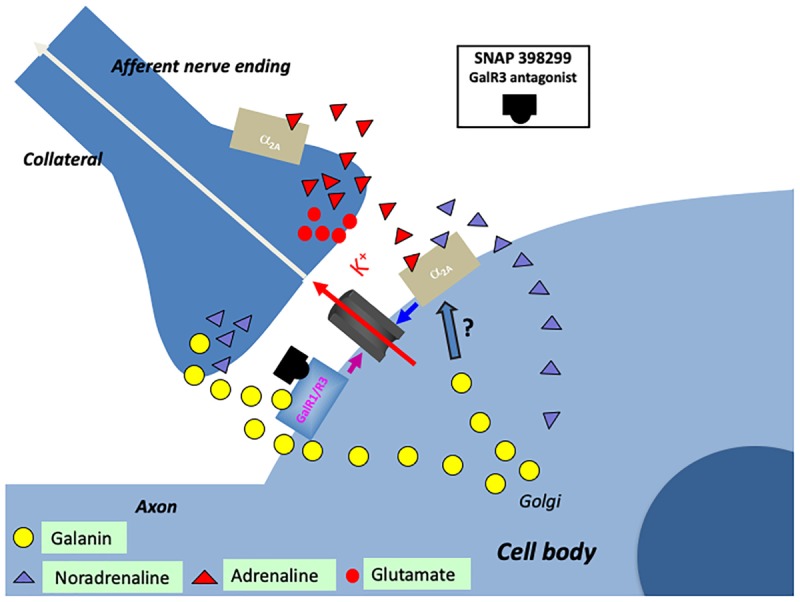
Cartoon showing several transmitters and signaling pathways in the locus coeruleus (LC) (part of a cell body with initial axon and an afferent nerve ending and a possible axon collateral). A noradrenergic LC neuron co-expresses galanin (yellow LDCVs) originating in the Golgi complex. The peptide in the LDCVs is, after transport to the somatic and dendritic cell membrane, released by exocytosis. Galanin then acts on inhibitory autoreceptors (GalR1/R3), opening potassium channels, in this way attenuating noradrenaline (NA) release in the forebrain. Galanin at low concentrations enhance the alpha2A mediated inhibition of the LC neuron (by an unknown mechanism). Galanin could also be released from collaterals. The GalR3 antagonist (SNAP 398299) may exert an antidepressive action by disinhibiting the LC neuron and restituting forebrain NA levels. With regard to small transmitters, NA (purple triangles) can be released from soma-dendrites and collaterals, acting on somato-dendritic, postsynaptic and presynaptic alpha2A receptors. The afferent nerve ending originates from C1 neurons which are glutamatergic (red dots) and co-release adrenaline (red triangles). Also adrenaline can act on the alpha2A receptors. The basis for this cartoon is animal experiments, and in the case of the galanin system, results from human postmortem brains are also incorporated.