


FIGURE 9.
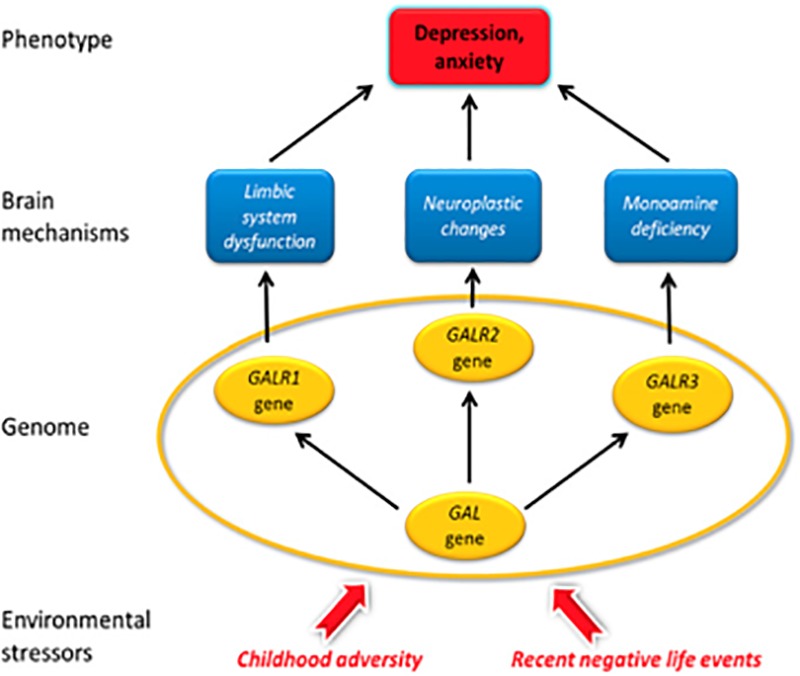
Galanin mechanisms hypothetically involved in MDD in humans. Galanin and its receptors are colocalized in some monoaminergic neurons in the brain. The galanin system is highly sensitive to experimental and naturalistic stressors. Stress-induced activation of the galanin system represents the first phase in the development of depression. Recent analysis of human brain has shown that the Gi protein-coupled GalR3 (and not GalR1 as in rodents) is the main galanin receptor in noradrenergic neurons in the locus coeruleus and probably the dorsal raphe nucleus and that the Gi protein-coupled GalR1 is the main receptor in the forebrain. Antidepressive effects may be achieved by (i) GalR3 antagonists, by reinstating normal monoamine turnover in LC neurons in the lower brainstem projecting to the forebrain, and by (ii) GalR1 antagonists in the forebrain by normalization of limbic system activity, or by (iii) agonists at GalR2, a Gq protein-coupled receptor, promoting neuroprotection. A candidate gene analysis suggests that GalR1 risk variants may compromise galanin signaling during childhood, whereas GalR2 signaling may be influenced by recent negative life events. In addition, all four galanin system genes have relevant roles in the development of depression-related phenotypes in those persons who were highly exposed to life stressors. From Juhasz et al. (2014).