



Abstract
Background
In Japan, Livestock Improvement Association of Japan started commercially producing sexed bovine semen 10 years ago, and sexed bovine semen is currently used for the artificial insemination (AI) in the farms. In this review, the authors introduce the technology for sperm sexing by flow cytometry, the efforts at commercializing sexed semen in Japan, and recent field data on artificial insemination of the cattle with sexed semen.
Methods
In the procedures of the flow cytometric method, X‐chromosome‐bearing sperm and Y‐chromosome‐bearing sperm were fluorescently stained, separated from each other by analyzing the difference in the DNA content, and cryopreserved. The authors surveyed the conception rates after AI with these sperm and sex ratios of the offspring with the cooperation from livestock associations, AI technicians, and farmers.
Main findings (Results)
Although AI with sexed semen was associated with lower conception rates in comparison with AI with conventional semen, the accuracy of sex selection using AI with sexed semen was beyond >90%.
Conclusion
Sexed semen produced by flow cytometry has the potential to produce offspring of the preferred sex with high accuracy and reliability. Thus, it is expected that sexed semen is used for AI more frequently in the farms.
Keywords: artificial insemination, cattle, sex selection, sexed semen, sexing technology
1. INTRODUCTION
The sex selection of the offspring in mammalian species, including humans and other animals, often attracts critical attentions as well as interests in the society. Sex determination1, 2, 3, 4 and sex selection4, 5, 6, 7 in humans should be accompanied necessarily by the ethical consideration. Previous reports suggest that the preferred sex of the child may tend to reflect the parental background, including culture, tradition, religion, and education.3, 4, 5, 8
In farm animals, especially cattle, there are economic requests of farmers that the offspring are desired to be of a particular sex. Specifically, dairy farmers are engaged in the production of milk, and thus prefer female calves and tend to consider male calves as by‐products. In contrast, castrated males are commercially beneficial for beef production, due to the merit of their superior growth. In the market of Japan, castrated male cattle (beef breeds) are generally traded at higher prices than heifers.9 Thus, sexing technology of calves is a good tool to make more benefits for animal farms, as it enables the preferential production of offspring of the desired sex, which is alternatively determined according to the breeds of cattle (namely, either dairy cattle or beef cattle, as described above).
The technology for sex selection in the cattle has already been widespread around the world.10, 11 Sexed semen technology is currently available with high accuracy and repeatability in selecting the sex of offspring. In fact, use of sexed semen for artificial insemination (AI)12 and in vitro fertilization (IVF)13 results in the birth of calves of the desired sex with approximately 90% probability. A flow cytometric method for sperm sexing14, 15 is currently the most frequently used method for sperm sexing. DNA contents of X‐chromosome‐bearing sperm (X‐sperm) are more than Y‐chromosome sperm (Y‐sperm) since X‐chromosome is larger than Y‐chromosome. The difference reflects on degree of intensity when fluorescence nucleic acid staining is performed and is applicable to fractionate each type of sperm. X‐sperm and Y‐sperm are separated from each other according to their different fluorescence intensities that are dependent on the DNA content of the nuclear‐stained sperm.14, 16.The improvement of this biotechnology has been continued over the past three decades,17 and sexed semen is now commonly used for AI in the cattle farms. Although none have been shown to be commercialized, there are a variety of reports for the sex selection: genetic approach,18 maternal energy condition,19, 20 centrifugal countercurrent distribution,21 immunologic approach,22, 23, 24 and swim‐down25, 26, 27 and swim‐up28 methods.
The flow cytometric sperm sexing technology was developed by Johnson and his colleagues who belonged to the Beltsville Agricultural Research Center, United States Department of Agriculture (USDA).29 Thus, this technology is referred to as “the Beltsville sperm sexing technology.”30 The sperm sexing procedure was patented by the USDA with Dr Johnson in 1991.31 The patent for non‐human animals was licensed by the USDA to XY, Inc, which was set up in 1996 as a joint venture between Cytomation Inc and the Colorado State University Research Foundation. The company developed MoFlo® SX, a specialized machine for sperm sexing, and commercialized a sexed semen production technique. XY, Inc has entered into commercial license agreements with bull studs in the United Kingdom, the United States, Japan, and other countries. In 2007, Inguran, LLC., dba Sexing Technologies, acquired XY, Inc and continues developing the technology.
Livestock Improvement Association of Japan, Inc (LIAJ) was one of the contributors involved in the commercialization of the sexed semen in cattle.10 In Japan, a decade has passed since LIAJ launched sexed semen. Thereafter, sexing technology has been growing in use and popularity. Farmers now can choose the use of the sexed semen for AI as one of the options for management strategies in their own farms, as it allows the efficient acquisition of offspring of the desired sex. In this review, we introduce the brief history of sexed semen, the methodology of sperm sexing, and the current status of sexed semen use in cattle farming.
2. A BRIEF HISTORY OF SEXED SEMEN TECHNOLOGY
Guyer32 published the first report on the observation of sex chromosomes in 1910; this report initiated attempts of biologists to separate X‐ and Y‐sperm.33 Although many researchers challenged the sperm separation since the report, it passed 60 years until Barlow and Vosa34 reported that quinacrine staining of the Y‐chromosome resulted in brighter heterochromatic fluorescence in comparison with other chromosomes in human spermatozoa. Moruzzi35 showed that the X‐chromosome is relatively larger than the Y‐chromosome in 24 kinds of mammalian species by the direct estimation of the chromatin differences, which was performed by measuring the lengths of the karyotype. Around the same time, it was considered that a more rapid and precise method was required for measuring the DNA contents of X‐ and Y‐chromosomes. Thus, some researchers attempted to measure the sperm DNA content by flow cytometry; however, fluorescent staining of the sperm head was not easy because of the highly condensed chromatin.36, 37 Moreover, accurate measurement of the fluorescence intensities was difficult because of the flat‐shaped head, since flow cytometers are basically constructed to analyze spherical particles. Otto et al38 first reported the use of flow cytometry with the improved techniques of the chromatin decondensation and staining resulted in the accurate measurement of the DNA content and the discrimination of X‐ and Y‐sperm in humans. The report ushered in the development of a flow cytometric technique that hydrodynamically orientates the sperm with a rapid‐ and high‐resolution measurement method.39
As stated above, progress has been made in the analysis of the sperm DNA content by flow cytometry since the 1970 s.14, 40, 41 These studies provided the basis for the improved technology of sperm sexing.39, 42, 43 Progress was made in the procedures of sperm sorting for sperm sexing technology in the 1980 s. In an early stage of development, the tail was removed from the sperm by sonication before cell sorting in order to make it easier to orientate the sperm head.14 Then, Johnson et al29 achieved a breakthrough that they succeeded in producing offspring via the surgical AI into the oviducts of rabbits of tail‐intact sperm. When X‐sperm‐rich fractions and Y‐sperm‐rich fractions were inseminated, the sex ratio of the offspring was 94% and 81% in females and males, respectively. Thereafter, production of calves with a desired sex has been performed by intracytoplasmic sperm injection (ICSI),44 IVF,13, 45 and AI12, 46 using sexed bovine sperm with or without the intact tail.
Development of two key equipments has made large contributions to the commercialization of sperm sexing technology: the Cytonozzle® and the high‐speed flow cytometer. The Cytonozzle® dramatically increased the efficiency of sperm sorting by enabling great improvements in sperm orientation before laser excitation. To detect the subtle difference between the DNA content of X‐ and Y‐sperm exactly, each sperm head, which has a flat paddle‐like shape, is required to be irradiated in a certain direction using an excitation light source. Rens et al47 reported that use of a double ellipse‐shaped nozzle improved the efficiency of orientation from 25% (the original ability) to more than 60% in 1998. The design of the nozzle has been further refined, and consequently, the efficiency of the sperm orientation is now above 70%. In 1989, van den Engh et al48 developed an experimental high‐speed cell sorter. Cytomation, Inc (since acquired by Beckman Coulter, Inc., Brea, CA, USA) modified the instrument and commercially released the MoFlo®. The performance of the MoFlo® in sperm sorting is approximately 5 times that of conventional equipment49; this improved from 5 times to 10‐15 times when used in combination with the Cytonozzle®.30 After these breakthroughs, sexed semen produced by these technologies has been put into commercial use in cattle farms around the world.
3. SPERM DNA CONTENT AND STAINING
Characteristics of different DNA content between the X‐ and Y‐chromosomes in mammalian species are applied to the separation of X‐ and Y‐sperm.39 In the early study, different DNA contents of X‐ and Y‐sperm were evidenced with twin peaks of fluorescent amount of sperm by flow cytometry.41 In cattle, the difference in DNA content between X‐ and Y‐sperm is approximately 4%.33, 39, 41, 44 Moreover, there are subtle differences in the DNA content among different cattle breeds (Holstein, 3.98%; Jersey, 4.24%; Angus, 4.05%; Hereford, 4.03%; Brahman, 3.73%).39 Thus far, the use of flow cytometry in the identification of X‐ and Y‐sperm in other species has been documented; the differences are as follows: human, 2.8%50, 51; dog, 3.9%51; horse, 3.7%51; buffalo, 3.6%52; goat, 4.4%53; sheep, 4.0%‐4.2%14, 41; pig, 3.5%‐3.7%14, 41; rabbit, 3.0%‐3.9%41, 51; and mouse, 3.2%.40 Overall, there is less difference in the DNA content between the X‐ and Y‐sperm of humans in comparison with other species.
Sperm nuclei are stained with Hoechst 33342, a less‐toxic fluorescent dye, to measure the DNA content.14, 15, 54, 55 The dye permeates the cell membrane of the intact sperm and then strongly binds by the van der Waals interaction to the DNA minor groove of the AATT sequence.16, 56 The DNA‐Hoechst 33342 complex is excited by ultraviolet light and then emits a blue light (excitation/emission = 350 nm/361 nm), resulting in the accurate measurement of the DNA content of X‐ and Y‐sperm.33 X‐sperm or Y‐sperm can be recognized by the difference in the fluorescence intensity between these two‐type sperm.
In the sperm sorting process, only viable sperm is sorted; dead sperm is aborted. To examine sperm viability, sperm is stained with a food coloring agent (eg, FD&C Red No. 4051 or Yellow No. 657) during or after Hoechst 33342 staining. As the food color permeates the sperm with damaged membranes and quenches the fluorescence of Hoechst 33342,16, 30, 51, 57 sperm with a fluorescence intensity that is below a certain level is considered dead. Propidium iodide is not used to stain dead cells as it has the potential to cause mutagenicity through intercalation.33, 39, 51
4. THE PROCEDURES USED IN THE PRODUCTION OF SEXED BOVINE SEMEN
A number of processes are necessary for the production of semen sexed by flow cytometry: semen collection, sperm staining, sperm sorting, removal of the sheath fluid, and extending, packaging, and cryopreservation of sorted sperm. In this review, we described the processes of semen collection, sperm staining, and sperm sorting. The other processes are referred to elsewhere.33
The collection of semen from bulls is usually performed using an artificial vagina. In Japan, a bull is generally handled and introduced to a dummy cow or a teaser. When a bull mounts a dummy cow, a collector inserts the bull's penis into an artificial vagina with a collection tube to induce the immediate ejaculation. Freshly ejaculated semen is the preferred material for producing sexed semen. Although it is possible to use liquid‐preserved semen to produce sexed semen, the productive efficiency gradually decreases because of the increase in dead sperm ratio. Thus, if bulls are kept in local farms, semen should be immediately transported to the semen‐sexing laboratory.
Figure 1 shows an overview of the method of sperm sexing using flow cytometer. Sperm samples stained with both Hoechst 33342 and a food color agent are injected into a stream of sheath fluid.33, 57, 58 In the sperm sexing sorter, the forward scatter detector and side scatter detector are replaced with two fluorescence detectors at 0º and 90º, respectively. The detectors measure the fluorescence intensity of each of stained sperm excited by a laser. The fluorescent signal detected with the 0º and 90º detectors indicates the amount of DNA and the orientation, respectively, in the sperm. Because of the flat‐shaped head of sperm, the fluorescence intensity is differently detected according to the orientation of the head. Populations in the bivariate histogram are identified as live‐oriented sperm, non‐oriented sperm, and dead sperm (Figure 2). The oriented sperm head faces toward 0º, and the non‐oriented sperm head faces toward 90º. The population of the desired sex is gated from the oriented sperm. Frequency waves are applied to the Cytonozzle®, which consists of a piezo crystal, which is coupled to the fluid inside the nozzle. Subsequently, a droplet composed of sheath flow and sample flow is broken off from the stream holding the charge. The droplets containing sperm of the desired sex are positively or negatively charged and then deflected to negative or positive fields, respectively. The deflected droplets are collected in collection tubes.
Figure 1.

X‐sperm sorting with a flow cytometer (the illustration was reused with the permission of Japanese Journal of Embryo Transfer63)
Figure 2.

A bivariate histogram of 0º (foreword) and 90º (side) fluorescence obtained by the flow cytometer. The image shows populations of live‐oriented sperm, non‐oriented live sperm, and dead sperm. After gating for the live‐oriented, X‐sperm‐enriched (upper) and Y‐sperm‐enriched (lower) populations are further gated to sort the required sex
The purity of the collected sperm is analyzed by sorting reanalysis.59 The arrangement of the sperm concentrations and sperm motility test are performed; then, cryopreservation is performed as it is for conventional semen.
5. THE COMMERCIALIZATION OF BOVINE SEXED SEMEN IN JAPAN
5.1. The development of sexed semen technology in Japan
Livestock Improvement Association of Japan, Inc, started to develop sexed semen technology in 1988. To learn the Beltsville technology, LIAJ invited Dr Johnson into our laboratory in 1989 and a researcher of LIAJ visited his laboratory the following year. At the beginning of the sperm sexing study, we introduced the EPICS‐753 device, which was manufactured by Coulter Electronics, Inc (Hialeah, FL, USA; now known as Beckman Coulter, Inc., USA). Because the high‐speed flow cytometer and Cytonozzle® had not been developed yet at that time, tails were removed from the sperm by sonication before sorting to make it easier to orientate the sperm head. The sorting rate was 50 000‐100 000/hour. Hamano et al44 reported that the purity of the sexed sperm head was analyzed by in situ hybridization using a Y‐specific DNA probe. The purity of X‐ and Y‐sorted sperm was 94% and 82% (of the targeted sperm), respectively. ICSI of the Y‐sperm heads sorted from frozen semen was performed. Seven to eight days after ICSI, the expanded blastocysts were non‐surgically transferred to 48 recipients, resulting in the successful birth of 10 calves.44 Eight of the 10 calves were male. In 1997, we introduced the FACS Vantage™, manufactured by Becton Dickinson.60 By the use of this machine, the sperm sorting rate was increased to 300 000‐400 000/hour. We succeeded in obtaining slightly motile sperm after sorting. However, they were not of a suitable level for IVF or AI. Thus, we focused on producing fertilized eggs by ICSI. In the meantime, XY, Inc was established and obtained the patent right to the sexing technology from the USDA. LIAJ then established a collaboration license agreement with XY, Inc and started production test of the sexed semen using two MoFlo® SX. We highly anticipated the possibility that the machines would be useful for producing sexed semen for AI for the following reasons. (a) The machines showed a far greater sorting rate in comparison with the machines we had used previously (>10 000 000/hour at the time). (b) The purity of both X‐ and Y‐sperm was >90%.
For 5 years from 2001 to 2005, we produced sexed semen from 44 bulls with a MoFlo® SX and performed field trials for AI, which were supported by commercial farms, AI technicians, and related associations.60, 61 In this review, we introduce some of the parts of our trials that demonstrated the effectiveness of sexed semen. X‐sorted semen from Holstein bulls and Y‐sorted semen from Japanese Black bulls were processed at 3 million per dose, and their purity was 92.8% and 92.4%, respectively.60 Non‐sorted semen (conventional semen) was used at the same sperm count per dose as a control. In our first AI trial, heifers were served with the semen. Figure 3 shows the conception rates (CRs) of the heifers, the calving rate of the pregnant heifers, and the sex ratio of the calves. The CRs for the 5‐year period were 47.9% with sexed semen and 58.7% with conventional semen.61 There was a significant difference between the groups (P < 0.05). The delivery rates of pregnant heifers inseminated with sexed semen were comparable to those inseminated with conventional semen. The sex ratio of the calves showed that the accuracy of both the X‐sorted and Y‐sorted semen was >90%. The gestational duration of the pregnant heifers and the body weight of the calves were compared between sexed semen and conventional semen groups in Holstein, Japanese Black, and crossbred cattle. The measurement demonstrated that the gestational duration (Figure 4A) and the body weight (Figure 4B) were comparable among the groups. We also investigated the differences between heifers and cows with regard to the conception rate in Holstein cattle.60 The CRs in heifers and cows inseminated with sexed semen were 46.2% and 33.6%, respectively (Table 1); in contrast, the CRs in heifers and cows inseminated with conventional semen were 58.4% and 40.0%, respectively. Thus, the CR in cows was found to be lower than that in heifers, regardless of whether sexed semen or conventional semen was used. These results indicated that heifers are more suitable for AI with sexed semen than cows; however, it can also be performed for cows.
Figure 3.

Conception rates (CR), delivery rates of normal calves (DR), and the sex ratio (SR) after artificial insemination with sexed semen and conventional semen from the same bulls and batches from 2001 to 2005 (the illustration was reused with the permission of Japanese Journal of Embryo Transfer63)
Figure 4.

(A) The duration of gestation and (B) birthweight of calves after artificial insemination with sexed semen and conventional semen from the same bulls and batches from 2001 to 2005 (the illustration was reused with the permission of Japanese Journal of Embryo Transfer63)
Table 1.
The conception rates in dairy heifers and cows after insemination with sexed semen or conventional semen from the same bulls and batches (the table was reused with the permission of Livestock Improvement Association of Japan, Inc62)
| Group | No. of insemination | Conception rate (%) |
|---|---|---|
| Sexed semen | ||
| Heifers | 524 | 46.2 |
| Cows | 214 | 33.6 |
| Conventional semen | ||
| Heifers | 219 | 58.4 |
| Cows | 65 | 40.0 |
We also compared the effect of flow pressure during sperm sorting on the CR60 Sexed semen was produced from Holstein (n = 2) and Japanese Black (n = 2) bulls by sorting sperm at 45 psi or 40 psi and was used to inseminate Holstein heifers. Although the higher pressure provided a sorting rate that was approximately 5% higher, the CR in the group was lower (103/227, 45.4%) than that in the lower pressure group (121/225, 53.8%). These results indicated that sorting at higher pressure damaged the sperm, resulting in a lower CR
The difference in the number of sperm that were inseminated at a time on the CR was evaluated.60 Sexed semen was obtained from Holstein (n = 5) and Japanese Black (n = 4) bulls by sorting at 2 million/straw and 3 million/straw. The conception rate at 3 million was higher (218/438, 49.8%) than that at 2 million (183/401, 45.6%), suggesting that the CR obtained with sexed semen was sensitive to a change in the number of sperm at this range.
Based on these results, we concluded that sexed semen could be commercialized in Japan and a commercial license agreement for the production and sale of bovine sexed semen was entered into between XY, Inc and LIAJ, Inc in 2006. Then, LIAJ launched IVF embryos produced with sexed semen in 2006 and then sexed semen itself for AI the following year. We applied to register Sort90 ® as a trademark for sexed bovine semen produced by LIAJ in September 2007.
5.2. Improved production of sexed semen after commercialization
To increase the production capacity, we introduced a third MoFlo® SX in 2007 and then two MoFlo XDP™ SX (the next generation of the MoFlo® SX) in 2009 and two more in 2010. The MoFlo SX and MoFlo XDP SX can sort X‐sperm at a rate of 20.4 ± 3.0 million/h (n = 1769, data from Apr 2012 to Mar 2017) and 24.7 ± 3.4 million/h (n = 3450, data from Apr 2012 to Mar 2017), respectively.62 In addition, to address a growing market demand for sexed semen, a new type of machine, the Genesis III™ (Cytonome/ST, LLC, MA, USA), was introduced in December 2016. The new machine runs up to three sort heads in parallel. Although the sorting rate of the individual Genesis III head for X‐sperm is currently lower (17.3 ± 2.7 million/h, n = 424, data from May 2017 to Apr 2018) than that of the MoFlo SX, the rate has tended to gradually increase through efforts in refinement and the amount of sperm sorted by the three heads of the machine has increased. Thus, we may need to further align the new machine to enhance the rate to reach or to exceed the level of the old ones.
The use of sexed semen has been growing during the last decade in Japan. In fiscal year 2007, sexed semen from dairy cattle accounted for 1.4% of the frozen semen distributed by LIAJ—including domestic and foreign products (Figure 5). The ratio has been consistently increasing and reached 31.2% in fiscal year 2017. According to a statistical survey on livestock conducted by the Ministry of Agriculture, Forestry and Fisheries of Japan,9 the female‐to‐male ratio at birth hovered at around 48% until 2007 (Figure 6).62 Thereafter, the ratio has been increasing and reached 53.1% in 2016. In Japan, local governments, livestock associations, and others encourage the use of sexed semen. AI technicians, including veterinarians, have reported their sexed semen service records to motivate themselves. Thus, it is surmised that sexed semen has been adapted to commercial field usage.
Figure 5.
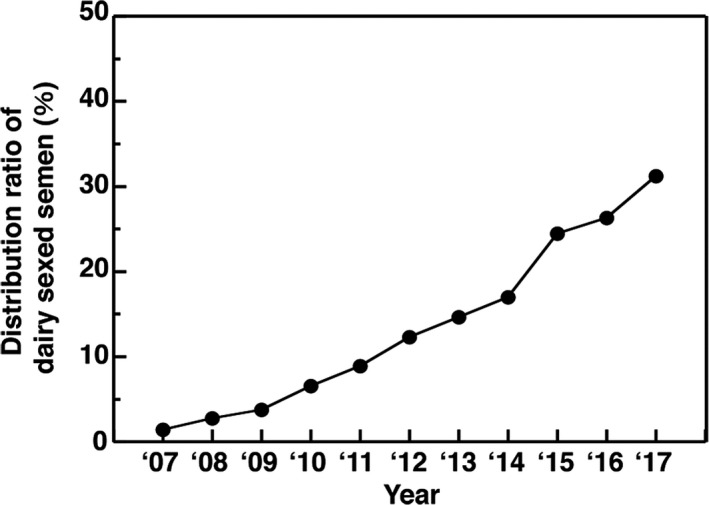
The distribution ratios of sexed semen to conventional semen distributed by LIAJ (dairy breeds) from April to March of each year
Figure 6.

The birth rates of female dairy calves in Hokkaido and the other prefectures of Japan from February to January each year (the illustration was reused with the permission of Japanese Journal of Embryo Transfer63)
5.3. Recent records of the conception rates and the calf sex ratio of dairy cattle inseminated with sexed semen
We have surveyed the conception rates and calf sex ratio with the cooperation from some livestock associations, AI technicians, and farmers. The insemination data of the sexed semen were collected from 17 progeny‐tested bulls selected by LIAJ from February 2012.62 The CR was calculated using the data reported before August 2016. The data included 4656 animals, of which 3123 and 1533 were heifers and cows, respectively. The conception rates of the heifers and cows were 52.8% and 40.1%, respectively (Table 2). The rates in the survey tended to improve in comparison with those in the field trial conducted in the early 2000 s. These results implied that technicians had been able to handle the sexed semen properly and that the production technology of the semen had improved.
Table 2.
The conception rates of heifers and cows in commercial fields after insemination with sexed semen produced from dairy bulls selected since February 2012 (calculated until June 22, 2016) (the table was reused with the permission of Japanese Journal of Embryo Transfer63)
| Group | No. of insemination | NC | No. of conception | Conception rate (%) |
|---|---|---|---|---|
| Heifers | 3135 | 12 | 1649 | 52.8 |
| Cows | 1535 | 2 | 614 | 40.1 |
| Total | 4670 | 14 | 2263 | 48.6 |
NC, conception not confirmed.
The sex ratio was surveyed from 804 calves produced with sexed semen (X‐sperm) made from 10 Holstein bulls in LIAJ during 2013 and 2015.62 Seven hundred fifty‐five of 804 (93.0%) female calves (the desired sex) were born. These results suggest that calves of the desired sex have been obtained with sexed semen with >90% accuracy since the products were first distributed.
6. THE ECONOMIC BENEFIT OF SEXED SEMEN IN THE CATTLE INDUSTRY
The use of sexed semen has been proven to be effective for increasing the desired sex ratio. This raises the question as to whether sexed semen is beneficial to farm management. Numerous reports have estimated the economic benefits of sexed semen produced by various strategies in many different countries, including the United States,63, 64, 65, 66 Denmark,67, 68 Iran,69 Ireland,70 and Japan.71, 72 In general, the use of sexed semen is expected to have a positive effect on the economics of the farms, maintaining replacement heifers and/or the efficiency of expanding dairy herds,73, 74, 75 resulting in an improved milk yield.
Sasaki et al71 investigated the economic effects of the use of sexed semen in Japanese dairy herds and found that the use of sexed semen in place of conventional semen increased the agricultural income in dairy herds in various simulations. Concretely, one of the simulations showed that the use of Holstein sexed semen at 90% purity (X‐sperm) increased the earnings of a Japanese herd delivering 60 calves a year by more than 1.2 million JPY in comparison with conventional semen. Thus, the use of sexed semen is likely to be a profitable farm management strategy. On the other hand, Kawano et al72 pointed out that CR after insemination with sexed semen influences the consistency of the profit. Although it is beneficial to expand dairy herds and acquire replacement heifers when the CRs using sexed semen are >45%, there is a possibility that lower CRs (<40%) will cause volatility in the profitability of Japanese herds due to the number of replacement heifers and the cost of the sexed semen. These simulations varied according to the size of the herds, feeding state, and CRs of the farm. It is certain that how much effects to gain from sexed semen depends on the technical levels of reproductive control in individual farm.
7. CONSIDERATION OF FERTILITY OF SEXED SEMEN
One of the greatest concerns regarding the use of sexed semen is the lower CR Numerous trials around the world have investigated conception rates in cattle inseminated with frozen sexed semen.10 These studies have revealed the fact that AI with sexed semen is associated with lower conception rates in comparison with conventional semen. The field data on the commercial use of sexed semen also showed that the conception rates were lower in the United States,17, 76, 77 Denmark,78 Australia,79 and Japan.61 Thus, the definite causes of this issue should be sought as rapidly as possible.
The number of inseminated sperm is one of the factors that are considered to affect the fertility of inseminated cattle.80, 81 Den Daas et al81 found individual differences among bulls in the maximal conception rates when insemination was performed with large numbers of spermatozoa (1‐11 million). These studies were conducted with unsorted, conventional semen, and the same findings apply for sexed semen. Our previous study60 and recent data demonstrated that increasing the number of spermatozoa from 2 million to 3 million improved the fertility when using sexed semen. Seidel and Garner33 reported in their review that there was no significant difference in CR of sexed semen when Black Angus were inseminated with 1.5 million and 4.5 million spermatozoa. However, in their later field trial, they demonstrated that the fertility rate when 10 million spermatozoa were used per insemination rather than 2 million was as high as the fertility rate of Black Angus inseminated the same number of unsorted control sperm.82 Other research indicates that sexed sperm was associated with a lower fertility rate in comparison with unsorted sperm when an equal number of sperm were used,76, 83, 84 and suggested that a 5‐fold increase in sperm numbers is required to achieve a fertility rate comparable to that of control semen.82 A recent study reported that the conception rate of a branded sexed semen packaged at 4 million sperm per straw, SexedULTRA 4 M™ developed by STgenetics™,17 reached that of conventional semen packaged at 15 million per straw.85 The branded sexed semen is made using improved media during sorting.17 Thus, these findings suggest that in addition to the number of sperm, other factors are involved in the lower fertility rate of sexed semen.
It is necessary to consider the potentially damaging effects of sperm sorting. The aspects of the sexed semen production processes that differ from those used in processing conventional semen include DNA staining, laser illumination, higher dilution, sheath pressure, and the medium environment. Both staining and laser exposure potentially increase the DNA damage of sorted sperm by 1.5%.39 Although it has been reported that Hoechst staining of sperm does not affect pregnancy rates or offspring size, UV laser use reduced pregnancy rates in pigs.86 Intriguingly, sorted sperm does not affect embryo development in rabbits87 or pigs,51, 86 suggesting that the use of an excitation laser has no mutagenic effects on fertile sperm. Sheath pressure during flow sorting affects sperm conception rates. A field trial60 that we performed in the early 2000 s revealed that the CR of sperm sorted at a higher pressure (45 psi) was lower than that of sperm sorted at a lower pressure (40 psi). Schenk et al88 also showed that sorting at 40 psi resulted in a higher pregnancy rate than sorting at 50 psi. During sorting, a variety of mechanical stresses are likely to affect sperm functions, resulting in subfertility.
Previous studies indicated a possible cause of the reduced fertility of sex‐sorted sperm, which may undergo functional changes. Maxwell et al89, 90 demonstrated that flow sorting induces capacitation‐like changes in porcine spermatozoa based on the chlortetracycline (CTC) assay pattern. Bovine sperm also change after sorting, and the patterns of CTC staining as well as actin tyrosine phosphorylation seemed to be at an intermediary level between fresh sperm and in vitro‐capacitated sperm.91 In addition, the sorting procedure alters molecular chaperones to a capacitation‐like pattern.92 It has been reported that capacitated sperm are less able to bind to the oviduct epithelial cells in bulls93 and pigs.94 Indeed, sex‐sorted porcine sperm showed less ability to bind to the oviduct epithelial cells.95 The results of studies that have been performed thus far indicate that the sperm life span in sexed semen is shortened by sorting damage, which causes capacitation‐like membrane changes with reduced binding to oviduct cells, resulting in lower fertility rates when AI is performed in the field. Actually, the optimal period of AI with sexed semen is shorter than that with conventional semen in heifers.96, 97, 98 For successful conception, it seems necessary to recognize the optimal timing of AI with sexed semen, which probably should be done more close to ovulation than in the case of standard AI.
Although increasing the number of sperm per insemination seems to be an easy way to increase fertility, it is associated with a higher cost than insemination with a standard number of sperm. It would make sense to use improved machines and medium that treat the sperm gently to reduce sperm damage.
8. SEX SELECTION USING FLOW‐SORTED SPERM IN HUMANS
Sexed human semen has been clinically employed to conceive a child of a particular sex in the United States and other countries. Sex selection is used for the purposes of preventing genetic disease and for family balancing.99 In humans, X‐sperm contains approximately 2.8% more DNA than Y‐sperm.50, 51 The sexing flow sorting technique for separating human X‐ and Y‐sperm is virtually the same as that used for other animals; however, a specialized nozzle and high‐speed cell sorter are not used.
In 1993, Johnson et al50 reported that human X‐ and Y‐sorted sperm were separated by flow cytometry at an average of 82% and 75% purity, respectively, as analyzed by in situ hybridization. Subsequently, the Genetics & IVF Institute (GIVF; Fairfax, VA, USA) firstly succeeded in producing a fetus using X‐sorted sperm.100 The clinic reported that normal babies were delivered using X‐sorted sperm; in most cases, intrauterine insemination had been performed.101 In this report, 13 out of 14 (92.4%) babies were of the desired sex (female). Subsequently, two fertility centers performed further clinical studies until 2012.99 The study showed that 944 of 1010 (93.5%) and 280 of 328 (85.4%) babies conceived with X‐sorted sperm and Y‐sorted sperm, respectively, were of the targeted sex.
The USDA granted an exclusive license for human sperm sexing technology to GIVF in 1992.99 GIVF calls the sexed semen production process MicroSort®. Through the studies described above, technology for humans is now available at laboratories in several countries.99
9. CONCLUSION
Sexed semen produced by flow cytometry has the potential to produce offspring of the preferred sex with high accuracy and reliability. Thus, the products are economically beneficial for farmers in terms of obtaining the desired sex in each breed. The improvement of sexed semen fertility would be expected to have further economic benefits. Although the technology remains to be refined, it is expected that the widespread use of sexed semen in the farm setting will be achieved in the future.
DISCLOSURES
Conflict of interest : Yousuke Naniwa, Yoshiya Sakamoto, Syohei Toda, and Kyoko Uchiyama are employees of Livestock Improvement Association of Japan, Inc, which produces and sells bovine sexed semen. Human rights statement and informed consent: This article does not contain any studies with human patients performed by any of the authors. Animal studies: This article does not contain any studies with laboratory animal subjects performed by any of the authors.
Naniwa Y, Sakamoto Y, Toda S, Uchiyama K. Bovine sperm sex‐selection technology in Japan. Reprod Med Biol. 2019;18:17–26. 10.1002/rmb2.12235
REFERENCES
- 1. Maaji SM, Ekele BA, Bello SO, Morhason‐Bello IO. Do women want disclosure of fetal gender during prenatal ultrasound scan? Ann Afr Med. 2010;9:11‐14. [DOI] [PubMed] [Google Scholar]
- 2. Kooper AJ, Pieters JJ, Eggink AJ, et al. Why do parents prefer to know the fetal sex as part of invasive prenatal testing? ISRN Obstet Gynecol. 2012;2012:524537. [DOI] [PMC free article] [PubMed] [Google Scholar]
- 3. Okeke TC, Enwereji JO, Okoro OS, et al. Desire for prenatal gender disclosure among primigravidae in Enugu, Nigeria. Patient Prefer Adherence. 2015;9:429‐433. [DOI] [PMC free article] [PubMed] [Google Scholar]
- 4. Larsson M, Berglund M, Jarl E, Tyden T. Do pregnant women want to know the sex of the expected child at routine ultrasound and are they interested in sex selection? Ups J Med Sci. 2018;1‐6. [DOI] [PMC free article] [PubMed] [Google Scholar]
- 5. Mori T, Watanabe H. Ethical considerations on indications for gender selection in Japan. J Assist Reprod Genet. 2002;19:420‐425. [DOI] [PMC free article] [PubMed] [Google Scholar]
- 6. Hall S, Reid E, Marteau TM. Attitudes towards sex selection for non‐medical reasons: a review. Prenat Diagn. 2006;26:619‐626. [DOI] [PubMed] [Google Scholar]
- 7. Van Balen F. Attitudes towards sex selection in the Western world. Prenat Diagn. 2006;26:614‐618. [DOI] [PubMed] [Google Scholar]
- 8. Yasmin S, Mukherjee A, Manna N, et al. Gender preference and awareness regarding sex determination among antenatal mothers attending a medical college of eastern India. Scand J Public Health. 2013;41:344‐350. [DOI] [PubMed] [Google Scholar]
- 9. Ministry of Agriculture, Forestry and Fisheries . The 91st statistical yearbook of Ministry of Agriculture, Forestry and Fisheries.2018:640.
- 10. Garner DL, Seidel GE Jr. History of commercializing sexed semen for cattle. Theriogenology. 2008;69:886‐895. [DOI] [PubMed] [Google Scholar]
- 11. Rath D, Moench‐Tegeder G, Taylor U, Johnson LA. Improved quality of sex‐sorted sperm: a prerequisite for wider commercial application. Theriogenology. 2009;71:22‐29. [DOI] [PubMed] [Google Scholar]
- 12. Seidel GE Jr, Allen CH, Johnson LA, et al. Uterine horn insemination of heifers with very low numbers of nonfrozen and sexed spermatozoa. Theriogenology. 1997;48:1255‐1264. [Google Scholar]
- 13. Cran DG, Johnson LA, Miller NG, Cochrane D, Polge C. Production of bovine calves following separation of X‐ and Y‐chromosome bearing sperm and in vitro fertilisation. Vet Rec. 1993;132:40‐41. [DOI] [PubMed] [Google Scholar]
- 14. Johnson LA, Pinkel D. Modification of a laser‐based flow cytometer for high‐resolution DNA analysis of mammalian spermatozoa. Cytometry. 1986;7:268‐273. [DOI] [PubMed] [Google Scholar]
- 15. Johnson LA, Flook JP, Look MV. Flow cytometry of X and Y chromosome‐bearing sperm for DNA using an improved preparation method and staining with Hoechst 33342. Gamete Res. 1987;17:203‐212. [DOI] [PubMed] [Google Scholar]
- 16. Garner DL. Hoechst 33342: the dye that enabled differentiation of living X‐and Y‐chromosome bearing mammalian sperm. Theriogenology. 2009;71:11‐21. [DOI] [PubMed] [Google Scholar]
- 17. Vishwanath R, Moreno JF. Review: Semen sexing ‐ current state of the art with emphasis on bovine species. Animal. 2018;1‐12. [DOI] [PubMed] [Google Scholar]
- 18. Herrmann BG, Koschorz B, Wertz K, McLaughlin KJ, Kispert A. A protein kinase encoded by the t complex responder gene causes non‐mendelian inheritance. Nature. 1999;402:141‐146. [DOI] [PubMed] [Google Scholar]
- 19. Roche JR, Lee JM, Berry DP. Pre‐conception energy balance and secondary sex ratio–partial support for the Trivers‐Willard hypothesis in dairy cows. J Dairy Sci. 2006;89:2119‐2125. [DOI] [PubMed] [Google Scholar]
- 20. Rosenfeld CS. Periconceptional influences on offspring sex ratio and placental responses. Reprod Fertil Dev. 2011;24:45‐58. [DOI] [PubMed] [Google Scholar]
- 21. Ollero M, Perez‐Pe R, Gargallo I, et al. Separation of ram spermatozoa bearing X and Y chromosome by centrifugal countercurrent distribution in an aqueous two‐phase system. J Androl. 2000;21:921‐928. [PubMed] [Google Scholar]
- 22. Hoppe PC, Koo GC. Reacting mouse sperm with monoclonal H‐Y antibodies does not influence sex ratio of eggs fertilized in vitro. J Reprod Immunol. 1984;6:1‐9. [DOI] [PubMed] [Google Scholar]
- 23. Hendriksen PJ, Welch GR, Grootegoed JA, Van der Lende T, Johnson LA. Comparison of detergent‐solubilized membrane and soluble proteins from flow cytometrically sorted X‐ and Y‐chromosome bearing porcine spermatozoa by high resolution 2‐D electrophoresis. Mol Reprod Dev. 1996;45:342‐350. [DOI] [PubMed] [Google Scholar]
- 24. Sang L, Yang WC, Han L, et al. An immunological method to screen sex‐specific proteins of bovine sperm. J Dairy Sci. 2011;94:2060‐2070. [DOI] [PubMed] [Google Scholar]
- 25. Ericsson RJ, Langevin CN, Nishino M. Isolation of fractions rich in human Y sperm. Nature. 1973;246:421‐424. [DOI] [PubMed] [Google Scholar]
- 26. Evans JM, Douglas TA, Renton JP. An attempt to separate fractions rich in human Y sperm. Nature. 1975;253:352‐354. [DOI] [PubMed] [Google Scholar]
- 27. Beal WE, White LM, Garner DL. Sex ratio after insemination of bovine spermatozoa isolated using a bovine serum albumin gradient. J Anim Sci. 1984;58:1432‐1436. [DOI] [PubMed] [Google Scholar]
- 28. Asma Ul H, Awan MA, Mehmood A, et al. Sperm sexing in Nili‐Ravi buffalo through modified swim up: Validation using SYBR((R)) green real‐time PCR. Anim Reprod Sci. 2017;182:69‐76. [DOI] [PubMed] [Google Scholar]
- 29. Johnson LA, Flook JP, Hawk HW. Sex preselection in rabbits: live births from X and Y sperm separated by DNA and cell sorting. Biol Reprod. 1989;41:199‐203. [DOI] [PubMed] [Google Scholar]
- 30. Johnson LA, Welch GR, Rens W. The Beltsville sperm sexing technology: high‐speed sperm sorting gives improved sperm output for in vitro fertilization and AI. J Anim Sci. 1999;77(Suppl 2):213‐220. [DOI] [PubMed] [Google Scholar]
- 31. Johnson LA. Method to preselect the sex of offspring. 1992, US 5135759.
- 32. Guyer MF. Accessory chromosomes in man. Biol Bull. 1910;19:219‐234. [Google Scholar]
- 33. Seidel GE Jr, Garner DL. Current status of sexing mammalian spermatozoa. Reproduction. 2002;124:733‐743. [DOI] [PubMed] [Google Scholar]
- 34. Barlow P, Vosa CG. The Y chromosome in human spermatozoa. Nature. 1970;226:961‐962. [DOI] [PubMed] [Google Scholar]
- 35. Moruzzi JF. Selecting a mammalian species for the separation of X‐ and Y‐chromosome‐bearing spermatozoa. J Reprod Fertil. 1979;57:319‐323. [DOI] [PubMed] [Google Scholar]
- 36. Gledhill BL, Lake S, Steinmetz LL, et al. microfluorometric analysis of sperm DNA content: effect of cell shape on the fluorescence distribution. J Cell Physiol. 1976;87:367‐375. [DOI] [PubMed] [Google Scholar]
- 37. Van Dilla MA, Gledhill BL, Lake S, et al. Measurement of mammalian sperm deoxyribonucleic acid by flow cytometry. Problems and approaches. J Histochem Cytochem. 1977;25:763‐773. [DOI] [PubMed] [Google Scholar]
- 38. Otto FJ, Hacker U, Zante J, Schumann J, Göhde W, Meistrich ML. Flow cytometry of human spermatozoa. Histochemistry. 1979;61:249‐254. [DOI] [PubMed] [Google Scholar]
- 39. Garner DL. Flow cytometric sexing of mammalian sperm. Theriogenology. 2006;65:943‐957. [DOI] [PubMed] [Google Scholar]
- 40. Pinkel D, Lake S, Gledhill BL, Van Dilla MA, Stephenson D, Watchmaker G. High resolution DNA content measurements of mammalian sperm. Cytometry. 1982;3:1‐9. [DOI] [PubMed] [Google Scholar]
- 41. Garner DL, Gledhill BL, Pinkel D, et al. Quantification of the X‐ and Y‐chromosome‐bearing spermatozoa of domestic animals by flow cytometry. Biol Reprod. 1983;28:312‐321. [DOI] [PubMed] [Google Scholar]
- 42. Johnson LA. Sexing mammalian sperm for production of offspring: the state‐of‐the‐art. Anim Reprod Sci. 2000;60–61:93‐107. [DOI] [PubMed] [Google Scholar]
- 43. Maxwell WM, Evans G, Hollinshead FK, et al. Integration of sperm sexing technology into the ART toolbox. Anim Reprod Sci. 2004;83:79‐95. [DOI] [PubMed] [Google Scholar]
- 44. Hamano K, Li X, Qian XQ, Funauchi K, Furudate M, Minato Y. Gender preselection in cattle with intracytoplasmically injected, flow cytometrically sorted sperm heads. Biol Reprod. 1999;60:1194‐1197. [DOI] [PubMed] [Google Scholar]
- 45. Cran DG, Cochrane DJ, Johnson LA, Wei H, Lu KH, Polge C. Separation of X‐ and Y‐chromosome bearing bovine sperm by flow cytometry for use in IVF. Theriogenology. 1994;41:183. [Google Scholar]
- 46. Seidel GE Jr, Schenk JL, Herickhoff LA, et al. Insemination of heifers with sexed sperm. Theriogenology. 1999;52:1407‐1420. [DOI] [PubMed] [Google Scholar]
- 47. Rens W, Welch GR, Johnson LA. A novel nozzle for more efficient sperm orientation to improve sorting efficiency of X and Y chromosome‐bearing sperm. Cytometry. 1998;33:476‐481. [DOI] [PubMed] [Google Scholar]
- 48. van den Engh G, Stokdijk W. Parallel processing data acquisition system for multilaser flow cytometry and cell sorting. Cytometry. 1989;10:282‐293. [DOI] [PubMed] [Google Scholar]
- 49. Gurnsey MP, Johnson LA. Recent improvements in flow cytometric sorting efficiency of X and Y‐chromosome bearing sperm of domestic animals: a review. Proc N Z Soc Anim Prod. 1998;58:16‐18. [Google Scholar]
- 50. Johnson LA, Welch GR, Keyvanfar K, Dorfmann A, Fugger EF, Schulman JD. Gender preselection in humans? Flow cytometric separation of X and Y spermatozoa for the prevention of X‐linked diseases . Hum Reprod. 1993;8:1733‐1739. [DOI] [PubMed] [Google Scholar]
- 51. Johnson LA, Welch GR. Sex preselection: high‐speed flow cytometric sorting of X and Y sperm for maximum efficiency. Theriogenology. 1999;52:1323‐1341. [DOI] [PubMed] [Google Scholar]
- 52. Lu YQ, Zhang M, Meng B, Lu SS, Wei YM, Lu KH. Identification of X‐ and Y‐chromosome bearing buffalo (Bubalus bubalis) sperm. Anim Reprod Sci. 2006;95:158‐164. [DOI] [PubMed] [Google Scholar]
- 53. Parrilla I, Vazquez JM, Roca J, Martinez EA. Flow cytometry identification of X‐ and Y‐chromosome‐bearing goat spermatozoa. Reprod Domest Anim. 2004;39:58‐60. [DOI] [PubMed] [Google Scholar]
- 54. Johnson LA, Flook JP, Look MV, Pinkel D. Flow sorting of X and Y chromosome‐bearing spermatozoa into two populations. Gamete Res. 1987;16:1‐9. [DOI] [PubMed] [Google Scholar]
- 55. Johnson LA, Clarke RN. Flow sorting of X and Y chromosome‐bearing mammalian sperm: activation and pronuclear development of sorted bull, boar, and ram sperm microinjected into hamster oocytes. Gamete Res. 1988;21:335‐343. [DOI] [PubMed] [Google Scholar]
- 56. Teng MK, Usman N, Frederick CA, Wang AH. The molecular structure of the complex of Hoechst 33258 and the DNA dodecamer d(CGCGAATTCGCG). Nucleic Acids Res. 1988;16:2671‐2690. [DOI] [PMC free article] [PubMed] [Google Scholar]
- 57. Sharpe JC, Evans KM. Advances in flow cytometry for sperm sexing. Theriogenology. 2009;71:4‐10. [DOI] [PubMed] [Google Scholar]
- 58. Garner DL, Evans KM, Seidel GE. Sex‐sorting sperm using flow cytometry/cell sorting. MethodsMol Biol. 2013;927:279‐295. [DOI] [PubMed] [Google Scholar]
- 59. Welch GR, Johnson LA. Sex preselection: laboratory validation of the sperm sex ratio of flow sorted X‐ and Y‐sperm by sort reanalysis for DNA. Theriogenology. 1999;52:1343‐1352. [DOI] [PubMed] [Google Scholar]
- 60. Minato Y. Sex selection using bovine sexed semen [Translated from Japanese]. LIAJ News. 2008;109:8‐13. [Google Scholar]
- 61. Kimura H. Application of bovine sexing technology for sex selection [Translated from Japanese]. LIAJ News. 2011;127:30‐33. [Google Scholar]
- 62. Naniwa Y, Ueda M, Uchiyama K. Production technology and application of bovine sexed semen in Japan [Translated from Japanese]. Jap J Embryo Trans. 2017;39:169‐175. [Google Scholar]
- 63. Seidel GE Jr. Economics of selecting for sex: the most important genetic trait. Theriogenology. 2003;59:585‐598. [DOI] [PubMed] [Google Scholar]
- 64. Olynk NJ, Wolf CA. Expected net present value of pure and mixed sexed semen artificial insemination strategies in dairy heifers. J Dairy Sci. 2007;90:2569‐2576. [DOI] [PubMed] [Google Scholar]
- 65. De Vries A, Overton M, Fetrow J, Leslie K, Eicker S, Rogers G. Exploring the impact of sexed semen on the structure of the dairy industry. J Dairy Sci. 2008;91:847‐856. [DOI] [PubMed] [Google Scholar]
- 66. McCullock K, Hoag DL, Parsons J, Lacy M, Seidel GE Jr, Wailes W. Factors affecting economics of using sexed semen in dairy cattle. J Dairy Sci. 2013;96:6366‐6377. [DOI] [PubMed] [Google Scholar]
- 67. Ettema JF, Ostergaard S, Sorensen MK. Effect of including genetic progress in milk yield on evaluating the use of sexed semen and other reproduction strategies in a dairy herd. Animal. 2011;5:1887‐1897. [DOI] [PubMed] [Google Scholar]
- 68. Ettema JF, Thomasen JR, Hjorto L, Kargo M, Ostergaard S, Sorensen AC. Economic opportunities for using sexed semen and semen of beef bulls in dairy herds. J Dairy Sci. 2017;100:4161‐4171. [DOI] [PubMed] [Google Scholar]
- 69. Hossein‐Zadeh NG, Nejati‐Javaremi A, Miraei‐Ashtiani SR, Kohram H. Bio‐economic evaluation of the use of sexed semen at different conception rates and herd sizes in Holstein populations. Anim Reprod Sci. 2010;121:17‐23. [PubMed] [Google Scholar]
- 70. Butler ST, Hutchinson IA, Cromie AR, Shalloo L. Applications and cost benefits of sexed semen in pasture‐based dairy production systems. Animal. 2014;8(Suppl 1):165‐172. [DOI] [PubMed] [Google Scholar]
- 71. Sasaki O, Kimura H, Ishii K, Satoh M, Nagamine Y, Yokouchi K. Economic effects of using sexed semen in Japanese dairy herds. Anim Sci J. 2011;82:486‐493. [DOI] [PubMed] [Google Scholar]
- 72. Kawano Y, Toma K, Sembokuya Y. Conditions for the introduction and current status of the use of sexed semen for dairy cattle. Japanese Journal of Farm Management. 2014;52:95‐100. [Google Scholar]
- 73. Hutchinson IA, Shalloo L, Butler ST. Expanding the dairy herd in pasture‐based systems: the role of sexed semen use in virgin heifers and lactating cows. J Dairy Sci. 2013;96:6742‐6752. [DOI] [PubMed] [Google Scholar]
- 74. Hutchinson IA, Shalloo L, Butler ST. Expanding the dairy herd in pasture‐based systems: the role for sexed semen use on virgin heifers. J Dairy Sci. 2013;96:1312‐1322. [DOI] [PubMed] [Google Scholar]
- 75. Murphy C, Shalloo L, Hutchinson IA, Butler ST. Expanding the dairy herd in pasture‐based systems: The role of sexed semen within alternative breeding strategies. J Dairy Sci. 2016;99:6680‐6692. [DOI] [PubMed] [Google Scholar]
- 76. DeJarnette JM, Nebel RL, Marshall CE. Evaluating the success of sex‐sorted semen in US dairy herds from on farm records. Theriogenology. 2009;71:49‐58. [DOI] [PubMed] [Google Scholar]
- 77. Norman HD, Hutchison JL, Miller RH. Use of sexed semen and its effect on conception rate, calf sex, dystocia, and stillbirth of Holsteins in the United States. J Dairy Sci. 2010;93:3880‐3890. [DOI] [PubMed] [Google Scholar]
- 78. Borchersen S, Peacock M, Danish AI. Field data with sexed semen. Theriogenology. 2009;71:59‐63. [DOI] [PubMed] [Google Scholar]
- 79. Healy AA, House JK, Thomson PC. Artificial insemination field data on the use of sexed and conventional semen in nulliparous Holstein heifers. J Dairy Sci. 2013;96:1905‐1914. [DOI] [PubMed] [Google Scholar]
- 80. Pace MM, Sullivan JJ, Elliott FI, Graham EF, Coulter GH. Effects of thawing temperature, number of spermatozoa and spermatozoal quality on fertility of bovine spermatozoa packaged in.5‐ml french straws. J Anim Sci. 1981;53:693‐701. [Google Scholar]
- 81. Den Daas JH, De Jong G, Lansbergen LM, Van Wagtendonk‐De Leeuw AM. The relationship between the number of spermatozoa inseminated and the reproductive efficiency of individual dairy bulls. J Dairy Sci. 1998;81:1714‐1723. [DOI] [PubMed] [Google Scholar]
- 82. Seidel GE Jr. Sexing mammalian sperm ‐ Where do we go from here? J Reprod Dev. 2012;58:505‐509. [DOI] [PubMed] [Google Scholar]
- 83. Seidel GE Jr, Schenk JL. Pregnancy rates in cattle with cryopreserved sexed sperm: effects of sperm numbers per inseminate and site of sperm deposition. Anim Reprod Sci. 2008;105:129‐138. [DOI] [PubMed] [Google Scholar]
- 84. Frijters AC, Mullaart E, Roelofs RM, et al. What affects fertility of sexed bull semen more, low sperm dosage or the sorting process? Theriogenology. 2009;71:64‐67. [DOI] [PubMed] [Google Scholar]
- 85. Lenz RW, Gonzalez‐Marin C, Gilligan TB, et al. 190 SexedULTRA™, A new method of processing sex‐sorted bovine sperm improves conception rates. Reprod Fertil Dev. 2017;29:203‐204. [Google Scholar]
- 86. Parrilla I, Vazquez JM, Cuello C, et al. Hoechst 33342 stain and u.v. laser exposure do not induce genotoxic effects in flow‐sorted boar spermatozoa. Reproduction. 2004;128:615‐621. [DOI] [PubMed] [Google Scholar]
- 87. McNutt TL, Johnson LA. Flow cytometric sorting of sperm: influence on fertilization and embryo/fetal development in the rabbit. Mol Reprod Dev. 1996;43:261‐267. [DOI] [PubMed] [Google Scholar]
- 88. Schenk JL, Cran DG, Everett RW, Seidel GE Jr. Pregnancy rates in heifers and cows with cryopreserved sexed sperm: effects of sperm numbers per inseminate, sorting pressure and sperm storage before sorting. Theriogenology. 2009;71:717‐728. [DOI] [PubMed] [Google Scholar]
- 89. Maxwell WM, Long CR, Johnson LA, Dobrinsky JR, Welch GR. The relationship between membrane status and fertility of boar spermatozoa after flow cytometric sorting in the presence or absence of seminal plasma. Reprod Fertil Dev. 1998;10:433‐440. [DOI] [PubMed] [Google Scholar]
- 90. Maxwell WM, Johnson LA. Chlortetracycline analysis of boar spermatozoa after incubation, flow cytometric sorting, cooling, or cryopreservation. Mol Reprod Dev. 1997;46:408‐418. [DOI] [PubMed] [Google Scholar]
- 91. Bucci D, Galeati G, Tamanini C, Vallorani C, Rodriguez‐Gil JE, Spinaci M. Effect of sex sorting on CTC staining, actin cytoskeleton and tyrosine phosphorylation in bull and boar spermatozoa. Theriogenology. 2012;77:1206‐1216. [DOI] [PubMed] [Google Scholar]
- 92. Spinaci M, Volpe S, Bernardini C, et al. Sperm sorting procedure induces a redistribution of Hsp70 but not Hsp60 and Hsp90 in boar spermatozoa. J Androl. 2006;27:899‐907. [DOI] [PubMed] [Google Scholar]
- 93. Gualtieri R, Talevi R. In vitro‐cultured bovine oviductal cells bind acrosome‐intact sperm and retain this ability upon sperm release. Biol Reprod. 2000;62:1754‐1762. [DOI] [PubMed] [Google Scholar]
- 94. Fazeli A, Duncan AE, Watson PF, Holt WV. Sperm‐oviduct interaction: induction of capacitation and preferential binding of uncapacitated spermatozoa to oviductal epithelial cells in porcine species. Biol Reprod. 1999;60:879‐886. [DOI] [PubMed] [Google Scholar]
- 95. Winters RA, Nettenstrom LM, Lopez DG, et al. Effect of sorting boar spermatozoa by sex chromosomes on oviduct cell binding. Theriogenology. 2018;108:22‐28. [DOI] [PubMed] [Google Scholar]
- 96. Sales JN, Neves KA, Souza AH, et al. Timing of insemination and fertility in dairy and beef cattle receiving timed artificial insemination using sex‐sorted sperm. Theriogenology. 2011;76:427‐435. [DOI] [PubMed] [Google Scholar]
- 97. Thomas JM, Lock SL, Poock SE, Ellersieck MR, Smith MF, Patterson DJ. Delayed insemination of nonestrous cows improves pregnancy rates when using sex‐sorted semen in timed artificial insemination of suckled beef cows. J Anim Sci. 2014;92:1747‐1752. [DOI] [PubMed] [Google Scholar]
- 98. Thomas JM, Locke J, Vishwanath R, et al. Effective use of SexedULTRA sex‐sorted semen for timed artificial insemination of beef heifers. Theriogenology. 2017;98:88‐93. [DOI] [PubMed] [Google Scholar]
- 99. Karabinus DS, Marazzo DP, Stern HJ, et al. The effectiveness of flow cytometric sorting of human sperm (MicroSort(R)) for influencing a child's sex. Reprod Biol Endocrinol. 2014;12:106. [DOI] [PMC free article] [PubMed] [Google Scholar]
- 100. Levinson G, Keyvanfar K, Wu JC, et al. DNA‐based X‐enriched sperm separation as an adjunct to preimplantation genetic testing for the prevention of X‐linked disease. Hum Reprod. 1995;10:979‐982. [DOI] [PubMed] [Google Scholar]
- 101. Fugger EF, Black SH, Keyvanfar K, Schulman JD. Births of normal daughters after MicroSort sperm separation and intrauterine insemination, in‐vitro fertilization, or intracytoplasmic sperm injection. Hum Reprod. 1998;13:2367‐2370. [DOI] [PubMed] [Google Scholar]