


Figure 2: Recognition of viral nucleic acids by endosomal TLRs, cytosolic RLRs and DNA sensors.
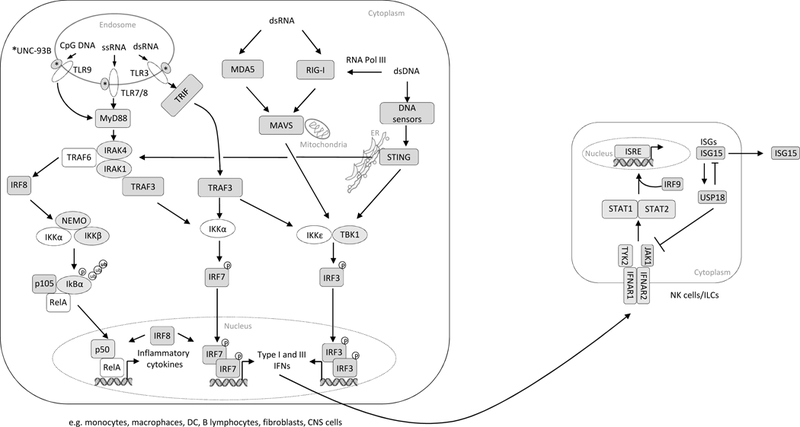
The UNC-93B chaperone protein guides TLR7/8 and TLR9 trafficking from the ER to the endosome, where these receptors recognize viral ssRNA and CpG DNA, respectively. These TLRs recruit MyD88, IRAK4 and IRAK1, which activate TRAF3 and TRAF6. TRAF6, in turn, mediates the activation of NF-κB, leading to the induction of inflammatory cytokine genes, whereas TRAF3 activates IKKα, which catalyzes the phosphorylation of IRF7 and induces type I IFN genes (the classic MyD88-dependent pathway). After recognizing the viral dsRNA, UNC-93B-dependent endosomal TLR3 recruits the adapter molecule TRIF for the activation of TBK1 and IKKε, followed by the activation of IRF3 and upregulation of IFN production (the alternative TRIF-dependent pathway). IRF8 facilitates the activation of NF-κB and IRF7. RLRs, such as MDA5 and RIG-I recruit mitochondrial MAVS adapter molecules after the recognition of cytoplasmic viral dsRNA. Various cytoplasmic dsDNA sensors signal via the ER-located adapter molecule STING. The activation of these RNA and DNA signaling pathways results in the production of inflammatory cytokines via NF-κB activation, and IFN production via TBK1-IKKε-IRF activation. Secreted type I IFNs interact with their surfaceexpressed receptor IFNAR1/2, leading to the recruitment and activation of TYK2 and JAK1, which in turn phosphorylate and activate STAT1 and STAT2. STAT1/STAT2/IRF9 form complexes that interact with ISRE promoters for the induction of ISGs expression. Intracellular ISG15 is type I IFN-inducible and is involved in the USP18-dependent regulation 47 of type I IFN and the prevention of type I IFN-dependent auto-inflammation. For all proteins 48 shadowed in grey mutations have been described.