



Abstract
Advances in our understanding of the metabolism and molecular functions of polyamines and their alterations in cancer have led to resurgence in the interest of targeting polyamine metabolism as an anticancer strategy. Increasing knowledge of the interplay between polyamine metabolism and other cancer-driving pathways, including the PTEN–PI3K–mTOR complex 1 (mTORC1), WNT signalling and RAS pathways, suggests potential combination therapies that will have considerable clinical promise. Additionally , an expanding number of promising clinical trials with agents targeting polyamines for both therapy and prevention are ongoing. New insights into molecular mechanisms linking dysregulated polyamine catabolism and carcinogenesis suggest additional strategies that can be used for cancer prevention in at-risk individuals. In addition, polyamine blocking therapy, a strategy that combines the inhibition of polyamine biosynthesis with the simultaneous blockade of polyamine transport, can be more effective than therapies based on polyamine depletion alone and may involve an antitumour immune response. These findings open up new avenues of research into exploiting aberrant polyamine metabolism for anticancer therapy.
The polyamines putrescine, spermidine and spermine are polycationic alkylamines and are present in mammalian cells in millimolar concentrations1 (Fig. 1). Importantly, these low-molecular-mass, highly charged molecules are involved in many fundamental processes of cell growth and survival including maintenance of protein and nucleic acid synthesis, stabilization of chromatin structure, differentiation, apoptosis, protection from oxidative damage and nucleic acid depurination and regulation of multiple ion channels necessary for cell-to-cell communication1–4. Polyamines are essential for normal cell growth, and their depletion results in cytostasis. In cancer, polyamine metabolism is frequently dysregulated, overall indicating that elevated polyamine levels are necessary for transformation and tumour progression5. New technologies have recently provided increased knowledge of the genetics and underlying molecular biology of the function of polyamines in both normal and neoplastic cells. The recognition that several oncogenic pathways lead to dysregulation of polyamine requirements and metabolism in the early stages of neoplastic transformation and tumour progression has provided greater insight into the essential roles that polyamines play in cancer and has suggested rational targets for intervention. New strategies for exploiting the differences between normal and neoplastic cell requirements for polyamines are being explored for both therapy for and prevention of several types of cancer.
Fig. 1. The polyamine metabolic pathway and ATP and methionine salvage pathways.

a | Arginase 1 (ARG1) produces ornithine from the amino acid arginine as part of the urea cycle. Ornithine decarboxylase (ODC) is a rate-limiting step in polyamine biosynthesis and produces the diamine 1,4-diaminobutane (putrescine). Decarboxylated S-adenosylmethionine (dcAdoMet) is the aminopropyl donor for spermidine synthase (SPDSY) and spermine synthase (SPMSY) for the synthesis of spermidine and spermine, respectively. Spermidine/spermine N1-acetyltransferase 1 (SSAT) catalyses the transfer of the acetyl group of acetyl-CoA to either spermidine or spermine, which can then either be excreted from the cell or serve as substrates for polyamine oxidase (PAOX). PAOX is a peroxisomal enzyme capable of catalyzing N1-acetylated polyamines. 3-Acetylaminopropanal (3-AAP) is a product of oxidation of the acetylated polyamines by PAOX. Spermine oxidase (SMOX) is a cytosolic and nuclear amine oxidase that directly oxidizes spermine to produce spermidine. 3-Aminopropanal (3-AP) is a product of the oxidation of spermine by SMOX. b | S-adenosylmethionine decarboxylase (AdoMetDC) is the second rate-limiting enzyme in polyamine biosynthesis and produces the aminopropyl donor dcAdoMet. Once decarboxylated, dcAdoMet cannot be used in methyl-transfer reactions. 5′-Methylthioadenosine (MTA) is the product resulting from the loss of the aminopropyl group of dcAdoMet in spermidine and spermine synthesis. 5′-methylthioadenosine phosphorylase (MTAP) converts MTA into adenine and 5-methylthioribose-1-phosphate. Adenine is converted to AMP by adenine phosphoribosyltransferase (APRT) using phosphoribosyl pyrophosphate (PRPP) as a phosphoribosyl donor and is converted to ATP by successive phosphorylation reactions using inorganic phosphate (Pi) as the donor. Methionine is salvaged from 5-methylthioribose-1-phosphate through a series of enzymatic steps, resulting in a substrate that can be combined with ATP to form S-adenosylmethionine (AdoMet) by the action of methionine adenosyltransferase 2 (MAT2). Ado, adenosine.
An example of the need for spermidine in mammalian cells is its role as a precursor of hypusine, a post-translational addition to eukaryotic initiation factor 5A isoform 1 (eIF5A) that is necessary to prevent ribosomal stalling in the translation of mRNAs encoding polyproline tracts and certain other amino acid combinations6–8. The MYC oncogene plays a role in hypusine formation by driving the transcription of the gene encoding ornithine decarboxylase (ODC) and indirectly increasing the availability of spermidine for hypusine synthesis. This role of MYC is likely critical to both normal and neoplastic cells. MYC and other oncogenes have also been implicated in the expression of eIF5A in cancers9 (Fig. 2). Ribosome-bound, hypusinated eIF5A interacts with the peptidyltransferase centre of the ribosome, stabilizing and orienting the CCA end of the peptidyl tRNA to allow synthesis through the regions prone to stalling10. Proteins regulating key functions in growth and development, including actin- associated and/or cytoskeletal-associated functions, RNA splicing and/or turnover, DNA binding and/or transcription and cell signalling, contain such regions and require hypusine for their efficient synthesis11. eIF5A may have additional critical functions that influence neoplastic growth and require its hypusination, including the enhancement of nonsense-mediated mRNA decay12,13.
Fig. 2. Hypusination of eukaryotic initiation factor 5A isoform 1 plays critical roles in both normal and neoplastic cell proliferation.

Ornithine decarboxylase (ODC) is a transcriptional target of the MYC oncogene in both normal and neoplastic cells. MYC-driven tumours rely on increased biomass creation (specifically proteins) to support proliferation, and MYC targets include ribosome components, tRNAs and initiation and elongation factors, including eukaryotic initiation factor 5A isoform 1 (eIF5A). Thus, the simultaneous increase in spermidine available for eIF5A modification enables translation. Several oncogenes, including those of the RAS family and BCR–ABL, have been implicated in leading to increased expression of eIF5A in multiple cancers. With increased ODC, polyamines, including spermidine, the substrate for deoxyhypusine synthase (DHS), are increased. Deoxyhypusine hydroxylase (DOHH) then forms the active hypusinated form of eIF5A. Hypusinated eIF5A facilitates the translation of polyproline tracks and prevents ribosome stalling on specific mRNAs in addition to promoting the translation necessary for cell growth in both normal and tumour tissue. This absolute requirement of spermidine in hypusination of eIF5A may represent its essential requirement for cell proliferation. Furthermore, oncogene-driven upregulation of hypusinated eIF5A could potentially lead to a skewing of protein translation towards a hypusine-dependent translatome153. eIF5A has also recently been implicated in enhancing nonsense-mediated mRNA decay9,12,13. The polyamine putrescine may also contribute to protein synthesis via its effects on mTOR complex 1 (mTORC1) and the eukaryotic translation initiation factor 4E (eIF4FE) cap-binding translation initiation complex153. Figure adapted with permission from REF.154, Wiley.
In this Review, we cover recent advances linking polyamine metabolism and cancer to the development and testing of new strategies to exploit polyamine metabolism for therapeutic advantage in the treatment and prevention of cancer. Because polyamine metabolism is downstream from several important oncogenic pathways, and because the polyamine pathway is frequently dysregulated in cancer, this pathway is a promising target for anticancer therapies.
Polyamine metabolism and transport
Polyamine structure, biosynthesis and degradation.
The intracellular demand for polyamines is maintained within a narrow range through the combination of a highly regulated metabolic pathway and import and export systems. Putrescine, the first mammalian polyamine, is formed by the action of ODC and is converted into higher polyamines by the addition of aminopropyl groups in reactions catalysed by spermidine synthase (SPDSY, encoded by SRM) and spermine synthase (SPMSY, encoded by SMS)14. The aminopropyl donor for these reactions is decarboxylated S-adenosylmethionine (dcAdoMet), produced by S-adenosylmethionine decarboxylase (AdoMetDC; which is encoded by AMD1). To maintain free concentrations and the relative amounts of spermidine and spermine, the activities of ODC and AdoMetDC are highly regulated at multiple levels, including transcription, translation and degradation15,16.
ODC protein levels respond rapidly to many stimuli including hormones, growth factors, oncogenes and the free polyamine content15. Regulation occurs during transcription of the gene encoding ODC (ODC1) and translation of its mRNA, which can be altered in both cap-dependent or internal ribosome entry site mechanisms. ODC protein turns over very rapidly in a unique process that involves antizyme 1 (AZ) (FIG. 3). Encoded by the OAZ1 gene, AZ binds to ODC monomers, blocking dimerization-dependent ODC activity and targeting the ODC monomer towards proteasomal degradation. AZ is induced by polyamines in a mechanism that involves frameshifting to allow translation of the OAZ1 mRNA17,18. AZ itself and thus polyamine synthesis are also affected by a protein termed antizyme inhibitor (AZI), which is encoded by the AZIN1 gene. This protein (structurally similar to ODC but without enzymatic activity) binds AZ more tightly than ODC and thus releases ODC from the AZ–ODC complex. Thus, AZI has been implicated in supporting cell growth through maintaining polyamine concentrations by blocking the ability of AZ to inhibit ODC and chaperone it to the 26S proteasome. It should be noted that there are three members of the antizyme family: AZ1, described here, AZ2 and AZ3. AZ2 is present in much lower cellular concentrations than AZ1, and AZ3 is expressed solely in the testis. Additionally, only AZ1 appears to be capable of improving ODC degradation19. In this Review, we refer to AZ1 as AZ in general.
Fig. 3. Regulation of ornithine decarboxylase by antizyme 1.
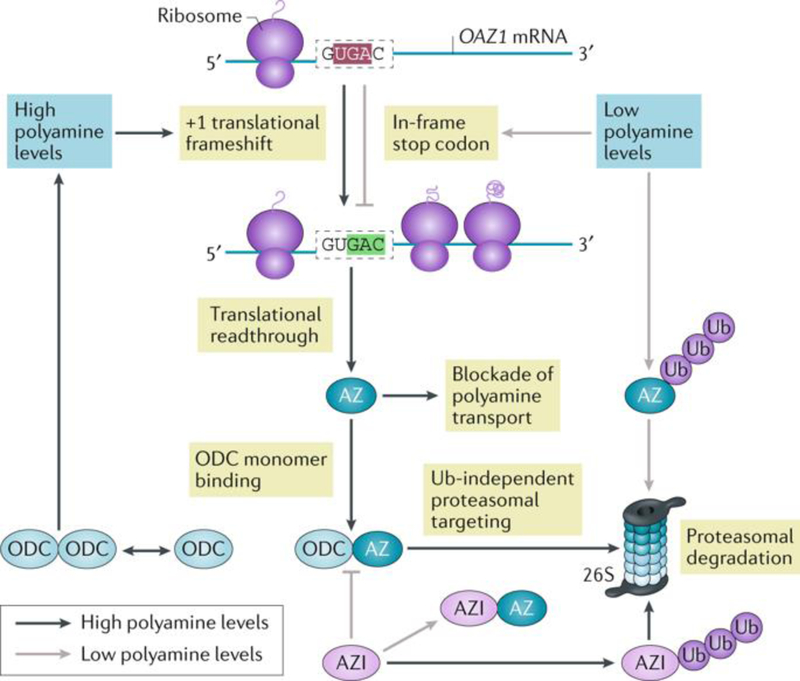
Ornithine decarboxylase (ODC) is active as a homodimer, but ODC monomers have higher affinity for ODC antizyme 1 (AZ). When intracellular polyamine concentrations are high, a+1 frameshift occurs (marked in green), leading to translational readthrough. OAZ1 mRNA is translated into full-length AZ that can then bind to ODC monomers, preventing ODC activity and chaperoning the ODC monomers to the 26S proteasome for degradation in an ubiquitin (Ub)-independent manner. AZ also inhibits polyamine transport through an unknown mechanism. When intracellular polyamine concentrations are low, full-length AZ is not translated owing to an upstream, in-frame stop codon (marked in red) in its mRNA and thus does not inhibit ODC or block polyamine transport. AZ binding to ODC can be blocked by the inactive ODC homologue, antizyme inhibitor (AZI). Both AZ and AZI, unlike ODC, are polyubiquitylated and degraded by the 26S proteasome. Tendencies when intracellular polyamine concentrations are high are indicated as black arrows, and tendencies when intracellular polyamine concentrations are low are indicated as grey arrows.Figure adapted with permission from REF.17, Portland Press.
The supply of dcAdoMet produced by AdoMetDC is regulated via a variety of mechanisms and limits production of the higher polyamines. This regulation includes endocrine effects on transcription, direct activation of the enzyme and increased processing of the initial proenzyme translation product by putrescine, inhibition of mRNA translation by spermidine and spermine (mediated by a 5′ untranslated region sequence encoding the MAGDIS peptide) and increased ubiquitylation and protein degradation when polyamines are elevated16,20.
The aminopropyltransferase reactions that form spermidine and spermine are effectively irreversible, but interconversion of the polyamines can occur via the action of spermine oxidase (SMOX) and polyamine oxidase (PAOX)21. The latter enzyme requires the action of spermidine/spermine N1-acetyltransferase 1 (SSAT; which is encoded by SAT1). SSAT is normally present at very low levels but is readily induced by increased free polyamine concentrations22. SSAT forms N1-acetylspermine and N1-acetylspermidine, which may be excreted from the cell or converted to 3-acetylaminopropanal, H2O2 and spermidine or putrescine, depending on the starting polyamine, by PAOX. In some circumstances, SSAT can also form N1,N12-diacetylspermine. SMOX directly oxidizes spermine to form 3-aminopropanal, H2O2 and spermidine. These catabolic pathways prevent excess polyamine content. However, both oxidases have the potential to generate substantial amounts of reactive oxygen species (ROS), resulting in oxidative damage21,23. Cytoplasmic and nuclear-localized SMOX may be more active in this respect, as PAOX is peroxisomal. The SMOX product 3-aminopropanal (3-AP) can also readily form acrolein and has been linked to ischaemia–reperfusion injury24.
Interaction with methionine metabolism
In tissues other than liver, polyamine synthesis utilizes a substantial fraction of cellular S-adenosylmethionine (AdoMet). Every aminopropylation reaction producing spermidine from putrescine or spermine from spermidine utilizes one molecule of AdoMet and generates 5-methylthioadenosine (MTA). MTA is a potent product inhibitor of polyamine biosynthesis, particularly of spermine synthase, but this inhibition is prevented by rapid metabolism of MTA and/or its excretion from the cell. MTA is recycled by a pathway initiated by 5′-methylthioadenosine phosphorylase (MTAP) (MTAP is frequently deleted in cancers) that forms adenine and 5′-methylthioribose-1-phosphate25,26 (FIG. 1b). These are converted into ATP and methionine through the respective salvage pathways, which is important in maintaining ATP and methionine pools.
Polyamine transport.
Fully protonated at physiological pH, polyamines do not passively diffuse through cell membranes. In mammalian cells, the polyamine transport system has been characterized as energy-dependent and saturable. However, the actual number of transport systems and all the molecular players involved in them are not currently known27. One proposed model relies on an unidentified membrane permease for the polyamines to enter the cell. Once inside, the polyamines are processed through a series of endosomes28. In a second model, polyamines bound to heparin sulfate moieties in glypican 1 at the cell surface are internalized by endocytosis29. A third model proposes caveolar endocytosis in gastrointestinal cells30. It is important to note that ODC antizymes also play a major role in regulating polyamine transport through a currently unknown mechanism31.
Although there is evidence that both polyamines and polyamine analogues can be taken up into tumour cells and that such uptake may antagonize the effects of drugs blocking polyamine synthesis, it is not clear to what extent dietary polyamines contribute to maintaining polyamine levels in tissues in the absence of polyamine synthesis inhibitors.
Polyamines and cancer
Polyamine metabolism, oncogenes and tumour suppressors.
The direct interplay between oncogenes and polyamine metabolism was first apparent with the demonstration that ODC was a transcriptional target of the MYC oncogene32. Growth stimuli leading to increased MYC expression result in increased ODC1 mRNA and increased ODC protein and activity, thus providing cells stimulated to divide the increase in polyamines necessary for proliferation. Thus, the MYC signalling pathway is seen as one of the major drivers in dysregulated polyamine metabolism-associated cancers. As members of the MYC family are frequently amplified or overexpressed in cancer, the regulation of polyamine biosynthesis by MYC family genes plays a substantial role in multiple cancer types including leukaemias and lung, neural and breast cancers33–37. Furthermore, the link between MYC, hypusine formation and eIF5A activation likely plays a role in neoplastic transformation9 (FIG. 2). More recently, other oncogenes have been associated with polyamine metabolism and requirement in multiple cancers.
The RAS–RAF–MEK–ERK signalling pathway has been shown to control polyamine metabolism in multiple aspects. RAS activation has been associated with increased polyamine transport by colon tumour cells38. Additionally, KRAS has been implicated in the downregulation of SSAT through interference with peroxisome proliferator-activated receptor-γ (PPARγ) transcriptional activation of SAT1, thus allowing transformed cells to maintain elevated levels of polyamines39. Another member of the RAS–RAF–MEK–ERK signalling pathway, which is frequently mutated in cancer, is the BRAF oncogene that is estimated to be mutated in half of melanoma tumours40. Although BRAF-mutant tumours initially respond to BRAF inhibitors, resistance to these inhibitors develops rapidly41. Interestingly, BRAF-mutant melanoma cells possess greater polyamine transport activity than their normal BRAF counterparts42. Furthermore, in vitro studies demonstrated that, when exposed to naphthalene conjugates that could enter the cell via only the polyamine transport system, there was selective killing of BRAF-mutant melanoma cells, whereas wild-type melanoma cells were resistant, indicating that BRAF-mutant melanoma cells can be more susceptible to certain drugs owing to the increase in polyamine transport activity. Additionally, treatment with a polyamine analogue may reduce the incidence of developed resistance to BRAF inhibitors42.
Furthermore, polyamine metabolism is regulated by AKT signalling in hypoxia-driven neovascularization43. It has also been demonstrated, in a series of human hepatocellular carcinomas and colon carcinoma cell models, that polyamine depletion through the overexpression of SSAT is a result of decreased AKT signalling and reduced nuclear β-catenin leading to decreased cell growth, migration and invasion44.
The PTEN–PI3K–mTOR complex 1 (mTORC1) pathway has been shown to be linked with polyamine metabolism in prostate cancer through the upregulation of AMD1 (REFS45–47). Using an integrative metabolomics approach in both mouse and human prostate tumours, mTORC1 was shown to be required for increased AdoMetDC activity and dcAdoMet levels. Inhibition of mTOR resulted in decreased AdoMetDC activity and decreased intracellular polyamine levels. The mechanism by which mTORC1 leads to increased AMD1 expression appears to involve stabilization of the AdoMetDC proenzyme through phosphorylation of residue S298 (FIG. 4). However, direct phosphorylation of AdoMetDC through the kinase activity of mTORC1 was not demonstrated, suggesting that mTORC1 is not directly responsible for this phosphorylation.
Fig. 4. mTOR complex 1 controls polyamine metabolism.

mTOR complex 1 (mTORC1) stabilizes pro-S-adenosylmethionine (AdoMet) decarboxylase (pro-AdoMetDC), leading to increased AdoMetDC and increased polyamine biosynthesis in prostate cancer. PTEN is a tumour suppressor that is frequently mutated or lost in prostate cancer. The loss of PTEN function results in aberrant response to growth factor (GF) stimuli through the PI3K signalling pathway, thus activating mTORC1. Mechanistically, activated mTORC1 indirectly blocks the proteasomal degradation of pro-AdoMetDC and leads to phosphorylation of the proenzyme at S298 (indicated by dotted arrow), thus stabilizing it further. The proenzyme then self-processes to the pyruvate-containing and active holoenzyme, thus facilitating the increased polyamine production necessary for neoplastic growth. dcAdoMet, decarboxylated S-adenosylmethionine; MLST8, mammalian lethal with SEC13 protein 8; RAPTOR, regulatory-associated protein of mTOR.Figure adapted from REF.46, Springer Nature Limited.
Like the oncogene MYC, the so-called early immediate genes JUN and FOS can also be involved in the stimulation of polyamine biosynthesis, thus promoting tumour growth. Methionine adenosyltransferase (MAT) is responsible for the transfer of methionine to ATP, forming AdoMet. MAT2 (also known as AdoMet synthase 2), the MAT isozyme that is expressed in all extrahepatic tissues, is a transcriptional target of activator protein 1 (AP-1) (FOS–JUN heterodimers). In colon cancers, ODC, MAT2, FOS and JUN are all expressed at higher levels in tumour tissue than in adjacent normal mucosa48. This results in increased ODC and polyamine production, thus providing tumour cells with the necessary increase in polyamines needed for continued proliferation.
A non-canonical Hedgehog signalling pathway has recently been implicated in the upregulation of polyamine biosynthesis in the precursor lesion to medulloblastoma49. ODC protein levels and polyamine biosynthesis are increased downstream from Hedgehog signalling by activated 5′-AMP-activated protein kinase (AMPK). AMPK phosphorylates the translational regulator cellular nucleic acid-binding protein (CNBP), resulting in CNBP stabilization and increased translation of ODC. When either the Hedgehog pathway or the polyamine pathway was inhibited, the growth of primary medulloblastoma cells in a mouse xenograft model was significantly impaired.
The WNT signalling pathway has been linked to prostate cancer, and activation of the canonical pathway is associated with advanced and metastatic cancers. Although activation of the non-canonical WNT5A pathway has been observed in both good and poor prognoses, WNT5A activation has also been shown to induce the epithelial-to-mesenchymal transition (EMT) observed in prostate cancer. Using a combination of transcriptomics, metabolomics and histopathology, with extensive follow-up, a non-canonical WNT gene expression signature was identified, termed the non-canonical WNT pathway (NCWP)-EMT signature, that was associated with higher Gleason score and more aggressive disease and was of predictive value for biochemical recurrence50. Although there were no apparent direct links between the NCWP-EMT gene signature and members of the polyamine metabolic pathway, decreased citrate and spermine levels were the most prominent metabolic alterations in the most aggressive phenotypes. Therefore, combining the NCWP-EMT signature with changes in the citrate and spermine levels may provide an avenue for better risk stratification and subtyping in patients with prostate cancer.
Although there have been several reports on the interplay between polyamine metabolism and oncogenes, little has been published on the interplay between polyamine metabolism and tumour suppressor genes. Recently, a direct link between the antitumour effects of the tumour suppressor p53 and SSAT has been suggested, indicating that p53-induced expression of SAT1 induces lipid peroxidation and ferroptosis in response to ROS-induced cell stress51,52. Thus, the tumour-suppressive function of p53 seems to be in part mediated by direct transcriptional activation of SSAT and SSAT-dependent lipid peroxidation. Importantly, although mouse embryonic fibroblasts (MEFs) derived from p53 acetylation-mutant (Trp533KR) mice are deficient in cell cycle arrest, apoptosis and senescence, these cells still maintain their ability to suppress spontaneous tumour formation, and the mutant p53 still induces SAT1 transcription as well as the wild-type p53; additionally, these cells undergo ferroptotic cell death. To demonstrate the linkage between p53 expression, SSAT and ferroptosis, MEFs from wild-type p53, p53 acetylation mutants and p53-null mice were used. Only the wild-type and acetylation mutants responded to Nutlin by inducing SSAT and ferroptosis (Nutlin binds the p53 regulatory protein E3 ubiquitin-protein ligase MDM2, thus freeing p53 to activate its target genes). The induction of ferroptosis was partially blocked by small interfering RNA targeting SSAT, indicating that the p53 induction of SSAT expression is necessary for the p53-induced ferroptosis. Unfortunately, no data were presented to confirm that actual changes in polyamine levels or their metabolites occur under any of the experimental conditions51.
Polyamines as biomarkers in cancer.
The use of polyamines and their metabolites as biomarkers of cancer is not new53. Past studies were hindered by relatively low sensitivity of the methodologies used and the lack of overall metabolic data. However, recently developed metabolomic techniques providing more sensitive measurements and more detailed and extensive metabolic profiles of various cancers suggest new promise for using polyamines as biomarkers in cancer and for predicting treatment response. Studies using a metabolomics approach in human epidermal growth factor receptor 2 (HER2; also known as ERBB2)-positive breast cancers show that good responders to trastuzumab–paclitaxel neoadjuvant therapy had higher serum spermidine and lower tryptophan levels than poor responders54. Similarly, polyamines and their metabolites in urine and plasma can be useful both in diagnosis and as markers of tumour progression in lung and liver cancers55,56. Urinary N1,N12-diacetylspermine has been implicated as an effective biomarker for lung and ovarian cancer57–59. N1,N12-diacetylspermine has also been observed in high concentrations in biofilm-associated, right-side colon cancers60,61. Finally, polyamines and polyamine metabolites measured in either urine or serum have shown potential as biomarkers for prostate, colon and pancreatic cancers62–66. Such analyses, combined with increasingly precise genomic signatures, may aid in the development of more personalized approaches to cancer diagnosis and treatment based on using polyamines as biomarkers.
Targeting of polyamine metabolism
Polyamines are required for proliferation. Therefore, many cancers, especially oncogene-driven cancers, might be sensitive to interference with polyamine metabolism. Thus, the loss of growth control in cancer cells predisposes transformed cells to be more sensitive to polyamine depletion than normal cells. The polyamine metabolic pathway is therefore a rational target for therapeutic intervention, and inhibitors of essentially all the polyamine metabolic enzymes have been identified. There are also candidate drugs that target the polyamine transport systems, the regulation of polyamine content and the production of oxidative damage associated with polyamine catabolism. Several of these strategies have been effective in cancer prevention and treatment in animal models, and some have progressed to clinical trials (TABLE 1). The effectiveness of these trials has to be fully evaluated, but the basic hypothesis that these are useful targets for cancer chemotherapy and chemoprevention continues to provide promising avenues to explore.
Table 1 |.
Drugs and compounds targeting polyamine metabolism, function and transport
 |
Inhibitors of S-adenosylmethionine decarboxylase and aminopropyltransferases.
Methylglyoxal bis(guanylhydrazone) (MGBG) was used as an anticancer drug in the 1960s, but its efficacy was limited by severe toxicity. MGBG was later found to be a tight-binding inhibitor of AdoMetDC16, suggesting AdoMetDC as a promising drug target. This work led to the synthesis of numerous inhibitors of AdoMetDC, including 4-amidinoindan-1-one 2′-amidinohydrazone (SAM486A)67. However, although these compounds had antitumour activity, issues of severe toxicity remained. The antitumour activity and/or toxicity of these analogues was due to not only interference with polyamine metabolism but also antimitochondrial actions and other off-target effects. More specific and potent inhibitors, such as 5′-(((Z)-4-amino-2-butenyl)methylamino)-5′-deoxyadenosine (AbeAdo) and its 8-methyl derivative (Genz-644131), inactivate AdoMetDC by an irreversible reaction at the active site5,16. These inhibitors specifically interfere with polyamine synthesis but have yet to be established as valuable antitumour agents.
Aminopropyltransferase inhibitors have been shown to reduce polyamine content when used in vitro14. However, the changes produced are somewhat modest, presumably owing to the limited potency of the compounds, the slow turnover of polyamines and the autoregulation of the polyamine pathway, resulting in increases in the biosynthetic decarboxylases and changes in the interconversion pathway.
Strategies involving methionine adenosyltransferase metabolism.
Absence of MTAP occurs at high frequency in many tumours either owing to aberrant methylation suppressing gene expression or to gene deletion. The MTAP gene is adjacent to the CDKN2A tumour suppressor locus and may be co-deleted. However, the absence of MTAP expression in many tumours may not be exclusively owing to this linkage. Global homozygous MTAP deletion leads to embryonic lethality in mice, but heterozygotes with reduced MTAP content develop lymphomas, suggesting that MTAP itself is a tumour suppressor68. Downregulation of MTAP increased the invasion and migration of oesophageal squamous carcinoma cells via effects on the glycogen synthase kinase-3β (GSK3β)–neural crest transcription factor SLUG (also known as SNAI2)–epithelial cadherin (E-cadherin; also known as CDH1) system, specifically downregulating GSK3β and E-cadherin while upregulating SLUG expression69,70.
Many tumours depend on exogenous methionine for growth, which may be partly a result of MTAP loss and lack of efficient methionine salvage in these tumours71. MTAP converts MTA into 5-methylthioribose 1-phosphate and adenine. While 5-methylthioribose 1-phosphate is converted in methionine through its respective salvage pathway, adenine is converted into AMP by adenine phosphoribosyltransferase (APRT) in a reaction using phosphoribosyl pyrophosphate (PRPP) (FIG. 1b), enabling ATP salvage. APRT also acts on purine analogues, leading to the formation of toxic nucleotides. This lethal synthesis is greatly reduced in normal cells because the available PRPP is depleted as a result of MTAP activity producing high levels of adenine26. In transformed cells lacking MTAP, however, PRPP is used less for AMP synthesis and available for other reactions, resulting in a much-improved therapeutic window. Strategies to exploit this MTAP deficiency are an active area of investigation26,72, including the administration of MTA followed by a toxic purine or pyrimidine analogue in tumours lacking MTAP. This approach has been suggested for a variety of purine and pyrimidine analogues that require conversion to nucleoside monophosphates by combination with PRPP, but on the basis of recent studies using human tumour mouse xenograft models, 2-fluoroadenine appears to be most promising72. This effect could be due to direct competition by adenine at the active site of APRT. Another suggested approach, which has not yet been exploited clinically, uses the finding that MTA inhibits protein arginine N-methyltransferase 5 (PRMT5), and further depletion of this enzyme causes cell death73,74.
The importance of MTAP in maintaining methionine and ATP pools in cells actively synthesizing polyamines has led to suggestions that MTAP inhibitors would be useful in treating tumours that express MTAP. For example, prostate cancers frequently retain the MTAP locus. The methionine salvage pathway initiated by MTAP is critical to maintaining metabolite pools in prostate cancer owing to the high level of flux through the polyamine metabolic pathway. Therefore, the use of drugs targeting MTAP may have potential for treating prostate cancer75 and other cancers that express MTAP. Numerous purine derivatives that inhibit MTAP have been synthesized, the most potent of which are transition-state analogues that contain a cationic nitrogen and a protonated 9-deazaadenine leaving group, such as methylthio-DADMe-immucillin-A (MTDIA)76. Mouse tumour xenografts of human lung carcinomas and head and neck cancers that express MTAP were effectively treated with MTDIA, as measured by significant inhibition of tumour growth and a reduction in metastases77. This treatment led to the expected increase in MTA levels and a widespread decrease in CpG island DNA methylation. Clinical trials have not yet been reported with MTA inhibitors, and their potential toxicity towards normal cells is a concern that will have to be addressed.
Inhibition of ornithine decarboxylase: use of difluoromethylornithine.
Numerous potent and highly specific inhibitors of ODC have been described, but by far the most widely used is difluoromethylornithine (DFMO) (polyamine-targeted drug structures are shown in TABLE 1)78–80. DFMO is a potent and highly specific enzyme-activated, irreversible inhibitor of ODC activity. In vitro, DFMO treatment typically leads to depletion of both putrescine and spermidine, with little effect on spermine levels, accompanied by growth inhibition. Addition of spermidine concurrent with DFMO treatment restores growth without restoring levels of putrescine, suggesting that it is spermidine that is required for cell proliferation1. The effectiveness of DFMO in vivo is somewhat limited by its poor pharmacokinetics owing to rapid excretion and the very short half-life of ODC protein15. Despite this, it has demonstrated significant therapeutic effects.
Many experimental in vivo studies suggest that ODC is a valid target for treatment and/or prevention of cancer. Clinical work with DFMO has supported this concept, although it has still to reach general acceptance for cancer therapy. Notable encouraging results include positive effects on anaplastic gliomas81, ongoing clinical trials on neuroblastoma82,83 and prevention of colorectal cancer84,85. In spite of a recent review that erroneously indicated that clinical trials of DFMO have been abandoned because of its toxicity86, the safety and therapeutic value of DFMO is well established. High doses are used as part of a highly successful therapy for sleeping sickness caused by Trypanosome brucei subsp. gambiense87, and it is clinically approved for treatment of hirsutism88.
The possibility of using DFMO in combination with cytotoxic agents (including MGBG and various alkylating agents) for treatment of brain tumours has been under examination for almost 40 years. A detailed description of the history and results of studies is given in a recent review by Levin and colleagues80. Early trials were hindered by substantial toxicities associated with the cytotoxic drugs, although this toxicity was not increased by DFMO. More recent phase II and phase III studies where DFMO was given both as a single agent and in combination with PCV therapy (procarbazine, lomustine and vincristine) showed statistically significant improvements in survival in patients with anaplastic astrocytomas and gliomas. These trials were both slow to complete and had limited numbers of patients owing to slow accrual. In order to obtain regulatory approval of DFMO for the treatment of anaplastic astrocytomas, a multicentre, six-country, randomized phase III trial is currently in progress comparing DFMO plus lomustine with lomustine alone in patients whose tumours have not responded to radiation therapy or temozolomide chemotherapy81.
Trials of DFMO are also ongoing for the treatment of refractory neuroblastoma. A strong rationale for such trials is provided by work showing that ODC is a downstream target of the protein product of MYCN, which is frequently amplified in neuroblastomas82,89,90, and that elevated ODC and decreased AZ expression correlate with unfavourable responses to standard therapy91. Additionally, there is evidence of ODC1 amplification in some patients with high-risk neuroblastoma who also harbour MYCN amplifications92. Treatment of MYCN-amplified neuroblastoma cells in culture with DFMO causes accumulation of cyclin-dependent kinase inhibitor p27 (also known as CDKN1B) and p27–RB-coupled G1 cell cycle arrest34. Transgenic and xenograft neuroblastoma models responded to combinations of DFMO and SAM486A and to DFMO plus celecoxib (which, among other actions, induces SSAT)69.
Encouraging results in phase I trials of DFMO for relapsed and/or refractory neuroblastoma suggest that this treatment should proceed to more extensive trials82,83. Interestingly, children with a minor T allele at rs2302616 of ODC1 with relapsed or refractory neuroblastoma had higher levels of urinary polyamine markers and responded better than those with the major G allele83. Differences in ODC expression and activity owing to these alleles (which influence ODC transcription) were previously shown to alter cancer risk and response to therapy. Additionally, it has recently been found that elevated levels of both ODC and deoxyhypusine synthase (DHS) are correlated with poor prognosis in neuroblastoma and that the combination of DFMO with GC7, a drug blocking DHS, synergistically induced caspase 3 (CASP3)–CASP7–CASP9-mediated apoptosis in these tumours93. DHS was also recently linked to cancer progression and metastasis through eIF5A-facilitated translation of RHOA and activation of the RHOA signalling pathway in squamous cell carcinoma and pancreatic ductal carcinoma94,95.
Combining difluoromethylornithine with exogenous polyamine depletion: polyamine blocking therapy.
Another promising area for the use of DFMO in therapy is the somewhat recent strategy termed ‘polyamine blocking therapy’ (PBT). A major disadvantage of DFMO as a monotherapy is the compensatory increase in polyamine transport when polyamines are depleted. One strategy to overcome this compensation is to reduce dietary polyamines in combination with DFMO treatment85. However, this strategy has major limitations because polyamines are present in virtually all foods and because the gut flora are a rich source of polyamines96. A second, potentially more promising approach is the combination of nontoxic, polyamine transport inhibitors with DFMO.
To test this approach, potent compounds blocking polyamine transport have been explored97,98. These include AMXT 1501, which synergizes with DFMO in depleting polyamine content and reducing the growth of various tumour models, including neuroblastoma99. Encouraging results from using this combination approach have also been reported in a gemcitabine-resistant orthotopic pancreatic cancer model100.
Potentially the most exciting finding is that PBT promotes the antitumour immune response, resulting in even greater antitumour effects than would be expected from polyamine depletion in tumour cells alone. In immune-competent mouse models of lymphoma, melanoma and colon cancer, treatment with the combination of DFMO plus AMXT 1501 led to a decrease of tumour-infiltrating myeloid suppressor cells and an increase of CD3+ T cells, resulting in inhibition of tumour growth101. Further, in an FVB murine mammary tumour model, PBT protected mice from a secondary tumour challenge after the primary tumour was treated and removed. In a similar study, a different polyamine transport inhibitor (Trimer PTI) in combination with DFMO was used. This resulted in decreased regulatory T cells and reduced tumour-infiltrating myeloid-derived suppressor cells, concurrent with increased granzyme B and interferon-γ (IFNγ) and activated effector T cells102. The net result is a dampened tumour-promoting microenvironment and an increase in an antitumour immune response.
The potential for PBT to enhance the antitumour immune response is consistent with recent studies using a myeloid-specific knockout of ODC103. ODC activity and polyamines favour the tumour-tolerant M2-like phenotype while reducing the antitumour M1-like phenotype. These findings are consistent with earlier work implicating ODC in the regulation of M1 macrophages104. In sum, results shown with PBT and other studies105–107 suggest that intervention in polyamine metabolism will be a fruitful avenue to pursue for developing anticancer therapy, possibly in combination with other immune therapy modalities. However, further investigation will be necessary to fully realize the potential of pursuing such a strategy.
Use of difluoromethylornithine in chemoprevention.
Many animal studies suggest that the polyamine pathway would be a suitable target for prevention of cancer in high-risk populations. Unregulated expression of ODC promotes carcinogenesis in animals treated with carcinogenic stimuli including chemicals and radiation. Conversely, expression of AZ from constructs with mutations that do not require the polyamine-induced frameshifting for synthesis reduces tumour incidence89,108–111. Even the modest reduction of ODC in Odc1+/− mice reduces MYC-driven lymphoma incidence112. A clinical trial of 350 patients prone to colorectal adenoma incidence showed that combined treatment with DFMO and the nonsteroidal anti-inflammatory drug (NSAID) sulindac significantly reduced the incidence of recurrent adenomas113 with few side effects114. Unfortunately, the trials did not include DFMO alone, and sulindac itself has a chemopreventive effect in humans and animal models115. A further trial containing separate treatment arms is currently in progress to determine whether DFMO and/or sulindac can reduce tumours in patients with familial adenomatous polyposis. There are also preliminary indications that DFMO may be useful in chemoprevention of oesophageal cancer in patients with Barrett oesophagus116. However, it has been suggested that the beneficial effects of DFMO are actually indirect and are based on the decreases in AdoMet pools caused by increased AdoMetDC activity117. Such changes were postulated to result in decreased thymidylate pools, and in experiments with colorectal cancer cells in vitro, thymidine supplementation overcame the cytostatic effects of DFMO117. These findings have not yet been confirmed in follow-up studies, and it remains to be demonstrated whether these results are actually seen in patients at the doses of DFMO used in the clinical trials, but they do emphasize the importance of maintaining awareness of the interactions between polyamine and AdoMet metabolism.
Modest attempts have commenced using similar approaches with DFMO for prostate cancer chemoprevention118. As indicated above, the recent findings that increased AdoMetDC occurs frequently in prostate cancers owing to activation of the mTORC1 pathway and that treatment with the mTORC1 inhibitor everolimus leads to a loss of AdoMetDC protein suggest that an AdoMetDC inhibitor would be even more effective. This concept is also supported by studies in a mouse model modulating PTEN expression, in which downregulation of AdoMetDC by short hairpin RNAs reduced tumour growth45,46.
Polyamine catabolism as a target for chemoprevention.
Expression levels of the polyamine catabolic enzymes SSAT and SMOX are frequently upregulated in response to infection and inflammation, which are both conditions that are associated with increased risk of cancer. Increases in SSAT and SMOX subsequent to these stimuli have been demonstrated in lung, prostate, colon, stomach and liver models119–125. Although it is possible that the ROS produced are coming from both SMOX and PAOX (downstream from increased SSAT activity), data indicate that the majority of damaging ROS results from SMOX, suggesting a pathway linking inflammation and infection to carcinogenesis through the production of ROS by polyamine catabolism in general and by SMOX specifically120,126. A prostate tissue microarray study revealed that SMOX expression is elevated in prostate samples from patients with prostate cancer at all stages of disease when compared with that from individuals who did not have prostate cancer. This is true even in normal-appearing prostate tissues from patients with cancer121. In the case of gastric cancer, in vitro, in vivo and patient samples indicate that infection of gastric epithelial cells by Helicobacter pylori induces SMOX activity, resulting in increased ROS production and DNA damage119,127,128 (BOX 1). Importantly, in animal models of both colon and gastric cancers, inhibition of SMOX by the polyamine oxidase inhibitor N1,N4-di(buta-2,3-dien-1-yl)butane-1,4-diamine (MDL 72527) leads to a significant decrease in ROS production, DNA damage and tumour incidence123,127. These data strongly imply that inhibition of SMOX is a rational target for chemoprevention in at-risk patients. To further bolster the argument that SMOX could serve as a safe target for a chemopreventive agent, a whole-animal knockout of SMOX in mice has no deleterious results129. Furthermore, N1-nonyl-1,4-butanediamine (C9–4) and N1-tridecyl-1,4-butanediamine (C13–4) (TABLE 1) are potent inhibitors of the polyamine oxidases, but they have not yet been tested in tumorigenesis models24. Unfortunately, the discovery of selective inhibitors of SMOX has been hindered by the lack of a crystal structure for the enzyme, and none of the currently available SMOX inhibitors is selective for SMOX, as these inhibitors also effectively inhibit PAOX and are potentially toxic when used over an extended period130.
Box 1 |. Polyamine metabolism in cancer-associated inflammation and infection.
Inflammation and/or infection are thought to play a role in the aetiology and progression of >20% of epithelial cancers125,156–159. A prime example is the well-established causal link between Helicobacter pylori infection and gastric cancer160,161. Similarly, bacterial infections of the colon, such as those with enterotoxigenic Bacteroides fragilis (ETBF), have linked inflammation to an increased risk of colon cancer162,163. In each of these cases, inflammation and/or infection are linked to increased polyamine catabolism. The net result is an increase in reactive oxygen species (ROS) and a decrease in spermine and spermidine5. The importance of this loss of polyamines concurrent with an increase in ROS is that both spermidine and spermine act as free radical scavengers and are closely associated with chromatin164. Thus, the potential for cellular and DNA damage is increased165. Notably, it is not only the potential for DNA damage and mutation that is associated with ROS but also the potential for epigenetic changes resulting in the silencing of tumour suppressor genes. This result has been demonstrated in both the ETBF and H. pylori models and is consistent with observations in affected individuals128,166.
H. pylori infection of gastric epithelium induces spermine oxidase (SmoX) leading to H2o2 production and DNA damage, increasing the potential for genetic and epigenetic changes. Mature miR-124, a tumour-suppressive microRNA, is transcribed from three distinct gene loci and targets the 3′ untranslated region of SMOX mrnA. In uninfected gastric epithelium (see the figure, part a), the mir-124 genes (miR-124–1, miR-124–2 and miR-124–3) are transcribed and the mature mir-124 effectively maintains basal SmoX activity levels by regulating translation. In infected gastric epithelium (see the figure, part b), an early event in H. pylori infection is CpG island DNA methylation of the promoters of miR-124 genes, which results in transcriptional silencing of mir-124. It also allows unregulated translation of H. pylori-stimulated SmoX activity, resulting in increased H2O2 production and an increased risk of DNA damage, which can potentially feedforward to additional aberrant epigenetic gene silencing128. 3-AP, 3-aminopropanal; ORF, open reading frame.

Interestingly, polyamine catabolism also appears to play a substantial role in the renal toxicity associated with frequently used chemotherapeutic platinum drugs129. Consequently, effective SMOX inhibitors may also have utility in reducing dose-limiting toxicities of these commonly used agents.
Development and use of polyamine analogues.
Although the direct inhibition of polyamine synthetic enzymes has demonstrated some promise, the results have been less than hoped for in the treatment of advanced cancers. This disconnect likely results from compensatory mechanisms that occur when polyamine biosynthesis is inhibited. As biosynthesis and transport are both regulated by the intracellular concentration of polyamines via AZ, when polyamine concentrations are reduced, transport is increased and compensatory increases in the uninhibited rate-limiting enzymes are increased. To exploit this negative regulation of polyamine content in cancer cells, analogues were developed that resemble natural polyamines sufficiently to mimic this effect and reduce their content while failing to fulfil their tumour-facilitating functions.
The first analogues designed to fulfil these criteria were the bis(ethyl)polyamine analogues131. In addition to downregulating polyamine biosynthesis and inhibiting transport, several of these analogues, including N1,N11-bis(ethyl)norspermine (BENSpm, also known as N1,N11-diethylnorspermine (DENSpm)) and N1,N12-bis(ethyl)spermine (BESpm), also greatly induce the polyamine catabolic enzymes SSAT and SMOX, resulting in rapid polyamine depletion and increases in ROS, leading to tumour-selective cytotoxicity21. BENSpm also elicited enhanced antitumour effects in combination with several common chemotherapeutic agents132,133.
Building on this paradigm, other structural analogues, including unsymmetrically substituted and rotationally restricted compounds, have been synthesized and evaluated134. Like BENSpm, N1,N12-bis(ethyl)-cis-6,7-dehydrospermine (PG-11047) inhibited polyamine biosynthesis, depleted polyamines and induced polyamine catabolism without significant toxicity in preclinical in vitro and in vivo studies of melanoma and lung, prostate and colon cancers, where responses ranged from inhibition of tumour growth to complete eradication of established tumours126,132,135–139. Although both BENSpm and PG-11047 were generally well tolerated in clinical trials, no activity greater than stable disease has been reported140–143. This lack of more encouraging results was possibly due to the suboptimal dosing schedules used in clinical trials, which can only be addressed by future studies.
Discovery of the histone-modifying enzyme lysine-specific histone demethylase 1A (LSD1, also known as KDM1A) and its high homology to both PAOX and SMOX suggested the use of polyamine analogues for epigenetic regulation144. LSD1 demethylates the transcriptionally activating marks monomethyl-lysine 4 and dimethyl-lysine 4 on histone H3 and is frequently dysregulated in cancer, leading to aberrant silencing of tumour suppressor genes145. Because LSD1 acts by the same oxidative mechanism as PAOX and SMOX, it was hypothesized that specific polyamine analogues could inhibit LSD1. Several reports in multiple systems have now demonstrated that specific polyamine analogues are efficient inhibitors of LSD1, leading to reactivation of aberrantly silenced genes and inhibiting tumour cell growth, both in vitro and in vivo146–149.
One highly innovative use of the polyamine analogues is in the construction of self-immolative, prodrug nanoparticles for the delivery of therapeutic nucleic acids and other drug cargos150,151 (FIG. 5). As backbones for nanoparticles, analogue molecules are linked together with reducing agent-sensitive linkers. Following endocytosis and release of the nanoparticles into an intracellular reducing environment, the particles break down, releasing the active antitumour polyamine analogues and the enclosed cargo. Proof-of-principle in vitro and in vivo experiments using nanoparticles constructed of BENSpm with miR-34a (a transcriptional target of p53 and a promoter of apoptosis) molecules as cargo were examined in the human colon carcinoma line HCT116 (REF.151). These experiments successfully demonstrated that the particles released functional miR-34a and the parent polyamine analogue, decreased polyamine biosynthesis and induced polyamine catabolism. Treatment of human colon tumour xenografts in vivo also reduced tumour volumes. Similar in vitro results were observed when PG-11047 was used in nanoparticle construction in the treatment of human non-small-cell lung cancer lines150.
Fig. 5. Polyamine analogue-based nanoparticles with drug cargo as antitumour therapy.

A proposed mechanism by which polyamine analogue-based nanoparticles deliver miR-34a mimic and inhibit tumour cell growth by altering polyamine metabolism and targeting p53-regulated genes is shown. a | Polyamine prodrugs (PaPs) condense microRNA (miRNA) into nanoparticles. b | The nanoparticles enter the cell by endocytosis. Upon endosomal escape, the particles disassemble in the cellular reducing environment, releasing the parent polyamine analogue and miR-34a mimic. Polyamine biosynthesis decreases, and polyamine catabolism increases. Increased polyamine catabolism in combination with the miR-34a mimic (which inhibits BCL2 translation) leads to increased apoptosis by simultaneously depleting polyamines while blocking oncogenic miR-34a targets, including the anti-apoptotic protein BCL-2. BENSpm, N1,N11-bis(ethyl)norspermine; GSH, glutathione (reduced); SMOX, spermine oxidase; SSAT, spermidine/spermine N1-acetyltransferase 1.Figure adapted with permission from REF.151, Elsevier.
Mechanistically, the polyamine analogues have fulfilled their original design goals of mimicking the regulatory roles of the natural polyamines without supporting growth. The surprising finding that many of the analogues also upregulate polyamine catabolism, as one mechanism of their antiproliferative activity, is still a promising avenue for exploration. New formulations and/or treatment schedules may yet allow the therapeutic polyamine analogues to live up to their early promise.
Conclusions and future directions
As our understanding of the pathways affected by polyamines and of the molecular mechanisms in which polyamines are involved has developed, the potential for exploiting the polyamine metabolic pathway as a strategy for cancer therapy and prevention has increased. The discovery of the direct involvement of polyamines in multiple oncogenic and cell signalling pathways offers new points of intervention to be explored. DFMO continues to show promise in chemoprevention and in combination with other agents for specific tumour types. New formulations using polyamine analogues as backbones for prodrug nanoparticles suggest additional ways in which the polyamine metabolic pathway can be targeted in combination with nucleic acids or additional therapeutics as cargo. The recent findings suggesting that PBT enhances the antitumour immune response are particularly exciting, as the field of anticancer immunotherapy has experienced an explosion of encouraging results. Other encouraging findings include the potential of targeting polyamine catabolism as a strategy for chemoprevention and the targeting of the methionine salvage pathway in specific cancers that maintain MTAP. One area in which substantial progress has been made, but in which much more needs to be learned, is understanding the precise molecular mechanisms involved in mammalian polyamine transport. Although considerable data have been published that are consistent with multiple transport mechanisms, large gaps in our knowledge still remain. Finally, even as considerable progress has been made since Leeuwenhoek discovered spermine in 1678 (REF.152), particularly in the past decade, the availability of new investigative tools and methods holds great promise to allow us a better understanding of the molecular mechanisms in which polyamines are involved and how best to target their metabolism and function for therapeutic benefit in the treatment of cancer.
Cytostasis
The process by which cells stop dividing without dying; it is a common response by normal cells to polyamine depletion, which can then recover growth once the polyamine block is removed.
Hypusine
A unique amino acid found in all eukaryotes and some archaea that is the product of a post-translational modification of a specific lysine (K50 in humans) residue of the transcription factor eukaryotic initiation factor 5A isoform 1 (eiF5A), which is produced by the transfer of the aminobutyl moiety of spermidine to the lysine residue.
5′-methylthioadenosine phosphorylase (MTAP).
The enzyme that catalyses the initial step in methionine and adenosine nucleotide salvage from the methylthioadenosine product of both spermidine and spermine synthesis; the gene coding for this protein is frequently lost or silenced in tumours, thus facilitating a unique biochemical difference that may be exploited in many cancers.
Protonated
The state of having accepted a proton; in the case of polyamines at physiological pH, all imine and amine nitrogens are positively charged.
Proenzyme
The inactive precursor of an active enzyme; S-adenosylmethionine decarboxylase (AdoMetDC) is a self-processing proenzyme that undergoes an autocatalytic serinolysis to produce the pyruvoyl group necessary for the activity of the mature AdoMetDC enzyme.
Ferroptosis
An iron-dependent programmed cell death process that is characterized by an accumulation of lipid peroxidases.
Prodrug
A formulation of an inactive compound that once metabolized or altered by the cellular environment produces the active form of the drug.
Acknowledgements
Work in the Casero laboratory is supported by grants from the US National Institutes of Health (CA204345), the Maryland Cigarette Restitution Fund and the Samuel Waxman Cancer Research Foundation.
Footnotes
Competing interests
The authors receive US National Institutes of Health grant support (R.A.C.) and are patent holders (R.A.C. and A.E.P.).T.M.S. declares no competing interests.
Publisher’s note
Springer Nature remains neutral with regard to jurisdictional claims in published maps and institutional affiliations.
References
- 1.Pegg AE & Casero RA Jr. Current status of the polyamine research field. Methods Mol. Biol 720, 3–35 (2011). [DOI] [PMC free article] [PubMed] [Google Scholar]
- 2.Terui Y et al. Polyamines protect nucleic acids against depurination. Int. J. Biochem. Cell Biol 99, 147–153 (2018). [DOI] [PubMed] [Google Scholar]
- 3.Kurata HT, Akrouh A, Li JB, Marton LJ & Nichols CG Scanning the topography of polyamine blocker binding in an inwardly rectifying potassium channel. J. Biol. Chem 288, 6591–6601 (2013). [DOI] [PMC free article] [PubMed] [Google Scholar]
- 4.Rao JN et al. Polyamines regulate intestinal epithelial restitution through TRPC1-mediated Ca(2)+ signaling by differentially modulating STIM1 and STIM2. Am. J. Physiol. Cell Physiol 303, C308–C317 (2012). [DOI] [PMC free article] [PubMed] [Google Scholar]
- 5.Murray-Stewart TR, Woster PM & Casero RA Jr. Targeting polyamine metabolism for cancer therapy and prevention. Biochem. J 473, 2937–2953 (2016). [DOI] [PMC free article] [PubMed] [Google Scholar]
- 6.Mandal A, Mandal S & Park MH Genome-wide analyses and functional classification of proline repeat-rich proteins: potential role of eIF5A in eukaryotic evolution. PLOS ONE 9, e111800 (2014). [DOI] [PMC free article] [PubMed] [Google Scholar]
- 7.Park MH, Nishimura K, Zanelli CF & Valentini SR Functional significance of eIF5A and its hypusine modification in eukaryotes. Amino Acids 38, 491–500 (2010). [DOI] [PMC free article] [PubMed] [Google Scholar]
- 8.Shin BS et al. Amino acid substrates impose polyamine, eIF5A, or hypusine requirement for peptide synthesis. Nucleic Acids Res 45, 8392–8402 (2017). [DOI] [PMC free article] [PubMed] [Google Scholar]
- 9.Nakanishi S & Cleveland JL Targeting the polyamine-hypusine circuit for the prevention and treatment of cancer. Amino Acids 48, 2353–2362 (2016). [DOI] [PMC free article] [PubMed] [Google Scholar]
- 10.Huter P et al. Structural basis for polyproline-mediated ribosome stalling and rescue by the translation elongation factor EF-P. Mol. Cell 68, 515–527 (2017). [DOI] [PubMed] [Google Scholar]
- 11.Pelechano V & Alepuz P eIF5A facilitates translation termination globally and promotes the elongation of many non polyproline-specific tripeptide sequences. Nucleic Acids Res 45, 7326–7338 (2017). [DOI] [PMC free article] [PubMed] [Google Scholar]
- 12.Hoque M et al. Regulation of gene expression by translation factor eIF5A: hypusine-modified eIF5A enhances nonsense-mediated mRNA decay in human cells. Translation 5, e1366294 (2017). [DOI] [PMC free article] [PubMed] [Google Scholar]
- 13.Mathews MB & Hershey JW The translation factor eIF5A and human cancer. Biochim. Biophys. Acta 1849, 836–844 (2015). [DOI] [PMC free article] [PubMed] [Google Scholar]
- 14.Ikeguchi Y, Bewley MC & Pegg AE Aminopropyltransferases: function, structure and genetics. J. Biochem 139, 1–9 (2006). [DOI] [PubMed] [Google Scholar]
- 15.Pegg AE Regulation of ornithine decarboxylase. J. Biol. Chem 281, 14529–14532 (2006). [DOI] [PubMed] [Google Scholar]
- 16.Pegg AE S-adenosylmethionine decarboxylase. Essays Biochem 46, 25–45 (2009). [DOI] [PubMed] [Google Scholar]
- 17.Kahana C Protein degradation, the main hub in the regulation of cellular polyamines. Biochem. J 473, 4551–4558 (2016). [DOI] [PubMed] [Google Scholar]
- 18.Wu HY et al. Structural basis of antizyme-mediated regulation of polyamine homeostasis. Proc. Natl Acad. Sci. USA 112, 11229–11234 (2015). [DOI] [PMC free article] [PubMed] [Google Scholar]
- 19.Kahana C Antizyme and antizyme inhibitor, a regulatory tango. Cell. Mol. Life Sci 66, 2479–2488 (2009). [DOI] [PMC free article] [PubMed] [Google Scholar]
- 20.Yordanova MM et al. AMD1 mRNA employs ribosome stalling as a mechanism for molecular memory formation. Nature 553, 356–360 (2018). [DOI] [PubMed] [Google Scholar]
- 21.Casero RA & Pegg AE Polyamine catabolism and disease. Biochem. J 421, 323–338 (2009). [DOI] [PMC free article] [PubMed] [Google Scholar]
- 22.Pegg AE Spermidine/spermine-N(1)-acetyltransferase: a key metabolic regulator. Am. J. Physiol. Endocrinol. Metab 294, E995–E1010 (2008). [DOI] [PubMed] [Google Scholar]
- 23.Pegg AE Toxicity of polyamines and their metabolic products. Chem. Res. Toxicol 26, 1782–1800 (2013). [DOI] [PubMed] [Google Scholar]
- 24.Masuko T et al. N(1)-Nonyl-1,4-diaminobutane ameliorates brain infarction size in photochemically induced thrombosis model mice. Neurosci. Lett 13, 118–122 (2018). [DOI] [PMC free article] [PubMed] [Google Scholar]
- 25.Albers E Metabolic characteristics and importance of the universal methionine salvage pathway recycling methionine from 5′-methylthioadenosine. IUBMB Life 61, 1132–1142 (2009). [DOI] [PubMed] [Google Scholar]
- 26.Bertino JR, Waud WR, Parker WB & Lubin M Targeting tumors that lack methylthioadenosine phosphorylase (MTAP) activity: current strategies. Cancer Biol. Ther 11, 627–632 (2011). [DOI] [PMC free article] [PubMed] [Google Scholar]
- 27.Poulin R, Casero RA & Soulet D Recent advances in the molecular biology of metazoan polyamine transport. Amino Acids 42, 711–723 (2012). [DOI] [PMC free article] [PubMed] [Google Scholar]
- 28.Soulet D, Gagnon B, Rivest S, Audette M & Poulin R A fluorescent probe of polyamine transport accumulates into intracellular acidic vesicles via a two-step mechanism. J. Biol. Chem 279, 49355–49366 (2004). [DOI] [PubMed] [Google Scholar]
- 29.Belting M et al. Glypican-1 is a vehicle for polyamine uptake in mammalian cells: a pivital role for nitrosothiol-derived nitric oxide. J. Biol. Chem 278, 47181–47189 (2003). [DOI] [PubMed] [Google Scholar]
- 30.Uemura T, Stringer DE, Blohm-Mangone KA & Gerner EW Polyamine transport is mediated by both endocytic and solute carrier transport mechanisms in the gastrointestinal tract. Am. J. Physiol. Gastrointest. Liver Physiol 299, G517–G522 (2010). [DOI] [PMC free article] [PubMed] [Google Scholar]
- 31.Kahana C Regulation of cellular polyamine levels and cellular proliferation by antizyme and antizyme inhibitor. Essays Biochem 46, 47–61 (2009). [DOI] [PubMed] [Google Scholar]
- 32.Bello-Fernandez C, Packham G & Cleveland JL The ornithine decarboxylase gene is a transcriptional target of c-Myc. Proc. Natl Acad. Sci. USA 90, 7804–7808 (1993). [DOI] [PMC free article] [PubMed] [Google Scholar]
- 33.Ozfiliz P et al. Bag-1 promotes cell survival through c-Myc-mediated ODC upregulation that is not preferred under apoptotic stimuli in MCF-7 cells. Cell Biochem. Funct 33, 293–307 (2015). [DOI] [PubMed] [Google Scholar]
- 34.Koomoa DL et al. DFMO/eflornithine inhibits migration and invasion downstream of MYCN and involves p27Kip1 activity in neuroblastoma. Int. J. Oncol 42, 1219–1228 (2013). [DOI] [PMC free article] [PubMed] [Google Scholar]
- 35.Funakoshi-Tago M, Sumi K, Kasahara T & Tago K Critical roles of Myc-ODC axis in the cellular transformation induced by myeloproliferative neoplasm-associated JAK2 V617F mutant. PLOS ONE 8, e52844 (2013). [DOI] [PMC free article] [PubMed] [Google Scholar]
- 36.Hogarty MD et al. ODC1 is a critical determinant of MYCN oncogenesis and a therapeutic target in neuroblastoma. Cancer Res 68, 9735–9745 (2008). [DOI] [PMC free article] [PubMed] [Google Scholar]
- 37.Rimpi S & Nilsson JA Metabolic enzymes regulated by the Myc oncogene are possible targets for chemotherapy or chemoprevention. Biochem. Soc. Trans 35, 305–310 (2007). [DOI] [PubMed] [Google Scholar]
- 38.Roy UK, Rial NS, Kachel KL & Gerner EW Activated K-RAS increases polyamine uptake in human colon cancer cells through modulation of caveolar endocytosis. Mol. Carcinog 47, 538–553 (2008). [DOI] [PMC free article] [PubMed] [Google Scholar]
- 39.Ignatenko NA, Babbar N, Mehta D, Casero RA Jr & Gerner EW Suppression of polyamine catabolism by activated Ki-ras in human colon cancer cells. Mol. Carcinog 39, 91–102 (2004). [DOI] [PubMed] [Google Scholar]
- 40.Davies H et al. Mutations of the BRAF gene in human cancer. Nature 417, 949–954 (2002). [DOI] [PubMed] [Google Scholar]
- 41.Solit DB & Rosen N Resistance to BRAF inhibition in melanomas. N. Engl. J. Med 364, 772–774 (2011). [DOI] [PubMed] [Google Scholar]
- 42.Peters MC, Minton A, Phanstiel Iv O & Gilmour SK A. Novel polyamine-targeted therapy for BRAF mutant melanoma tumors. Med. Sci 6, 10.3390/medsci6010003 (2018). [DOI] [PMC free article] [PubMed] [Google Scholar]
- 43.Kucharzewska P, Welch JE, Svensson KJ & Belting M The polyamines regulate endothelial cell survival during hypoxic stress through PI3K/AKT and MCL-1. Biochem. Biophys. Res. Commun 380, 413–418 (2009). [DOI] [PubMed] [Google Scholar]
- 44.Wang C et al. Spermidine/spermine N1-acetyltransferase regulates cell growth and metastasis via AKT/beta-catenin signaling pathways in hepatocellular and colorectal carcinoma cells. Oncotarget 8, 1092–1109 (2017). [DOI] [PMC free article] [PubMed] [Google Scholar] [Retracted]
- 45.Zabala-Letona A et al. Corrigendum: mTORC1-dependent AMD1 regulation sustains polyamine metabolism in prostate cancer. Nature 554, 554 (2018). [DOI] [PubMed] [Google Scholar]
- 46.Zabala-Letona A et al. mTORC1-dependent AMD1 regulation sustains polyamine metabolism in prostate cancer. Nature 547, 109–113 (2017). [DOI] [PMC free article] [PubMed] [Google Scholar]; This is an important new study describing the dysregulation of AdoMetDC in prostate cancer and suggesting new targets for therapeutic intervention.
- 47.Gomes AP, Schild T & Blenis J Adding polyamine metabolism to the mTORC1 toolkit in cell growth and cancer. Dev. Cell 42, 112–114 (2017). [DOI] [PMC free article] [PubMed] [Google Scholar]
- 48.Tomasi ML et al. Polyamine and methionine adenosyltransferase 2A crosstalk in human colon and liver cancer. Exp. Cell Res 319, 1902–1911 (2013). [DOI] [PMC free article] [PubMed] [Google Scholar]
- 49.D’Amico D et al. Non-canonical hedgehog/AMPK-mediated control of polyamine metabolism supports neuronal and medulloblastoma cell growth. Dev. Cell 35, 21–35 (2015). [DOI] [PMC free article] [PubMed] [Google Scholar]
- 50.Sandsmark E et al. A novel non-canonical Wnt signature for prostate cancer aggressiveness. Oncotarget 8, 9572–9586 (2017). [DOI] [PMC free article] [PubMed] [Google Scholar]
- 51.Ou Y, Wang SJ, Li D, Chu B & Gu W Activation of SAT1 engages polyamine metabolism with p53-mediated ferroptotic responses. Proc. Natl Acad. Sci. USA 113, E6806–E6812 (2016). [DOI] [PMC free article] [PubMed] [Google Scholar]
- 52.Cao JY & Dixon SJ Mechanisms of ferroptosis. Cell. Mol. Life Sci 73, 2195–2209 (2016). [DOI] [PMC free article] [PubMed] [Google Scholar]
- 53.Tormey DC et al. Biological markers in breast carcinoma. I. Incidence of abnormalities of CEA, HCG, three polyamines, and three minor nucleosides. Cancer 35, 1095–1100 (1975). [DOI] [PubMed] [Google Scholar]
- 54.Miolo G et al. Pharmacometabolomics study identifies circulating spermidine and tryptophan as potential biomarkers associated with the complete pathological response to trastuzumab-paclitaxel neoadjuvant therapy in HER-2 positive breast cancer. Oncotarget 7, 39809–39822 (2016). [DOI] [PMC free article] [PubMed] [Google Scholar]
- 55.Liu R et al. Plasma N-acetylputrescine, cadaverine and 1,3-diaminopropane: potential biomarkers of lung cancer used to evaluate the efficacy of anticancer drugs. Oncotarget 8, 88575–88585 (2017). [DOI] [PMC free article] [PubMed] [Google Scholar]
- 56.Xu H et al. Polyamine metabolites profiling for characterization of lung and liver cancer using an LC-tandem MS method with multiple statistical data mining strategies: discovering potential cancer biomarkers in human plasma and urine. Molecules 21, E1040 (2016). [DOI] [PMC free article] [PubMed] [Google Scholar]
- 57.Kato M et al. Prognostic significance of urine N1, N12-diacetylspermine in patients with non-small cell lung cancer. Anticancer Res 34, 3053–3059 (2014). [PubMed] [Google Scholar]
- 58.Takahashi Y et al. Urinary N1, N12-diacetylspermine is a non-invasive marker for the diagnosis and prognosis of non-small-cell lung cancer. Br. J. Cancer 113, 1493–1501 (2015). [DOI] [PMC free article] [PubMed] [Google Scholar]
- 59.Niemi RJ et al. Urinary polyamines as biomarkers for ovarian cancer. Int. J. Gynecol. Cancer 27, 1360–1366 (2017). [DOI] [PubMed] [Google Scholar]
- 60.Dejea CM & Sears CL Do biofilms confer a pro-carcinogenic state? Gut Microbes 7, 54–57 (2016). [DOI] [PMC free article] [PubMed] [Google Scholar]
- 61.Johnson CH et al. Metabolism links bacterial biofilms and colon carcinogenesis. Cell Metab 21, 891–897 (2015). [DOI] [PMC free article] [PubMed] [Google Scholar]
- 62.Nakajima T et al. Urinary polyamine biomarker panels with machine-learning differentiated colorectal cancers, benign disease, and healthy controls. Int. J. Mol. Sci 19, E756 (2018). [DOI] [PMC free article] [PubMed] [Google Scholar]; This paper describes a novel approach to improve the use of polyamine biomarker panels in determining disease states in detection of colon cancers.
- 63.Liu R, Lin X, Li Z, Li Q & Bi K Quantitative metabolomics for investigating the value of polyamines in the early diagnosis and therapy of colorectal cancer. Oncotarget 9, 4583–4592 (2018). [DOI] [PMC free article] [PubMed] [Google Scholar]
- 64.Asai Y et al. Elevated polyamines in saliva of pancreatic cancer. Cancers 10, E43 (2018). [DOI] [PMC free article] [PubMed] [Google Scholar]
- 65.Fitzgerald BL et al. Elucidating the structure of N(1)-acetylisoputreanine: a novel polyamine catabolite in human urine. ACS Omega 2, 3921–3930 (2017). [DOI] [PMC free article] [PubMed] [Google Scholar]
- 66.Giskeodegard GF et al. Spermine and citrate as metabolic biomarkers for assessing prostate cancer aggressiveness. PLOS ONE 8, e62375 (2013). [DOI] [PMC free article] [PubMed] [Google Scholar]
- 67.Millward MJ et al. Multi-centre phase II trial of the polyamine synthesis inhibitor SAM486A (CGP48664) in patients with metastatic melanoma. Invest. New Drugs 23, 253–256 (2005). [DOI] [PubMed] [Google Scholar]
- 68.Kadariya Y et al. Mice heterozygous for germ-line mutations in methylthioadenosine phosphorylase (MTAP) die prematurely of T cell lymphoma. Cancer Res 69, 5961–5969 (2009). [DOI] [PMC free article] [PubMed] [Google Scholar]
- 69.Evageliou NF et al. Polyamine antagonist therapies inhibit neuroblastoma initiation and progression. Clin. Cancer Res 22, 4391–4404 (2016). [DOI] [PubMed] [Google Scholar]; This paper describes the underlying rationale for and the current status of clinical trials of inhibitors of polyamine biosynthesis in the treatment of neuroblastomas.
- 70.Cheng XY et al. Deletion and downregulation of MTAP contribute to the motility of esophageal squamous carcinoma cells. Onco Targets Ther 10, 5855–5862 (2017). [DOI] [PMC free article] [PubMed] [Google Scholar]
- 71.Chaturvedi S, Hoffman RM & Bertino JR Exploiting methionine restriction for cancer treatment. Biochem. Pharmacol 154, 170–173 (2018). [DOI] [PubMed] [Google Scholar]
- 72.Tang B, Lee HO, An SS, Cai KQ & Kruger WD Specific targeting of MTAP-deleted tumors with a combination of 2-fluoroadenine and 5′-methylthioadenosine. Cancer Res 10.1158/0008-5472.CAN-18-0814 (2018). [DOI] [PMC free article] [PubMed] [Google Scholar]
- 73.Marjon K et al. MTAP deletions in cancer create vulnerability to targeting of the MAT2A/PRMT5/RIOK1 axis. Cell Rep 15, 574–587 (2016). [DOI] [PubMed] [Google Scholar]; This paper provides a description of the novel targeting of methylthioadenosine metabolism.
- 74.Mavrakis KJ et al. Disordered methionine metabolism in MTAP/CDKN2A-deleted cancers leads to dependence on PRMT5. Science 351, 1208–1213 (2016). [DOI] [PubMed] [Google Scholar]
- 75.Bistulfi G et al. The essential role of methylthioadenosine phosphorylase in prostate cancer. Oncotarget 7, 14380–14393 (2016). [DOI] [PMC free article] [PubMed] [Google Scholar]
- 76.Evans GB et al. Tight binding enantiomers of pre-clinical drug candidates. Bioorg. Med. Chem 23, 5326–5333 (2015). [DOI] [PMC free article] [PubMed] [Google Scholar]
- 77.Basu I et al. Growth and metastases of human lung cancer are inhibited in mouse xenografts by a transition state analogue of 5′-methylthioadenosine phosphorylase. J. Biol. Chem 286, 4902–4911 (2011). [DOI] [PMC free article] [PubMed] [Google Scholar]
- 78.Qu N et al. Inhibition of human ornithine decarboxylase activity by enantiomers of difluoromethylornithine. Biochem. J 375, 465–470 (2003). [DOI] [PMC free article] [PubMed] [Google Scholar]
- 79.Danzin C, Casara P, Claverie N, Metcalf BW & Jung MJ (2R,5R)-6-heptyne-2,5-diamine, an extremely potent inhibitor of mammalian ornithine decarboxylase. Biochem. Biophys. Res. Commun 116, 237–243 (1983). [DOI] [PubMed] [Google Scholar]
- 80.Mamont PS, Duchesne MC, Grove J & Bey P Anti-proliferative properties of DL-alpha-difluoromethyl ornithine in cultured cells. A consequence of the irreversible inhibition of ornithine decarboxylase. Biochem. Biophys. Res. Commun 81, 58–66 (1978). [DOI] [PubMed] [Google Scholar]
- 81.Levin VA, Ictech SE & Hess KR Clinical importance of eflornithine (alpha-difluoromethylornithine) for the treatment of malignant gliomas. CNS Oncol 7, CNS16 (2018). [DOI] [PMC free article] [PubMed] [Google Scholar]; This paper provides an excellent description of the historical and current attempts to treat glioblastomas and other brain tumours with antagonists of polyamine biosynthesis.
- 82.Bassiri H et al. Translational development of difluoromethylornithine (DFMO) for the treatment of neuroblastoma. Transl Pediatr 4, 226–238 (2015). [DOI] [PMC free article] [PubMed] [Google Scholar]
- 83.Saulnier Sholler GL et al. A phase I trial of DFMO targeting polyamine addiction in patients with relapsed/refractory neuroblastoma. PLOS ONE 10, e0127246 (2015). [DOI] [PMC free article] [PubMed] [Google Scholar]
- 84.Laukaitis CM, Erdman SH & Gerner EW Chemoprevention in patients with genetic risk of colorectal cancers. Colorectal Cancer 1, 225–240 (2012). [DOI] [PMC free article] [PubMed] [Google Scholar]
- 85.Raj KP et al. Role of dietary polyamines in a phase III clinical trial of difluoromethylornithine (DFMO) and sulindac for prevention of sporadic colorectal adenomas. Br. J. Cancer 108, 512–518 (2013). [DOI] [PMC free article] [PubMed] [Google Scholar]
- 86.Madeo F, Eisenberg T, Pietrocola F & Kroemer G Spermidine in health and disease. Science 359, eaan2788 (2018). [DOI] [PubMed] [Google Scholar]
- 87.Kennedy PG Clinical features, diagnosis, and treatment of human African trypanosomiasis (sleeping sickness). Lancet Neurol 12, 186–194 (2013). [DOI] [PubMed] [Google Scholar]
- 88.Vissing AC, Taudorf EH, Haak CS, Philipsen PA & Haedersdal M Adjuvant eflornithine to maintain IPL-induced hair reduction in women with facial hirsutism: a randomized controlled trial. J. Eur. Acad. Dermatol. Venereol 30, 314–319 (2016). [DOI] [PubMed] [Google Scholar]
- 89.Rounbehler RJ et al. Targeting ornithine decarboxylase impairs development of MYCN-amplified neuroblastoma. Cancer Res 69, 547–553 (2009). [DOI] [PMC free article] [PubMed] [Google Scholar]
- 90.Gamble LD et al. Polyamine pathway inhibition as a novel therapeutic approach to treating neuroblastoma. Front. Oncol 2, 162 (2012). [DOI] [PMC free article] [PubMed] [Google Scholar]
- 91.Geerts D et al. The polyamine metabolism genes ornithine decarboxylase and antizyme 2 predict aggressive behavior in neuroblastomas with and without MYCN amplification. Int. J. Cancer 126, 2012–2024 (2010). [DOI] [PMC free article] [PubMed] [Google Scholar]
- 92.Depuydt P et al. Genomic amplifications and distal 6q loss: novel markers for poor survival in high-risk neuroblastoma patients. J. Natl Cancer Inst 10.1093/jnci/djy022 (2018). [DOI] [PMC free article] [PubMed] [Google Scholar]
- 93.Schultz CR et al. Synergistic drug combination GC7/DFMO suppresses hypusine/spermidine-dependent eIF5A activation and induces apoptotic cell death in neuroblastoma. Biochem. J 475, 531–545 (2018). [DOI] [PubMed] [Google Scholar]; This paper describes preclinical studies combining an inhibitor of hypusine synthesis with an inhibitor of polyamine synthesis and demonstrates synergy with the combination.
- 94.Fujimura K et al. Eukaryotic translation initiation factor 5A (EIF5A) regulates pancreatic cancer metastasis by modulating RhoA and Rho-associated kinase (ROCK) protein expression levels. J. Biol. Chem 290, 29907–29919 (2015). [DOI] [PMC free article] [PubMed] [Google Scholar]
- 95.Muramatsu T et al. The hypusine cascade promotes cancer progression and metastasis through the regulation of RhoA in squamous cell carcinoma. Oncogene 35, 5304–5316 (2016). [DOI] [PubMed] [Google Scholar]
- 96.Sarhan S, Knodgen B & Seiler N The gastrointestinal tract as polyamine source for tumor growth. Anticancer Res 9, 215–223 (1989). [PubMed] [Google Scholar]
- 97.Burns MR, Graminski GF, Weeks RS, Chen Y & O’Brien TG Lipophilic lysine-spermine conjugates are potent polyamine transport inhibitors for use in combination with a polyamine biosynthesis inhibitor. J. Med. Chem 52, 1983–1993 (2009). [DOI] [PMC free article] [PubMed] [Google Scholar]
- 98.Weeks RS et al. Novel lysine-spermine conjugate inhibits polyamine transport and inhibits cell growth when given with DFMO. Exp. Cell Res 261, 293–302 (2000). [DOI] [PubMed] [Google Scholar]
- 99.Samal K et al. AMXT-1501, a novel polyamine transport inhibitor, synergizes with DFMO in inhibiting neuroblastoma cell proliferation by targeting both ornithine decarboxylase and polyamine transport. Int. J. Cancer 133, 1323–1333 (2013). [DOI] [PubMed] [Google Scholar]
- 100.Gitto SB et al. Difluoromethylornithine combined with a polyamine transport inhibitor is effective against gemcitabine resistant pancreatic cancer. Mol. Pharm 15, 369–376 (2018). [DOI] [PubMed] [Google Scholar]; This paper provides a description of the successful use of the polyamine blocking therapy strategy in the treatment of a pancreatic ductal carcinoma model.
- 101.Hayes CS et al. Polyamine-blocking therapy reverses immunosuppression in the tumor microenvironment. Cancer Immunol. Res 2, 274–285 (2014). [DOI] [PMC free article] [PubMed] [Google Scholar]
- 102.Alexander ET, Minton A, Peters MC, Phanstiel O. t. & Gilmour SK A novel polyamine blockade therapy activates an anti-tumor immune response. Oncotarget 8, 84140–84152 (2017). [DOI] [PMC free article] [PubMed] [Google Scholar]
- 103.Singh K et al. Ornithine decarboxylase in macrophages exacerbates colitis and promotes colitis-associated colon carcinogenesis by impairing M1 immune responses. Cancer Res 10.1158/0008-5472.CAN-18-0116 (2018). [DOI] [PMC free article] [PubMed] [Google Scholar]
- 104.Hardbower DM et al. Ornithine decarboxylase regulates M1 macrophage activation and mucosal inflammation via histone modifications. Proc. Natl Acad. Sci. USA 114, E751–E760 (2017). [DOI] [PMC free article] [PubMed] [Google Scholar]
- 105.Chaturvedi R et al. Polyamines impair immunity to Helicobacter pylori by inhibiting L-arginine uptake required for nitric oxide production. Gastroenterology 139, 1686–1698 (2010). [DOI] [PMC free article] [PubMed] [Google Scholar]
- 106.Chaturvedi R, de Sablet T, Coburn LA, Gobert A & Wilson KT Arginine and polyamines in Helicobacter pylori-induced immune dysregulation and gastric carcinogenesis. Amino Acids 42, 627–640 (2012). [DOI] [PMC free article] [PubMed] [Google Scholar]
- 107.Hesterberg RS, Cleveland JL & Epling-Burnette K Role of polyamines in immune cell functions. Med. Sci 6, E22 (2018). [DOI] [PMC free article] [PubMed] [Google Scholar]
- 108.Feith DJ, Pegg AE & Fong LY Targeted expression of ornithine decarboxylase antizyme prevents upper aerodigestive tract carcinogenesis in p53-deficient mice. Carcinogenesis 34, 570–576 (2013). [DOI] [PMC free article] [PubMed] [Google Scholar]
- 109.Feith DJ et al. Mouse skin chemical carcinogenesis is inhibited by antizyme in promotion-sensitive and promotion-resistant genetic backgrounds. Mol. Carcinog 46, 453–465 (2007). [DOI] [PubMed] [Google Scholar]
- 110.Nowotarski SL, Feith DJ & Shantz LM Skin carcinogenesis studies using mouse models with altered polyamines. Cancer Growth Metastasis 8, 17–27 (2015). [DOI] [PMC free article] [PubMed] [Google Scholar]
- 111.Gilmour SK Polyamines and nonmelanoma skin cancer. Toxicol. Appl. Pharmacol 224, 249–256 (2007). [DOI] [PMC free article] [PubMed] [Google Scholar]
- 112.Guo Y, Cleveland JL & O’Brien TG Haploinsufficiency for ODC modifies mouse skin tumor susceptibility. Cancer Res 65, 1146–1149 (2005). [DOI] [PubMed] [Google Scholar]
- 113.Meyskens FL Jr et al. Difluoromethylornithine plus sulindac for the prevention of sporadic colorectal adenomas: a randomized placebo-controlled, double-blind trial. Cancer Prev. Res 1, 32–38 (2008). [DOI] [PMC free article] [PubMed] [Google Scholar]; This study shows the effectiveness of the combination of an NSAID with DFMO in the prevention of sporadic colorectal adenomas.
- 114.Zell JA et al. Role of obesity in a randomized placebo-controlled trial of difluoromethylornithine (DFMO) + sulindac for the prevention of sporadic colorectal adenomas. Cancer Causes Control 23, 1739–1744 (2012). [DOI] [PMC free article] [PubMed] [Google Scholar]
- 115.Chandra S, Nymeyer AC, Rice PF, Gerner EW & Barton JK Intermittent dosing with sulindac provides effective colorectal cancer chemoprevention in the azoxymethane-treated mouse model. Cancer Prev. Res 10, 459–466 (2017). [DOI] [PMC free article] [PubMed] [Google Scholar]
- 116.Sinicrope FA et al. Evaluation of difluoromethylornithine for the chemoprevention of Barrett’s esophagus and mucosal dysplasia. Cancer Prev. Res 4, 829–839 (2011). [DOI] [PubMed] [Google Scholar]
- 117.Witherspoon M, Chen Q, Kopelovich L, Gross SS & Lipkin SM Unbiased metabolite profiling indicates that a diminished thymidine pool is the underlying mechanism of colon cancer chemoprevention by alpha-difluoromethylornithine. Cancer Discov 3, 1072–1081 (2013). [DOI] [PMC free article] [PubMed] [Google Scholar]
- 118.Meyskens FL Jr, Simoneau AR & Gerner EW Chemoprevention of prostate cancer with the polyamine synthesis inhibitor difluoromethylornithine. Recent Results Cancer Res 202, 115–120 (2014). [DOI] [PubMed] [Google Scholar]
- 119.Xu H et al. Spermine oxidation induced by Helicobacter pylori results in apoptosis and DNA damage: implications for gastric carcinogenesis. Cancer Res 64, 8521–8525 (2004). [DOI] [PubMed] [Google Scholar]
- 120.Babbar N & Casero RA Jr. Tumor necrosis factor-alpha increases reactive oxygen species by inducing spermine oxidase in human lung epithelial cells: a potential mechanism for inflammation-induced carcinogenesis. Cancer Res 66, 11125–11130 (2006). [DOI] [PubMed] [Google Scholar]
- 121.Goodwin AC et al. Increased spermine oxidase expression in human prostate cancer and prostatic intraepithelial neoplasia tissues. Prostate 68, 766–772 (2008). [DOI] [PMC free article] [PubMed] [Google Scholar]
- 122.Chaturvedi R et al. Spermine oxidase mediates the gastric cancer risk associated with Helicobacter pylori CagA. Gastroenterology 141, 1696–1708 (2011). [DOI] [PMC free article] [PubMed] [Google Scholar]
- 123.Goodwin AC et al. Polyamine catabolism contributes to enterotoxigenic Bacteroides fragilis-induced colon tumorigenesis. Proc. Natl Acad. Sci. USA 108, 15354–15359 (2011). [DOI] [PMC free article] [PubMed] [Google Scholar]
- 124.Hong SK et al. Increased expression and cellular localization of spermine oxidase in ulcerative colitis and relationship to disease activity. Inflamm. Bowel Dis 16, 1557–1566 (2010). [DOI] [PMC free article] [PubMed] [Google Scholar]
- 125.Smirnova OA et al. Hepatitis C virus alters metabolism of biogenic polyamines by affecting expression of key enzymes of their metabolism. Biochem. Biophys. Res. Commun 483, 904–909 (2017). [DOI] [PubMed] [Google Scholar]
- 126.Pledgie A et al. Spermine oxidase SMO(PAOh1), not N1-acetylpolyamine oxidase PAO, is the primary source of cytotoxic H2O2 in polyamine analogue-treated human breast cancer cell lines. J. Biol. Chem 280, 39843–39851 (2005). [DOI] [PubMed] [Google Scholar]
- 127.Chaturvedi R et al. Increased Helicobacter pylori-associated gastric cancer risk in the Andean region of Colombia is mediated by spermine oxidase. Oncogene 34, 3429–3440 (2015). [DOI] [PMC free article] [PubMed] [Google Scholar]
- 128.Murray-Stewart T et al. Epigenetic silencing of miR-124 prevents spermine oxidase regulation: implications for. Helicobacter pylori-induced gastric cancer. Oncogene 35, 5480–5488 (2016). [DOI] [PMC free article] [PubMed] [Google Scholar]; This study defines an epigenetic mechanism by which SMOX expression is dysregulated in individuals with Helicobacter pylori infection who are at high risk of developing gastric cancer.
- 129.Zahedi K et al. Activation of endoplasmic reticulum stress response by enhanced polyamine catabolism is important in the mediation of cisplatin-induced acute kidney injury. PLOS ONE 12, e0184570 (2017). [DOI] [PMC free article] [PubMed] [Google Scholar]
- 130.Seiler N How important is the oxidative degradation of spermine?: minireview article. Amino Acids 26, 317–319 (2004). [DOI] [PubMed] [Google Scholar]
- 131.Porter CW & Bergeron RJ Regulation of polyamine biosynthetic activity by spermidine and spermine analogs — a novel antiproliferative strategy. Adv. Exp. Med. Biol 250, 677–690 (1988). [DOI] [PubMed] [Google Scholar]
- 132.Tummala R et al. Combination effects of platinum drugs and N1, N11 diethylnorspermine on spermidine/spermine N1-acetyltransferase, polyamines and growth inhibition in A2780 human ovarian carcinoma cells and their oxaliplatin and cisplatin-resistant variants. Cancer Chemother. Pharmacol 67, 401–414 (2011). [DOI] [PMC free article] [PubMed] [Google Scholar]
- 133.Hector S et al. Polyamine catabolism in colorectal cancer cells following treatment with oxaliplatin, 5-fluorouracil and N1, N11 diethylnorspermine. Cancer Chemother. Pharmacol 62, 517–527 (2008). [DOI] [PubMed] [Google Scholar]
- 134.Casero RA Jr & Woster PM Recent advances in the development of polyamine analogues as antitumor agents. J. Med. Chem 52, 4551–4573 (2009). [DOI] [PMC free article] [PubMed] [Google Scholar]
- 135.Allen WL et al. The role of spermidine/spermine N1-acetyltransferase in determining response to chemotherapeutic agents in colorectal cancer cells. Mol. Cancer Ther 6, 128–137 (2007). [DOI] [PubMed] [Google Scholar]
- 136.Hacker A, Marton LJ, Sobolewski M & Casero RA Jr. In vitro and in vivo effects of the conformationally restricted polyamine analogue CGC-11047 on small cell and non-small cell lung cancer cells. Cancer Chemother. Pharmacol 63, 45–53 (2008). [DOI] [PMC free article] [PubMed] [Google Scholar]
- 137.Murray-Stewart T, Hanigan CL, Woster PM, Marton LJ & Casero RA Jr. Histone deacetylase inhibition overcomes drug resistance through a miRNA-dependent mechanism. Mol. Cancer Ther 12, 2088–2099 (2013). [DOI] [PMC free article] [PubMed] [Google Scholar]
- 138.Smith MA et al. Initial testing (stage 1) of the polyamine analog PG11047 by the pediatric preclinical testing program. Pediatr. Blood Cancer 57, 268–274 (2011). [DOI] [PMC free article] [PubMed] [Google Scholar]
- 139.Pledgie-Tracy A et al. The role of the polyamine catabolic enzymes SSAT and SMO in the synergistic effects of standard chemotherapeutic agents with a polyamine analogue in human breast cancer cell lines. Cancer Chemother. Pharmacol 65, 1067–1081 (2010). [DOI] [PMC free article] [PubMed] [Google Scholar]
- 140.Goyal L et al. Phase 1 study of N(1),N(11) diethylnorspermine (DENSPM) in patients with advanced hepatocellular carcinoma. Cancer Chemother. Pharmacol 72, 1305–1314 (2013). [DOI] [PubMed] [Google Scholar]
- 141.Wolff AC et al. A phase II study of the polyamine analog N1,N11-diethylnorspermine (DENSpm) daily for five days every 21 days in patients with previously treated metastatic breast cancer. Clin. Cancer Res 9, 5922–5928 (2003). [PubMed] [Google Scholar]
- 142.Hahm HA et al. Phase I study of N(1),N(11)-diethylnorspermine in patients with non-small cell lung cancer. Clin. Cancer Res 8, 684–690 (2002). [PubMed] [Google Scholar]
- 143.Streiff RR & Bender JF Phase 1 study of N1-N11-diethylnorspermine (DENSPM) administered TID for 6 days in patients with advanced malignancies. Invest. New Drugs 19, 29–39 (2001). [DOI] [PubMed] [Google Scholar]
- 144.Shi Y et al. Histone demethylation mediated by the nuclear amine oxidase homolog LSD1. Cell 119, 941–953 (2004). [DOI] [PubMed] [Google Scholar]
- 145.Hosseini A & Minucci S A comprehensive review of lysine-specific demethylase 1 and its roles in cancer. Epigenomics 9, 1123–1142 (2017). [DOI] [PubMed] [Google Scholar]
- 146.Huang Y, Marton LJ, Woster PM & Casero RA Polyamine analogues targeting epigenetic gene regulation. Essays Biochem 46, 95–110 (2009). [DOI] [PMC free article] [PubMed] [Google Scholar]
- 147.Nowotarski SL et al. Structure-activity study for (bis) ureidopropyl- and (bis)thioureidopropyldiamine LSD1 inhibitors with 3–5-3 and 3–6-3 carbon backbone architectures. Bioorg. Med. Chem 23, 1601–1612 (2015). [DOI] [PMC free article] [PubMed] [Google Scholar]
- 148.Schenk T et al. Inhibition of the LSD1 (KDM1A) demethylase reactivates the all-trans-retinoic acid differentiation pathway in acute myeloid leukemia. Nat. Med 18, 605–611 (2012). [DOI] [PMC free article] [PubMed] [Google Scholar]
- 149.Sharma SK et al. Bis)urea and (Bis)thiourea inhibitors of lysine-specific demethylase 1 as epigenetic modulators. J. Med. Chem 53, 5197–5212 (2010). [DOI] [PMC free article] [PubMed] [Google Scholar]
- 150.Murray-Stewart T et al. Biochemical evaluation of the anticancer potential of the polyamine-based nanocarrier Nano11047. PLOS ONE 12, e0175917 (2017). [DOI] [PMC free article] [PubMed] [Google Scholar]
- 151.Xie Y et al. Self-immolative nanoparticles for simultaneous delivery of microRNA and targeting of polyamine metabolism in combination cancer therapy. J. Control. Release 246, 110–119 (2017). [DOI] [PMC free article] [PubMed] [Google Scholar]; This is the first description of the use of a polyamine analogue as a backbone for nanoparticle construction, which results in a prodrug as a delivery system for therapeutic nucleic acids.
- 152.Leeuwenhoek A Natis e semine genitali animalculis. Phi. Trans. R. Soc 12, 1040–1043 (1678). [Google Scholar]
- 153.Flynn AT & Hogarty MD Myc, oncogenic protein translation, and the role of polyamines. Med. Sci 6, E41 (2018). [DOI] [PMC free article] [PubMed] [Google Scholar]
- 154.Tong Y et al. Crystal structure of human eIF5A1: insight into functional similarity of human eIF5A1 and eIF5A2. Proteins 75, 1040–1045 (2009). [DOI] [PubMed] [Google Scholar]
- 155.US National Library of Medicine. ClinicalTrials.gov https://clinicaltrials.gov/ct2/show/NCT03536728?term=NCT03536728&rank=1 (2018).
- 156.Sfanos KS, Isaacs WB & De Marzo AM Infections and inflammation in prostate cancer. Am. J. Clin. Exp. Urol 1, 3–11 (2013). [PMC free article] [PubMed] [Google Scholar]
- 157.Hartnett L & Egan LJ Inflammation, DNA methylation and colitis-associated cancer. Carcinogenesis 33, 723–731 (2012). [DOI] [PubMed] [Google Scholar]
- 158.Arthur JC et al. Intestinal inflammation targets cancer-inducing activity of the microbiota. Science 338, 120–123 (2012). [DOI] [PMC free article] [PubMed] [Google Scholar]
- 159.Babbar N, Murray-Stewart T & Casero RA Jr. Inflammation and polyamine catabolism: the good, the bad and the ugly. Biochem. Soc. Trans 35, 300–304 (2007). [DOI] [PubMed] [Google Scholar]
- 160.Noto JM & Peek RM Jr. The gastric microbiome, its interaction with Helicobacter pylori, and its potential role in the progression to stomach cancer. PLOS Pathog 13, e1006573 (2017). [DOI] [PMC free article] [PubMed] [Google Scholar]
- 161.Hardbower DM, Peek RM Jr & Wilson KT At the Bench: Helicobacter pylori, dysregulated host responses, DNA damage, and gastric cancer. J. Leukoc. Biol 96, 201–212 (2014). [DOI] [PMC free article] [PubMed] [Google Scholar]
- 162.Wu S et al. A human colonic commensal promotes colon tumorigenesis via activation of T helper type 17 T cell responses. Nat. Med 15, 1016–1022 (2009). [DOI] [PMC free article] [PubMed] [Google Scholar]
- 163.Toprak NU et al. A possible role of Bacteroides fragilis enterotoxin in the aetiology of colorectal cancer. Clin. Microbiol. Infect 12, 782–786 (2006). [DOI] [PubMed] [Google Scholar]
- 164.Ha HC et al. The natural polyamine spermine functions directly as a free radical scavenger. Proc. Natl Acad. Sci. USA 95, 11140–11145 (1998). [DOI] [PMC free article] [PubMed] [Google Scholar]
- 165.Murray-Stewart T et al. Nuclear localization of human spermine oxidase isoforms — possible implications in drug response and disease etiology. FEBS J 275, 2795–2806 (2008). [DOI] [PMC free article] [PubMed] [Google Scholar]
- 166.O’Hagan HM et al. Oxidative damage targets complexes containing DNA methyltransferases, SIRT1, and polycomb members to promoter CpG Islands. Cancer Cell 20, 606–619 (2011). [DOI] [PMC free article] [PubMed] [Google Scholar]