


Abstract
Background
Transitional care provides for the continuity of care as patients move between different stages and settings of care. Medication discrepancies arising at care transitions have been reported as prevalent and are linked with adverse drug events (ADEs) (e.g. rehospitalisation).
Medication reconciliation is a process to prevent medication errors at transitions. Reconciliation involves building a complete list of a person's medications, checking them for accuracy, reconciling and documenting any changes. Despite reconciliation being recognised as a key aspect of patient safety, there remains a lack of consensus and evidence about the most effective methods of implementing reconciliation and calls have been made to strengthen the evidence base prior to widespread adoption.
Objectives
To assess the effect of medication reconciliation on medication discrepancies, patient‐related outcomes and healthcare utilisation in people receiving this intervention during care transitions compared to people not receiving medication reconciliation.
Search methods
We searched CENTRAL, MEDLINE, Embase, seven other databases and two trials registers on 18 January 2018 together with reference checking, citation searching, grey literature searches and contact with study authors to identify additional studies.
Selection criteria
We included only randomised trials. Eligible studies described interventions fulfilling the Institute for Healthcare Improvement definition of medication reconciliation aimed at all patients experiencing a transition of care as compared to standard care in that institution. Included studies had to report on medication discrepancies as an outcome.
Data collection and analysis
Two review authors independently screened titles and abstracts, assessed studies for eligibility, assessed risk of bias and extracted data. Study‐specific estimates were pooled, using a random‐effects model to yield summary estimates of effect and 95% confidence intervals (CI). We used the GRADE approach to assess the overall certainty of evidence for each pooled outcome.
Main results
We identified 25 randomised trials involving 6995 participants. All studies were conducted in hospital or immediately related settings in eight countries. Twenty‐three studies were provider orientated (pharmacist mediated) and two were structural (an electronic reconciliation tool and medical record changes). A pooled result of 20 studies comparing medication reconciliation interventions to standard care of participants with at least one medication discrepancy showed a risk ratio (RR) of 0.53 (95% CI 0.42 to 0.67; 4629 participants). The certainty of the evidence on this outcome was very low and therefore the effect of medication reconciliation to reduce discrepancies was uncertain. Similarly, reconciliation's effect on the number of reported discrepancies per participant was also uncertain (mean difference (MD) –1.18, 95% CI –2.58 to 0.23; 4 studies; 1963 participants), as well as its effect on the number of medication discrepancies per participant medication (RR 0.13, 95% CI 0.01 to 1.29; 2 studies; 3595 participants) as the certainty of the evidence for both outcomes was very low.
Reconciliation may also have had little or no effect on preventable adverse drug events (PADEs) due to the very low certainty of the available evidence (RR 0.37. 95% CI 0.09 to 1.57; 3 studies; 1253 participants), with again uncertainty on its effect on ADE (RR 1.09, 95% CI 0.91 to 1.30; 4 studies; 1363 participants; low‐certainty evidence). Evidence of the effect of the interventions on healthcare utilisation was conflicting; it probably made little or no difference on unplanned rehospitalisation when reported alone (RR 0.72, 95% CI 0.44 to 1.18; 5 studies; 1206 participants; moderate‐certainty evidence), and had an uncertain effect on a composite measure of hospital utilisation (emergency department, rehospitalisation RR 0.78, 95% CI 0.50 to 1.22; 4 studies; 597 participants; very low‐certainty evidence).
Authors' conclusions
The impact of medication reconciliation interventions, in particular pharmacist‐mediated interventions, on medication discrepancies is uncertain due to the certainty of the evidence being very low. There was also no certainty of the effect of the interventions on the secondary clinical outcomes of ADEs, PADEs and healthcare utilisation.
Plain language summary
What interventions improve the accuracy and continuity of medication lists as patients move between healthcare providers and settings?
What is the aim of this review?
We aimed to find out if medication (medicine) reconciliation improves medication discrepancies, outcomes affecting patients specifically and healthcare utilisation as patients move or transition between healthcare providers (e.g. pharmacists, nurses, doctors) and settings (e.g. emergency department, primary care). Medication reconciliation involves building a complete list of a person's medications, checking them for accuracy, reconciling and documenting any changes. Medication reconciliation is recommended as an intervention to improve the accuracy of medication information at transitions. All care transitions (e.g. home to hospital, ED to hospital ward) and patient types (e.g. children, older people) were open for inclusion in the review.
Key messages
Review authors collected and analysed all relevant studies to answer this question and found 25 studies. This review found unreliable evidence that interventions reduced the number of discrepancies in patients' medications as they transition between different healthcare settings. Similarly, the benefit in terms of clinically orientated outcomes (e.g. admission to hospital) was uncertain.
What was studied in the review?
We included studies that used a randomised design where people were randomly put into one of two or more treatment groups. The main outcome of interest was whether the possibility of any discrepancies in a patient's medication list was reduced following the intervention. Other outcomes that were assessed in the review were the intervention's impact on the number of medication discrepancies, medication side effects, preventable medication side effects, hospital usage (e.g. emergency department visits and readmission to hospital), negative/adverse impacts of the intervention and resource usage.
What are the main results of the review?
The review authors found 25 studies conducted in eight different countries in hospital or immediately related settings. Twenty‐three studies were primarily pharmacist delivered, one was an electronic reconciliation tool and one medical record changes. Studies mainly included older people prescribed multiple medications.
While many studies reduced the presence of at least one medication discrepancy in people receiving the intervention, we were uncertain whether reconciliation reduced discrepancies as the reliability of the evidence was very low. The evidence for the intervention's effect on the number of discrepancies and on clinical outcomes such as actual and preventable medication side effects, combined measures of healthcare utilisation and unplanned readmissions to hospital itself was varying with evidence ranging from moderate to low or very low reliability.
How up‐to‐date is this review?
The review authors searched for studies that had been published up to January 2018.
Summary of findings
Summary of findings for the main comparison. Medication reconciliation interventions compared to standard care for all patients at a transition of care.
| Medication reconciliation interventions compared to standard care for all patients at a transition of care | ||||||
| Patient or population: all patients (aged > 18 years) at a transition of care Setting: hospitals, primary care practices, long‐term care facilities in USA (6 studies); Australia (6 studies); Canada (4 studies); and Colombia, Egypt, Netherlands, Singapore and Ireland (1 study each)) Intervention: medication reconciliation (construct of best possible medication list by clinical pharmacists; medication review and communication) Comparison: standard care (no intervention or 'usual care' as provided by the relevant healthcare provider) | ||||||
| Outcomes | Anticipated absolute effects* (95% CI) | Relative effect (95% CI) | № of participants (studies) | Certainty of the evidence (GRADE) | Comments | |
| Risk with standard care | Risk with medication reconciliation | |||||
| ≥ 1 medication discrepancy per participant (dichotomous) | 559 per 1000 | 296 per 1000 (235 to 375) | RR 0.53 (0.42 to 0.67) | 4629 (20 RCTs) | ⊕⊝⊝⊝ Very lowa,b,c,d,e | Number of participants with medication discrepancies (≥ 1) was equivalent to those who did not achieve "medication profile appropriateness" in Beckett 2012 study. Multiple time points and locations reported. 1 time point per study reported here to coincide with end of intervention. |
| Number of medication discrepancies per participant (continuous) | The mean number of medication discrepancies per participant (continuous) was 0 | MD 1.18 lower (2.58 lower to 0.23 higher) | — | 1963 (4 RCTs) | ⊕⊝⊝⊝ Very lowa,c,f | 3 studies could not be included in the meta‐analysis of this outcome; Bolas 2004 reported improved accuracy of medication in the intervention group (P < 0.005) but did not provide comparable discrepancy figures for meta‐analysis. Similarly, Khalil 2016 reported reduced error rates (which included omissions) in intervention group (P < 0.0001) but could not provide discrepancy figures specifically. Cadman 2017 showed 0.02 discrepancies in the intervention vs 2.71 in the control group. |
| Discrepancies per participant medication | 256 per 1000 | 33 per 1000 (3 to 331) | RR 0.13 (0.01 to 1.29) | 3595 (2 RCTs) | ⊕⊝⊝⊝ Very lowa,b,e,f | — |
| PADEs | 241 per 1000 | 89 per 1000 (22 to 379) | RR 0.37 (0.09 to 1.57) | 1253 (3 RCTs) | ⊕⊝⊝⊝ Very lowa,b,c,d,e,f | Assessed with Bates and colleagues method and Naranjo causality using participant interview ± chart review post discharge (Bates 1995; Naranjo 1992) follow‐up: range 25–35 days |
| ADEs | 244 per 1000 | 266 per 1000 (222 to 317) | RR 1.09 (0.91 to 1.30) | 1363 (4 RCTs) | ⊕⊕⊝⊝ Lowb,c | Assessed with a mixture of methods. Bates and colleagues method and Naranjo causality using participant interview ± chart review post discharge (Bates 1995; Naranjo 1992) follow‐up: range 25–60 days |
| Unplanned rehospitalisation | 146 per 1000 | 105 per 1000 (64 to 172) | RR 0.72 (0.44 to 1.18) | 1206 (5 RCTs) | ⊕⊕⊕⊝ Moderateb,d,e,f | 5 studies distinctly reported numbers of unplanned rehospitalisation. Assessed with review of medical record or participant interview (or both) follow‐up: range 5–30 days |
| Hospital usage (composite measure of ED, rehospitalisation) | 300 per 1000 | 234 per 1000 (150 to 366) | RR 0.78 (0.50 to 1.22) | 597 (4 RCTs) | ⊕⊝⊝⊝ Very lowa,b,c,d,f | A composite measure of hospital utilisation reported by 4 studies making no distinction between ED attendance or rehospitalisation (or both) Assessed with mixture of methods. Using participant interview ± chart review post discharge follow‐up: range 25–60 days Bolas 2004 reported a difference in hospitalisation in favour of the intervention group (P > 0.05) but did not report the actual number of participants in each group or the CI. |
| *The risk in the intervention group (and its 95% confidence interval) is based on the assumed risk in the comparison group and the relative effect of the intervention (and its 95% CI). ADE: adverse drug events; CI: confidence interval; ED: emergency department; MD: mean difference; PADE: preventable adverse drug event; RCT: randomised controlled trial; RR: risk ratio. | ||||||
| GRADE Working Group grades of evidence High certainty: we are very confident that the true effect lies close to that of the estimate of the effect. Moderate certainty: we are moderately confident in the effect estimate: the true effect is likely to be close to the estimate of the effect, but there is a possibility that it is substantially different. Low certainty: our confidence in the effect estimate is limited: the true effect may be substantially different from the estimate of the effect. Very low certainty: we have very little confidence in the effect estimate: the true effect is likely to be substantially different from the estimate of effect. | ||||||
aEvidence downgraded due to inconsistency of evidence.
bEvidence downgraded due to high risk of bias.
cEvidence downgraded due to indirectness of evidence.
dEvidence upgraded due to no publication bias.
eEvidence upgraded due to large effect size.
fEvidence downgraded due to imprecision of evidence.
Full GRADE evidence profile provided in Appendix 3.
Background
Errors in the prescribing and administration of medication are frequent, costly and harmful (Bates 2007). More than 40% of medication errors result from inadequate medication reconciliation at care transitions (Hughes 2008). Transitional care provides for the continuity of care as patients move between different stages and settings of care (Coleman 2004). The prevalence of medication discrepancies arising at care transitions have been reported in many different settings (hospital, community and long‐term care facilities) and stages of care (admission, transfer and discharge); in particular, transitioning between an inpatient and outpatient setting is associated with an increase in medication errors relative to other stages of care (Boockvar 2006; Coleman 2004; Moore 2003; Tam 2005). Prevalence of adverse events post hospitalisation as high as 19% have been reported with the majority of these related to adverse drug events (ADEs), which may be the result of medication error (Forster 2003).
"Medication reconciliation is a conscientious, patient centred, inter‐professional process that supports optimal medicines management" (Greenwald 2010). The process aims to create the most accurate list of medications at all transition points, with the goal of providing the correct medications to the patient (Karapinar 2011). Different patient groups and locations have been studied. A variety of intervention types have been investigated, including information technology (Kramer 2007; Schnipper 2009), pharmacist‐led (Gillespie 2009), and more complex multifaceted interventions (Koehler 2009). The benefits of medication reconciliation interventions are often assessed by comparing medication regimens across transitions and reporting discrepancy reduction as the primary outcome. A previous systematic review reported that although unintended medication discrepancies were common, clinically significant discrepancies may affect only a few patients (Kwan 2013). Challenges arise in identifying those discrepancies that are considered clinically significant and which may give rise to patient harm.
Therefore, despite reconciliation being recognised as a key aspect of patient safety, there remains a lack of consensus and evidence as to the most effective methods of implementing reconciliation and calls have been made to strengthen the evidence base prior to widespread adoption (Greenwald 2010).
Description of the condition
Transitional care describes the care provided to patients to ensure the co‐ordination and continuity of healthcare as they transfer between different settings or different stages of care (or both) within the same settings (Coleman 2003a). Improved continuity of prescribed medication via medication reconciliation for patients at care transitions is recommended by national standard setting bodies and internationally led initiatives (e.g. World Health Organization's (WHO) High 5s project (IHI 2011; NICE 2007; WHO 2006). However, the effectiveness, and most effective method of conducting reconciliation, remains unclear.
Description of the intervention
Medication reconciliation consists of the following three steps (IHI 2011).
Verification: a current medication list is developed using one or more sources of information (e.g. general practitioner medical records, patient's own supply, pharmacy records).
Clarification: medication and dosages are checked for appropriateness. Here appropriateness means ensuring that there are no unintentional changes, rather than a medication review leading to optimal medication appropriateness).
Reconciliation: newly prescribed medications are compared to old and any changes made are documented.
How the intervention might work
Failure to reconcile medications can result in medication error and subsequent ADEs (IHI 2011). Interventions to improve medication reconciliation may work by improving the communication between all those involved in the medication‐use process (dispensing, administration, monitoring across settings and stages of care), including the patient. Additionally, these interventions may well help in reducing transcribing errors, improved monitoring of prescriptions, information technology systems and reorganisation of care delivery.
Why it is important to do this review
Medication reconciliation is incorporated into the National Patient Safety Goals of the Joint Commission under the umbrella of improving the safety of using medications (The Joint Commission 2013). The National Institute for Health and Care Excellence (NICE) in collaboration with the National Patient Safety Agency in the UK encouraged the standardisation of reconciliation processes within healthcare organisations (NICE 2007). The Canadian Patient Safety Institute and the Institute for Safe Medication Practices (Canada) have advocated for medication reconciliation and the WHO launched the High 5s project, focusing on care transitions, as well as the 3rd Global Patient Safety Challenge: Medication without Harm in 2017 (Donaldson 2017).
The findings of this proposed review are relevant at both a national and international level. Regulatory bodies, healthcare institutions, patient safety advocates, healthcare practitioners and the wider public would be receptive audiences for the findings from a systematic review of the most effective method of medicines reconciliation.
Objectives
To assess the effect of medication reconciliation on medication discrepancies, patient‐related outcomes and healthcare utilisation in people receiving this intervention during care transitions compared to people not receiving medication reconciliation.
Methods
Criteria for considering studies for this review
Types of studies
We included randomised trials only. Studies were eligible for inclusion irrespective of language or publication status. We excluded non‐randomised trials, controlled before‐and‐after studies, interrupted time series studies and repeated measures studies.
Types of participants
We included studies involving patients experiencing a transition of care. Care transitions referred to changes in the level, location or providers of care as patients moved within the healthcare system (Coleman 2003b; Kim 2013). This included, but was not limited to, hospital admission/discharge, acute and subacute facilities/units/wards, primary and speciality care, long‐term care institutions and patients' homes. Transition could have been in either direction (e.g. admission or discharge (or both) to an intensive care unit from a general ward).
There was no restriction on age, gender, ethnicity, location or patient population.
Types of interventions
We included studies where the intervention was broadly compliant with the process of medication reconciliation as outlined by the Institute for Healthcare Improvement (IHI 2011): "the process of creating the most accurate list possible of all medications a patient is taking – including drug name, dosage, frequency, and route – and comparing that list against the physician's admission, transfer, and/or discharge orders, with the goal of providing correct medications to the patient at all transition points..." Medication reconciliation involves three steps (IHI 2011):
create an accurate and complete list of current medications (verify);
check appropriateness of medication regimens (clarify);
document the reason for medication changes (reconcile).
The intervention must have been applied as patients transitioned from different levels or locations of care (or both).
Medication reconciliation interventions must have been aligned to a number of broad interventional categories, as defined by the Cochrane Effective Practice and Organisation of Care (EPOC) review group, including professional interventions, financial, organisational and regulatory (EPOC 2013a).
We excluded trials investigating interventions to improve the quality of prescribing during care transitions, with no medication reconciliation focus.
The comparator group was those patients who did not receive reconciliation (i.e. received 'usual care' as provided by the relevant healthcare provider (HCP)).
Types of outcome measures
The outcomes chosen reflected the EPOC guidance as those being important to the population of interest as well as decision makers in healthcare (EPOC 2013b). We excluded studies reporting secondary outcomes only. We included process measures, patient‐related outcomes and healthcare utilisation.
Primary outcomes
-
Medication discrepancies; this has previously been defined as unexplained differences in documented medication regimens across different sites of care (Mueller 2012). Discrepancies, dependent on available study data, were presented as:
at least one medication discrepancy per participant (dichotomous);
number of medication discrepancies per participant (continuous);
discrepancies per participant medication (e.g. drug/dose/name/mode of administration/frequency – both continuous and dichotomous).
Secondary outcomes
-
Participant‐related and process outcomes:
medication discrepancy with the potential for ADEs, which have been previously described as "incidents with potential for injury related to a drug" (PADEs) (Bates 1995);
adverse drug events (ADEs);
mortality;
medication adherence (non‐adherent with at least one medication).
-
Healthcare utilisation:
primary care visits;
emergency department (ED) visits;
unplanned rehospitalisation;
hospital usage (composite measure of ED, rehospitalisation);
length of stay.
-
Additional outcomes:
adverse effects of interventions (e.g. unanticipated increased workload, health worker attrition);
resource use (dependent on studies of effectiveness selected for inclusion in the review, a narrative summary of the characteristics of economic analysis is reported.
Search methods for identification of studies
Cochrane EPOC searched the Cochrane Database of Systematic Reviews (CDSR) and the Database of Abstracts of Reviews of Effects (DARE) for related systematic reviews and the following databases for primary studies.
Electronic searches
We searched the following databases without language, publication year or publication status restrictions up to 18 January 2018:
Cochrane Central Register of Controlled Trials (CENTRAL; 2017, Issue 12) in the Cochrane Library;
MEDLINE and MEDLINE Epub Ahead of Print, In‐Process and other non‐indexed citations, Ovid (1946 to 18 January 2018);
Embase, Ovid (1974 to 18 January 2018);
PsycINFO, Ovid (2002 to January Week 2 2018);
CINAHL (Cumulative Index to Nursing and Allied Health Literature), EBSCO;
Dissertations and Theses Database; COS conference papers index, ProQuest;
Science Citation Index, ISI Web of Knowledge (1945 to 18 January 2018);
Conference Proceedings Citation Index – Science, ISI Web of Knowledge (1990 to 18 January 2018);
International Pharmaceutical Abstracts (IPA), ProQuest (22 January 2018).
We translated the MEDLINE search strategy for other databases using appropriate syntax and vocabulary for those databases. The strategy included medical subject headings and synonyms for medication reconciliation and care transitions. We limited results using the "Cochrane Highly Sensitive Search Strategy for identifying randomised trials in MEDLINE: sensitivity‐ and precision‐maximising version (2008 revision); Ovid format," to identify randomised trials, as well as the Cochrane EPOC methodology filter. Search strategies for major databases are provided in Appendix 1.
Searching other resources
We conducted a grey literature search to identify studies not indexed in the databases listed above. Sources included the sites listed below.
Open Grey (www.opengrey.eu/; date of last search: 22 January 2018);
Grey Literature Report (New York Academy of Medicine) (greylit.org/; date of last search: 22 January 2018);
Agency for Healthcare Research and Quality (AHRQ) (www.ahrq.gov/; date of last search: 22 January 2018);
National Research Register (NRR) Archive (www.nihr.ac.uk/Pages/NRRArchive.aspx; date of last search: 28 August 2013);
Joanna Briggs Institute (joannabriggs.org/; date of last search: 22 January 2018);
NICE (www.nice.org.uk/; date of last search: 22 January 2018);
NHS Evidence Search (www.evidence.nhs.uk/; date of last search: 22 January 2018).
We searched the following registries:
International Clinical Trials Registry Platform (ICTRP) search portal, WHO (apps.who.int/trialsearch/; date of last search: 22 January 2018);
ClinicalTrials.gov, US National Institutes of Health (NIH) (clinicaltrials.gov/; date of last search: 22 January 2018).
We also:
screened individual journals and conference proceedings;
reviewed reference lists of all included studies, relevant systematic reviews/primary studies/other publications;
contacted authors of relevant studies or reviews to clarify reported published information/seek unpublished results/data;
contacted researchers with expertise relevant to the review topic/Cochrane EPOC interventions.
Data collection and analysis
Selection of studies
A combination of two review authors (PR, TG, RMcD, FB) independently screened titles and abstracts to decide which studies satisfied the inclusion criteria and identified multiple reports from single studies. Any papers not meeting the inclusion criteria were excluded at this stage. If there was uncertainty, we reached consensus by discussion with another review author. Following this, a combination of two review authors (PR, TG, FB) independently assessed the full‐text articles to ensure the studies still fulfilled the inclusion criteria. We collated multiple reports for the same study, so that each study rather than each report is the unit of interest
Data extraction and management
A combination of two review authors (PR, TG, RMcD, FB) independently undertook data extraction using a modified version of the Cochrane EPOC data collection checklist to include: study design, study population, intervention, usual care, outcome measures used and length of follow‐up data (EPOC 2013c). We resolved any disagreements by discussion between review authors. Where necessary, we contacted study authors for missing information or clarification. Information from data extraction forms guided the extraction of numerical data for meta‐analysis in Cochrane's statistical software, Review Manager 5 (Review Manager 2013).
Assessment of risk of bias in included studies
A combination of two review authors (PR, TG, RMcD, FB, CH, TF) independently performed the risk of bias assessment. We resolved disagreements by discussion and, if needed, arbitration by a third review author. The criteria against which the risk of bias in a study was judged was based on the following domains (EPOC 2011; Higgins 2011):
Random sequence generation (selection bias);
Allocation concealment (selection bias);
Were baseline outcome measurements similar?
Were baseline characteristics similar?
Incomplete outcome data (attrition bias);
Was knowledge of the allocated interventions adequately prevented during the study?
Was the study adequately protected against contamination?
Selective outcome reporting (reporting bias);
Other biases.
We tabulated the description of the domains for each included study, along with a judgement on the risk of bias (low, high or unclear), using one key domain of a study‐level entry (allocation concealment) and one key domain of an outcome‐level entry (incomplete outcome data) based on the Cochrane Handbook for Systematic Reviews of Interventions (Higgins 2011). We undertook a summary assessment of the risk of bias for the primary outcome across the studies (Higgins 2011).
Measures of treatment effect
We reported outcomes for each study in natural units. We calculated, where possible, absolute change from baseline with 95% confidence intervals (CI). We reported estimates for dichotomous outcomes (e.g. ADEs) as risk ratios (RR). We reported estimates for continuous outcomes as mean differences (MD) if they were measured on the same scale; if continuous outcomes were measured on multiple scales, we reported the standardised mean difference (SMD).
We tabulated all relevant information of studies included in the review. This included all pre‐ and postintervention results (sample sizes, means, proportions, 95% CIs, etc.) for each group for each outcome of interest.
Unit of analysis issues
We dealt with unit of analysis issues (including clustering) according to guidance of the Cochrane Handbook for Systematic Reviews of Interventions (Higgins 2011).
Dealing with missing data
We contacted lead study investigators or corresponding authors for any missing trial data or data missing from published reports or for additional clarification. If there were any missing data from a study, we explicitly stated this.
Assessment of heterogeneity
We identified and measured statistical and clinical heterogeneity as recommended by the Cochrane Handbook for Systematic Reviews of Interventions (Higgins 2011).
Assessment of reporting biases
We examined asymmetry in funnel plots of the primary outcome to assess the potential for study effects such as publication bias. Where there was a possibility of publication bias and small‐study effects, we undertook a sensitivity analysis as described below.
Data synthesis
We performed statistical analysis using Review Manager 5 (Review Manager 2013). Pooled estimates (RRs with 95% CIs) of the evaluated outcome measures were calculated by the generic inverse variance method.
Where it was not possible to synthesise the data from the included studies, we provided a narrative synthesis of the results, grouping together studies that used similar interventions and provided a comparison of different approaches.
'Summary of findings' table
We prepared a 'Summary of findings' table to draw conclusions about the certainty of the evidence within the text of the review. Two review authors (PR, TG) independently assessed the certainty of the evidence (high, moderate, low and very low) using the five GRADE considerations (study limitations, consistency of effect, imprecision, indirectness and publication bias) (GRADEpro GDT 2015; Schünemann 2013).
The 'Summary of findings' table reported the following important outcomes:
at least one medication discrepancy per participant (dichotomous)
number of medication discrepancies per participant (continuous)
discrepancies per participant medication
PADEs
ADEs
unplanned rehospitalisation;
hospital usage (composite measure of ED, rehospitalisation).
Subgroup analysis and investigation of heterogeneity
Subgroup analyses and investigation of heterogeneity (via meta‐regression) was carried out a priori on the following characteristics:
participants with polypharmacy;
participants' age;
different approaches to medication reconciliation (e.g. information technology, pharmacist delivered, integrated medicines management);
different transitions/settings of care.
Sensitivity analysis
We conducted a sensitivity analysis to calculate the effect of risk of bias (including missing data) within studies on effect size, by calculating the effect of excluding or including studies with a higher risk of bias.
Results
Description of studies
See Characteristics of included studies and Characteristics of ongoing studies tables.
Results of the search
Following searches and deduplication, we reviewed the titles and abstracts of 13,585 records. We retrieved 549 full‐text records (including publications, conference presentations, reports, etc.) for more detailed assessment. Of these, 25 studies met all inclusion criteria and we included these in the review. We excluded 508 records (Figure 1). We identified 16 ongoing studies from conference abstracts, published protocols and trial registry listings (see Characteristics of ongoing studies table).
1.
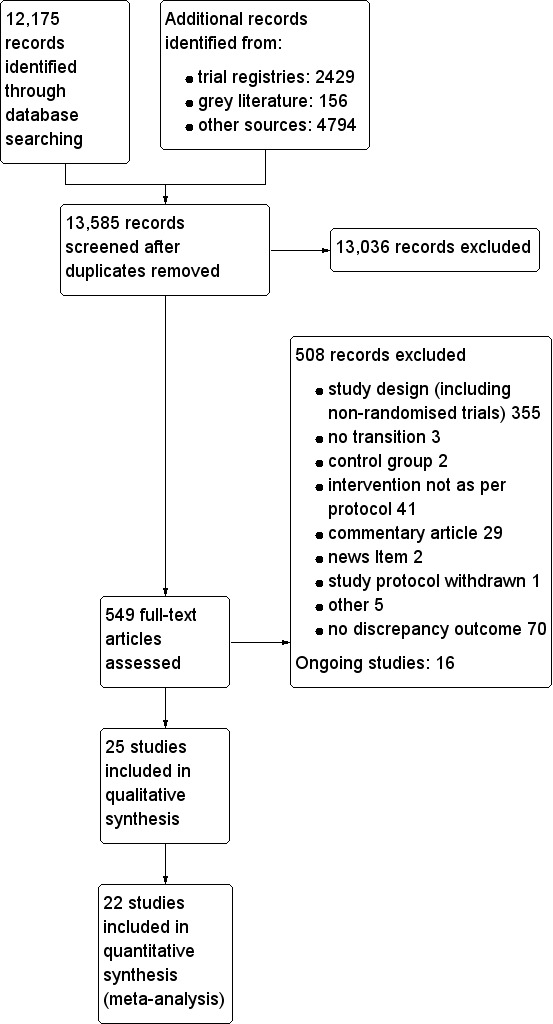
PRISMA flow diagram of search strategy.
Included studies
Twenty‐five studies meet the inclusion criteria. We contacted the authors of seven studies to attain data relevant for this review (Farley 2014; George 2011; Hale 2013; Kripalani 2012; Lalonde 2008; Marotti 2011; Tompson 2012). Two studies, despite contacting the authors, did not have data available to allow pooling of results (Bolas 2004; Khalil 2016). All study details are provided in the Characteristics of included studies table and are briefly summarised below.
Study design
There were 24 randomised trials and one cluster randomised trial (Schnipper 2011). Three studies had two intervention arms and one control arm (Farley 2014; Marotti 2011; Pevnick 2018).
Settings
All of the studies were conducted in hospital or immediately related settings. The included studies were carried out in eight countries: USA (seven studies); Australia (six studies); Canada (four studies); Singapore (two studies); and the UK, Colombia, Egypt, Netherlands, Spain and Ireland (one study each).
Participants
There were 6995 participants (3654 in the intervention group, 3341 in the control group) included in the review. The mean age of participants was 66.1 years. Two studies did not report the age of study participants (Heng 2013; Schnipper 2011). Most studies recruited participants prescribed multiple medications (e.g. more than one medication: Cadman 2017; George 2011; Lalonde 2008; Marotti 2011; Vega 2016; Yau 2008; more than three medications: Becerra‐Camargo 2013; Bolas 2004; Tompson 2012; five or more medications: Char 2017; Eggink 2010; Schnipper 2011; more than eight medications: Hawes 2014; more than 10 medications Pevnick 2018).
Interventions
All studied interventions were classified as 'organisational' according to EPOC taxonomy.
Organisational
-
Provider orientated
Twenty‐three studies were complex, multifaceted interventions within the EPOC 'organisational' subclassification of 'provider‐orientated interventions'. Studies were a mix of 'continuity of care', 'skills mix changes', 'revision of professional roles', 'clinical multidisciplinary teams', 'formal integration of services' and 'communication of case discussions between distant health professionals'.
-
Structural
One study, subclassified as 'changes in physical structure, facilities and equipment', examined the availability of an electronic reconciliation tool built into the electronic medical record of a network of primary care practices (Schnipper 2011).
One study, subclassified as 'changes in medical records system', examined the inclusion of a 'medication discharge plan' at the time of discharge (Lalonde 2008).
Provider(s) of intervention
In 22 studies, clinical pharmacists primarily delivered the intervention. One study's intervention arm was provided by "pharmacist supervised pharmacy technicians" (Pevnick 2018). One study's intervention was primarily the provision of a 'medication discharge plan' also provided by the hospital clinical pharmacy service (Lalonde 2008). The final study was provided through an information and communication technology (ICT) reconciliation tool linking secondary and primary care (Schnipper 2011).
Medication reconciliation was commonly provided by pharmacists working closely with other healthcare professionals in a variety of settings (at preadmission: three; admission: six; during hospitalisation; five; discharge: five; postdischarge: four; hospital outpatient clinic setting: two).
Format of reconciliation intervention
Information gathering
All study interventions included an attempt to construct a 'best possible medication list', with various levels of intensity and almost all including patient interview. Twenty‐two study interventions were conducted face‐to‐face with participants; in two it was unclear (Heng 2013; Lalonde 2008), and one was ICT mediated (Schnipper 2011).
Post‐transition communication
Ten studies included a provision within the intervention to communicate the output of reconciliation to receiving HCPs (Bolas 2004; Cadman 2017; Crotty 2004; Eggink 2010; Farley 2014; Lalonde 2008; Nickerson 2005; Schnipper 2006; Schnipper 2011; Yau 2008). Four studies included a follow‐up telephone call to participants post transition to clarify medication regimens, assess adherence, etc. (Farley 2014; Ibrahim 2012; Kripalani 2012; Schnipper 2006).
Resources
Six studies provided personalised medication information sheets to participants (Bolas 2004; Farley 2014; George 2011; Hawes 2014; Kripalani 2012; Lalonde 2008), with one study developing low literacy aids specific to its population (Kripalani 2012). One study required the development and integration of an electronic reconciliation tool into an existing functioning linked electronic medical record (Schnipper 2011), while two studies used an electronic link with community pharmacists or access to a "central clinical data repository" to gather preadmission medication information (Char 2017; Tompson 2012). In addition to the four interventions which performed follow‐up telephone calls, one study established a medication helpline for participants post‐transition (Bolas 2004).
Additional interventions beyond medication reconciliation included 'medication review' (Bolas 2004; Crotty 2004; Eggink 2010; Ibrahim 2012; Khalil 2016; Nickerson 2005; Schnipper 2006), participant counselling/education (Bolas 2004; Eggink 2010; Farley 2014; Hawes 2014; Ibrahim 2012; Kripalani 2012; Lalonde 2008; Nickerson 2005; Schnipper 2006), prescriber education (Crotty 2004), and enhanced roles as non‐medical prescribers (Hale 2013; Khalil 2016; Marotti 2011).
Comparisons
Twenty‐three studies reported the control group's intervention to consist of usual care in the context in which the study took place. This meant there was a large interstudy variation in the usual care provided to control groups.
Three studies had two intervention groups in addition to a usual care group (Farley 2014; Marotti 2011; Pevnick 2018).
Outcomes
Primary outcome
The primary outcome for this review was medication discrepancies per patient or medication (or both).
None of the studies used a validated measure of the primary outcome. Ten studies clearly reported an outcome of unintentional discrepancy, where the discrepancy between medication lists could not be accounted for through reviewing medical records, order forms or discussion with treating physicians (Cadman 2017; Char 2017; Farley 2014; Hawes 2014; Ibrahim 2012; Kwan 2007; Schnipper 2006; Schnipper 2011; Tompson 2012; Yau 2008). Three studies reported an outcome of discrepancy but did not clearly define or investigate whether that discrepancy was intentional or not (Becerra‐Camargo 2013; Beckett 2012; Eggink 2010). Three studies reported discrepancies as a mismatch in a direct comparison of two lists (e.g. discharge prescription and home medication) (Bolas 2004), medication summary sent to a long‐term care facility and actual medication sent (Crotty 2004), and a medication discharge planner and community pharmacy records (Lalonde 2008). One study recorded the outcome as whether reconciliation took place or not (George 2011). Seven studies recorded the outcome in various ways ("Omissions, prescribing and communication errors" Hale 2013; "medication discrepancies with potential ADEs" Kripalani 2012; "missed and incorrect dose and frequency of medications" Marotti 2011; "drug therapy inconsistency and omission" Nickerson 2005 and medication errors (including omissions) Khalil 2016, "Reconciliation Error that Reached the Patient" (Vega 2016), "admission medication order error" (Pevnick 2018), and one study did not report how the outcome was defined (Heng 2013).
Seven study authors provided additional study data or a reanalysis of published data (Farley 2014; George 2011; Hale 2013; Kripalani 2012; Lalonde 2008; Marotti 2011; Tompson 2012).
Outcome assessment was done variously by the study pharmacist (Beckett 2012; Eggink 2010; Farley 2014; Hawes 2014; Kwan 2007; Nickerson 2005; Pevnick 2018; Tompson 2012), or other members of the research team (Becerra‐Camargo 2013; Bolas 2004; Char 2017; George 2011; Hale 2013; Ibrahim 2012; Khalil 2016; Kripalani 2012; Marotti 2011; Schnipper 2006; Schnipper 2011); and it was unclear in five studies who had performed the outcome assessment (Cadman 2017; Crotty 2004; Heng 2013; Lalonde 2008; Vega 2016). Only six studies specifically mentioned blinding of outcome assessors (Becerra‐Camargo 2013; Farley 2014; Hale 2013; Ibrahim 2012; Kripalani 2012; Schnipper 2006).
Twenty studies reported a dichotomous outcome of at least one discrepancy per patient (Becerra‐Camargo 2013; Beckett 2012; Char 2017; Crotty 2004; Eggink 2010; George 2011; Hale 2013; Hawes 2014; Heng 2013; Ibrahim 2012; Kripalani 2012; Kwan 2007; Lalonde 2008; Marotti 2011; Nickerson 2005; Schnipper 2006; Schnipper 2011; Tompson 2012; Vega 2016; Yau 2008). Two studies reported a dichotomous outcome of any discrepancy per medication (Eggink 2010; Hale 2013). Five studies reported discrepancies per patient as a continuous outcome (Becerra‐Camargo 2013; Cadman 2017; Farley 2014; Kripalani 2012; Pevnick 2018). One study reported discrepancies per medication as a continuous outcome (Lalonde 2008). In those studies reporting discrepancies as a continuous outcome, not all studies reported a mean and standard deviation of discrepancies per unit of analysis. Only two studies reported median figures per group (Becerra‐Camargo 2013; Kripalani 2012).
Secondary outcomes
Participant‐related and process outcomes
Three studies reported PADEs (Ibrahim 2012; Kripalani 2012; Schnipper 2006). Ibrahim 2012 and Schnipper 2006 report this as "preventable" ADEs but used the same methodology (Bates 1995). Four studies reported ADEs (Crotty 2004; Ibrahim 2012; Kripalani 2012; Schnipper 2006). One study reported mortality (Cadman 2017).
Healthcare utilisation
Eight studies reported an outcome fitting the description of healthcare utilisation. These were often listed as secondary or composite outcomes and the trials were not powered to detect a significant difference between groups. Schnipper 2006 stated primary care visits ("scheduled/unscheduled office visits") as an outcome but did not actually report them. Five studies reported ED visits (Crotty 2004; Hawes 2014; Ibrahim 2012; Kripalani 2012; Schnipper 2006), 10 reported unplanned rehospitalisation (Bolas 2004; Cadman 2017; Char 2017; Crotty 2004; Hawes 2014; Ibrahim 2012; Kripalani 2012; Pevnick 2018; Schnipper 2006; Tompson 2012), and five reported length of stay (Bolas 2004; Cadman 2017; George 2011; Pevnick 2018; Tompson 2012).
Additional outcomes
None of the studies reported adverse effects of interventions. Two studies reported resource use by reporting the median time spent with participants to deliver the intervention, with one extrapolating possible full‐time equivalent (FTE) pharmacists required for intervention implementation (Beckett 2012; Khalil 2016).
Excluded studies
Most studies that we excluded were not randomised trials (Figure 1). We reported on a selection studies in the Characteristics of excluded studies table.
Studies awaiting classification
We found no studies awaiting classification.
Ongoing studies
There were 16 ongoing studies (see Characteristics of ongoing studies table). These included trial registered protocols, abstracts, conference proceedings or a combination of these. All studies stated a randomised design. Seven studies are listed as occurring in the USA; three in France; two in Australia; and one each in Norway, Taiwan, the UK and Germany. Only one study is recruiting participants under 18 years of age. Five studies specifically recruited participants aged 65 years and older. Three studies are based in primary care and the remainder are hospital based. Six studies describe their intervention as ICT‐based and the remainder are pharmacist delivered.
Risk of bias in included studies
Details of the risk of bias are presented in Figure 2 and Figure 3 and in the Characteristics of included studies tables. There were no major differences in the risk of bias of studies included in the review.
2.
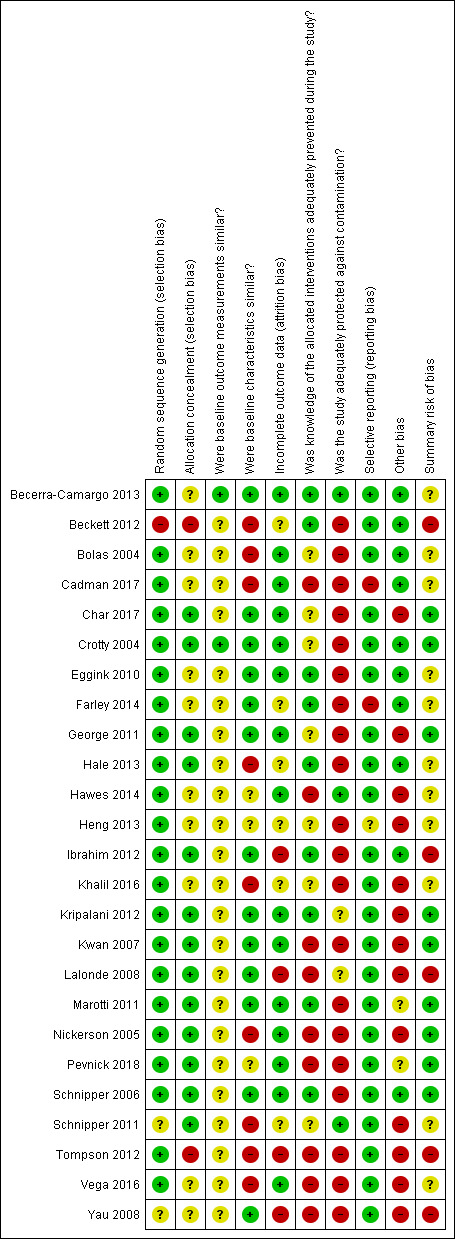
Risk of bias summary: review authors' judgements about each risk of bias item for each included study.
3.
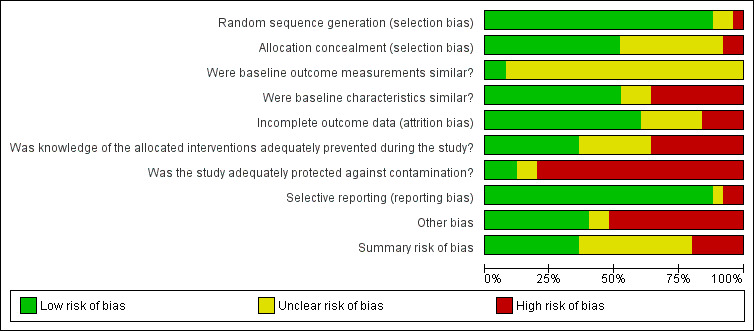
Risk of bias graph: review authors' judgements about each risk of bias item presented as percentages across all included studies.
Allocation
Twenty‐two trials reported adequate sequence generation;13 reported concealment of allocation (Figure 2).Two studies were at high risk of bias with no concealment of allocation (Tompson 2012) or allocation sequence generation (Beckett 2012), and the remainder were at unclear risk.
Blinding
Nine studies had low risk of performance and detection bias as either blinded measurement of outcomes had taken place to ensure that primary outcome assessors had no knowledge of the intervention received by participants or the outcomes were objective (Figure 2).
Incomplete outcome data
Fifteen studies adequately addressed incomplete outcome data (Figure 2). In one study, 35 participants consented but the analysis included only 29 participants and were removed with no explanation (Yau 2008). Another study randomised 92 participants to the intervention group and 84 participants to the control group (Schnipper 2006). Due to loss to follow‐up, their primary analysis included only 79 in the intervention group and 73 in the control group. There was no imputation of missing data when reporting the results. Loss to follow up, with either an imbalance between groups or insufficient descriptive detail, affected other studies (Ibrahim 2012;Lalonde 2008;Tompson 2012).
Selective reporting
Farley 2014 was a substudy of a larger trial and did not report identified outcomes of the larger trial.
Other potential sources of bias
Two studies had no information beyond a conference abstract so there was little methodological detail to assess (Heng 2013; Schnipper 2011), with one study author providing an unpublished manuscript for additional detail (Yau 2008). Two studies had possible selection bias issues by not including certain wards (Kwan 2007) or prespecifying a large number of conditions/requirements for exclusion (Lalonde 2008). Two studies only recruited participants when the intervention pharmacist was scheduled to work in the clinic or between certain hours (George 2011; Nickerson 2005). One study changed the inclusion criteria significantly in the second year of recruitment (Hawes 2014). Contamination bias (when members of the control group were inadvertently exposed to the intervention) was an important limitation in many of the included studies in this review. Sixteen studies were at high risk of contamination, with a further two where it was unclear whether protection against contamination had been provided.
Publication bias
Funnel plots of postintervention estimates of the primary outcome for 20 studies showed a visually mildly asymmetrical plot suggesting the possible presence of bias potentially because some smaller studies of lower methodological quality producing an exaggerated intervention effect estimates (Figure 4). However, considering the dichotomous nature of the outcome, this was further tested using the Harbord's modified test for small‐study effects (P = 0.601) and the Peter's test (P = 0.739); neither of which showed evidence of a publication bias.
4.
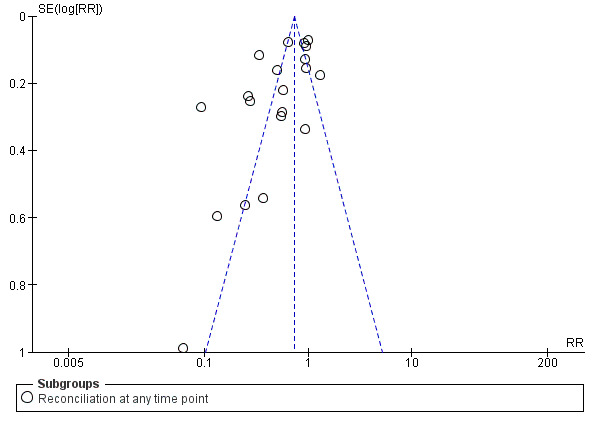
Funnel plot: at least 1 medication discrepancy per participant (dichotomous, per participant): reconciliation at any time point.
Unit of analysis error
One study, a cluster randomised trial, did not appear to take account of clustering at the practice level (Schnipper 2011). Adjustment of the reported incident rate and subsequent effect size was undertaken to allow for this (an intracluster correlation coefficient (ICC) of 0.06 was chosen from a similar study's methodology (Westbrook 2016)). None of these influenced the pooled point estimate and CIs in considering the primary comparison where the study was included. See Analysis 1.1.1.
1.1. Analysis.

Comparison 1 Medication reconciliation versus standard care, Outcome 1 At least 1 medication discrepancy per participant (dichotomous).
Effects of interventions
See: Table 1
Primary outcomes
See Table 1 for the main comparisons. Meta‐analysis of the primary outcomes showed a high degree of statistical heterogeneity and low certainty of evidence, making it difficult to have any certainty of the effect of the interventions.
Medication discrepancies
At least one medication discrepancy per participant
Twenty studies (participants = 4629; intervention group = 2274; control group = 2355) had sufficient data to pool results for the dichotomous outcome of at least one medication discrepancy per patient. There was no certainty of the effect due to very low certainty evidence (RR 0.53, 95% CI 0.42 to 0.67; Analysis 1.1.1; very low‐certainty evidence). There was marked heterogeneity between studies (I2 = 91%, P < 0.00001) (note that this RR was for reconciliation at any time point).
-
Reconciliation at admission:
RR 0.43, 95% CI 0.27 to 0.68; participants = 1167; studies = 4; very low‐certainty evidence (Analysis 1.1.2).
-
Reconciliation at discharge:
RR 0.71, 95% CI 0.50 to 1.02; participants = 649; studies = 5; very low‐certainty evidence. (Analysis 1.1.3).
-
Reconciliation throughout hospital stay:
RR 0.92, 95% CI 0.80 to 1.07; participants = 933; studies = 2; very low‐certainty evidence. Farley 2014 described the intervention as being discharge focused, but provided reconciliation at admission and discharge and reported a continuous outcome (Analysis 1.1.4).
-
Reconciliation at preadmission clinic (PAC):
RR 0.38, 95% CI 0.13 to 1.11; participants = 1082; studies = 3; very low‐certainty evidence (Analysis 1.1.5).
Number of medication discrepancies per participant
There was no certainty on the effect of reconciliation (MD –1.18, 95% CI –2.58 to 0.23; studies = 4; participants = 1963; very low‐certainty evidence; Analysis 1.2) and a high degree of statistical heterogeneity (I2 = 96%). Cadman 2017 reported 0.02 discrepancies in the intervention and 2.71 in the control group, but did not provide a standard deviation for pooling.
1.2. Analysis.

Comparison 1 Medication reconciliation versus standard care, Outcome 2 Number of medication discrepancies per participant (continuous).
Discrepancies per participant medication
It was uncertain if discrepancies per medication (reported dichotomously) were reduced, as the certainty of the evidence was very low (RR 0.13, 95% CI 0.01 to 1.29; studies = 2; participants = 3595; very low‐certainty evidence; Analysis 1.3). There was a high degree of statistical heterogeneity in the pooled odds ratio of these studies (I2 = 98%). Only one study reported discrepancies per medication as a continuous measure (MD –2.10, 95% CI –9.64 to 5.44; participants = 82; Analysis 1.4).
1.3. Analysis.
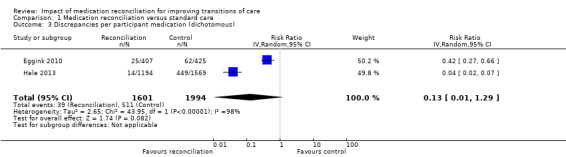
Comparison 1 Medication reconciliation versus standard care, Outcome 3 Discrepancies per participant medication (dichotomous).
1.4. Analysis.
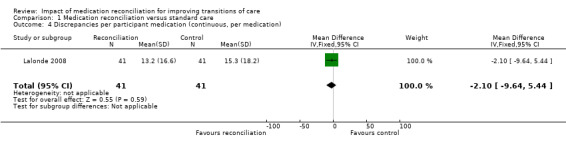
Comparison 1 Medication reconciliation versus standard care, Outcome 4 Discrepancies per participant medication (continuous, per medication).
Interventions often concentrated on a specific transition point (e.g. hospital admission), therefore studies reporting the primary outcome were further subgrouped into the transition point primarily focused on in their intervention. Again, due to the certainty of evidence being very low no conclusions could be drawn on the impact of the intervention.
Two studies did not report the outcome of discrepancies in a directly comparable way. The study authors when contacted were unable to provide the original data (Bolas 2004; Khalil 2016). Bolas 2004 reported the mismatch between discharge prescriptions and home medication upon discharge in 171 participants based on three criteria: drug name (P < 0.005), dose (P < 0.07) and frequency (P < 0.004). There were no further details, including number of participants per groups etc., available. Khalil 2016 reported a reduction in all medication errors (which included omissions) in the intervention group (P < 0.0001).
Secondary outcomes
Participant‐related and process outcomes
Medication discrepancy with potential for adverse drug events
One study reported potential ADEs; defined as being due to discrepancies or non‐adherence (Kripalani 2012). It reported an adjusted incidence rate ratio between groups of 0.79 (95% CI 0.61 to 1.01).
Three studies described an outcome of PADEs or ameliorable ADEs calculated using the Bates methodology to retrospectively identify medication‐related ADEs with no certainty of whether reconciliation reduced PADEs (RR 0.37, 95% CI 0.09 to 1.57; participants = 1253; very low‐certainty evidence). Note Kripalani's methodology lists secondary outcomes of PADEs and potential ADEs but reported ADEs and potential ADEs (Analysis 1.5).
1.5. Analysis.

Comparison 1 Medication reconciliation versus standard care, Outcome 5 Preventable adverse drug events.
Adverse drug events
Four studies reported reconciliation may make little or no difference to ADEs (RR 1.09, 95% CI 0.91 to 1.30; participants = 1363; studies = 4; low‐certainty evidence; Analysis 1.6). There was little statistical heterogeneity between the studies (I2 = 0%).
1.6. Analysis.
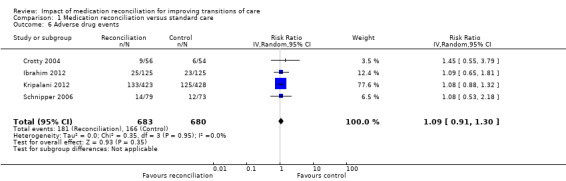
Comparison 1 Medication reconciliation versus standard care, Outcome 6 Adverse drug events.
Mortality
One study reported no difference in mortality (RR 0.75, 95% CI 0.27 to 2.08; participants = 190; low‐certainty evidence; Analysis 1.7).
1.7. Analysis.

Comparison 1 Medication reconciliation versus standard care, Outcome 7 Mortality.
Medication adherence (non‐adherent with at least one medication)
Two studies directly asked participants about adherence to medication, reporting a dichotomous outcome of those who were not adherent to at least one medication (RR 0.76, 95% CI 0.41 to 1.42; participants = 379; very low certainty) (Analysis 1.8). One study reported adherence via the Morisky Medication Adherence Scale (MMAS‐8), but only for all participants as one group (Char 2017).
1.8. Analysis.

Comparison 1 Medication reconciliation versus standard care, Outcome 8 Medication adherence (non‐adherent with at least 1 medication).
Healthcare utilisation
Primary care visits
None of the studies reported primary care visits.
Emergency department visits
One study reported reduced rates in favour of the intervention (RR 0.07, 95% CI 0.00 to 1.07; participants = 61; Analysis 1.9).
1.9. Analysis.

Comparison 1 Medication reconciliation versus standard care, Outcome 9 Emergency department (ED) visits.
Unplanned rehospitalisation
There was probably little or no difference in unplanned rehospitalisations (RR 0.72, 95% CI 0.44 to 1.18; participants = 1206; studies = 5; I2 = 45%; moderate‐certainty evidence; Analysis 1.10).
1.10. Analysis.
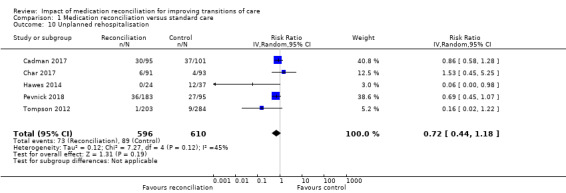
Comparison 1 Medication reconciliation versus standard care, Outcome 10 Unplanned rehospitalisation.
Hospital usage (composite measure of emergency department, rehospitalisation)
Four studies reported a combined measure (hospitalisation, ED attendance) of healthcare utilisation with no certainty of the effect of the intervention (RR 0.78, 95% CI 0.50 to 1.22; participants = 597; studies = 4; very low‐certainty evidence). There was some evidence of heterogeneity between these studies (I2 = 48%) (Analysis 1.11).
1.11. Analysis.
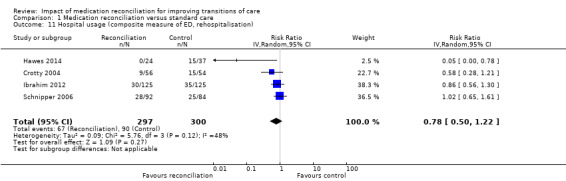
Comparison 1 Medication reconciliation versus standard care, Outcome 11 Hospital usage (composite measure of ED, rehospitalisation).
Length of stay
Five studies reported on length of stay, with only two studies providing both means and standard deviations (MD 0.48, 95% CI –1.04 to 1.99; participants = 475; studies = 2; I2 = 52%; very low‐certainty evidence; Analysis 1.12).
1.12. Analysis.

Comparison 1 Medication reconciliation versus standard care, Outcome 12 Length of stay.
Additional outcomes
Adverse effects of interventions
None of the studies reported adverse effects of interventions.
Resource use
Two studies reported on the median time spent with patients to deliver the intervention, with one extrapolating possible Full Time Equivalent (FTE) pharmacists required for intervention implementation (Beckett 2012; Khalil 2016).
Sensitivity analysis
The primary comparison of at least one medication discrepancy per participant: reconciliation at any time point reported a high degree of statistical heterogeneity (RR 0.53, 95% CI 0.42 to 0.67; participants = 4629; studies = 20; I2 = 91%; Analysis 1.1.1). We undertook a sensitivity analysis to investigate the effect of those studies with a high risk of bias on the primary comparison. Five studies reported a high summary risk of bias (Beckett 2012; Ibrahim 2012; Lalonde 2008; Tompson 2012; Yau 2008). Once we excluded these studies, there was no appreciable difference in the pooled estimate or CI of the primary outcome (RR 0.50, 95% CI 0.38 to 0.67; participants = 3700; studies = 15). There was also no improvement in the reported statistical heterogeneity (I2 = 91%).
Furthermore, we undertook an analysis of the 20 studies included in the primary outcome to investigate the influence of a single study on the overall meta‐analysis estimate. This was done via the 'metainf' command in Stata (where the meta‐analysis was re‐estimated omitting each study in turn). Inspection of the graphical output showed no undue influence of any one study (figure not shown).
Metaregression
To examine the potential effect of certain study characteristics on the effect size, we identified a small number of characteristics a priori and we undertook a metaregression of the effect estimate and potential effect modifiers. We tested age, number of medications, summary risk of bias and transition point at which an intervention was applied. It was agreed that the proportions of chronic illnesses in studies was less clearly reported and, therefore, not appropriate to examine further. Pharmacists primarily delivered the intervention in 18 of the 21 studies, therefore, there was little value in subgrouping between different intervention types.
We tested mean number of medications in 18 studies as a continuous and categorical (five or more medications – polypharmacy, 10 or more medications – excessive polypharmacy) variable. Neither continuous (β = 0.14, 95% CI –0.14 to 0.41, P = 0.312) nor categorical (polypharmacy: β = 1.17, 95% CI –0.17 to 2.51, P = 0.082), excessive polypharmacy: β = 1.28, 95% CI –0.89 to 3.46, P = 0.229) variables proved to be influential. We repeated this analysis with polypharmacy defined as four or more medications with the results unchanged.
We tested mean age of study participants in 20 studies with no effect found (β = 0.01, 95% CI –0.04 to 0.02, P = 0.472) and a summary risk of bias measure for 20 studies with no effect found (e.g. low risk of bias compared to unclear risk of bias) (β = 0.33, 95% CI –1.07 to 1.73, P = 0.624).
We included 20 studies comparing the transition point at which the study intervention was applied (PAC, admission, throughout hospital stay, discharge and others) with none reporting differences.
Discussion
Summary of main results
The outcomes are presented in Table 1 with the presence of at least one medication discrepancy per participant, at any transition following reconciliation, being the main outcome used in the included studies to measure the effectiveness of reconciliation. We pooled 20 of the 25 studies in a meta‐analysis of the dichotomous outcome of the presence of discrepancies or not. The pooled effect showed a reduced relative risk in the intervention group at any time point (RR 0.53, 95% CI 0.42 to 0.67; Analysis 1.1). However, there was a high degree of heterogeneity in the effect of the interventions on the presence of discrepancies (I2 = 91%). We investigated this via both meta‐regression and sensitivity analysis with no obvious influence of a single study, or study characteristic (number of medications, age, transition point, risk of bias). Consequently, the limited evidence that reconciliation reduced medication discrepancy has to be treated with caution.
We also reported the primary outcome of discrepancies as both a continuous measure per patient and per medication. Neither of these showed a consistent trend in the effect of the intervention. The certainty of the evidence for these outcomes was very low.
We undertook subgroup analysis to investigate the effect of reconciliation on specific transitions. Studies were grouped via hospital admission, discharge, throughout the hospital stay and PACs. Of the four studies pooled where interventions were applied primarily at hospital admission, there was uncertainty of the effect on discrepancies (RR 0.43, 95% CI 0.27 to 0.68), again with a high degree of heterogeneity (I2 = 91%). None of the other transitions showed an effect of the intervention on discrepancies. The certainty of the evidence was very low.
Secondary outcomes of PADEs, ADEs, a composite measure of healthcare utilisation (ED visits, and rehospitalisation) and medication adherence showed no consistent effect of the intervention with the certainty of the evidence being low or very low. The intervention also probably had little or no impact on unplanned rehospitalisation with moderate‐certainty evidence (RR 0.72, 95% CI 0.44 to 1.18; participants = 1206; studies = 5; I2 = 45%; Analysis 1.10)). Of note, none of the studies reported the potential adverse effects of interventions and only two studies briefly mentioned resource usage.
Overall completeness and applicability of evidence
The types of interventions included in the review were primarily pharmacist delivered. Only one trial involved using an electronic reconciliation tool. The interventions were complex and mostly multifaceted with notable variability between studies in how they were applied locally. This considerable local variability limits the generalisability of effects to settings beyond the original study environments.
Although there was a promising result suggesting that the interventions described in this review were successful in improving the presence of discrepancies per participant, the certainty of the evidence was very low. In addition, the clinical impact of this intervention on the secondary clinical outcomes was also unknown. The various endpoints of medication discrepancies and PADEs considered in this review were surrogate markers. Only five of the included studies reported healthcare utilisation, with the outcome variously reported. Of note, other non‐included studies have focused on this outcome but this review included studies based on the primary outcome of discrepancies. Future research should focus on designing studies adequately powered to investigate clinical outcomes such ADEs, ED visits and hospital (re)admissions.
Finally, many of the studies were affected by incomplete outcome data with 10 studies classed as high or unclear risk of attrition bias. This impacts on the certainty of the evidence as reported in the GRADE process of the 'Summary of findings' table.
Certainty of the evidence
Different definitions, data collection procedures and follow‐up duration make comparison to other studies difficult. The heterogeneity between studies included in this review should be treated cautiously as the interventions did not seem to work consistently across all studies. Factors contributing to this heterogeneity included variation in types, intensity and duration of interventions, or differences in timing of follow‐up measurements. This is perhaps because of differences in how the interventions were provided, background practice, and culture and variable processes in delivery of care.
Potential biases in the review process
There was evidence of potential bias in some studies, for example only 13 studies reported adequate concealment of allocation and only three reported appropriate protection from contamination, both of which may have influenced the effect estimate in these studies and therefore the overall pooled estimate.
A limited number of the possible studies testing reconciliation as an intervention were included in this review as many did not report the primary outcome of this review (medication discrepancies). This limits the relevance of this review in commenting on the effects of reconciliation on long‐term patient‐focused outcomes (e.g. ADEs, rehospitalisation). However, in considering the causal pathway of ADEs arising from care transitions, it was deemed that discrepancies were the most likely starting point and, therefore, most worthwhile studying.
As shown in the 'Summary of findings' table for the main comparisons, the certainty of evidence presented in this review, as described by the GRADE approach, was almost universally very low (Table 1).
We placed no language restrictions on the search strategy, but all of the included trials were published in English. Funnel plots and formal tests of publication bias showed no apparent cause for concern regarding this bias.
Agreements and disagreements with other studies or reviews
We identified 45 relevant previously published reviews and reports (Appendix 2). The conclusions were similar, that is, there were mixed results from several intervention types tested in heterogeneous studies of limited methodological quality.
Many reviews included non‐randomised study designs, a reflection of the more common method by which reconciliation efforts are studied (e.g. controlled before‐and‐after study, interrupted time series). Most studies included in reviews were conducted in high‐income countries. Hospital‐based care was the most commonly studied transition, with primary care (Bayoumi 2009; Nazar 2015), and long term‐care (Chhabra 2012), less so.
Medication discrepancies were extremely common (3.4% to 98.2% of participants) (Lehnbom 2014). However, there is limited evidence of the potential for harm from these discrepancies (Kwan 2013).
Most studies found an improvement in process measures (Spinewine 2013), but disagreed on the impact of interventions on ADEs, hospital readmissions and medication adherence (Kwan 2013; Mueller 2012; Mekonnen 2016; Mekonnen 2016a). There was significant study population, intervention and outcome heterogeneity. In addition, most studies were underpowered to examine clinical outcomes. No review carried out formal cost–benefit analysis of interventions, this is an underexplored area with limited publications generally (Karnon 2009). Meta‐analysis was often not undertaken due to the dissimilarity of studies.
Pharmacist‐conducted reconciliation (e.g. transition pharmacist co‐ordinator) was the most commonly studied intervention, with ICT interventions less commonly tested (Bassi 2010). Measures that worked included pharmacist involvement, patient education, counselling, improved HCP communication and targeting high‐risk populations.
Reviews call for further research on high‐risk populations, multicentre designs and adequate sample size to evaluate clinical outcomes.
Authors' conclusions
Implications for practice.
The interventions implemented in the studies in this review reduced the number of medication discrepancies at care transitions; however, the certainty in this result is unclear as the evidence was of very low certainty. Included studies had no clear effect on any other patient‐focused outcome (e.g. emergency department visits, adverse drug events) again with the evidence being of very low certainty. The majority of studies implemented reconciliation via pharmacist‐mediated efforts.
Implications for research.
Overall, the quality of the studies in this review was poor and further research should attend to the rigour in study design. The term 'medication discrepancies' has no uniform definition, making objective comparison between studies difficult. Further work is required to develop a consensus on identifying, defining, measuring and reporting discrepancies. Future studies should utilise clear definitions of discrepancies as well as objective measurement techniques and appropriate choice of time points attendant to the transition point at which the intervention is applied. Similarly the method by which 'gold standard' medication lists are compiled is not uniform and therefore the subsequent identification of discrepancies is entirely dependent on this process.
To ensure the accurate replication of successful study interventions there should be careful documentation of the development of interventions and the training and background of the providers. Documentation of intervention processes utilised would enable identification of the critical elements for successful interventions. Many of the studies included in this review lacked sufficient detail in how these processes were conducted.
The lack of economic analysis of the interventions included in this review is also important. Policy makers require cost–benefit analysis information in deciding to fund interventions.
The prioritisation of patient‐level outcomes (e.g. hospitalisations, adverse drug events) is also an important consideration. The link between discrepancies and subsequent increased healthcare utilisation, while plausible, is not clear. Therefore, planning studies of sufficient power to test these hypotheses is important.
Acknowledgements
We would like to acknowledge the Health Research Board, who funded a Cochrane Fellowship for Patrick Redmond (PR). We would also like to thank the Cochrane EPOC Editorial group (Daniela Gonçalves Bradley, Janet Squires, Sofia Massa, Julia Worswick, Michelle Fiander, Paul Miller and Pierre Durieux), who provided ongoing advice, critical review and support in writing this review and developing the search strategy. Thank you also for the contribution of the peer reviewer (Marc Blockman).
The National Institute for Health Research (NIHR) provide, via Cochrane Infrastructure, funding to the Effective Practice and Organisation of Care Group. The views and opinions expressed herein are those of the review authors and do not necessarily reflect those of the Systematic Reviews Programme, NIHR, National Health Service or the Department of Health.
Appendices
Appendix 1. Search strategies
MEDLINE (Ovid)
Date of search: 18 January 2018
| No. | Search terms | Results |
| 1 | medication reconciliation/ | 577 |
| 2 | ((medication? or medicine? or drug or drugs or pharmacist? or pharmacy or pharmacies or formulary or formularies or prescription? or prescrib*) adj3 (reconcil* or review or reviewing)).ti,ab. | 11733 |
| 3 | ((medication? or medicine? or drug or drugs or pharmacist? or pharmacy or pharmacies or formulary or formularies or prescription? or prescrib*) adj3 (assess* or audit?)).ti,ab. | 17391 |
| 4 | (stopp or beer's criteria).ti,ab. | 556 |
| 5 | (medication? adj2 discrepanc*).ti,ab. | 248 |
| 6 | ((medication? or prescribing) adj2 error?).ti,ab. | 4927 |
| 7 | stewardship.ti,ab. | 3087 |
| 8 | or/1‐7 | 36728 |
| 9 | medication systems, hospital/ | 3303 |
| 10 | pharmacy service, hospital/ | 10470 |
| 11 | ((pharmaceutical care or pharmacy or pharmacies or pharmacist? or prescribing) and (inpatient? or hospital* or ward? or unit or units)).ti. | 3712 |
| 12 | ((pharmaceutical care or pharmacy or pharmacies or pharmacist? or prescribing) adj2 (inpatient? or hospital* or ward? or unit or units)).ab. | 3441 |
| 13 | ((medication? or prescribing or prescription? or dispensing) adj2 system?).ti,ab. and (hospital* or ward or wards or (care adj2 unit?) or inpatient?).ti,hw. | 660 |
| 14 | or/9‐13 | 16361 |
| 15 | pharmacists/ or pharmacists' aides/ | 13100 |
| 16 | pharmaceutical services/ or drug information services/ or clinical pharmacy information systems/ | 11972 |
| 17 | drug monitoring/ or medication therapy management/ or drug therapy/ or drug therapy, computer‐assisted/ | 48333 |
| 18 | prescriptions/ or drug prescriptions/ or pharmaceutical preparations/ or drug therapy/ or drug dosage calculations/ or electronic prescribing/ or medication systems/ | 102601 |
| 19 | medication errors/ or polypharmacy/ or inappropriate prescribing/ | 15666 |
| 20 | drug utilization review/ | 3349 |
| 21 | (pharmacy or pharmacies or pharmacist? or prescription? or prescribing).ti. | 51608 |
| 22 | (pharmacist‐led or pharma* initiated or ((driven or lead or led) adj2 pharmacist?)).ab. | 510 |
| 23 | (prescribing adj2 pattern?).ab. | 1949 |
| 24 | ("physician‐pharmacist?" or "doctor‐pharmacist?").ti,ab. | 203 |
| 25 | ((improv* or optimi?ing or optimi?e? or optimal*) and (dosing or dosage or pharmac* or prescrib* or prescript*)).ti. or ((improv* or optimi?ing or optimi?e? or optimal*) adj2 (pharmaceutical care or pharmacy or prescrib* or prescript*)).ab. | 6723 |
| 26 | ((pharmaceutical adj (care or consult*)) or (pharmacist? adj2 (care or consult* or intervention? or managed))).ab. | 3304 |
| 27 | ((drug therapy or drug regime? or medication? or medicines or pharmacy or pharmacist? or pharmaceutical or prescrib* or prescription?) adj2 (audit* or monitor* or reconcil* or review?)).ti,ab. | 7205 |
| 28 | ((medication? or prescrib* or pharmac*) adj2 (manage? or management or service? or system?)).ti,ab. | 18412 |
| 29 | (("drug therapy" or dosage? or dose? or medication? or prescription? or prescrib* or pharmacist? or pharmaceutical care) adj2 (managing or management or monitor*)).ti,ab. | 9567 |
| 30 | ("drug utili?ation" adj2 (review? or reconcil* or audit?)).ab. or ("drug utili?ation" and (review? or reconcil* or audit?)).ti. | 323 |
| 31 | (inappropriate* adj2 (medicine? or medication? or prescrib* or drug?)).ti,ab. | 2461 |
| 32 | drug utilization/ | 18323 |
| 33 | or/15‐32 | 211178 |
| 34 | ((care or patient?) adj3 transition*).ti,ab. | 7308 |
| 35 | (hospital adj3 releas*).ti,ab. | 543 |
| 36 | "hospital to home".ti,ab. | 2169 |
| 37 | patient admission/ or patient discharge/ or patient readmission/ or patient transfer/ | 56153 |
| 38 | (patient? or hospital* or medical centre or medical centres or medical center?).ti,hw. and (discharg* or admission? or admitting or readmission? or readmit* or transfer? or transferred or transferring).ti. | 32990 |
| 39 | ((patient? or care facility or medical facility or hospital? or medical centre or medical centres or medical center? or emergency or ward or wards or unit or units or (intensive adj2 care) or icu or acute care or (hospital? adj2 department?)) adj2 (discharg* or admission? or admitting or readmission? or transfer? or transferring or transferred)).ab. | 113634 |
| 40 | (exp academic medical centers/ or exp hospital units/ or exp hospitals/ or exp ambulatory care facilities/) and (transfer or transferred or discharge or admission? or readmission? or re‐admission?).ti. | 7886 |
| 41 | ((earlie* or early) adj2 discharg*).ab. | 3828 |
| 42 | ((icu or (intensive adj2 care) or acute care or unit or units or ward or wards or department) adj3 transition*).ti,ab. | 540 |
| 43 | (transfer* adj3 emergency).ti,ab. | 732 |
| 44 | (hospital adj8 (transfer? or transferred)).ti,ab. | 5637 |
| 45 | discharge.ti. | 18232 |
| 46 | (discharge adj3 (medication? or prescription? or communication? or (information adj2 exchang*))).ab. | 1675 |
| 47 | or/34‐46 | 183427 |
| 48 | 8 and 47 | 1747 |
| 49 | (and/14,47) not 48 | 627 |
| 50 | (and/33,47) not (or/48‐49) | 3074 |
| 51 | (randomized controlled trial or controlled clinical trial).pt. or randomized.ab. or placebo.ab. or clinical trials as topic.sh. or randomly.ab. or trial.ti. | 1067990 |
| 52 | exp animals/ not humans.sh. | 4316367 |
| 53 | 51 not 52 | 984770 |
| 54 | intervention?.ti. or (intervention? adj6 (clinician? or collaborat* or community or complex or design* or doctor? or educational or family doctor? or family physician? or family practitioner? or financial or gp or general practice? or hospital? or impact? or improv* or individuali?e? or individuali?ing or interdisciplin* or multicomponent or multi‐component or multidisciplin* or multi‐disciplin* or multifacet* or multi‐facet* or multimodal* or multi‐modal* or personali?e? or personali?ing or pharmacies or pharmacist? or pharmacy or physician? or practitioner? or prescrib* or prescription? or primary care or professional* or provider? or regulatory or regulatory or tailor* or target* or team* or usual care)).ab. | 220003 |
| 55 | (pre‐intervention? or preintervention? or "pre intervention?" or post‐intervention? or postintervention? or "post intervention?").ti,ab. | 15424 |
| 56 | (hospital* or patient?).hw. and (study or studies or care or health* or practitioner? or provider? or physician? or nurse? or nursing or doctor?).ti,hw. | 813565 |
| 57 | demonstration project?.ti,ab. | 2224 |
| 58 | (pre‐post or "pre test*" or pretest* or posttest* or "post test*" or (pre adj5 post)).ti,ab. | 87300 |
| 59 | (pre‐workshop or post‐workshop or (before adj3 workshop) or (after adj3 workshop)).ti,ab. | 824 |
| 60 | trial.ti. or ((study adj3 aim?) or "our study").ab. | 847155 |
| 61 | (before adj10 (after or during)).ti,ab. | 417535 |
| 62 | ("quasi‐experiment*" or quasiexperiment* or "quasi random*" or quasirandom* or "quasi control*" or quasicontrol* or ((quasi* or experimental) adj3 (method* or study or trial or design*))).ti,ab,hw. | 124582 |
| 63 | ("time series" adj2 interrupt*).ti,ab,hw. | 1745 |
| 64 | (time points adj3 (over or multiple or three or four or five or six or seven or eight or nine or ten or eleven or twelve or month* or hour? or day? or "more than")).ab. | 12815 |
| 65 | pilot.ti. | 51962 |
| 66 | pilot projects/ | 97108 |
| 67 | (clinical trial or controlled clinical trial or multicenter study).pt. | 684276 |
| 68 | (multicentre or multicenter or multi‐centre or multi‐center).ti. | 37800 |
| 69 | random*.ti,ab. or controlled.ti. | 939029 |
| 70 | (control adj3 (area or cohort? or compare? or condition or design or group? or intervention? or participant? or study)).ab. not (controlled clinical trial or randomized controlled trial).pt. | 509609 |
| 71 | "comment on".cm. or review.ti,pt. or randomized controlled trial.pt. | 3417201 |
| 72 | (rat or rats or cow or cows or chicken? or horse or horses or mice or mouse or bovine or animal?).ti. | 1479919 |
| 73 | exp animals/ not humans.sh. | 4316367 |
| 74 | (or/54‐70) not (or/71‐73) | 2607618 |
| 75 | ((or/48‐50) and 53) not placebo*.ti,ab,hw. | 570 |
Embase (Ovid)
Date of search: 18 January 2018
| No. | Search terms | Results |
| 1 | medication therapy management/ | 5857 |
| 2 | ((medication? or medicine? or drug or drugs or pharmacist? or pharmacy or pharmacies or formulary or formularies or prescription? or prescrib*) adj3 (reconcil* or review or reviewing)).ti,ab. | 17895 |
| 3 | ((medication? or medicine? or drug or drugs or pharmacist? or pharmacy or pharmacies or formulary or formularies or prescription? or prescrib*) adj3 (assess* or audit?)).ti,ab. | 26682 |
| 4 | (stopp or beer's criteria).ti,ab. | 1068 |
| 5 | (medication? adj2 discrepanc*).ti,ab. | 520 |
| 6 | ((medication? or prescribing) adj2 error?).ti,ab. | 7616 |
| 7 | stewardship.ti,ab. | 4001 |
| 8 | or/1‐7 | 58665 |
| 9 | ((pharmaceutical care or pharmacy or pharmacies or pharmacist? or prescribing) and (inpatient? or hospital* or ward? or unit or units)).ti. | 6980 |
| 10 | ((pharmaceutical care or pharmacy or pharmacies or pharmacist? or prescribing) adj2 (inpatient? or hospital* or ward? or unit or units)).ab. | 7158 |
| 11 | ((medication? or prescribing or prescription? or dispensing) adj2 system?).ti,ab. and (hospital* or ward or wards or (care adj2 unit?) or inpatient?).ti,hw. | 1334 |
| 12 | or/9‐11 | 13581 |
| 13 | (pharmacist‐led or pharma* initiated or ((driven or lead or led) adj2 pharmacist?)).ab. | 1122 |
| 14 | (prescribing adj2 pattern?).ab. | 3190 |
| 15 | ("physician‐pharmacist?" or "doctor‐pharmacist?").ti,ab. | 374 |
| 16 | ((improv* or optimi?ing or optimi?e? or optimal*) and (dosing or dosage or pharmac* or prescrib* or prescript*)).ti. or ((improv* or optimi?ing or optimi?e? or optimal*) adj2 (pharmaceutical care or pharmacy or prescrib* or prescript*)).ab. | 10259 |
| 17 | ((pharmaceutical adj (care or consult*)) or (pharmacist? adj2 (care or consult* or intervention? or managed))).ab. | 7272 |
| 18 | ((drug therapy or drug regime? or medication? or medicines or pharmacy or pharmacist? or pharmaceutical or prescrib* or prescription?) adj2 (audit* or monitor* or reconcil* or review?)).ti,ab. | 12580 |
| 19 | inappropriate prescribing/ | 2397 |
| 20 | ("drug utili?ation" adj2 (review? or reconcil* or audit?)).ab. or ("drug utili?ation" and (review? or reconcil* or audit?)).ti. | 492 |
| 21 | (inappropriate* adj2 (medicine? or medication? or prescrib* or drug?)).ti,ab. | 3888 |
| 22 | or/13‐21 | 36120 |
| 23 | *pharmacist/ | 20055 |
| 24 | *drug monitoring/ or medication therapy management/ or *drug therapy/ or computer‐assisted drug therapy/ | 261987 |
| 25 | *prescription/ or *drug therapy/ or *dose calculation/ or electronic prescribing/ | 270752 |
| 26 | *medication error/ or polypharmacy/ | 16802 |
| 27 | (pharmacy or pharmacies or pharmacist? or prescription? or prescribing).ti. | 85551 |
| 28 | ((medication? or prescrib* or pharmac*) adj2 (manage? or management or service? or system?)).ti,ab. | 30503 |
| 29 | (("drug therapy" or dosage? or dose? or medication? or prescription? or prescrib* or pharmacist? or pharmaceutical care) adj2 (managing or management or monitor*)).ti,ab. | 14674 |
| 30 | "drug use"/ | 91682 |
| 31 | (or/23‐30) and (reconcil* or audit or audits or auditing).ti,ab. | 5371 |
| 32 | or/22,31 | 38459 |
| 33 | ((care or patient?) adj3 transition*).ti,ab. | 11039 |
| 34 | (hospital adj3 releas*).ti,ab. | 746 |
| 35 | "hospital to home".ti,ab. | 2909 |
| 36 | (patient? or hospital* or medical centre or medical centres or medical center?).ti,hw. and (discharg* or admission? or admitting or readmission? or readmit* or transfer? or transferred or transferring).ti. | 50556 |
| 37 | ((patient? or care facility or medical facility or hospital? or medical centre or medical centres or medical center? or emergency or ward or wards or unit or units or (intensive adj2 care) or icu or acute care or (hospital? adj2 department?)) adj2 (discharg* or admission? or admitting or readmission? or transfer? or transferring or transferred)).ab. | 179998 |
| 38 | (hospital/ or (academic medical centers or hospital units or ambulatory care facilities).ti,ab.) and (transfer or transferred or discharge or admission? or readmission? or re‐admission?).ti. | 7897 |
| 39 | ((earlie* or early) adj2 discharg*).ab. | 5740 |
| 40 | ((icu or (intensive adj2 care) or acute care or unit or units or ward or wards or department) adj3 transition*).ti,ab. | 673 |
| 41 | (transfer* adj3 emergency).ti,ab. | 1097 |
| 42 | (hospital adj8 (transfer? or transferred)).ti,ab. | 9489 |
| 43 | discharge.ti. | 22467 |
| 44 | (discharge adj3 (medication? or prescription? or communication? or (information adj2 exchang*))).ab. | 3388 |
| 45 | or/33‐44 | 238270 |
| 46 | 8 and 45 | 3696 |
| 47 | (and/12,45) not 46 | 796 |
| 48 | (and/32,45) not (or/46‐47) | 959 |
| 49 | controlled clinical trial/ or controlled study/ or randomized controlled trial/ | 5126441 |
| 50 | randomi?ed.ti. or ((random* or control) adj3 (group? or cohort? or patient? or hospital* or department?)).ab. or (controlled adj2 (study or trial)).ti. | 884146 |
| 51 | (random sampl* or random digit* or random effect* or random survey or random regression).ti,ab. not randomized controlled trial/ | 75111 |
| 52 | (exp animals/ or exp invertebrate/ or animal experiment/ or animal model/ or animal tissue/ or animal cell/ or nonhuman/) and (human/ or normal human/ or human cell/) | 17622202 |
| 53 | (exp animals/ or exp invertebrate/ or animal experiment/ or animal model/ or animal tissue/ or animal cell/ or nonhuman/) not 52 | 6002861 |
| 54 | (or/49‐50) not (or/51,53) | 3543579 |
| 55 | intervention?.ti. or (intervention? adj6 (clinician? or collaborat* or community or complex or design* or doctor? or educational or family doctor? or family physician? or family practitioner? or financial or gp or general practice? or hospital? or impact? or improv* or individuali?e? or individuali?ing or interdisciplin* or multicomponent or multi‐component or multidisciplin* or multi‐disciplin* or multifacet* or multi‐facet* or multimodal* or multi‐modal* or personali?e? or personali?ing or pharmacies or pharmacist? or pharmacy or physician? or practitioner? or prescrib* or prescription? or primary care or professional* or provider? or regulatory or regulatory or tailor* or target* or team* or usual care)).ab. | 281936 |
| 56 | (pre‐intervention? or preintervention? or "pre intervention?" or post‐intervention? or postintervention? or "post intervention?").ti,ab. | 20724 |
| 57 | (hospital* or patient?).hw. and (study or studies or care or health* or practitioner? or provider? or physician? or nurse? or nursing or doctor?).ti,hw. | 2144042 |
| 58 | demonstration project?.ti,ab. | 2615 |
| 59 | (pre‐post or "pre test*" or pretest* or posttest* or "post test*" or (pre adj5 post)).ti,ab. | 135195 |
| 60 | (pre‐workshop or post‐workshop or (before adj3 workshop) or (after adj3 workshop)).ti,ab. | 1221 |
| 61 | trial.ti. or ((study adj3 aim?) or "our study").ab. | 1207481 |
| 62 | (before adj10 (after or during)).ti,ab. | 542862 |
| 63 | (time points adj3 (over or multiple or three or four or five or six or seven or eight or nine or ten or eleven or twelve or month* or hour? or day? or "more than")).ab. | 17836 |
| 64 | pilot.ti. or (pilot adj (project? or study or trial)).ab. | 117052 |
| 65 | (multicentre or multicenter or multi‐centre or multi‐center).ti. | 55018 |
| 66 | random*.ti,ab. or controlled.ti. | 1185707 |
| 67 | (control adj3 (area or cohort? or compare? or condition or design or group? or intervention? or participant? or study)).ab. | 777592 |
| 68 | *experimental design/ or *pilot study/ or quasi experimental study/ | 13212 |
| 69 | ("quasi‐experiment*" or quasiexperiment* or "quasi random*" or quasirandom* or "quasi control*" or quasicontrol* or ((quasi* or experimental) adj3 (method* or study or trial or design*))).ti,ab. | 141696 |
| 70 | ("time series" adj2 interrupt*).ti,ab. | 1830 |
| 71 | or/55‐70 | 5150452 |
| 72 | (rat or rats or cow or cows or chicken? or horse or horses or mice or mouse or bovine or animal?).ti. | 1680464 |
| 73 | (exp animals/ or exp invertebrate/ or animal experiment/ or animal model/ or animal tissue/ or animal cell/ or nonhuman/) and (human/ or normal human/ or human cell/) | 17622202 |
| 74 | (exp animals/ or exp invertebrate/ or animal experiment/ or animal model/ or animal tissue/ or animal cell/ or nonhuman/) not 73 | 6002861 |
| 75 | 71 not (or/72,74) | 4515431 |
| 76 | ((or/46‐48) and 54) not placebo*.ti,ab,hw. | 1089 |
Cochrane Library: CENTRAL, CDSR, DARE, NHS EED, HTA (WILEY)
Search date: 18 January 2018
| No. | Search terms |
| #1 | [mh "medication reconciliation"] |
| #2 | ((medication or medicine or drug or drugs or pharmacist or pharmacy or pharmacies or formulary or formularies or prescription or prescrib*) near/3 (reconcil* or review or reviewing)):ti,ab |
| #3 | ((medication or medicine or drug or drugs or pharmacist or pharmacy or pharmacies or formulary or formularies or prescription or prescrib*) near/3 (assess* or audit)):ti,ab |
| #4 | (stopp or beer's criteria):ti,ab |
| #5 | (medication near/2 discrepanc*):ti,ab |
| #6 | ((medication or prescribing) near/2 error):ti,ab |
| #7 | stewardship:ti,ab |
| #8 | {or #1‐#7} |
| #9 | [mh "medication systems, hospital"] |
| #10 | [mh "pharmacy service, hospital"] |
| #11 | ((pharmaceutical care or pharmacy or pharmacies or pharmacist or prescribing) and (inpatient or hospital* or ward? or unit or units)):ti |
| #12 | ((pharmaceutical care or pharmacy or pharmacies or pharmacist or prescribing) near/2 (inpatient or hospital* or ward or unit or units)):ab |
| #13 | ((medication or prescribing or prescription or dispensing) near/2 system):ti,ab and (hospital* or ward or wards or (care near/2 unit) or inpatient):ti,kw |
| #14 | {or #9‐#13} |
| #15 | [mh pharmacists] or [mh "pharmacists' aides"] or [mh "pharmaceutical services"] or [mh "drug information services"] or [mh "clinical pharmacy information systems"] or [mh "drug monitoring"] or [mh "medication therapy management"] or [mh "drug therapy"] or [mh "drug therapy, computer‐assisted"] or [mh prescriptions] or [mh "drug prescriptions"] or [mh "pharmaceutical preparations"] or [mh "drug dosage calculations"] or [mh "electronic prescribing"] or [mh "medication systems"] or [mh "medication errors"] or [mh polypharmacy] or [mh "inappropriate prescribing"] or [mh "drug utilization review"] |
| #16 | (pharmacy or pharmacies or pharmacist or prescription or prescribing):ti |
| #17 | (pharmacist‐led or (pharma* initiated) or ((driven or lead or led) near/2 pharmacist)):ab |
| #18 | (prescribing near/2 pattern):ab |
| #19 | ("physician‐pharmacist" or "doctor‐pharmacist"):ti,ab |
| #20 | ((improv* or optimi?ing or optimi?e or optimal*) and (dosing or dosage or pharmac* or prescrib* or prescript*)):ti or ((improv* or optimi?ing or optimi?e or optimal*) near/2 (pharmaceutical care or pharmacy or prescrib* or prescript*)):ab |
| #21 | ((pharmaceutical near/1 (care or consult*)) or (pharmacist near/2 (care or consult* or intervention or managed))):ab |
| #22 | (((drug therapy) or (drug regime) or medication or medicine or pharmacy or pharmacist or pharmaceutical or prescrib* or prescription) near/2 (audit* or monitor* or reconcil* or review)):ti,ab |
| #23 | ((medication or prescrib* or pharmac*) near/2 (manage or management or service or system)):ti,ab |
| #24 | (("drug therapy" or dosage or dose or medication or prescription or prescrib* or pharmacist or pharmaceutical care) near/2 (managing or management or monitor*)):ti,ab |
| #25 | ("drug utili?ation" near/2 (review or reconcil* or audit)):ab or ("drug utili?ation" and (review or reconcil* or audit)):ti |
| #26 | (inappropriate* near/2 (medicine or medication or prescrib* or drug?)):ti,ab |
| #27 | [mh "drug utilization"] |
| #28 | {or #15‐#27} |
| #29 | ((care or patient) near/3 transition*):ti,ab |
| #30 | (hospital near/3 releas*):ti,ab |
| #31 | hospital to home:ti,ab |
| #32 | [mh "patient admission"] |
| #33 | [mh "patient discharge"] |
| #34 | [mh "patient readmission"] |
| #35 | [mh "patient transfer"] |
| #36 | (patient or hospital* or medical centre or medical centres or medical center):ti,kw and (discharg* or admission or admitting or readmission or readmit* or transfer or transferred or transferring):ti |
| #37 | ((patient or (care facility) or (medical facility) or hospital or (medical centre) or (medical centres) or (medical center) or emergency or ward or wards or unit or units or (intensive near/2 care) or icu or (acute care) or (hospital near/2 department)) near/2 (discharg* or admission or admitting or readmission or transfer or transferring or transferred)):ab |
| #38 | [mh "academic medical centers"] |
| #39 | [mh "hospital units"] |
| #40 | [mh hospitals] |
| #41 | [mh "ambulatory care facilities"] |
| #42 | {or #38‐#41} and (transfer or transferred or discharge or admission or readmission or re‐admission):ti |
| #43 | (earl* near/2 discharg*):ab |
| #44 | ((icu or (intensive near/2 care) or acute care or unit or units or ward or wards or department) near/3 transition*):ti,ab |
| #45 | (transfer* near/3 emergency):ti,ab |
| #46 | ("hospital" near/8 (transfer or transferred)):ti,ab |
| #47 | discharge:ti |
| #48 | ("discharge" near/3 (medication or prescription or communication or (information near/2 exchang*))):ab |
| #49 | {or #29‐#37, #42‐#48} |
| #50 | #8 or #14 or #28 |
| #51 | #49 and #50 |
CINAHL (EBSCO)
Date of search: 18 January 2018
| No. | Search terms | Results |
| S1 | MH medication reconciliation | 623 |
| S2 | TI (((medication# or medicine# or drug or drugs or pharmacist# or pharmacy or pharmacies or formulary or formularies or prescription# or prescrib*) N3 (reconcil* or review or reviewing))) OR AB (((medication# or medicine# or drug or drugs or pharmacist# or pharmacy or pharmacies or formulary or formularies or prescription# or prescrib*) N3 (reconcil* or review or reviewing))) | 3,776 |
| S3 | TI (((medication# or medicine# or drug or drugs or pharmacist# or pharmacy or pharmacies or formulary or formularies or prescription# or prescrib*) N3 (assess* or audit#))) OR AB (((medication# or medicine# or drug or drugs or pharmacist# or pharmacy or pharmacies or formulary or formularies or prescription# or prescrib*) N3 (assess* or audit#))) | 3,733 |
| S4 | TI ((stopp or beer's criteria)) OR AB ((stopp or beer's criteria)) | 142 |
| S5 | TI (medication# N2 discrepanc*) OR AB (medication# N2 discrepanc*) | 94 |
| S6 | TI (((medication# or prescribing) N2 error#)) OR AB (((medication# or prescribing) N2 error#)) | 3,228 |
| S7 | TI stewardship OR AB stewardship | 851 |
| S8 | S1 OR S2 OR S3 OR S4 OR S5 OR S6 OR S7 | 11,595 |
| S9 | MH Medication Systems AND hospital | 395 |
| S10 | MH pharmacy service AND hospital | 866 |
| S11 | TI ((PHARMACEUTICAL CARE or PHARMACY or PHARMACIES or PHARMACIST# or PRESCRIBING) and (inpatient# or hospital* or WARD# or UNIT or UNITS)) | 704 |
| S12 | AB ((PHARMACEUTICAL CARE or PHARMACY or PHARMACIES or PHARMACIST# or PRESCRIBING) N2 (inpatient# or hospital* or WARD# or UNIT or UNITS)) | 694 |
| S13 | (TI (((medication# or prescribing or prescription# or dispensing) N2 system#)) OR AB (((medication# or prescribing or prescription# or dispensing) N2 system#))) AND (TI ((hospital* or WARD or WARDS or (CARE N2 UNIT#) or INPATIENT#)) OR MW ((hospital* or WARD or WARDS or (CARE N2 UNIT#) or INPATIENT#))) | 233 |
| S14 | S9 OR S10 OR S11 OR S12 OR S13 | 2,177 |
| S15 | MH Pharmacists OR MH Pharmacy technician | 5,119 |
| S16 | MH drug information services OR MH clinical pharmacy information systems OR pharmaceutical services | 2,188 |
| S17 | MH Drug Monitoring OR MH Drug Therapy OR MH Drug Therapy, Computer‐Assisted OR Medication Therapy Management OR MH dosage calculations OR MH Medication Systems OR Electronic Prescribing | 12,243 |
| S18 | MH prescription, drugs OR prescriptions OR pharmaceutical preparations OR MH medication errors OR MH polypharmacy OR MH drug utilization OR inappropriate prescribing | 42,050 |
| S19 | TI (pharmacy or pharmacies or pharmacist# or prescription# or prescribing) | 16,927 |
| S20 | AB (pharmacist‐led or pharma* initiated or ((driven or lead or led) N2 pharmacist#)) | 204 |
| S21 | AB (PRESCRIBING N2 PATTERN#) | 354 |
| S22 | TI (("physician‐pharmacist#" or "doctor‐pharmacist#")) OR AB (("physician‐pharmacist#" or "doctor‐pharmacist#")) | 37 |
| S23 | TI (((IMPROV* or OPTIMI#ING or OPTIMI#E# or OPTIMAL*) and (DOSING or DOSAGE or PHARMAC* or PRESCRIB* or PRESCRIPT*))) OR AB (((IMPROV* or OPTIMI#ING or OPTIMI#E# or OPTIMAL*) N2 (PHARMACEUTICAL CARE or PHARMACY or PRESCRIB* or PRESCRIPT*))) | 1,571 |
| S24 | AB ((pharmaceutical N1 (care or consult*)) or (pharmacist# N2 (care or consult* or intervention# or managed))) | 711 |
| S25 | TI (((drug therapy or drug regime# or medication# or medicineS or pharmacy or pharmacist# or pharmaceutical or PRESCRIB* or prescription#) N2 (audit* or monitor* or RECONCIL* or review#))) OR AB (((drug therapy or drug regime# or medication# or medicineS or pharmacy or pharmacist# or pharmaceutical or PRESCRIB* or prescription#) N2 (audit* or monitor* or RECONCIL* or review#))) | 3,177 |
| S26 | TI (((medication# or prescrib* or pharmac*) N2 (manage# or management or service# or system#))) OR AB (((medication# or prescrib* or pharmac*) N2 (manage# or management or service# or system#))) | 6,355 |
| S27 | TI ((("drug therapy" or dosage# or dose# or medication# or PRESCRIPTION# or PRESCRIB* or PHARMACIST# or PHARMACEUTICAL CARE) N2 (managing or management or monitor*))) OR AB ((("drug therapy" or dosage# or dose# or medication# or PRESCRIPTION# or PRESCRIB* or PHARMACIST# or PHARMACEUTICAL CARE) N2 (managing or management or monitor*))) | 3,695 |
| S28 | AB (("drug utili#ation" N2 (review# or reconcil* or audit#))) OR TI (("drug utili#ation" and (review# or reconcil* or audit#))) | 58 |
| S29 | AB ((inappropriate* N2 (medicine# or medication# or prescrib* or drug#))) OR TI ((inappropriate* N2 (medicine# or medication# or prescrib* or drug#))) | 828 |
| S30 | MH drug utilization | 4,058 |
| S31 | S15 OR S16 OR S17 OR S18 OR S19 OR S20 OR S21 OR S22 OR S23 OR S24 OR S25 OR S26 OR S27 OR S28 OR S29 OR S30 | 68,421 |
| S32 | TI (((care or patient#) N3 transition*)) OR AB (((care or patient#) N3 transition*)) | 3,039 |
| S33 | TI (hospital N3 releas*) OR AB (hospital N3 releas*) | 146 |
| S34 | TI "hospital to home" OR AB "hospital to home" | 1,040 |
| S35 | MH Patient admission OR MH Patient discharge OR MH readmission OR MH transfer, discharge | 23,786 |
| S36 | (TI ((patient# or hospital* or medical centre or medical centres or medical center#)) OR MW ((patient# or hospital* or medical centre or medical centres or medical center#))) AND TI ((discharg* or admission# or admitting or readmission# or readmit* or transfer# or transferred or transferring)) | 12,379 |
| S37 | AB ((patient# or care facility or medical facility or hospital# or medical centre or medical centres or medical center# or emergency or ward or wards or unit or units or (intensive N2 care) or ICU or acute care or (hospital# N2 department#)) N2 (discharg* or admission# or admitting or readmission# or transfer# or transferring or transferred)) | 25,943 |
| S38 | (MH "Academic medical centers+" or MH "Hospital Units+" or MH "Hospitals+" or MH "Ambulatory Care Facilities+") AND TI ((transfer or transferred or discharge or admission# or readmission# or re‐ admission#)) | 3,084 |
| S39 | AB ((earlie* or early) N2 discharg*) | 1,028 |
| S40 | TI (((icu or (intensive N2 care) or acute care or unit or units or ward or wards or department) N3 transition*)) OR AB (((icu or (intensive N2 care) or acute care or unit or units or ward or wards or department) N3 transition*)) | 394 |
| S41 | TI (transfer* N3 emergency) OR AB (transfer* N3 emergency) | 217 |
| S42 | TI ((hospital N8 (transfer# or transferred))) OR AB ((hospital N8 (transfer# or transferred))) | 1,441 |
| S43 | TI (discharge N3 (medication# or prescription# or communication# or (information N2 exchang*))) | 142 |
| S44 | S32 OR S33 OR S34 OR S35 OR S36 OR S37 OR S38 OR S39 OR S40 OR S41 OR S42 OR S43 | 51,391 |
| S45 | S8 AND S44 | 680 |
| S46 | (S14 AND S44) NOT S45 | 130 |
| S47 | (S31 AND S44) NOT (S45 OR S46) | 1,513 |
| S48 | (MM "Clinical Trials+") | 9,428 |
| S49 | TI (“clinical study” or “clinical studies”) or AB (“clinical study” or “clinical studies”) | 8,077 |
| S50 | TI random* or AB random* | 129,817 |
| S51 | TI (control group or control groups OR control* experiment* or control* design or controlled study) OR AB (control group OR control groups or control* cohort* or controlled experiment* controlled design or controlled study) | 58,585 |
| S52 | TI (cluster N2 trial* or cluster N2 study or cluster N2 group or cluster N2 groups or cluster N2 cohort or cluster N2 design or cluster N2 experiment*) OR AB (cluster N2 trial* or cluster N2 study or cluster N2 group or cluster N2 groups or cluster N2 cohort or cluster N2 design or cluster N2 experiment*) | 2,274 |
| S53 | TI multicentre or multicenter or multi‐centre or multi‐center | 25,616 |
| S54 | AB ((multicent* n2 design*) or (multicent* n2 study) or (multicent* n2 studies) or (multicent* n2 trial*)) or AB ((multi‐cent* n2 design*) or (multi‐cent* n2 study) or (multi‐cent* n2 studies) or (multi‐cent* n2 trial*)) | 8,351 |
| S55 | TI controlled AND TI (trial or trials or study or experiment* or intervention) | 23,370 |
| S56 | S48 OR S49 OR S50 OR S51 OR S52 OR S53 OR S54 OR S55 | 191,654 |
| S57 | ((S45 or S46 or S47) AND S56) | 364 |
Science Citation Index Expanded (SCI‐EXPANDED) – 1945–present Conference Proceedings Citation Index‐ Science (CPCI‐S) – 1990–present
Date of search: 18 January 2018
| No. | Search terms | Results |
| #01 | (TS=(Medication Reconciliation) or TI=((medication? or medicine? or drug or drugs or pharmacist? or pharmacy or pharmacies or formulary or formularies or prescription? or prescrib*) NEAR/3 (reconcil* or review or reviewing)) or TI=((medication? or medicine? or drug or drugs or pharmacist? or pharmacy or pharmacies or formulary or formularies or prescription? or prescrib*) NEAR/3 (assess* or audit?)) or TI=(stopp or beer's criteria) or TI=(medication? NEAR/2 discrepanc*) or TI=((medication? or prescribing) NEAR/2 error?) or TI=stewardship) | 2,715 |
| #02 | (TS="hospital medication system" OR TS= "hospital Medication systems") | 15 |
| #03 | (TI=(physician‐pharmacist or doctor‐pharmacist) or TI=((IMPROV* or OPTIMI?ING or OPTIMI?E? or OPTIMAL*) and (DOSING or DOSAGE or PHARMAC* or PRESCRIB* or PRESCRIPT*)) or TS=((IMPROV* or OPTIMI?ING or OPTIMI?E? or OPTIMAL*) AND (PHARMACEUTICAL CARE or PHARMACY or PRESCRIB* or PRESCRIPT*)) or TS=((pharmaceutical NEAR (care or consult*)) or (pharmacist? NEAR/2 (care or consult* or intervention? or managed))) or TI=((drug therapy or drug regime? or medication? or medicineS or pharmacy or pharmacist? or pharmaceutical or PRESCRIB* or prescription?) AND (audit* or monitor* or RECONCIL* or review?)) or TI=((medication? or prescrib* or pharmac*) NEAR/2 (manage? or management or service? or system?)) or TI=(("drug therapy" or dosage? or dose? or medication? or PRESCRIPTION? or PRESCRIB* or PHARMACIST? or PHARMACEUTICAL CARE) AND (managing or management or monitor*)) or TS=("drug utili?ation" NEAR/2 (review? or reconcil* or audit?)) OR TI=("drug utili?ation" and (review? or reconcil* or audit?)) or TI=(inappropriate* NEAR/2 (medicine? or medication? or prescrib* or drug?)) or TS="Drug utilization") | 56,744 |
| #04 | TI=((care or patient?) NEAR/3 transition*) or TI=(hospital NEAR/3 releas*) or TI="hospital to home" or TS=("Patient admission" or "Patient discharge" or "Patient readmission" or "Patient transfer") | 2,730 |
| #05 | TS=("Academic Medical Centers" or "Hospital Units" or "Hospitals" or "Ambulatory Care Facilities") and TI=(transfer or transferred or discharge or admission? or readmission? or re‐admission?) | 2,379 |
| #06 | TS=(earl* NEAR/2 discharg*) | 4,468 |
| #07 | TI=((icu or (intensive NEAR/2 care) or acute care or unit or units or ward or wards or department) AND (transfer or transition*)) | 2,074 |
| #08 | TI=(transfer* NEAR/3 emergency) | 157 |
| #09 | TI=(hospital NEAR/8 transfer*) | 487 |
| #10 | TI=(discharge near/4 patient) or TI=(discharge near/4 patients) or TI=(discharge near/4 hospital*) or TI=(discharge near/4 early) or TI=(discharge near/4 pharmacist*) or TI=(discharge near/4 physician*) or TI=(discharge near/4 nurse) or TI=(discharge near/4 nurses) | 5,243 |
| #11 | TS=(discharge NEAR/3 (medication? or prescription? or communication? or (information NEAR/2 exchang*))) | 1,280 |
| #12 | #11 OR #10 OR #9 OR #8 OR #7 OR #6 OR #5 OR #4 | 16,074 |
| #13 | #12 AND #1 | 180 |
| #14 | (#2 and #12) NOT #13 | 0 |
| #15 | (#3 and #12) NOT (#13 or #14) | 387 |
| #16 | TI=(random* or trial or study or pilot or comparative or tool or tools or innovat* or organisation* or organization* or impact or influence or change or changing or reduce or improv* or quality or implement*) or TS=(random* or trial or study or pilot or comparative or tool or tools or innovat* or organisation* or organization* or impact or influence or change or changing or reduce or improv* or quality or implement*) | 19,657,830 |
| #17 | ((#13 or #14 or #15) and #16) not (TS=placebo* or TI=placebo* or TI=animal or TS=animal or TS=animals) | 533 |
| #18 | TS="medication reconciliation" | 768 |
| #19 | TI=((medication? or prescription?) and reconcil*) | 15 |
| #20 | TS=((medication? NEAR/3 reconcil*) OR (prescription? NEAR/3 reconcil*)) | 62 |
| #21 | (#18 or #19 or #20) not (#17 or TI=placebo* or TS=placebo* or TI=animal or TS=animal) | 653 |
| #22 | #21 OR #17 | 1,186 |
PsycINFO (Ovid)
Date of search: 18 January 2018
| No. | Search terms | Results |
| 1 | ((medication? or medicine? or drug or drugs or pharmacist? or pharmacy or pharmacies or formulary or formularies or prescription? or prescrib*) adj3 (reconcil* or review or reviewing)).ti,ab. | 1540 |
| 2 | ((medication? or medicine? or drug or drugs or pharmacist? or pharmacy or pharmacies or formulary or formularies or prescription? or prescrib*) adj3 (assess* or audit?)).ti,ab. | 2759 |
| 3 | (stopp or beer's criteria).ti,ab. | 108 |
| 4 | (medication? adj2 discrepanc*).ti,ab. | 28 |
| 5 | ((medication? or prescribing) adj2 error?).ti,ab. | 486 |
| 6 | stewardship.ti,ab. | 570 |
| 7 | or/1‐6 | 5323 |
| 8 | ((pharmaceutical care or pharmacy or pharmacies or pharmacist? or prescribing) and (inpatient? or hospital* or ward? or unit or units)).ti. | 141 |
| 9 | ((pharmaceutical care or pharmacy or pharmacies or pharmacist? or prescribing) adj2 (inpatient? or hospital* or ward? or unit or units)).ab. | 183 |
| 10 | ((medication? or prescribing or prescription? or dispensing) adj2 system?).ti,ab. and (hospital* or ward or wards or (care adj2 unit?) or inpatient?).ti,hw. | 33 |
| 11 | or/8‐10 | 318 |
| 12 | (pharmacy or pharmacies or pharmacist? or prescription? or prescribing).ti. | 4842 |
| 13 | (pharmacist‐led or pharma* initiated or ((driven or lead or led) adj2 pharmacist?)).ab. | 67 |
| 14 | (prescribing adj2 pattern?).ab. | 276 |
| 15 | ("physician‐pharmacist?" or "doctor‐pharmacist?").ti,ab. | 15 |
| 16 | ((improv* or optimi?ing or optimi?e? or optimal*) and (dosing or dosage or pharmac* or prescrib* or prescript*)).ti. or ((improv* or optimi?ing or optimi?e? or optimal*) adj2 (pharmaceutical care or pharmacy or prescrib* or prescript*)).ab. | 539 |
| 17 | ((pharmaceutical adj (care or consult*)) or (pharmacist? adj2 (care or consult* or intervention? or managed))).ab. | 247 |
| 18 | ((drug therapy or drug regime? or medication? or medicines or pharmacy or pharmacist? or pharmaceutical or prescrib* or prescription?) adj2 (audit* or monitor* or reconcil* or review?)).ti,ab. | 1222 |
| 19 | ((medication? or prescrib* or pharmac*) adj2 (manage? or management or service? or system?)).ti,ab. | 2962 |
| 20 | (("drug therapy" or dosage? or dose? or medication? or prescription? or prescrib* or pharmacist? or pharmaceutical care) adj2 (managing or management or monitor*)).ti,ab. | 1984 |
| 21 | ("drug utili?ation" adj2 (review? or reconcil* or audit?)).ab. or ("drug utili?ation" and (review? or reconcil* or audit?)).ti. | 42 |
| 22 | (inappropriate* adj2 (medicine? or medication? or prescrib* or drug?)).ti,ab. | 376 |
| 23 | or/12‐22 | 9143 |
| 24 | ((care or patient?) adj3 transition*).ti,ab. | 1497 |
| 25 | (hospital adj3 releas*).ti,ab. | 65 |
| 26 | "hospital to home".ti,ab. | 302 |
| 27 | (patient? or hospital* or medical centre or medical centres or medical center?).ti,hw. and (discharg* or admission? or admitting or readmission? or readmit* or transfer? or transferred or transferring).ti. | 2548 |
| 28 | ((patient? or care facility or medical facility or hospital? or medical centre or medical centres or medical center? or emergency or ward or wards or unit or units or (intensive adj2 care) or icu or acute care or (hospital? adj2 department?)) adj2 (discharg* or admission? or admitting or readmission? or transfer? or transferring or transferred)).ab. | 8673 |
| 29 | (academic medical centers or hospital units or hospitals or ambulatory care facilities).ti,ab. and (transfer or transferred or discharge or admission? or readmission? or re‐admission?).ti. | 428 |
| 30 | ((earlie* or early) adj2 discharg*).ab. | 231 |
| 31 | ((icu or (intensive adj2 care) or acute care or unit or units or ward or wards or department) adj3 transition*).ti,ab. | 105 |
| 32 | (transfer* adj3 emergency).ti,ab. | 54 |
| 33 | (hospital adj8 (transfer? or transferred)).ti,ab. | 402 |
| 34 | discharge.ti. | 1317 |
| 35 | (discharge adj3 (medication? or prescription? or communication? or (information adj2 exchang*))).ab. | 218 |
| 36 | or/24‐35 | 12324 |
| 37 | 7 and 36 | 139 |
| 38 | (11 and 36) not 37 | 39 |
| 39 | (23 and 36) not (37 or 38) | 159 |
| 40 | double‐blind.tw. | 12286 |
| 41 | random* assigned.tw. | 18670 |
| 42 | control.tw. | 223726 |
| 43 | or/40‐42 | 243995 |
| 44 | intervention?.ti. or (intervention? adj6 (clinician? or collaborat* or community or complex or design* or doctor? or educational or family doctor? or family physician? or family practitioner? or financial or gp or general practice? or hospital? or impact? or improv* or individuali?e? or individuali?ing or interdisciplin* or multicomponent or multi‐component or multidisciplin* or multi‐disciplin* or multifacet* or multi‐facet* or multimodal* or multi‐modal* or personali?e? or personali?ing or pharmacies or pharmacist? or pharmacy or physician? or practitioner? or prescrib* or prescription? or primary care or professional* or provider? or regulatory or regulatory or tailor* or target* or team* or usual care)).ab. | 86090 |
| 45 | (pre‐intervention? or preintervention? or "pre intervention?" or post‐intervention? or postintervention? or "post intervention?").ti,ab. | 6072 |
| 46 | (hospital* or patient?).hw. and (study or studies or care or health* or practitioner? or provider? or physician? or nurse? or nursing or doctor?).ti,hw. | 29550 |
| 47 | demonstration project?.ti,ab. | 594 |
| 48 | (pre‐post or "pre test*" or pretest* or posttest* or "post test*" or (pre adj5 post)).ti,ab. | 30129 |
| 49 | (pre‐workshop or post‐workshop or (before adj3 workshop) or (after adj3 workshop)).ti,ab. | 343 |
| 50 | trial.ti. or ((study adj3 aim?) or "our study").ab. | 95648 |
| 51 | (before adj10 (after or during)).ti,ab. | 36705 |
| 52 | ("quasi‐experiment*" or quasiexperiment* or "quasi random*" or quasirandom* or "quasi control*" or quasicontrol* or ((quasi* or experimental) adj3 (method* or study or trial or design*))).ti,ab,hw. | 28131 |
| 53 | ("time series" adj2 interrupt*).ti,ab,hw. | 420 |
| 54 | (time points adj3 (over or multiple or three or four or five or six or seven or eight or nine or ten or eleven or twelve or month* or hour? or day? or "more than")).ab. | 3165 |
| 55 | pilot.ti. | 9575 |
| 56 | (multicentre or multicenter or multi‐centre or multi‐center).ti. | 1643 |
| 57 | random*.ti,ab. or controlled.ti. | 115275 |
| 58 | (control adj3 (area or cohort? or compare? or condition or design or group? or intervention? or participant? or study)).ab. not (controlled clinical trial or randomized controlled trial).pt. | 69642 |
| 59 | "comment on".cm. or review.ti,pt. or randomized controlled trial.pt. | 89807 |
| 60 | review.ti. | 89807 |
| 61 | (rat or rats or cow or cows or chicken? or horse or horses or mice or mouse or bovine or animal?).ti. | 61497 |
| 62 | (or/44‐58) or experimental design/ or between groups design/ or quantitative methods/ or quasi experimental methods/ | 389594 |
| 63 | exp animals/ or animal?.ti,id,hw. | 169482 |
| 64 | 62 not (or/60‐61,63) | 355108 |
| 65 | ((or/37‐39) and 43) not placebo*.ti,ab,hw. | 41 |
COS Conference Papers Index (ProQuest) ProQuest Dissertations & Theses: UK & Ireland (ProQuest) ProQuest Dissertations & Theses Global Search (ProQuest)
Date of search: 18 January 2018
(subject("Prescription drugs") AND subject("Reconciliation")) OR (((ti,ab(((medication* OR medicine* OR drug OR drugs OR pharmacist* OR pharmacy OR pharmacies OR formulary OR formularies OR prescription* OR prescrib*) NEAR/3 (reconcil* OR review OR reviewing)) OR ((medication* OR medicine* OR drug OR drugs OR pharmacist* OR pharmacy OR pharmacies OR formulary OR formularies OR prescription* OR prescrib*) NEAR/3 (assess* OR audit*)) OR (stopp OR beer's criteria) OR (medication* NEAR/2 discrepanc*) OR ((medication* OR prescribing) NEAR/2 error*) OR (stewardship)) OR su(medication reconciliation)) AND ti,ab((patient* OR "care facility" OR "medical facility" OR hospital* OR "medical centre" OR "medical centres" OR "medical center*" OR emergency OR ward OR wards OR unit OR units OR (intensive NEAR/2 care) OR ICU OR "acute care" OR (hospital* NEAR/2 department*)) NEAR/2 (discharg* OR admission* OR admitting OR readmission* OR transfer* OR transferring OR transferred))) OR (ti(medication OR medicine OR drug OR drugs OR prescription*) AND ti(reconcil*)))
Joanna Briggs Institute Library
Date of Search: January 22, 2018
1 “medication management"
2 "medication reconciliation"
3 "medication systems"
4 "medicines reconciliation"
5 “medicines discrepancies”
6 “medication discrepancies”
NHS Evidence Search
Date of Search January 22, 2018
filter AHRQ/Care Quality Commission/Centre for Reviews and Dissemination Health Technology Assessment/ National Institute for Health and Care Excellence (includes National electronic Library for Medicines)/National Patient Safety Agency – National Reporting and Learning Service/ National Prescribing Centre/ UKMi (includes Pharmline)/
1 “Medicines Management”
2 “Medication Reconciliation”
3 “Medicines Reconciliation”
4 “Medication systems”
Agency for Healthcare Research and Quality
Date of Search January 22, 2018
1 “Medication Reconciliation”
2 “Medicines Reconciliation”
3 “Medication Systems”
4 “Medicines Management”
or/1‐4
National Research Register Archive (2000–2007)
Date of search 28 August 2013
1 “medication management"
2 "medication reconciliation"
3 "medication systems"
4 "medicines reconciliation"
5 “medicines discrepancies”
6 “medication discrepancies”
7 or/1‐6
International Pharmaceuticals Abstract
Date of search 22 January 2018
1 "medication reconciliation"
2 "medicines reconciliation"
3 "medication management"
4 "medication discrepanc*"
5 "medicines discrepanc*"
6 "medication systems"
Open Grey
Date of search 22 January 2018
1 “medication reconciliation”
2 “medication management”
3 "medicines reconciliation"
4 "medication systems"
5 “medicines discrepancies”
6 “medication discrepancies”
National Institute for Health and Care Excellence (NICE)
Date of search 22 January 2018
1 “Medication Reconciliation”
2 “Medicines Reconciliation”
3 “Medication Systems”
4 “Medicines Management”
Grey Literature Report
Date of search 22 January 2018
1 “medication reconciliation”
2 “medicines reconciliation”
3 “medication systems”
4“medicines management”
5 “medication discrepancies”
6 “medicines discrepancies”
World Health Organisation (WHO) –International Clinical Trials Registry Platform (ICTRP)
Date of search 22 January 2018
“medication reconciliation”
“medication management”
“Medication Systems”
“Medication Therapy Management”
“medication errors”
“Pharmacy service”
“Pharmacist”
“Pharmacy”
“Pharmacies”
“Medication discrepanc*”
“Prescrib*”
“Pharmaceutical Services”
“inappropriate prescribing”
“polypharmacy”
“Patient admission”
“Patient discharge”
“Patient readmission”
“Patient transfer”
Clinical Trials.gov, US National Institutes of Health (NIH)
Date of search 22 January 2018
1 “medication reconciliation”
2 "medicines reconciliation"
3 “medication errors”
4 “medication discrepancy”
Google Alerts (https://www.google.ie/alerts)
Final search: 23 April 2018
"medication reconciliation"
Appendix 2. Reviews screened for included studies
Alfaro‐Lara ER, Vega‐Coca MD, Galvan‐Banqueri M, Nieto‐Martin MD, Perez‐Guerrero C, Santos‐Ramos B. Pharmacological treatment conciliation methodology in patients with multiple conditions. Atencion Primaria 2013;46(2):89‐99.
Allen D, Hons RG, Rixson L. The effectiveness of integrated care pathways for adults and children in health care settings: a systematic review. JBI Library of Systematic Reviews 2009;7(3):80‐129.
Barnsteiner JH. Medication Reconciliation. In: Hughes R, editor. Patient Safety and Quality: An Evidence‐Based Handbook for Nurses. Rockville (MD): Agency for Healthcare Research and Quality; 2008.
Bassi J, Lau F, Bardal S. Use of information technology in medication reconciliation: a scoping review. Annals of Pharmacotherapy 2010;44(5):885–97.
Bayoumi I, Howard M, Holbrook AM, Schabort I. Interventions to improve medication reconciliation in primary care. Annals of Pharmacotherapy 2009; 43(10):1667‐75.
Cameli D, Francis M, Francois VE, Medder NR, Von EL, Truglio‐Londrigan M, et al. The effectiveness of medication reconciliation strategies to reduce medication errors in community dwelling older adults: a systematic review. JBI Database of Systematic Reviews and Implementation Reports 2013;1(7):1‐31.
Campbell F, Karnon J, Czoski‐Murray C, Jones R. Systematic review for clinical and cost effectiveness of interventions in medicines reconciliation at the point of admission, 2007. Sheffield, UK. www.nice.org.uk/guidance/index.jsp?action=download&o=38591.
Campo MV, Martinez Q, Alfredo A. Efficacy of medication reconciliation in the prevention of adverse events [Spanish]. Metas de Enfermeria 2011;14(1):28‐32.
Chhabra PT, Rattinger GB, Dutcher SK, Hare ME, Parsons KL, Zuckerman IH. Medication reconciliation during the transition to and from long‐term care settings: a systematic review. Research in Social & Administrative Pharmacy: RSAP 2012;8(1):60‐75.
Claeys C, Foulon V, de Winter S, Spinewine A. Initiatives promoting seamless care in medication management: an international review of the grey literature. International Journal of Clinical Pharmacy 2013;35(6):1040‐52.
Cohen V, Jellinek SP, Hatch A, Motov S. Effect of clinical pharmacists on care in the emergency department: a systematic review. American Journal of Health‐system Pharmacy 2009;66(15):1353‐61.
Domingo GR, Reyes FC, Thompson FV, Johnson PM, Shortridge‐Baggett LM. Effectiveness of structured discharge process in reducing hospital readmission of adult patients with community acquired pneumonia: a systematic review. JBI Database of Systematic Reviews and Implementation Reports 2012;10(18):1086‐121.
Ellitt GR, Brien JE, Aslani P, Chen TF. Quality patient care and pharmacists' role in its continuity – a systematic review. Annals of Pharmacotherapy (USA) 2009;43(4):677‐91.
Ensing HT. Identifying the optimal role for pharmacists in care transitions: a systematic review. Journal of Managed Care & Speciality Pharmacy 2015;21(8):614‐36.
Etchells E, Koo M, Daneman N, McDonald A, Baker M, Matlow A, et al. Comparative economic analyses of patient safety improvement strategies in acute care: a systematic review. BMJ Quality & Safety 2012;21:448‐56.
Geurts MM, Talsma J, Brouwers JR, de Gier JJ. Medication review and reconciliation with cooperation between pharmacist and general practitioner and the benefit for the patient: a systematic review. British Journal of Clinical Pharmacology 2012;74(1):16‐33.
Godfrey CM, Harrison MB, Lang A, Macdonald M, Leung T, Swab M. Homecare safety and medication management with older adults: a scoping review of the quantitative and qualitative evidence. JBI Database of Systematic Reviews and Implementation Reports 2013;11(7):82.
Hesselink G, Schoonhoven L, Barach P, Spijker A, Gademan P, Kalkman C, et al. Improving patient handovers from hospital to primary care: a systematic review. Annals of Internal Medicine 2012;157(6):417‐28.
Hodgkinson B, Koch S, Nay R, Nichols K. Strategies to reduce medication errors with reference to older adults. International Journal of Evidence‐Based Healthcare 2006;4:2‐41.
Huynh C, Wong IC, Tomlin S, Terry D, Sinclair A, Wilson K, et al. Medication discrepancies at transitions in pediatrics: a review of the literature. Pediatric Drugs (New Zealand) 2013;15(3):203‐15.
Kaboli PJ, Hoth AB, McClimon BJ, Schnipper JL. Clinical pharmacists and inpatient medical care: a systematic review. Archives of Internal Medicine 2006;166(9):955‐64.
Karapinar F. Transitional pharmaceutical care for patients discharged from the hospital. 2012 [Unpublished]
Kwan JL, Lo L, Sampson M, Shojania KG. Medication reconciliation during transitions of care as a patient safety strategy: a systematic review. Annals of Internal Medicine 2013;158(5 Pt 2):397‐403.
LaMantia MA, Scheunemann LP, Viera AJ, Busby‐Whitehead J, Hanson LC. Interventions to improve transitional care between nursing homes and hospitals: a systematic review. Journal of the American Geriatrics Society 2010;58(4):777‐82.
Lehnbom EC, Stewart MJ, Manias E, Westbrook JI. Impact of medication reconciliation and review on clinical outcomes. Annals of Pharmacotherapy 2014;48(10):1298‐312.
Lo L, Kwan J, Fernandes OA, Phm BS, Pharm D, Kaveh G. Making Health Care Safer II: an Updated Critical Analysis of the Evidence for Patient Safety Practices ‐ Chapter 25. Medication Reconciliation Supported by Clinical Pharmacists. 2013;46‐56.
Making Health Care Safer II. (2013, March 4). Agency for Health Research and Quality. www.ahrq.gov/research/findings/evidence‐based‐reports/ptsafetyuptp.html
Mansah M, Bn RN, Mrca H. Effectiveness of strategies to promote safe transition of elderly people across care settings. JBI Library of Systematic Reviews 2009;7(24):1034‐88.
McKibbon KA, McKibbon A. Enabling medication management through health information technology. Agency for Health Research and Quality, 2011. www.ahrq.gov/downloads/pub/evidence/pdf/healthit/medmgt.pdf (accessed prior to 17 July 2018).
McKibbon KA, Lokker C, Handler SM, Dolovich LR, Holbrook AM, O'Reilly D, et al. The effectiveness of integrated health information technologies across the phases of medication management: a systematic review of randomised controlled trials. Journal of the American Medical Informatics Association : JAMIA 2012;19(1):22‐30.
CADTH. Medication reconciliation at discharge: a review of the clinical evidence and guidelines, 2012. Health Technology Assessment Database. www.crd.york.ac.uk/crdweb/ShowRecord.asp?LinkFrom=OAI&ID=32012000668 (accessed prior to 17 July 2018.
Michaelsen M, McCague P, Bradley C, Sahm L. Medication reconciliation at discharge from hospital: a systematic review of the quantitative literature. Pharmacy 2015;3(2);53‐71.
Mueller SK, Sponsler KC, Kripalani S, Schnipper JL. Hospital‐based medication reconciliation practices: a systematic review. Archives of Internal Medicine 2012;172(14):1057‐69.
Muir E, Wallace C. A systematic review of the effect of medication reconciliation on medication discrepancies and adverse drug events. Canadian Journal of Hospital Pharmacy 2010;63(1):79.
Nazar H, Nazar Z, Portlock J, Todd A, Slight SP. A systematic review of the role of community pharmacies in improving the transition from secondary to primary care. British Journal of Clinical Pharmacology 2015;80(5):936‐48.
Patterson SM, Hughes C, Kerse N, Cardwell CR, Bradley MC. Interventions to improve the appropriate use of polypharmacy for older people. Cochrane Database of Systematic Reviews 2012, Issue 5. Art. No.: CD008165. DOI: 10.1002/14651858.CD008165.pub2.
Peikes D, Chen A, Schore J, Brown R. Effects of care coordination on hospitalisation, quality of care, and health care expenditures among Medicare beneficiaries: 15 randomised trials. JAMA 2009;301(6):603‐18.
Rennke S, Shoeb MH, Nguyen OK, Wachter RM, Ranji SR, Protection TP. Interventions To Improve Care Transitions at Hospital Discharge. In: Shekelle P, editor. Making Health Care Safer II: An Updated Critical Analysis of the Evidence for Patient Safety Practices. Rockville (MD): Agency for Healthcare Research and Quality; 2013. p. 425–38.
Royal S, Smeaton L, Avery AJ, Hurwitz B, Sheikh A. Interventions in primary care to reduce medication related adverse events and hospital admissions: systematic review and meta‐analysis. Quality & Safety in Health Care 2006;15(1): 23‐31.
Semple SJ, Roughead EE. Medication safety in acute care in Australia: where are we now? Part 2: a review of strategies and activities for improving medication safety 2002‐2008. Australia and New Zealand Health Policy 2009;6:24.
Shojania KG, Duncan BW, McDonald KM, Wachter RM, Markowitz AJ. Making health care safer: a critical analysis of patient safety practices. Evidence Report/technology Assessment (Summary) 2001(43), i‐x, 1‐668.
Spinewine A, Claeys C, Foulon V, Chevalier P. Approaches for improving continuity of care in medication management: a systematic review. International Journal for Quality in Health Care 2013;25(4):403‐17.
Teixeira JP, Rodrigues MC, Machado VB. Patient education on drug treatment regimen in the process of hospital discharge: an integrative review. Revista Gaucha de Enfermagem 2012;33(2):186‐96.
Mekonnen AB, McLachlan AJ, Brien JE. Effectiveness of pharmacist‐led medication reconciliation programmes on clinical outcomes at hospital transitions: a systematic review and meta‐analysis. BMJ Open 2016;6(2):e010003.
Mekonnen AB, McLachlan AJ, Brien JE. Pharmacy‐led medication reconciliation programmes at hospital transitions: a systematic review and meta‐analysis. Journal of Clinical Pharmacy and Therapeutics 2016;41(2):128‐44.
Appendix 3. GRADE evidence profile
Certainty assessment of evidence for each outcome
| No of studies | Design | Risk of bias | Inconsistency | Indirectness | Imprecision | Other |
Certainty (overall score) |
| Outcome: ≥ 1 medication discrepancy per participant (dichotomous) | |||||||
| 20 | Randomised trials (20) |
Very serious risk of bias (–2) |
Very serious inconsistency (–2) |
Very serious indirectness (–2) |
No serious imprecision | Large effect size, no confounding, publication bias undetected (+2) |
Very low (1) |
| Outcome: number of medication discrepancies per participant (continuous) | |||||||
| 4 | Randomised trials (4) |
No serious risk of bias | Very serious inconsistency (–2) |
Serious indirectness (–1) |
No serious imprecision | No large effect size | Very low (1) |
| Outcome: Discrepancies per participant medication (dichotomous) | |||||||
| 2 | Randomised trials (2) |
Very serious risk of bias (–2) |
Very serious inconsistency (–2) |
No serious indirectness | Serious imprecision (–1) |
Very large effect size (+2) |
Very low (1) |
| Outcome: preventable adverse drug events (PADEs) | |||||||
| 3 | Randomised trials (3) |
Serious risk of bias (–1) |
Very serious inconsistency (–2) |
Very serious indirectness (–2) |
Serious imprecision (–1) |
Large effect size, publication bias undetected (+2) |
Very low (1) |
| Outcome: adverse drug events (ADEs) | |||||||
| 4 | Randomised trials (4) |
Serious risk of bias (–1) |
No serious inconsistency | Serious indirectness (–1) |
No serious imprecision | — | Low (2) |
| Outcome: unplanned rehospitalisation | |||||||
| 5 | Randomised trials (5) |
Very serious risk of bias (–2) |
No serious inconsistency | No serious indirectness | Serious imprecision (–1) |
Very large effect size, no publication bias detected (+2) |
Moderate (3) |
| Outcome: hospital usage (composite measure of emergency department, rehospitalisation) | |||||||
| 4 | Randomised trials (4) |
Very serious risk of bias (–2) |
Serious inconsistency (–1) |
Serious indirectness (–1) |
Serious imprecision (–1) |
No publication bias detected (+1) |
Very low (1) |
Appendix 4. EPOC Taxonomy of Interventions
Available from: epoc.cochrane.org/sites/epoc.cochrane.org/files/public/uploads/datacollectionchecklist.pdf
Type of intervention
2.1.1 Professional interventions
a. Distribution of educational materials (distribution of published or printed recommendations for clinical care, including clinical practice guidelines, audio‐visual materials and electronic publications. The materials may have been delivered personally or through mass mailings.)
b. Educational meetings (healthcare providers who have participated in conferences, lectures, workshops or traineeships.)
c. Local consensus processes (inclusion of participating providers in discussion to ensure that they agreed that the chosen clinical problem was important and the approach to managing the problem was appropriate.)
d. Educational outreach visits (use of a trained person who met with providers in their practice settings to give information with the intent of changing the provider's practice. The information given may have included feedback on the performance of the provider(s).
e. Local opinion leaders (use of providers nominated by their colleagues as 'educationally influential'. The investigators must have explicitly stated that their colleagues identified the opinion leaders)
f. Participant‐mediated interventions (new clinical information (not previously available) collected directly from participants and given to the provider e.g. depression scores from an instrument)
g. Audit and feedback (any summary of clinical performance of health care over a specified period of time. The summary may also have included recommendations for clinical action. The information may have been obtained from medical records, computerised databases, or observations from participants)
The following interventions are excluded:
• Provision of new clinical information not directly reflecting provider performance which was collected from participants e.g. scores on a depression instrument, abnormal test results. These interventions should be described as patient mediated.
• Feedback of individual participants' health record information in an alternate format (e.g. computerised). These interventions should be described as organisational.
h. Reminders (patient or encounter specific information, provided verbally, on paper or on a computer screen, which is designed or intended to prompt a health professional to recall information. This would usually be encountered through their general education; in the medical records or through interactions with peers, and so remind them to perform or avoid Page 10 checklist some action to aid individual patient care. Computer aided decision support and drugs dosage are included.)
i. Marketing (use of personal interviewing, group discussion ('focus groups'), or a survey of targeted providers to identify barriers to change and subsequent design of an intervention that addresses identified barriers.)
j. Mass media ((i) varied use of communication that reached great numbers of people including television, radio, newspapers, posters, leaflets, and booklets, alone or in conjunction with other interventions; (ii) targeted at the population level.)
k. Other (Other categories to be agreed in consultation with the EPOC editorial team.)
2.1.2 Financial interventions
2.1.2.1 Provider interventions
a. Fee‐for‐service (provider has been paid for number and type of service delivered)
b. Prepaid (no other description)
c. Capitation (provider was paid a set amount per participant for providing specific care)
d. Provider salaried service (provider received basic salary for providing specific care)
e. Prospective payment (provider was paid a fixed amount for health care in advance)
f. Provider incentives (provider received direct or indirect financial reward or benefit for doing specific action)
g). Institution incentives (institution or group of providers received direct or indirect financial rewards or benefits for doing specific action)
h. Provider grant/allowance (provider received direct or indirect financial reward or benefit not tied to specific action)
i. Institution grant/allowance (institution or group of providers received direct or indirect financial reward or benefit not tied to specific action)
j. Provider penalty (provider received direct or indirect financial penalty for inappropriate behaviour)
k. Institution penalty (institution or group of providers received direct or indirect financial penalty for inappropriate behaviour)
l. Formulary (added or removed from reimbursable available products)
m. Other (other categories to be agreed in consultation with the EPOC editorial team)
2.1.2.2 Patient interventions
a. Premium (patient payment for health insurance. It is important to determine if the patient paid the entire premium, or if the patient's employer paid some of it. This includes different types of insurance plans.)
b. Copayment (patient payment at the time of health care delivery in addition to health insurance e.g. in many insurance plans that cover prescription medications the patient may pay 5 dollars per prescription, with the rest covered by insurance.)
c. User‐fee (patient payment at the time of health care delivery.)
d. Patient incentives (patient received direct or indirect financial reward or benefit for doing or encouraging them to do specific action.)
e. Patient grant/allowance (patient received direct or indirect financial reward or benefit not tied to specific action.)
f. Patient penalty (patient received direct or indirect financial penalty for specified behaviour e.g. reimbursement limits on prescriptions.)
g. Other (other categories to be agreed in consultation with the EPOC editorial team)
2.1.3 Organisational interventions
2.1.3.1 Provider‐orientated interventions
a. Revision of professional roles (Also known as 'professional substitution', 'boundary encroachment' and includes the shifting of roles among health professionals. For example, nurse midwives providing obstetrical care; pharmacists providing drug counselling that was formerly provided by nurses and physicians; nutritionists providing nursing care; physical therapists providing nursing care. Also includes expansion of role to include new tasks.)
b. Clinical multidisciplinary teams (creation of a new team of health professionals of different disciplines or additions of new members to the team who work together to care for participants)
c. Formal integration of services (bringing together of services across sectors or teams or the organisation of services to bring all services together at one time also sometimes called 'seamless care')
d. Skill mix changes (changes in numbers, types or qualifications of staff)
e. Continuity of care (including one or many episodes of care for inpatients or outpatients) • Arrangements for follow‐up. • Case management (including co‐ordination of assessment, treatment and arrangement for referrals)
f. Satisfaction of providers with the conditions of work and the material and psychic rewards (e.g. interventions to 'boost morale')
g. Communication and case discussion between distant health professionals (e.g. telephone links; telemedicine; there is a television/video link between specialist and remote nurse practitioners)
h. Other (other categories to be agreed in consultation with the EPOC editorial team)
2.1.3.2 Patient‐orientated interventions
a. Mail order pharmacies (e.g. compared to traditional pharmacies)
b. Presence and functioning of adequate mechanisms for dealing with participants' suggestions and complaints
c. Consumer participation in governance of health care organisation d) Other (other categories to be agreed in consultation with the EPOC editorial team)
2.1.3.3 Structural interventions
a. Changes to the setting/site of service delivery (e.g. moving a family planning service from a hospital to a school)
b. Changes in physical structure, facilities and equipment (e.g. change of location of nursing stations, inclusion of equipment where technology in question is used in a wide range of problems and is not disease specific, for example an MRI scanner.)
c. Changes in medical records systems (e.g. changing from paper to computerised records, patient tracking systems)
d. Changes in scope and nature of benefits and services
e. Presence and organisation of quality monitoring mechanisms
f. Ownership, accreditation, and affiliation status of hospitals and other facilities
g. Staff organisation
h. Other (other categories to be agreed in consultation with the EPOC editorial team)
2.1.4 Regulatory interventions
Any intervention that aims to change health services delivery or costs by regulation or law.
(These interventions may overlap with organisational and financial interventions.)
a. Changes in medical liability
b. Management of patient complaints
c. Peer review
d. Licensure
e. Other (other categories to be agreed in consultation with the EPOC editorial team)
Data and analyses
Comparison 1. Medication reconciliation versus standard care.
| Outcome or subgroup title | No. of studies | No. of participants | Statistical method | Effect size |
|---|---|---|---|---|
| 1 At least 1 medication discrepancy per participant (dichotomous) | 20 | Risk Ratio (IV, Random, 95% CI) | Subtotals only | |
| 1.1 Reconciliation at any time point | 20 | 4629 | Risk Ratio (IV, Random, 95% CI) | 0.53 [0.42, 0.67] |
| 1.2 Reconciliation at admission | 4 | 1167 | Risk Ratio (IV, Random, 95% CI) | 0.43 [0.27, 0.68] |
| 1.3 Reconciliation at discharge | 5 | 649 | Risk Ratio (IV, Random, 95% CI) | 0.71 [0.50, 1.02] |
| 1.4 Reconciliation throughout hospital stay | 2 | 933 | Risk Ratio (IV, Random, 95% CI) | 0.92 [0.80, 1.07] |
| 1.5 Reconciliation at preadmission clinic | 3 | 1082 | Risk Ratio (IV, Random, 95% CI) | 0.38 [0.13, 1.11] |
| 2 Number of medication discrepancies per participant (continuous) | 4 | 1963 | Mean Difference (IV, Random, 95% CI) | ‐1.18 [‐2.58, 0.23] |
| 3 Discrepancies per participant medication (dichotomous) | 2 | 3595 | Risk Ratio (IV, Random, 95% CI) | 0.13 [0.01, 1.29] |
| 4 Discrepancies per participant medication (continuous, per medication) | 1 | 82 | Mean Difference (IV, Fixed, 95% CI) | ‐2.10 [‐9.64, 5.44] |
| 5 Preventable adverse drug events | 3 | 1253 | Risk Ratio (IV, Random, 95% CI) | 0.37 [0.09, 1.57] |
| 6 Adverse drug events | 4 | 1363 | Risk Ratio (IV, Random, 95% CI) | 1.09 [0.91, 1.30] |
| 7 Mortality | 1 | 190 | Risk Ratio (M‐H, Random, 95% CI) | 0.75 [0.27, 2.08] |
| 8 Medication adherence (non‐adherent with at least 1 medication) | 2 | 379 | Risk Ratio (IV, Random, 95% CI) | 0.76 [0.41, 1.42] |
| 9 Emergency department (ED) visits | 1 | 61 | Risk Ratio (IV, Random, 95% CI) | 0.07 [0.00, 1.07] |
| 10 Unplanned rehospitalisation | 5 | 1206 | Risk Ratio (IV, Random, 95% CI) | 0.72 [0.44, 1.18] |
| 11 Hospital usage (composite measure of ED, rehospitalisation) | 4 | 597 | Risk Ratio (IV, Random, 95% CI) | 0.78 [0.50, 1.22] |
| 12 Length of stay | 2 | 475 | Mean Difference (IV, Random, 95% CI) | 0.48 [‐1.04, 1.99] |
Characteristics of studies
Characteristics of included studies [ordered by study ID]
Becerra‐Camargo 2013.
| Methods | Study design: multicentre, double‐blind, randomised and controlled parallel‐group trial Unit of allocation: participants and doctors randomly assigned to intervention or standard care groups Unit of analysis: individual participant Follow‐up: outcome recorded at admission Duration: admission interface, first 24 hours Providers: pharmacist‐acquired medication history, made available for use to support the doctor. Little detail provided regarding credentials of intervention pharmacist |
|
| Participants | Setting/participants: 270 participants (intervention: 134; control: 136). 3 large teaching hospitals in Bogota, Colombia. Lost to follow‐up: intervention: 17; control: 11 Study period: 26 October to 30 November 2012 Inclusion criteria: consecutive participants (aged ≥ 18 years) admitted an ED, taking ≥ 1 medication or had been prescribed ≥ 1 prescription medication before admission, assessed as triage I and II on admission and hospitalised for ≥ 24 hours. Transition of care: admission through ED Age (mean): intervention: 59 (SD 18) years; control: 58 (SD 20) years Female: intervention: 59.8%; control: 56% Ethnicity: no information |
|
| Interventions | Intervention: pharmacist‐acquired medication history in ED focusing on participant's current home medication regimen documented on the AMO form (F1). Doctors verified data with participants and indicated which home medications were to be reordered, suspended or discontinued. Control: standard care; included doctors documenting medication histories in admission notes and nurses reviewing medication orders for appropriateness. Doctors wrote inpatient orders during consultation without having access to F1 (form completed for intervention group). Medication information entered on each medical chart forming part of hospital's eHRs. Pharmacists not routinely involved in documenting participants' admission medication histories, which was primarily the admitting resident doctor or medical student's responsibility. |
|
| Outcomes | ≥ 1 admission medication discrepancy (defined as any medication clarification related to current home medication made whilst being in ED. Could have been associated with any of the following: drug, dosage, frequency, administration route, appropriateness of restarting medication, therapeutic duplicity, medications lacking indication, or a combination. Discrepancies identified using a systematic approach. Characteristics of discrepancy: not recorded. Clinical severity of discrepancy: degree of effect for each medication discrepancy defined as (Cornish 2005): Class 1: unlikely to cause participant discomfort or clinical deterioration; Class 2: potential to cause moderate discomfort or clinical deterioration; Class 3: potential to result in severe discomfort or clinical deterioration. |
|
| Notes | ||
| Risk of bias | ||
| Bias | Authors' judgement | Support for judgement |
| Random sequence generation (selection bias) | Low risk | Allocation by each randomisation manager daily and depended on number of participants, doctors and residents per shift. Combined coded numbers concealed in sequentially numbered, sealed, opaque envelopes and kept by clinical trials group at Universidad Nacional de Colombia, Bogota. Assignments concealed in sequentially numbered containers. All envelopes numbered in advance and equal in weight and appearance. Guaranteed that envelopes were opened sequentially and only after a participant's name and other details had been written on the assignation list (page 5). |
| Allocation concealment (selection bias) | Unclear risk | Allocation by each randomisation manager daily and depended on number of participants, doctors and residents per shift. Combined coded numbers concealed in sequentially numbered, sealed, opaque envelopes and kept by clinical trials group at Universidad Nacional de Colombia, Bogota. Assignments concealed in sequentially numbered containers. |
| Were baseline outcome measurements similar? | Low risk | Table 1 gave participants' baseline demographic and clinical characteristics. Little or no differences between treatment groups. |
| Were baseline characteristics similar? | Low risk | Number lost to follow‐up: intervention: 17; control: 11; mainly due to non‐adherence to protocol (i.e. discharged before 24 hours' follow‐up) (Figure 2, page 7) |
| Incomplete outcome data (attrition bias) All outcomes | Low risk | Primary outcome was objective. Secondary outcomes: authors stated, "The clinical severity of medication discrepancies was independently assessed by two clinical pharmacists blinded to the patient data collection forms" (page 3). |
| Was knowledge of the allocated interventions adequately prevented during the study? | Low risk | Participants and doctors randomised. Doctors assigned to receive only participants in intervention or control group during their shifts to ensure blinding. Forms were identical (e.g. logo, colours and fonts) so doctor though s/he was filling out another new form. All statistical analysis involved maintaining the masking. Analysis completed before randomisation code broken at end of completed trial. Each researcher sent data online via an information system link provided by statistics office. All records checked. |
| Was the study adequately protected against contamination? | Low risk | No issues |
| Selective reporting (reporting bias) | Low risk | All outcomes mentioned in methods were present in results section (page 3, outcomes; page 5, results) |
| Other bias | Low risk | No evidence of any other bias. |
| Summary risk of bias | Unclear risk | Unclear |
Beckett 2012.
| Methods | Study design: randomised non‐blinded trial with randomisation based on last digit of medical card number (i.e. quasi‐randomised); intervention: even numbers; control: odd numbers. Unit of allocation: participant Unit of analysis: participant Follow‐up: 48 hours post admission Duration: admission to 48‐hour post pharmacist medication review Providers: pharmacists, no information provided regarding their credentials |
|
| Participants | Setting/participants: 81 participants (: 41; control: 40 control). Aged > 70 years eligible for inclusion if they were admitted to 1 of 2 general medicine floors or 1 general surgery floor, Rush University Medical Center, Chicago, IL, USA (676‐bed tertiary care medical centre). Study period: 1 December 2009 to 31 March 2010) Exclusion criteria: expected duration of hospital stay < 48 hours as indicated by admission to a designated short‐stay service or if admitted to a primary service rounding with a clinical pharmacist. Transition of care: comprehensive MR performed by a pharmacist within 24 hours of admission Age (mean): intervention: 80 (SD 6.7) years; control: 79 (SD 7.1) years Female: intervention: 63.4%; control: 62.5% Ethnicity: intervention: white 46.3%; African American 43.9%; Hispanic 9.8%; Asian American 0%. Control: white 55%; African American 32.5%; Hispanic 7.5%; Asian American 5% |
|
| Interventions | Intervention: pharmacist‐led MR within 24 hours of inpatient admission. Pharmacists were required to use ≥ 1 source of information apart from participant's eMR and interviewed every participant when feasible. There were situations when a full participant interview by pharmacist was not conducted, but these were limited to participants unable to participate in an interview for medical, psychological or social reasons. Other sources of information included, but were not limited to, family discussion, review of a home medication list, assessment of prescription vials and communication with outpatient or retail pharmacy. Pharmacists used standard MR form prefilled with participant demographic and background information and home medications from the medical resident history and physical note to guide participant discussion. Prior to, and throughout, study, pharmacists received training regarding expectation for the project and how best to interview participants, identify discrepancies and document interventions (primarily to promote standardised approach between clinicians). Discrepancies broadly defined as: any inappropriate medication use or ordering requiring intervention per the pharmacists' clinical judgement. Interventions communicated to participant's primary medical resident using electronic paging, telephone conversation or personal interaction. Control group: standard hospital practice of admitting medical resident or intern performed MR at time of admission or as soon as family could be contacted for any necessary input. Additionally, as part of existing hospital practice, staff pharmacists reviewed medication orders for appropriateness and agreement with electronic home medication list completed by admitting medical resident; however, they did not have significant opportunity for direct participant contact and relied on that list to be accurate. Control participants received standard practice followed by additional quality assurance performed by a pharmacist at 48 hours after admission, to determine whether the original medication list was reconciled correctly and allow for comparison to intervention group. |
|
| Outcomes | Primary endpoint: medication profile appropriateness at 48‐hour pharmacist review (all discrepancies from MR resolved and all medication use appropriate as documented by reviewing pharmacist) Secondary endpoint: type of discrepancies (Table 2 and Table 3) |
|
| Notes | Included based on advice from EPOC contact editor (JS). Possible bias because of quasi‐randomisation Limited to people aged ≥ 70 years (e.g. potential bias with regard to comorbidity, polypharmacy, susceptibility to drug‐related harm) |
|
| Risk of bias | ||
| Bias | Authors' judgement | Support for judgement |
| Random sequence generation (selection bias) | High risk | All participants randomly assigned to control or pharmacist‐led MR based on the last digit of their medical record number (i.e. intervention: evens; controls: odds) (page 137). Discussed with EPOC contact editor (JW) and advised to keep in with note of possible bias. |
| Allocation concealment (selection bias) | High risk | All participants randomly assigned to either control or pharmacist‐led MR based on the last digit of their medical record number (i.e. intervention: evens; controls: odds) (page 137). |
| Were baseline outcome measurements similar? | Unclear risk | No baseline measure of outcome |
| Were baseline characteristics similar? | High risk | Baseline characteristics similar between groups except that 37% of participants had altered mental status per pharmacist assessment in intervention group compared to 23% in control group (Table 1). Analysis not adjusted for any differences (page 138) |
| Incomplete outcome data (attrition bias) All outcomes | Unclear risk | Not specified |
| Was knowledge of the allocated interventions adequately prevented during the study? | Low risk | Outcomes were objective. |
| Was the study adequately protected against contamination? | High risk | Participants randomised and intervention conducted by pharmacist and control by admitting medical resident or intern. |
| Selective reporting (reporting bias) | Low risk | All outcomes mentioned in methods were present in results section (pages 137 and 138). |
| Other bias | Low risk | No evidence of any other bias |
| Summary risk of bias | High risk | High |
Bolas 2004.
| Methods | Study design: randomised trial (cluster) Unit of allocation: participant Unit of analysis: participant Follow‐up: following discharge, at participant's home Duration: full inpatient episode, from initial presentation through to discharge Providers: liaison pharmacist, no information provided regarding credentials |
|
| Participants | Setting/participants: 243 participants (intervention: 119; control: 124). 162 participants completed full protocol. Recruited after emergency or unplanned admission to medical admissions unit at Antrim Area Hospital, Northern Ireland (426‐bed district general hospital). Participants in the area were registered with 1 GP and admitted to Antrim Hospital on a geographical basis. Inclusion criteria: aged ≥ 55 years and receiving > 3 drugs, which were taken regularly and not on an as required basis. Participants were excluded from the study if they were: transferred to another hospital, admitted or transferred to a nursing home, participant or carer unable to communicate with pharmacist, any mental illness or alcohol‐related admission or home visit or follow‐up was declined on admission. Transition of care: admission and discharge Age (mean): intervention: 73 years; control: 75 years Female: intervention 41/81; control: 39/81 Ethnicity: not reported |
|
| Interventions | Intervention: full medication history taken by comparing GP referral letter, initial inpatient prescription, GP surgery record, community pharmacy PMR, participant's own drugs brought into hospital and participant or carer as sources of information. Unintentional discrepancies were recorded. Recorded prescription and non‐prescription medication and herbal product use. Final correct version of drug history verified by liaison pharmacist was used as gold standard to compare the other sources for accuracy.
Control: standard clinical pharmacy service, which did not include discharge counselling. Few further details provided. |
|
| Outcomes | Primary outcome unclear. Outcomes included: Eadon scores (for intervention only); name of drug, dose and frequency of complete drug history compared to other sources (intervention only); mismatch between GP prescription and hospital discharge letter; participant recall of drugs; emergency readmission rates; rate of reconciliation of participants own drugs with discharge medications. |
|
| Notes | Contacted authors for original data to reanalyse the mismatch data (presented as %) for our primary outcome; unable to provide additional data. | |
| Risk of bias | ||
| Bias | Authors' judgement | Support for judgement |
| Random sequence generation (selection bias) | Low risk | Computer‐generated random number (page 115) |
| Allocation concealment (selection bias) | Unclear risk | Not specified, computer‐generated number but was the computer on site? (page 115) |
| Were baseline outcome measurements similar? | Unclear risk | No baseline measurements (pages 116 and 117) |
| Were baseline characteristics similar? | High risk | Characteristics only for those who finished the protocol, not all those randomised (page 116). |
| Incomplete outcome data (attrition bias) All outcomes | Low risk | Table 1 had similar numbers in each group (page 117) |
| Was knowledge of the allocated interventions adequately prevented during the study? | Unclear risk | Not all outcomes were objective. |
| Was the study adequately protected against contamination? | High risk | Participants were randomised; however, 11 received counselling and were excluded (pages 115 and 116). |
| Selective reporting (reporting bias) | Low risk | All outcomes mentioned in the methods were reported in the results (page 116 and 117) |
| Other bias | Low risk | Primary outcome not clearly specified |
| Summary risk of bias | Unclear risk | Unclear |
Cadman 2017.
| Methods | Study design: parallel‐group randomised trial Unit of allocation: participant Unit of analysis: participant Follow‐up: admission through to GP provided data at 3 months post discharge Duration: admission through to discharge Providers: hospital pharmacist Randomisation: Norwich Clinical Trials Unit automated service with participants stratified by ward. When wards were later closed for infection control reasons, participants on the 'backup ward' were randomised and stratified as if they had entered the closed ward. |
|
| Participants | Setting/participants: 200 participants randomised (intervention: 96; control: 102). Cambridge University Hospitals NHS Foundation Trust on 5 adult medical wards from a range of medical specialities where participants did not routinely receive MR from a pharmacist within 24 hours of admission. 1 similar ward was identified as a 'backup', in the eventuality that one of the study wards was closed for any reason (e.g. norovirus outbreak) during recruitment period. Transition of care: hospital admission through to discharge Ethnicity: not reported Baseline characteristics Intervention
Control
Overall
Inclusion criteria: aged ≥18 years; admitted with ≥ 1 prescribed medicine to 1 of 5 medical wards; not already received MR from pharmacy team as part of routine pharmaceutical input at time of recruitment; identified from hospital computer system as having been admitted straight from ED to 1 of the 2 participating wards within previous 24 hours Exclusion criteria: none reported Pretreatment: "The groups were broadly comparable". Statistical significance not reported. Intervention participants appeared to have a slightly higher number of medications and slightly higher QoL score. Number of regular medicines (mean): control: 6.67 (4.64); intervention: 5.84 (SD 4.07); EQ5D Quality of Life VAS (mean): control: 54.7 (SD 23.5); intervention 55.9 (SD 23.2). |
|
| Interventions | Intervention: SOP based on hospital guidelines used to deliver MR by 5 trained MRP within 24 hours of admission (including weekends) and at point of transfer of care out of hospital, or as soon as possible following participant discharge from hospital to the next care provider. Recorded all UDs, defined as differences between participant records with no identifiable rationale, identified between collated information and inpatient medication chart on admission and between inpatient chart and discharge letter. MRPs followed up on all identified UDs to ensure that they were addressed prior to discharge. Control: usual care which may or may not have consisted of MR and where it was provided it may not have occurred within 24 hours and could either be delivered by a pharmacist or pharmacy technician. The MRPs within the intervention group did not deliver MR to control participants and the SOP used for study intervention purposes was not automatically followed within the control group. All MR details regarding interventions undertaken within the control group were recorded and costed. |
|
| Outcomes |
Length of stay
Unintentional discrepancies
Hospital readmissions (any)
Hospital readmissions (emergency)
Mortality
EQ5D‐3L Quality of Life
|
|
| Notes | Sponsorship source: independent research funded by the NIHR under its Research for Patient Benefit (RfPB) Programme (Grant Reference Number PB‐PG‐0110‐20116). Country: UK Authors name: Prof David Wright Institution: University of East Anglia Email: d.j.wright@uea.ac.uk Address: School of Pharmacy, University of East Anglia, Norwich, UK |
|
| Risk of bias | ||
| Bias | Authors' judgement | Support for judgement |
| Random sequence generation (selection bias) | Low risk | Quote: "Randomisation was performed using the Norwich Clinical Trials Unit automated service with patients stratified by ward". |
| Allocation concealment (selection bias) | Unclear risk | Judgement comment: nothing reported about concealment prior to delivery of intervention. The manuscript reported that Norwich Clinical Trials unit was used to randomise, but did not explicitly mention allocation concealment. |
| Were baseline outcome measurements similar? | Unclear risk | No baseline measurement |
| Were baseline characteristics similar? | High risk | Reported groups were "broadly comparable" but did not provide statistical evidence. There were more women in the control group and older participants in the intervention. The QoL scoring between groups was also different. |
| Incomplete outcome data (attrition bias) All outcomes | Low risk | In terms of outcomes, there were complete data available on length of stay and readmission data. |
| Was knowledge of the allocated interventions adequately prevented during the study? | High risk | 3 months post discharge the stored information was used to develop an 'accurate medication list' for the control group participants by the research team on admission and at discharge. These were compared with the inpatient chart on admission and discharge letter to identify any discrepancies. Medical notes were subsequently reviewed, unblinded to group allocation, to enable differentiation between those that were UDs that could not be explained from the information available and those that were intentional. |
| Was the study adequately protected against contamination? | High risk | High risk due to the nature of the intervention delivery |
| Selective reporting (reporting bias) | High risk | Participants' satisfaction and morbidity mentioned in protocol, did not seem to be reported. |
| Other bias | Low risk | No evidence of any other bias |
| Summary risk of bias | Unclear risk | Unclear risk |
Char 2017.
| Methods | Study design: parallel‐group randomised trial Unit of allocation: participant Unit of analysis: participant Follow‐up: primary care visit to 30 days following consultation Duration: primary clinic review following hospital discharge Providers: pharmacist Randomisation: randomised to intervention or control group in balanced allocation. Computer‐generated random list generated using STATA (StataCorp. 2011. Stata Statistical Software: Release 12. College Station, TX: StataCorp LP). Assignment occurred within randomly ordered blocks of 2, 4 or 6. |
|
| Participants | Setting/participants: 200 participants recruited and randomised, only 189 (intervention: 95; control: 94) analysed. 3 public sector primary care clinics in Singapore that provide outpatient, maternal, and child health services in the community. Study period: March 2016 to February 2017 Inclusion criteria: aged ≥ 21 years, taking ≥ 5 chronic medications and on first follow‐up visit to NHGP for chronic disease management following recent discharge from local public hospital or an ED short stay ward where the participant was admitted for ≥ 24 hours. Required to be able to self‐administer medications or be accompanied by a carer who assisted in administering medications on day of recruitment. Only participants or primary carers who could give informed consent and speak English, Mandarin or Malay were recruited. Exclusion criteria: nursing home residents, seeing a NHGP doctor for an acute condition or were unwilling to consent to a 30‐day follow‐up telephone call. Transition of care: primary care visit Ethnicity (Chinese): intervention: 85.3%; control: 76.6% Baseline characteristics
Control
|
|
| Interventions | Intervention: pharmacist MR. Underwent MR with pharmacist before physician's consultation and a BPMH was created and saved as an electronic draft in the CPSS2. Initial system MR performed by retrieving participant's medication records (up to 1 year from date of recruitment or latest medication record from a specific prescribing institution, whichever was more recent) from the different prescribing institutions using; 1. NEHR; 2. CCDR; 3. discharge memorandum brought by participants. Pharmacist then drafted an initial BPMH list in the form of an electronic prescription in CPSS2. Pharmacist performed physical MR via an interview with the participant or carer (or both) regarding the administration of each of the recorded medications and the intake of any other chronic medications not initially recorded. Discrepancies detected during system MR would then be clarified and documented in CPSS2 and on the Unintentional Medication Discrepancy Form. Final BPMH list in the form of an electronic prescription in CPSS2 was drafted for the physician's review during consultation. The drafted prescription would document all medication discrepancies, both intentional and unintentional. Postconsultation MR process: MR performed by comparing electronic prescription given on date of visit against medication records from different prescribing institutions. Subsequently, pharmacist drafted an initial BPMH list under the Patient Medication List function in NEHR. Physical MR was then conducted via an interview with participant or carer (or both). Any further unintentional medication discrepancies were recorded on the Unintentional Medication Discrepancy Form and were resolved via a discussion with the prescribing physician. Final BPMH created in NEHR and a copy printed and given to the participant or carer (or both). All study pharmacists were registered with the Singapore Pharmacy Council and underwent a structured inhouse training for conducting MR before study commencement. Control: usual care where the consulting physician reviewed the participant and ordered an electronic prescription. |
|
| Outcomes | ≥1 medication discrepancy
30‐day rehospitalisation
MMAS‐8
Medication discrepancy per participant
|
|
| Notes | Sponsorship source: Clinician‐Scientist Preparatory Programme Grant from National Healthcare Group Research and Development Office. Authors name: Cheryl Wai Teng Char Institution: National Healthcare Group Pharmacy, Hougang Polyclinic, 89 Avenue, Singapore Email: cheryl_wai_teng_char@pharmacy.nhg.com.sg Address: National Healthcare Group Pharmacy, Hougang Polyclinic, 89 Avenue, Singapore |
|
| Risk of bias | ||
| Bias | Authors' judgement | Support for judgement |
| Random sequence generation (selection bias) | Low risk | Randomised to intervention or control group in balanced allocation. Computer‐generated random list generated using STATA (StataCorp. 2011. Stata Statistical Software: Release 12. College Station, TX: StataCorp LP). Assignment occurred within randomly ordered blocks of 2, 4 or 6. |
| Allocation concealment (selection bias) | Low risk | Sequentially numbered opaque and sealed envelopes. To prevent subversion of allocation sequence, initials of participant were written on the envelope before the envelope was opened. Randomisation assignment revealed to participants. |
| Were baseline outcome measurements similar? | Unclear risk | No baseline measure of outcome |
| Were baseline characteristics similar? | Low risk | Participants' baseline demographics (age, gender, race, income level, education level), number of chronic medications, ability to administer medications independently and medication adherence level summarised in Table 1. No significant differences in baseline characteristics |
| Incomplete outcome data (attrition bias) All outcomes | Low risk | Figure 2 shows similar numbers excluded from both groups for main analysis and a further 4 participants in intervention and 1 in control could not be contacted for 30 days follow‐up. However, in some of the tables it was unclear how many participants were used in calculations. |
| Was knowledge of the allocated interventions adequately prevented during the study? | Unclear risk | Postconsultation reconciliation (to determine outcome) was conducted by a separate pharmacist but there was no comment on whether s/he was blinded to allocation. Participants were unblinded. |
| Was the study adequately protected against contamination? | High risk | Participants were randomised. No clear separation of groups, contamination was possible. |
| Selective reporting (reporting bias) | Low risk | All outcomes specified in methods section appeared to be reported in results section. |
| Other bias | High risk | Excluded any person who was discharged to a nursing home. Also in some of the tables it was unclear how many participants were used in calculations. |
| Summary risk of bias | Low risk | Low risk |
Crotty 2004.
| Methods | Study design: randomised trial Unit of allocation: participant Unit of analysis: participant Follow‐up: 3 months Duration: 2 case conferences 6–12 weeks apart. Prior to transfer through to 28 days after transfer. Providers: pharmacist transition co‐ordinator, who also worked with the CP, and who co‐ordinated a case conference with the family physician, CP and nurse at the long‐term care facility. |
|
| Participants | Setting/participants: 110 participants (intervention: 56; control: 54) from making a first‐time transition from a hospital to a long‐term residential care facility were recruited from the 3 metropolitan public hospitals in southern region of Adelaide. Study period: October 2002 and July 2003 Inclusion criteria: they or their carer gave consent and they had a life‐expectancy of ≥ 1 month as assessed by their medical team. Residents were prescribed > 5 medications. Transition of care: discharge from hospital and admission to the long‐term care facility Age (mean): intervention: 82 (95% CI 80.2 to 83.7) years; control: 83.4 (95% CI 81.7 to 85.1) years Female (%): intervention: 58.9%; control: 63% Ethnicity: "non English speaking background:" intervention: 8.9%; control: 5.6% |
|
| Interventions | Intervention: focused on transferring information on medications to case providers in long‐term care facilities, including nursing staff; family physician and accredited CP. On participant's discharge from hospital to long‐term care facility, both family physician and CP were faxed a medication transfer summary compiled by transition pharmacist and signed by hospital medical officer. This communication supplemented the usual hospital discharge summary and included specific information on changes to medications that had been made in file hospital and aspects of medication management that required monitoring. After transfer of participant to long‐term care facility, the transition pharmacist co‐ordinated evidence‐based medication review that was to be performed by CP contracted to facility within 10–14 days of transfer. Transition pharmacist also co‐ordinated a case conference involving himself or herself, family physician, CP and registered nurse at the facility within 14–28 days of the transfer. At this case conference, transition pharmacist provided information concerning medication use and appropriateness. A half‐day training workshop examining use of a toolkit in the management of challenging behaviours was provided to all facilities in the study, including control facilities. Control: usual hospital discharge process including standard hospital discharge summary. In Australia, CPs were paid to perform an annual medication review for residents of long‐term care facilities. This review is usually independent of GP and is not necessarily co‐ordinated with first‐time transfer. |
|
| Outcomes | Appropriateness of participants' medication plans as assessed using the MAI. All regular and as‐needed medications prescribed as of the date of hospital discharge (baseline) and 8 weeks after discharge (follow‐up) were included in the MAI assessment. Change in MAI was reported. All residents had their medication charts reviewed before and after the intervention by an independent pharmacist. The NHBPS was used to assess the effect of the intervention on residents' behaviour. Monthly drug costs for all regular medications on the government's pharmaceutical benefits scheme were calculated for all residents in the intervention and control groups. Other outcomes included unplanned visits to the ED or hospital readmissions (grouped together as hospital usage), ADEs, falls, worsening mobility, worsening behaviours, increased confusion and worsening pain. Discrepancies did not seem to be recorded. However, in Table 2 it listed: "discrepancy between medication summary and medication sent" although this was not listed in outcomes. |
|
| Notes | Discrepancies did not seem to be recorded. However, in Table 2 it listed: "discrepancy between medication summary and medication sent" although this was not listed in outcomes. | |
| Risk of bias | ||
| Bias | Authors' judgement | Support for judgement |
| Random sequence generation (selection bias) | Low risk | Computer‐generated allocation sequence using block randomisation stratified by hospital (page 258). |
| Allocation concealment (selection bias) | Low risk | Randomisation co‐ordinated by a centralised hospital pharmacy service. |
| Were baseline outcome measurements similar? | Low risk | No significant differences in primary outcome (Table 1, page 259) |
| Were baseline characteristics similar? | Low risk | No significant differences in characteristics between treatment groups with the exception of the number of medications discontinued during hospitalisation. However, analysis controlled for this difference (page 259, results paragraph 2 and statistical analysis paragraph 2). |
| Incomplete outcome data (attrition bias) All outcomes | Low risk | 12 participants in intervention and 10 in control group died or did not complete the study or follow‐up. High‐risk data available on 44 participants for intervention and 44 for control (page 259, results paragraph 1) |
| Was knowledge of the allocated interventions adequately prevented during the study? | Unclear risk | Did not indicate who assessed the outcomes. Pharmacists blinded but did not state if they did assessment (pages 258 and 259; study assessments). |
| Was the study adequately protected against contamination? | High risk | Participants were randomised (page 258, study intervention paragraph 1) |
| Selective reporting (reporting bias) | Low risk | All outcomes mentioned in methods were reported in the results (page 263 Table IV) |
| Other bias | Low risk | No evidence of any other bias |
| Summary risk of bias | Low risk | Low |
Eggink 2010.
| Methods | Study design: randomised trial Unit of allocation: participant Unit of analysis: participant Follow‐up: OPD visit ≤ 6 weeks' postdischarge Duration: discharge from the hospital + post discharge clinic visit – included an outpatient visit within 6 weeks after hospital discharge and an additional visit to the heart failure nurse if necessary. Providers: clinical pharmacist + cardiologist + hospital physician. Provided by a single pharmacist only – no credentials provided. |
|
| Participants | Setting/participants: 89 participants (intervention: 41; control: 48). The study was conducted at the department of cardiology of a teaching hospital in Tilburg, the Netherlands Study period: May 2007 and July 2008. Inclusion criteria: aged > 18 years admitted with diagnosis of heart failure and prescribed ≥ 5 medicines (from any class) at discharge. Exclusion criteria: living in a nursing home or unable to give informed consent, due to mental incapacity or terminal illness. Transition of care: discharge from hospital Age (years): intervention: 74 (SD 12); control: 72 (SD 10) Male (%): intervention: 59%; control: 75% Ethnicity: not reported |
|
| Interventions | Intervention: clinical pharmacist identified potential prescription errors in discharge medication and discussing them with cardiologist. This resulted in final discharge medication. Participants received both verbal and written information about (side) effects of, and changes in, their inhospital drug therapy from a clinical pharmacist upon hospital discharge. In addition to this, the clinical pharmacist made a discharge medication list which contained additional information related to dosage changes and discontinued items. After physician approval, list was faxed to CP and given as written information to participant with instruction to hand it to their GP. All participants (both regular care and intervention) collected medication at their community pharmacy and received usual routine management by their cardiologist after discharge. This included an outpatient visit within 6 weeks after hospital discharge and an additional visit to the heart failure nurse if necessary. |
|
| Outcomes | Primary endpoint: frequency of prescription errors in the discharge medication and medication discrepancies after discharge combined. Discrepancies classified as: restart of discontinued medication, discontinuation of prescribed discharge medication, use of higher or lower dose, more or less frequent use than prescribed and incorrect time of taking medication. Prescription error defined as an error which occurred in the process of prescribing medication, namely dosing errors, dosage form errors, contraindications, drug–drug interactions and double‐medication. All prescription errors identified by clinical pharmacist and agreed upon by the cardiologist were collected. The clinical relevance of prescription or discrepancy error was assessed by the NCCMERP Index. Brief Medication Questionnaire – Regimen Screen, a measure of adherence |
|
| Notes | ||
| Risk of bias | ||
| Bias | Authors' judgement | Support for judgement |
| Random sequence generation (selection bias) | Low risk | All participants who provided written informed consent were randomised using a random number table, to receive intervention or regular care (page 761, setting and study population, 3rd paragraph) |
| Allocation concealment (selection bias) | Unclear risk | Not specified in the paper |
| Were baseline outcome measurements similar? | Unclear risk | No baseline measure of outcome |
| Were baseline characteristics similar? | Low risk | Participant characteristics represented in Table 3. The characteristics of both groups did not differ (page 763, Table 3) |
| Incomplete outcome data (attrition bias) All outcomes | Low risk | 4 (2 lost to follow‐up and 2 died in the control group) and all were followed up in the intervention group (page 736, Figure 1) |
| Was knowledge of the allocated interventions adequately prevented during the study? | Low risk | Primary outcome measure was objective, the primary endpoint was the frequency of prescription errors in the discharge medication and medication discrepancies after discharge combined (page 761, paragraphs 3, 4, 5 and 6). |
| Was the study adequately protected against contamination? | High risk | All participants who provided written informed consent were randomised using a random number table, to receive intervention or regular care. No clear separation of groups, contamination was possible. |
| Selective reporting (reporting bias) | Low risk | All outcomes mentioned in methods were present in results section (pages 763 and 764, results). |
| Other bias | Low risk | No evidence of any other bias |
| Summary risk of bias | Unclear risk | Unclear |
Farley 2014.
| Methods | Study design: randomised trial Unit of allocation: participant Unit of analysis: participant Follow‐up: up to 90 days post discharge Duration: admission to discharge from hospital Providers: PCM |
|
| Participants | Setting/participants: 592 participants (enhanced intervention: 195; minimal intervention: 199; control: 198). The broader ICOC study enrolled participants that were admitted to the cardiology, internal medicine, family medicine or orthopaedic services at the University of Iowa Hospitals and Clinics (UIHC), a large, tertiary care, academic medical centre in the USA. Inclusion criteria: aged ≥ 18 years, spoke English or Spanish and had ≥ 1 of the following diagnoses: hypertension, hyperlipidaemia, heart failure, coronary artery disease, myocardial infarction, transient Ischaemic attack, stroke, diabetes, asthma, chronic obstructive pulmonary disease or require anticoagulation. Exclusion criteria: hearing impairments, life expectancy < 6 months, cognitive impairments, substance abuse problems or severe psychiatric conditions Transition of care: admission and discharge from hospital Age (mean): minimal intervention: 59.8 (SD 12.8) years; enhanced intervention: 61.1 (SD 12.8); control: 60 (SD 12.7) years. Female (%): minimal Intervention: 51.7%; enhanced intervention: 49.2%; control: 44.9%. Ethnicity: not reported |
|
| Interventions | Enhanced intervention: minimal intervention + having the discharge care plan prepared and faxed to their community physician and community pharmacy. Plan focused on medication issues and changes that happened during the hospitalisation and highlighted which medications had been added, changed or stopped. They also received a follow‐up telephone call from the clinical PCM 3–5 days after discharge to address any medication‐related issues that had developed since discharge. Minimal intervention: visit from a clinical PCM to counsel them on their medications after admission to hospital. Clinical PCM took a detailed medical history, including interview participant, called pharmacy and updated medical record. This was followed by MR where the clinical PCM compared the inpatient medications to the participant's home list to identify any discrepancies and bring them to the attention of the prescriber. The MR process was repeated at discharge and a teaching session covering the important aspects of the participant's current medications and making sure new medications were fully understood by the participant. The discharge MR focused on comparing the medications a participant was currently taking in the hospital with the participant's prior to admission (home) medication list and making sure all medications were addressed and active medications were appropriate for the participant and consistent with practice guidelines. The participant also received a discharge medication list listing all discharge medication and their purpose. Control: usual hospital care without any involvement of clinical PCM. All participants in the study received exposure to usual hospital medication list collection process, which was most often done by the participant's floor nurse on admission. They also received the typical discharge summaries from the University of Iowa Hospitals and Clinics sent to primary care physicians for their records. |
|
| Outcomes | Medication discrepancies: discrepancy was deemed present if 1. medications that documentation indicated should be active were not on the list (unintended omission), 2. medications were on list without documentation (unintended addition) or 3. medications were found with different dose or frequency. Clinical significance of discrepancies: CRP determined the clinical significance of each discrepancy by giving a low, moderate or high designation based on the potential for participant harm. The following definitions were used by CRP in the evaluation of medication discrepancy significance.
|
|
| Notes | This was a substudy from the ICOC study, funded by the NIH. The study was a randomised controlled trial to determine if introducing clinical PCMs into the inpatient care team could reduce medication underutilisation, ADEs, and readmissions. Additional outcomes were listed in the ICOC protocol paper but were not reported in this study. Retrieved additional data and recalculations from author. Data now available included mean discrepancies per patient for each group recorded from physician notes and pharmacists notes. Also reported at 30 and 90 days. Outcome chosen for comparison was combined discrepancies from both records at 30 days. A pooled mean of the 2 intervention groups was calculated for meta‐analysis. |
|
| Risk of bias | ||
| Bias | Authors' judgement | Support for judgement |
| Random sequence generation (selection bias) | Low risk | Randomisation developed using pseudo‐random number generation via SAS statistical software to ensure the probabilities of assignment to each treatment group were equal. It stated in Carter 2008 that the randomisation was developed using pseudo‐random number generation via SAS statistical software to ensure the probabilities of assignment to each treatment group were equal. Definition of pseudo‐random was a process that appeared to be random but was not. However, it was done using a statistical package and hence allocation was likely concealed (page 4 of Carter 2008). |
| Allocation concealment (selection bias) | Unclear risk | Specified 'sealed envelopes' but unclear if they were opaque (page 4 of Carter 2008). |
| Were baseline outcome measurements similar? | Unclear risk | Not measured |
| Were baseline characteristics similar? | Low risk | No significant differences (Table 1 and demographics in results section) |
| Incomplete outcome data (attrition bias) All outcomes | Unclear risk | No mention of loss to follow‐up |
| Was knowledge of the allocated interventions adequately prevented during the study? | Low risk | For the primary outcome measure, blinded, CRP evaluated and compared the discharge medication lists from the hospital (updated to reflect intended changes since discharge) to 30‐ and 90‐day postdischarge medication lists found in the community physician and community pharmacy records evaluating the lists for medication discrepancies (methods, data collection). |
| Was the study adequately protected against contamination? | High risk | Participants were randomised. No clear separation of groups, contamination was possible. |
| Selective reporting (reporting bias) | High risk | Farley et al refer to another paper, Carter 2008, for the background and methods. All the outcome measures mentioned in Carter paper were not reported in Farley paper (Carter 2008, pages 7–9) |
| Other bias | Low risk | No evidence of any other bias |
| Summary risk of bias | Unclear risk | Unclear |
George 2011.
| Methods | Study design: randomised trial Unit of allocation: participant Unit of analysis: participant Follow‐up: preadmission clinic to discharge Duration: preadmission to admission Providers: 2 pharmacists on rotation 3 days each week. 2 and 8 years of clinical pharmacy experience, although no previous experience in PAC. |
|
| Participants | Setting/participants: 401 participants (intervention: 192 ; control: 209). Participants were eligible if they attended the surgical PAC at a large metropolitan teaching hospital in Melbourne prior to orthopaedic, colorectal and vascular surgery. Inclusion criteria: aged ≥ 60 years, with or without comorbidities or current medication use, or < 60 years of age, with ≥ 1 pre‐existing comorbidity and taking regular prescribed medication. Exclusion criteria: people for non‐elective, day and other surgical procedures and people unable to give written informed consent. Transition of care: preadmission clinic to admission Age (median): intervention: 68 (IQR 61‐75) years; control: 67 (IQR 60‐76) years Female (%): intervention: 54%; control: 51% Ethnicity: not reported but non‐English speaking: intervention: 17%; control: 10% |
|
| Interventions | Intervention: standard PAC care plus assessment by a PAC pharmacist including participant interview in a dedicated consulting room in PAC, consisted of taking a history of the participant's regular and as needed medications, including self‐ and doctor‐prescribed medications, on the hospital's dedicated form. Details were corroborated with ≥ 1 other source, e.g. participant's own, GP, CP. Participant's medication supply requirements on discharge were noted on the form for attention following admission. Given a medication management plan detailing medications to cease and medications to continue or start up to and including the day of admission. The completed form was filed in the medical record for reference by hospital staff when prescribing admission medications. The PAC pharmacist contacted the intervention group participants during the preoperative period to confirm they understood the drug plan, and to document and advise on any changes since their PAC visit. Participants were also asked to contact the PAC pharmacist if there were any changes to their medication regimen during the preoperative period. Control: standard care saw allied health staff when appropriate. Both groups received standard inpatient care on admission, including clinical pharmacy services from the rostered clinical pharmacist. Important to note that standard care involved a ward pharmacist involved in building the preadmission medication list. |
|
| Outcomes | Interventions: Pharmacist interventions were any actions that resulted in a change in medication management or therapy Intervention severity assessment: Visual analogue scale (0 = no potential adverse effect to 10 = potential for causing death or lasting impairment) MR: Process of checking that the medicines the participant was taking prior to hospital admission correlated with medicines prescribed during the admission and on discharge, and any discrepancies were intentional. Further communication with the author clarified exactly what this outcome reported: "It means the percentage [of participants] that had accurate medications as an outcome assessment... inaccurate meaning at least one unintended medication discrepancy". |
|
| Notes | MR was reported at admission and discharge. Discharge outcome recording was chosen for comparison data. Study had a selected population, reasoning given as: "Patients from these surgery types were selected as they would benefit from a PAC pharmacist's input, due to their age, length of inpatient stay, potential for co morbidities and complex medication regimens." Also the study hospital had a well‐established PAC, where participants were assessed by nurses, surgeons and anaesthetists, approximately 2 weeks prior to surgery. Important to note that standard care involved a ward pharmacist involved in building the preadmission medication list. Original published data reanalysed by author following communication |
|
| Risk of bias | ||
| Bias | Authors' judgement | Support for judgement |
| Random sequence generation (selection bias) | Low risk | Computer‐generated randomisation numbers and group assignments were presealed in sequentially numbered, opaque envelopes held by the pharmacy technician (page 213). |
| Allocation concealment (selection bias) | Low risk | Computer‐generated randomisation numbers and group assignments were presealed in sequentially numbered, opaque envelopes held by the pharmacy technician (page 213). |
| Were baseline outcome measurements similar? | Unclear risk | Outcomes measurements not clear and some measurements appeared to have no baseline information collected (e.g. medication documentation) (pages 214, 215). |
| Were baseline characteristics similar? | Low risk | It appeared from the data in Table 1 there was little or no difference in baseline characteristics of participants between the intervention and control group. Note that Table 1 showed differences in medication documentation, but review authors think this was an outcome (Table 1, page 215). |
| Incomplete outcome data (attrition bias) All outcomes | Low risk | In Figure 1 it showed that 21 participants were ineligible for analysis in the intervention group and 25 in the control group. However, review authors noted that in the paragraph on MR on page 215 it was unclear if all the participants were followed up. It gave denominator figures for admission but not for follow‐up. follow‐up to discharge was not clear (Figure 1, page 214). Following contact with the study authors loss to follow‐up was confirmed: intervention: 9 (5.3%); control: 12 (6.5%). |
| Was knowledge of the allocated interventions adequately prevented during the study? | Unclear risk | Did not specify if outcomes were assessed blindly (page 213). |
| Was the study adequately protected against contamination? | High risk | The PAC, pharmacy and ward staff were aware a study was underway, but were not privy to the study protocol or participant allocation. Randomised by participant (page 213) |
| Selective reporting (reporting bias) | Low risk | All outcomes mentioned in methods were present in the results section (page 214–215). |
| Other bias | High risk | Participants were only recruited on certain days; "Eligible patients attending clinic days when the PAC pharmacist was in attendance were invited to participate" (page 213). |
| Summary risk of bias | Low risk | Low |
Hale 2013.
| Methods | Study design: randomised trial Unit of allocation: participant Unit of analysis: participant Follow‐up: perioperatively Duration: PAC attendance to admission Providers: nurse, prescribing pharmacist, RMO and anaesthetist |
|
| Participants | Setting/participants: 400 participants; intervention: 200; control: 200. Following cancelled surgeries: intervention: 194; control: 190. Surgical PAC at Princess Alexandra Hospital, a 750‐bed tertiary teaching hospital in Queensland, Australia. Inclusion criteria: people who attended PAC and could provide written informed consent. Exclusion criteria: aged < 18 years, unable to communicate due to language difficulties or undergoing day surgery, urology and renal transplant participants were excluded (intervention: 34; control: 43) from VTE prophylaxis prescribing as the director of urology was unavailable to confirm the scope of the project, and the director for transplant requested exclusion on the grounds that VTE prophylaxis in these participants was driven more by consultant discretion as opposed to being driven by guidelines. Transition of care: PAC attendance, admission to hospital Age (mean): intervention: 55.8 (range 18‐86) years; control: 57.6 (range 18‐89) years Male (%): intervention: 59%; control: 58% Ethnicity: not reported |
|
| Interventions | Intervention: participants were seen by a nurse, prescribing pharmacist, RMO and anaesthetist. Participants had to be seen by the pharmacist before they were seen by the RMO to allow usual RMO duties and a countersignature of the pharmacist prescriptions, a site requirement. The pharmacist undertook all pharmacist duties as per usual care, as well as prescribing medications on the medication chart. The scope of prescribing was continuing or withholding regular medications and prescribing VTE prophylaxis according to local and national guidelines, following a risk and contraindication assessment. Control: participants were seen by all 4 healthcare professionals in clinic, in no particular order, as per usual care. Either pharmacist in the clinic saw control participants for documentation of medication history. The prescribing of the medication chart was the responsibility of the RMO. In both groups, review and monitoring were undertaken, both by RMOs in clinic at countersignature and by RMOs and clinical pharmacists at the ward level, once the participant was admitted. Changes made by RMOs to intervention participant medication charts in clinic were recorded. |
|
| Outcomes | Primary endpoint: accuracy of medication charts, with regard to concordance of the medication chart with medication history, plan for medications perioperatively, and quality of the individual orders related to legality and safety for administration purposes. Prescribing errors: anomaly in drug name, strength, dose, frequency or route, with no documentation in participant chart Communication errors: unclear prescription in terms of name, route, dose, frequency, slow release medication notification or intermittent order prescribing VTE prophylaxis prescribing: VTE risk assessment, contraindication assessment and VTE prescribing Assessment of clinical significance of omissions: an expert panel, comprising a surgeon, clinical pharmacologist, anaesthetist, RMO, pharmacist and nurse, was convened to assess the clinical significance of omissions in a randomly selected 5% sample of the total cohort of participants from both arms (intervention: 9; control: 10). Panel members were blinded to randomisation. |
|
| Notes | Original data from author retrieved and reanalysed, combining both prescribing and communication errors. Both regular and PRN medications summarised together. Only 1 pharmacist in the PAC, with 3 years' experience as a hospital pharmacist and having a postgraduate diploma in clinical pharmacy, was trained to be a prescriber. The pharmacist attended a prescribing course which was accredited by the General Pharmaceutical Council, UK as an Independent Pharmacist Prescribing Course. Training included a minimum of 12 days of 'period of learning in practice' under a DMP), who was the consultant anaesthetist for PAC. The training included case studies and sessions on VTE prophylaxis with a consultant vascular physician and the clinical nurse consultant for VTE prophylaxis at Princess Alexandra Hospital. The DMP endorsed the pharmacist's competency to prescribe before the study could start. For the pilot, an amendment was facilitated to the Queensland Health (Drugs and Poisons) Regulation 1996 to allow "Pharmacists registered in Queensland who are employed or contracted to Queensland Health and working in the Pharmacist Prescribing Pilot" to prescribe controlled drugs, restricted drugs and schedule 2 and 3 poisons. |
|
| Risk of bias | ||
| Bias | Authors' judgement | Support for judgement |
| Random sequence generation (selection bias) | Low risk | After consent, participants were randomised using computer‐generated randomisation list, in blocks of 10 (Microsoft Excel). Sealed envelopes (not prepared by the recruiting researcher) contained a 0 or 1 as per the computer list; the next envelope was opened after consent to determine whether a participant entered the control (0) or intervention (1) group (page 3) |
| Allocation concealment (selection bias) | Low risk | After consent, participants were randomised using computer‐generated randomisation list, in blocks of 10 (Microsoft Excel). Sealed envelopes (not prepared by the recruiting researcher) contained a 0 or 1 as per the computer list; the next envelope was opened after consent to determine whether a participant entered the control (0) or intervention (1) group (page 3) |
| Were baseline outcome measurements similar? | Unclear risk | No baseline measurements (pages 4 and 5) |
| Were baseline characteristics similar? | High risk | The demographics of the participants randomised into the trial were similar, except for the higher number of medications taken by participants in the control group (see table 3, page 5). |
| Incomplete outcome data (attrition bias) All outcomes | Unclear risk | Figure 1 showed people omitted because their surgery was cancelled, 6 in intervention group and 10 in control group. However, no mention of loss to follow‐up. Participants may not have been follow‐up (page 3). |
| Was knowledge of the allocated interventions adequately prevented during the study? | Low risk | Assessment was conducted in tandem by 2 assessors, 1 a member of the research team and 1 an external assessor, both trained in the use of validated audit tools and blinded to randomisation. Any ambiguities were clarified by consensus (page 4) |
| Was the study adequately protected against contamination? | High risk | Participants were randomised (page 3). No clear separation of groups, contamination was possible. |
| Selective reporting (reporting bias) | Low risk | All outcomes mentioned in methods appeared to be reported in results. |
| Other bias | Low risk | None |
| Summary risk of bias | Unclear risk | Unclear |
Hawes 2014.
| Methods | Study design: randomised trial Unit of allocation: participant Unit of analysis: participant Follow‐up: 30 days post discharge Duration: 72 hours post discharge Providers: transition pharmacist + clinical pharmacy service |
|
| Participants | Setting/participants: 61 participants (intervention: 24; control: 37) conducted at an 804‐bed academic medical centre. Participants with risk factors for rehospitalisation admitted to the FMIS who also received primary care at the health care system's outpatient family medicine centre were eligible for inclusion. Study period: October 2009 to April 2011 Inclusion criteria: Year 1: participant must meet 1 of the 3 criteria below:
Year 2:
Exclusion criteria: inability to speak English, incarceration, no telephone access, transferring to another medical service/SNF/rehabilitation facility/hospice, no transportation to follow‐up clinic, decisionally impaired people, aged < 18 years, not receiving care from PCP involved with research institution. Year 2 removed most of these restrictions except number of medications. Transition of care: hospital discharge to primary care physician Age (mean): 62.8 year; no breakdown given Female (%): 61%; no breakdown given Ethnicity: 59% African American, 41% Caucasian; no breakdown given |
|
| Interventions | Intervention: participants were scheduled for a care transitions clinic visit with a clinical pharmacist approximately 72 hours postdischarge, and prior to the post hospitalisation PCP visit. The visit involved performing a complete medication history, identifying and resolving medication discrepancies, creating a current medication list for both the medical record and the participant, and counselling on appropriate medication use. During these visits, the pharmacist identified discrepancies between the Best Possible Medication Discharge List and the discharge summary and characterised medication discrepancies using predefined categories. Control: participants were scheduled to see their PCP for a post hospitalisation visit with no interim pharmacist intervention. Medication discrepancies of study participants not attending care transitions visits were identified and characterised by study personnel in the same manner as those in the intervention group. At the study institution, pharmacists provide clinical pharmacy services for the FMIS and outpatient family medicine clinic. Inpatient clinical pharmacists round with the medical team daily, review and monitor medications for effectiveness and safety, and make recommendations to the physician staff to optimise medications. Participants in both groups received this usual care from the inpatient pharmacist. The role of the inpatient pharmacist in the study was to collaborate with the inpatient medical team to create a Best Possible Medication Discharge List for all study participants just prior to discharge. |
|
| Outcomes | Primary outcomes were a composite of the occurrence of a hospital admission or an ED visit within 30 days after hospital discharge and the resolution of medication discrepancies before the PCP visit. Secondary outcomes included the individual rates of rehospitalisation and ED visits within 30 days after discharge. We counted no more than 1 rehospitalisation and ED visit for each study participant. If participants were admitted to the hospital from the ED, they were not considered to have both an ED visit and a hospital admission. Resolution of medication discrepancies before the PCP visit: BPMDL used to generate list of medication discrepancies. Reported as "medication discrepancies resolved or not resolved" having reviewed discrepancies present at discharge, prior to transition visit. Only participants who were noted to have a discrepancy at discharge were included for discrepancy analysis at 30 days. Individual rates of rehospitalisation within 30 days after discharge: we counted no more than one rehospitalisation and ED visit for each study participant. If participants were admitted to the hospital from the ED, they were not considered to have both an ED visit and a hospital admission. Individual rates of ED visits within 30 days after discharge |
|
| Notes | During first year of the study, 30 participants enrolled and a random number generator used for randomisation. Because of unequal allocation of participants to the study groups, block randomisation with a block size of 4 was used for the second year of the study, during which 31 participants were enrolled. Also there was a significant change in the inclusion criteria in the second year of the study. Only participants who were noted to have a discrepancy at discharge were included for discrepancy analysis at 30 days. |
|
| Risk of bias | ||
| Bias | Authors' judgement | Support for judgement |
| Random sequence generation (selection bias) | Low risk | 30 participants enrolled and a random number generator used for randomisation. Because of unequal allocation of participants to the study groups, block randomisation with a block size of 4 was used for the second year of the study, during which 31 participants were enrolled. Change in methodology as other risk of bias (page 2). |
| Allocation concealment (selection bias) | Unclear risk | Not specified in paper |
| Were baseline outcome measurements similar? | Unclear risk | No baseline measure |
| Were baseline characteristics similar? | Unclear risk | There were few or no differences in baseline characteristics between groups (page 3; results paragraph 1). |
| Incomplete outcome data (attrition bias) All outcomes | Low risk | All participants were reported on. |
| Was knowledge of the allocated interventions adequately prevented during the study? | High risk | Although a medication discrepancy identification tool was used and discrepancies were categorised into prespecified groups to reduce subjectivity, clinician judgement was required, which could have introduced bias. All other outcomes were objective (page 4 discussion; page 3). |
| Was the study adequately protected against contamination? | Low risk | Participants randomised but unlikely that control received intervention or vice versa (page 3) |
| Selective reporting (reporting bias) | Low risk | All outcomes mentioned in methods were present in the results section (page 3 and Table 2 on page 4). |
| Other bias | High risk | In year 2 of study, the inclusion criteria changed (from those of year 1). Unequally sized groups (i.e. control/intervention). Numerous participants in the intervention group did not attend the clinic visit (page 2, study design, page 3, results (paragraph 2), page 4, discussion (paragraph 2)). Also discrepancies outcome was decided based on discrepancies at discharge, after randomisation and < 50% of enrolled participants. |
| Summary risk of bias | Unclear risk | Unclear |
Heng 2013.
| Methods | Study design: randomised trial Unit of allocation: participant Unit of analysis: participant Follow‐up: unclear Duration: immediately prior to clinic appointment Providers: pharmacist + doctor |
|
| Participants | Setting/participants: 40 participants (intervention: 20; control: 20). Endocrine outpatient clinic in Tan Tock Seng Hospital, Singapore. Inclusion criteria: not specified. Exclusion criteria: not specified. Transition of care: endocrine hospital outpatient clinic visit Age: not reported Gender: not reported Ethnicity: not reported |
|
| Interventions | Intervention: pharmacist performed MR done before consultation, and the MR list was passed to the doctor. Control: pharmacist performed MR done before consultation, but the MR list was not passed to the doctor. |
|
| Outcomes | Discrepancies between doctor's orders and pharmacist's MR list. No further details given. |
|
| Notes | Endocrine clinic only. | |
| Risk of bias | ||
| Bias | Authors' judgement | Support for judgement |
| Random sequence generation (selection bias) | Low risk | Computer‐generated random number |
| Allocation concealment (selection bias) | Unclear risk | Not specified |
| Were baseline outcome measurements similar? | Unclear risk | No outcome measurement |
| Were baseline characteristics similar? | Unclear risk | Not specified |
| Incomplete outcome data (attrition bias) All outcomes | Unclear risk | Not specified in the paper |
| Was knowledge of the allocated interventions adequately prevented during the study? | Unclear risk | Not specified |
| Was the study adequately protected against contamination? | High risk | Participants were randomised. No clear separation of groups, contamination was possible. |
| Selective reporting (reporting bias) | Unclear risk | Outcomes not clearly specified |
| Other bias | High risk | There was not enough information given and contact details for authors could not be found |
| Summary risk of bias | Unclear risk | Unclear |
Ibrahim 2012.
| Methods | Study design: randomised trial Unit of allocation: participant Unit of analysis: participant Follow‐up: admitted to 30 days post discharge Duration: day of discharge to 3–4 days following Providers: clinical pharmacist + medical team |
|
| Participants | Setting/participants: 250 participants (intervention: 125 ; control: 125). Conducted at a major teaching hospital in Cairo, Egypt Study period: April 2009 to March 2010. Inclusion criteria: participants admitted to the general medicine service then being discharged home and who could be followed up by telephone 30 days after discharge. Exclusion criteria: not reported Transition of care: hospital discharge Age (mean): intervention: 62.7 (18.3) years; control: 59.8 (16.8) years Female: intervention: 47.2%; control: 44.8% Ethnicity: not reported |
|
| Interventions | Intervention: pharmacist review on the day of discharge consisted of several parts. First, DRP including therapeutic failure and regimens and all discrepancies were reconciled with the medical team's help. Participants were screened for previous DRPs, including non‐adherence, lack of efficacy and adverse effects. Pharmacist reviewed the indications, directions for use and potential adverse effects of each discharge medication with the participant. Intervention group also received a telephone follow‐up 3–4 days after discharge during which the clinical pharmacist asked about medication adherence, possible ADEs, and adherence with scheduled follow‐up visits and laboratory appointments. Control: usual care with routine review of medication orders by a ward‐based pharmacist at the time of discharge. Discharge counselling typically focused on directions to use medications and may have included a discussion of indications or potential adverse effects, especially for new medications. |
|
| Outcomes | Presence of a preventable ADE in participants 30 days after hospital discharge: assessed with a modified version of the method developed by Bates 1995.Participants were asked a screening question for new or worsening symptoms since hospital admission. In the case of an affirmative response, follow‐up questions to uncover details about these symptoms and their relation to medications. Case summaries were prepared from these answers and they also included medication lists at admission and discharge, the hospital discharge summary, any available outpatient visit notes, discharge summaries from ED visits or hospital readmissions, and any available laboratory test results in the month since discharge. From these summaries, a clinical pharmacist who was blinded to treatment group determined whether an ADE had occurred, using the Naranjo algorithm which is a validated scoring system to assess causality. The clinical pharmacist also evaluated ADE severity and preventability. For all hospital admissions or ED visits, the blinded clinical pharmacist assessed any relationship to medication use or preventability. Preventable medication‐related ED visits or readmissions were considered to be preventable ADEs. If participants could not be contacted by telephone 30 days after discharge but had been readmitted to the hospital or visited the ED, case summaries were prepared and ADEs assessed but without the participants' responses. Participant satisfaction: satisfaction with hospitalisation and discharge processes assessed using a standard questionnaire. Medication adherence: assessed by asking participants whether they had taken each medication exactly as prescribed during the previous day and on how many days during the previous week. Medication discrepancies: determined by comparing the discharge medication regimen with the medications reported by each participant at 30 days. Differences not attributable to a physician's order or completion of a prescribed course of treatment were considered discrepancies. Healthcare utilisation: ED visit or readmission. Assessed as per primary outcome |
|
| Notes | ||
| Risk of bias | ||
| Bias | Authors' judgement | Support for judgement |
| Random sequence generation (selection bias) | Low risk | Randomisation performed through computer‐generated algorithm, and treatment assignments kept in sealed opaque envelopes which were opened after participant consent was obtained (page 1, methods, second paragraph). |
| Allocation concealment (selection bias) | Low risk | Randomisation performed through computer‐generated algorithm, and treatment assignments kept in sealed opaque envelopes which were opened after participant consent was obtained (page 1, methods (second paragraph). |
| Were baseline outcome measurements similar? | Unclear risk | No baseline measure of outcomes |
| Were baseline characteristics similar? | Low risk | At baseline, there were no significant differences between participants in the 2 study groups (page 2, statistical analysis, paragraph 2). |
| Incomplete outcome data (attrition bias) All outcomes | High risk | Lost to follow‐up: Intervention: 15; control: 21. Effect size low so could be affected by loss to follow‐up (page 2, Figure 1) |
| Was knowledge of the allocated interventions adequately prevented during the study? | Low risk | Although participants and clinical pharmacists were not blinded to the treatment assignment, outcomes were assessed by research assistants who were blinded to treatment assignment. A clinical pharmacist who was blinded to treatment group determined whether an ADE had occurred, using the Naranjo algorithm which is a validated scoring system to assess causality]. The clinical pharmacist also evaluated ADE severity and preventability. For all hospital admissions or ED visits, the blinded clinical pharmacist assessed any relationship to medication use or preventability. Preventable medication‐related ED visits or readmissions were considered to be preventable ADEs (page 1, methods, paragraphs 2 and 6). |
| Was the study adequately protected against contamination? | High risk | Participants were randomised. No clear separation of groups, contamination was possible. |
| Selective reporting (reporting bias) | Low risk | All outcomes mentioned in methods were present in the results section (page 1, methods, paragraph 5 and page 3, Table 3) |
| Other bias | Low risk | None obvious |
| Summary risk of bias | High risk | High |
Khalil 2016.
| Methods | Study design: randomised trial Unit of allocation: participant Unit of analysis: participant Follow‐up: 24 hours post hospital admission Duration: hospital admission to 24 hours post admission Providers: clinical pharmacist + medical team |
|
| Participants | Setting/participants: 110 participants (intervention: 56; control: 54). 400 bed Australian metropolitan hospital. Intervention specifically targeted general medical inpatients admitted to the AAA via the ED. Participants were managed by the AAA medical staff. Exclusion criteria: participants excluded if they were not admitted to AAA ward within 24 hours or if they did not have any medications prior to admission or were not a general medical participant. Transition of care: hospital admission Age (mean): intervention: 65.1 (95% CI 60 to 69); control: 74.8 (95% CI 70 to 79) year Male:female ratio: intervention: 1.24; control: 1.45 Number of medications per participant: intervention: 10.66; control: 10.26 Ethnicity: not reported |
|
| Interventions | Intervention: pharmacist accepted referrals from senior medical staff and obtained a BPMH from the participant or other sources (or both). The pharmacist would then undertake admission MR (according to the hospital policy for medication history and reconciliation process, a minimum of 2 sources were required to verify participants' medications – the participant or carer (primary source) and participant's community pharmacies, primary HCPs, own medications or previous medical records (second source), or a combination of these, review current medications and the need for new medications in relation to the admission diagnosis. A medication management plan was developed collaboratively with, and signed off by, the referring senior medical officer prior to the pharmacist charting on the electronic MAR. Control: medications orders charted by the medical staff. |
|
| Outcomes | Primary endpoints: number of medication errors per participant and per drug order at 24 hours after admission. The quality of allergy documentation and appropriateness of VTE prophylaxis was also assessed. All data from the control period were compared with the intervention period. Secondary endpoints included the types of errors based on an inhouse classification system and their severity which were rated by a blinded independent physician and a senior pharmacist using the risk assessment tool from the Society of Hospital Pharmacists of Australia standards of practice of clinical pharmacy. Number of errors per participant (continuous): total and mean per group reported Number of errors per drug order (continuous) Error severity: "The severity of all errors was then rated by a 'blinded' consultant physician and an independent senior pharmacist according to a standardized matrix and recorded for analysis". |
|
| Notes | ||
| Risk of bias | ||
| Bias | Authors' judgement | Support for judgement |
| Random sequence generation (selection bias) | Low risk | Participants were randomly allocated to groups using a random number generator (page 663, methods). |
| Allocation concealment (selection bias) | Unclear risk | No details provided |
| Were baseline outcome measurements similar? | Unclear risk | No baseline measures |
| Were baseline characteristics similar? | High risk | Control participants were older (Table 1) |
| Incomplete outcome data (attrition bias) All outcomes | Unclear risk | Findings were reported for all 110 participants. However, there was no detail on the numbers of participants randomised; no study flow chart; and no mention of withdrawals, exclusions, attrition or missing data. |
| Was knowledge of the allocated interventions adequately prevented during the study? | Unclear risk | No blinding but senior clinical pharmacist who reconciled errors in both groups was "independent." Classification of severity of error was undertaken by a "blinded consultant physician and an independent senior pharmacist." There was no explicit mention of concealment. |
| Was the study adequately protected against contamination? | High risk | Randomisation of participants but intervention took place in parallel with control group receiving treatment in AAA ward so high likelihood of contamination. It was not clear whether the reviewing pharmacist was the investigating pharmacist. It was not clear whether the pharmacist delivering the intervention was the same pharmacist who provided a more limited service to the control participants. |
| Selective reporting (reporting bias) | Low risk | All outcomes mentioned were reported; however, no prior study protocol was available. |
| Other bias | High risk | Outcome assessment did not appear to have been blinded, although the assessment of the severity of the outcome was. |
| Summary risk of bias | Unclear risk | Unclear |
Kripalani 2012.
| Methods | Study design: randomised trial Unit of allocation: participant Unit of analysis: participant Follow‐up: 25–35 days post discharge Duration: hospital admission to 1‐4 days post discharge Providers: clinical pharmacist (note: "pharmacist‐led", but importantly collaborative with inpatient and outpatient physicians) |
|
| Participants | Setting/participants: 862 participants (intervention: 430; control: 432). Adults hospitalised at Vanderbilt University Hospital or BWH, USA for acute coronary syndromes or acute decompensated heart failure. Study period: May 2008 and September 2009 Exclusion criteria: people being discharged within 3 hours; were too ill to participate; could not communicate in English or Spanish; had active psychosis, bipolar disorder, delirium or severe dementia; had hearing or vision impairment; did not manage their own medications; were unlikely to be discharged to home; lacked a telephone or were in police custody. Transition of care: admission and discharge from hospital Age (mean): intervention: 61 (SD 14) years; control: 59 (SD 14) years Male (%): intervention: 59.1%; control: 58.2% Ethnicity (%): intervention: white 75.4%; black 18.2%; other: 6.4%; control: white: 78.3%; black: 16.6%; other: 5.1% |
|
| Interventions | Intervention: 4 components: pharmacist‐assisted MR, tailored inpatient counselling by a pharmacist, provision of low‐literacy adherence aids and individualised telephone follow‐up after discharge. 11 study pharmacists performed MR at the time of enrolment, discharge and inhospital transfers. They communicated with the treating physicians to resolve any clinically relevant, unintentional medication discrepancies. Intervention counselling was sensitive to the participant's health literacy and cognition. It was typically provided during 2 sessions, or during a single session when discharge occurred on the day of enrolment. During the initial meeting, the pharmacist assessed the participant's baseline understanding of medications and prescription labels, barriers to adherence, and social support. The second meeting generally occurred at discharge and included tailored counselling on the discharge medication regimen and the participant's needs, as previously identified. The pharmacist focused on changes between the preadmission and discharge regimen; strategies to promote adherence and minimise adverse effects and high‐risk medications, such as insulin or warfarin. Pharmacists confirmed understanding by using "teach back" and provided low‐literacy adherence aids, including a tablet box and illustrated daily medication schedule. Within 1–4 days after discharge, an unblinded research co‐ordinator called intervention participants and used a structured interview to identify medication‐related problems. As needed, pharmacists then called to address any identified issues in collaboration with the treating inpatient and responsible outpatient physicians. Control: participants' treating physicians and nurses performed MR and provided discharge counselling. At each hospital, MR was facilitated by electronic records from the hospital and affiliated clinics, as well as internally developed interfaces to construct a preadmission medication list. At BWH, the programme had additional features (such as reminders to complete a preadmission medication list and integration with order entry) and required providers to continue, stop or change each preadmission medication at admission; this application, combined with process redesign, was previously shown to reduce potential ADEs. Participants assigned to usual care were not routinely provided with a tablet box, illustrated medication schedule or telephone follow‐up. |
|
| Outcomes | Primary composite outcome: number of clinically important medication errors per participant within 30 days after hospital discharge. This included preventable or ameliorable ADEs and potential ADEs due to medication discrepancies or non‐adherence. Clinical important medication errors per participant within 30 days post discharge: adjudicators followed a standardised approach based on previously validated methods to ascertain the presence of ADEs and to grade severity, preventability and ameliorability. For each medication discrepancy or episode of non‐adherence, adjudicators graded the potential for harm if left uncorrected; if the likelihood of potential harm exceeded 50%, it was counted as a potential ADE. A drug implicated in an ADE was not eligible to be adjudicated as a potential ADE in the same participant. For each ADE and potential ADE, adjudicators categorised the severity as significant, serious or life‐threatening, following rules and examples from an adjudication manual. Disagreements between the independent adjudicators about whether or not a medication was implicated in a study outcome were uncommon (approximately 3% for ADEs and 5% for potential ADEs) and occurred with similar frequency at each site. Disagreements were resolved by discussion or, in about 5% of cases, with assistance from a third adjudicator. Preventable or ameliorable ADEs: potential ADEs due to discrepancies or non‐adherence Preventable or ameliorable ADEs judged to be serious, life‐threatening or fatal 2 independent clinician adjudicators, blinded to treatment assignment. Each adjudicator reviewed all available medical records during the 30 days after discharge and the results of a participant follow‐up telephone interview conducted by research staff 25–35 days after discharge |
|
| Notes | Data on all discrepancies retrieved through direct contact with author. Additional data and analysis received through contact with the author. | |
| Risk of bias | ||
| Bias | Authors' judgement | Support for judgement |
| Random sequence generation (selection bias) | Low risk | Randomisation was stratified by site and diagnosis, in permuted blocks of 2–6 participants, by a computer program that maintained allocation concealment (page 2, methods). |
| Allocation concealment (selection bias) | Low risk | Randomisation was stratified by site and diagnosis, in permuted blocks of 2–6 participants, by a computer program that maintained allocation concealment (page 2, methods). |
| Were baseline outcome measurements similar? | Unclear risk | Not possible to do, as the outcomes were discrete events occurring after discharge (page 3, Outcomes). |
| Were baseline characteristics similar? | Low risk | Similar for most characteristics, with the exception of age (intervention: 61 years; control: 59 years). Extensive reporting of other characteristics, and little or no differences identified (page 4, last sentence and table 1). |
| Incomplete outcome data (attrition bias) All outcomes | Low risk | Very little attrition, balanced between the 2 groups (Figure 1 and table 2). |
| Was knowledge of the allocated interventions adequately prevented during the study? | Low risk | Outcomes were determined by 2 independent clinician adjudicators who were blinded to treatment assignment (page 3, outcomes, paragraph 2). |
| Was the study adequately protected against contamination? | Unclear risk | Participants were randomised. However, HCPs delivered care commonly to both groups, although the pharmacist intervention was restricted to the intervention group. Also, at each hospital, MR was facilitated electronically (page 2, methods). |
| Selective reporting (reporting bias) | Low risk | All outcomes mentioned in methods were present in the results section (page 3, outcomes and follow‐up; page 6, Tables 2 and 3). |
| Other bias | High risk | Not all participants received the full intervention as intended, although the vast majority did (page 9, Figure 1, discussion). |
| Summary risk of bias | Low risk | Low |
Kwan 2007.
| Methods | Study design: randomised trial Unit of allocation: participant Unit of analysis: participant Follow‐up: preadmission clinic assessment to postsurgical unit Duration: surgical preadmission clinic appointment to surgical procedure Providers: hospital‐based pharmacists (no mention of specific training) |
|
| Participants | Setting/participants: 464 participants (intervention: 227; control: 237). Tertiary care university, affiliated teaching hospital in Toronto, Ontario, Canada. All consecutive participants who had a surgical preadmission clinic visit before undergoing surgical procedures from the urology; plastic surgery; general surgery; thoracic surgery; gynaecology oncology; and ear, nose and throat services were eligible for inclusion. Exclusion criteria: people scheduled for discharge on the same day as their surgery. Transition of care: presurgical admission clinic (orders prepared for review at postoperative surgical review also) Age (median): intervention: 57 (range 18–89) years; control: 57 (range 16–86) years Male: intervention: 52.5%; control: 54.7% Ethnicity: not reported |
|
| Interventions | Intervention: provider‐orientated interventions using a combined intervention of the pharmacist as part of the multidisciplinary team completing structured medication assessments and a postoperative medication order form in the surgical preadmission clinic. Pharmacists in the preadmission clinic conducted a standardised comprehensive medication history interview and assessment focusing on the participant's current home medication regimen. This was documented in the health record, and the results were used by the pharmacist to generate a preprinted postoperative medication order form for preoperative home medications. Through the use of check boxes, the surgeon indicated on this medication order form after surgery which home medications were to be reordered. Home medications that required further clarification before being ordered on hospital admission (e.g. conflicting information between participant report vs medication vials) or that required special management in the postoperative setting (e.g. anticoagulants, antiplatelets, analgesics and hypoglycaemic agents) were listed in the bottom section of the form. A detailed description of the issue was written in the medical record to be considered by the surgeon at hospital admission. On reassessment, the continuation of medications listed in this section required that the physician write a separate medication order. Pharmacists conducted telephone interviews with participants they were unable to see in the clinic. If needed, the pharmacist contacted the participant's community pharmacy or family physician to clarify the medication regimen. After postoperative admission, the pharmacist also attempted to verify with the participant if any medication changes had been made since the clinic assessment. Before study implementation, nurses and participating physicians were instructed on the proper use of the new medication order form. Control: standard care consisted of nurses conducting medication histories with participants at the surgical preadmission clinic or occasionally over the telephone. Medication history information was entered in the hospital eHR and printed. Surgeons could refer to this printout to generate their postoperative medication orders. The participant's community pharmacy or family physician was contacted for additional medication clarifications if needed. It was not standard practice to routinely follow‐up after surgery to clarify medication changes since the clinic assessment. |
|
| Outcomes | Postoperative medication discrepancy: defined as any medication clarification related to home medications that was made during the postoperative period. Medication discrepancies could be associated with any of the following: drug, dosage, duration, frequency, formulation, route of administration, appropriateness of restarting medications, orders requesting the pharmacist to clarify medications, illegible orders and miscellaneous items. On admission of participants to surgical inpatient units, the pharmacists prospectively identified participants' medication discrepancies. Medication discrepancies were detected using a systematic approach whereby the participants' home medications were compared with the AMOs. If an in congruency was detected and the reason was not documented in the medical record, this was clarified with the medical team and participant. Medication discrepancies included unintentional and undocumented intentional discrepancies. An undocumented intentional discrepancy was one in which the physician had made an intentional choice to add, change or discontinue a medication but was not clearly documented. These discrepancies were recorded because they can lead to confusion for the healthcare team and to potential medication errors. Characteristics and clinical severity of postoperative medication discrepancies: the clinical effect of the postoperative medication discrepancies was assessed independently by 3 pharmacy clinician evaluators. For each postoperative medication discrepancy, the degree of effect was based on the potential that the discrepancy could result in "unlikely", "possible", or "probable" participant discomfort or clinical deterioration (or both) if the discrepancy was not identified and addressed. This ranking system was adapted from the method used by Cornish 2005. Each evaluator independently reviewed blinded participant data collection forms, pharmacy participant profiles if available, and medical record orders if needed. The reviewers then rated the medication discrepancies and voted; if disagreements occurred, discussion ensued until a consensus was reached. |
|
| Notes | ||
| Risk of bias | ||
| Bias | Authors' judgement | Support for judgement |
| Random sequence generation (selection bias) | Low risk | "Eligible patients were centrally randomised by an independent ward clerk to the intervention or standard care arm using a random number computer generator in blocks of 24 (the daily maximum number of patients seen at the clinic). The treatment assignments were sealed in sequentially numbered, identical, opaque envelopes according to the allocation sequence" (page 1035). |
| Allocation concealment (selection bias) | Low risk | Treatment assignments sealed in sequentially numbered, identical, opaque envelopes according to allocation sequence (page 1035). |
| Were baseline outcome measurements similar? | Unclear risk | Baseline outcome reporting not reported, per protocol method used and sensitivity analysis also undertaken (page 1037). |
| Were baseline characteristics similar? | Low risk | Table 1 gave baseline participant characteristics in the intervention and standard care groups. There was little or no difference between the 2 groups except for the number of home medications. Participants in the intervention group vs the standard care group had a greater number of home medications (intervention: 4; control: 3; P = 0.001) (page 1037, Table 1). |
| Incomplete outcome data (attrition bias) All outcomes | Low risk | 47 participants had their plan of care changed after randomisation and were not admitted to a postsurgical unit participating in the study during the study period; therefore, they were excluded from the main study analysis. 1 same‐day discharge participant was incorrectly randomised into the study and was also excluded from the main study analysis (page 1037). |
| Was knowledge of the allocated interventions adequately prevented during the study? | High risk | On admission of study participants to the participating surgical inpatient units, the pharmacists prospectively identified participants' medication discrepancies. Medication discrepancies were detected using a systematic approach whereby the participants' home medications were compared with the AMOs. If an in congruency was detected and the reason was not documented in the medical record, this was clarified with the medical team and participant. Medication discrepancies included unintentional and undocumented intentional discrepancies. An undocumented intentional discrepancy was one in which the physician had made an intentional choice to add, change or discontinue a medication but was not clearly documented. Although every effort was made to conceal the treatment groups during the clinical assessment, the assignment of the participant was unblinded if the independent assessors thought they needed to look into the medication discrepancy in more detail (page 1035). |
| Was the study adequately protected against contamination? | High risk | All participants attended the preadmission clinic. Both control and pharmacists interventions taking place within same clinic (page 1035). |
| Selective reporting (reporting bias) | Low risk | Both a priori outcomes were identified; discrepancies and clinical impact. |
| Other bias | High risk | A per protocol analysis was performed instead of an intention‐to‐treat analysis. Participants admitted to inpatient units not participating in this study were not formally assessed for medication discrepancies – a possible selection bias (page 1040). |
| Summary risk of bias | Low risk | Low |
Lalonde 2008.
| Methods | Study design: randomised trial Unit of allocation: block randomisation of participants stratified by medical ward Unit of analysis: participant Follow‐up: recruited prior to discharge and then contacted at home 1 week following discharge Duration: admission to discharge from hospital Providers: clinical pharmacist |
|
| Participants | Setting/participants: 83 participants (intervention: 42; control: 41). Cité de la Santé de Laval hospital and in pharmacies in Laval, Quebec, Canada. Inclusion criteria: aged ≥ 18 years; discharged from a geriatric, family‐medicine or psychiatric ward; discharged with ≥ 2 pharmacotherapeutic changes and have had a medication history taken by a clinical pharmacist during hospitalisation. Exclusion criteria: person spoke neither French nor English, were transferred to another hospital or rehabilitation centre, were unreachable or unavailable for a telephone interview following discharge, had no identified community pharmacy at discharge, had already been recruited into this study during a previous hospitalisation or were unable to provide informed consent. Transition of care: admission and discharge from hospital Age (mean): intervention: 69.8 (SD 17.2) years; control: 72.8 (SD 13.4) years Female: intervention: 73.8%; control: 73.2% Ethnicity: not reported |
|
| Interventions | Structural interventions – changes in the medical record system (MDP) Intervention: after discussions with Laval hospital pharmacists, the MDP was adapted from MDPs in current use in other hospitals and at the Cité de la Santé de Laval hospital. The MDP included participant information (name, address, telephone numbers) and contact information (names, telephone numbers) for the hospital physician and pharmacist. It also included the participant's clinical information (weight, height, allergies, intolerances) and pharmacotherapy information (drug name, dose, route, frequency, duration) and the pharmacist's recommendations. All medications reported at admission were listed along with their current status at discharge (represcribed without changes, represcribed with changes, discontinued) and new medications added during hospitalisation. At the time of hospital admission, ward pharmacists were responsible for documenting medication history. If necessary, the participant's community pharmacy was contacted to complete or confirm the medication history. Medication changes during hospitalisation were documented from the hospital pharmacy MARs, physicians' prescriptions and pharmacists' notes. All participants received the comprehensive pharmaceutical care routinely provided by hospital pharmacists during their hospital stay and at discharge. This included obtaining medication history, chart documentation, case discussion with physicians and participant counselling at discharge. An MDP was completed for each participant in the intervention group. If discrepancies were observed between the MDP and the discharge prescription, pharmacists were responsible for reconciling the information. However, on rare occasions, MDPs were completed before the discharge prescriptions were finalised. MDP participants received a copy of the MDP, and a copy was faxed to their treating physician and pharmacy or long‐term care pharmacist. Control: participants received similar pharmaceutical care during their hospital stay and at discharge. An MDP was completed for each control participant; however, a copy of the MDP was not given to participants and was not sent to their treating physician and community pharmacy. Participants received a conventional hospital discharge prescription and, if relevant, a medication administration schedule with or without medication information leaflets. |
|
| Outcomes | Intervention: medication discrepancies were evaluated between the MDP, considered as the standard for purposes of the study, and 3 other sources of information: the discharge prescription, the participant's community pharmacy dispensing records, and the participant's MDP. Using MDP information, the status of each medication at discharge was classified into 1 of 5 categories: represcribed without changes, represcribed with changes, added during hospitalisation, discontinued during hospitalisation and not reported in the MDP. In addition, for medications in the first 3 categories, the discrepancy was further defined as a medication reported in the MDP only or a different medication dosage reported (including discrepancies regarding the dosage, route of administration, frequency of use and duration of use). Clinical severity of discrepancies: severity was assessed as not clinically significant, clinically significant but not life threatening, serious (i.e. life‐threatening or may cause major clinical problem or hospitalisation), not enough information to judge or not applicable (discrepancy judged to be due to an MDP error). |
|
| Notes | Clustering by discharge unit (geriatric, psychiatric, family medicine, other), and pharmacies. No mention of this in the analysis. Contacted author for original data on participants with "at least one discrepancy" between MDP and discharge prescription. |
|
| Risk of bias | ||
| Bias | Authors' judgement | Support for judgement |
| Random sequence generation (selection bias) | Low risk | Block randomisation. "The randomisation, blocked in groups of 10, was stratified by medical ward. Group allocation was determined using a computer‐generated, random‐number table and placed in numbered, sealed envelopes to be opened in strict sequence" (page 1452). |
| Allocation concealment (selection bias) | Low risk | The randomisation, blocked in groups of 10, was stratified by medical ward. Group allocation was determined using a computer‐generated, random‐number table and placed in numbered, sealed envelopes to be opened in strict sequence (page 1452). |
| Were baseline outcome measurements similar? | Unclear risk | No recording of outcome measures prior to randomisation. |
| Were baseline characteristics similar? | Low risk | Presented as table. No obvious differences between groups (page 1454, Table 3). |
| Incomplete outcome data (attrition bias) All outcomes | High risk | Copies of the discharge prescriptions were obtained for 65 participants and copies of the community pharmacy dispensing records were obtained for all participants but 1. 6 participants could not be contacted for the telephone interview. Data were missing for 18 participants because they left the hospital with their discharge prescription before the researchers could record it (Table 2). |
| Was knowledge of the allocated interventions adequately prevented during the study? | High risk | A pharmacist systematically interviewed participants by telephone approximately 1 week after discharge. Participants were asked when and where they had their discharge prescription filled and the name and dosage taken of each of their medications (medication, dosage, route of administration, duration of use). The participant's community pharmacy was then contacted to obtain a listing of the participant's active medications available from the dispensing records. Clinical severity was assessed by blinded assessors. |
| Was the study adequately protected against contamination? | Unclear risk | Randomisation by individual participant but allocated to medical wards. Also intervention was a physical reminder of MDP so unlikely to be contaminated. |
| Selective reporting (reporting bias) | Low risk | Both outcomes reported on |
| Other bias | High risk | Numerous a priori exclusion criteria, including not being available to take a telephone call or being transferred to a nursing home. |
| Summary risk of bias | High risk | High |
Marotti 2011.
| Methods | Study design: randomised trial Unit of allocation: participant Unit of analysis: participant Follow‐up: from presentation to the unit on day of surgery. Control participants were contacted following discharge to construct preadmission medication list. Duration: participants admitted on day of surgery, medication history acquired presurgery, prescribing perioperatively Providers: group 1 and 2: pharmacist and RMO; control: RMO |
|
| Participants | Setting/participants: 357 participants (intervention 1: 119; intervention 2: 118; control: 118). All adult elective surgery participants admitted to the John Hunter Hospital on the day of surgery were candidates for inclusion in the study. John Hunter Hospital is a 750‐bed regional tertiary referral hospital in Newcastle, New South Wales, Australia. Approximately 92% of elective surgery participants staying ≥ 1 night were admitted on the day of surgery. Higher‐risk participants (approximately 62% of all surgical participants who stay ≥ 1 night) were seen by a nurse and a doctor in a preoperative assessment and preparation clinic before admission. Surgery types included general; cardiothoracic; gynaecology; vascular; urology; ear, nose and throat; faciomaxillary and transplant surgery. Orthopaedic surgery participants were excluded due to local process differences. Participants were excluded from the trial if they took no regular medications, were unable to provide consent, had medications charted during a preoperative clinic visit or were admitted as a day‐only participant. Transition of care: hospital admission Age (median): intervention 1: 62 (IQR 52–71) years; intervention 2: 64 (IQR 47–75) years; control: 65 (IQR 54–75) years Male: intervention 1: 55%; intervention 2: 51%; control: 49% Ethnicity: not reported |
|
| Interventions | Intervention group 1 (preoperative pharmacist medication history only): pharmacist interviewed participants at time of admission on day of surgery and documented a regular medication list. Intervention group 2 (preoperative pharmacist medication history and supplementary prescribing on the day of surgery): pharmacist interviewed participants at the time of admission on the day of surgery and documented a regular medication list. The pharmacist also prescribed their regular medicines on the medication chart. Pharmacist prescribing was guided by protocols advising which medications should be withheld and for how long, for each type of surgery. These were developed before the study in consultation with surgeons and anaesthetists and approved by the hospital's drug and therapeutics committee. Control: usual care involved no clinical pharmacist consultation prior to surgery. These participants had their medications charted immediately prior to surgery or postoperatively by the medical officer in the normal time frame. New medications required perioperatively were charted by a medical officer in the usual way, for all 3 groups. |
|
| Outcomes | Missed doses of regular medication (itemised to missed dose or incorrect dose/frequency): participant's regular medication list was compared with their inpatient medication chart to determine number of missed doses during their inpatient stay. Comparisons were based on hospital protocols for regular medication management. Decisions to change medicines and cease medicines that were clearly documented were also taken into consideration. In the control group, the participant's regular medication list was obtained from the participant post discharge by the trial pharmacist by telephone. A combination of the preoperative questionnaire filled out by the participant, the admission and progress notes, and lists faxed from the community pharmacy and community doctor were used to prompt the participant on their regular medication prior to admission. The final list was then used as the participant's regular medication list for the purpose of comparison with their inpatient orders. Incorrect dose, frequency or missed medication doses postoperatively of significant medications such as beta‐blockers, 3‐hydroxy‐3‐methyl‐glutaryl‐CoA reductase inhibitors, antiplatelets and anticoagulants. |
|
| Notes | Contacted author for original data to reanalyse for primary outcome. Reanalysed original data with the reported outcomes "different dose or frequency per participant" to equal "any discrepancy per participant." | |
| Risk of bias | ||
| Bias | Authors' judgement | Support for judgement |
| Random sequence generation (selection bias) | Low risk | Participants were randomised via a computer‐generated list, held by an independent investigator to ensure allocation concealment. Randomisation was done in permuted blocks of 60 to ensure balance of numbers in each group (page 1065). |
| Allocation concealment (selection bias) | Low risk | Held by independent investigator to ensure allocation concealment (page 1065). |
| Were baseline outcome measurements similar? | Unclear risk | Not recorded |
| Were baseline characteristics similar? | Low risk | No major differences (page 1066, Table 1) |
| Incomplete outcome data (attrition bias) All outcomes | Low risk | Minimal lost to follow‐up (2 in 1 group) (page 1067, Figure 1) |
| Was knowledge of the allocated interventions adequately prevented during the study? | Low risk | Outcome measures were collected after discharge by an independent technician through retrospective chart review and participant administration system records (page 1066). |
| Was the study adequately protected against contamination? | High risk | intervention groups were unable to be blinded from the participant, pharmacist or the clinicians, introducing the opportunity for bias. It was also recognised that medication history taking postdischarge over the telephone was not an ideal method of taking an accurate medication history and may have resulted in medications being omitted from the medication history. For this reason, other secondary sources were utilised in prompting the participant to gain as accurate a list as possible. It was also possible that the presence of a pharmacist in the perioperative service highlighted the importance of prescribing regular medications for participants. Each of these factors may have artificially improved the results for the control group. |
| Selective reporting (reporting bias) | Low risk | All outcomes mentioned in methods were present in the results section. |
| Other bias | Unclear risk | Stated it was an intention to treat analysis and meta‐analysis now done with original study numbers. |
| Summary risk of bias | Low risk | Low |
Nickerson 2005.
| Methods | Study design: randomised trial Unit of allocation: participant (but clustered by 2 inpatient units, not clear if adjusted for this) Unit of analysis: participant Follow‐up: from admission to discharge Duration: hospital discharge Providers: hospital pharmacist |
|
| Participants | Setting/participants: 253 participants (intervention: 134; control: 119). Family practice participants discharged from 2 family practice patient units. The study was conducted at The Moncton Hospital, South‐East Health Regional Health Authority, Moncton, New Brunswick, Canada. The Moncton Hospital is a 381‐bed regional hospital that provides tertiary care services. Inclusion criteria: being discharged between 8 am and 2 pm, not discharged to another hospital, prescribed ≥ 1 prescription medication at discharge, completion of informed consent form, participant's community pharmacy had signed study participation agreement and no previous enrolment in the study from a prior admission. Exclusion criteria: not able to answer the questions needed to complete the study (i.e. the surveys) or if they would not be available for follow‐up after their discharge. Transition of care: hospital discharge Age (mean): intervention: 67.3; control: 61.8 Female (%): intervention: 69%; control: 68% Ethnicity: not reported |
|
| Interventions | Intervention: "seamless care pharmacist" carried out the MR process by reviewing discharge prescriptions (as written by a physician) and compared these with the MAR and the participant's medical chart to identify any discrepancies in the discharge orders. This pharmacist also reviewed the intervention participant's drug regimen at discharge as part of a comprehensive pharmaceutical care workup. The pharmacist also identified problems with drug therapy and communicated these to the participant's community pharmacy, hospital staff and family physician(s). Additionally, the seamless care pharmacist performed the medication discharge counselling to all intervention participants and provided them with a medication compliance chart. Control: hospital's standard of care at discharge where a nurse on the unit performed the discharge counselling and manually transcribe the discharge notes from the participant's medical chart |
|
| Outcomes | Frequency and potential clinical impact of DTPsm as identified by a seamless care pharmacist at time of discharge and frequency and potential clinical impact of DTIOs in hospital discharge medication orders as identified by the seamless care pharmacist as part of the MR process. Frequency and potential clinical impact of DTPsm: DTP defined as an event or circumstance involving drug treatment that actually or potentially interfered with the participant experiencing an optimum outcome of medical care. The DTPs were classified into 1 of the categories previously established by Strand 1990. To facilitate the CP in monitoring the participant's progress, each DTP was individually supplemented with additional relevant information such as laboratory findings, diagnosis and general participant notes. This provided the CP with a more complete picture of the participant's drug therapy and medical conditions. With this additional information provided to the CP for follow‐up, the DTP was termed DTPsm to better reflect its true composition. The complete list of DTPsm was generated for each participant and faxed to their CP and copied to the family physician at the time of discharge. Frequency and potential clinical impact of DTIOs: the seamless care pharmacist also carried out a MR process by reviewing the intervention participant's discharge medication list as prepared by the physician or hard copies of discharge prescriptions (or both) and comparing these with the hospital's computerised MAR for the day of discharge, and progress and consultation notes. Variations between the discharge medication list and the MAR and participant's medical chart were identified and recorded as either a DTIO. An inconsistency was defined as an alteration in a drug order component occurring between the MAR and discharge medication list. An omission was defined as a deletion of a drug order component occurring between the MAR and the discharge medication list. All variations were further classified into subgroupings according to the nature of the variation. The subgroupings were: dose, drug, duration, frequency and legal. These subgroupings were chosen based on a previous pilot project. |
|
| Notes | Very broad exclusion criteria of "they would not be available for follow‐up after their discharge." Possible unit of analysis error The DTIO recorded at discharge in the intervention group was actually recording done as part of the intervention. The recording done in the chart review post discharge only looked at a small sample (28/134 participants). This was chosen as the intervention group outcome because it post dated the intervention and was not recorded while the intervention was being delivered. |
|
| Risk of bias | ||
| Bias | Authors' judgement | Support for judgement |
| Random sequence generation (selection bias) | Low risk | "The patient was then randomised to the intervention or control group using computer generated random numbers produced by the hospital's Information technology services" (page 66) |
| Allocation concealment (selection bias) | Low risk | "The patient was then randomised to the intervention or control group using computer generated random numbers produced by the hospital's Information Technology services. The physician and nursing staff were blinded to the participants' study group allocation to ensure that all participants received the same standard of care while hospitalised." |
| Were baseline outcome measurements similar? | Unclear risk | Not recorded |
| Were baseline characteristics similar? | High risk | Differences between intervention group and control group, not allowed for in analysis (Table 1) |
| Incomplete outcome data (attrition bias) All outcomes | Low risk | No loss to follow‐up |
| Was knowledge of the allocated interventions adequately prevented during the study? | High risk | Spot checking only and not done blindly by second pharmacist. Study pharmacist was the intervention and reported the primary outcome (page 68). |
| Was the study adequately protected against contamination? | High risk | Possibility of contamination and no mention made of risk. |
| Selective reporting (reporting bias) | Low risk | All outcomes mentioned in methods were present in the results section. |
| Other bias | High risk | Study pharmacist conducted the intervention and recorded the outcome at the same time. Also participants only selected between house of 8 am to 2 pm. Broad exclusion categories including those "who would not be able available for follow‐up after their discharge". |
| Summary risk of bias | Low risk | Low |
Pevnick 2018.
| Methods | Study design: parallel‐group randomised trial Unit of allocation: participant Unit of analysis: participant Follow‐up: ED attendance to hospital admission Duration: hospital admission only Providers: pharmacist, PSPTs Randomisation: investigators reviewed the eHR to identify ED participants for whom providers had already placed an admission order. Upon identifying trial candidates, investigators reviewed inclusion/exclusion criteria. After enrolling participants meeting criteria, investigators used RANDI2 randomisation software to randomise each participant. Each block of 6 consecutively enrolled participants was allocated in a 2:2:2 distribution across the three study groups. |
|
| Participants | Setting/participants: Cedars‐Sinai Medical Center is a large university‐affiliated hospital. 3‐arm randomised controlled trial of 306 inpatients. Eligible participants were medically complex participants admitted to Cedars‐Sinai Medical Center through the ED. Enrolment screening occurred Mondays through Thursdays from approximately 11 am to 8 pm Study period: 7 January 2014 to 14 February 2014. Transition of care: hospital admission Baseline characteristics Ethnicity (white): intervention 1: 73%; intervention 2: 64%; control: 65% Control
Intervention 1
Intervention2
Overall
Inclusion criteria: medically complex participants admitted to Cedars‐Sinai Medical Center through the ED, ≥ 10 active chronic prescription medications in the eHR, history of acute myocardial infarction or congestive heart failure in the eHR problem list, admission from a SNF, history of transplant, or active anticoagulant, insulin or narrow therapeutic index medications (online supplementary appendix). Exclusion criteria: previously enrolled in study, or if admitted to paediatric or trauma services or transplant services with pharmacists Pretreatment: no evident differences. Participant characteristics, including age, sex, race, ethnicity, insurance, number of medications, income and co morbidities, were similar across study groups (Table 1). |
|
| Interventions | Intervention 1: pharmacist: usual care + a pharmacist had primary responsibility for obtaining the AMH. Obtaining the initial AMH usually began with reviewing the medication regimen present in the eHR if one was available from a prior encounter. Next, participants, families and carers present in the ED were interviewed. Tablet bottles, medication lists and SNF MARs were also reviewed. In cases where sources matched convincingly, no further efforts were undertaken. However, in most cases, other sources including family, pharmacies providers or a combination of these were contacted until questions were resolved. This was consistent with a published protocol for obtaining a BPMH. Pharmacists attempted to complete all intervention‐arm AMHs soon after the ED decision to admit was made and before any AMOs were placed, such that the workflow of admitting physicians would not be affected, and that there would be no need to contact and convince admitting physicians to fix AMHs or AMOs retroactively. All pharmacists and pharmacy technicians underwent standardised training in obtaining AMHs. Didactic training generally took 8–16 hours and included: review of background publications; review of locally created general and ED‐specific MR manuals with detailed guides of AMH work flows, the participant interview and eHR utilisation; and a didactic training evaluation. Experiential training included observing > 5 AMHs obtained by an expert pharmacist, followed by the trainee obtaining > 5 AMHs under the proctoring of an expert pharmacist. Training continued until proctors deemed trainees competent. Intervention 2: PSPT: usual care + a PSPT had primary responsibility for obtaining the AMH. Obtaining the initial AMH usually began with reviewing the medication regimen present in the eHR if one was available from a prior encounter. Next, participants, families and carers present in the ED were interviewed. Tablet bottles, medication lists and SNF MARs were also reviewed. In cases where sources matched convincingly, no further efforts were undertaken. However, in most cases, other sources including family, pharmacies, providers or a combination of these were contacted until questions were resolved. This was consistent with a published protocol for obtaining a BPMH. PSPTs attempted to complete all intervention‐group AMHs soon after the ED decision to admit was made and before any AMOs were placed, such that the workflow of admitting physicians would not be affected, and that there would be no need to contact and convince admitting physicians to fix AMHs or AMOs retroactively. PSPTs presented their AMHs to a supervising pharmacist to allow the pharmacist to decide whether data sources needed further review, or whether the AMH was ready to be entered into the eHR. Requiring pharmacists to enter PSPTs' AMHs into the eHR ensured that pharmacists reviewed all medications in the AMH, and constituted the pharmacist supervision of PSPTs. All pharmacists and pharmacy technicians underwent standardised training in obtaining AMHs. Didactic training generally took 8–16 hours and included: review of background publications; review of locally created general and ED‐specific MR manuals with detailed guides of AMH work flows, the participant interview and eHR utilisation; and a didactic training evaluation. Experiential training included observing > 5 AMHs obtained by an expert pharmacist, followed by the trainee obtaining > 5 AMHs under the proctoring of an expert pharmacist. Training continued until proctors deemed trainees competent. Control: all arms received usual care for participants admitted from the ED, which commonly involved multiple process variations. eHR‐derived medication regimen accuracy was subject to variation in the knowledge and efforts of prior providers, which are often driven by participant acuity and participant care priorities. Participants and carers' recall of medication regimens varies over time and across participants. Nurse and physician contributions likely varied in accordance with their pharmacological training and with competing obligations, including participants' requests for home medications. Finally, physicians may place AMOs before or after participants have had their AMH obtained by an inpatient nurse (dotted lines and italicised text highlight common process variations in Figure 1). To minimise unnecessary overlap, inpatient pharmacists and nurses were advised not to initiate new efforts to improve upon pharmacist‐approved AMHs. However, they were able to address any concerning AMH or AMO data that arose during clinical care. |
|
| Outcomes |
Length of stay, tertiary outcome, study not powered to detect
Hospital readmissions (any), tertiary outcome, study not powered to detect
AMH errors per participant
Mean severity‐weighted AMO error score per participant
Mean severity‐weighted AMH error per participant
AMO errors per participant
|
|
| Notes | Sponsorship source: National Institute On Aging and the National Center for Advancing Translational Science of the NIH under awards K23AG049181 and UCLA CTSI KL2TR000122 Country: USA Setting: Cedars‐Sinai Medical Center Emergency Department, a large university affiliated hospital Authors name: Joshua M Pevnick Institution: Department of Medicine, Division of General Internal Medicine, Cedars‐Sinai Health System Email: Joshua.Pevnick@cshs.org Address: Department of Medicine, Division of General Internal Medicine, Cedars‐Sinai Health System, 8700 Beverly Blvd, B113, Los Angeles, CA 90048, USA |
|
| Risk of bias | ||
| Bias | Authors' judgement | Support for judgement |
| Random sequence generation (selection bias) | Low risk | Quote: "Investigators used RANDI2 randomisation software to randomise each patient. 8 Each block of six consecutively enrolled patients was allocated in a 2:2:2 distribution across the three study arms (figure 1)." |
| Allocation concealment (selection bias) | Low risk | Quote: "Patients meeting criteria, investigators used RANDI2 randomisation software to randomise each patient. 8 Each block of six consecutively enrolled patients was allocated in a 2:2:2 distribution across the three study arms (figure 1). |
| Were baseline outcome measurements similar? | Unclear risk | Not recorded |
| Were baseline characteristics similar? | Unclear risk | Table 1, no statistical analysis. However, populations appear similar across most variables, with the exception of having a history of acute myocardial infarction and anticoagulant, insulin or narrow therapeutic index drug |
| Incomplete outcome data (attrition bias) All outcomes | Low risk | All outcomes reported |
| Was knowledge of the allocated interventions adequately prevented during the study? | High risk | Because the reference standard pharmacist obtained their AMH while the participants were still hospitalised and used contemporaneous information (e.g. conversations with participants and family members), study group could not be masked. Because of the vast amount of complex information that might be consulted in determining error severity, we also chose not to mask study group with case summaries for other reviewers. |
| Was the study adequately protected against contamination? | High risk | Participants were randomised. No clear separation of groups, contamination was possible. |
| Selective reporting (reporting bias) | Low risk | All outcomes mentioned in methods were presented in the results section (page 4–5) |
| Other bias | Unclear risk | Potential for sampling bias |
| Summary risk of bias | Low risk | Low |
Schnipper 2006.
| Methods | Study design: randomised trial Unit of allocation: participant Unit of analysis: participant Follow‐up: admission to outcome assessment at 30 days following discharge (± 3 days) Duration: discharge from hospital to 3–5 days later Providers: pharmacist |
|
| Participants | Setting/participants: 176 participants (intervention: 92; control: 84). Participants admitted to 1 of 4 teams on the general medicine service, BWH, Boston, MA, USA. Inclusion criteria: people who were being discharged home and who could be contacted 30 days after discharge, spoke English and were cared for by a BWH primary care physician or internal medicine resident. Exclusion criteria not listed. Transition of care: hospital discharge Age (mean): intervention: 60.7 (SD 17.2) years; control: 57.7 (SD 15.9) years Female: intervention: 67%; control: 65% Ethnicity: not recorded |
|
| Interventions | Intervention: pharmacist intervention on the day of discharge consisted of several parts. First, discharge medication regimens were compared with preadmission regimens and all discrepancies were reconciled with the medical team's help. Participants were screened for previous DRPs, including non‐adherence, lack of efficacy and adverse effects. The pharmacist reviewed the indications, directions for use and potential adverse effects of each discharge medication with the participant and discussed significant findings with the medical team. During the follow‐up telephone call, the pharmacist compared the participant's self‐reported medication list with the discharge list, exploring any discrepancies. The pharmacist also asked about medication adherence, possible ADEs and adherence with scheduled follow‐up and laboratory appointments. Significant findings were entered into the eMR used by all BWH outpatient practices and communicated to the participant's primary care physician via a standard e‐mail template. Control: usual care received routine review of medication orders by a ward‐based pharmacist and medication counselling by a nurse at the time of discharge. Nursing discharge counselling typically focused on medication directions and may have included a discussion of indications or potential adverse effects, especially for new medications. These sessions sometimes included informal MR, such as comparing discharge medications with those currently prescribed in the hospital. |
|
| Outcomes | Primary outcome: presence of a preventable ADEs 30 days after hospital discharge. Secondary outcomes: all ADEs (preventable or not), participant satisfaction, healthcare utilisation, medication adherence and medication discrepancies. Presence of a preventable ADE in participants 30 days after hospital discharge: preventable ADEs were assessed with a modified version of the method developed by Bates 1995 and their group. Participants were asked a screening question for new or worsening symptoms since hospital admission. In the case of an affirmative response, follow‐up questions elicited details about these symptoms and their relation to medications. Case summaries were prepared from these responses, medication lists at admission and discharge, the hospital discharge summary, any available outpatient visit notes, discharge summaries from ED visits or hospital readmissions, and laboratory test results in the month since discharge. For all hospital admissions or ED visits, blinded physician adjudicators assessed any relationship to medication use or preventability. Preventable medication‐related ED visits or readmissions were considered to be preventable ADEs. If participants could not be contacted by telephone 30 days after discharge but had been readmitted to the hospital or visited the ED, case summaries were prepared and ADEs assessed as described in the preceding paragraph but without the participants' responses. This improved our ability to detect serious and preventable ADEs while minimising bias due to loss to follow‐up. Because ADE assessment without participant responses was less well established than assessment using participant interview, all ED visits or readmissions that were at least possibly medication related were automatically reviewed by an independent, blinded expert in drug safety at BWH. All ADEs (preventable or not): 2 of 3 physician adjudicators blinded to treatment group independently determined whether an ADE had occurred, using the Naranjo algorithm. Participant satisfaction: satisfaction with hospitalisation and discharge processes was assessed with a standard questionnaire. Health care utilisation: including scheduled and unscheduled clinic visits, urgent care and ED visits, and hospital admissions, were assessed by survey questions and hospital administrative data. Administrative data from BWH were subsequently chosen as the gold standard for hospital admission and ED visits because we found evidence of participant under‐reporting and minimal evidence of readmissions to other hospitals (i.e. no hospital readmissions and only 3 self‐reported ED visits, all in the intervention group, that could not be confirmed by BWH administrative data). Medication adherence: assessed by asking participants whether they had taken each medication exactly as prescribed during the previous day and on how many days during the previous week. We collected pharmacy refill data for a subset of participants who used the hospital outpatient pharmacy, to confirm the validity of this approach. Medication discrepancies: determined by comparing the discharge medication regimen with the medications reported by each participant at 30 days. Differences not attributable to a physician's order or completion of a prescribed course of treatment were considered discrepancies. |
|
| Notes | ||
| Risk of bias | ||
| Bias | Authors' judgement | Support for judgement |
| Random sequence generation (selection bias) | Low risk | Randomisation by computer‐generated algorithm, and treatment assignments, kept in sealed opaque envelopes, were opened only after participant consent was obtained. |
| Allocation concealment (selection bias) | Low risk | Randomisation by computer‐generated algorithm, and treatment assignments, kept in sealed opaque envelopes, were opened only after participant consent was obtained. |
| Were baseline outcome measurements similar? | Unclear risk | Not recorded |
| Were baseline characteristics similar? | Low risk | Increased hospitalisation in the control group. the characteristics were measured and reported. The cutoff for "statistical significance was 10%", however, this seems reasonable for the sample size. Reviewing the data provided in Table 1, the variables that might cause concern at a 5% significance level were 'hospitalised in the past year' and 'someone to help when patient returns home' (Table 1). |
| Incomplete outcome data (attrition bias) All outcomes | Low risk | The proportion of missing data was similar in the intervention and control groups. The losses seem balanced across the 2 groups, and the effect size for primary outcome and for discrepancy was non‐significant. Additionally, it seems to be per‐protocol analysis in the paper (even though the stated statistical analysis claims to follow the intention‐to‐treat principal) (page 567, Flowchart) |
| Was knowledge of the allocated interventions adequately prevented during the study? | Low risk | All participants in the trial were contacted 30 days after discharge (SD 3 days) by a research assistant blinded to treatment assignment (page 566). |
| Was the study adequately protected against contamination? | High risk | Allocation between medical teams, may have been opportunity for contamination between HCPs. |
| Selective reporting (reporting bias) | Low risk | All outcomes mentioned in methods were present in the results section. |
| Other bias | Low risk | None |
| Summary risk of bias | Low risk | Low |
Schnipper 2011.
| Methods | Study design: randomised trial (cluster) Unit of allocation: primary care practice Unit of analysis: per participant Follow‐up: admission and 30 days post discharge Duration: preadmission to readmission to primary care (post discharge) Providers: Information Communication Technology Tool |
|
| Participants | Setting/participants: 759 participants, clustered by 19 primary care sites and 2 secondary care facilities (380 participants in intervention practices, and 379 in usual care). Primary‐care practices affiliated with BWH and Massachusetts General Hospital, USA. Inclusion criteria: inpatients belonging to these practices, aged > 55 years and ≥ 5 medications. Exclusion criteria: not reported. Transition of care: post hospital discharge, readmission to primary care Age: not reported Female: not reported Ethnicity: not reported |
|
| Interventions | Intervention: novel tool built into an ambulatory EMR. The tool compares the preadmission medication list in the ambulatory EMR to the hospital discharge medication list, highlights all changes and allows the EMR medication list to be updated. Control: usual care in primary care practice, no more information provided. |
|
| Outcomes | Proportion of concordant medications (exact matches in medication, dose and frequency) Accuracy of EMR medication list: 30 days after discharge, participants were contacted by telephone, and a research assistant obtained the "gold‐standard" postdischarge medication regimen by including all discharge medications, removing any planned completions in therapy and incorporating any reported changes made by participants' physicians since discharge. The documented ambulatory EMR medication list at the time of the call was compared to this gold‐standard regimen and the proportion of concordant medications (exact matches in medication, dose, and frequency) was calculated. |
|
| Notes | Outcome of discrepancies seemed to be averaged across practices. Contacted author, but did not provide more information. Unit of analysis error, allocation was by practice, analysis by individual. Therefore, adjustment made with intracluster correlation |
|
| Risk of bias | ||
| Bias | Authors' judgement | Support for judgement |
| Random sequence generation (selection bias) | Unclear risk | Quote: "[Practices] matched and randomised to receive the tool or usual care". No further details provided |
| Allocation concealment (selection bias) | Low risk | Allocation by practice at start of study |
| Were baseline outcome measurements similar? | Unclear risk | Not reported |
| Were baseline characteristics similar? | High risk | Not reported |
| Incomplete outcome data (attrition bias) All outcomes | Unclear risk | Not reported |
| Was knowledge of the allocated interventions adequately prevented during the study? | Unclear risk | Not specified |
| Was the study adequately protected against contamination? | Low risk | Allocation by practice |
| Selective reporting (reporting bias) | Low risk | All outcomes mentioned in methods were present in results section. |
| Other bias | High risk | Abstract only, full paper never published |
| Summary risk of bias | Unclear risk | Unclear |
Tompson 2012.
| Methods | Study design: randomised trial Unit of allocation: participant Unit of analysis: participant Follow‐up: admission to discharge only Duration: up to 24 hours post hospital admission Providers: hospital pharmacist, communication with CP and RMO |
|
| Participants | Setting/participants: 487 participants (intervention: 203; control: 284). "High risk" patients of 5 Australian hospitals (2 Tasmania, 2 in Western Australia and 1 Victoria). Inclusion criteria: aged ≥ 50 years, ≥ 2 chronic conditions (≥ 1 of which was cardiovascular, diabetes mellitus or chronic obstructive pulmonary disease; and were taking ≥ 3 chronic medications. Participants had to be able to nominate a regular GP and community pharmacy, not live in a residential aged care facility and were able to provide informed consent. Transition of care: hospital admission Age (mean): intervention: 70.7 (SD 10.3) years; control: 73.8 (SD 9.5) years Female (%): intervention: 46.8%; control: 52.5% Ethnicity: not reported |
|
| Interventions | Intervention: hospital‐based trial pharmacist utilised the following to construct a reconciled list of medication: community pharmacy's 6 months dispensing history, comprehensive interview with participant, review of the participant's own medication, information obtained from the GP, the hospital doctor's initial medication history. CP records were transferred by secure electronic website or fax. Reconciled and initial drug charts were compared for discrepancies. Discrepancies for intervention participants were discussed with the attending doctor. Control: usual care, which was building of the reconciled list as described in the intervention but did not communicate discrepancies to their attending doctor. |
|
| Outcomes | Drug discrepancies: for intervention participants the reconciled admission medication list and the initial drug chart were compared and discrepancies between the 2 identified and documented. Discrepancies were classified as omissions of medications, wrong medications and dosing errors, those discussed with doctor (in the intervention group) and if deemed to be intentional were removed from the total. To decide if they were intentional in the control group a chart review was done by the trial pharmacist. The hospital‐based trial pharmacist observed the management of each participant's medication regimen for the duration of their stay. Progress of the resolution of identified discrepancies was assessed for all participants at number of time points: admission, within 48 hours, over 48 hours, before discharge. For intervention participants the discrepancies were actively followed up by staff, whereas for control participants the process was purely observational. The outcome time point recorded in the forest plot of this review was the discrepancy rate "not resolved during the hospital stay". Readmission: defined as within 5 days of discharge Length of stay: no definition provided |
|
| Notes | Figures of the primary outcome "one or more discrepancies per patient" were reported as percentages in published paper. Author contacted and provided the original absolute figures. Conducted in a number of sites ?clustering effect – although randomisation was at participant level. "patients randomised centrally." Possible major bias with all discrepancies in the intervention group discussed with the doctor and removed if deemed to be intentional. The same process was not undertaken in the control and may have led to misclassification. Instead they relied on chart review to decide if intentional or not. |
|
| Risk of bias | ||
| Bias | Authors' judgement | Support for judgement |
| Random sequence generation (selection bias) | Low risk | Computer‐generated randomisation tables (page 641) |
| Allocation concealment (selection bias) | High risk | "Trial not blinded to group allocation" (page 645) |
| Were baseline outcome measurements similar? | Unclear risk | Not reported |
| Were baseline characteristics similar? | High risk | Difference in baseline details on age only (Table 2) |
| Incomplete outcome data (attrition bias) All outcomes | High risk | Withdrawn/death/discharge with no additional details (page 642). |
| Was knowledge of the allocated interventions adequately prevented during the study? | High risk | No blinding of outcome assessors to group allocation (page 641). |
| Was the study adequately protected against contamination? | High risk | Same physicians and pharmacists managing usual and intervention groups. |
| Selective reporting (reporting bias) | Low risk | Discrepancies was selected outcome and it was reported. |
| Other bias | High risk | Selection bias – no nursing home residents or those without a GP or pharmacist were not included. |
| Summary risk of bias | High risk | High |
Vega 2016.
| Methods | Study design: parallel‐group randomised trial Unit of allocation: participant Unit of analysis: participant Follow‐up: first cycle through to third cycle of chemotherapy (depending on group allocation) Duration: chemotherapy clinic appointments Providers: pharmacists Randomisation: randomisation (1:1) was carried out by random number assignment. |
|
| Participants | Setting/participants: oncology patients. Carried out in Puerta del Mar University Hospital, Cádiz, Spain, a tertiary care centre with 620 beds. Randomisation of 172 participants, of which 147 were included (intervention: 76; control: 71). Study period: February and September 2013 Transition of care: outpatient provided chemotherapy Baseline characteristics Ethnicity: not reported Intervention
Control
Inclusion criteria: aged > 18 years who started or changed chemotherapy in an outpatient setting for some oncological disorder and who were also receiving ≥ 1 additional outpatient medication on a chronic basis (prescription or non‐prescription medication) Exclusion criteria: medication history could not be obtained due to cognitive impairment or the lack of a career capable of supplying the required information (or both) Pretreatment: some baseline characteristics were different between groups (e.g. diagnosis, gender distribution, major polymedication) |
|
| Interventions | Intervention: pharmacist‐led MR programme that was specifically developed for cancer patients during the first cycle of chemotherapy. Standard practice for the intervention group included validation of chemotherapy and supportive care medications in the treatment protocol: indication, dose, route and administration sequence, dose adjustments based on toxicity, and stability of intravenous preparations. Control: standard practice included validation of chemotherapy and supportive care medications in the treatment protocol: indication, dose, route and administration sequence, dose adjustments based on toxicity and stability of intravenous preparations. Standard practice did not include MR. The MR programme was applied to control participants in the third cycle of chemotherapy. |
|
| Outcomes |
Reconciliation error that reached the participant
|
|
| Notes | Sponsorship source: "No outside funding supported this study." Country: Spain Setting: oncology patients treated in the outpatient setting at Puerta del Mar University Hospital, Cádiz, Spain. Authors name: Triana Gonzalez‐Carrascosa Vega Institution: Hospital Universitario Puerta del Mar, Cádiz, Spain Email: trianaglez‐carrascosavega@hotmail.com Address: Hospital de Jerez, Ronda de Circunvalación s/n, 11407, Jerez de laFrontera, Cádiz, Spain Significant bias in that control group participants who were too unwell to have third cycle of chemotherapy were not included in the study. |
|
| Risk of bias | ||
| Bias | Authors' judgement | Support for judgement |
| Random sequence generation (selection bias) | Low risk | Quote: "Randomization (1:1) was carried out by random number assignment." |
| Allocation concealment (selection bias) | Unclear risk | Not reported |
| Were baseline outcome measurements similar? | Unclear risk | Outcomes not reported at baseline |
| Were baseline characteristics similar? | High risk | Some baseline characteristics were different. In particular, "the number of patients with major poly‐medication according to the criteria of Bjerrum et al. was found to be greater in the intervention group". There were also differing diagnoses between groups (e.g. lung, stomach and ovarian cancer), as well as a different gender distribution, with more women than men in the control group. |
| Incomplete outcome data (attrition bias) All outcomes | Low risk | In general missing outcome data appeared balanced in numbers but reasons for missing data differed slightly. Quote: "...randomisation of 172 patients, of which 147 were included (76 patients in the intervention group and 71 controls)" (Flowchart, Figure 2). Similar number of participants excluded in each group (intervention: 11; control: 14); however, 10 (of 14) participants in control group were excluded as they did not reach cycle 3, all in intervention appeared to reach cycle 3. |
| Was knowledge of the allocated interventions adequately prevented during the study? | High risk | Quote: "Since the intervention was a professional act, blind patient assignment was not possible." |
| Was the study adequately protected against contamination? | High risk | No clarity on who administered intervention to control group. Contamination was possible and no mention of it. |
| Selective reporting (reporting bias) | Low risk | All proposed outcomes were reported. |
| Other bias | High risk | Unbalanced gender distribution between groups. Some baseline characteristics different between groups but no adjustment in analysis. |
| Summary risk of bias | Unclear risk | Unclear |
Yau 2008.
| Methods | Study design: randomised trial Unit of allocation: participant Unit of analysis: participant Follow‐up: admission to inpatient ward until follow‐up 3 days following discharge Duration: hospital discharge Providers: resident pharmacist |
|
| Participants | Setting/participants: 29 participants (intervention: 13; control: 16). Inpatient wards at the Cross Cancer Institute hospital in Edmonton, AB, Canada which consisted of 59 beds that provided specific care for cancer patients. Inclusion criteria: aged ≥ 18 years, had ≥ 1 home medication or herbal medication, and were under the care of 1 of the 3 clinical associate physicians that agreed to participate in the study. Exclusion criteria: inpatients who were radioactive such as selectron patients, people who were to remain in hospital < 72 hours, language barrier such as unable to speak English, and people who were readmitted into the hospital but had already been enrolled on the study. Transition of care: hospital discharge Age (mean): intervention: 50.6 years; control: 54.9 years Female (%): intervention: 53.8%; control: 25% Ethnicity: no information provided, but English speakers only being a recruitment requirement |
|
| Interventions | Intervention: standard care + pharmacist discharge MR, which entailed a pharmacist‐conducted participant interview, telephone calls to community pharmacies, telephone calls to a participant's GP and a review of medication list from the Alberta Electronic Health Record to obtain a BPMH of a participant's home medications. In addition, the last 24‐hour hospital MAR was reviewed and documented. A discharge MR tool was created showing the participant's home medications (including non‐prescription drugs and herbals), medications on last MAR and medication changes. The pharmacy resident acted as the pharmacist in this study group. The discharge MR tool acted as a resource for the physician and discharge nurse to help in the assessment of prescribing discharge medications. Afterwards, a medication list for health professionals was created and sent out to the participant's community pharmacy and family physician for information purposes. A participant discharge medication list was also provided for the participant. Control: standard of care involved the physician or nurse asking the participant if they had medications on the last hospital MAR at home. The physician would then write a prescription for medications that they believe the participant needs and does not have at home. Standard care involved MR by the pharmacist at admission. At discharge, standard of care involved review of participant MAR and an interview with the participant regarding home medications by the physician or nurse. The clinical associate physician assessed which medications to prescribe to the participants at discharge. Discharge counselling was done by either discharge nurse or physician. No discharge MR was done by a pharmacist. |
|
| Outcomes | Unintentional discrepancies: for both control and study participants, baseline discharge medication lists were created by the investigator after participant had been discharged from the hospital. The baseline discharge medication list represented what the physician believed the participant was taking when discharged to home. This list was then verified by the physician. 3 days after discharge, participants received a telephone interview by the pharmacist, at home or discharge facility, regarding what medications and herbal medications they were currently taking. Medications taken at home or transferred facility was compared to the baseline discharge medication list to identify any medication discrepancies. The investigator classified each discrepancy in accordance to the Safer Health Care Now campaign guidelines as "Intentional Documented Discrepancy", "Intentional Undocumented Discrepancy" or "Unintentional Discrepancy". Clinical importance of discrepancies: panel of investigators, which included 1 physician, 1 pharmacist and 1 pharmacy resident, analysed the discrepancies for harm. Severity of discrepancies were also determined by the same panel of investigators as either "Unlikely to cause harm", "Potential to cause moderate harm" or "Potential to cause severe or serious harm" based on adapted criteria set by Cornish 2005. Unlikely to cause harm would result in little to no effect on the participant. Potential to cause moderate harm would result in moderate discomfort to the participant such as an adverse effect. Potential to cause severe or serious harm would cause significant morbidity to the participant requiring immediate medical attention or hospitalisation. |
|
| Notes | Unpublished. Conference poster only, author supplied unpublished manuscript. | |
| Risk of bias | ||
| Bias | Authors' judgement | Support for judgement |
| Random sequence generation (selection bias) | Unclear risk | No detail described |
| Allocation concealment (selection bias) | Unclear risk | No detail described |
| Were baseline outcome measurements similar? | Unclear risk | Not recorded |
| Were baseline characteristics similar? | Low risk | The characteristics of both groups did not differ (Table 1). |
| Incomplete outcome data (attrition bias) All outcomes | High risk | ≥ 6 participants lost to follow‐up with no reason why. |
| Was knowledge of the allocated interventions adequately prevented during the study? | High risk | Study pharmacist recorded outcome and applied intervention too. |
| Was the study adequately protected against contamination? | High risk | Quote: "As the prescribers knew they were part of the study, prescribers may have been more attentive to the patient's home medications when discharging the patient." |
| Selective reporting (reporting bias) | Low risk | All specified outcomes were reported. |
| Other bias | High risk | Unpublished study, small sample size |
| Summary risk of bias | High risk | High |
AAA: Acute Assessment and Admission unit; ADE: adverse drug event; AMH: admission medication history; AMO: admission medication order; BPMH: best possible medication history; BWH: Brigham and Women's Hospital; CCDR: Central Clinical Data Repository; CP: community pharmacist; CPSS2: Computerised Patient Support System 2; CRP: clinical research pharmacist; DMP: designated medical practitioner; DRP: drug‐related problem; DTIO: drug therapy inconsistencies and omissions; DTP: drug‐therapy (related) problem; DTPsm: drug‐therapy problems for seamless monitoring; ED: emergency department; eHR: electronic health record; EMR: electronic medical record; FMIS: family medicine inpatient service; GP: general practitioner; HCP: healthcare provider; ICOC: Iowa Continuity of Care; PMR: patient medication record; MAI: Medication Appropriateness Index; MAR: medication administration record; MDP: medication discharge plan; MMAS‐8: Morisky Medication Adherence Scale; MR: medication reconciliation; MRP: medication reconciliation pharmacist; NCCMERP: National Coordinating Council for Medication Error Reporting and Prevention; NEHR: National Electronic Health Record; NHBPS: Nursing Home Behaviour Problem Scale; NHGP: National Healthcare Group Polyclinic; NIH: National Institutes of Health; NIHR: National Institute for Health Research; OPD: Out Patient Department; PAC: preadmission clinic; PCM: pharmacist case manager; PCP: primary care provider; PSPT: pharmacist supervised pharmacy technician; QoL: quality of life; RMO: resident medical officer; SD: standard deviation; SNF: skilled nursing facility; SOP: standard operating procedure; UD: unintentional discrepancy; VTE: venous thromboembolism.
Characteristics of excluded studies [ordered by study ID]
| Study | Reason for exclusion |
|---|---|
| Corbett 2011 | Insufficient detail available to make judgement on inclusion. Unable to contact authors. |
| Fernandes 2011 | Control group included medication reconciliation |
| NCT01819974 | Proceeded to ineligible study design, DOI 10.1007/s11096‐016‐0345‐y |
| NCT02047448 | Intervention not as per protocol |
| NCT02368548 | Intervention not as per protocol |
| Quach 2015 | Primary outcome not consistent with protocol |
| Romero 2015 | Primary outcome not consistent with protocol |
Characteristics of ongoing studies [ordered by study ID]
ISRCTN23949491.
| Trial name or title | Medicines reconciliation at the interface: a pilot randomised controlled trial to determine the costs and effects of a pharmacy provided service |
| Methods | Pilot RCT |
| Participants |
|
| Interventions | Medicines reconciliation vs medicines reconciliation within 24 hours of admission by the study pharmacist. |
| Outcomes | Primary outcomes
Secondary outcomes
|
| Starting date | July 2012 |
| Contact information | Miss Amanda Bale Email: amanda.bale@addenbrookes.nhs.uk Cambridge, UK |
| Notes | Conference presentation (Medication errors: do they persist in primary care and can they be identified?) and thesis reporting pilot results of ongoing MedRec study (https://ueaeprints.uea.ac.uk/48020/) doi.org/10.1186/ISRCTN23949491. Linked to review's included study Cadman 2017. |
NCT00844025.
| Trial name or title | Pharmaceutical care and clinical outcomes for the elderly taking potentially inappropriate medication |
| Methods | RCT |
| Participants | Inclusion criteria
Exclusion criteria
|
| Interventions | Intervention group will receive pharmaceutical care delivered by clinical pharmacist, which including medication review, medication reconciliation, participant education and recommended actions. Control group: "Patients randomized to usual care group will receive routine review of medication by ward‐based pharmacist and nurse". |
| Outcomes |
|
| Starting date | February 2009 |
| Contact information | Liu Jen Wei, Shin Kong Wo Ho‐Su Memorial Hospital, Department of Pharmacy, Taipei, Taiwan |
| Notes | clinicaltrials.gov/show/NCT00844025 Listing not updated and no response from study co‐ordinator. |
NCT01082978.
| Trial name or title | Portable health files improve quality of care and health outcomes: a randomized controlled trial (PHF‐Randomised Controlled Trial (RCT)) |
| Methods | RCT |
| Participants | Inclusion criteria:
Exclusion criteria:
|
| Interventions | Intervention will be given a USB memory device that contains the PHF software. The PHFs contained core medical data which functions as a subset of a comprehensive medical record. The PHF was updated by the healthcare provider at each visit and could also be updated by participant between visits if necessary. |
| Outcomes |
|
| Starting date | March 2010 |
| Contact information | Marissa ND Lassere, St George Hospital, Kogarah, New South Wales, Australia |
| Notes | clinicaltrials.gov/show/NCT01082978 Study is ongoing |
NCT01195051.
| Trial name or title | Medication reconciliation technology to improve quality of transitional care (MedMatch) |
| Methods | RCT |
| Participants | Inclusion criteria
Exclusion criteria
|
| Interventions | Electronic medication reconciliation A new, computer‐based application will be used to document and prescribe outpatient medications in the inpatient setting. |
| Outcomes |
|
| Starting date | November 2010 |
| Contact information | Michael Weiner, MD, MPH Indiana University School of Medicine, Department of Medicine Indianapolis, Indiana, United States. |
| Notes | clinicaltrials.gov/show/NCT01195051 Completed, but not submitted for publication yet. No further response from study co‐ordinators. |
NCT02006797.
| Trial name or title | Communication between hospital and community pharmacists: impact on drug management at discharge (REPHVIM) |
| Methods | Cluster RCT |
| Participants | Inclusion criteria:
Exclusion criteria
|
| Interventions | Medication reconciliation at discharge and communication of this intervention to participant's CP |
| Outcomes |
|
| Starting date | January 2014 |
| Contact information | Xavier Pourrat, Centre Hospitalier Régional Universitaire de Tours Tours, France. |
| Notes | clinicaltrials.gov/show/NCT02006797 Recruitment ongoing |
NCT02135731.
| Trial name or title | Medication review software to improve the accuracy of outpatient medication histories |
| Methods | RCT |
| Participants | Inclusion criteria
Exclusion criteria
|
| Interventions | Medication review software with pictures The intervention is a self‐service software program that displays each prescription on screen along with an image of the pharmaceutical product. Participants must use response buttons to describe adherence patterns and to advance through the questionnaire items. |
| Outcomes | Number of medication discrepancies from the reference standard |
| Starting date | May 2014 |
| Contact information | Blake Lesselroth, Director, Portland Patient Safety Center of Inquiry, Portland VA Medical Center. Portland, USA |
| Notes | clinicaltrials.gov/show/NCT02135731 Completed, but not submitted for publication yet. |
NCT02413957.
| Trial name or title | Medication reconciliation in comparison to an extensive medication safety check |
| Methods | RCT |
| Participants | Inclusion criteria
Exclusion criteria
|
| Interventions | Pharmacist take the BPMH, comparison of the BPMH with the admission order (AMO), clarify and solve all discrepancies between the BPMH and the AMO. |
| Outcomes |
|
| Starting date | January 2015 |
| Contact information | Albrecht Eisert, University Hospital Aachen, Aachen, Germany & Katharina Schmitz Aachen, Germany. |
| Notes | clinicaltrials.gov/show/NCT02413957 Completed but not yet submitted for publication |
NCT02482025.
| Trial name or title | The Secure Messaging for Medication Reconciliation Tool (SMMRT) trial |
| Methods | RCT |
| Participants | Inclusion criteria
Exclusion criteria
|
| Interventions | Secure Messaging for Medication Reconciliation Tool (SMMRT), with a pharmacist communicating with Veterans to review medications and reconcile discrepancies after hospital discharge via Secure Messaging (SM), within My HealtheVet (MHV), VA's participant portal. |
| Outcomes |
|
| Starting date | September 2015 |
| Contact information | Steven R Simon, MD MPH BS VA Boston Healthcare System Jamaica Plain Campus, Jamaica Plain, MA Boston, Massachusetts, United States. |
| Notes | clinicaltrials.gov/show/NCT02482025 |
NCT02598115.
| Trial name or title | Impact of the implementation of collaborative pharmaceutical care on hospital admission drug prescriptions for patients 65 years of age and older |
| Methods | RCT |
| Participants | Inclusion criteria
Exclusion criteria:
|
| Interventions | Collaborative Pharmaceutical Care The pharmacist performs collaborative pharmaceutical care in the ward: reconciliation of drug treatments and revision of drug prescriptions indicated on the admission drug prescription. He/she emits pharmaceutical interventions recorded on the standardised support provided by the French Society of Clinical Pharmacy. The pharmaceutical interventions are discussed during a collaborative interview. |
| Outcomes |
|
| Starting date | September 2016 |
| Contact information | Jean‐Marie Kinowski, Centre Hospitalier Universitaire de Nimes, Nimes, France. |
| Notes | Completed, but not published as yet. No response from study co‐ordinators. |
NCT02689076.
| Trial name or title | Regional data exchange to improve care for Veterans after non‐VA hospitalization |
| Methods | RCT |
| Participants | Inclusion criteria:
Exclusion criteria:
|
| Interventions | HIE Notification plus Care Coordination VA provider notification of non‐VA hospitalisation via electronic HIE + posthospital geriatric care transitions intervention |
| Outcomes |
|
| Starting date | March 2016 |
| Contact information | Kenneth S Boockvar, VA Office of Research and Development James J. Peters VA Medical Center, Bronx, NY, USA. |
| Notes |
NCT02871115.
| Trial name or title | Pilot study of a pharmacy intervention for older adults with cancer |
| Methods | RCT |
| Participants | Inclusion criteria:
Exclusion criteria:
|
| Interventions | Pharmacy intervention: participants randomised to the pharmacy intervention (PRIME) will undergo evaluation with a clinical pharmacist at their second or third chemotherapy infusion who will: 1. perform detailed medication reconciliation and obtain allergy and vaccination history; 2. evaluate and document polypharmacy, potentially inappropriate medications, lack of appropriate medications; and 3. document their findings in the medical record and discuss their recommendations the oncology team. |
| Outcomes |
|
| Starting date | January 2017 |
| Contact information | Ryan Nipp, Massachusetts General Hospital, Boston, Massachusetts, United States. |
| Notes | Recruitment ongoing |
NCT02905474.
| Trial name or title | Harnessing mobile health technology to personalize the care of chronic kidney disease patients: medication domain randomized controlled trial |
| Methods | RCT |
| Participants | Inclusion criteria
Exclusion criteria:
|
| Interventions | eKidneyCare The eKidneyCare mobile app has an active interface with the renal clinic pharmacy system to allow for updated medication profiles to be sent directly to the participant's smart phone for the renal clinic pharmacy information system. |
| Outcomes |
|
| Starting date | May 2016 |
| Contact information | Alexander G Logan, Samuel Lunenfeld Research Institute, Mount Sinai Hospital Toronto, Ontario, Canada. |
| Notes |
NCT03029052.
| Trial name or title | A comparative pilot study in an infectious disease department assessing the impact of medication reconciliation at discharge associated with a participant's counseling session, both provided by a pharmacist, on participant's care after discharge |
| Methods | RCT |
| Participants | Inclusion criteria
Exclusion criteria
|
| Interventions | Behavioural: reconciliation In addition to standard healthcare procedures, the pharmacist will analyse discharge prescriptions and proceed to medication reconciliation. A participant's counselling session will also be provided by the pharmacist. A reconciliation mail will be addressed to the PCP. |
| Outcomes |
The number of inhospital prescription changes will be evaluated only on discharge prescription transmitted to the participant (after prescription analysis by a clinical pharmacist in the "reconciliation" group) Compared to the list of all current medications at admission, inhospital prescription changes include the following:
Among these hospital prescription changes, some will not be maintained by the PCP 1 month after discharge. Inhospital prescription changes not maintained by the PCP will be evaluated on the first prescription of the PCP following discharge. |
| Starting date | February 2017 |
| Contact information | Frederique Bouchand. Centre d'Investigation Clinique et Technologique 805 Garches, France. |
| Notes |
NCT03173690.
| Trial name or title | Medicines reconciliation at an intensive care unit |
| Methods | RCT |
| Participants | Inclusion criteria
Exclusion criteria
|
| Interventions | Receive medication reconciliation at the intensive care unit + medication reconciliation at the ward |
| Outcomes |
|
| Starting date | February 2017 |
| Contact information | Silje Engdal Ørnes. Akershus University Hospital Lørenskog, Akershus, Norway |
| Notes |
Westbrook 2016.
| Trial name or title | Stepped‐wedge cluster randomised controlled trial to assess the effectiveness of an electronic medication management system to reduce medication errors, adverse drug events and average length of stay at two paediatric hospitals: a study protocol |
| Methods | Cluster RCT |
| Participants | Inclusion criteria
Exclusion criteria:
|
| Interventions | eMM allows electronic prescribing, recording of drug dispensing, drug administration, and medication reconciliation and monitoring processes. The system allows for the ordering and administration of all oral, and intravenous medications and fluids, but excludes anaesthesia medications. The eMM contains both passive and active decision support in the form of links to guidelines, policies, protocols, order sets, order sentences, safety alerts (e.g. drug–drug interactions, dose range checks) and dosage calculators. During the course of the study, the eMM system will be accessible via any computer in the hospital allocated for inpatient clinical care, but will not be available for patients in the intensive care units, theatres or outpatients. The system will be predominantly accessed in hospital wards and in the hospital pharmacy. Both fixed and mobile computing devices are available to staff using the system. Medication reconciliation on admission and at discharge will be performed using the eMM system when implemented. On admission, medication histories are taken and converted to inpatient orders. While the participant is in hospital any new medication orders will be created within the eMM system. On discharge, a discharge medication reconciliation occurs and orders are converted to paper prescriptions for the participant. Participants then have their prescriptions filled at community pharmacies. |
| Outcomes |
|
| Starting date | April 2016 |
| Contact information | Professor JI Westbrook. Centre for Health Systems and Safety Research, Australian Institute of Health Innovation, Macquarie University, Sydney, New South Wales, Australia |
| Notes | ACTRN12616001452482 |
Williams 2013.
| Trial name or title | Project impact: improving participant adherence through communication at transition |
| Methods | RCT |
| Participants | People with HIV/AIDS being discharged from the university hospital |
| Interventions | An accurate list of discharge medications is identified by a pharmacy team. This pharmacy team will 1. compare the discharge medication list to participants' prehospitalisation list of medications; 2. identify any medication errors and communicate these with the appropriate healthcare provider; 3. conduct a face‐to‐face consultation with intervention participants, counselling them on the discharge medications; and 4. call participants 3–5 days post discharge to review discussion and identify problems. The discharge medication list is communicated to participants' healthcare providers and community pharmacies. |
| Outcomes |
|
| Starting date | March 2013 |
| Contact information | M Williams, University of Cincinnati, USA and Teresa Cavanaugh |
| Notes | "Completing data analysis" in 2015; no further response since. |
ADE: adverse drug event; AMO: admission medication order; BPMH: best possible medication history; CI: confidence interval; CP: community pharmacist; ED: emergency department; eMM: electronic medication management; ePHF: electronic portable health file; GP: general practitioner; HIE: health information exchange; IQR: interquartile range; MR: medication reconciliation; PADE: preventable adverse drug event; PCP: primary care provider; PHF: portable health file; RCT: randomised controlled trial; SD: standard deviation; VA: Veteran's Affairs.
Differences between protocol and review
Following completion of the search process a large number of randomised trials (amongst non‐randomised trials) were identified for inclusion. Following discussion with EPOC editors (Julia Worswick/Alain Mayhew), it was decided to limit the review to randomised trials only. Randomised trials represent the best opportunity of limiting the bias of unrecognised effects in healthcare settings and improving the external validity of effect estimates in disseminating the findings of this review. Presenting the results of randomised trials only will provide greater confidence in the findings.
The title of the review differs from the protocol. The title was reworded to clarify medication reconciliation as the intervention of interest.
The primary outcome described in the protocol was "discrepancies per patient or medication". Upon completion of the search, we refined this based on the included studies to "Discrepancies in prescription per patient or medication".
We added the following outcomes from the protocol to this review:
patient‐related and outcome processes: medication adherence (non‐adherent with at least one medication);
healthcare utilisation: hospital usage (composite measure of emergency department, rehospitalisation).
The protocol listed potential subgroups for analysis. It was not possible to undertake this analysis for all of those subgroups listed (i.e. people with chronic disease), due to insufficient data.
The risk of bias criteria were reworded to provide more clarity on their interpretation.
The protocol for this review listed Pharmline (National Electronic Library for Medicines) as a resource to search. This database was subsequently subsumed (in its entirety, including archived material) into the NHS Evidence resource. Therefore, it was not searched separately.
Contributions of authors
PR was involved in screening, data extraction, risk of bias assessment, data analysis, and led writing of the review. TG, RMcD, and FB were involved in screening, data extraction, risk of bias assessment, data analysis and contributed to writing the review.CH contributed to screening, data analysis, and writing of the review. TF contributed to screening, data analysis, writing of the review and acted as guarantor of the review.
Sources of support
Internal sources
No sources of support supplied
External sources
-
Health Research Board, Ireland.
The lead author was awarded a Cochrane Fellowship 2012 by the Health Research Board (HRB) for the purpose of completing this review.
Declarations of interest
PR: awarded a Cochrane Fellowship in 2012 by the Health Research Board (HRB) for the purpose of completing this review.
TG: none known.
RMcD: none known.
FB: none known.
CH: Received an honorarium as speaker to present results of an unrelated Cochrane review.
TF: none known.
New
References
References to studies included in this review
Becerra‐Camargo 2013 {published data only}
- Becerra‐Camargo J, Martinez‐Martinez F, Garcia‐Jimenez E. A multi centre, double‐blind, randomised, controlled, parallel‐group study of the effectiveness of a pharmacist‐acquired medication history in an emergency department. BMC Health Services Research 2013;13:337. [DOI: 10.1186/1472-6963-13-337; PUBMED: 23984830] [DOI] [PMC free article] [PubMed] [Google Scholar]
Beckett 2012 {published data only}
- Beckett RD, Crank CW, Wehmeyer A. Effectiveness and feasibility of pharmacist‐led admission medication reconciliation for geriatric patients. Journal of Pharmacy Practice 2012;25(2):136‐41. [DOI] [PubMed] [Google Scholar]
Bolas 2004 {published data only}
- Bolas H, Brookes K, Scott M, McElnay J. Evaluation of a hospital‐based community liaison pharmacy service in Northern Ireland. Pharmacy World & Science : PWS 2004;26(2):114‐20. [DOI] [PubMed] [Google Scholar]
Cadman 2017 {published data only}
- Cadman B, Wright D, Bale A, Barton G, Desborough J, Hammad EA, et al. Pharmacist provided medicines reconciliation within 24 hours of admission and on discharge: a randomised controlled pilot study. BMJ Open 2017;7(3):e013647. [DOI] [PMC free article] [PubMed] [Google Scholar]
Char 2017 {published data only}
- Char CW, Yip AY, Kee KW, Lee ES, Chua AH. Effectiveness of pre‐consultation medication reconciliation service in reducing medication discrepancies during transition of care from hospital discharge to primary care setting in Singapore – a randomised controlled trial. Journal of Applied Pharmacy 2017;09(04):1‐8. [Google Scholar]
Crotty 2004 {published data only}
- Crotty M, Rowett D, Spurling L, Giles LC, Phillips PA. Does the addition of a pharmacist transition coordinator improve evidence‐based medication management and health outcomes in older adults moving from the hospital to a long‐term care facility? Results of a randomised, controlled trial. American Journal of Geriatric Pharmacotherapy 2004;2(4):257‐64. [DOI] [PubMed] [Google Scholar]
Eggink 2010 {published data only}
- Eggink RN, Lenderink AW, Widdershoven JWMG, Bemt PMLA. The effect of a clinical pharmacist discharge service on medication discrepancies in patients with heart failure. Pharmacy World & Science : PWS 2010;32(6):759‐66. [DOI] [PMC free article] [PubMed] [Google Scholar]
Farley 2014 {published and unpublished data}
- Farley TM, Shelsky C, Powell S, Farris KB, Carter BL. Effect of clinical pharmacist intervention on medication discrepancies following hospital discharge. International Journal of Clinical Pharmacy 2014;36(2):430‐7. [DOI] [PMC free article] [PubMed] [Google Scholar]
George 2011 {published data only (unpublished sought but not used)}
- George LJW, Senturk‐Raif R, Hodgkinson MR, Emmerton M, Larmour I. Impact of a surgical preadmission clinic pharmacist on the quality of medication management from preadmission to discharge: a randomised controlled study. Journal of Pharmacy Practice and Research 2011;41(3):212‐6. [Google Scholar]
Hale 2013 {published and unpublished data}
- Hale AR, Coombes ID, Stokes J, McDougall D, Whitfield K, Maycock E, et al. Perioperative medication management: expanding the role of the preadmission clinic pharmacist in a single centre, randomised controlled trial of collaborative prescribing. BMJ Open 2013;3(7):1‐10. [DOI] [PMC free article] [PubMed] [Google Scholar]
Hawes 2014 {published data only}
- Hawes EM, Maxwell WD, White SF, Mangun J, Lin F‐C. Impact of an outpatient pharmacist intervention on medication discrepancies and health care resource utilization in post hospitalisation care transitions. Journal of Primary Care & Community Health 2014;5(1):14‐8. [DOI] [PubMed] [Google Scholar]
Heng 2013 {published data only}
- Heng ST, Lee JC. Medication reconciliation in outpatient hospital clinics. Annals of the Academy of Medicine Singapore 2013;42(9 Suppl):S7. [Google Scholar]
Ibrahim 2012 {published data only}
- Ibrahim OHM. Impact of clinical pharmacist intervention on decreasing incidence of preventable adverse drug events after hospital discharge. Advances in Pharmacoepidemiology & Drug Safety 2012;1(2):174. [Google Scholar]
Khalil 2016 {published and unpublished data}
- Khalil V, DeClifford JM, Lam S, Subramaniam A. Implementation and evaluation of a collaborative clinical pharmacist's medications reconciliation and charting service for admitted medical inpatients in a metropolitan hospital. Journal of Clinical Pharmacy and Therapeutics 2016;41(6):662‐6. [DOI] [PubMed] [Google Scholar]
Kripalani 2012 {published and unpublished data}
- Kripalani S, Roumie CL, Dalal AK, Cawthon C, Businger A, Eden SK, et al. Effect of a pharmacist intervention on clinically important medication errors after hospital discharge: a randomised trial. Annals of Internal Medicine 2012;157:1‐10. [DOI] [PMC free article] [PubMed] [Google Scholar]
Kwan 2007 {published data only}
- Kwan Y, Fernandes OA, Nagge JJ, Wong GG, Huh J‐H, Hurn DA, et al. Pharmacist medication assessments in a surgical preadmission clinic. Archives of Internal Medicine 2007;167(10):1034‐40. [DOI] [PubMed] [Google Scholar]
Lalonde 2008 {published and unpublished data}
- Lalonde L, Lampron A, Vanier M, Levasseur P, Khaddag R, Chaar N. Effectiveness of a medication discharge plan for transitions of care from hospital to outpatient settings. American Journal of Health‐System Pharmacy 2008;65(15):1451‐7. [DOI] [PubMed] [Google Scholar]
Marotti 2011 {published and unpublished data}
- Marotti SB, Kerridge RK, Grimer MD. A randomised controlled trial of pharmacist medication histories and supplementary prescribing on medication errors in postoperative medications. Anaesthesia and Intensive Care 2011;39(6):1064‐70. [DOI] [PubMed] [Google Scholar]
Nickerson 2005 {published data only}
- Nickerson A, MacKinnon NJ, Roberts N, Saulnier L. Drug‐therapy problems, inconsistencies and omissions identified during a medication reconciliation and seamless care service. Healthcare Quarterly (Toronto, Ont.) 2005;8:65‐72. [DOI] [PubMed] [Google Scholar]
Pevnick 2018 {published data only}
- Pevnick JM, Nguyen C, Jackevicius CA, Palmer KA, Shane R, Cook‐Wiens G, et al. Improving admission medication reconciliation with pharmacists or pharmacy technicians in the emergency department: a randomised controlled trial. BMJ Quality & Safety 2018;27(7):512‐20. [DOI] [PMC free article] [PubMed] [Google Scholar]
Schnipper 2006 {published data only}
- Schnipper JL, Kirwin JL, Cotugno MC, Wahlstrom SA, Brown BA, Tarvin E, et al. Role of pharmacist counselling in preventing adverse drug events after hospitalisation. Archives of Internal Medicine 2006;166(5):565‐71. [DOI] [PubMed] [Google Scholar]
Schnipper 2011 {published data only}
- Schnipper JL, Liang CL, Hamann C, Karson AS, Lee J, Burdick E, et al. Effects of an electronic post‐discharge medication reconciliation tool on the 3 accuracy of ambulatory medication documentation. Journal of General Internal Medicine 2011;26(1):S324. [Google Scholar]
Tompson 2012 {published data only}
- Tompson AJ, Peterson GM, Jackson SL, Hughes JD, Raymond K. Utilizing community pharmacy dispensing records to disclose errors in hospital admission drug charts. International Journal of Clinical Pharmacology and Therapeutics 2012;50(9):639‐46. [DOI] [PubMed] [Google Scholar]
Vega 2016 {published data only}
- Vega TG, Sierra‐Sanchez JF, Martinez‐Bautista MJ, Garcia‐Martin F, Suarez‐Carrascosa F, Baena‐Canada JM. Medication reconciliation in oncological patients: a randomized clinical trial. Journal of Managed Care & Specialty Pharmacy 2016;22(6):734‐40. [DOI] [PMC free article] [PubMed] [Google Scholar]
Yau 2008 {unpublished data only}
- Yau P. The impact of pharmacist discharge medication reconciliation on unintentional medication discrepancies from inpatient discharges at the Alberta Cancer Board Cross Cancer Institute.. National Oncology Pharmacy Symposium 2008 New Frontiers in Oncology Pharmacy. 2008 Oct 17‐19; Calgary, Alberta.. http://www.capho.org/sites/default/files/resources/NOPS08%20Onsite%20program%20final.pdf: Canadian Association of Pharmacy in Oncology, 2008:154.
References to studies excluded from this review
Corbett 2011 {published data only}
- Corbett C, Setter S. A health IT intervention to reduce transition‐related medication discrepancies. Western Institute of Nursing Annual Communicating Nursing Research Conference. Transitions: Unifying Practice, Education, and Research to Improve Health. 2012 Jan 21; Honolulu, Hawaii. https://www.researchgate.net/publication/268146402_A_HEALTH_IT_INTERVENTION_TO_REDUCE_TRANSITION‐RELATED_MEDICATION_DISCREPANCIES: Western Institute of Nursing, 2012:269.
Fernandes 2011 {published data only}
- Fernandes O, Etchells E, Lee AW, Siu V, Bell C, Wong G, et al. What is the impact of a centralized provincial drug profile viewer on the quality and efficiency of patient admission medication reconciliation? A randomised controlled trial. Canadian Journal of Hospital Pharmacy 2011;64(1):85. [Google Scholar]
NCT01819974 {published data only}
- NCT01819974. Effect of medication reviews performed in high risk patients. clinicaltrials.gov/show/NCT1819974 (first received March 28, 2013).
NCT02047448 {published data only}
- NCT02047448. Improving medication adherence through a transitional care pharmacy practice model. clinicaltrials.gov/show/NCT02047448 (first received January 28, 2014).
NCT02368548 {published data only}
- NCT02368548. Randomized clinical trial of a pharmaceutical care program in chronic patients users of an emergency department. clinicaltrials.gov/show/NCT02368548 (first received February 23, 2015).
Quach 2015 {published data only}
- Quach J, Hua S, Traylor B, Burton J. Reduce medication errors by doing early medication reconciliation in the emergency department. Pharmacotherapy 2015;35:e197. [Google Scholar]
Romero 2015 {published data only}
- Romero CP, Hernanz BC, Fragoso AS, Gonzalez RJ, Javato MAB, Hernandez MAC. Efficacy of a reconciliation intervention by a specialized pharmacist to resolve medication‐related problems of elderly patients admitted to an emergency department short‐stay unit: a randomized clinical trial. Emergencias 2015;27:364‐70. [PubMed] [Google Scholar]
References to ongoing studies
ISRCTN23949491 {published data only}
- ISRCTN23949491. Medicines reconciliation at the interface: a pilot randomised controlled trial to determine the costs and effects of a pharmacy provided service. www.isrctn.com/ISRCTN23949491 (first received September 9, 2012).
NCT00844025 {published data only}
- NCT00844025. Pharmaceutical care and clinical outcomes for the elderly taking potentially inappropriate medication: a randomized‐controlled trial. clinicaltrials.gov/show/NCT00844025 (first received February 13, 2009).
NCT01082978 {published data only}
- NCT01082978. Portable health files improve quality of care and health outcomes: a randomized controlled trial. clinicaltrials.gov/show/NCT01082978 (first received March 9, 2010).
NCT01195051 {published data only}
- NCT01195051. Medication reconciliation to improve quality of transitional care. clinicaltrials.gov/show/NCT01195051 (first received September 3, 2010).
NCT02006797 {published data only}
- NCT02006797. Communication between hospital and community pharmacists: impact on drug management at discharge (REPHVIM). clinicaltrials.gov/show/NCT02006797. Pourrat,Xavier. Pharmacy Department, Pharm D, Tours University Hospital, 2 boulevard Tonnelle, 37044 Tours cedex 09, France. x.pourrat@chu‐tours.fr, (first received December 10, 2013).
NCT02135731 {published data only}
- Lesselroth BJ, Dorr DA, Adams K, Church V, Adams S, Mazur D, et al. Medication review software to improve the accuracy of outpatient medication histories: protocol for a randomised controlled trial. Human Factors and Ergonomics in Manufacturing 2012; Vol. 22, issue 1:72‐86.
NCT02413957 {published data only}
- NCT02413957. Medication reconciliation in comparison to an extensive medication safety check. clinicaltrials.gov/show/NCT02413957 (first received April 10, 2015).
NCT02482025 {published data only}
- NCT02482025. The Secure Messaging for Medication Reconciliation Tool (SMMRT) trial. clinicaltrials.gov/show/NCT02482025 (first received June 25, 2015).
NCT02598115 {published data only}
- NCT02598115. Impact of collaborative pharmaceutical care on hospital admission drug prescriptions for patients 65 years of age and older (MEDREV). clinicaltrials.gov/ct2/show/NCT02598115 (first received November 5, 2015).
NCT02689076 {published data only}
- NCT02689076. Regional data exchange to improve care for Veterans after non‐VA hospitalization. clinicaltrials.gov/ct2/show/NCT02689076 (first received February 23, 2016).
NCT02871115 {published data only}
- NCT02871115. Pilot study of a pharmacy intervention for older adults with cancer. clinicaltrials.gov/ct2/show/NCT02871115 (first received August 18, 2016).
NCT02905474 {published data only}
- NCT02905474. Mobile health technology for chronic kidney disease patients: medication management. clinicaltrials.gov/ct2/show/NCT02905474 (first received September 19, 2016).
NCT03029052 {published data only}
- NCT03029052. Medication reconciliation at discharge: impact on patient's care (CONCIVILLE). clinicaltrials.gov/ct2/show/NCT03029052 (first received January 24, 2017).
NCT03173690 {published data only}
- NCT03173690. Medicines reconciliation at an intensive care unit. clinicaltrials.gov/ct2/show/NCT03173690 (first received June 2, 2017).
Westbrook 2016 {published data only}
- Westbrook JI, Li L, Raban MZ, Baysari MT, Mumford V, Prgomet M, et al. Stepped‐wedge cluster randomised controlled trial to assess the effectiveness of an electronic medication management system to reduce medication errors, adverse drug events and average length of stay at two paediatric hospitals: a study protocol. BMJ Open 2016;6:e011811. [DOI] [PMC free article] [PubMed] [Google Scholar]
Williams 2013 {published data only}
- Williams M, Swearingen K, Cavanaugh T. Project impact: improving patient adherence through communication at transition. Journal of the American Pharmacists Association 2013;53:e16. [Google Scholar]
Additional references
Bassi 2010
- Bassi Jesdeep, Lau Francis, Bardal Stan. Use of Information Technology in Medication Reconciliation: A Scoping Review. Annals of Pharmacotherapy (USA) 2010;44(5):885‐97. [DOI] [PubMed] [Google Scholar]
Bates 1995
- Bates DW, Cullen DJ, Laird N, Petersen LA, Small SD, Servi D, et al. Incidence of adverse drug events and potential adverse drug events. Implications for prevention. ADE Prevention Study Group. JAMA 1995;274(1):29‐34. [PubMed] [Google Scholar]
Bates 2007
- Bates DW. Preventing medication errors: a summary. American Journal of Health‐system Pharmacy 2007;64(14 Suppl 9):S3‐9. [DOI] [PubMed] [Google Scholar]
Bayoumi 2009
- Bayoumi Imaan, Howard Michelle, Holbrook Anne M, Schabort Inge. Interventions to improve medication reconciliation in primary care. The Annals of pharmacotherapy 2009;43(10):1667‐75. [DOI] [PubMed] [Google Scholar]
Boockvar 2006
- Boockvar KS, Carlson LaCorte H, Giambanco V, Fridman B, Siu A. Medication reconciliation for reducing drug‐discrepancy adverse events. American Journal of Geriatric Pharmacotherapy 2006;4(3):236‐43. [DOI] [PubMed] [Google Scholar]
Carter 2008
- Carter BL, Farris KB, Abramowitz PW, Weetman DB, Kaboli PJ, Dawson JD, et al. The Iowa Continuity of Care study: background and methods. American Journal of Health‐system Pharmacy 2008;65(17):1631‐42. [DOI] [PMC free article] [PubMed] [Google Scholar]
Chhabra 2012
- Chhabra Pankdeep T, Rattinger Gail B, Dutcher Sarah K, Hare Melanie E, Parsons Kelly L, Zuckerman Ilene H. Medication reconciliation during the transition to and from long‐term care settings: a systematic review. Research in social & administrative pharmacy : RSAP 2012;8(1):60‐75. [DOI] [PubMed] [Google Scholar]
Coleman 2003a
- Coleman EA, Boult C. Improving the quality of transitional care for persons with complex care needs. Journal of the American Geriatrics Society 2003;51(4):556‐7. [DOI] [PubMed] [Google Scholar]
Coleman 2003b
- Coleman EA. Falling through the cracks: challenges and opportunities for improving transitional care for persons with continuous complex care needs. Journal of the American Geriatrics Society 2003;51(4):549‐55. [DOI] [PubMed] [Google Scholar]
Coleman 2004
- Coleman EA, Berenson RA. Lost in transition: challenges and opportunities for improving the quality of transitional care. Annals of Internal Medicine 2004;141(7):533‐6. [DOI] [PubMed] [Google Scholar]
Cornish 2005
- Cornish PL, Knowles SR, Marchesano R, Tam V, Shadowitz S, Juurlink DN, et al. Unintended medication discrepancies at the time of hospital admission. Archives of Internal Medicine 2005;165(4):424‐9. [PUBMED: 15738372] [DOI] [PubMed] [Google Scholar]
Donaldson 2017
- Donaldson LJ, Kelley ET, Dhingra‐Kumar N, Kieny MP, Sheikh A. Medication without harm: WHO's third global patient safety challenge. Lancet 2017;389(10080):1680‐1. [DOI] [PubMed] [Google Scholar]
EPOC 2013a
- Cochrane Effective Practice and Organisation of Care (EPOC) Group. Effective Practice and Organisation of Care (EPOC). EPOC taxonomy; 2013. epoc.cochrane.org/epoc‐taxonomy (accessed 17 October 2013).
EPOC 2013b
- Cochrane Effective Practice and Organisation of Care (EPOC) Group. What outcomes should be reported in EPOC reviews? EPOC Resources for review authors, 2017. epoc.cochrane.org/resources/epoc‐resources‐review‐authors (accessed 17 October 2013).
EPOC 2013c
- Cochrane Effective Practice and Organisation of Care (EPOC) Group. Cochrane Effective Practice and Organisation of Care (EPOC). Data collection form. EPOC Resources for review authors, 2017. epoc.cochrane.org/epoc‐specific‐resources‐review‐authors (accessed 17 October 2013).
Forster 2003
- Forster AJ, Murff HJ, Peterson JF, Gandhi TK, Bates DW. The incidence and severity of adverse events affecting patients after discharge from the hospital. Annals of Internal Medicine 2003;138(3):161‐7. [DOI] [PubMed] [Google Scholar]
Gillespie 2009
- Gillespie U, Alassaad A, Henrohn D, Garmo H, Hammarlund‐Udenaes M, Toss H, et al. A comprehensive pharmacist intervention to reduce morbidity in patients 80 years or older: a randomised controlled trial. Archives of Internal Medicine 2009;169(9):894‐900. [DOI] [PubMed] [Google Scholar]
GRADEpro GDT 2015 [Computer program]
- McMaster University (developed by Evidence Prime, Inc.). GRADEpro Guideline Development Tool. Hamilton (ON): McMaster University (developed by Evidence Prime, Inc.), 2015.
Greenwald 2010
- Greenwald JL, Halasyamani L, Greene J, LaCivita C, Stucky E, Benjamin B, et al. Making inpatient medication reconciliation patient entered, clinically relevant and implementable: a consensus statement on key principles and necessary first steps. Journal of Hospital Medicine 2010;5(8):477‐85. [DOI] [PubMed] [Google Scholar]
Higgins 2011
- Higgins JP, Green S, editor(s). Cochrane Handbook for Systematic Reviews of Interventions Version 5.1.0 (updated March 2011). The Cochrane Collaboration, 2011. Available from handbook.cochrane.org.
Hughes 2008
- Hughes RG, editor. Patient safety and quality: an evidence‐based handbook for nurses. (Prepared with support from the Robert Wood Johnson Foundation.) AHRQ Publication No. 08‐0043. Rockville, MD: Agency for Healthcare Research and Quality; March 2008. www.ahrq.gov/professionals/clinicians‐providers/resources/nursing/resources/nurseshdbk/nurseshdbk.pdf (accessed 17 October 2013). [PubMed]
IHI 2011
- Institute for Healthcare Improvement. How‐to guide: prevent adverse drug events by implementing medication reconciliation. www.ihi.org/_layouts/ihi/login/login.aspx?ReturnURL=%2fknowledge%2fPages%2fTools%2fHowtoGuidePreventAdverseDrugEvents.aspx (accessed 17 October 2013).
Karapinar 2011
- Karapinar F, Terry DR. Medication reconciliation : a necessity for continuity of care (EAHP 16th Congress Report). European Journal of Hospital Pharmacy: Practice 2011;17:32‐3. [Google Scholar]
Karnon 2009
- Karnon Jonathan, Campbell Fiona, Czoski‐Murray Carolyn. Model‐based cost‐effectiveness analysis of interventions aimed at preventing medication error at hospital admission (medicines reconciliation). Journal of Evaluation in Clinical Practice 2009;15(2):299‐306. [DOI] [PubMed] [Google Scholar]
Kim 2013
- Kim CS, Flanders SA. Transitions of care. Annals of Internal Medicine 2013;158(5 Pt 1):ITC3‐1. [DOI] [PubMed] [Google Scholar]
Koehler 2009
- Koehler BE, Richter KM, Youngblood L, Cohen BA, Prengler ID, Cheng D, et al. Reduction of 30‐day postdischarge hospital readmission or emergency department (ED) visit rates in high‐risk elderly medical patients through delivery of a targeted care bundle. Journal of Hospital Medicine 2009;4(4):211‐8. [DOI] [PubMed] [Google Scholar]
Kramer 2007
- Kramer JS, Hopkins PJ, Rosendale JC, Garrelts JC, Hale LS, Nester TM, et al. Implementation of an electronic system for medication reconciliation. American Journal of Health‐system Pharmacy 2007;64(4):404‐22. [DOI] [PubMed] [Google Scholar]
Kwan 2013
- Kwan JL, Lo L, Sampson M, Shojania KG. Medication reconciliation during transitions of care as a patient safety strategy: a systematic review. Annals of Internal Medicine 2013;158(5 Pt 2):397‐403. [DOI] [PubMed] [Google Scholar]
Lehnbom 2014
- Lehnbom Elin C, Stewart Michael J, Manias Elizabeth, Westbrook Johanna I. Impact of medication reconciliation and review on clinical outcomes. The Annals of pharmacotherapy 2014;48(10):1298‐312. [DOI] [PubMed] [Google Scholar]
Mekonnen 2016
- Mekonnen Alemayehu B, McLachlan Andrew J, Brien Jo‐anne E. Pharmacy‐led medication reconciliation programmes at hospital transitions: a systematic review and meta‐analysis. Journal of clinical pharmacy and therapeutics 2016;41(2):128‐44. [DOI] [PubMed] [Google Scholar]
Mekonnen 2016a
- Mekonnen Alemayehu B, McLachlan Andrew J, Brien Jo‐anne E. Effectiveness of pharmacist‐led medication reconciliation programmes on clinical outcomes at hospital transitions: a systematic review and meta‐analysis. BMJ Open 2016;6(2):e010003. [DOI] [PMC free article] [PubMed] [Google Scholar]
Moore 2003
- Moore C, Wisnivesky J, Williams S, McGinn T. Medical errors related to discontinuity of care from an inpatient to an outpatient setting. Journal of General Internal Medicine 2003;18(8):646‐51. [DOI] [PMC free article] [PubMed] [Google Scholar]
Mueller 2012
- Mueller SK, Sponsler KC, Kripalani S, Schnipper JL. Hospital‐based medication reconciliation practices: a systematic review. Archives of Internal Medicine 2012;172(14):1057‐69. [DOI] [PMC free article] [PubMed] [Google Scholar]
Naranjo 1992
- Naranjo CA, Shear NH, Lanctôt KL. Advances in the diagnosis of adverse drug reactions. Journal of Clinical Pharmacology 1992;32(10):897‐904. [DOI] [PubMed] [Google Scholar]
Nazar 2015
- Nazar Hamde, Nazar Zachariah, Portlock Jane, Todd Adam, Slight Sarah P. A systematic review of the role of community pharmacies in improving the transition from secondary to primary care. British journal of clinical pharmacology 2015;80(5):936‐48. [DOI] [PMC free article] [PubMed] [Google Scholar]
NICE 2007
- National Institute for Health and Care Excellence. Technical patient safety solutions for medicines reconciliation on admission of adults to hospital: guidance. guidance.nice.org.uk/PSG001 (accessed prior to 17 July 2018).
Review Manager 2013 [Computer program]
- The Nordic Cochrane Centre, The Cochrane Collaboration. Review Manager (RevMan). Version 5.2. Copenhagen: The Nordic Cochrane Centre, The Cochrane Collaboration, 2013.
Schnipper 2009
- Schnipper JL, Hamann C, Ndumele CD, Liang CL, Carty MG, Karson AS, et al. Effect of an electronic medication reconciliation application and process redesign on potential adverse drug events: a cluster‐randomised trial. Archives of Internal Medicine 2009;169(8):771‐80. [DOI] [PubMed] [Google Scholar]
Schünemann 2013
- Schünemann H, Brozek J, Guyatt G, Oxman AD, editors. GRADE Handbook for Grading Quality of Evidence and Strength of Recommendations. GRADE Working Group, 2013. [Google Scholar]
Spinewine 2013
- Spinewine Anne, Claeys Coraline, Foulon Veerle, Chevalier Pierre. Approaches for improving continuity of care in medication management: a systematic review. International journal for quality in health care 2013;25(4):403‐17. [DOI] [PubMed] [Google Scholar]
Strand 1990
- Strand L M, Morley P C, Cipolle R J, Ramsey R, Lamsam G D. Drug‐related problems: their structure and function. DICP : the annals of pharmacotherapy 1990;24(11):1093‐7. [DOI] [PubMed] [Google Scholar]
Tam 2005
- Tam VC, Knowles SR, Cornish PL, Fine N, Marchesano R, Etchells EE. Frequency, type and clinical importance of medication history errors at admission to hospital: a systematic review. Canadian Medical Association Journal 2005;173(5):510‐5. [DOI] [PMC free article] [PubMed] [Google Scholar]
The Joint Commission 2013
- The Joint Commission. National Patient Safety Goals. www.jointcommission.org/standards_information/npsgs.aspx (accessed 17 October 2013).
WHO 2006
- World Health Organization. Action on Patient Safety – High 5s. http://www.who.int/patientsafety/topics/high‐5s/en/ (accessed 5 August 2018).
References to other published versions of this review
Redmond 2013
- Redmond P, Grimes TC, McDonnell R, Boland F, Hughes C, Fahey T. Interventions for improving medication reconciliation across transitions of care. Cochrane Database of Systematic Reviews 2013, Issue 10. [DOI: 10.1002/14651858.CD010791] [DOI] [PMC free article] [PubMed] [Google Scholar]