



Abstract
Context
Nesfatin-1 is a novel peptide with both central and peripheral anorexigenic regulatory properties. Besides its effects on food intake, few studies have suggested a possible role for this peptide in the pathogenesis of diabetes mellitus type 2.
Objective
To compare serum levels of nesfatin-1 between healthy, normal-weight persons and three groups including healthy underweight, healthy obese and diabetic subjects.
Design
Prospective, case-control study, performed between January 2015 and January 2016.
Subjects and Methods
Fasting levels in serum nesfatin-1 were measured in 30 healthy, normal-weight individuals (controls), 30 healthy underweight persons, 30 healthy obese persons, and 30 patients with newly diagnosed diabetes type 2 using standard enzyme-linked immunosorbent assay (ELISA) kits.
Results
The mean serum nesfatin-1 level was significantly higher in controls (2.61 ng/mL) compared to that in obese (1.13 ng/mL) and diabetic (0.99 ng/mL) patients; and significantly lower than that in the underweight group (3.50 ng/mL). The obese and diabetic groups were comparable in this regard. No significant association was found between serum nesfatin-1 level and age, sex, or body mass index.
Conclusions
Serum nesfatin-1 is possibly associated with weight-related abnormalities in otherwise healthy subjects and diabetes type 2. Obesity and diabetes type 2 may share a common pathologic point in this regard.
Keywords: underweight, obesity, diabetes mellitus, nesfatin-1
INTRODUCTION
For the first time, nesfatin-1 and its related encoding gene and precursors were identified by Oh and his group in 2006 (1). This neuropeptide is the result of encoding of the N-terminal region of protein precursor, Nucleobindin2 (NUCB2), and the major sites of its expression are the hypothalamus and other areas of the brain, gastric endocrine cells, pancreatic islets, and adipocytes (2-5).
Since the hypothalamus is the primary organ responsible for hunger and satiety, nesfatin-1 has become an interesting topic of research by scientists active in the field of obesity in recent years. Some of these studies have reported nesfatin-1 as a significant inhibitory regulator of food intake and body weight (6, 7), with consequential cardiovascular (8-10), psychological (11, 12), and endocrine (13) impacts. According to some findings, this satiety molecule in the hypothalamus suppresses food intake independent of leptin but dependent on the melanocortin receptor (14). Some investigators even have used synthetic nesfatin-1 subcutaneously, intraperitoneally and intracerebroventricularly with success in suppressing appetite for 3 to 14 hours in animal models, but for a practical use, further studies in humans are required (15). Furthermore, it is of note that the results of human studies, in contrast to animal models, are along with more conflicting results in terms of the association between serum nesfatin-1 and body weight. For example, while in a study an anorexigenic effect of nesfatin-1 was suggested in obese patients (15), another report denied such an effect in obese females (16).
Besides obesity, some studies have recently suggested a role for nesfatin-1 in the pathophysiology of diabetes mellitus (DM) (17-19). But like in obesity, these studies have been conducted in animal models and the actual status of nesfatin-1 in humans is still unknown (20).
Because of shortage of information as to the role of nesfatin-1 in obesity and in DM out of animal laboratories, the present study seeks to compare fasting serum nesfatin-1 levels in three groups including normal-weight healthy subjects, otherwise healthy underweight and obese individuals, and newly diagnosed patients with DM.
MATERIALS AND METHODS
Patients and study design
A total of 120 individuals including 30 healthy, normal-weight volunteers (body mass index, BMI between 19 and 26); 30 healthy, underweight volunteers (BMI less than 19); 30 healthy, obese volunteers (BMI over 30), and 30 newly diagnosed patients with type 2 diabetes mellitus were enrolled in this prospective, case-control study.
Except for DM in the last group, patients with any other medical condition and/or illegal substance abuser were not allowed to enter this study.
DM was diagnosed with the 75 g oral glucose tolerance test following the last guidelines provided by World Health Organization. The diabetic patients were newly diagnosed cases who had not received any diabetes medication or special diets prior to including in this study.
Informed written consent was obtained from each participant and the ethics committee of a local university approved this study.
Clinical and laboratory examination
Weight and height of the participants were documented in the morning before breakfast and BMI was calculated using the following formula: BMI = weight (kg)/[height (m)]2.
Venous blood samples were collected after 12 h overnight fasting (between 8 and 9 A.M before any significant physical activity), and the level of serum nesfatin-1 was measured using standard enzyme-linked immunosorbent assay (ELISA) kits (CUSABIO, Hebei, China; precision: intra-assay < 10%, inter-assay < 8%; sensitivity: 0.0005 ng/mL) according to the manufacturer’s instruction.
Statistical analysis
The statistical analyses were performed using the SPSS software version 22.0 (IBM Inc., USA). A normal distribution of quantitative data was assured using the Kolmogorov-Smirnov test. One-way ANOVA with Tukey’s post hoc analysis, independent samples t test, and the chi-square test were used for comparisons. Pearson coefficient (r) was employed to assess correlations. Receiver operator characteristic (ROC) curves were plotted to detect optimal cut-off values. The P-value of less than 0.05 (two-tailed) was considered to be statistically significant.
RESULTS
Demographic data of the studied groups are summarized and compared in Table 1. Accordingly, the four groups were comparable in terms of sex and age.
Table 1.
General study variables in the four study groups
| Variables | Groups | P | ||||
|
Control (n= 30) |
Underweight (n= 30) |
Obese (n= 30) |
Diabetes mellitus (n= 30) |
|||
| Sex | Male | 17 (56.7) | 16 (53.3) | 17 (56.7) | 14 (46.7) | 0.85 |
| Female | 13 (43.3) | 14 (46.7) | 13 (43.3) | 16 (53.3) | ||
| Age | 43.43 ± 10.45 (22-67) | 42.50 ± 10.16 (26-65) | 39.10 ± 11.31 (22-67) | 44.97 ± 10.05 (28-65) | 0.18 | |
| BMI | 22.03 ± 3.02 (19-25) | 16.63 ± 1.07 (14-18) | 33.63 ± 1.83 (31-37) | 27.90 ± 3.46 (23-35) | < 0.001* | |
Data are presented as frequency (%) or mean ± standard deviation (minimum-maximum).
P < 0.001 is statistically significant (*).
The mean level of serum nesfatin-1 was 2.61±0.92 ng/mL (range, 1-4) in the normal-weight group, 3.50±0.91 ng/mL (range, 1.9-5.1) in the underweight group, 1.13±0.51 ng/mL (range, 0.6-2.6) in the obese group, and 0.99±0.29 ng/mL (range, 0.7-1.9) in the diabetic group (Fig. 1). According to the results of the one-way ANOVA, there was a significant difference between the study groups in terms of the mean level of serum nesfatin-1 (P < 0.001). On the basis of Tukey’s post hoc analysis, except for the difference between obese and diabetic groups (P = 0.86), all paired comparisons were statistically significant (P < 0.001 for all).
Figure 1.
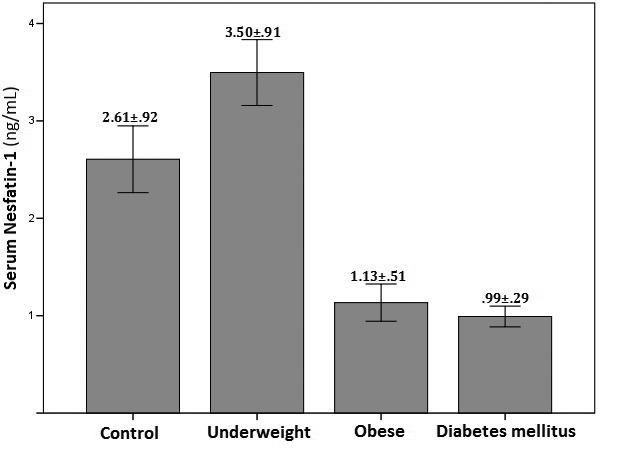
Mean serum nefatin-1 levels in the four study groups. Error bars indicate 95% confidence interval. Data are presented as mean ± standard deviation.
The ROC curves of serum nesfatin-1 levels in differentiating normal individuals from underweight, obese and diabetic subjects are shown in Figure 2. The corresponding under-the-curve areas were 0.74 (95% confidence interval, 0.61-0.86; P = 0.002), 0.93 (95% confidence interval, 0.87-0.99; P < 0.001) and 0.97 (95% confidence interval, 0.94-1; P < 0.001); and the optimal cut-off values were 3.05 ng/mL (sensitivity, 63.3%, specificity, 66.7%), 1.70 ng/mL (sensitivity, 83.3%, specificity, 83.3%), and 1.45 ng/mL (sensitivity, 86.7%, specificity, 86.7%), respectively.
Figure 2.

Receiver operator characteristics curves of the mean serum nesfatin-1 levels in differentiation healthy normal-weight individuals from underweight, obese, and diabetic subjects.
The mean serum nesfatin-1 level did not differ significantly between males and females (2.05 ± 1.22 ng/mL and 2.06 ± 1.31 ng/mL, P = 0.97).
No significant correlation was found between the serum nesfatin-1 level and age (r = 0.04, P = 0.71), nor between the serum sefatin-1 level and BMI (r = 0.42, P = 0.46).
In the present study, the fasting serum nesfatin-1 level was measured in four groups consisting of healthy normal-weight individuals, healthy underweight subject, otherwise healthy obese individuals, and newly diagnosed patients with type 2 DM. According to our results, the mean level of serum nesfatin-1 was significantly higher in normal subjects than in both obese and diabetic groups, but significantly lower than that in underweight persons. At the same time, no significant difference was found between the obese and diabetic groups.
DISCUSSION
Nesfatin-1 is an 82 aminoacid neuropeptide that has been found very effective in reducing appetite when administered in the brain and peritoneal cavity of rats (6).
In a recent study by Dogan et al. (15), the level of serum nesfatin-1 was measured in morbidly obese patients after laparoscopic sleeve gastrectomy. According to their findings, the level of serum nesfatin-1 increased gradually after the operation. The authors finally concluded that, in line with our findings, nesfatin-1 has important anorexigenic effects. In another study by Ustabaş Kahraman et al. (21) on malnourished children, the authors concluded that nesfatin-1 plays a significant role in the maintenance of nutritional status and regulating food intake.
Increased serum nesfatin-1 level in underweight individuals found in our series was also confirmed in another report by Kaba et al. (22), who showed a significantly higher level of serum nesfatin-1 in underweight children compared to that in normal-weight controls. In a study by Burgos et al. (23), it was shown that nesfatin-1 is also involved in cancer anorexia-cachexia syndrome by reducing calorie intake in these patients.
To the best of the authors’ knowledge, this is the first study that compares levels of serum nesfatin-1 between healthy, normal weight human subjects and those with abnormal weight conditions and diabetic patients.
Animal-model studies have reported both central and peripheral activities of nesfatin-1 in controlling appetite and food intake. These anorexigenic actions are believed to be exerted through the interaction with brain transmitters regulating food intake and metabolic factors (24), inducing sleep disturbances (25), changing drinking behavior (26), a glucose control effect by direct actions on the pancreas tissue (27, 28) and insulin signaling (29), a regulatory effect on adipogenesis (30), inducing a dopaminergic effect (31), modulation of intestinal absorption (32), and its influence on gastric emptying, gastric acid secretion and gastroduodenal motility (33, 34).
Besides the appetite-suppressing effects of nesfatin-1 on the body weight, the mentioned interactions between this peptide and the pancreas, and its regulatory consequences on insulin release could implicate a potential role in the pathogenesis of diabetes mellitus. A significantly lower mean serum nesfatin-1 level in our diabetic group compared to controls supports this assumption.
In line with this finding, Li et al. (35) also showed that fasting nesfatin-1 was significantly lower in patients with type 2 DM compared to that in healthy subjects. They suggested that this difference might underlie a significant role of serum nesfatin-1 in diabetic hyperphagia.
In another recent study, Ding et al. (17) also showed that the serum nesfatin-1 level is reduced in type 2 DM patients with peripheral arterial disease. In a study by Shimizu et al. (36), they showed that nesfatin-1 plays a role in the development of insulin resistance and fat deposition in the liver, independent of effects on energy intake in rats.
As mentioned before, we did not find a significant difference between obese subjects and diabetic patients in terms of the mean serum nesfatin-1 level. This may indicate a common pathological context for both conditions, as suggested by another animal study in this regard. It should be noted, however, that while type 2 DM is not necessarily associated with obesity, overweight is a very well known risk factor in this regard. But at the same time, we did not find a significant correlation between body mass index and the serum level of nesfatin-1 in the present study. The related reports in the literature are also conflicting (37). A possible explanation for this controversy may be the complexity of the pathogenesis of DM. Indeed, many other factors may play a role in this regard, making drawing a solid conclusion regarding the diabetogenic role of nesfatin-1 difficult (24, 38).
The serum nesfatin-1 levels in healthy and diabetic patients vary significantly in different series, from 0 to 9.7 ng/mL (17, 39). Using different ELISA kits, racial differences, and the effect of age all have been suggested as possible contributors to this heterogeneity (35).
Using ROC curve analysis, we suggested optimal cut-off values for serum nesfatin-1 in differentiating the three studied groups from normal weight, healthy subjects. Although due to the complexity of the issue, the suggested values need to be verified in further, larger studies, they can be found useful for preventive and therapeutic purposes.
In conclusion, this study showed that there are significant differences between normal-weight healthy subjects, healthy underweight persons, otherwise healthy obese people and diabetic patients in terms of serum nesfatin-1 level. In conformity with some previous reports in animal models and rare human studies, this peptide may play a pivotal role in the pathogenesis of both weight-related abnormalities and type 2 DM.
Conflict of interest
The authors declare that they have no conflict of interest.
References
- 1.Oh IS, Shimizu H, Satoh T, Okada S, Adachi S, Inoue K, Eguchi H, Yamamoto M, Imaki T, Hashimoto K, Tsuchiya T, Monden T, Horiguchi K, Yamada M, Mori M. Identification of nesfatin-1 as a satiety molecule in the hypothalamus. Nature. 2006;443(7112):709–712. doi: 10.1038/nature05162. [DOI] [PubMed] [Google Scholar]
- 2.Mohan H, Gasner M, Ramesh N, Unniappan S. Ghrelin, ghrelin-O-acyl transferase, nucleobindin-2/nesfatin-1 and prohormone convertases in the pancreatic islets of Sprague Dawley rats during development. J Mol Histol. 2016;47(3):325–336. doi: 10.1007/s10735-016-9673-4. [DOI] [PubMed] [Google Scholar]
- 3.Nakata M, Gantulga D, Santoso P, Zhang B, Masuda C, Mori M, Okada T, Yada T. Paraventricular NUCB2/nesfatin-1 supports oxytocin and vasopressin neurons to control feeding behavior and fluid balance in male mice. Endocrinology. 2016;157(6):2322–2332. doi: 10.1210/en.2015-2082. [DOI] [PubMed] [Google Scholar]
- 4.Ozcan M, Gok ZB, Kacar E, Serhatlioglu I, Kelestimur H. Nesfatin-1 increases intracellular calcium concentration by protein kinase C activation in cultured rat dorsal root ganglion neurons. Neurosci Lett. 2016;619:177–181. doi: 10.1016/j.neulet.2016.03.018. [DOI] [PubMed] [Google Scholar]
- 5.Prinz P, Goebel-Stengel M, Teuffel P, Rose M, Klapp BF, Stengel A. Peripheral and central localization of the nesfatin-1 receptor using autoradiography in rats. Biochem Biophys Res Commun. 2016;470(3):521–527. doi: 10.1016/j.bbrc.2016.01.113. [DOI] [PubMed] [Google Scholar]
- 6.Stengel A, Goebel M, Tache Y. Nesfatin-1: a novel inhibitory regulator of food intake and body weight. Obes Rev. 2011;12(4):261–271. doi: 10.1111/j.1467-789X.2010.00770.x. [DOI] [PMC free article] [PubMed] [Google Scholar]
- 7.Stengel A, Tache Y. Role of brain NUCB2/nesfatin-1 in the regulation of food intake. Curr Pharm Des. 2013;19(39):6955–6959. doi: 10.2174/138161281939131127125735. [DOI] [PubMed] [Google Scholar]
- 8.Yilmaz MS, Altinbas B, Guvenc G, Erkan LG, Avsar O, Savci V, Kucuksen DU, Arican I, Yalcin M. The role of centrally injected nesfatin-1 on cardiovascular regulation in normotensive and hypotensive rats. Auton Neurosci. 2015;193:63–68. doi: 10.1016/j.autneu.2015.07.009. [DOI] [PubMed] [Google Scholar]
- 9.Mazza R, Gattuso A, Filice M, Cantafio P, Cerra MC, Angelone T, Imbrogno S. Nesfatin-1 as a new positive inotrope in the goldfish (Carassius auratus) heart. Gen Comp Endocrinol. 2015;224:160–167. doi: 10.1016/j.ygcen.2015.08.003. [DOI] [PubMed] [Google Scholar]
- 10.Feijoo-Bandin S, Rodriguez-Penas D, Garcia-Rua V, Mosquera-Leal A, Gonzalez-Juanatey JR, Lago F. Nesfatin-1: a new energy-regulating peptide with pleiotropic functions. Implications at cardiovascular level. Endocrine. 2016;52(1):11–29. doi: 10.1007/s12020-015-0819-z. [DOI] [PubMed] [Google Scholar]
- 11.Hofmann T, Ahnis A, Elbelt U, Rose M, Klapp BF, Stengel A. NUCB2/nesfatin-1 Is Associated with Elevated Levels of Anxiety in Anorexia Nervosa. PLoS One. 2015;10(7) doi: 10.1371/journal.pone.0132058. e0132058. [DOI] [PMC free article] [PubMed] [Google Scholar]
- 12.Hofmann T, Elbelt U, Ahnis A, Rose M, Klapp BF, Stengel A. Sex-specific regulation of NUCB2/nesfatin-1: Differential implication in anxiety in obese men and women. Psychoneuroendocrinology. 2015;60:130–137. doi: 10.1016/j.psyneuen.2015.06.014. [DOI] [PubMed] [Google Scholar]
- 13.Tohma Y, Akturk M, Altinova A, Yassibas E, Cerit ET, Gulbahar O, Arslan M, Sanlier N, Toruner F. Circulating Levels of Orexin-A, Nesfatin-1, Agouti-Related Peptide, and Neuropeptide Y in Patients with Hyperthyroidism. Thyroid. 2015;25(7):776–783. doi: 10.1089/thy.2014.0515. [DOI] [PubMed] [Google Scholar]
- 14.Stengel A, Tache Y. Minireview: nesfatin-1--an emerging new player in the brain-gut, endocrine, and metabolic axis. Endocrinology. 2011;152(11):4033–4038. doi: 10.1210/en.2011-1500. [DOI] [PMC free article] [PubMed] [Google Scholar]
- 15.Dogan U, Bulbuller N, Cakir T, Habibi M, Mayir B, Koc U, Aslaner A, Ellidag HY, Gomceli I. Nesfatin-1 hormone levels in morbidly obese patients after laparoscopic sleeve gastrectomy. Eur Rev Med Pharmacol Sci. 2016;20(6):1023–1031. [PubMed] [Google Scholar]
- 16.Celik F, Belviranli M, Okudan N. Circulating levels of leptin, nesfatin-1 and kisspeptin in postmenopausal obese women. Arch Physiol Biochem. 2016;122(4):195–199. doi: 10.3109/13813455.2016.1171365. [DOI] [PubMed] [Google Scholar]
- 17.Ding S, Qu W, Dang S, Xie X, Xu J, Wang Y, Jing A, Zhang C, Wang J. Serum nesfatin-1 is reduced in type 2 diabetes mellitus patients with peripheral arterial disease. Med Sci Monit. 2015;21:987–991. doi: 10.12659/MSM.892611. [DOI] [PMC free article] [PubMed] [Google Scholar]
- 18.Xia Z, Wang G, Li H, Hu C, Wang Q, Li A, Zhao E, Shuai X, Wang J, Cai K, Tao K, Wang G. Influence of bariatric surgery on the expression of nesfatin-1 in rats with type 2 diabetes mellitus. Curr Pharm Des. 2015;21(11):1464–1471. doi: 10.2174/1381612821666141219125527. [DOI] [PubMed] [Google Scholar]
- 19.Lee WJ, Chen CY, Ser KH, Chong K, Chen SC, Lee PC, Liao YD, Lee SD. Differential influences of gastric bypass and sleeve gastrectomy on plasma nesfatin-1 and obestatin levels in patients with type 2 diabetes mellitus. Curr Pharm Des. 2013;19(32):5830–5835. doi: 10.2174/13816128113198880010. [DOI] [PubMed] [Google Scholar]
- 20.Stengel A. Nesfatin-1 - More than a food intake regulatory peptide. Peptides. 2015;72:175–183. doi: 10.1016/j.peptides.2015.06.002. [DOI] [PubMed] [Google Scholar]
- 21.Ustabas Kahraman F, Vehapoglu A, Ozgen IT, Terzioglu S, Cesur Y, Dundaroz R. Correlation of Brain Neuropeptide (Nesfatin-1 and Orexin-A) Concentrations with Anthropometric and Biochemical Parameters in Malnourished Children. J Clin Res Pediatr Endocrinol. 2015;7(3):197–202. doi: 10.4274/jcrpe.1930. [DOI] [PMC free article] [PubMed] [Google Scholar]
- 22.Kaba S, Karaman K, Komuroglu U, K AB, Demir N, Kocaman S, Dogan M, Ceylan N. Role of circulating nesfatin-1 in the underweight children with poor appetite. Eur Rev Med Pharmacol Sci. 2015;19(24):4703–4706. [PubMed] [Google Scholar]
- 23.Burgos JR, Iresjo BM, Smedh U. MCG101-induced cancer anorexia-cachexia features altered expression of hypothalamic Nucb2 and Cartpt and increased plasma levels of cocaine- and amphetamine-regulated transcript peptides. Oncol Rep. 2016;35(4):2425–2430. doi: 10.3892/or.2016.4558. [DOI] [PubMed] [Google Scholar]
- 24.Stengel A, Mori M, Tache Y. The role of nesfatin-1 in the regulation of food intake and body weight: recent developments and future endeavors. Obes Rev. 2013;14(11):859–870. doi: 10.1111/obr.12063. [DOI] [PMC free article] [PubMed] [Google Scholar]
- 25.Gonnissen HK, Adam TC, Hursel R, Rutters F, Verhoef SP, Westerterp-Plantenga MS. Sleep duration, sleep quality and body weight: parallel developments. Physiol Behav. 2013;121:112–116. doi: 10.1016/j.physbeh.2013.04.007. [DOI] [PubMed] [Google Scholar]
- 26.Yosten GL, Redlinger L, Samson WK. Evidence for a role of endogenous nesfatin-1 in the control of water drinking. J Neuroendocrinol. 2012;24(7):1078–1084. doi: 10.1111/j.1365-2826.2012.02304.x. [DOI] [PubMed] [Google Scholar]
- 27.Mohan H, Unniappan S. Ontogenic pattern of nucleobindin-2/nesfatin-1 expression in the gastroenteropancreatic tissues and serum of Sprague Dawley rats. Regul Pept. 2012;175(1-3):61–69. doi: 10.1016/j.regpep.2012.02.006. [DOI] [PubMed] [Google Scholar]
- 28.Riva M, Nitert MD, Voss U, Sathanoori R, Lindqvist A, Ling C, Wierup N. Nesfatin-1 stimulates glucagon and insulin secretion and beta cell NUCB2 is reduced in human type 2 diabetic subjects. Cell Tissue Res. 2011;346(3):393–405. doi: 10.1007/s00441-011-1268-5. [DOI] [PubMed] [Google Scholar]
- 29.Nakata M, Manaka K, Yamamoto S, Mori M, Yada T. Nesfatin-1 enhances glucose-induced insulin secretion by promoting Ca(2+) influx through L-type channels in mouse islet beta-cells. Endocr J. 2011;58(4):305–313. doi: 10.1507/endocrj.k11e-056. [DOI] [PubMed] [Google Scholar]
- 30.Ramanjaneya M, Addison M, Randeva HS. Possible role of NUCB2/nesfatin-1 in adipogenesis. Curr Pharm Des. 2013;19(39):6976–6980. doi: 10.2174/138161281939131127142959. [DOI] [PubMed] [Google Scholar]
- 31.Chen X, Shu X, Cong ZK, Jiang ZY, Jiang H. Nesfatin-1 acts on the dopaminergic reward pathway to inhibit food intake. Neuropeptides. 2015;53:45–50. doi: 10.1016/j.npep.2015.07.004. [DOI] [PubMed] [Google Scholar]
- 32.Ramesh N, Mortazavi S, Unniappan S. Nesfatin-1 stimulates cholecystokinin and suppresses peptide YY expression and secretion in mice. Biochem Biophys Res Commun. 2016;472(1):201–208. doi: 10.1016/j.bbrc.2016.02.095. [DOI] [PubMed] [Google Scholar]
- 33.Goebel-Stengel M, Wang L, Stengel A, Tache Y. Localization of nesfatin-1 neurons in the mouse brain and functional implication. Brain Res. 2011;1396:20–34. doi: 10.1016/j.brainres.2011.04.031. [DOI] [PMC free article] [PubMed] [Google Scholar]
- 34.Atsuchi K, Asakawa A, Ushikai M, Ataka K, Tsai M, Koyama K, Sato Y, Kato I, Fujimiya M, Inui A. Centrally administered nesfatin-1 inhibits feeding behaviour and gastroduodenal motility in mice. Neuroreport. 2010;21(15):1008–1011. doi: 10.1097/WNR.0b013e32833f7b96. [DOI] [PubMed] [Google Scholar]
- 35.Li QC, Wang HY, Chen X, Guan HZ, Jiang ZY. Fasting plasma levels of nesfatin-1 in patients with type 1 and type 2 diabetes mellitus and the nutrient-related fluctuation of nesfatin-1 level in normal humans. Regul Pept. 2010;159(1-3):72–77. doi: 10.1016/j.regpep.2009.11.003. [DOI] [PubMed] [Google Scholar]
- 36.Shimizu H, Tanaka M, Osaki A. Transgenic mice overexpressing nesfatin/nucleobindin-2 are susceptible to high-fat diet-induced obesity. Nutr Diabetes. 2016;6:e201. doi: 10.1038/nutd.2015.42. [DOI] [PMC free article] [PubMed] [Google Scholar]
- 37.Zhang Z, Li L, Yang M, Liu H, Boden G, Yang G. Increased plasma levels of nesfatin-1 in patients with newly diagnosed type 2 diabetes mellitus. Exp Clin Endocrinol Diabetes. 2012;120(2):91–95. doi: 10.1055/s-0031-1286339. [DOI] [PubMed] [Google Scholar]
- 38.Wiedmer P, Nogueiras R, Broglio F, D’Alessio D, Tschop MH. Ghrelin, obesity and diabetes. Nat Clin Pract Endocrinol Metab. 2007;3(10):705–712. doi: 10.1038/ncpendmet0625. [DOI] [PubMed] [Google Scholar]
- 39.Taji Tabas A, Mogharnasi M. The effect of 10 weeks resistance exercise training on serum levels of Nesfatin-1 and Insulin Resistance Index in women with type 2 diabetes. Iranian Journal of Diabetes and Lipid Disorders. 2016;14(3):179–188. [Google Scholar]