


Figure 2.
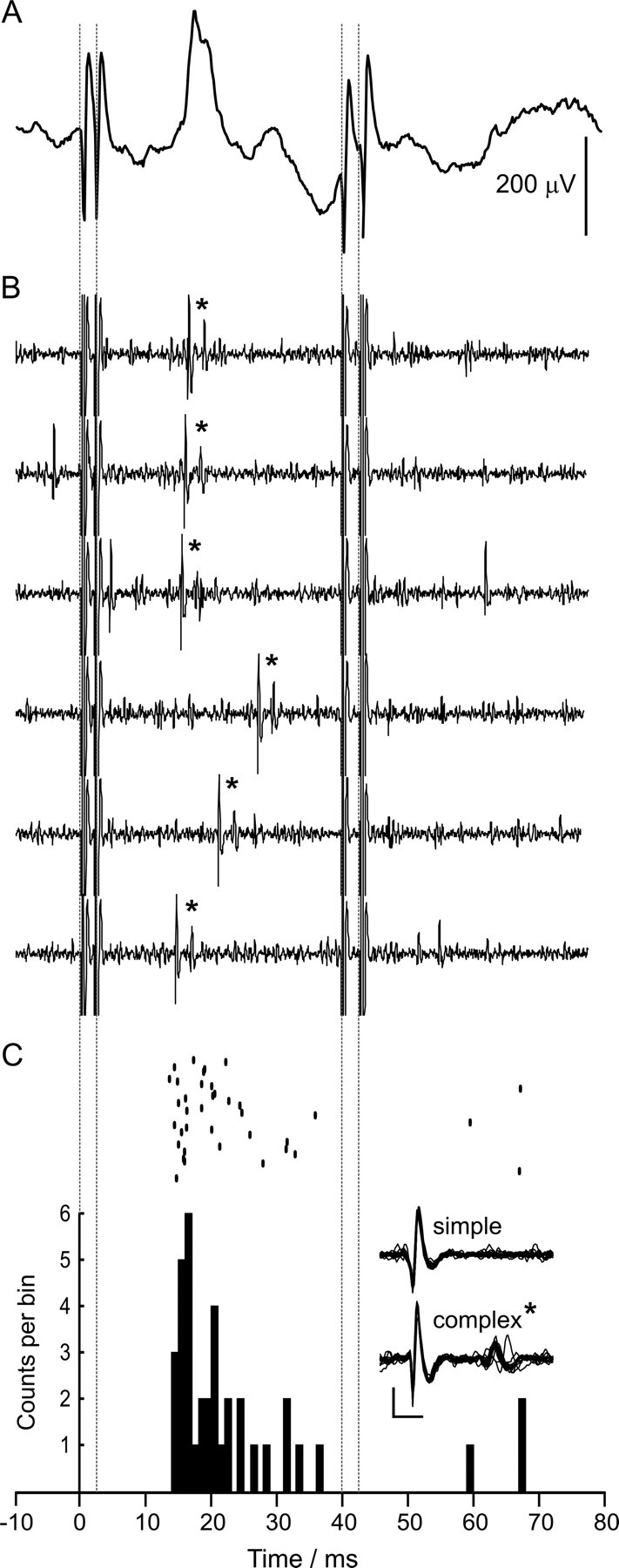
Periocular-evoked climbing fiber activity in a periocular microzone. Two pairs of stimuli are presented 40 ms apart (dotted lines, stimulus artifacts in A and B), an example of low-intensity periocular stimulation (see Materials and Methods, Electrical stimulation). A, An example of a periocular-evoked CFP from a periocular microzone (average of 20 trials, onset latency 14 ms). B, Single trials from a Purkinje cell recording made at the same location; complex spikes are evoked by the first pair of stimuli and are indicated by an asterisk. C, Raster and peristimulus time histogram for complex spikes of the same Purkinje cell showing strongly evoked activity that mirrors the time course of the LFP (50 trials, bin width of 1 ms). Overlays from 20 simple and complex spikes from the recording are shown (calibration: 1 ms, 0.5 mV). Note that the evoked climbing fiber activity is characteristically diminished after second pair of stimuli. In this example, stimulation of the forelimbs did not evoke a climbing fiber LFP or complex spikes in the Purkinje cell (data not shown).