


Figure 1.
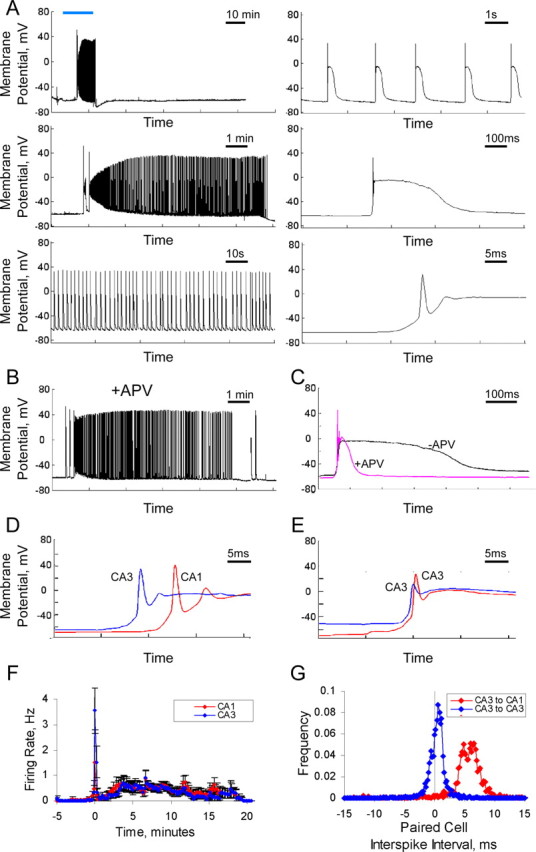
Electrophysiological characteristics of chemLTP induction. A, Whole-cell recording of a CA1 pyramidal cell held in current clamp during a chemLTP protocol. LTP-inducing solution was applied at the time indicated by the blue bar. Note the lack of activity after the washout of LTP-inducing solution. This is one of several critical differences between this LTP induction protocol and an epilepsy induction protocol (for additional discussion, see Kopec et al., 2006). The panels show activity at different time scales. B, C, ChemLTP in the presence of APV. B, In the presence of APV, cells produce action potentials with a similar frequency and count, indicating that the failed induction of synaptic potentiation is not attributable to failed spontaneous activity. C, APV reduces the long depolarization after each action potential. D–G, Paired whole-cell recordings during chemLTP reveal that the spontaneous activity follows a stereotyped consistent firing pattern. CA3 cells fire synchronously and precede cells in the CA1 region. D, E, Single period showing that the CA3 cell fires ∼7 ms before the CA1 cell, and two CA3 pyramidal cells fire nearly simultaneously. F, Average spike rate during chemLTP for CA1 and CA3 cells (n = 5 each). Time relative to chemLTP induction. G, Frequency histogram of interspike intervals. The interval taken between consecutive spikes in a paired cell recording is shown. CA1-CA3, n = 5 cell pairs, 3261 interspike events; CA3-CA3, n = 5 cell pairs, 2757 interspike events. Error bars represent SEM. One CA3-CA3 cell pair and one CA1-CA3 cell pair showed evidence of a direct synaptic connection and yielded data equivalent to the population. This separation between presynaptic and postsynaptic action potentials corresponds well with optimal timing to induce spike timing-dependent plasticity (Magee and Johnston, 1997; Markram et al., 1997; Bi and Poo, 1998) and may explain how a 0.5 Hz stimulus can lead to stable potentiation; the large NMDA current during each event may also be sufficient to drive this potentiation.