


Figure 3.
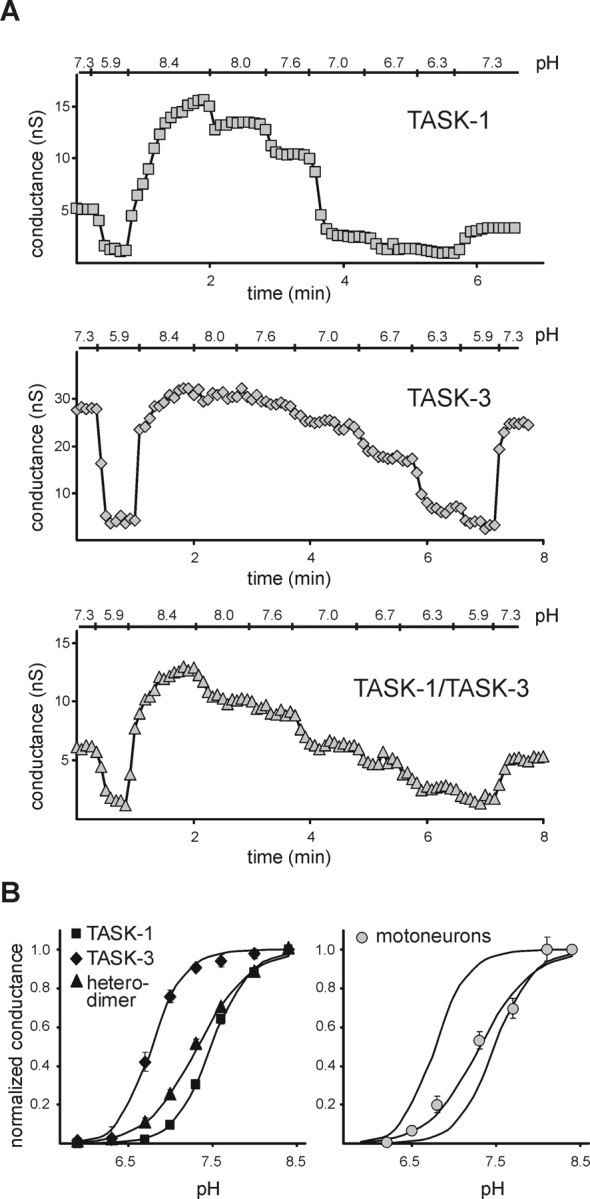
The pH sensitivity of TASK-like conductance in motoneurons resembles that of TASK-1/TASK-3 tandem heterodimeric channels. HEK 293 cells were transfected with cloned rat TASK-1, TASK-3, or tandem heterodimeric TASK-1/TASK-3 and TASK-3/TASK-1 constructs. A, Time series illustrating effects of changes in extracellular pH on whole-cell conductance (measured between -130 and -60 mV) in representative cells expressing TASK-1 (top), TASK-3 (middle), and TASK-1/TASK-3 (bottom). B, Left, pH sensitivity curves for TASK-1 (squares), TASK-3 (diamonds), and tandem heterodimers (pooled data from TASK-1/TASK-3 and TASK-3/TASK-1; triangles). Slope conductance at each bath pH was normalized to the total pH-sensitive conductance (pH 8.4-5.9) in individual cells and averaged; data points (mean ± SEM) were fitted with logistic equations (solid lines). The pK of the tandem heterodimer TASK channel constructs (pK ∼7.3; n = 11) was closer to that of TASK-1 (pK ∼7.5; n = 6) than to that of TASK-3 (pK ∼6.8; n = 5). Right, The pH sensitivity of motoneuronal TASK-like current was determined in hypoglossal motoneurons recorded in brainstem slices from neonatal rats (Talley et al., 2000). The pH sensitivity of the native motoneuronal TASK-like currents (circles) overlays the fitted curve of the pH sensitivity of the tandem heterodimer TASK channels, with a pK of ∼7.4 (n = 9).