


Fig. 2.
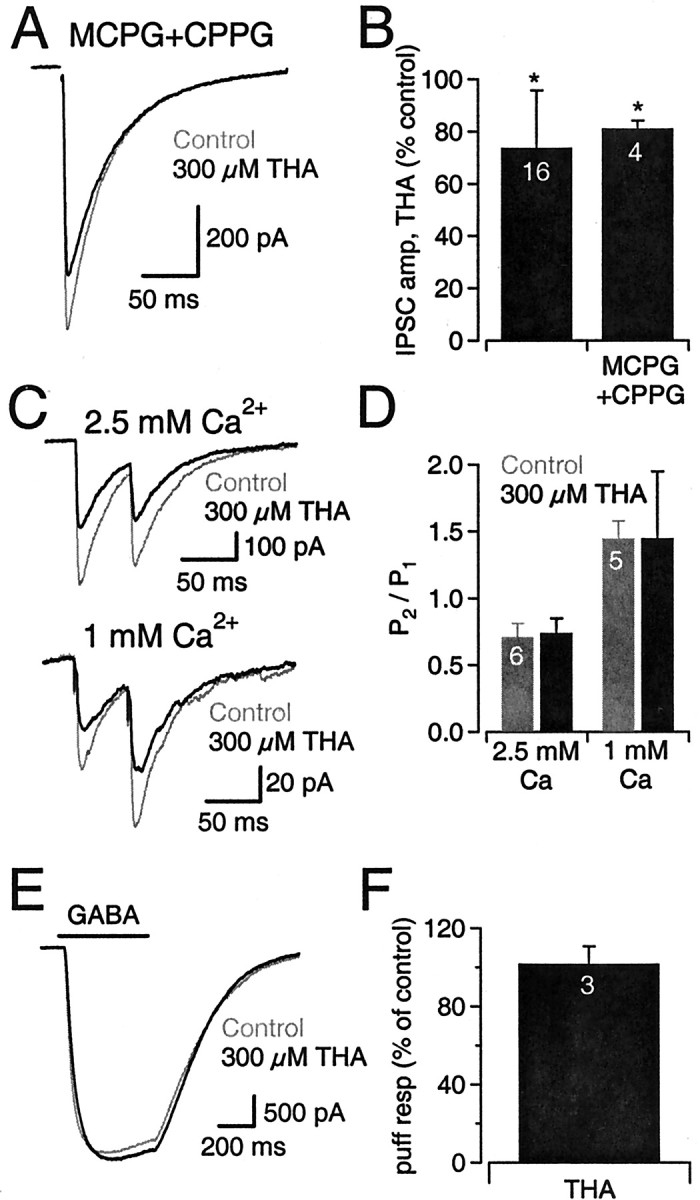
THA does not affect release probability or postsynaptic GABAA receptors. A, In the presence of group I and II and group III metabotropic glutamate receptor antagonists (MCPG, 500 μm; and CPPG, 200 μm, respectively), THA still reduced evoked IPSCs.B, Bar graph comparing the effects of THA alone and in the presence of mGluR antagonists. amp, Amplitude.C, Effects of 300 μm THA on IPSCs elicited by a pair of stimuli (50 msec interval). Paired pulse depression was observed in normal (2.5 mm) calcium (top), and paired pulse facilitation was observed in low (1 mm) calcium (bottom). THA (black) reduced IPSC amplitudes compared with control (gray) but did not affect the paired pulse ratio. D, Summary bar graph showing that THA (black bars) affected neither paired pulse depression nor facilitation. E, Currents elicited in a pyramidal cell by puff application of GABA in control solution (gray) and in the presence of 300 μm THA (black; THA was included in the bath and puffer solutions). F, Summary graph showing that THA did not affect GABAA receptors on pyramidal cells. In all bar graphs, white numbers indicate the numbers of cells tested, and error bars indicate SD.