


Fig. 1.
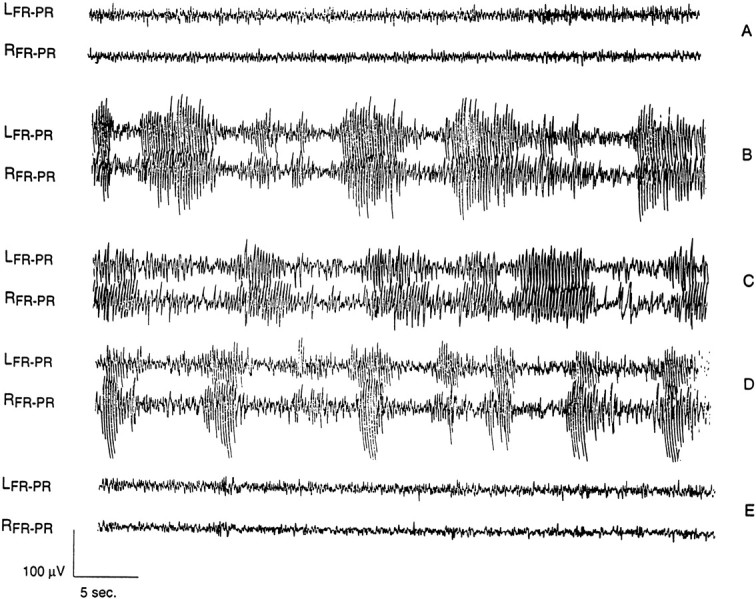
Electrocorticography (ECoG) of mGluR4−/− and mGluR4+/+ mice given either GBL or PTZ. In all ECoG figuresLFR-PR andRFR-PR represent the ECoG recording from the left and right frontoparietal electrodes, respectively. A , Baseline ECoG in a mGluR4−/− mouse. There was no difference between mGluR4+/+ and mGluR4−/− mice in baseline recordings.B, ECoG in a mGluR4+/+ mouse 20 min after 100 mg/kg of GBL. C, ECoG in a mGluR4−/− mouse 20 min after 100 mg/kg of GBL.D, ECoG in an mGluR4+/+ mouse 20 min after 30 mg/kg of PTZ. E, ECoG in an mGluR4−/− mouse 20 min after 30 mg/kg of PTZ. The dose of PTZ was the CD100 in the absence seizure dose–response studies. All drugs were given intraperitoneally. Administration of PTZ and GBL to mGluR4+/+ mice and of GBL to mGluR4−/− mice resulted in the bilaterally synchronous SWD shown. These paroxysms were associated with absence-like behavior in all of the mGluR4−/− mice that were tested, namely facial myoclonus, vibrissal twitching, and arrest of motor activity. Administration of (−) baclofen (20 mg/kg, i.p.) produced EEG and behavioral findings similar to those shown for PTZ and GBL in both mGluR4−/− and mGluR4+/+ mice. In addition to being refractory to the PTZ-induced absence seizures as shown in E, mGluR4−/− mice also were resistant to bicuculline- and picrotoxin-induced absence seizures.