



Abstract
Coral reefs are suffering on a global scale due to human impacts, thereby necessitating cryopreservation efforts. The objective of this study was to develop a suitable vitrification and laser warming protocol for larvae of the scleractinian coral Seriatopora caliendrum, which inherit their dinoflagellate algal symbionts vertically. Toxicity experiments were conducted with the cryoprotectants (CPAs) ethylene glycol (EG), propylene glycol (PG), dimethyl sulfoxide (DMSO), glycerol (GLY), and methanol (METH; listed in order from least to most toxic), and larvae were subjected to vitrification and laser warming using 2 M EG + 1 M PG and 2 M EG + 1 M DMSO. Vitrification and laser warming (300 V, 10 ms pulse width, 2 mm beam diameter) using a vitrification solution of 2 M EG + 1 M PG, 40% w/v Ficoll, and 10% v/v gold nanobars (GNB) at a final concentration of 1.2 × 10¹⁸ GNB/mL and a characteristic wavelength of 535 nm resulted in larvae with vitality and settlement percentages of 55 and 9%, respectively. This represents the first successful instance of cryopreservation of coral larvae that proceeded to settle upon warming, and suggests that the vitrification and ultra-fast laser warming approach may be applicable to other threatened marine species.
Subject terms: Reproductive biology, Cell biology
Introduction
Coral reefs are ecologically and geologically complex marine communities that host a wealth of biodiversity and provide over US$375 billion per year in goods and services1,2. Unfortunately, coral reefs are suffering due to numerous anthropogenic insults that manifest across local and global scales3,4. Local threats, including marine pollution5,6, and global threats like climate change (and particularly rising seawater temperatures)7 have led to the need for better management aimed at conserving these fragile ecosystems8. Gamete cryopreservation (i.e., the use of extremely low temperatures to stabilize biologically active material indefinitely) is one means of conserving living coral tissues9–12, and we currently have the capacity to cryopreserve coral sperm10,13,14. Ideally, coral oocytes, or even larvae, could be cryopreserved, but limited success has been met with such materials, potentially due to corals’ poorly permeable membranes and high lipid content15–17. Oocytes of gorgonian corals, however, including Junceella juncea, J. fragilis, and Ellisella robusta, have been successfully cryopreserved using vitrification18,19, which has become increasingly popular in recent years with otherwise difficult-to-cryopreserve tissues20. Upon infiltrating the tissues with a high concentration of cryoprotectants (CPAs), the biological material is then supercooled at an ultra-fast cooling rate that thwarts detrimental intracellular ice formation21,22. To avoid recrystallization and possible damage during thawing, it is of equal importance to thaw rapidly; this can be achieved using laser warming23. Recent breakthroughs in vitrification and laser warming technologies have enabled the successful cryopreservation of zebrafish embryos24 and symbiont-free coral larvae25 for the first time. We hypothesized that this approach could be used to cryopreserve the larvae of the common Indo-Pacific reef coral Seriatopora caliendrum, which contain symbiotic dinoflagellates (family Symbiodinaceae) inherited from the parental colony (Fig. 1).
Figure 1.

A specimen of Seriatopora caliendrum sampled by SCUBA divers (a), the coral larvae hatchery (b), and details of the water flow throughout the hatchery (c).
Methods
Coral larval collection
SCUBA divers collected S. caliendrum (Fig. 1a) colonies at 10-m depth from the reef flats of Kenting National Park (KNP), Nanwan, Taiwan (GPS coordinates: 21°56′N, 120°44′E) upon obtaining approval from the KNP management office (permit number:10803191125) in 2018 and 2019. The corals were transported immediately to the husbandry center of the National Museum of Marine Biology and Aquarium and kept individually in 5-L tanks with continuous seawater flow (Fig. 1b) at 25 °C. On the upper part of each tanks there was an outlet that allowed seawater to exit. We placed handmade traps consisting of tubes with nets on the lower faces (Fig. 1c) beneath each outlet. The larvae were naturally spawned between 4–6 AM. After spawning, traps containing coral larvae (Fig. 2) were transported to the laboratory, and the larvae were washed thrice with filtered seawater (FSW) prepared by filtering raw seawater through a 47- mm glass fiber filter with mesh size 0.2 µm (PALL, USA) via a Rocker 300 (Taiwan) vacuum pump. Pelagic phase larvae were used within six hours of release.
Figure 2.
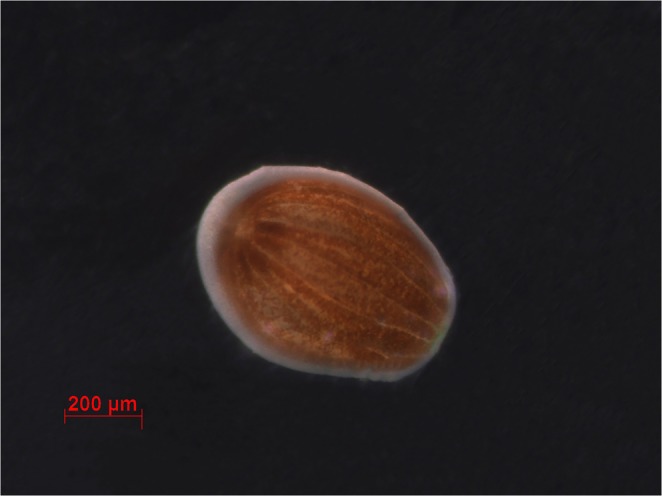
A Seriatopora caliendrum larva used for vitrification and laser warming.
(EG), (PG), dimethyl sulfoxide (DMSO), (GLY), and (METH).
CPA toxicity
Larvae were incubated in 1 ml of 0.5, 1, 2, or 3-M concentrations of ethylene glycol (EG; JT Baker, Phillipsburg, USA), propylene glycol (PG; JT Baker), DMSO (Sigma-Aldrich, St. Louis, USA), glycerol (GLY; Darmstadt, Germany), or methanol (METH; Darmstadt) (five larvae per treatment) for 10, 20, or 30 min (n = 3 experiments) at 25 °C and the experiment was repeated three times. After CPA exposure, larvae (including controls incubated in FSW) were washed thrice with FSW, and ATP concentration was measured in one subset (with the others allowed to settle as described below). ATP concentration was measured using a cell viability assay kit (BioThema, Sweden) and a Lumat 9507 luminometer (Berthold Technologies, Germany). Larvae were mixed with 50 µL of light-stable ATP reagent for 3 min, and ATP concentration was estimated as recommended by the manufacturer.
Gold nanobar synthesis
GNB synthesis followed a prior protocol26 and featured preparation of: (1) seed solution; (2) growth solution; and (3) the GNBs themselves. First, 5 mL of 0.1 mM HAuCl4 (Alfa Aeser; Haverhill, USA) were mixed with 5 mL of cetyltrimethylammonium bromide (0.20 M; Sigma-Aldrich). Then, 0.6 mL of 0.01 M NaBH4 solution (Sigma-Aldrich) were added, and the resulting solution was mixed for 20 min, at which point an orange-brown color appeared (indicative of gold nanoparticle formation; i.e., the seed solution). Next, 50 mL of 1 mM HAuCl4 were added to 50 mL of 0.20 M CTAB and stirred for 3 min. Then, 1 mL of 4 × 10⁻³ M was added to the solution and stirred for 10 min. Next, 2 mL of 0.0788 M ascorbic acid (Sigma-Aldrich) were added to the solution; upon stirring, the solution changed from yellow to colorless (indicating reduction of Au(III) to Au(I); i.e., the growth solution). Then, 0.3 mL of seed solution were added to the growth solution, incubated at room temperature (RT) for 2 hr, and centrifuged at 7370 × g for 20 min. The precipitate was re-suspended in 100 mL of Milli-Q water to obtain the GNB colloidal solution. A 2 µL drop of this solution was then loaded onto a single nickel ovular slot (1 × 2 mm) coated with formvar/carbon (Bar-Naor Ltd., Israel) and then air-dried at RT. Digital images were acquired with a Hitachi 600 transmission electron microscope (JEM-1400, JEOL, Japan) connected to a camera system (Gatan digital micrograph) at an accelerating voltage of 82 kV (filament, 56 µA).
Vitrification and laser warming
Based on the CPA toxicity data, two vitrification solutions (VS) were designed; VS1 consisted of 2 M EG, 1 M PG, 40% (w/v) Ficoll, and 10% (v/v) of GNBs in FSW (final concentration of 1.2 × 10¹⁸ particles/mL and an optimized emission wavelength of 535 nm). VS2 consisted of 2 M EG, 1 M DMSO, 40% m/V Ficoll, and 10% v/v of GNBs in (same properties as for VS1) in FSW. Equilibration solutions were prepared by diluting VS solutions at ratios of 1:3 (ES1) and 1:1 (ES2) to create quarter- and half-strength VS solutions respectively. Individual coral larvae were first exposed to a 10-µL drop of ES1 for 4 min, followed by a 10-uL drop of ES2 for 2 min, and then, finally, the VS [0.8 µL; One drop is 0.8 ul, and a S. caliedrum larva is approximately 400 × 400 × 400 um = 0.064 µl (maximum since some shrinkage occurs in VS). Therefore, an 0.8-µl droplet can accommodate a single larval cell], in order to reduce the potential for osmotic shock or other potentially detrimental effects of the VS on the coral larvae (this exposition was conducted at 25 °C). The larva in the final drop was placed on a Kitazato Vitrification Cryotop® (Japan) and plunged into liquid nitrogen (LN2) after 1 min exposure to the VS. A custom-made device was utilized to lower the Cryotop into LN2 and to raise the sample on the aim of a single laser pulse for warming. The vitrified samples were warmed using a bench-top iWeld 980 Series, 60 joule, Nd:YAG infrared laser (LaserStar Technologies Corporation, Riverside, USA). The wavelength of the beam was 1064 nm, and the laser was equipped with a stereomicroscope to allow for the alignment of samples with the laser beam. The laser settings utilized in this study were 300 V and 10 ms pulse width with a 2-mm laser beam diameter. If the sample was vitrified during the warming stage, it was rehydrated at 25 °C in stepwise fashion by transferring the larva to 10 µl of ES2 for 2 min, followed by 10 µl of ES1 for 4 min, and finally FSW.
Larval movement and settlement
Laser-warmed larvae were washed thrice with FSW, and larvae successfully subjected to vitrification and warming without ice crystal formation (verified by naked eye under the laser microscope) were collected individually in a 6-well Petri dish (Alpha Plus, Taiwan). Vitality (percentage of swimming and/or settled larvae over the entire larval sample size) and integrity (([number of swimming and⁄or settled larvae × 1] + [number of intact, immobile larvae × 0.5]))/(number of experimental larvae) × 100) were determined after 0.5, 1, 3, 6, 12, and 24 hr under a SteREO Discovery.V8 (Zeiss, USA) stereomicroscope. Coral larvae could swim and/or settle were scored as 1, with those intact but immobile scored as 0.5.
Statistical analysis
All statistical analyses were undertaken with SPSS (version 17.0; Chicago, IL, USA), and one-sample Kolmogorov-Smirnov tests were used to ensure that the data were normally distributed. One-way ANOVAs were then performed upon confirming homogeneity of variance with Levene’s tests (p > 0.05). When there were differences detected by ANOVA, Tukey’s post-hoc tests were used to identify individual mean differences. All data were presented as mean ± SEM across the three replicates and p values < 0.05 were considered to be significant.
Results
The UV-vis-NIR spectrum of the GNB colloids revealed a peak at ~535 nm (Fig. 3a), presumably corresponding to the longitudinal dipolar localized surface plasmon resonance (LSPR) mode of the GNBs. The peak position, which is quite close to the LSPR band of the spherical gold nanoparticles (13-nm in diameter), indicates that the aspect ratio of the GNBs prepared was close to 1, consistent with the TEM image (Fig. 3b).
Figure 3.
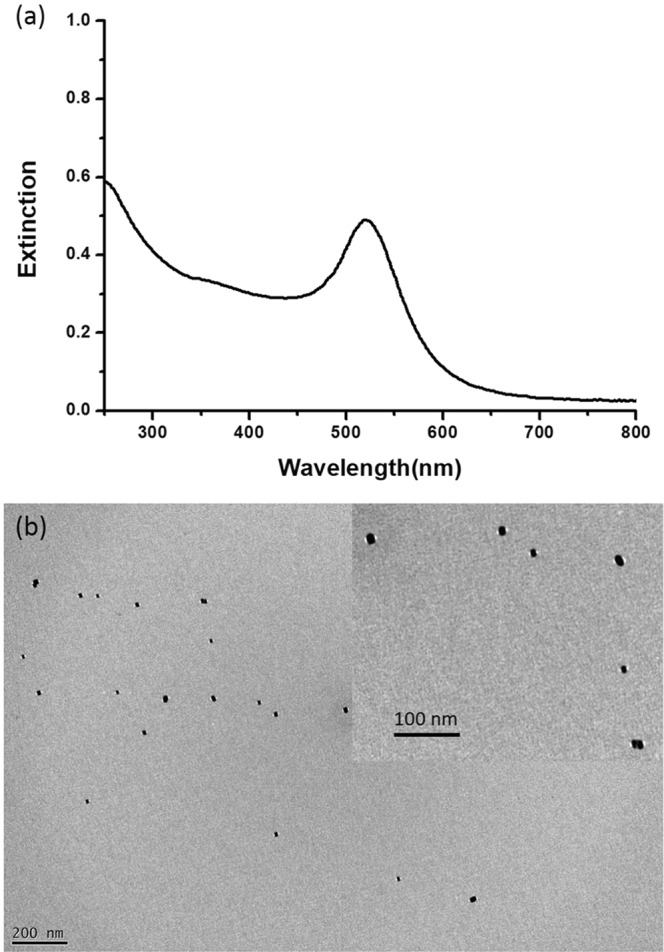
Gold nanobars (GNBs) used for laser warming. (a) The UV-vis-NIR spectrum of the GNB colloids; (b) Transmission electron microscopy (TEM) image of GNBs. Figure of High magnification (100 K) shows in the top-right corner.
Cryoprotectant toxicity towards S. caliendrum larvae generally increased with increasing concentrations and exposure times (Fig. 4), as gauged by larval viability and settlement. ATP is critical to show that larvae maintain the ability to generate ATP upon CPA treatment. Therefore, ATP content was referred to viability. The least toxic CPAs were EG (Fig. 4a; 0.5–2 M), PG (Fig. 4b; 0.5–1 M), and DMSO (Fig. 4c; 0.5–1 M), none of which led to significant changes in these response variables relative to controls after 10 min of exposure. The use of 1 M METH (Fig. 4e; most toxic) and GLY (Fig. 4d; next-to-most toxic), on the other hand, led to significantly lower settlement rates (p < 0.05) after 10 min. The highest settlement rate was achieved upon using 1 M EG: 68 and 59% after 10 and 20 min (Fig. 4a; respectively. Low settlement rates were observed in larvae incubated in 3 M CPA. Regarding the ATP content, 10-min exposures to 0.5, 1, and 2 M of DMSO (Fig. 4c), GLY (Fig. 4d), and METH (Fig. 4e) induced increases in ATP content relative to controls (though the results were not statistically significant; p > 0.05). The same trend occurred after 20 min, except for 1 M, 2 M, and 3 M concentrations of DMSO, GLY, and all CPAs, respectively, after 30 min of exposure (which led to lower ATP content).
Figure 4.

Toxic effects (mean +/− SEM) of different cryoprotectants (CPA) on larval viability (top row of each panel) and settlement rate (bottom row of each panel) of Seriatopora caliendrum larvae: ethylene glycol (EG; a), propylene glycol (PG; 2), DMSO (c), glycerol (GLY; d), and methanol (METH; e). Each CPA was used at concentrations of 0.5, 1, 2, or 3 M for 10, 20, or 30 min. The bars with different numbers and letters on top, respectively, indicate significant differences (Tukey’s p < 0.05) in ATP content and settlement rate, respectively. Viability was referred by ATP content.
The concentration and type of cryoprotectant selected for VS was based on the results of the toxicity study; CPAs that did not elicit a significantly different effect were chosen. Vitrification and laser warming utilizing vitrification solutions VS1 and VS2 resulted in 50% (24/48) and 44% (22/50) of larvae resuming swimming, respectively (Table 1). Of the larvae that resumed swimming, 4 larvae that were vitrified and laser warmed using VS1 settled (8.5% of the initial 48; Fig. 5a,b). Although VS2 scored slightly lower than VS1 in terms of larval integrity (Fig. 5b; 81 and 78% for VS1 and VS2, respectively) and vitality (Fig. 5c; 55 and 50%, respectively) after vitrification and warming, none of the VS2 larvae that were vitrified and laser-warmed settled (Fig. 5d); VS1 was, therefore, superior.
Table 1.
The effects of two vitrification solutions (VS) on coral larval motion, settlement, and morphology after vitrification and laser warming.
| VS used | Total larvae used | Mobile larvae | Settled larvae | Intact, mobile larvae | Damaged larvae |
|---|---|---|---|---|---|
| VS1 | 48 (100%) | 24 (50%) | 4 (8%) | 22 (46%) | 2 (4%) |
| VS2 | 50 (100%) | 22 (44%) | 0 | 24 (48%) | 4 (8%) |
Figure 5.
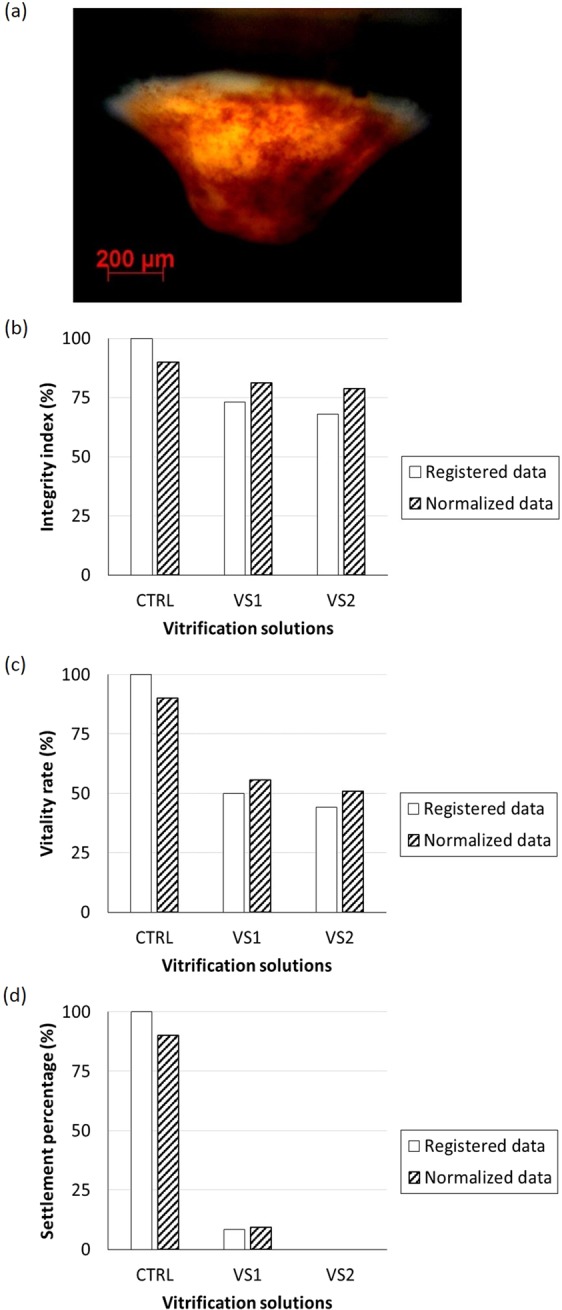
A Seriatopora caliendrum larva (a) that settled 12 hours after vitrification and warming using vitrification solution 1 (VS1). Integrity of vitrified and laser-warmed larvae (b; as an index; see methods), vitality (c; as a rate), and settlement (d; %) represented as registered (raw) and normalized data.
Discussion
This study represents the first successful attempt to cryopreserve coral larvae containing the dinoflagellate endosymbionts that are vital to their survival. It is also important to note that the larvae used in the present study were around twice the size (~450 µm) as coral larvae that have previously been successfully cryopreserved (Fungia scutaria, ~200 µm25). Most Acropora species (the main reef-building coral on coral reefs around the world) have larvae that are around 500 µm or larger in size, so the ability to cryopreserve coral larvae in this size range will be crucial to the ability to preserve the genetics of these species in biorepositories. The coral species used in the present study may therefore be a useful model species for the continued development of laser warming technology for application in threatened coral species worldwide.
We attribute the success achieved in the present study, to some extent, to the use of multiple CPAs, which can act to dampen the toxic effects of either in isolation27. Specifically, EG, PG, and DMSO were mixed into one VS; all three having been used successfully in cryopreservation efforts of other invertebrate material28–30 (including gorgonian coral oocytes18 and coral larvae25). Upon combining EG and PG, a sufficiently viscous VS was generated, which may have permitted the successful vitrification that ultimately led to larvae that were competent upon thawing. During vitrification, it is important to limit the degree of osmotic stress to which samples are exposed during VS equilibration and removal, as such stress can damage cell membranes and lead to cell death31. One means of mitigating this problem is the stepwise addition and removal of VS through the use of equilibration solutions (ES)20. The VS composition, exposure time and equilibration strategy adopted in this study generated an osmotic pressure that allowed an adequate removal of intracellular water content. This dehydration enhanced the ability of the coral larva to survive vitrification and subsequent warming by minimizing intracellular ice crystal formation23. Equilibration strategies have successfully prevented osmotic shock by gradual dehydration in prior works18,32 and may have contributed to the success of the method developed herein.
Droplet volume is another factor that can affect the success of vitrification both during cooling and warming phases; the smaller the droplets of CPAs with sample, the less likely it is that ice crystal will form32,33. Therefore, vitrification drops of only 0.8 uL were used. During warming, the energy of the laser that hits the droplet must be uniform enough to avoid large thermal gradients; otherwise, membrane damages may occur in the sample34. GNBs were used to homogenize the heat distribution of the laser on the droplet, and it was found that the optimal GNB concentration was 1.2 × 10¹⁸ particles/mL (data not shown) in combination with a voltage of 300 V, pulse width of 10 ms, and a laser beam diameter of 2.0 mm. However, light effects on GNBs must also be considered, and GNBs must have a resonance energy in line with the wavelength of the laser beam in order to generate a homogeneous heat dissipation25. The interaction between light and GNBs is given by the surface plasmon resonance35, and prior works have revealed that the maximum optical torque between the laser and GNB wavelengths can cause severe deformation, and even melting, of the latter36. Therefore, a laser with an off-resonant and red-shifted wavelength (1064 nm) was used with GNBs (535 nm); this yielded a sufficient plasmonic resonance for uniformly warming the sample in a way in which GNBs were not damaged.
VS composition and exposure, droplet volume, laser beam voltage and diameter, and GNB resonance energy were all considered in protocol development, though, despite having optimized all such parameters, we surmise that an improved, less invasive protocol could be devised. This stems from our observation that, although a small percentage of cryopreserved larvae could settle and maintain brown coloration for a week thereafter (despite a gradual loss of endosymbionts), they ultimately died. Control larvae were also placed in a petri dish that was then immersed in an aquarium in the husbandry facility, and they survived approximately one month. Perhaps lingering heat damage from the fast-thawing process led to macromolecular damage to the larvae or algal symbionts that could not readily be repaired by the larval recruits. The higher ATP content in the CPA-inoculated larvae could also attest to a prolonged cellular response to the cryoprotectant process, as has been documented in coral oocytes and coral endosymbiont Symbiodinum37–40. Regardless of the explanation, this first study of cryopreserved endosymbiont-bearing larvae constitutes one mechanism by which coral biological material may be conserved over prolonged time periods, and this vitrification approach may prove successful with larvae from other reef-building corals to where “cryo-arks” could be developed for storage of biological material to be later used to reseed marine ecosystems.
Author contributions
C.L. and S.T. conceived the experiment, L.C., K.H., C.L.H., Q.L.L. and L.H.W. conducted the experiment, L.C., C.L., C.S.C., Z.H.W., J.D. and S.T. analysed the results, L.C., S.T. and C.L. wrote the paper.
Competing interests
The authors declare no competing interests.
Footnotes
Publisher’s note Springer Nature remains neutral with regard to jurisdictional claims in published maps and institutional affiliations.
Contributor Information
Sujune Tsai, Email: stsai@mdu.edu.tw.
Chiahsin Lin, Email: chiahsin@nmmba.gov.tw.
References
- 1.de Groot R, et al. Global estimates of the value of ecosystems and their services in monetary units. Ecosyst Ser. 2012;1(1):50–611. doi: 10.1016/j.ecoser.2012.07.005. [DOI] [Google Scholar]
- 2.Lough J. 10th Anniversary Review: a changing climate for coral reefs. J Environ Monit. 2008;10(1):21–29. doi: 10.1039/B714627M. [DOI] [PubMed] [Google Scholar]
- 3.Pet-soede C, Cesar H, Pet J. An economic analysis of blast fishing on Indonesian coral reefs. Environ Conserv. 1999;26(2):83–93. doi: 10.1017/S0376892999000132. [DOI] [Google Scholar]
- 4.Wilkinson, C. Status of Coral Reefs of the World, Australian Institute of Marine Science, Townsville. (2002).
- 5.Hughes T, et al. Coral reefs in the Anthropocene. Nature. 2017;546(7656):82–90. doi: 10.1038/nature22901. [DOI] [PubMed] [Google Scholar]
- 6.Lin C, et al. The effects of aquarium culture on coral oocyte ultrastructure. Sci Rep. 2018;8:15159. doi: 10.1038/s41598-018-33341-x. [DOI] [PMC free article] [PubMed] [Google Scholar]
- 7.Albright R, Cooley S. A review of interventions proposed to abate impacts of ocean acidification on coral reefs. Regional Studies in Marine Science. Reg Stud Mar Sci. 2019;29:100612. doi: 10.1016/j.rsma.2019.100612. [DOI] [Google Scholar]
- 8.Billé R, et al. Taking action against ocean acidification: a review of management and policy. Options Environ Manage. 2013;52(4):761–779. doi: 10.1007/s00267-013-0132-7. [DOI] [PubMed] [Google Scholar]
- 9.Day, J. & McLellan, M. Cryopreservation and Freeze-Drying Protocols. Methods in Molecular Biology, Springer, Totowa. (1995). [DOI] [PubMed]
- 10.Hagedorn M, et al. Preserving and using germplasm and dissociated embryonic cells for conserving caribbean and Pacific coral. PLoS ONE. 2012;7(3):e33354. doi: 10.1371/journal.pone.0033354. [DOI] [PMC free article] [PubMed] [Google Scholar]
- 11.Lin C, Kuo F, Chavanich S, Viyakarn V. Membrane lipid phase transition behavior of oocytes from three gorgonian corals in relation to chilling injury. PLoS ONE. 2014;9(3):e92812. doi: 10.1371/journal.pone.0092812. [DOI] [PMC free article] [PubMed] [Google Scholar]
- 12.Mayfield, A., Tsai, S. & Lin, C. The Coral Hospital. Biopreserv Biobank., 10.1089/bio.2018.0137 (2019). [DOI] [PubMed]
- 13.Viyakarn V, Chavanich S, Chong G, Tsai S, Lin C. Cryopreservation of sperm from the coral Acropora humilis. Cryobiology. 2018;80:130–138. doi: 10.1016/j.cryobiol.2017.10.007. [DOI] [PubMed] [Google Scholar]
- 14.Ohki S, Morita M, Kitanobo S, Kowalska A, Kowalski R. Cryopreservation of Acropora digitifera sperm with use of sucrose and methanol based solution. Cryobiology. 2014;69(1):134–139. doi: 10.1016/j.cryobiol.2014.06.005. [DOI] [PubMed] [Google Scholar]
- 15.Hagedorn M. Preliminary studies of sperm cryopreservation in the mushroom coral, Fungia scutaria. Cryobiology. 2006;52:454–458. doi: 10.1016/j.cryobiol.2006.03.001. [DOI] [PubMed] [Google Scholar]
- 16.Lin C, Tsai S. The effect of chilling and cryoprotectants on hard coral (Echinopora spp.) oocytes during short-term low temperature preservation. Theriogenology. 2011;77(6):1257–1261. doi: 10.1016/j.theriogenology.2011.09.021. [DOI] [PubMed] [Google Scholar]
- 17.Lin C, Zhang T, Kuo FW, Tsai S. Studies on oocytes chilling sensitivity in the context of ATP response of two gorgonian coral species (J. juncea and J. fragilis) CryoLetters. 2011;32:141–147. [PubMed] [Google Scholar]
- 18.Tsai S, Yen W, Chavanich S, Viyakarn V, Lin C. Development of cryopreservation techniques for gorgonian (Junceella juncea) oocytes through vitrification. PLoS ONE. 2015;10(5):e0123409. doi: 10.1371/journal.pone.0123409. [DOI] [PMC free article] [PubMed] [Google Scholar]
- 19.Tsai S, Yang V, Lin C. Comparison of the cryo-tolerance of vitrified gorgonian oocytes. Sci Rep. 2016;6:23290. doi: 10.1038/srep23290. [DOI] [PMC free article] [PubMed] [Google Scholar]
- 20.Kuwayama M. Highly efficient vitrification for cryopreservation of human oocytes and embryos: The Cryotop method. Theriogenology. 2007;67(1):73–80. doi: 10.1016/j.theriogenology.2006.09.014. [DOI] [PubMed] [Google Scholar]
- 21.Sakai A, Engelmann F. Vitrification, encapsulation-vitrification and droplet-vitrification: A review. CryoLetters. 2007;28:151–172. [PubMed] [Google Scholar]
- 22.Saragusty J, Arav A. Current progress in oocyte and embryo cryopreservation by slow freezing and vitrification. Reproduction. 2011;141(1):1–19. doi: 10.1530/REP-10-0236. [DOI] [PubMed] [Google Scholar]
- 23.Jin B, Mazur P. High survival of mouse oocytes/embryos after vitrification without permeating cryoprotectants followed by ultra-rapid warming with an IR laser pulse. Sci Rep. 2015;5:9271. doi: 10.1038/srep09271. [DOI] [PMC free article] [PubMed] [Google Scholar]
- 24.Khosla K, Wang Y, Hagedorn M, Qin Z, Bischof J. Gold Nanorod Induced Warming of Embryos from the Cryogenic State Enhances Viability. ACS Nano. 2017;11(8):7869–7878. doi: 10.1021/acsnano.7b02216. [DOI] [PubMed] [Google Scholar]
- 25.Daly J, et al. Successful cryopreservation of coral larvae using vitrification and laser warming. Sci Rep. 2018;8:15714. doi: 10.1038/s41598-018-34035-0. [DOI] [PMC free article] [PubMed] [Google Scholar]
- 26.Gole A, Murphy CJ. Seed-mediated synthesis of gold nanorods: role of the size and nature of the seed. Chem Mater. 2004;16(19):3633–3640. doi: 10.1021/cm0492336. [DOI] [Google Scholar]
- 27.Chao N, Liao I. Cryopreservation of finfish and shellfish gametes and embryos. Aquaculture. 2001;197(1-4):161–189. doi: 10.1016/S0044-8486(01)00586-5. [DOI] [Google Scholar]
- 28.Babin, P., Cerdà, J. & Lubzens, E. The fish oocyte, Springer, Dordrecht. (2007).
- 29.Campbell S, Crawford B, Reimer C. A simple ethanol-based freeze-substitution technique for marine invertebrate embryos which allows retention of antigenicity. J Microsc-Oxford. 1991;164(3):197–215. doi: 10.1111/j.1365-2818.1991.tb03208.x. [DOI] [Google Scholar]
- 30.Tervit H, et al. Successful cryopreservation of Pacific oyster (Crassostrea gigas) oocytes. Cryobiology. 2005;51(2):142–151. doi: 10.1016/j.cryobiol.2005.06.001. [DOI] [PubMed] [Google Scholar]
- 31.Wolfe J, Bryant G. Freezing, drying, and/or vitrification of membrane–solute–water systems. Cryobiology. 1999;39(2):103–129. doi: 10.1006/cryo.1999.2195. [DOI] [PubMed] [Google Scholar]
- 32.Khosla, K. et al. Characterization of Laser Gold Nanowarming: A Platform for Millimeter-Scale Cryopreservation. Langmuir., 10.1021/acs.langmuir.8b03011 (2018). [DOI] [PMC free article] [PubMed]
- 33.Bautista J, Kanagawa H. Current status of vitrification of embryos and oocytes in domestic animals: Ethylene glycol as an emerging cryoprotectant of choice. Jpn J Vet Res. 1998;45(4):183–191. [PubMed] [Google Scholar]
- 34.Steif P, Palastro M, Rabin Y. The effect of temperature gradients on stress development during cryopreservation via vitrification. Cell Preserv Technol. 2007;5(2):104–115. doi: 10.1089/cpt.2007.9994. [DOI] [PMC free article] [PubMed] [Google Scholar]
- 35.Qin Z, Bischof J. ChemInform Abstract: Thermophysical and biological responses of gold nanoparticle laser heating. Chem Inform. 2012;43(17):1191–1217. doi: 10.1039/c1cs15184c. [DOI] [PubMed] [Google Scholar]
- 36.Liaw J, Lo W, Kuo M. Wavelength-dependent longitudinal polarizability of gold nanorod on optical torques. Opt Express. 2014;22(9):10858–10867. doi: 10.1364/OE.22.010858. [DOI] [PubMed] [Google Scholar]
- 37.Lin, C., Chong, G., Wang, L., Kuo, F. &Tsai, S. Use of luminometry and flow cytometry for evaluating the effects of cryoprotectants in the gorgonian coral endosymbiont Symbiodinium. Phycol Res., 10.1111/pre.12386 (2019).
- 38.Tsai S, Spikings E, Kuo F, Lin N, Lin C. Use of an adenosine triphosphate assay, and simultaneous staining with fluorescein diacetate and propidium iodide, to evaluate the effects of cryoprotectants on hard coral (Echinopora spp.) oocytes. Theriogenology. 2010;73(5):605–611. doi: 10.1016/j.theriogenology.2009.10.016. [DOI] [PubMed] [Google Scholar]
- 39.Chong G, Tsai S, Wang L, Huang C, Lin C. Cryopreservation of the gorgonian endosymbiont Symbiodinium. Sci Rep-UK. 2016;6:18816. doi: 10.1038/srep18816. [DOI] [PMC free article] [PubMed] [Google Scholar]
- 40.Lin, C. et al. Cryopreservation of a thermotolerant lineage of the coral reef dinoflagellate Symbiodinium. Biopreserv Biobank., 10.1089/bio.2019.0019 (2019). [DOI] [PubMed]