


Abstract
Background
A specific manual‐based form of cognitive behavioural therapy (CBT) has been developed for the treatment of bulimia nervosa (CBT‐BN) and other common related syndromes such as binge eating disorder. Other psychotherapies and modifications of CBT are also used.
Objectives
To evaluate the efficacy of CBT, CBT‐BN and other psychotherapies in the treatment of adults with bulimia nervosa or related syndromes of recurrent binge eating.
Search methods
Handsearch of The International Journal of Eating Disorders since first issue; database searches of MEDLINE, EXTRAMED, EMBASE, PsycInfo, CURRENT CONTENTS, LILACS, SCISEARCH, CENTRAL and the The Cochrane Collaboration Depression, Anxiety & Neurosis Controlled Trials Register; citation list searching and personal approaches to authors were used. Search date June 2007.
Selection criteria
Randomised controlled trials of psychotherapy for adults with bulimia nervosa, binge eating disorder and/or eating disorder not otherwise specified (EDNOS) of a bulimic type which applied a standardised outcome methodology and had less than 50% drop‐out rate.
Data collection and analysis
Data were analysed using the Review Manager software program. Relative risks were calculated for binary outcome data. Standardised mean differences were calculated for continuous variable outcome data. A random effects model was applied.
Main results
48 studies (n = 3054 participants) were included. The review supported the efficacy of CBT and particularly CBT‐BN in the treatment of people with bulimia nervosa and also (but less strongly due to the small number of trials) related eating disorder syndromes.
Other psychotherapies were also efficacious, particularly interpersonal psychotherapy in the longer‐term. Self‐help approaches that used highly structured CBT treatment manuals were promising. Exposure and Response Prevention did not enhance the efficacy of CBT.
Psychotherapy alone is unlikely to reduce or change body weight in people with bulimia nervosa or similar eating disorders.
Authors' conclusions
There is a small body of evidence for the efficacy of CBT in bulimia nervosa and similar syndromes, but the quality of trials is very variable and sample sizes are often small. More and larger trials are needed, particularly for binge eating disorder and other EDNOS syndromes. There is a need to develop more efficacious therapies for those with both a weight and an eating disorder.
Plain language summary
Psychological treatments for people with bulimia nervosa and binging
Bulimia nervosa (BN) is an eating disorder in which people binge on food and then try to make up for this by extreme measures such as making themselves sick, taking laxatives or starving themselves. We reviewed studies of psychotherapies, including a specific form of psychotherapy called cognitive behavioural therapy (CBT‐BN). We compared psychotherapy to control groups who got no treatment (e.g. people on waiting lists) and the specific CBT‐BN with other types of psychotherapy. We found that CBT was better than other therapies, and better than no treatment, at reducing binge eating. Other psychotherapies were also better than no treatment in reducing binge eating. Some studies found that self‐help using the CBT manual can be helpful, but more research and larger trials are needed.
Background
Description of the condition
Historically, bulimia nervosa was the first eating disorder to be characterised by recurrent binge eating, namely episodes of eating unusually large amounts of food over which there is a sense of loss of control, in people of normal or above average body weight (APA 1994). Typically, the sufferer engages in extreme weight‐control behaviours to counteract the binge eating. These behaviours may take the form of self‐induced vomiting and/or laxative or diuretic use (purging) or severe dietary restriction and/or intense exercise (the non‐purging form of bulimia nervosa ) (APA 1994). A second syndrome of recurrent binge eating, binge eating disorder, was proposed in the Appendix to the American Psychiatric Association Diagnostic and Statistical Manual of Mental Disorders, the DSM‐IV (APA 1994). Binge eating disorder differs from bulimia nervosa in that sufferers do not regularly engage in extreme weight control behaviours. While some validation studies have supported the two disorders as occurring on a continuum of severity (e.g. Hay 1998a) a large study of community participants found that those with bulimia nervosa had a significantly poorer outcome at five years compared to those with binge eating disorder (Fairburn 2000).
Estimates of the prevalence of psychiatric disorders rest on accurate recognition and delineation of disorders in classification schemes, and the development of methods for community‐based epidemiological studies. It is now agreed that the first point prevalence estimates of eating disorders in the general population likely overestimated bulimia nervosa. 'Second generation' studies (e.g. Bushnell 1990, Fairburn 1994, Fairburn 1993a) are in general agreement that bulimia nervosa occurs in around 1% of young western women and that partial eating disorder syndromes or eating disorder not otherwise specified (EDNOS) (APA 1994) occur in between 2 and 5% of young women (Hay 1998c). Accurate incident studies have been more difficult to complete but cohort and clinical incidence studies (e.g. Bushnell 1990, Hall 1991) supported an increase in the incidence of bulimia nervosa in the decade following its recognition in 1980. A systematic review (Hoek 2003) of cumulative incidence studies reported an estimated mean yearly incidence in the general population of 8 cases per 100,000, with a likely increase in the incidence of anorexia nervosa in young women in the last century up to the 1970s. The estimated incidence of bulimia nervosa was 12 cases per 100,000 per year (Hoek 2003). A more recent US study involving consecutive surveys of college students (Keel 2006) from 1982, 1992, and 2002, suggested that the incidence and/or prevalence of bulimia nervosa and related disorders may be decreasing over the 20 year period. However, findings from national surveys indicate that the 12‐month or current prevalence of eating disorders in recent community surveys in North America (Hudson 2007), New Zealand (Wells 2006) and Europe (Fichter 2005) may vary by more than four fold, and in North America, Hudson and colleagues (Hudson 2007) found cohort effects supporting a putative increase in prevalence of eating disorders over time and comparatively high rates (2.1%) of binge eating in both men (1.7%) and women (2.5%). While variable case definition in community surveys may account for discrepant findings, it appears that more broadly defined EDNOS binge eating syndromes may be becoming more prevalent (Hay 2008a).
Bulimia nervosa, and similar eating disorders such as binge eating disorder, are also commonly encountered in community and general practices. Studies have reported a point prevalence rate of bulimic eating disorders at 3 and 7% (King 1989, Whitehouse 1992, Hay 1998b) in young female general practice attenders. However, studies have found that a low proportion of sufferers, as low as 10% in one community‐based study (Welch 1994), are receiving treatment (King 1989, Whitehouse 1992, Hay 2007). This highlights the wide gap between the development of treatments for these disorders and patients accessing care.
Description of the intervention
Moderately intensive psychological treatments have been developed for patients who have a chronic and relapsing disorder (Herzog 1991a, Fairburn 2000). A manualised form of CBT for bulimia nervosa (CBT‐BN) has been developed by Fairburn and colleagues (see Additional Table 1 and Fairburn 1989, Fairburn 1993b). In this therapy, a range of cognitive behavioural procedures are used in a specific sequence of tasks and experiments set within the context of a personalised version of cognitive behavioural theory of the maintenance of bulimia nervosa. Treatment is out‐patient based and involves 15‐20 sessions over about five months.
While there is good evidence from controlled studies that CBT‐BN is an effective approach in bulimia nervosa, it has been recognised that for some patients it is unnecessarily intensive, while for others it is not sufficient (Fairburn 1992, Fairburn 2003). Subsequently a stepped‐care approach to the treatment of those with bulimia nervosa and binge eating disorder, has received empirical support from research by leading investigators in eating disorders (Garner 1986, Laessle 1991, Treasure 1996, Carter 1998). In this approach, sufferers are offered brief educative or self‐help therapies and then re‐evaluated for further treatment as appropriate. Self‐help interventions are frequently based around a manual that includes educative material and a version of the CBT‐BN manual. It is also thought that such less intensive treatments (Agras 1989), which can, for example, be provided in primary care, may be clinically appropriate, cost‐effective and play a role in secondary prevention for at least a subgroup of sufferers, particularly those with disorders of more moderate severity such as binge eating disorder and those with the non‐purging form of bulimia nervosa. In an uncontrolled trial (Cooper 1994) patients with bulimia nervosa were treated successfully with brief therapy, by a social worker with no previous specialist training in eating disorders.
Other psychotherapies have been less frequently evaluated in the treatment of bulimia nervosa. However, there has been recent interest in interpersonal psychotherapy (IPT) and dialectical behaviour therapy (DBT) as alternatives to CBT. In addition, several studies have examined dismantled forms of CBT‐BN.
Many patients who present for the treatment of obesity have a problem with recurrent binge eating similar to that seen among patients with bulimia nervosa (Gormally 1982, Wilson 1993, Darby 2007). The combination of obesity and binge eating may render them vulnerable to treatment approaches that emphasize restrictive dieting, and thus potentially exacerbate their problem with binge eating. However, others (Yanovski 1994) found that dietary restriction did not worsen eating disorder symptoms in obese women with binge eating disorder, albeit that disinhibition and hunger remained problematic. In addition, many women with bulimic eating disorders seek treatments that will help them lose weight, whether or not they are overweight (Hay 1998b). The best approach to the management of those with both obesity and a bulimic type eating disorder is unknown.
There have also been many studies demonstrating the effectiveness of antidepressants for bulimia nervosa sufferers in the shorter term (Walsh 1991). Evaluation of pharmacological therapy is addressed in two related reviews (Bacaltchuk 1999; Bacaltchuk 2000). Readers are also referred to a recent systematic review for an evaluation of cost‐effectiveness of treatments and prognostic indicators (NICE 2004). NICE 2004 found only four consistent pre‐treatment predictors of poorer outcome for treatment of bulimia nervosa: features of borderline personality disorder, concurrent substance misuse, low motivation for change and a history of obesity.
How the intervention might work
Psychological treatments
Cognitive behavioural therapy (CBT)
CBT is the rational disputation of patients’ belief combined with behavioural experiments which function to help patients disconfirm their original conclusions and confirm alternative beliefs. The model was based on a theoretical understanding of the origin of disordered eating and weight and shape concern based on a cycle of binge‐eating followed by extreme dieting and/or weight‐control behaviours which exacerbate extreme weight concern and reinforce in turn the eating disorder behaviours. The rationale for CBT‐BN is to first address the dieting/binge‐eating/extreme weight control behaviour(s) cycle by use of behavioural experiments and specific strategies, such as proscribing restrictive dieting, that reduce the frequency of the behaviours. Second, a range of cognitive techniques are employed, that address the eating disorder ideation, such as fear of weight gain after binging, that underpins and drives the behavioural cycle. The goal is a ‘normalisation’ of both eating patterns and an individual’s thoughts (and subsequently feelings) about food and body image issues Fairburn 1993b.
Psychodynamic therapies
Psychodynamic therapies have the longest history in therapies for eating disorders. They have developed from open‐ended to more time‐limited structured approaches (Dare 1995). A key figure in the application of such therapies in anorexia nervosa was Bruch (Bruch 1973). She described the core therapeutic elements to change in anorexia nervosa, as being through developing an understanding of the meaning of food for the patient, and helping them find alternatives to anorexic self‐experience and self‐expression. Self‐psychology for eating disorders such as bulimia nervosa (Goodsitt 1997) has developed out of the older psychodynamic traditions. This approaches bulimia nervosa as a specific case of the pathology of the self. The treated person cannot rely on people to fulfil their needs such as self‐esteem. They rely instead on a substance, food, to fulfil personal needs. Therapy progresses when the people move to rely on humans, starting with the therapist.
In bulimia nervosa, interpersonal psychotherapy is a three phase treatment (Agras 2000, Fairburn 1986). Phase one investigates in detail the interpersonal context of the eating disorder. This leads to the formulation of one or more interpersonal problem areas, which forms the focus of the second stage; this is aimed at helping the person to make interpersonal changes (and consequently attenuation of eating disorder symptoms). Phase three is devoted to the person’s progress and an exploration of ways to handle future interpersonal difficulties. At no stage is attention paid to eating habits or body attitudes.
Other ‘behavioral’ therapies
Cognitive‐analytic therapy
Cognitive‐analytic therapy (CAT) is a treatment that combines elements of cognitive therapy and brief‐focused psychodynamic therapy. CAT integrates active symptom management, and has been recommended as a viable alternative to CBT for anorexia nervosa (Garner 1997). People are helped to evolve a formal, mapped‐out structure of the place of anorexia nervosa in their experience of themselves and their early and current relationships. This is drawn in diagrammatic form, and the figure may be modified over the course of the treatment (Treasure 1995). Treatment is conducted in 20 weekly sessions, with monthly "booster" sessions over three months. Therapists require specific training and supervision.
Cognitive orientation therapy
Cognitive orientation theory aims to generate a systematic procedure for exploring the meaning of a behavior around themes, such as avoidance of certain emotions. Therapy for modifying behavior focuses on systematically changing beliefs related to themes, not beliefs referring directly to eating behavior. No attempt is made to persuade the people that their beliefs are incorrect or maladapative (Bachar 1999).
Exposure and response prevention therapy
In the 1980s a modification of the exposure and response prevention (ERP) therapy developed for obsessive compulsive disorder was developed for adults with bulimia nervosa. It involved exposure to food and then psychological prevention strategies of weight‐control behavior, such as vomiting after eating, until the urge or compulsion to vomit receded (Leitenberg 1988; Carter 2002). It does not appear to have gained widespread support for its use.
Hypnobehavioural psychotherapy
Hypnobehavioural psychotherapy uses a combination of behavioural techniques, such as self monitoring, to change maladaptive eating disorders, and hypnotic techniques to reinforce and encourage behaviour change (Griffiths 1993). Exposure therapy has also been used in bulimia nervosa where it is a modification of the exposure and response prevention therapy developed for obsessive‐compulsive disorder (Wilson 1991). It involves, for example, exposure to food, and then psychological prevention strategies to control weight behaviour, such as vomiting after eating, until the urge or compulsion to vomit has receded.
Dialectical behavioural therapy (DBT)
A more recent to the field of eating disorders, but promising psychotherapy is dialectical behavioural therapy (DBT) (Wisniewski 2009). This is a type of behavioural therapy that views emotional dysregulation as the core problem in bulimia nervosa, with binge eating and purging understood as attempts to influence, change, or control painful emotional states. In DBT there is an “Employment of the dialectic” namely that two opposing views can be true at the same time. For example, a patient with BN can simultaneously find her symptom of vomiting repulsive and experience relief in it. This dialectical frame of vomiting can help a patient to see that the truth can only evolve from the synthesis of each side: she both hates the vomiting and gets something out of it. This lends itself to understanding why at times the patient wants to stop the behavior while at other times she feels that she cannot resist. In addition, people are taught a repertoire of skills to replace dysfunctional behaviours including training in emotion regulation skills, ‘Meaning making’ as acceptance and change, active validating of the worth of the individual, and mindfulness skills to substitute sensual activities for food satiety.
Self‐help
Pure/unguided self help cognitive behavioural therapy as applied in bulimia nervosa is most often a modified form of cognitive behavioural therapy, in which a treatment manual is provided for people to proceed with treatment on their own with no support (e.g. a book is mailed to the person). Unguided self help may be considered a variant of pure self help, in which the self help is provided without guidance, but there is contact with treating professionals (e.g. if the participant is randomised to an arm of treatment that includes placebo or medication with the pure self help therapy). Guided self help cognitive behavioural therapy is a modified form of cognitive behavioural therapy, in which a treatment manual is provided with support, usually from a non‐professional or professional without specialist expertise in eating disorders. A good discussion of the development and types of self help can be found in Williams (Williams 2003).
Why it is important to do this review
The current review aims to provide a comprehensive and up to date summary on the effectiveness and comparative effectiveness of psychological treatments for bulimia nervosa and binging which are common eating disorders. The focus is on psychotherapies in common use. The aims of the review were thus to investigate the efficacy of any form of CBT and CBT‐BN compared to no treatment/waiting list, alternate psychotherapies and self‐help forms of CBT. A second aim was to assess the evidence for the efficacy of alternative psychotherapies compared to a waiting list or no treatment control group. The efficacy of augmenting CBT with exposure and response prevention (ERP) was also examined for completeness. The updated version of the review evaluated the impact of treatment on participants' weight (Wilson 1993) and also examined, as a separate sub‐group, behavioural weight loss therapy compared to CBT in those with a weight disorder in addition to binge eating disorder.
Objectives
Primary objectives
1. To evaluate the efficacy of CBT on binge eating severity and compare it with wait‐list and with other psychotherapies in the treatment of adult patients with bulimia nervosa and disorders of recurrent binge eating. 2. To evaluate the evidence for the efficacy of CBT‐BN (Fairburn 1993b) and compare it with other psychotherapies in the treatment of adult patients with bulimia nervosa and disorders of recurrent binge eating.
3. To evaluate the evidence for the efficacy of other psychotherapies for bulimia nervosa and disorders of recurrent binge eating when compared to a no treatment control group 4. To evaluate the evidence for the efficacy of other psychotherapies for bulimia nervosa and disorders of recurrent binge eating when compared to a control therapy.
Secondary objectives
1. To evaluate the evidence for the efficacy of augmenting CBT with exposure and response prevention (ERP) 2. To evaluate the efficacy of CBT in self‐help forms
In addition to the primary outcome of bulimia symptoms, non‐completion rates, depressive symptoms and general psychiatric symptoms and functioning were also examined.
Methods
Criteria for considering studies for this review
Types of studies
All studies using a randomised controlled trial (RCT) design were eligible for inclusion in the review. Studies with a higher than 50% dropout rate were excluded.
Types of participants
Patient characteristics and setting
1. People of either gender 2. Adults (aged > 16 years) 3. Recruited from the community (e.g. volunteers from newspaper advertisements) or primary, secondary or tertiary clinical units 4. Treated in primary, secondary or tertiary sectors
Diagnosis
The primary diagnoses comprised: 1. Purging and non‐purging bulimia nervosa (DSM‐III, DSM‐III‐R, DSM‐IV diagnostic criteria; APA 1994); or equivalent diagnostic criteria, for example, ICD‐10 2. Binge eating disorder (DSM‐IV diagnostic criteria) 3. Eating disorders not otherwise specified (EDNOS), with recurrent binge eating episodes (DSM‐IV diagnostic criteria)
Many studies include a broader definition of bulimia nervosa than the DSM‐IV (APA 1994) e.g. applying the DSM‐III bulimia or DSM‐III‐R bulimia nervosa definitions (e.g. Wilfley 1993) and/or include mixed diagnostic groups (e.g. Treasure 1996, Loeb 2000, Garner 1993). For example the Wilfley 1993 study used an interpretation of DSM‐III‐R bulimia nervosa which included people who may have been be diagnosed with binge eating disorder in the DSM‐IV. For this reason, the efficacy of CBT was first examined for all disorders of recurrent binge eating in people of normal or above average weight, and second by diagnostic groups using the strict DSM‐IV criteria for bulimia nervosa and binge eating disorder.
Types of interventions
Interventions
Psychotherapy interventions were categorised as follows: 1. Cognitive behaviour psychotherapy or CBT: For the purpose of this review, this is a psychotherapy that uses the specific techniques and model of cognitive behavioural therapy for bulimia nervosa as described by Fairburn and colleagues (CBT‐BN; Fairburn 1993b), but not necessarily the number of sessions or specialist expertise. The classic form of CT‐BN, developed in Oxford, consists of 19 sessions over about 20 weeks. In the analyses comparing CBT to pure self‐help, guided self‐help when guided by someone with some expertise, was thus categorised as CBT. In trials of bulimia nervosa, data were analysed for both the broader "CBT" and the strict "CBT‐BN" 2. Nutritional counselling (as an adjunct to a psychological treatment) 3. Interpersonal psychotherapy or IPT 4. Hypnotherapy 5. Psychoanalytic or psychodynamic psychotherapy 6. Any other psychotherapy including BWLT (behavioural weight loss treatment) for overweight binge eaters 7. "Pure self‐help" ‐ this specifically refers to modified forms of the classic CBT as described above, delivered without therapeutic guidance (in this review by reading a book). It does not refer to all forms of self‐help used in eating disorders (concerning which the reader is referred to Perkins 2006).
More detailed information on the psychotherapy interventions listed above is presented in Additional Table 11.
1. CBT versus wait‐list control outcome in trials of bulimia nervosa (DSM‐IIIR/IV).
| Comparison | number of studies | n participants | SMD [Fixed] | RR [Random] | 95% C.I. |
| Number not abstinent | 5 | 204 | 0.67 | 0.58;0.78 | |
| Mean bulimic symptom scores | 9 | 323 | ‐1.01 | ‐1.33;‐0.68 | |
| Number not completing trial | 9 | 331 | 1.89 | 0.83;4.30 | |
| Mean depression scores | 6 | 223 | ‐0.80 | ‐1.22;‐0.37 |
Control conditions
The control condition comprised: 1. No treatment, to include waiting list 2. Other psychotherapy approaches, as categorised above
Types of outcome measures
Primary outcomes
1. 100% abstinence from binge eating at the end of therapy 2. Mean bulimic symptom scores either from an eating disorders symptom rating scale, or the estimated (most often weekly) binge frequency at end of therapy
Secondary outcomes
1. Side effects or negative effects of therapy 2. Proportion of non‐completers due to any reason (post hoc addition), and those due to adverse events 3. Mean scores at end of therapy on any scale measuring depressive symptoms. 4. General psychiatric symptomatology (mean scores at end of therapy on any general psychiatric symptom rating scale that is validated e.g. the Brief Symptom Inventory, Derogatis 1983) 5. Improvement in interpersonal functioning (mean scores at end of therapy on scales measuring social and interpersonal functioning) 6. Weight (body mass index where possible) at the end of therapy 7. Patient satisfaction by a validated questionnaire or interview schedule
Search methods for identification of studies
Electronic searches
Electronic searches have been run for different versions of this review with the assistance of The Australasian Cochrane Centre, Sam Vincent and Jane McHugh of the BMJ Publishing Group and the Trial Search Coordinator of CCDAN.
Relevant randomised trials were identified by searching the following electronic databases: MEDLINE (January 1966‐June 2007) EXTRAMED (to June 2007)
EMBASE (1982 ‐June 2007) PsycInfo (to June 2007) Current Contents LILACS SCISEARCH The Cochrane Central Register of Controlled Trials (CENTRAL) (to April 2007)
Cochrane Depression, Anxiety and Neurosis Group Controlled Trials Register (CCDANCTR‐Studies) (to June 2007). Search terms for this register were as follows:
Intervention = psycho* or cognitive or behavio* or *therap* or self* or educat* or counsel*
Condition = bulimia or “binge eating" or “eating disorder*"
Searching other resources
Hand searching
The International Journal of Eating Disorders was hand searched from its first issue in August 1981 to June 2004 (PJH) to identify relevant randomised trials.
Reference lists
The reference lists of all papers selected were inspected for further relevant studies
Personal contact
The first authors of all included studies were contacted where appropriate for further information, and these and other specialists in the treatment of eating disorders were contacted for information about unpublished trials.
Data collection and analysis
Selection of studies
All studies were evaluated according to the inclusion criteria listed above. Studies were selected by authors independently, based on inspection of abstracts and reading full articles. If the abstract indicated that it was a trial of psychotherapy for bulimia nervosa or binging, the full article was reviewed to determine, firstly, if the trial was randomised and secondly, if it was a trial of psychotherapy for adults with bulimia nervosa. Each author made this evaluation independently (PH, JB and SS for previous versions of this review; PH and PK for the current version) and consensus between authors was reached through discussion.
Data extraction and management
Authorship was not concealed at the point of data collection. Data were extracted by one review author, to include documentation of the country and/or specific cultural aspects of the treatment setting. A random 10% selection of trials were re‐evaluated for quality of trial assessments and data extraction was then conducted by a second author (JB). Double‐checking and extraction of new data was completed with the assistance of the Cochrane Advanced Reviewers Support (CARS) from the Australasian Cochrane Centre and the third investigator (SS). Data were entered into a spreadsheet programme, and into the Review Manager 5.0 software program.
Assessment of risk of bias in included studies
Studies were assessed for quality by one review author. A random 10% of trials were re‐evaluated for quality of trial assessments by a second investigator (JB). Trials were graded according to:
1. Allocation concealment
A. indicates adequate concealment B. indicates uncertainty about whether allocation was adequately concealed C. indicates the allocation was definitely not adequately concealed
2. Randomisation method (sequence generation)
A. Appropriate method of randomisation used B. Method of randomisation not described C. Randomised method described but not randomised (e.g. every alternate patient given the control treatment).
5. Blinding
The quality of blinding was rated according to the following scale: A. Blinding of both outcome assessor and participant (double‐blind) B. Blinding of outcome assessor only (single‐blind) C. Blinding not done.
4. Control of selection bias after treatment assignment (incomplete outcome data)
A. Intention‐to‐treat analysis
B. Analysis by treatment completed only
5. Outcome of randomisation
We assessed the success of randomisation in controlling for the following putative confounding factors: age, gender, body weight, severity of illness at study inception (using measures applied at outcome assessment).
Trials were also assessed on the percent exclusion rate of participants at the point of determining eligibility for the study.
Measures of treatment effect
Relative risk analyses were conducted for binary outcome data and standardised mean difference analyses were conducted for continuous outcome data, together with 95% confidence intervals (CI).
Unit of analysis issues
Where more than one type of psychotherapy was included in a trial for comparison against CBT, the psychotherapy approach that was least like CBT was used.
Dealing with missing data
Authors were contacted to provide information not available in the published study, including information needed for subgroup and sensitivity analyses, for quality evaluation of the trials and to obtain the results of unpublished or partly published trials. Where authors responded this has been documented with what information was supplied (see Characteristics of included studies). The only data that were imputed were where outcomes on binge eating abstinence of non‐completing participants were not available. In this instance it was assumed that they did not reach abstinence from binge eating.
Assessment of heterogeneity
The chi‐squared test was used to test for homogeneity, set at a 10% level of significance. Heterogenity was also assessed using the I‐squared ( I2) test, which provides an estimate of the percentage of variability due to heterogeneity rather than chance alone, with a value >50% considered substantial heterogeneity. For interested readers where heterogeneity exceeded this a series of sensitivity analyses were done and results may be found in Appendix 1.
Assessment of reporting biases
Funnel plots were generated to investigate the possibility of publication bias.
Data synthesis
A random effects model was applied in all analyses.
Subgroup analysis and investigation of heterogeneity
The following subgroup analysis was conducted:
Duration of psychotherapy: brief (</= 10 weeks) versus medium term (11 to 20 weeks) versus longer term (> 20 weeks).
Sensitivity analysis
See Appendix 1 and Appendix 2.
Results
Description of studies
Results of the search
Forty eight relevant randomised controlled trials have been now identified, from an original pool of 1365 studies generated by the search (which identified 27 eligible trials) and from updated searches conducted over 2000 to June 2004 and to June 2007. Eighty studies have been formally excluded, eight studies remain awaiting classification and four are classed as 'ongoing'.
Of studies included in this review, only two comparisons in the metananalysis had 10 or more trials, the median number of trials was 3, range 2 to 11.
Included studies
Participants
Trials were all conducted in a developed country. Twenty seven trials were conducted in the USA or Canada, and eight in the United Kingdom.
Thirty‐one trials were of solely bulimia nervosa subjects (18 exclusively the purging type; 3 exclusively non‐purging). Eight trials included EDNOS subjects (four with BED participants) and nine were exclusively of binge eating disorder subjects. Twenty‐seven (56.3%) recruited subjects directly from the community, mostly by media advertising and almost all, 45, conducted treatment in secondary or tertiary referral settings (thus it was not possible to do subgroup analyses by treatment setting).
The mean number of participants for all trials was 62.9, median 52.5, SD 43.3, range 14 to 220
Intervention
Twenty trials used two control groups and five trials used three control groups. The "waiting list" was the most frequently used control group (21 of 73 control groups, 29%). Comparison psychotherapies included IPT, DBT, hypnobehavioural therapy, supportive psychotherapy, BWLT and self‐monitoring. The majority of therapy sessions occurred weekly. The mean duration of psychotherapy was 15.5 weeks (SD=7.6, median 16, range 6 to 52), thirteen were "brief" (</= 10 weeks), one long‐term (one year) and the remainder were medium term (11 to 24 weeks).
Outcomes
The mean duration of follow‐up assessments was 9.67 months (SD=10.7, median 6 months). The majority of trials (39, 81%) reported follow‐up.
Excluded studies
A total of 80 studies were excluded from the review. Hard copies and full reports were obtained for these and reasons for exclusion are listed in the Characteristics of excluded studies table. Thirty nine reports were excluded because they were the wrong topic in regards to the review objectives (one also had >50% non‐completion); 30 were not randomised controlled trials; eight were narrative reviews, and three included patient groups which did not meet inclusion criteria for this review.
Risk of bias in included studies
1. Allocation concealment
In only eleven (22.9%) trials was sufficient information on adequate randomisation concealment available at this stage.
2. Randomisation method (sequence generation)
In only sixteen (33.3%) trials was the description of the randomisation method available and appropriate.
3. Blinding
Thirty‐one (65%) trials did not use blinding. One was double‐blinded (Carter 2003) and sixteen applied, at the least, a blinded outcome assessment (trials where the control group comprised a "waiting‐list" are, by the nature of the control group, single‐blinded at best.)
With the exception of bulimia nervosa and binge eating disorder overweight (BMI>/= 27), there were too few trials of diagnostic subgroups to allow meaningful separate analyses of these diagnostic groups.
The mean percent "exclusion" rate of subjects was 49.2% (SD= 23.7, median 43% range 12‐90.5%).
4. Control of selection bias after randomisation (incomplete outcome data)
Just over half (27; 56.3%) of the trials used an intention‐to‐treat analysis.
5. Outcome of randomisation
The majority (45;93.8%) of trials had an evaluation of the adequacy of the outcome of the randomisation procedure. In three cases only (Bailer 2003, Bossert 1989 and Ljotsson 2007), between group differences were found, which were in levels of depression, past history of anorexia nervosa, and scores on the drive for thinness scale of the Eating Disorder Inventory‐2 respectively, and these were not primary outcome variables.
Effects of interventions
The comparisons between CBT, waiting list and other control groups and or other psychotherapies versus waiting list control groups are shown in the tables of analyses. In some instances we report results where there are fewer than three studies. This applies especially to post‐treatment weight outcomes in comparisons. A relative risk (RR) of less than 1, or standardised mean difference (SMD) of less than 0, indicates that the experimental group was more effective. In addition to remission and bulimic symptoms, the effects of treatment were also examined for dropout rates due to adverse events, overall dropout rates, depressive symptoms, general psychiatric symptoms, psychosocial/interpersonal functioning and weight.
On all comparisons, we found higher rates of abstinence from binge eating in the experimental groups, with robust effect sizes, when the control group was a "waiting list". This is as expected, as people on a waiting list may be less likely to spontaneously remit than if they are provided with a control therapy. The non‐completion rates usually are lower in comparison groups, but the differences are modest and do not reach statistical significance.
Active therapy appears to be associated with lower depression scores in all comparisons of more than three trials, except the comparison of CBT versus CBT augmented by ERP, and the differences are largest where the control group was a "waiting list".
Comparison 01: Cognitive behavioural therapy versus no treatment / waiting list
Effect of CBT for adults of normal or above average weight with a disorder of recurrent binge eating:
Primary outcomes
1. Remission (Analysis 1.1) Eight studies, with a total of 349 participants, contributed to the remission outcome at the end of treatment. The difference between the two groups was highly significant in favour of CBT (RR 0.69, 95% CI 0.61 to 0.79). No statistical heterogeneity was indicated.
1.1. Analysis.
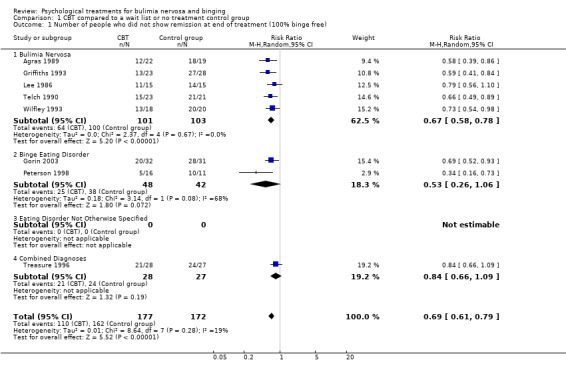
Comparison 1 CBT compared to a wait list or no treatment control group, Outcome 1 Number of people who did not show remission at end of treatment (100% binge free).
2. Bulimic symptoms (Analysis 1.2) Twelve studies, with a total of 465 participants, contributed to the bulimic symptoms outcome at the end of treatment. The difference in bulimic symptom mean scores between the CBT group and the no treatment/WL group was highly significant, in favour of CBT (SMD ‐0.94, 95%CI ‐1.19 to ‐0.70). No statistical heterogeneity was indicated.
1.2. Analysis.
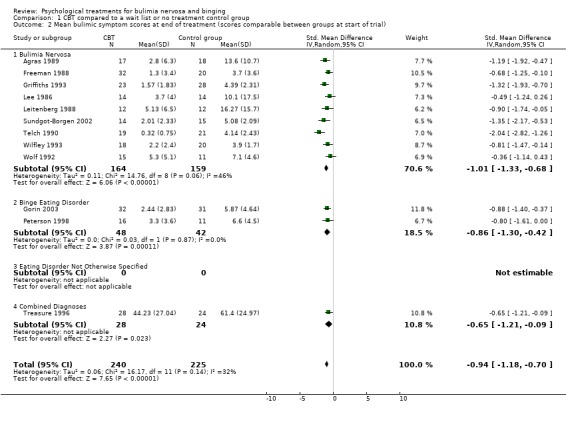
Comparison 1 CBT compared to a wait list or no treatment control group, Outcome 2 Mean bulimic symptom scores at end of treatment (scores comparable between groups at start of trial).
Secondary outcomes
1. Dropout due to adverse events (Analysis 1.3) Only one study, with 44 participants, contributed to the outcome of dropout due to adverse events and a meta‐analysis was not conducted.
2. Overall dropout rates due to any reason (Analysis 1.4) Eleven studies, with a total of 413 participants, reported dropout rates at the end of treatment. One study did not have any dropouts, therefore only ten studies (396 participants) contributed data. The difference in attrition rate between the CBT group and the no treatment/WL group was non‐significant (RR 1.46, 95% CI 0.77 to 2.79). Some heterogeneity was indicated, with an I2 of 41%.
3. Depression symptoms (Analysis 1.5) Seven studies, with a total of 286 participants, contributed to the depression outcome at the end of treatment. The difference in depression scores between the CBT group and no treatment/WL was significant in favour of CBT (SMD ‐0.69, 95% CI ‐1.09 to ‐0.30). Statistical heterogeneity was indicated, with an I2 of 59%.
4. General psychiatric symptoms No studies contributed data to this outcome
5. Psychosocial/ interpersonal functioning (Analysis 1.6) Two studies, with a total of 101 participants, contributed to the psychosocial/interpersonal functioning outcome at the end of treatment. The difference in functioning scores between the CBT group and no treatment/WL was not significant. No statistical heterogeneity was indicated.
6. Weight (Analysis 1.7) Four studies,with a total of 218 participants, contributed to the mean weight outcome at the end of treatment. The difference in mean weight between the CBT group and no treatment/WL was not significant (SMD 0.18, 95% CI ‐0.12 to 0.48). No statistical heterogeneity was indicated.
7. Patient satisfaction No studies contributed data to this outcome
Comparison 2: CBT versus any other psychotherapy approach
Primary outcomes
1. Remission (Analysis 2.1) Ten studies, with a total of 763 participants, contributed to the remission outcome at the end of treatment. The difference between the two groups was not significant but in favour of CBT (RR 0.87, 95% CI 0.74 to 1.02). No statistical heterogeneity was indicated. When bulimia nervosa studies only were considered the difference was significant (n=7 trials, 484 participants, RR 0.83 95% CI 0.71, 0.97).
2.1. Analysis.

Comparison 2 CBT compared to any other psychotherapy, Outcome 1 Number of people who did not show remission at end of treatment (100% binge free).
2. Bulimic symptoms (Analysis 2.2)
2.2. Analysis.

Comparison 2 CBT compared to any other psychotherapy, Outcome 2 Mean bulimic symptom scores at end of treatment.
Fifteen studies, with a total of 941 participants, contributed to the outcome at the end of treatment. The difference between the two groups was significant and in favour of CBT (SMD ‐0.21, 95% CI ‐0.34 to ‐0.09). No statistical heterogeneity was indicated.
Secondary outcomes
1. Dropout due to adverse events (Analysis 2.3) Only two studies, with 73 participants, contributed to the outcome of dropout due to adverse events and a meta‐analysis was not conducted.
2. Overall dropout rates due to any reason (Analysis 2.4)
Fourteen studies, with a total of 962 participants, contributed to the outcome at the end of treatment. The difference between the two groups was not significant (RR 0.97, 95% CI 0.70 to 1.35). No statistical heterogeneity was indicated.
3. Depression symptoms (Analysis 2.5)
Thirteen studies, with a total of 616 participants, contributed to the outcome at the end of treatment. The difference between the two groups was not significant but in favour of CBT (SMD ‐0.28, 95% CI ‐0.57 to 0.00). Statistical heterogeneity was indicated, with an I2 of 64.2%.
4. General psychiatric symptoms (Analysis 2.6) Seven studies, with a total of 371 participants, contributed to the outcome at the end of treatment. The difference between the two groups was not significant (SMD ‐0.13, 95% CI ‐0.35 to 0.09). Statistical heterogeneity was not indicated.
5. Psychosocial/interpersonal functioning (Analysis 2.7)
Seven studies, with a total of 577 participants, contributed to the outcome at the end of treatment. The difference between the two groups was not significant (SMD ‐0.12, 95% CI ‐0.28 to 0.05). No statistical heterogeneity was indicated.
6. Weight (Analysis 2.8)
Eleven studies, with a total of 572 participants, contributed to the outcome at the end of treatment. The difference between the two groups was in favour of alternate psychotherapies (SMD 0.18, 95% CI 0.01 to 0.34). No statistical heterogeneity was indicated. When compared with behavioural weight loss therapy in the diagnostic group of BED overweight (BMI>/= 27), CBT was not favoured (n=4 trials, n= 190 participants, SMD 0.24 95% CI ‐0.05 to 0.53) but this did not reach significance.
7. Patient satisfaction
No studies contributed data to this outcome.
Comparison 3: Guided self‐help CBT versus 'pure self help'
Primary outcomes
1. Remission (Analysis 3.1) Three studies, with a total of 140 participants, contributed to the remission outcome at the end of treatment. The difference between the two groups was not significant (RR 0.91, 95% CI 0.71 to 1.17). No statistical heterogeneity was indicated.
3.1. Analysis.
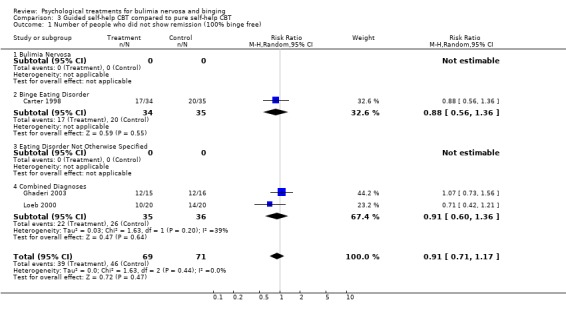
Comparison 3 Guided self‐help CBT compared to pure self‐help CBT, Outcome 1 Number of people who did not show remission (100% binge free).
2. Bulimic symptoms (Analysis 3.2)
3.2. Analysis.

Comparison 3 Guided self‐help CBT compared to pure self‐help CBT, Outcome 2 Average difference in bulimic symptoms at end of treatment.
Three studies, with a total of 140 participants, contributed to the outcome at the end of treatment. The difference between the two groups was significant and in favour of guided self‐help (SMD ‐0.42, 95% CI ‐0.76 to ‐0.09). No statistical heterogeneity was indicated.
Secondary outcomes
1. Dropout due to adverse events Only one study, with 58 participants, contributed to the outcome of dropout due to adverse events and a meta‐analysis was not conducted.
2. Overall dropout rates due to any reason (Analysis 3.4)
Eleven studies, with a total of 413 participants, contributed to the outcome at the end of treatment. The difference between the two groups was not significant (RR 1.54, 95% CI 0.54 to 4.41). Statistical heterogeneity was indicated, with an I2 of 56.9%.
3. Depression symptoms
Only two studies, with 109 participants, contributed to the outcome of dropout due to adverse events and a meta‐analysis was not conducted.
4. General psychiatric symptoms Only two studies, with 109 participants, contributed to the outcome of dropout due to adverse events and a meta‐analysis was not conducted.
5. Psychosocial/interpersonal functioning (Analysis 3.6)
No studies contributed data to this outcome.
6. Weight (Analysis 3.7)
Three studies, with a total of 140 participants, contributed to the outcome at the end of treatment. The difference between the two groups was not significant (SMD ‐0.03, 95% CI ‐0.36 to 0.31). No statistical heterogeneity was indicated.
7. Patient satisfaction
No studies contributed data to this outcome.
Comparison 4: CBT versus CBT augmented by ERP
Primary outcomes
1. Remission (Analysis 4.1) Three studies, with a total of 168 participants, contributed to the remission outcome at the end of treatment. The difference between the two groups was not significant (RR 0.87, 95% CI 0.65 to 1.16). No statistical heterogeneity was indicated.
4.1. Analysis.

Comparison 4 CBT versus CBT augmented by ERP, Outcome 1 Number of people who did not show remission (100% binge free).
2. Bulimic symptoms (Analysis 4.2)
4.2. Analysis.
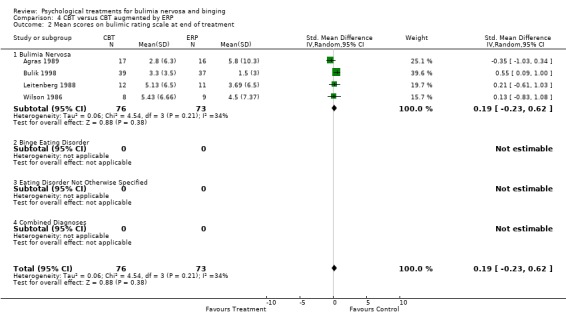
Comparison 4 CBT versus CBT augmented by ERP, Outcome 2 Mean scores on bulimic rating scale at end of treatment.
Four studies, with a total of 149 participants, contributed to the outcome at the end of treatment. The difference between the two groups was not significant (SMD 0.19, 95% CI ‐0.23 to 0.62). No statistical heterogeneity was indicated.
Secondary outcomes
1. Dropout due to adverse events No studies contributed data to this outcome.
2. Overall dropout rates due to any reason (Analysis 4.3)
Four studies, with a total of 193 participants, contributed to the outcome at the end of treatment. The difference between the two groups was not significant (RR 0.97, 95% CI 0.32 to 2.89). Statistical heterogeneity was not indicated.
3. Depression symptoms (Analysis 4.4)
Four studies, with a total of 145 participants, contributed to the outcome at the end of treatment. The difference between the two groups was not significant (SMD 0.38, 95% CI ‐0.27 to 1.02). Statistical heterogeneity was indicated with an I2 of 67.1%.
4. General psychiatric symptoms No studies contributed data to this outcome.
5. Psychosocial/interpersonal functioning
No studies contributed data to this outcome.
6. Weight
No studies contributed data to this outcome.
7. Patient satisfaction
No studies contributed data to this outcome.
Comparison 5: Any psychotherapy (other than CBT) compared no treatment or to a waitlist control
Primary outcomes
1. Remission (Analysis 5.1) Six studies, with a total of 291 participants, contributed to the remission outcome at the end of treatment. The difference between the two groups was significant and favoured any psychotherapy (RR 0.63, 95% CI 0.48 to 0.83). Statistical heterogeneity was indicated with an I2 of 76.7%.
5.1. Analysis.
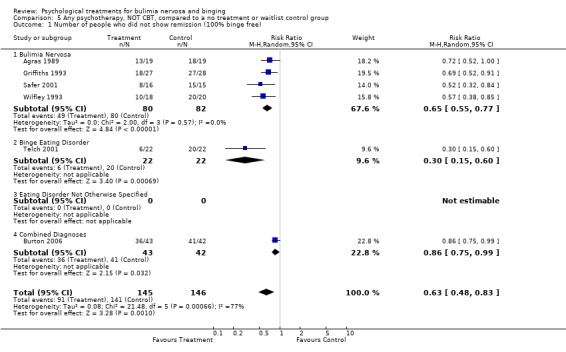
Comparison 5 Any psychotherapy, NOT CBT, compared to a no treatment or waitlist control group, Outcome 1 Number of people who did not show remission (100% binge free).
2. Bulimic symptoms (Analysis 5.2)
5.2. Analysis.
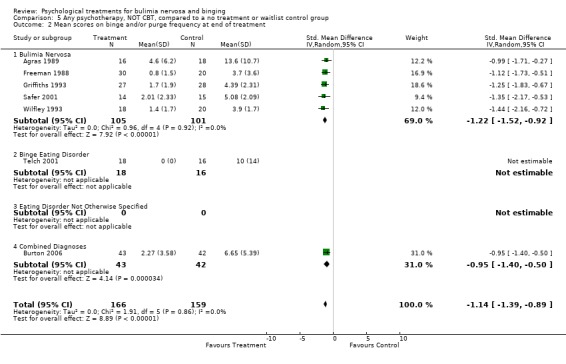
Comparison 5 Any psychotherapy, NOT CBT, compared to a no treatment or waitlist control group, Outcome 2 Mean scores on binge and/or purge frequency at end of treatment.
Seven studies, with a total of 325 participants, contributed to the outcome at the end of treatment. The difference between the two groups was significant and favoured any psychotherapy (SMD ‐1.14, 95% CI ‐1.39 to ‐0.89). No statistical heterogeneity was indicated.
Secondary outcomes
1. Dropout due to adverse events No studies contributed data to this outcome.
2. Overall dropout rates due to any reason (Analysis 5.5)
Six studies, with a total of 291 participants, contributed to the outcome at the end of treatment. The difference between the two groups was not significant (RR 1.44, 95% CI 0.83 to 2.49). Statistical heterogeneity was not indicated.
3. Depression symptoms (Analysis 5.3)
Four studies, with a total of 135 participants, contributed to the outcome at the end of treatment. The difference between the two groups was significant and favoured psychotherapy (SMD ‐0.51, 95% CI ‐0.85 to ‐0.16). Statistical heterogeneity was not indicated.
4. General psychiatric symptoms No studies contributed data to this outcome.
5. Psychosocial/interpersonal functioning
No studies contributed data to this outcome.
6. Weight
Only two studies, with 119 participants, contributed to the outcome of dropout due to adverse events and a meta‐analysis was not conducted.
7. Patient satisfaction
No studies contributed data to this outcome.
Comparison 6: Any psychotherapy (not CBT) compared to a control therapy (to date, either nutritional management or behaviour therapy
Primary outcomes
1. Remission (Analysis 6.1)
6.1. Analysis.
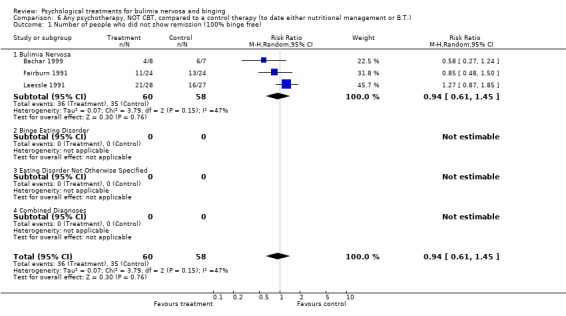
Comparison 6 Any psychotherapy, NOT CBT, compared to a control therapy (to date either nutritional management or B.T.), Outcome 1 Number of people who did not show remission (100% binge free).
Three studies, with a total of118 participants, contributed to the remission outcome at the end of treatment. The difference between the two groups was not significant (RR 0.94, 95% CI 0.61 to 1.45). Some heterogeneity was indicated with an I2 of 47.2%.
2. Bulimic symptoms (Analysis 6.2)
6.2. Analysis.
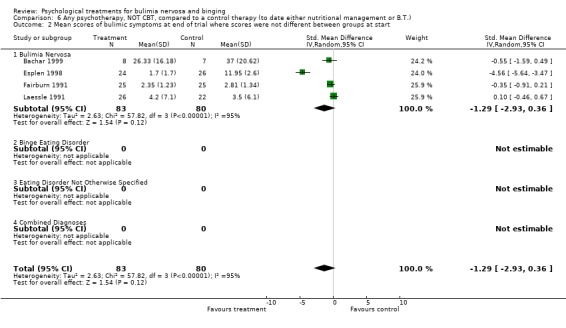
Comparison 6 Any psychotherapy, NOT CBT, compared to a control therapy (to date either nutritional management or B.T.), Outcome 2 Mean scores of bulimic symptoms at end of trial where scores were not different between groups at start.
Four studies, with a total of 163 participants, contributed to the outcome at the end of treatment. The difference between the two groups was significant (SMD ‐1.29, 95% CI ‐2.93 to 0.36). Statistical heterogeneity was indicated, with an I2 of 94.8%.
Secondary outcomes
1. Dropout due to adverse events No studies contributed data to this outcome.
2. Overall dropout rates due to any reason (Analysis 6.4)
Three studies, with a total of 162 participants, contributed to the outcome at the end of treatment. The difference between the two groups was not significant (RR 0.68, 95% CI 0.32 to 1.43). Statistical heterogeneity was not indicated.
3. Depression symptoms
Only one study of 48 participants contributed data to this outcome.
4. General psychiatric symptoms No studies contributed data to this outcome.
5. Psychosocial/interpersonal functioning
Only one study of 48 participants contributed data to this outcome.
6. Weight
Only one study of 48 participants contributed data to this outcome.
7. Patient satisfaction
No studies contributed data to this outcome.
Comparison 7 : CBT versus a component of CBT ‐ most commonly, a behavioural component (B.T.)
Primary outcomes
1. Remission (Analysis 7.1)
7.1. Analysis.
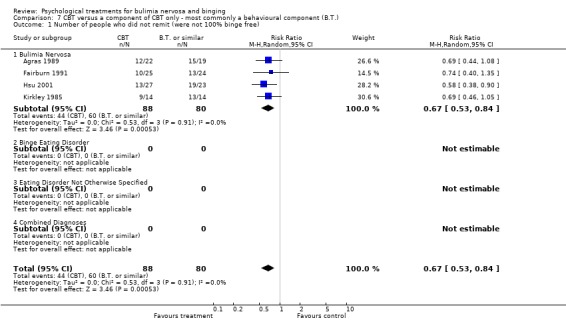
Comparison 7 CBT versus a component of CBT only ‐ most commonly a behavioural component (B.T.), Outcome 1 Number of people who did not remit (were not 100% binge free).
Four studies, with a total of 168 participants, contributed to the remission outcome at the end of treatment. The difference between the two groups was significant and favoured CBT (RR 0.67, 95% CI 0.53 to 0.84). Statistical heterogeneity was not indicated.
2. Bulimic symptoms
Only two studies of 80 participants contributed data to this outcome.
Secondary outcomes
1. Dropout due to adverse events No studies contributed data to this outcome.
2. Overall dropout rates due to any reason (Analysis 7 04)
Four studies, with a total of 148 participants, contributed to the outcome at the end of treatment. The difference between the two groups was not significant (RR 0.70, 95% CI 0.27 to 1.79). Statistical heterogeneity was not indicated.
3. Depression symptoms
Only one study of 33 participants contributed data to this outcome.
4. General psychiatric symptoms Only one study of 50 participants contributed data to this outcome.
5. Psychosocial/interpersonal functioning
Only one study of 50 participants contributed data to this outcome.
6. Weight
Only one study of 39 participants contributed data to this outcome.
7. Patient satisfaction
No studies contributed data to this outcome.
Comparison 8: Guided nonspecialist self‐help (GSH) versus waiting list control
Primary outcome
1. Remission (Analysis 8.1)
8.1. Analysis.
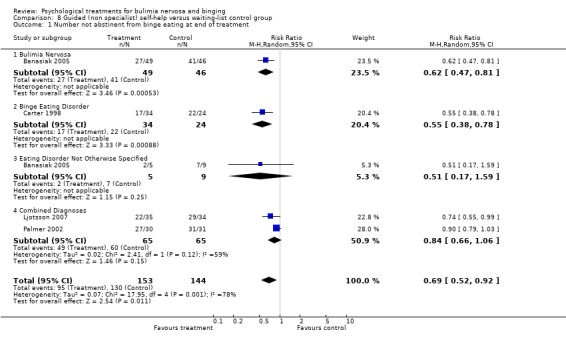
Comparison 8 Guided (non specialist) self‐help versus waiting‐list control group, Outcome 1 Number not abstinent from binge eating at end of treatment.
Five studies, with a total of 297 participants, contributed to the remission outcome at the end of treatment. The difference between the two groups was significant and favoured GSH (RR 0.69, 95% CI 0.52 to 0.92). Statistical heterogeneity was indicated, with an I2 of 77.7%.
2. Bulimic symptoms (Analysis 8.2)
8.2. Analysis.
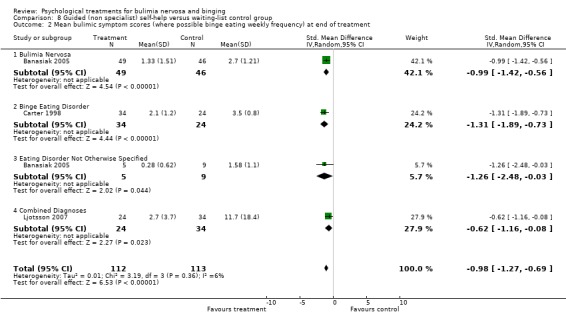
Comparison 8 Guided (non specialist) self‐help versus waiting‐list control group, Outcome 2 Mean bulimic symptom scores (where possible binge eating weekly frequency) at end of treatment.
Four studies, with a total of 25 participants, contributed to the remission outcome at the end of treatment. The difference between the two groups was significant and favoured GSH (SMD‐0.98, 95% CI‐1.27 to ‐0.69). Statistical heterogeneity was not indicated.
Secondary outcomes
1. Dropout due to adverse events Only one study of 109 participants contributed data to this outcome.
2. Overall dropout rates due to any reason (Analysis 8.7)
Five studies, with a total of 292 participants, contributed to the outcome at the end of treatment. The difference between the two groups was not significant (RR 1.11, 95% CI 0.56 to 2.22). Some heterogeneity was indicated, with an I2 of 41.7%.
3. Depression symptoms (Analysis 8.3)
Four studies, with a total of 220 participants, contributed to the remission outcome at the end of treatment. The difference between the two groups was not significant (SMD‐0.34, 95% CI0.97 to 0.28). Statistical heterogeneity was indicated, with an I2 of 77.7%.
4. General psychiatric symptoms Only one study of 58 participants contributed data to this outcome.
5. Psychosocial/interpersonal functioning (Analysis 8.5)
Three studies, with a total of 160 participants, contributed to the remission outcome at the end of treatment. The difference between the two groups was not significant (SMD‐0.21, 95% CI ‐0.72 to 0.30). Statistical heterogeneity was indicated, with an I2 of 53.3%.
6. Weight (Analysis 8.6)
Three studies, with a total of 171 participants, contributed to the remission outcome at the end of treatment. The difference between the two groups was not significant (SMD‐0.11, 95% CI ‐0.41 to 0.19). Statistical heterogeneity was not indicated.
7. Patient satisfaction
No studies contributed data to this outcome.
Comparison 9: Guided self‐help versus specialist psychotherapy (CBT or IPT)
Primary outcomes
1. Remission
Only one study of 81 participants contributed data to this outcome.
2. Bulimic symptoms
Only two studies of 149 participants contributed data to this outcome.
Secondary outcomes
1. Dropout due to adverse events No studies contributed data to this outcome.
2. Overall dropout rates due to any reason (Analysis 8.7)
Only two studies of 149 participants contributed data to this outcome.
3. Depression symptoms (Analysis 8.4)
Only two studies of 122 participants contributed data to this outcome.
4. General psychiatric symptoms No studies contributed data to this outcome.
5. Psychosocial/interpersonal functioning
Only one study of 37 participants contributed data to this outcome.
6. Weight
No studies contributed data to this outcome.
7. Patient satisfaction
No studies contributed data to this outcome.
Comparison 10: Pure self‐help (PSH) versus waitlist control
Primary outcomes
1. Remission (Analysis 10.1)
10.1. Analysis.

Comparison 10 Pure self help versus waitlist control group, Outcome 1 Mean end of trial interpersonal functioning.
Three studies, with a total of 187 participants, contributed to the remission outcome at the end of treatment. The difference between the two groups was not significant (RR 0.79, 95% CI 0.53 to 1.17). Statistical heterogeneity was indicated, with an I2 of 88.1%.
2. Bulimic symptoms (Analysis 10.2)
10.2. Analysis.

Comparison 10 Pure self help versus waitlist control group, Outcome 2 Mean end of trial depression scores.
Three studies, with a total of 181 participants, contributed to the remission outcome at the end of treatment. The difference between the two groups was significant and favoured PSH (SMD ‐0.40, 95% CI ‐0.73 to ‐0.07). Statistical heterogeneity was not indicated.
Secondary outcomes
1. Dropout due to adverse events No studies contributed data to this outcome.
2. Overall dropout rates due to any reason (Analysis 10.3) Three studies, with a total of 187 participants, contributed to the remission outcome at the end of treatment. The difference between the two groups was not significant (RR 0.75, 95% CI 0.42 to 1.35). Statistical heterogeneity was not indicated.
3. Depression symptoms (Analysis 10.4)
Only one study of 57 participants contributed data to this outcome.
4. General psychiatric symptoms No studies contributed data to this outcome.
5. Psychosocial/interpersonal functioning
Only one study of 57 participants contributed data to this outcome.
6. Weight
No studies contributed data to this outcome.
7. Patient satisfaction
No studies contributed data to this outcome.
Sub‐group analysis: Trials of short versus longer duration
When trials of short duration (</= 10 weeks of therapy) are removed there were no changes in the direction or significance of any results.
Funnel plots
Funnel plots are available by text file from PJH upon request. The funnel plots show that no studies reported a negative outcome for CBT compared to a waiting list. However, this does not necessarily mean that publication bias has occurred (see Sterne 2001 for a discussion of funnel plots and bias in meta‐analyses). Negative trials are reported for comparisons between CBT and any other psychotherapy and larger trials tend to be closer to a relative risk of 1. This may contribute to the relatively high heterogeneity in the latter comparisons. This heterogeneity may also come from the range of different control psychotherapies.
Results for trials of psychotherapy in participants with bulimia nervosa
For the following analyses all trials that were not composed entirely of participants with bulimia nervosa were removed. Also removed were trials of participants with DSM‐III and DSM‐III‐R bulimia nervosa of non‐purging or not majority purging type, as it is likely the latter would not meet DSM‐IV criteria for bulimia nervosa. With regard to the efficacy of CBT specifically for bulimia nervosa, Table 11 indicates that CBT was associated with greater improvements in bulimic symptoms, binge eating abstinence and depression than a waiting‐list control (trials were Agras 1989, Freeman 1988, Griffiths 1993, Sundgot‐Borgen 2002 and Wolf 1992). In addition, CBT was associated with significantly greater improvements in binge eating abstinence rates, but not mean bulimic symptoms, general psychiatric symptoms or depression compared to any other psychotherapy (Table 12; trials were Agras 2000, Cooper 1995, Fairburn 1991, Fairburn 1986, Griffiths 1993, Hsu 2001 and Walsh 1997). Any other psychotherapy compared to a waiting‐list control (Agras 1989, Freeman 1988, Griffiths 1993, Wilfley 1993 and Safer 2001 (Table 13)) was associated with significantly greater improvements in bulimic symptoms and abstinence rates at the end of therapy. Insufficient data were available to compare CBT in guided forms versus pure self‐help CBT and there were no changes in comparisons of CBT versus CBT augmented by ERP or CBT versus a component of CBT. In the comparison of any other psychotherapy versus a control therapy there were no significant differences in bulimic symptoms for the active treatment group (SMD=‐1.29, 95%CI ‐2.93;0.36, 163 participants, n=4 trials: Bachar 1999, Esplen 1998, Fairburn 1991 and Laessle 1991). With regard to the efficacy of manual‐based CBT for bulimia nervosa (CBT‐BN) (Fairburn 1993b) with outcome assessed over a 4‐week period by interview (using the Eating Disorder Examination) there were insufficient trials for meta‐analyses of CBT‐BN versus wait‐list control groups. Only four trials have compared this manualized treatment to any other psychotherapy (Agras 2000, Fairburn 1986, Fairburn 1991, Walsh 1997). CBT‐BN was associated with significantly greater improvements in bulimic symptoms (n=4 trials, SMD=‐0.17 95%CI ‐0.60;‐0.17) and binge eating abstinence rates (n=3 trials, RR 0.81, 95%CI 0.69;0.95) but not greater reduction in depression scores (n=3 trials; SMD=‐o.33, 95% CI ‐0.70;0.05) than another psychotherapy.
2. Comparisons of CBT vs any other psychotherapy in trials of DSMIIIR/IV BN.
| Comparison | N studies | N participants | SMD [Fixed] | RR {Random] | 95% C.I. |
| N not abstinent (100% binge free) | 7 | 484 | 0.83 | 0.71;0.97 | |
| Mean bulimic symptom scores | 8 | 514 | ‐0.15 | ‐0.38;0.07 | |
| N non‐completers | 8 | 523 | 1.00 | 0.63;1.58 | |
| Depression scores at end of treatment | 7 | 242 | ‐0.48 | ‐0.98;0.02 | |
| General psychiatric symptom scores | 5 | 165 | ‐0.14 | ‐0.45;0.17 | |
| Mean weight (or BMI) at end of treatment | 5 | 190 | 0.13 | ‐0.15;0.42 |
3. Other psychotherapies versus a waitlist control for DSMIIIR/IV bulimia nervosa.
| Comparison | N trials | N participants | SMD [Fixed] | RR [Random] | 95% C.I. |
| Number not abstinent | 4 | 162 | 0.65 | 0.54;0.77 | |
| Bulimic symptom scores | 5 | 2.6 | ‐1.22 | ‐1.52;‐0.92 | |
| Number of non‐completers | 4 | 162 | 1.40 | 0.63;3.10 |
Discussion
Summary of main results
The review supported the efficacy of CBT and particularly CBT‐BN, in the treatment of people with bulimia nervosa and also (but less strongly due to the small number of trials) related eating disorder syndromes. Compared to no treatment, CBT achieved a superior outcome with 37% cumulative binge eating abstinence versus a rate of almost zero (3%) in the cumulative wait‐list trials. Other psychotherapies were also efficacious, particularly IPT in the longer‐term. In addition non‐completion rates were moderate to low (between 24% and 23%) for CBT and around 24% for other psychotherapies. Self‐help approaches that used highly structured CBT treatment manuals, were promising albeit with more modest results when applied without guidance ("pure self‐help") and their evaluation in bulimia nervosa merits further research. Exposure and response prevention did not appear to enhance the efficacy of CBT. Psychotherapy alone appeared unlikely to reduce or change body weight in people with bulimia nervosa or similar eating disorders.
The efficacy of psychotherapy in reducing bulimic symptom severity, as well as depressive symptom severity, for people with disorders of recurrent binge eating and specifically people with bulimia nervosa, is thus supported by this review. CBT had more studies supporting it, and on direct comparison with control therapies, there were trends for CBT to be superior, which reached significance for end of treatment binge eating abstinence rates (34% vs 22% for cumulative other therapies), and mean bulimic symptom severity scores. In addition, CBT‐BN was superior for binge eating abstinence rates in trials of people with bulimia nervosa. CBT‐BN for bulimia nervosa has since been endorsed by leading clinical practice guidelines (e.g. NICE 2004) but there is room for improvement, and attempts are being made to enhance CBT‐BN with additional psychotherapeutic strategies and approaches (e.g. Ghaderi 2006; Fairburn 2003). It will be important in future revisions of this review to evaluate the efficacy of these approaches as they begin to be trialled.
Our review suggested that other psychotherapies were more efficacious than waiting list control groups for end of treatment scores on bulimic symptom severity. Studies used a wide range of types of other psychotherapies, including hypnobehavioural therapy and IPT and on qualitative review of the meta‐analysis, the only other psychotherapy that performed poorly was supportive psychotherapy. The meta‐analyses of comparisons between other psychotherapies and a control therapy also supported the active therapy. The results point to the need for more studies assessing the nonspecific effects of psychotherapy in bulimia nervosa and related disorders. While CBT was also favoured over "dismantled" forms of CBT (most commonly a behavioural therapy only), enhancing CBT with exposure therapy was not supported.
The results of Agras 2000 were important, in that while CBT was superior at the end of treatment, at one year follow‐up participants who had received IPT had improved to the level of those in the CBT group. This study suggests that CBT generates a more rapid response than IPT, with a difference observed by week six of treatment. As the number of studies grows, future meta‐analyses could be conducted of comparative maintenance of change and speed of response between treatments.
Self‐help modalities, particularly guided (non specialist) CBT, appear promising as an alternative "first‐step" care. However, there is insufficient evidence for these in people with bulimia nervosa (only one study). In addition, while guided self‐help was favoured over pure self‐help approaches, the results did not reach significance for binge eating abstinence rates and more studies are needed. The high heterogeneity in comparisons of pure self help versus waitlist suggest that the results of the three studies of different diagnostic groups should be interpreted separately at this stage of evidence. The result was weakest and not significant in the one trial of participants with bulimia nervosa. While not pertinent to the meta‐analyses in this review, Grilo 2005a also have reported an interesting study showing that CBT in guided self‐help form had significantly higher remission rates (46%) than either behavioual weight‐loss guided self‐help (18%) or a control therapy (13%) for participants with binge eating disorder (weight loss was minimal in all groups).
Finally, too few trials report results to formulate conclusions regarding the effects of therapies on participants' weight. There is insufficient evidence to support any of the psychotherapies as having an impact on weight change although behavioural weight loss therapy approached significance in reducing weight in the overweight with binge eating disorder. Behavioural weight loss therapy was not however superior to CBT in symptomatic reduction of binge eating for this group.
Overall completeness and applicability of evidence
In contrast to trials of pharmacotherapy (e.g. Bacaltchuk 1999, Bacaltchuk 2000), the duration and frequency of follow‐up was good, and the non‐completion or "dropout" rates were modest (only one study (Walsh 2004) was excluded because of greater than 50% dropout rate). Thus, even where people had to wait, psychotherapy appeared to be an acceptable treatment modality. It should be noted that the low percentage of participants excluded from trials, and the high number recruited from community settings, increases the generalisability of the findings, supporting the effectiveness as well as efficacy, of psychotherapy for these patients
Quality of the evidence
This review includes trial data with very small numbers of participants and there are small numbers of events and zero events in some trials. Meta‐analyses are less robust with small trials and thus the results should be interpreted with caution. In addition, the overall quality of trials was variable with many not reporting intention‐to‐treat analyses. However, sensitivity analysis based on quality criteria had minimal impact on primary outcomes for the results of treatment.
Potential biases in the review process
There was some risk of bias in results due to the use of outcome data that were not assessed blind to treatment allocation. For example, where participants are in a waiting‐list control group it is not possible for the participant to be unaware which group they are in, and many studies rely on participants' self‐report assessments for outcome data. Notwithstanding the challenges in truly blinding psychotherapy trials and mindful of the amount of information available to participants on therapies, studies where a control therapy was used (such as those by Fairburn 1991) and where outcome assessments were made by interviewers blind to treatment groups, arguably protect against bias. The sensitivity analysis of trials that had such assessments of outcome supported the overall findings.
In comparison to pharmaceutical research, the size and number of trials is also low. This unfortunately limits the secondary analyses that could be performed. The majority of trials are of bulimia nervosa of the purging type, which limits generalisability of the results to the broader group of people with eating disorders.
The funnel plot suggested possible publication bias in the CBT versus waiting list comparisons, as no negative trials were found. This is in contrast to the analyses where CBT was compared to other therapies. However, it is possible that the lack of negative trials denoted the efficacy of CBT, compared to a waiting list control. Arguably, waiting list control groups may be expected to be associated with less improvement than groups treated with a control therapy or other active psychotherapy and it is also not possible to blind people to group assignment when one is on a wait‐list. There was also a trend for those in all the control groups, including waiting list, to have a lower dropout rate than those in the experimental groups. It may be that people on waiting lists are motivated to wait in order to pursue active treatment. Larger trials and numbers in future meta‐analyses are required to address this further.
Agreements and disagreements with other studies or reviews
The present findings are in agreement with other authoritative reviews such as the NICE guidleines (NICE 2004). In particular, systematic reviews have consistently supported CBT as having a high level of evidence for efficacy in bulimia nervosa. In the NICE (NICE 2004) guidelines it reached Level I (see above), in the RTI International University of North Carolina Evidence‐based Practice Center (RTI‐UNC EPC; Shapiro 2007) review it received a rating of ‘strong’ evidence and in Clinical Evidence (Hay 2008b) it is listed as ‘likely to be beneficial’. In all these CBT for bulimia nervosa was noted for being the only psychotherapy to be endorsed with the highest ranking of evidence and in other meta‐analyses (NICE 2004) of trials CBT is favoured over wait‐list and other psychotherapies for a range of outcome measures including binge eating abstinence rates, bulimia symptom (usually binge frequency) severity, depression, general psychiatric symptom severity and function. This is an important consistency noting that the first two reviews were conducted independently and all three applied similar but individual methodologies including inclusion and exclusion criteria for trials.
In addition, other critical reviews such as Sysko 2008, and meta‐analyses by Stefano 2006 and Perkins 2006 support self‐help approaches for bulimic eating disorders. However, both these meta‐analyses conflate diagnostic groups and the latter also conflates types of self‐help in all but one meta‐analysis, which limits information in regards to specific diagnostic groups or type of self‐help.
Authors' conclusions
Implications for practice.
The review supports the efficacy of CBT and particularly CBT‐BN in the treatment of people with bulimia nervosa and also (but less strongly due to the small number of trials) similar eating disorder syndromes. CBT has been used effectively in group settings.
Other psychotherapies were also efficacious, particularly IPT in the longer‐term. Self‐help approaches, particularly those with some guidance such as highly structured CBT treatment manuals as opposed to pure self‐help, are very promising. Their evaluation in bulimia nervosa particularly merits further research. Pure self‐help may be more effective for people with binge eating disorder than people with bulimia nervosa. Exposure and response prevention (ERP) did not appear to enhance the efficacy of CBT.
Psychotherapy alone is unlikely to reduce or change body weight in people with bulimia nervosa or similar eating disorders.
Implications for research.
Notwithstanding the practical constraints of conducting psychotherapy research, larger trials are desirable for evaluating the efficacy of psychotherapies in bulimia nervosa, and more trials are needed for people with binge eating disorder and EDNOS.
Research is needed to evaluate specific versus general effects of psychotherapy, and to determine patient characteristics that may predict response to less intensive (e.g. self‐help) therapies and non‐CBT psychotherapies, particularly IPT. In particular, more trials are needed which directly compare stepped‐care and guided self‐help and pure self‐help approaches, with standard care and waitlist control groups.
The findings of an advantage for CBT over other control psychotherapies merits further research. Psychotherapy research should apply more use of "placebo" therapies in comparison groups, in contrast to waiting list groups. This would allow truly double‐blinded trials to be done. Trials of approaches other than ERP that may enhance the effects of CBT are also needed.
It is increasingly important to develop more efficacious treatments for those with both a weight and an eating disorder.
Feedback
Comment Bulimia nervosa reviews
Summary
Criticism
There are a number of problems with this review, some of which are sufficiently serious as to compromise it. It is probably for this reason this review has attracted little attention from clinicians and researchers. It should be noted that most of the shortcomings specified below also apply to the sister Cochrane reviews on the pharmacological treatment of bulimia nervosa (Bacaltchuk et al, 1999, 2000).
Conflation of Different Clinical States
This is the most serious shortcoming. It is generally accepted in the eating disorder field that a distinction should be drawn between bulimia nervosa and the provisional new eating disorder "binge eating disorder" (American Psychiatric Association, 1994). The two conditions differ in their clinical and demographic characteristics. They also differ in their natural course and response to treatment. They are not distinguished in this review. In distinguishing between the two conditions, it should be noted that the RCTs on the treatment of "non‐purging" bulimia nervosa are now viewed as having been studies of binge eating disorder.
Conflation of Different Treatments
Much of the research on the psychological treatment of bulimia nervosa has focused on a specific form of cognitive behaviour therapy (CBT) devised by Fairburn (1981). This involves 15 to 20 treatment sessions over 4 to 5 months. The characteristics of this treatment have been specified in a number of treatment manuals (e.g., Fairburn, 1985; Fairburn et al, 1993). Recently there have been attempts to abbreviate and simplify this form of CBT. These have included the development of self‐help versions. These treatments are of interest and potential importance but they should not be confused with CBT. Instead, they should be compared with CBT. This distinction is not made in this review. Also, a treatment that had almost nothing in common with CBT (cf., Bachar et al, 1999) is categorised as CBT.
Neglect of Persistence of Treatment Effects
Bulimia nervosa tends to run a chronic course. Therefore treatment effects which are short‐lived or of uncertain stability are of limited clinical significance. The review places insufficient emphasis on the longer‐terms effects of treatment, the focus being on their immediate impact. This is a major shortcoming since the treatments studied differ in this regard.
Neglect of Quality of Research Assessment
Although the review pays due attention to generic RCT methodology, it ignores other important methodological issues. These concern the assessment methods used. Perhaps of greatest importance is how the central behavioural feature of bulimia nervosa was defined and assessed. "Binge eating" is not a simple phenomenon and reliance upon patient self‐report has been shown to be unreliable. The methods used to assess binge eating have changed over the years with the great majority of researchers now using the "investigator‐based" mode of assessment incorporated within the Eating Disorder Examination. The second issue concerns the time frame of the assessment. Many of the earlier studies used a one‐week time frame. This is now regarded as unsatisfactory since bulimic features fluctuate in severity with patients commonly having "good" and "bad" weeks. Instead, a four‐week time frame has been adopted as more or less standard. This is the time frame used by the EDE. A distinction should therefore be drawn between EDE‐based and non‐EDE‐based RCTs, perhaps by sensitivity analysis.
Neglect of Associated Psychiatric Features
The review focuses primarily on certain behavioural features of bulimia nervosa, namely the frequency of binge eating and purging. This has the merit of simplicity but it results in other important features receiving insufficient attention. These include dietary restraint, depressive features and interpersonal functioning. These and other features are commonly reported in studies of the treatment of bulimia nervosa. Any evaluation of the effects of treatment should include reference to change in these domains.
Concluding Remark
These shortcomings should be relatively easily remedied.
I certify that I have no affiliations with or involvement in any organisation or entity with a direct financial interest in the subject matter of my criticisms.
Reply
Response to critique on Bulimia Nervosa Psychotherapy review.
Date: September 13th 2002
The authors thank the reviewer for their comments and are pleased to have the opportunity to answer their concerns.
Regarding: Conflation of different clinical states.
We acknowledge that the review when first prepared combined all forms of disorders of recurrent binge eating in those of normal or above average weight. This was because at the time the review was first prepared, there were fewer trials than currently, and there was doubt about the validity of distinctions between the non‐purging form of bulimia nervosa and binge eating disorder. As the reviewer comments, "RCTs on the treatment of 'non‐purging' bulimia nervosa are now viewed as having been studies of binge eating disorder." However, at the time when the review was first prepared there was not general agreement on this point. It is anticipated that as the validity of the different diagnostic criteria for binge eating syndromes in normal or above average weight people are further refined, and internationally accepted diagnostic criteria, such as the American Psychiatric Association DSM‐IV, revised, future trials of the non purging forms of bulimia nervosa, binge eating disorder and EDNOS syndromes will be done of better defined syndromes. Unfortunately many trials also "conflate" the diagnostic groups.
The majority of trials are of the purging form of bulimia nervosa, and with an increase in number of trials overall since the review was first published, it has been possible now to add further analyses in the review of this specific subgroup. These analyses of bulimia nervosa are in the most recent update, submitted on 28th August, 2002. Similar analyses of binge eating disorder do not produce meaningful statistical results as there are yet too few trials for meta‐analyses.
Regarding: Conflation of different treatments
The review does not confuse the specific manualised form of CBT with abbreviated forms. Only in the comparisons of CBT with pure self‐help forms is an abbreviated form, namely guided self‐help,"allowed" as a form of CBT. Thus the review does not claim guided self‐help CBT is the same as the manualised form as devised by Fairburn and colleagues. In fact, the review specifies it is not under its description of cognitive behaviour psychotherapy in the section: "Types of Interventions".
We took the view that it is of clinical interest to compare all variants of CBT, in addition to the specific form devised by Fairburn and colleagues for bulimia nervosa. While the reviewer asserts that "much of the research has focused on a specific form of CBT", there are only a few trials which have used this form, and there are many more studies which have tested variants of it. We recognised the interest in subgroup analyses of this specific form of CBT (termed CBT‐BN in the most recent update of the review) and have done a subgroup analysis, taking account also of outcome assessment over 4‐weeks (see below). When this was done only 4 trials remained, three of which were conducted by Fairburn and colleagues. Head‐to‐head comparisons of CBT‐BN versus guided CBT‐BN in people with bulimia nervosa will be added to the review when such RCTs are done.
The review does not describe the treatment in the Bachar et al 1999 study as CBT. It describes it an alternative psychotherapy, and as such, data from this trial are found in meta‐analyses of "other psychotherapies". As reported in the table of included studies with regard to the Bachar trial : "In this review self‐psychology is compared to nutritional counselling".
Regarding: Neglect of persistence of treatment effects.
The review does regard the persistence of treatment effects as of importance and reports that "in all but two trials improvements were maintained at follow‐up".
In addition, the results of the trial of Agras et al 2000, which is the largest such trial to date, reporting a "catch‐up" effect of IPT compared to CBT‐BN at one year, are highlighted in the discussion and meta‐analyses of comparative maintenance of change between treatments are foreshadowed for future reviews. Another example is from the review of combination treatment and drug therapies, where it is stated in the discussion that "longer term maintenance of change appears to be better with CBT than antidepressant drugs, as relapse rates with drug discontinuation seem to be high".
Notwithstanding this, comparative effects at the end of treatment remain highly clinically relevant. Given the evidence, many patients may prefer a treatment with a better end‐of‐treatment outcome that is maintained over time, as CBT appears to be, and not to wait the additional time for another psychotherapy to have similar effects.
Regarding: Neglect of quality of research assessment. The review does regard the quality of the assessment instrument as of importance, particularly with respect to the use of not blind self‐report data in comparative studies where the control is a waiting list. Sensitivity analyses are reported of blinded outcome data, and in former reviews self‐report data, and in the more recent version interview based data assessing bingeing over 4‐weeks for trials of bulimia nervosa. While the reviewer asserts, no doubt correctly, that the "great majority of researchers are now using the Eating Disorder Examination" (an interview based assessment instrument developed by Fairburn and colleagues) many trials did not use this, and instead relied on self‐reported binge‐frequency, a point emphasised in this review in assessing quality of trials.
Regarding: Neglect of associated psychiatric features
The authors are puzzled by this criticism as in every comparison an attempt is made to report on analyses of comparative changes in depressive symptoms, psych‐social (interpersonal) functioning, non‐completion rates, weight and levels of general psychiatric symptoms. It would be interesting to add levels of dietary restraint but it is seldom reported in trials. The authors chose a broad range of outcome domains that were commonly reported.
Concluding remark: These shortcomings should be relatively easily remedied.
The authors are pleased to report that the issues raised in the critique with regard to conflation of diagnostic groups have been pre‐emptively addressed in the most recent update of the review. Other issues are answered as above.
Contributors
Comment Bulimia nervosa reviews (especially that on psychological treatments) Sender Christopher G Fairburn, D.M., FRCPsych Sender Description ..... a clinical scientist who specialises in research on the nature and treatment of eating disorders Sender Email credo@medicine.ox.ac.uk Sender Address University Dept of Psychiatry, Warneford Hospital, Oxford, OX3 7JX Date Received 27/08/02 17:08:41
What's new
| Date | Event | Description |
|---|---|---|
| 6 August 2009 | New citation required and conclusions have changed | The title of this review has changed from 'Psychotherapy for bulimia nervosa and binging' to 'Psychological treatments for bulimia nervosa and binging' to better reflect the nature of interventions covered within the review. The review search has been updated, eight new trials identified, and one new option added, namely CBT vs behavioural weight loss treatment in binge eating disorder. There were changes in results of CBT vs any other psychotherapy. Data entry on 08.03 on Carter 2003 was corrected. There were new meta‐analyses for guided self‐help versus waitlist comparisons. An author has been added (Priyanka Kashyap). |
History
Protocol first published: Issue 2, 1998 Review first published: Issue 4, 1999
| Date | Event | Description |
|---|---|---|
| 19 May 2008 | Amended | Converted to new review format. |
| 20 January 2008 | Amended | Minor update |
| 27 May 2005 | New search has been performed | The review has been updated with the assistance of Sarah Hetrick and others from the Cochrane Advanced Reviewers Support (CARS) Pilot Project, an initiative of the Australasian Cochrane Centre. Unpublished data has been entered from the Sundgot‐Bergen trial. The search has been updated to June 2004, and four new trials entered. A new criterion for study exclusion has been added, namely studies with >50% non‐completion rates are excluded. Data has been re‐entered by diagnostic groups (bulimia nervosa, binge eating disorder, eating disorder not otherwise specified and combined diagnoses). The comparison "CBT in guided or unguided forms compared to pure self‐help CBT" has been simplified to "Guided self ‐help CBT compared to pure self‐help CBT" reflecting the state of the field. The CARS assistance was with entry and data extraction on all newly included studies (which was double checked by PH), standardisation of the Table of Included Studies (checked by PH) entry of new outcome data with new subgroups (checked by PH) and re‐entry of data by diagnostic groups (checked by PH). |
| 10 January 2005 | Amended | Minor updates to information in the Table of Included Studies |
| 21 April 2004 | New citation required and conclusions have changed | Substantive amendment |
| 19 November 2002 | Feedback has been incorporated | Feedback was added and responded to |
| 28 August 2002 | New search has been performed | Conclusions changed |
Notes
February 2003 This review has undergone slight revision (in response to statistical editors comments) since the previous issue. The Abstract has also been shortened.
Acknowledgements
We thank the Australasian Cochrane centre staff, particularly Phillipa Middleton & Vivian Moore, who provided invaluable advice and support and searching; the CCDAN Editorial Team who provided access to the CCDAN Controlled Trials Register, advice, support and the search updates; all the authors who provided trial information, some many years after the studies were competed, and to Susan Lemar who assisted with trial searching and screening.
For the most recent version of the review, we thank the Australian CARS programme, the Australasian Cochrane Centre and the BMJ Publishing Group for their assistance in updating.
Appendices
Appendix 1. Sensitivity analyses investigating heterogeneous outcomes
Sensitivity analysis Where statistical heterogeneity was observed, and to test the robustness of the findings, sensitivity analyses were applied to determine the effect of including or excluding certain types of studies. Studies were removed sequentially in order of size until p>/=0.05 and an I2 <50% was achieved.The following sensitivity analyses were planned: 1. Size of trials ‐ trials with 10 or fewer participants 2. Allocation concealment gradings (removal of trials graded C and then B). 3. Single‐blinded (ie only outcome assessments were blinded) versus double‐blind 4. Use of intention to treat analyses 5. Mixed groups of non‐purging and purging bulimia nervosa 6. Loss to completion ‐ trials with > 15% non‐completion rates 7. Duration of follow‐up: trials which do not report a six‐month or longer follow‐up 8. Trials of bulimia nervosa that did not assess frequency of binge eating by interview and for at least 4 weeks (this method of assessment is more rigorous, but it has the disadvantage of potentially lower response rates and thus higher non‐completion rates)
Results
Appendix 2. Sensitivity analyses investigating trial quality
The following sensitivity analyses were conducted where appropriate to determine the effect of including or excluding certain types of studies: 1. Size of trials ‐ trials with 10 or fewer participants 2. Allocation concealment gradings (removal of trials graded C and then B). 3. Single‐blinded (ie only outcome assessments were blinded) versus double‐blind 4. Use of intention to treat analyses 5. Mixed groups of non‐purging and purging bulimia nervosa 6. Loss to completion ‐ trials with > 15% non‐completion rates 7. Duration of follow‐up: trials which do not report a six‐month or longer follow‐up 8. Trials of bulimia nervosa that did not assess frequency of binge eating by interview and for at least 4‐weeks (This method of assessment is more rigorous, but it has the disadvantage of potentially lower response rates and thus higher non‐completion rates.) Results: 1. No trials had fewer than 10 participants. Sensitivity analyses were not done. 2. The majority of trials were graded 'B' for allocation concealment. There were ten rated 'A', and two rated 'C' (Garner 1993, Peterson 1998). When these two rated 'C' were removed there were no changes to the significance or direction of any result. Removing trials graded 'C' or 'B' left only eight comparisons with at least 3 studies in the meta‐analyses. These were in the groups of CBT versus wait‐list, guided self‐help versus wait‐list, and pure self‐help versus wait‐list. For each of these findings on comparisons of end‐of ‐treatment bulimic symptoms, binge eating abstinence and number of non‐completers, there were no differences in the direction or significance of the nine results. 3. Removing trials without blinded outcome data left only comparisons of CBT versus another psychotherapy with sufficient numbers of studies (>3) for meta‐analyses. The comparison to CBT compared to any other psychotherapy now reached significance favouring CBT in numbers of people in remission (RR=0.78, 95%CI 0.7; 0.87). However the comparison of weight at end of treatment no longer favoured the comparison therapy. In the comparison of participants with bulimia nervosa CBT now was significantly favoured in regards to mean bulimic symptom scores at end of treatment (n = 5 trials, Fairburn 1986, Fairburn 1991, Cooper 1995, Walsh 1997, Agras 2000, RR= ‐0.33, 95%CI ‐0.53; ‐0.12) an din regards to depression scores at end of treatment (n = 5 trials, Fairburn 1986, Bossert 1989, Fairburn 1991, Cooper 1995, Walsh 1997, RR= ‐0.5, 95%CI 0.86; ‐0.14). In addition the comparison of attrition rates for CBT versus any other psychotherapy in the diagnostic subgroup BED overweight, only one study remained favouring CBT (Agras 1994; RR=0.21, 95%CI 0.05; 0.87). Only one study remained in comparison of weight at end of treatment for CBT versus any other psychotherapy in the diagnostic subgroup BED overweight and this had no significant differences (Agras 1994). 4. Where intention‐to‐treat (ITT) analyses were not reported, data were extracted directly from published reports, and/or authors were approached. Where applicable intention‐to‐treat data were calculated for binary outcome variables (abstinence and non‐completion rates). Where data for participants were missing because they had not completed the study and had not been assessed at end of treatment, an assumption was made that the participants had not improved from baseline. With regards to continuous data outcomes a sensitivity analyses were done removing trials without ITT data. The only change was that other psychotherapies compared to CBT failed to show a significant difference in weight at end of treatment and too few trials remained for the comparison of guided self‐help CBT vs waitlist binge eating frequency data. 5. There were only 10 trials of bulimia nervosa participants of mixed purging and non‐purging type and in only four was the proportion of purgers reported. Thus, in too few trials was a high proportion of (or any) people with non‐purging bulimia nervosa for sensitivity analyses of this. 6.Twenty‐six trials had >15% and one (Walsh 1997) with unclear non‐completion rates. Many analyses have insufficient data when analyses are repeated with these excluded. The only group of comparisons that remained were those of CBT versus wait‐list, CBT versus any other psychotherapy and any other psychotherapy not CBT versus control group. In the comparison of CBT compared to a waitlist in those with bulimia nervosa, there were now significantly fewer dropouts int he waitlist compared to CBT groups (n = 5 trials, Lee 1986, Laessle 1987, Agras 1989, Telch 1990, Wolf 1992, RR=3.75, 95%CI 1.05; 13.38).In participants with bulimia nervosa there were significantly lower mean depression scores at end of treatment (n = 3 trials, Fairburn 1986, Bossert 1989, Cooper 1995, SMD= ‐0.75, 95%CI= ‐1.34; ‐0.16).Only one trial remained in the comparison for BED overweight diagnostic group CBT versus BWLT. There were no other changes in the direction or significance level of results. 7. When trials with less than six months follow‐up were removed, 29 trials remained.In the comparison of CBT versus BWLT int he diagnostic group of BED overweight the result favouring CBT for mean bulimic symptoms at end of treatment lost significance (n = trials, Porzelius 1995, Nauta 2000, Munsch 2007, SMD = ‐0.19, 95%CI ‐0.54; 0.15). the overall difference in lower weights for a control therapy versus CBT lost significance (n = 8 trials, Fairburn 1986, Fairburn 1991,Griffiths 1993, Cooper 1995, Porzelius 1995, Nauta 2000, Munsch 2007, SMD = 0.15, 95%CI ‐0.04; 0.34). 8.Twenty‐nine (62%) trials clearly used an interview to determine bulimic symptom severity, most importantly binge eating frequency, at outcome. When these only were considered meta‐analyses could only be conducted of >3 trials in six comparisons: CBT versus waitlist, CBT versus an other psychotherapy, guided self‐help versus pure self‐help, any psychotherapy not CBT compared to no treatment or waitlist, guided self help versus waitlist, and pure self‐help versus a waitlist. The only changes in the direction or significance of any results were: (i) CBT was now significantly favoured in abstinence rates when compared to any other psychotherapy (n=9 trials, RR=0.83;95%CI 0.71;0.97), (ii) CBT was now significantly favoured in reduction of depression when compared to any other psychotherapy (n=11 trials, SMD=‐0.37; 95% CI ‐0.67; ‐0.07) but significance was returned for the bulimia nervosa diagnostic subgroup (n=6 trials , SMD ‐0.67, 95% CI ‐1.08; ‐0.25) and (iii) any other psychotherapy lost significance in reduction of mean weight when compared to CBT (n=10 trials, SMD 0.17, 95% CI 0.00; 0.34) . The use of the Eating Disorder Examination (which assesses binge eating frequency over a 4‐week period) is also addressed in the analyses with regard to bulimia nervosa only below. 9. One study (Walsh 1997) is a placebo‐drug and psychotherapy trial. In the analyses of CBT versus any other psychotherapy, the placebo plus psychotherapy group is treated as a psychotherapy group. As this is not truly equivalent to a psychotherapy group the analyses in which this study appeared were repeated without the study, but this did not change the results. 10. Some participants in one study (Palmer 2002) were taking an antidepressant. These were randomly allocated to the groups to ensure an even distribution. This study was also not strictly nonspecialist guided self‐ help as therapists were nurses experienced in the treatment of eating disorders. A sensitivity analysis was conducted of relevant meta‐analyses with this study removed because of possible enhancement of the psychotherapy with medication biasing results. This related to only two comparisons within those of guided self‐help versus a waitlist, and only two studies remained, which result continued to favour guided self‐help. 11. The participants in one study (Wilfley 2002) were selected to all be overweight or obese in a comparison of CBT versus IPT. Removal of this study resulted in only one change the direction or significance of results for the comparisons of CBT versus any other psychotherapy, which was that mean depression scores were significantly lower in those treated with CBT (n=12 trials, SMD ‐0.34, 95% CI ‐0.64; ‐0.03).
Data and analyses
Comparison 1. CBT compared to a wait list or no treatment control group.
| Outcome or subgroup title | No. of studies | No. of participants | Statistical method | Effect size |
|---|---|---|---|---|
| 1 Number of people who did not show remission at end of treatment (100% binge free) | 8 | 349 | Risk Ratio (M‐H, Random, 95% CI) | 0.69 [0.61, 0.79] |
| 1.1 Bulimia Nervosa | 5 | 204 | Risk Ratio (M‐H, Random, 95% CI) | 0.67 [0.58, 0.78] |
| 1.2 Binge Eating Disorder | 2 | 90 | Risk Ratio (M‐H, Random, 95% CI) | 0.53 [0.26, 1.06] |
| 1.3 Eating Disorder Not Otherwise Specified | 0 | 0 | Risk Ratio (M‐H, Random, 95% CI) | 0.0 [0.0, 0.0] |
| 1.4 Combined Diagnoses | 1 | 55 | Risk Ratio (M‐H, Random, 95% CI) | 0.84 [0.66, 1.09] |
| 2 Mean bulimic symptom scores at end of treatment (scores comparable between groups at start of trial) | 12 | 465 | Std. Mean Difference (IV, Random, 95% CI) | ‐0.94 [‐1.18, ‐0.70] |
| 2.1 Bulimia Nervosa | 9 | 323 | Std. Mean Difference (IV, Random, 95% CI) | ‐1.01 [‐1.33, ‐0.68] |
| 2.2 Binge Eating Disorder | 2 | 90 | Std. Mean Difference (IV, Random, 95% CI) | ‐0.86 [‐1.30, ‐0.42] |
| 2.3 Eating Disorder Not Otherwise Specified | 0 | 0 | Std. Mean Difference (IV, Random, 95% CI) | 0.0 [0.0, 0.0] |
| 2.4 Combined Diagnoses | 1 | 52 | Std. Mean Difference (IV, Random, 95% CI) | ‐0.65 [‐1.21, ‐0.09] |
| 3 Number of people who dropped out due to adverse events | 1 | 44 | Risk Ratio (M‐H, Random, 95% CI) | 0.0 [0.0, 0.0] |
| 3.1 Bulimia Nervosa | 1 | 44 | Risk Ratio (M‐H, Random, 95% CI) | 0.0 [0.0, 0.0] |
| 3.2 Binge Eating Disorder | 0 | 0 | Risk Ratio (M‐H, Random, 95% CI) | 0.0 [0.0, 0.0] |
| 3.3 Eating Disorder Not Otherwise Specified | 0 | 0 | Risk Ratio (M‐H, Random, 95% CI) | 0.0 [0.0, 0.0] |
| 3.4 Combined Diagnoses | 0 | 0 | Risk Ratio (M‐H, Random, 95% CI) | 0.0 [0.0, 0.0] |
| 4 Number of people who dropped out due to any reason | 11 | 413 | Risk Ratio (M‐H, Random, 95% CI) | 1.46 [0.77, 2.78] |
| 4.1 Bulimia Nervosa | 9 | 331 | Risk Ratio (M‐H, Random, 95% CI) | 1.89 [0.83, 4.30] |
| 4.2 Binge Eating Disorder | 1 | 27 | Risk Ratio (M‐H, Random, 95% CI) | 0.69 [0.11, 4.17] |
| 4.3 Eating Disorder Not Otherwise Specified | 0 | 0 | Risk Ratio (M‐H, Random, 95% CI) | 0.0 [0.0, 0.0] |
| 4.4 Combined Diagnoses | 1 | 55 | Risk Ratio (M‐H, Random, 95% CI) | 0.84 [0.36, 2.01] |
| 5 Mean depression scores at end of treatment | 7 | 286 | Std. Mean Difference (IV, Random, 95% CI) | ‐0.69 [‐1.08, ‐0.30] |
| 5.1 Bulimia Nervosa | 6 | 223 | Std. Mean Difference (IV, Random, 95% CI) | ‐0.80 [‐1.22, ‐0.37] |
| 5.2 Binge Eating Disorder | 1 | 63 | Std. Mean Difference (IV, Random, 95% CI) | ‐0.21 [‐0.71, 0.28] |
| 5.3 Eating Disorder Not Otherwise Specified | 0 | 0 | Std. Mean Difference (IV, Random, 95% CI) | 0.0 [0.0, 0.0] |
| 5.4 Combined Diagnoses | 0 | 0 | Std. Mean Difference (IV, Random, 95% CI) | 0.0 [0.0, 0.0] |
| 6 Mean psychosocial/interpersonal functioning scores at end of treatment | 2 | 101 | Std. Mean Difference (IV, Random, 95% CI) | 0.17 [‐0.22, 0.56] |
| 6.1 Bulimia Nervosa | 1 | 38 | Std. Mean Difference (IV, Random, 95% CI) | 0.35 [‐0.29, 1.00] |
| 6.2 Binge Eating Disorder | 1 | 63 | Std. Mean Difference (IV, Random, 95% CI) | 0.06 [‐0.43, 0.56] |
| 6.3 Eating Disorder Not Otherwise Specified | 0 | 0 | Std. Mean Difference (IV, Random, 95% CI) | 0.0 [0.0, 0.0] |
| 6.4 Combined Diagnoses | 0 | 0 | Std. Mean Difference (IV, Random, 95% CI) | 0.0 [0.0, 0.0] |
| 7 Mean weight at end of treatment | 4 | 218 | Std. Mean Difference (IV, Random, 95% CI) | 0.18 [‐0.12, 0.48] |
| 7.1 Bulimia Nervosa | 1 | 80 | Std. Mean Difference (IV, Random, 95% CI) | 0.43 [‐0.05, 0.91] |
| 7.2 Binge Eating Disorder | 2 | 88 | Std. Mean Difference (IV, Random, 95% CI) | ‐0.12 [‐0.53, 0.30] |
| 7.3 Eating Disorder Not Otherwise Specified | 0 | 0 | Std. Mean Difference (IV, Random, 95% CI) | 0.0 [0.0, 0.0] |
| 7.4 Combined Diagnoses | 1 | 50 | Std. Mean Difference (IV, Random, 95% CI) | 0.39 [‐0.17, 0.95] |
1.3. Analysis.
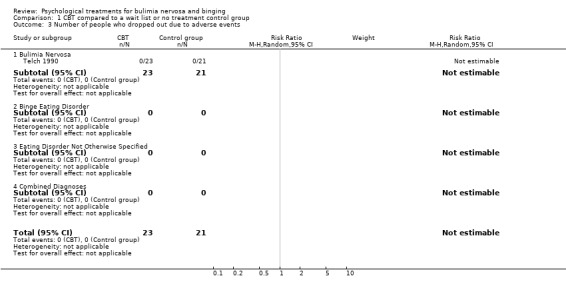
Comparison 1 CBT compared to a wait list or no treatment control group, Outcome 3 Number of people who dropped out due to adverse events.
1.4. Analysis.
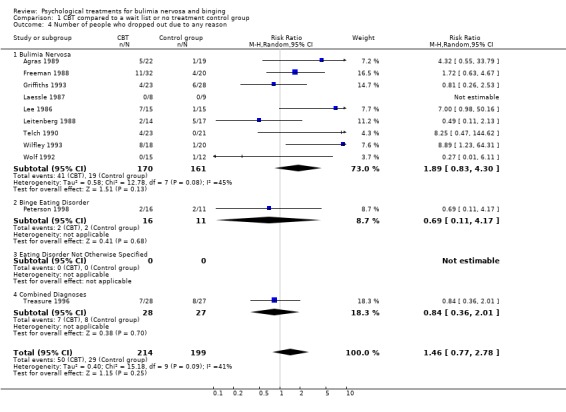
Comparison 1 CBT compared to a wait list or no treatment control group, Outcome 4 Number of people who dropped out due to any reason.
1.5. Analysis.
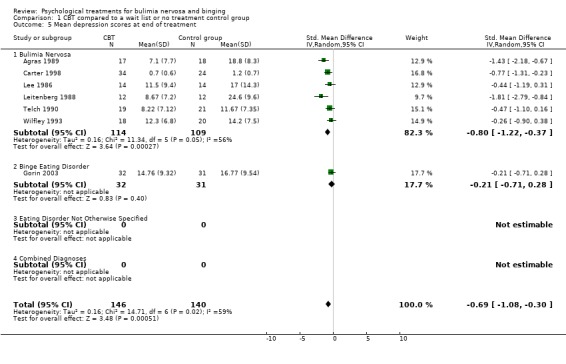
Comparison 1 CBT compared to a wait list or no treatment control group, Outcome 5 Mean depression scores at end of treatment.
1.6. Analysis.

Comparison 1 CBT compared to a wait list or no treatment control group, Outcome 6 Mean psychosocial/interpersonal functioning scores at end of treatment.
1.7. Analysis.
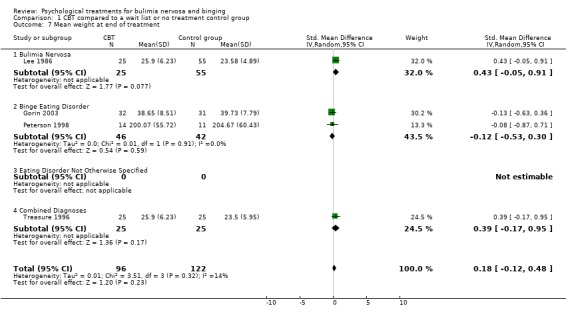
Comparison 1 CBT compared to a wait list or no treatment control group, Outcome 7 Mean weight at end of treatment.
Comparison 2. CBT compared to any other psychotherapy.
| Outcome or subgroup title | No. of studies | No. of participants | Statistical method | Effect size |
|---|---|---|---|---|
| 1 Number of people who did not show remission at end of treatment (100% binge free) | 10 | 763 | Risk Ratio (M‐H, Random, 95% CI) | 0.87 [0.74, 1.02] |
| 1.1 Bulimia Nervosa | 7 | 484 | Risk Ratio (M‐H, Random, 95% CI) | 0.83 [0.71, 0.97] |
| 1.2 Binge Eating Disorder | 1 | 162 | Risk Ratio (M‐H, Random, 95% CI) | 0.77 [0.44, 1.34] |
| 1.3 Eating Disorder Not Otherwise Specified | 0 | 0 | Risk Ratio (M‐H, Random, 95% CI) | 0.0 [0.0, 0.0] |
| 1.4 Combined Diagnoses | 0 | 0 | Risk Ratio (M‐H, Random, 95% CI) | 0.0 [0.0, 0.0] |
| 1.5 BInge eating disorder overweight (.BMI>/= 27): CBT vs weight loss therapies (BWLT) | 2 | 117 | Risk Ratio (M‐H, Random, 95% CI) | 0.96 [0.41, 2.26] |
| 2 Mean bulimic symptom scores at end of treatment | 15 | 941 | Std. Mean Difference (IV, Random, 95% CI) | ‐0.21 [‐0.34, ‐0.09] |
| 2.1 Bulimia Nervosa | 8 | 514 | Std. Mean Difference (IV, Random, 95% CI) | ‐0.15 [‐0.38, 0.07] |
| 2.2 Binge Eating Disorder | 1 | 158 | Std. Mean Difference (IV, Random, 95% CI) | ‐0.16 [‐0.48, 0.15] |
| 2.3 Eating Disorder Not Otherwise Specified | 1 | 34 | Std. Mean Difference (IV, Random, 95% CI) | ‐0.32 [1.00, 0.36] |
| 2.4 Combined Diagnoses | 1 | 46 | Std. Mean Difference (IV, Random, 95% CI) | ‐0.19 [‐0.77, 0.39] |
| 2.5 BED overweight (BMI>/=27): CBT vs behavioural weight loss therapy | 4 | 189 | Std. Mean Difference (IV, Random, 95% CI) | ‐0.31 [‐0.61, ‐0.02] |
| 3 Number of people who dropped out due to adverse events | 2 | 73 | Risk Ratio (M‐H, Random, 95% CI) | 1.0 [0.07, 14.21] |
| 3.1 Bulimia Nervosa | 2 | 73 | Risk Ratio (M‐H, Random, 95% CI) | 1.0 [0.07, 14.21] |
| 3.2 Binge Eating Disorder | 0 | 0 | Risk Ratio (M‐H, Random, 95% CI) | 0.0 [0.0, 0.0] |
| 3.3 Eating Disorder Not Otherwise Specified | 0 | 0 | Risk Ratio (M‐H, Random, 95% CI) | 0.0 [0.0, 0.0] |
| 3.4 Combined Diagnoses | 0 | 0 | Risk Ratio (M‐H, Random, 95% CI) | 0.0 [0.0, 0.0] |
| 3.5 BED overweight (BMI >/=27): CBT vs behavioural weight loss therapy | 0 | 0 | Risk Ratio (M‐H, Random, 95% CI) | 0.0 [0.0, 0.0] |
| 4 Number of people who dropped out due to any reason | 14 | 962 | Risk Ratio (M‐H, Random, 95% CI) | 0.97 [0.70, 1.35] |
| 4.1 Bulimia Nervosa | 8 | 523 | Risk Ratio (M‐H, Random, 95% CI) | 1.00 [0.63, 1.58] |
| 4.2 Binge Eating Disorder | 1 | 162 | Risk Ratio (M‐H, Random, 95% CI) | 1.29 [0.50, 3.29] |
| 4.3 Eating Disorder Not Otherwise Specified | 1 | 34 | Risk Ratio (M‐H, Random, 95% CI) | 0.0 [0.0, 0.0] |
| 4.4 Combined Diagnoses | 1 | 50 | Risk Ratio (M‐H, Random, 95% CI) | 1.0 [0.33, 3.03] |
| 4.5 BED overweight (BMI>/=27): CBT vs BWLT | 3 | 193 | Risk Ratio (M‐H, Random, 95% CI) | 0.68 [0.24, 1.95] |
| 5 Mean depression scores at end of treatment | 13 | 616 | Std. Mean Difference (IV, Random, 95% CI) | ‐0.28 [‐0.57, 0.00] |
| 5.1 Bulimia Nervosa | 7 | 242 | Std. Mean Difference (IV, Random, 95% CI) | ‐0.48 [‐0.98, 0.02] |
| 5.2 Binge Eating Disorder | 1 | 158 | Std. Mean Difference (IV, Random, 95% CI) | 0.14 [‐0.17, 0.46] |
| 5.3 Eating Disorder Not Otherwise Specified | 0 | 0 | Std. Mean Difference (IV, Random, 95% CI) | 0.0 [0.0, 0.0] |
| 5.4 Comined Diagnoses | 1 | 49 | Std. Mean Difference (IV, Random, 95% CI) | ‐0.58 [‐1.15, ‐0.00] |
| 5.5 BED overwight (BMI>/=27): CBT vs BWLT | 4 | 167 | Std. Mean Difference (IV, Random, 95% CI) | ‐0.03 [‐0.33, 0.28] |
| 6 Mean end of trial scores of general psychiatric symptoms | 7 | 371 | Std. Mean Difference (IV, Random, 95% CI) | ‐0.13 [‐0.35, 0.09] |
| 6.1 Bulimia Nervosa | 5 | 165 | Std. Mean Difference (IV, Random, 95% CI) | ‐0.14 [‐0.45, 0.17] |
| 6.2 Binge Eating Disorder | 1 | 158 | Std. Mean Difference (IV, Random, 95% CI) | 0.06 [‐0.25, 0.37] |
| 6.3 Eating Disorder Not Otherwise Specified | 0 | 0 | Std. Mean Difference (IV, Random, 95% CI) | 0.0 [0.0, 0.0] |
| 6.4 Combined Diagnoses | 1 | 48 | Std. Mean Difference (IV, Random, 95% CI) | ‐0.60 [‐1.18, ‐0.02] |
| 6.5 BED overweight (BMI>/=27): CBT vs BWLT | 0 | 0 | Std. Mean Difference (IV, Random, 95% CI) | 0.0 [0.0, 0.0] |
| 7 Mean differences in psychosocial/interpersonal functioning at end of treatment | 7 | 577 | Std. Mean Difference (IV, Random, 95% CI) | ‐0.12 [‐0.28, 0.05] |
| 7.1 Bulimia Nervosa | 4 | 330 | Std. Mean Difference (IV, Random, 95% CI) | ‐0.09 [‐0.31, 0.13] |
| 7.2 Binge Eating Disorder | 1 | 158 | Std. Mean Difference (IV, Random, 95% CI) | ‐0.20 [‐0.51, 0.11] |
| 7.3 Eating Disorder Not Otherwise Specified | 0 | 0 | Std. Mean Difference (IV, Random, 95% CI) | 0.0 [0.0, 0.0] |
| 7.4 Combined Diagnoses | 1 | 41 | Std. Mean Difference (IV, Random, 95% CI) | ‐0.39 [‐1.01, 0.23] |
| 7.5 BED overweight (BMI>/=27): CBT vs BWLT | 1 | 48 | Std. Mean Difference (IV, Random, 95% CI) | 0.18 [‐0.39, 0.75] |
| 8 Mean weight at end of therapy (BMI where possible) | 11 | 572 | Std. Mean Difference (IV, Random, 95% CI) | 0.18 [0.01, 0.34] |
| 8.1 Bulimia Nervosa | 5 | 190 | Std. Mean Difference (IV, Random, 95% CI) | 0.13 [‐0.15, 0.42] |
| 8.2 Binge Eating Disorder | 1 | 158 | Std. Mean Difference (IV, Random, 95% CI) | 0.06 [‐0.26, 0.37] |
| 8.3 Eating Disorder Not Otherwise Specified | 1 | 34 | Std. Mean Difference (IV, Random, 95% CI) | 0.63 [‐0.06, 1.32] |
| 8.4 Combined Diagnoses | 0 | 0 | Std. Mean Difference (IV, Random, 95% CI) | 0.0 [0.0, 0.0] |
| 8.5 BED overweight (BMI>/=27): CBT vs BWLT | 4 | 190 | Std. Mean Difference (IV, Random, 95% CI) | 0.24 [‐0.05, 0.53] |
2.3. Analysis.
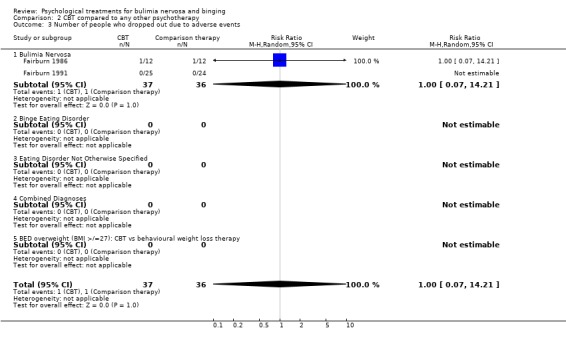
Comparison 2 CBT compared to any other psychotherapy, Outcome 3 Number of people who dropped out due to adverse events.
2.4. Analysis.
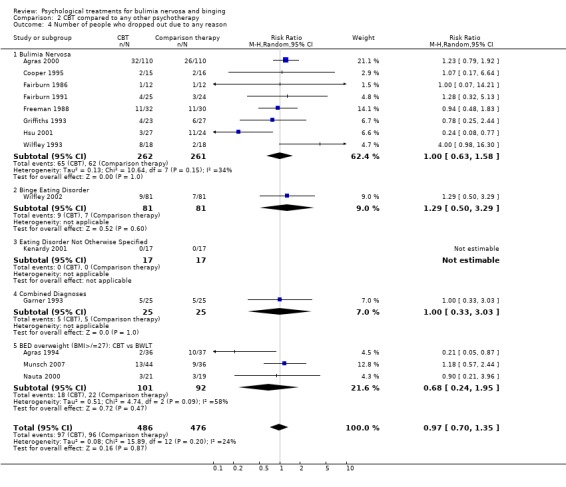
Comparison 2 CBT compared to any other psychotherapy, Outcome 4 Number of people who dropped out due to any reason.
2.5. Analysis.
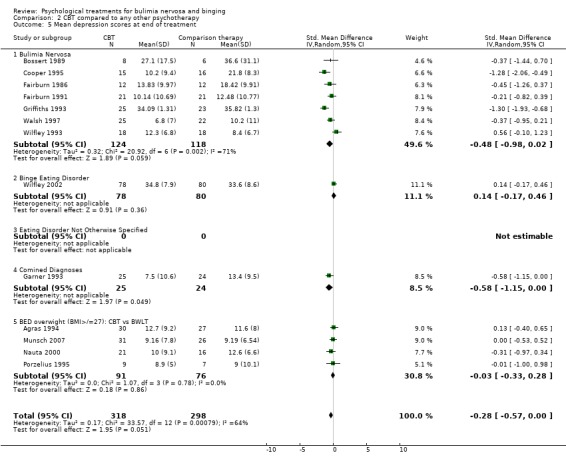
Comparison 2 CBT compared to any other psychotherapy, Outcome 5 Mean depression scores at end of treatment.
2.6. Analysis.
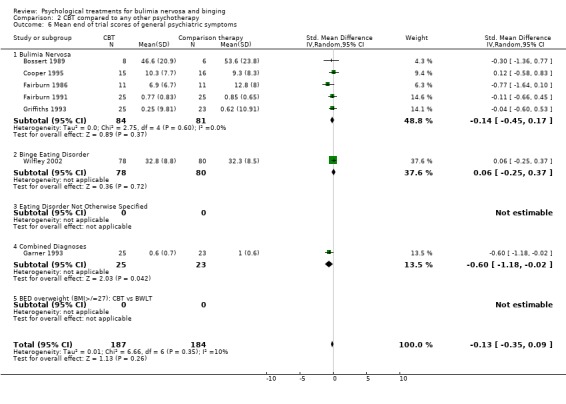
Comparison 2 CBT compared to any other psychotherapy, Outcome 6 Mean end of trial scores of general psychiatric symptoms.
2.7. Analysis.

Comparison 2 CBT compared to any other psychotherapy, Outcome 7 Mean differences in psychosocial/interpersonal functioning at end of treatment.
2.8. Analysis.

Comparison 2 CBT compared to any other psychotherapy, Outcome 8 Mean weight at end of therapy (BMI where possible).
Comparison 3. Guided self‐help CBT compared to pure self‐help CBT.
| Outcome or subgroup title | No. of studies | No. of participants | Statistical method | Effect size |
|---|---|---|---|---|
| 1 Number of people who did not show remission (100% binge free) | 3 | 140 | Risk Ratio (M‐H, Random, 95% CI) | 0.91 [0.71, 1.17] |
| 1.1 Bulimia Nervosa | 0 | 0 | Risk Ratio (M‐H, Random, 95% CI) | 0.0 [0.0, 0.0] |
| 1.2 Binge Eating Disorder | 1 | 69 | Risk Ratio (M‐H, Random, 95% CI) | 0.88 [0.56, 1.36] |
| 1.3 Eating Disorder Not Otherwise Specified | 0 | 0 | Risk Ratio (M‐H, Random, 95% CI) | 0.0 [0.0, 0.0] |
| 1.4 Combined Diagnoses | 2 | 71 | Risk Ratio (M‐H, Random, 95% CI) | 0.91 [0.60, 1.36] |
| 2 Average difference in bulimic symptoms at end of treatment | 3 | 140 | Std. Mean Difference (IV, Random, 95% CI) | ‐0.42 [‐0.76, ‐0.09] |
| 2.1 Bulimia Nervosa | 0 | 0 | Std. Mean Difference (IV, Random, 95% CI) | 0.0 [0.0, 0.0] |
| 2.2 Binge Eating Disorder | 1 | 69 | Std. Mean Difference (IV, Random, 95% CI) | ‐0.47 [‐0.95, 0.00] |
| 2.3 Eating Disorder Not Otherwise Specified | 0 | 0 | Std. Mean Difference (IV, Random, 95% CI) | 0.0 [0.0, 0.0] |
| 2.4 Combined Diagnoses | 2 | 71 | Std. Mean Difference (IV, Random, 95% CI) | ‐0.37 [‐0.84, 0.10] |
| 3 Number of people who dropped out due to adverse events | 1 | 58 | Risk Ratio (M‐H, Random, 95% CI) | 12.14 [0.73, 200.81] |
| 3.1 Bulimia Nervosa | 0 | 0 | Risk Ratio (M‐H, Random, 95% CI) | 0.0 [0.0, 0.0] |
| 3.2 Binge Eating Disorder | 1 | 58 | Risk Ratio (M‐H, Random, 95% CI) | 12.14 [0.73, 200.81] |
| 3.3 Eating Disorder Not Otherwise Specified | 0 | 0 | Risk Ratio (M‐H, Random, 95% CI) | 0.0 [0.0, 0.0] |
| 3.4 Combined Diagnoses | 0 | 0 | Risk Ratio (M‐H, Random, 95% CI) | 0.0 [0.0, 0.0] |
| 4 Number of people who dropped out due to any reason | 3 | 140 | Risk Ratio (M‐H, Random, 95% CI) | 1.54 [0.54, 4.41] |
| 4.1 Bulimia Nervosa | 0 | 0 | Risk Ratio (M‐H, Random, 95% CI) | 0.0 [0.0, 0.0] |
| 4.2 Binge Eating Disorder | 1 | 69 | Risk Ratio (M‐H, Random, 95% CI) | 17.49 [1.05, 291.59] |
| 4.3 Eating Disorder Not Otherwise Specified | 0 | 0 | Risk Ratio (M‐H, Random, 95% CI) | 0.0 [0.0, 0.0] |
| 4.4 Combined Diagnoses | 2 | 71 | Risk Ratio (M‐H, Random, 95% CI) | 1.13 [0.61, 2.07] |
| 5 Average difference in depression at end of treatment | 2 | 109 | Std. Mean Difference (IV, Random, 95% CI) | ‐0.19 [‐0.56, 0.19] |
| 5.1 Bulimia Nervosa | 0 | 0 | Std. Mean Difference (IV, Random, 95% CI) | 0.0 [0.0, 0.0] |
| 5.2 Binge Eating Disorder | 1 | 69 | Std. Mean Difference (IV, Random, 95% CI) | ‐0.16 [‐0.64, 0.31] |
| 5.3 Eating Disorder Not Otherwise Specified | 0 | 0 | Std. Mean Difference (IV, Random, 95% CI) | 0.0 [0.0, 0.0] |
| 5.4 Combined Diagnoses | 1 | 40 | Std. Mean Difference (IV, Random, 95% CI) | ‐0.22 [‐0.85, 0.40] |
| 6 Average difference in general psychiatric symptoms at end of treatment | 2 | 109 | Std. Mean Difference (IV, Random, 95% CI) | ‐1.13 [‐3.07, 0.81] |
| 6.1 Bulimia Nervosa | 0 | 0 | Std. Mean Difference (IV, Random, 95% CI) | 0.0 [0.0, 0.0] |
| 6.2 Binge Eating Disorder | 1 | 69 | Std. Mean Difference (IV, Random, 95% CI) | ‐0.16 [‐0.64, 0.31] |
| 6.3 Eating Disorder Not Otherwise Specified | 0 | 0 | Std. Mean Difference (IV, Random, 95% CI) | 0.0 [0.0, 0.0] |
| 6.4 Combined Diagnoses | 1 | 40 | Std. Mean Difference (IV, Random, 95% CI) | ‐2.14 [‐2.94, ‐1.35] |
| 7 Average difference in psycho‐social functioning at end of therapy | 0 | 0 | Std. Mean Difference (IV, Random, 95% CI) | 0.0 [0.0, 0.0] |
| 8 Mean weight at end of therapy (BMI where possible) | 3 | 140 | Std. Mean Difference (IV, Random, 95% CI) | ‐0.03 [‐0.36, 0.31] |
| 8.1 Bulimia Nervosa | 0 | 0 | Std. Mean Difference (IV, Random, 95% CI) | 0.0 [0.0, 0.0] |
| 8.2 Binge Eating Disorder | 1 | 69 | Std. Mean Difference (IV, Random, 95% CI) | 0.16 [‐0.32, 0.63] |
| 8.3 Eating Disorder Not Otherwise Specified | 0 | 0 | Std. Mean Difference (IV, Random, 95% CI) | 0.0 [0.0, 0.0] |
| 8.4 Combined Diagnoses | 2 | 71 | Std. Mean Difference (IV, Random, 95% CI) | ‐0.21 [‐0.67, 0.26] |
3.3. Analysis.

Comparison 3 Guided self‐help CBT compared to pure self‐help CBT, Outcome 3 Number of people who dropped out due to adverse events.
3.4. Analysis.

Comparison 3 Guided self‐help CBT compared to pure self‐help CBT, Outcome 4 Number of people who dropped out due to any reason.
3.5. Analysis.
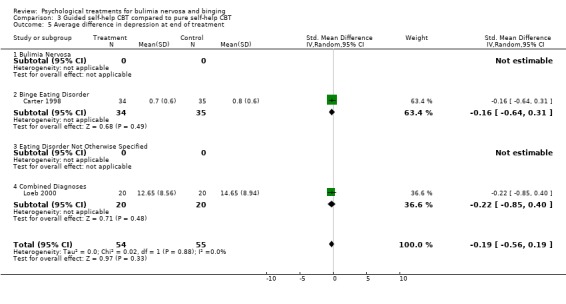
Comparison 3 Guided self‐help CBT compared to pure self‐help CBT, Outcome 5 Average difference in depression at end of treatment.
3.6. Analysis.
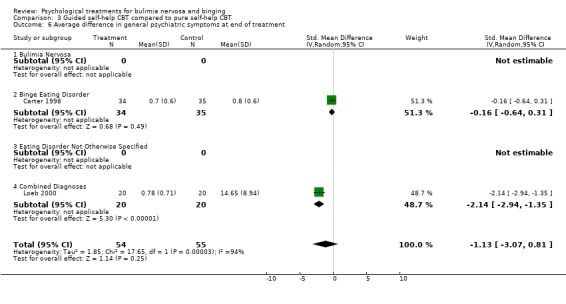
Comparison 3 Guided self‐help CBT compared to pure self‐help CBT, Outcome 6 Average difference in general psychiatric symptoms at end of treatment.
3.8. Analysis.
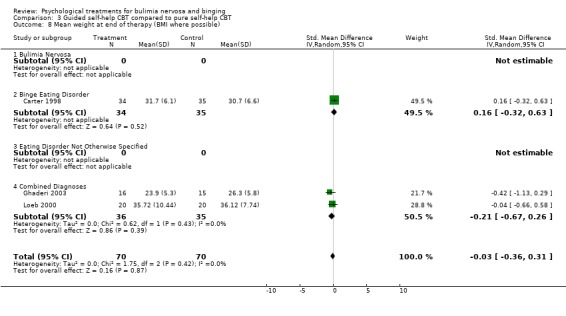
Comparison 3 Guided self‐help CBT compared to pure self‐help CBT, Outcome 8 Mean weight at end of therapy (BMI where possible).
Comparison 4. CBT versus CBT augmented by ERP.
| Outcome or subgroup title | No. of studies | No. of participants | Statistical method | Effect size |
|---|---|---|---|---|
| 1 Number of people who did not show remission (100% binge free) | 3 | 168 | Risk Ratio (M‐H, Random, 95% CI) | 0.87 [0.65, 1.16] |
| 1.1 Bulimia Nervosa | 3 | 168 | Risk Ratio (M‐H, Random, 95% CI) | 0.87 [0.65, 1.16] |
| 1.2 Binge Eating Disorder | 0 | 0 | Risk Ratio (M‐H, Random, 95% CI) | 0.0 [0.0, 0.0] |
| 1.3 Eating Disorder Not Otherwise Specified | 0 | 0 | Risk Ratio (M‐H, Random, 95% CI) | 0.0 [0.0, 0.0] |
| 1.4 Combined Diagnoses | 0 | 0 | Risk Ratio (M‐H, Random, 95% CI) | 0.0 [0.0, 0.0] |
| 2 Mean scores on bulimic rating scale at end of treatment | 4 | 149 | Std. Mean Difference (IV, Random, 95% CI) | 0.19 [‐0.23, 0.62] |
| 2.1 Bulimia Nervosa | 4 | 149 | Std. Mean Difference (IV, Random, 95% CI) | 0.19 [‐0.23, 0.62] |
| 2.2 Binge Eating Disorder | 0 | 0 | Std. Mean Difference (IV, Random, 95% CI) | 0.0 [0.0, 0.0] |
| 2.3 Eating Disorder Not Otherwise Specified | 0 | 0 | Std. Mean Difference (IV, Random, 95% CI) | 0.0 [0.0, 0.0] |
| 2.4 Combined Diagnoses | 0 | 0 | Std. Mean Difference (IV, Random, 95% CI) | 0.0 [0.0, 0.0] |
| 3 Number of noncompleters due to any reason | 4 | 193 | Risk Ratio (M‐H, Random, 95% CI) | 0.97 [0.32, 2.89] |
| 3.1 Bulimia Nervosa | 4 | 193 | Risk Ratio (M‐H, Random, 95% CI) | 0.97 [0.32, 2.89] |
| 3.2 Binge Eating Disorder | 0 | 0 | Risk Ratio (M‐H, Random, 95% CI) | 0.0 [0.0, 0.0] |
| 3.3 Eating Disorder Not Otherwise Specified | 0 | 0 | Risk Ratio (M‐H, Random, 95% CI) | 0.0 [0.0, 0.0] |
| 3.4 Combined Diagnoses | 0 | 0 | Risk Ratio (M‐H, Random, 95% CI) | 0.0 [0.0, 0.0] |
| 4 Mean depression scores at end of treatment | 4 | 145 | Std. Mean Difference (IV, Random, 95% CI) | 0.38 [‐0.27, 1.02] |
| 4.1 Bulimia Nervosa | 4 | 145 | Std. Mean Difference (IV, Random, 95% CI) | 0.38 [‐0.27, 1.02] |
| 4.2 Binge Eating Disorder | 0 | 0 | Std. Mean Difference (IV, Random, 95% CI) | 0.0 [0.0, 0.0] |
| 4.3 Eating Disorder Not Otherwise Specified | 0 | 0 | Std. Mean Difference (IV, Random, 95% CI) | 0.0 [0.0, 0.0] |
| 4.4 Combined Diagnoses | 0 | 0 | Std. Mean Difference (IV, Random, 95% CI) | 0.0 [0.0, 0.0] |
| 5 Mean scores on psychiatric symptom rating scale at end of treatment | 0 | 0 | Std. Mean Difference (IV, Random, 95% CI) | 0.0 [0.0, 0.0] |
| 6 Mean weight at end of therapy | 0 | 0 | Std. Mean Difference (IV, Random, 95% CI) | 0.0 [0.0, 0.0] |
4.3. Analysis.
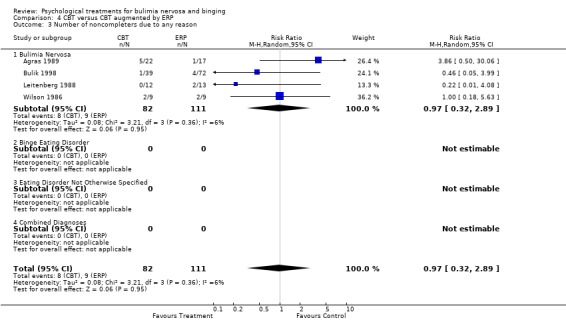
Comparison 4 CBT versus CBT augmented by ERP, Outcome 3 Number of noncompleters due to any reason.
4.4. Analysis.
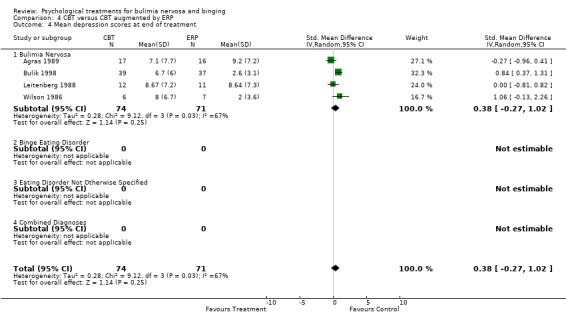
Comparison 4 CBT versus CBT augmented by ERP, Outcome 4 Mean depression scores at end of treatment.
Comparison 5. Any psychotherapy, NOT CBT, compared to a no treatment or waitlist control group.
| Outcome or subgroup title | No. of studies | No. of participants | Statistical method | Effect size |
|---|---|---|---|---|
| 1 Number of people who did not show remission (100% binge free) | 6 | 291 | Risk Ratio (M‐H, Random, 95% CI) | 0.63 [0.48, 0.83] |
| 1.1 Bulimia Nervosa | 4 | 162 | Risk Ratio (M‐H, Random, 95% CI) | 0.65 [0.55, 0.77] |
| 1.2 Binge Eating Disorder | 1 | 44 | Risk Ratio (M‐H, Random, 95% CI) | 0.30 [0.15, 0.60] |
| 1.3 Eating Disorder Not Otherwise Specified | 0 | 0 | Risk Ratio (M‐H, Random, 95% CI) | 0.0 [0.0, 0.0] |
| 1.4 Combined Diagnoses | 1 | 85 | Risk Ratio (M‐H, Random, 95% CI) | 0.86 [0.75, 0.99] |
| 2 Mean scores on binge and/or purge frequency at end of treatment | 7 | 325 | Std. Mean Difference (IV, Random, 95% CI) | ‐1.14 [‐1.39, ‐0.89] |
| 2.1 Bulimia Nervosa | 5 | 206 | Std. Mean Difference (IV, Random, 95% CI) | ‐1.22 [‐1.52, ‐0.92] |
| 2.2 Binge Eating Disorder | 1 | 34 | Std. Mean Difference (IV, Random, 95% CI) | 0.0 [0.0, 0.0] |
| 2.3 Eating Disorder Not Otherwise Specified | 0 | 0 | Std. Mean Difference (IV, Random, 95% CI) | 0.0 [0.0, 0.0] |
| 2.4 Combined Diagnoses | 1 | 85 | Std. Mean Difference (IV, Random, 95% CI) | ‐0.95 [‐1.40, ‐0.50] |
| 3 Mean depression scores at end of treatment. | 4 | 135 | Std. Mean Difference (IV, Random, 95% CI) | ‐0.51 [‐0.85, ‐0.16] |
| 3.1 Bulimia Nervosa | 3 | 101 | Std. Mean Difference (IV, Random, 95% CI) | ‐0.58 [‐0.98, ‐0.18] |
| 3.2 Binge Eating Disorder | 1 | 34 | Std. Mean Difference (IV, Random, 95% CI) | ‐0.31 [‐0.98, 0.37] |
| 3.3 Eating Disorder Not Otherwise Specified | 0 | 0 | Std. Mean Difference (IV, Random, 95% CI) | 0.0 [0.0, 0.0] |
| 3.4 Combined Diagnoses | 0 | 0 | Std. Mean Difference (IV, Random, 95% CI) | 0.0 [0.0, 0.0] |
| 4 Mean scores on general psychiatric symptom rating scales at end of treatment | 0 | 0 | Std. Mean Difference (IV, Random, 95% CI) | 0.0 [0.0, 0.0] |
| 5 Number of treatment non‐completers | 6 | 291 | Risk Ratio (M‐H, Random, 95% CI) | 1.44 [0.83, 2.49] |
| 5.1 Bulimia Nervosa | 4 | 162 | Risk Ratio (M‐H, Random, 95% CI) | 1.40 [0.63, 3.10] |
| 5.2 Binge Eating Disorder | 1 | 44 | Risk Ratio (M‐H, Random, 95% CI) | 0.67 [0.22, 2.04] |
| 5.3 Eating Disorder Not Otherwise Specified | 0 | 0 | Risk Ratio (M‐H, Random, 95% CI) | 0.0 [0.0, 0.0] |
| 5.4 Combined Diagnoses | 1 | 85 | Risk Ratio (M‐H, Random, 95% CI) | 2.93 [1.03, 8.36] |
| 6 Numbers not completing due to adverse events. | 0 | 0 | Risk Ratio (M‐H, Random, 95% CI) | 0.0 [0.0, 0.0] |
| 7 Mean weight at end of therapy | 2 | 119 | Std. Mean Difference (IV, Random, 95% CI) | ‐0.03 [‐0.40, 0.34] |
| 7.1 Bulimia Nervosa | 0 | 0 | Std. Mean Difference (IV, Random, 95% CI) | 0.0 [0.0, 0.0] |
| 7.2 Binge Eating Disorder | 1 | 34 | Std. Mean Difference (IV, Random, 95% CI) | ‐0.32 [‐1.00, 0.35] |
| 7.3 EDNOS | 0 | 0 | Std. Mean Difference (IV, Random, 95% CI) | 0.0 [0.0, 0.0] |
| 7.4 Combined Diagnosis | 1 | 85 | Std. Mean Difference (IV, Random, 95% CI) | 0.09 [‐0.34, 0.51] |
| 8 EDE restraint scale scores at end of treatment | 2 | 63 | Std. Mean Difference (IV, Random, 95% CI) | ‐0.54 [‐1.05, ‐0.04] |
| 8.1 Bulimia Nervosa | 1 | 29 | Std. Mean Difference (IV, Random, 95% CI) | ‐0.80 [‐1.56, ‐0.04] |
| 8.2 Binge Eating Disorder | 1 | 34 | Std. Mean Difference (IV, Random, 95% CI) | ‐0.34 [‐1.02, 0.34] |
| 8.3 Eating Disorder Not Otherwise Specified | 0 | 0 | Std. Mean Difference (IV, Random, 95% CI) | 0.0 [0.0, 0.0] |
| 8.4 Combined Diagnoses | 0 | 0 | Std. Mean Difference (IV, Random, 95% CI) | 0.0 [0.0, 0.0] |
5.3. Analysis.

Comparison 5 Any psychotherapy, NOT CBT, compared to a no treatment or waitlist control group, Outcome 3 Mean depression scores at end of treatment..
5.5. Analysis.

Comparison 5 Any psychotherapy, NOT CBT, compared to a no treatment or waitlist control group, Outcome 5 Number of treatment non‐completers.
5.7. Analysis.

Comparison 5 Any psychotherapy, NOT CBT, compared to a no treatment or waitlist control group, Outcome 7 Mean weight at end of therapy.
5.8. Analysis.
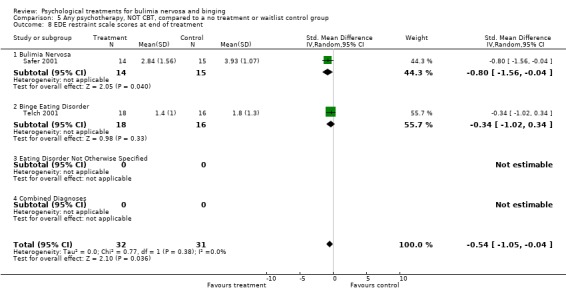
Comparison 5 Any psychotherapy, NOT CBT, compared to a no treatment or waitlist control group, Outcome 8 EDE restraint scale scores at end of treatment.
Comparison 6. Any psychotherapy, NOT CBT, compared to a control therapy (to date either nutritional management or B.T.).
| Outcome or subgroup title | No. of studies | No. of participants | Statistical method | Effect size |
|---|---|---|---|---|
| 1 Number of people who did not show remission (100% binge free) | 3 | 118 | Risk Ratio (M‐H, Random, 95% CI) | 0.94 [0.61, 1.45] |
| 1.1 Bulimia Nervosa | 3 | 118 | Risk Ratio (M‐H, Random, 95% CI) | 0.94 [0.61, 1.45] |
| 1.2 Binge Eating Disorder | 0 | 0 | Risk Ratio (M‐H, Random, 95% CI) | 0.0 [0.0, 0.0] |
| 1.3 Eating Disorder Not Otherwise Specified | 0 | 0 | Risk Ratio (M‐H, Random, 95% CI) | 0.0 [0.0, 0.0] |
| 1.4 Combined Diagnoses | 0 | 0 | Risk Ratio (M‐H, Random, 95% CI) | 0.0 [0.0, 0.0] |
| 2 Mean scores of bulimic symptoms at end of trial where scores were not different between groups at start | 4 | 163 | Std. Mean Difference (IV, Random, 95% CI) | ‐1.29 [‐2.93, 0.36] |
| 2.1 Bulimia Nervosa | 4 | 163 | Std. Mean Difference (IV, Random, 95% CI) | ‐1.29 [‐2.93, 0.36] |
| 2.2 Binge Eating Disorder | 0 | 0 | Std. Mean Difference (IV, Random, 95% CI) | 0.0 [0.0, 0.0] |
| 2.3 Eating Disorder Not Otherwise Specified | 0 | 0 | Std. Mean Difference (IV, Random, 95% CI) | 0.0 [0.0, 0.0] |
| 2.4 Combined Diagnoses | 0 | 0 | Std. Mean Difference (IV, Random, 95% CI) | 0.0 [0.0, 0.0] |
| 3 Number of people who dropped out due to adverse events | 0 | 0 | Risk Ratio (M‐H, Random, 95% CI) | 0.0 [0.0, 0.0] |
| 4 Number of people who dropped out due to any reason | 3 | 162 | Risk Ratio (M‐H, Random, 95% CI) | 0.68 [0.32, 1.43] |
| 4.1 Bulimia Nervosa | 3 | 162 | Risk Ratio (M‐H, Random, 95% CI) | 0.68 [0.32, 1.43] |
| 4.2 Binge Eating Disorder | 0 | 0 | Risk Ratio (M‐H, Random, 95% CI) | 0.0 [0.0, 0.0] |
| 4.3 Eating Disorder Not Otherwise Specified | 0 | 0 | Risk Ratio (M‐H, Random, 95% CI) | 0.0 [0.0, 0.0] |
| 4.4 Combined Diagnoses | 0 | 0 | Risk Ratio (M‐H, Random, 95% CI) | 0.0 [0.0, 0.0] |
| 5 Mean end of trial depression scores | 1 | 48 | Std. Mean Difference (IV, Random, 95% CI) | 0.22 [‐0.35, 0.79] |
| 5.1 Bulimia Nervosa | 1 | 48 | Std. Mean Difference (IV, Random, 95% CI) | 0.22 [‐0.35, 0.79] |
| 5.2 Binge Eating Disorder | 0 | 0 | Std. Mean Difference (IV, Random, 95% CI) | 0.0 [0.0, 0.0] |
| 5.3 Eating Disorder Not Otherwise Specified | 0 | 0 | Std. Mean Difference (IV, Random, 95% CI) | 0.0 [0.0, 0.0] |
| 5.4 Combined Diagnoses | 0 | 0 | Std. Mean Difference (IV, Random, 95% CI) | 0.0 [0.0, 0.0] |
| 6 Mean end of trial scores on measures of social or interpersonal functioning | 1 | 48 | Std. Mean Difference (IV, Random, 95% CI) | ‐0.02 [‐0.59, 0.55] |
| 6.1 Bulimia Nervosa | 1 | 48 | Std. Mean Difference (IV, Random, 95% CI) | ‐0.02 [‐0.59, 0.55] |
| 6.2 Binge Eating Disorder | 0 | 0 | Std. Mean Difference (IV, Random, 95% CI) | 0.0 [0.0, 0.0] |
| 6.3 Eating Disorder Not Otherwise Specified | 0 | 0 | Std. Mean Difference (IV, Random, 95% CI) | 0.0 [0.0, 0.0] |
| 6.4 Combined Diagnoses | 0 | 0 | Std. Mean Difference (IV, Random, 95% CI) | 0.0 [0.0, 0.0] |
| 7 Mean weight at end of therapy (Body Mass Index where possible) | 1 | 48 | Std. Mean Difference (IV, Random, 95% CI) | ‐0.65 [‐1.24, ‐0.07] |
| 7.1 Bulimia Nervosa | 1 | 48 | Std. Mean Difference (IV, Random, 95% CI) | ‐0.65 [‐1.24, ‐0.07] |
| 7.2 Binge Eating Disorder | 0 | 0 | Std. Mean Difference (IV, Random, 95% CI) | 0.0 [0.0, 0.0] |
| 7.3 Eating Disorder Not Otherwise Specified | 0 | 0 | Std. Mean Difference (IV, Random, 95% CI) | 0.0 [0.0, 0.0] |
| 7.4 Combined Diagnoses | 0 | 0 | Std. Mean Difference (IV, Random, 95% CI) | 0.0 [0.0, 0.0] |
6.4. Analysis.
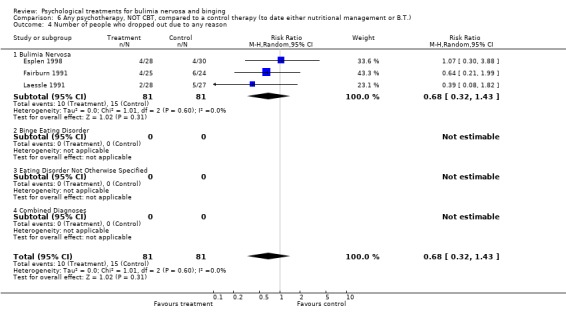
Comparison 6 Any psychotherapy, NOT CBT, compared to a control therapy (to date either nutritional management or B.T.), Outcome 4 Number of people who dropped out due to any reason.
6.5. Analysis.
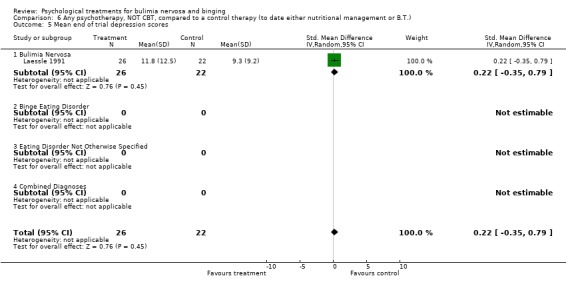
Comparison 6 Any psychotherapy, NOT CBT, compared to a control therapy (to date either nutritional management or B.T.), Outcome 5 Mean end of trial depression scores.
6.6. Analysis.

Comparison 6 Any psychotherapy, NOT CBT, compared to a control therapy (to date either nutritional management or B.T.), Outcome 6 Mean end of trial scores on measures of social or interpersonal functioning.
6.7. Analysis.
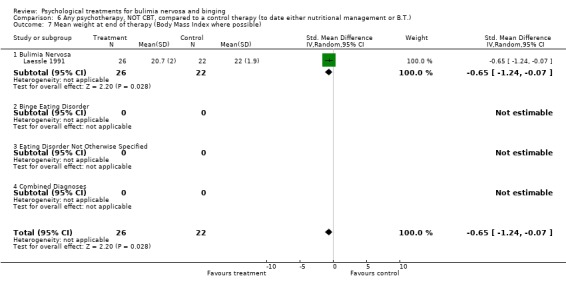
Comparison 6 Any psychotherapy, NOT CBT, compared to a control therapy (to date either nutritional management or B.T.), Outcome 7 Mean weight at end of therapy (Body Mass Index where possible).
Comparison 7. CBT versus a component of CBT only ‐ most commonly a behavioural component (B.T.).
| Outcome or subgroup title | No. of studies | No. of participants | Statistical method | Effect size |
|---|---|---|---|---|
| 1 Number of people who did not remit (were not 100% binge free) | 4 | 168 | Risk Ratio (M‐H, Random, 95% CI) | 0.67 [0.53, 0.84] |
| 1.1 Bulimia Nervosa | 4 | 168 | Risk Ratio (M‐H, Random, 95% CI) | 0.67 [0.53, 0.84] |
| 1.2 Binge Eating Disorder | 0 | 0 | Risk Ratio (M‐H, Random, 95% CI) | 0.0 [0.0, 0.0] |
| 1.3 Eating Disorder Not Otherwise Specified | 0 | 0 | Risk Ratio (M‐H, Random, 95% CI) | 0.0 [0.0, 0.0] |
| 1.4 Combined Diagnoses | 0 | 0 | Risk Ratio (M‐H, Random, 95% CI) | 0.0 [0.0, 0.0] |
| 2 Mean binge eating frequency at end of therapy | 1 | 30 | Std. Mean Difference (IV, Random, 95% CI) | ‐0.33 [‐1.06, 0.39] |
| 2.1 Bulimia Nervosa | 1 | 30 | Std. Mean Difference (IV, Random, 95% CI) | ‐0.33 [‐1.06, 0.39] |
| 2.2 Binge Eating Disorder | 0 | 0 | Std. Mean Difference (IV, Random, 95% CI) | 0.0 [0.0, 0.0] |
| 2.3 Eating Disorder Not Otherwise Specified | 0 | 0 | Std. Mean Difference (IV, Random, 95% CI) | 0.0 [0.0, 0.0] |
| 2.4 Combined Diagnoses | 0 | 0 | Std. Mean Difference (IV, Random, 95% CI) | 0.0 [0.0, 0.0] |
| 3 Mean depression scores at end of therapy | 1 | 33 | Std. Mean Difference (IV, Random, 95% CI) | ‐0.69 [‐1.40, 0.01] |
| 3.1 Bulimia Nervosa | 1 | 33 | Std. Mean Difference (IV, Random, 95% CI) | ‐0.69 [‐1.40, 0.01] |
| 3.2 Binge Eating Disorder | 0 | 0 | Std. Mean Difference (IV, Random, 95% CI) | 0.0 [0.0, 0.0] |
| 3.3 Eating Disorder Not Otherwise Specified | 0 | 0 | Std. Mean Difference (IV, Random, 95% CI) | 0.0 [0.0, 0.0] |
| 3.4 Combined Diagnoses | 0 | 0 | Std. Mean Difference (IV, Random, 95% CI) | 0.0 [0.0, 0.0] |
| 4 Number of subjects not completing therapy | 4 | 148 | Risk Ratio (M‐H, Random, 95% CI) | 0.70 [0.27, 1.79] |
| 4.1 Bulimia Nervosa | 4 | 148 | Risk Ratio (M‐H, Random, 95% CI) | 0.70 [0.27, 1.79] |
| 4.2 Binge Eating Disorder | 0 | 0 | Risk Ratio (M‐H, Random, 95% CI) | 0.0 [0.0, 0.0] |
| 4.3 Eating Disorder Not Otherwise Specified | 0 | 0 | Risk Ratio (M‐H, Random, 95% CI) | 0.0 [0.0, 0.0] |
| 4.4 Combined Diagnoses | 0 | 0 | Risk Ratio (M‐H, Random, 95% CI) | 0.0 [0.0, 0.0] |
| 5 Body mass index or weight at end of treatment | 1 | 39 | Std. Mean Difference (IV, Random, 95% CI) | 0.08 [‐0.55, 0.71] |
| 5.1 Bulimia Nervosa | 1 | 39 | Std. Mean Difference (IV, Random, 95% CI) | 0.08 [‐0.55, 0.71] |
| 5.2 Binge Eating Disorder | 0 | 0 | Std. Mean Difference (IV, Random, 95% CI) | 0.0 [0.0, 0.0] |
| 5.3 Eating Disorder Not Otherwise Specified | 0 | 0 | Std. Mean Difference (IV, Random, 95% CI) | 0.0 [0.0, 0.0] |
| 5.4 Combined Diagnoses | 0 | 0 | Std. Mean Difference (IV, Random, 95% CI) | 0.0 [0.0, 0.0] |
| 6 Mean general psychiatric symptom severity scores at end of treatment | 1 | 50 | Std. Mean Difference (IV, Random, 95% CI) | ‐0.27 [‐0.82, 0.29] |
| 6.1 Bulimia Nervosa | 1 | 50 | Std. Mean Difference (IV, Random, 95% CI) | ‐0.27 [‐0.82, 0.29] |
| 6.2 Binge Eating Disorder | 0 | 0 | Std. Mean Difference (IV, Random, 95% CI) | 0.0 [0.0, 0.0] |
| 6.3 Eating Disorder Not Otherwise Specified | 0 | 0 | Std. Mean Difference (IV, Random, 95% CI) | 0.0 [0.0, 0.0] |
| 6.4 Combined Diagnoses | 0 | 0 | Std. Mean Difference (IV, Random, 95% CI) | 0.0 [0.0, 0.0] |
| 7 Mean social adjustment scores at end of therapy | 1 | 50 | Std. Mean Difference (IV, Random, 95% CI) | ‐0.05 [‐0.60, 0.51] |
| 7.1 Bulimia Nervosa | 1 | 50 | Std. Mean Difference (IV, Random, 95% CI) | ‐0.05 [‐0.60, 0.51] |
| 7.2 Binge Eating Disorder | 0 | 0 | Std. Mean Difference (IV, Random, 95% CI) | 0.0 [0.0, 0.0] |
| 7.3 Eating Disorder Not Otherwise Specified | 0 | 0 | Std. Mean Difference (IV, Random, 95% CI) | 0.0 [0.0, 0.0] |
| 7.4 Combined Diagnoses | 0 | 0 | Std. Mean Difference (IV, Random, 95% CI) | 0.0 [0.0, 0.0] |
| 8 Mean bulimic symptom severity scores at end of treatment (eg Global EDE score) | 2 | 80 | Std. Mean Difference (IV, Random, 95% CI) | ‐0.60 [‐1.05, ‐0.15] |
| 8.1 Bulimia Nervosa | 2 | 80 | Std. Mean Difference (IV, Random, 95% CI) | ‐0.60 [‐1.05, ‐0.15] |
| 8.2 Binge Eating Disorder | 0 | 0 | Std. Mean Difference (IV, Random, 95% CI) | 0.0 [0.0, 0.0] |
| 8.3 Eating Disorder Not Otherwise Specified | 0 | 0 | Std. Mean Difference (IV, Random, 95% CI) | 0.0 [0.0, 0.0] |
| 8.4 Combined Diagnoses | 0 | 0 | Std. Mean Difference (IV, Random, 95% CI) | 0.0 [0.0, 0.0] |
7.2. Analysis.
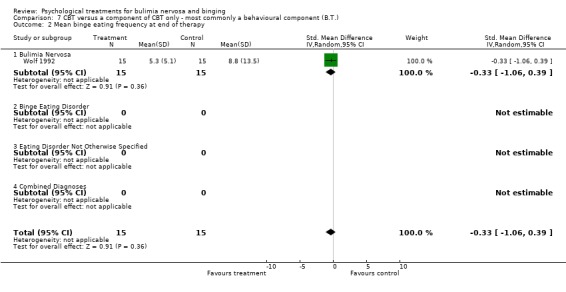
Comparison 7 CBT versus a component of CBT only ‐ most commonly a behavioural component (B.T.), Outcome 2 Mean binge eating frequency at end of therapy.
7.3. Analysis.

Comparison 7 CBT versus a component of CBT only ‐ most commonly a behavioural component (B.T.), Outcome 3 Mean depression scores at end of therapy.
7.4. Analysis.
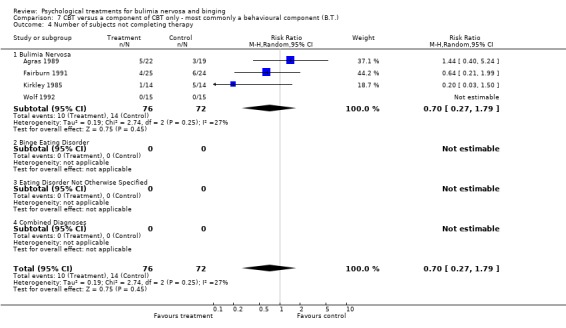
Comparison 7 CBT versus a component of CBT only ‐ most commonly a behavioural component (B.T.), Outcome 4 Number of subjects not completing therapy.
7.5. Analysis.
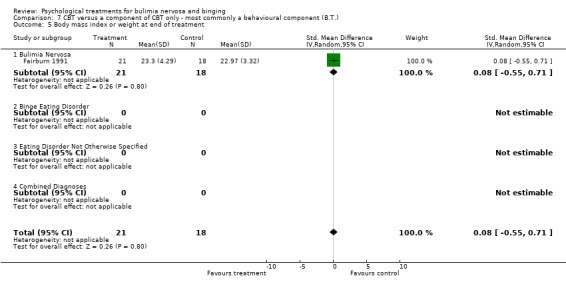
Comparison 7 CBT versus a component of CBT only ‐ most commonly a behavioural component (B.T.), Outcome 5 Body mass index or weight at end of treatment.
7.6. Analysis.
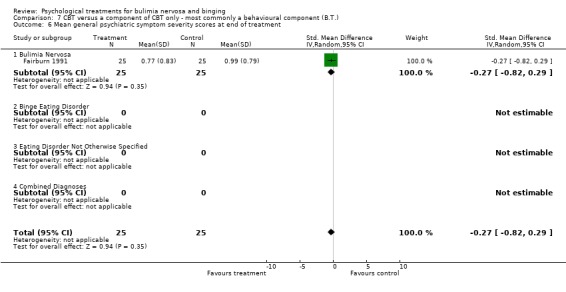
Comparison 7 CBT versus a component of CBT only ‐ most commonly a behavioural component (B.T.), Outcome 6 Mean general psychiatric symptom severity scores at end of treatment.
7.7. Analysis.

Comparison 7 CBT versus a component of CBT only ‐ most commonly a behavioural component (B.T.), Outcome 7 Mean social adjustment scores at end of therapy.
7.8. Analysis.

Comparison 7 CBT versus a component of CBT only ‐ most commonly a behavioural component (B.T.), Outcome 8 Mean bulimic symptom severity scores at end of treatment (eg Global EDE score).
Comparison 8. Guided (non specialist) self‐help versus waiting‐list control group.
| Outcome or subgroup title | No. of studies | No. of participants | Statistical method | Effect size |
|---|---|---|---|---|
| 1 Number not abstinent from binge eating at end of treatment | 4 | 297 | Risk Ratio (M‐H, Random, 95% CI) | 0.69 [0.52, 0.92] |
| 1.1 Bulimia Nervosa | 1 | 95 | Risk Ratio (M‐H, Random, 95% CI) | 0.62 [0.47, 0.81] |
| 1.2 Binge Eating Disorder | 1 | 58 | Risk Ratio (M‐H, Random, 95% CI) | 0.55 [0.38, 0.78] |
| 1.3 Eating Disorder Not Otherwise Specified | 1 | 14 | Risk Ratio (M‐H, Random, 95% CI) | 0.51 [0.17, 1.59] |
| 1.4 Combined Diagnoses | 2 | 130 | Risk Ratio (M‐H, Random, 95% CI) | 0.84 [0.66, 1.06] |
| 2 Mean bulimic symptom scores (where possible binge eating weekly frequency) at end of treatment | 3 | 225 | Std. Mean Difference (IV, Random, 95% CI) | ‐0.98 [‐1.27, ‐0.69] |
| 2.1 Bulimia Nervosa | 1 | 95 | Std. Mean Difference (IV, Random, 95% CI) | ‐0.99 [‐1.42, ‐0.56] |
| 2.2 Binge Eating Disorder | 1 | 58 | Std. Mean Difference (IV, Random, 95% CI) | ‐1.31 [‐1.89, ‐0.73] |
| 2.3 Eating Disorder Not Otherwise Specified | 1 | 14 | Std. Mean Difference (IV, Random, 95% CI) | ‐1.26 [‐2.48, ‐0.03] |
| 2.4 Combined Diagnoses | 1 | 58 | Std. Mean Difference (IV, Random, 95% CI) | ‐0.62 [‐1.16, ‐0.08] |
| 3 Mean depression symptom scores on any depression rating scale at end of treatment | 3 | 220 | Std. Mean Difference (IV, Random, 95% CI) | ‐0.34 [‐0.97, 0.28] |
| 3.1 Bulimia Nervosa | 2 | 148 | Std. Mean Difference (IV, Random, 95% CI) | 0.03 [‐0.79, 0.86] |
| 3.2 Binge Eating Disorder | 0 | 0 | Std. Mean Difference (IV, Random, 95% CI) | 0.0 [0.0, 0.0] |
| 3.3 Eating Disorder not Otherwise Specified | 1 | 14 | Std. Mean Difference (IV, Random, 95% CI) | ‐0.78 [‐1.92, 0.37] |
| 3.4 Combined Diagnoses | 1 | 58 | Std. Mean Difference (IV, Random, 95% CI) | ‐0.89 [‐1.44, ‐0.34] |
| 4 Mean interpersonal and social functioning on any appropriate rating scale at end of treatment. | 2 | 160 | Std. Mean Difference (IV, Random, 95% CI) | ‐0.21 [‐0.72, 0.30] |
| 4.1 Bulimia Nervosa | 2 | 147 | Std. Mean Difference (IV, Random, 95% CI) | ‐0.22 [‐0.90, 0.47] |
| 4.2 Binge Eating Disorder | 0 | 0 | Std. Mean Difference (IV, Random, 95% CI) | 0.0 [0.0, 0.0] |
| 4.3 Eating Disorder Not Otherwise Specified | 1 | 13 | Std. Mean Difference (IV, Random, 95% CI) | ‐0.13 [‐1.25, 0.99] |
| 4.4 Combined Diagnoses | 0 | 0 | Std. Mean Difference (IV, Random, 95% CI) | 0.0 [0.0, 0.0] |
| 5 Mean general psychiatric symptom severity scores on any appropriate scale at end of treatment. | 1 | 58 | Std. Mean Difference (IV, Random, 95% CI) | ‐0.77 [‐1.31, ‐0.23] |
| 5.1 Bulimia Nervosa | 0 | 0 | Std. Mean Difference (IV, Random, 95% CI) | 0.0 [0.0, 0.0] |
| 5.2 Binge Eating Disorder | 1 | 58 | Std. Mean Difference (IV, Random, 95% CI) | ‐0.77 [‐1.31, ‐0.23] |
| 5.3 Eating Disorder Not Otherwise Specified | 0 | 0 | Std. Mean Difference (IV, Random, 95% CI) | 0.0 [0.0, 0.0] |
| 5.4 Combined Diagnoses | 0 | 0 | Std. Mean Difference (IV, Random, 95% CI) | 0.0 [0.0, 0.0] |
| 6 Number of participants who withdrew because of an adverse event | 1 | 109 | Risk Ratio (M‐H, Random, 95% CI) | 0.76 [0.18, 3.25] |
| 6.1 Bulimia nervosa | 0 | 0 | Risk Ratio (M‐H, Random, 95% CI) | 0.0 [0.0, 0.0] |
| 6.2 Binge eating disorder | 0 | 0 | Risk Ratio (M‐H, Random, 95% CI) | 0.0 [0.0, 0.0] |
| 6.3 EDNOS | 0 | 0 | Risk Ratio (M‐H, Random, 95% CI) | 0.0 [0.0, 0.0] |
| 6.4 Combined diagnoses | 1 | 109 | Risk Ratio (M‐H, Random, 95% CI) | 0.76 [0.18, 3.25] |
| 7 Number of participants who withdrew from the study for any reason | 4 | 292 | Risk Ratio (M‐H, Random, 95% CI) | 1.11 [0.56, 2.22] |
| 7.1 Bulimia Nervosa | 1 | 95 | Risk Ratio (M‐H, Random, 95% CI) | 1.33 [0.72, 2.47] |
| 7.2 Binge Eating Disorder | 1 | 58 | Risk Ratio (M‐H, Random, 95% CI) | 5.65 [0.76, 42.23] |
| 7.3 Eating Disorder Not Otherwise Specified (EDNOS) | 1 | 14 | Risk Ratio (M‐H, Random, 95% CI) | 0.45 [0.07, 3.01] |
| 7.4 Combined Diagnoses | 2 | 125 | Risk Ratio (M‐H, Random, 95% CI) | 0.86 [0.27, 2.71] |
| 8 Mean weight (BMI where possible) at end of treatment. | 2 | 171 | Std. Mean Difference (IV, Random, 95% CI) | ‐0.11 [‐0.41, 0.19] |
| 8.1 Bulimia Nervosa | 1 | 95 | Std. Mean Difference (IV, Random, 95% CI) | ‐0.22 [‐0.62, 0.19] |
| 8.2 Binge Eating Disorder | 1 | 58 | Std. Mean Difference (IV, Random, 95% CI) | ‐0.03 [‐0.55, 0.49] |
| 8.3 Eating Disorder Not Otherwise Specified | 1 | 18 | Std. Mean Difference (IV, Random, 95% CI) | 0.20 [‐0.73, 1.13] |
| 8.4 Combined Diagnoses | 0 | 0 | Std. Mean Difference (IV, Random, 95% CI) | 0.0 [0.0, 0.0] |
8.3. Analysis.
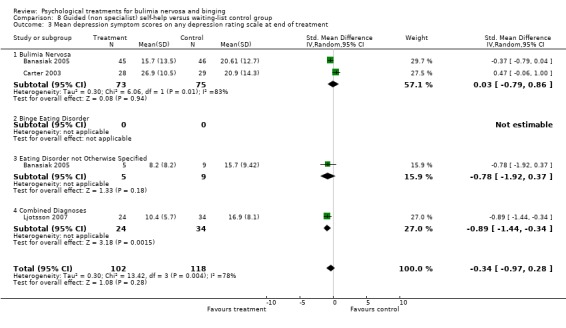
Comparison 8 Guided (non specialist) self‐help versus waiting‐list control group, Outcome 3 Mean depression symptom scores on any depression rating scale at end of treatment.
8.4. Analysis.
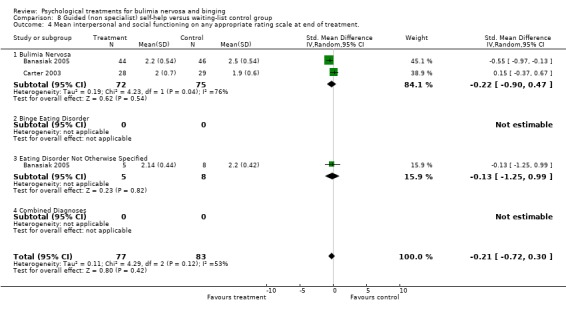
Comparison 8 Guided (non specialist) self‐help versus waiting‐list control group, Outcome 4 Mean interpersonal and social functioning on any appropriate rating scale at end of treatment..
8.5. Analysis.
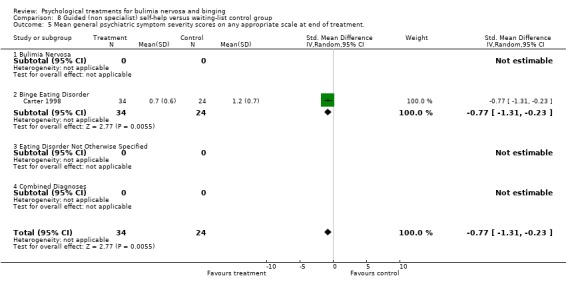
Comparison 8 Guided (non specialist) self‐help versus waiting‐list control group, Outcome 5 Mean general psychiatric symptom severity scores on any appropriate scale at end of treatment..
8.6. Analysis.

Comparison 8 Guided (non specialist) self‐help versus waiting‐list control group, Outcome 6 Number of participants who withdrew because of an adverse event.
8.7. Analysis.
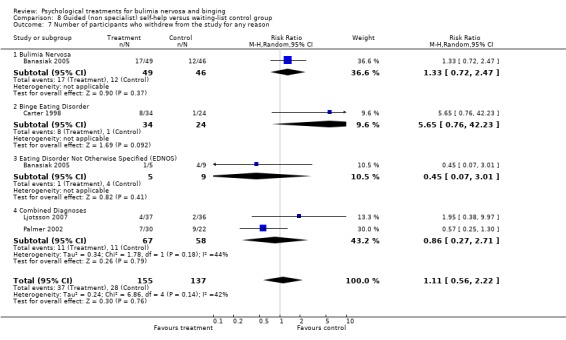
Comparison 8 Guided (non specialist) self‐help versus waiting‐list control group, Outcome 7 Number of participants who withdrew from the study for any reason.
8.8. Analysis.
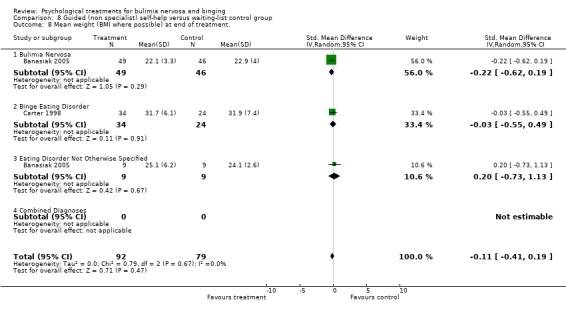
Comparison 8 Guided (non specialist) self‐help versus waiting‐list control group, Outcome 8 Mean weight (BMI where possible) at end of treatment..
Comparison 9. Guided self‐help versus specialist psychotherapy (CBT &/or IPT).
| Outcome or subgroup title | No. of studies | No. of participants | Statistical method | Effect size |
|---|---|---|---|---|
| 1 Non‐Abstinence rates for binge eating at end of therapy | 1 | 81 | Risk Ratio (M‐H, Random, 95% CI) | 1.05 [0.91, 1.22] |
| 1.1 Bulimia Nervosa | 1 | 81 | Risk Ratio (M‐H, Random, 95% CI) | 1.05 [0.91, 1.22] |
| 1.2 Binge Eating Disorder | 0 | 0 | Risk Ratio (M‐H, Random, 95% CI) | 0.0 [0.0, 0.0] |
| 1.3 Eating Disorder Not Otherwise Specified | 0 | 0 | Risk Ratio (M‐H, Random, 95% CI) | 0.0 [0.0, 0.0] |
| 1.4 Combined Diagnoses | 0 | 0 | Risk Ratio (M‐H, Random, 95% CI) | 0.0 [0.0, 0.0] |
| 2 Mean end of trial bulimic symptoms (where possible binge eating frequency) | 2 | 149 | Std. Mean Difference (IV, Random, 95% CI) | ‐0.13 [‐0.82, 0.57] |
| 2.1 Bulimia Nervosa | 2 | 149 | Std. Mean Difference (IV, Random, 95% CI) | ‐0.13 [‐0.82, 0.57] |
| 2.2 Binge Eating Disorder | 0 | 0 | Std. Mean Difference (IV, Random, 95% CI) | 0.0 [0.0, 0.0] |
| 2.3 Eating Disorder Not Otherwise Specified | 0 | 0 | Std. Mean Difference (IV, Random, 95% CI) | 0.0 [0.0, 0.0] |
| 2.4 Combined Diagnoses | 0 | 0 | Std. Mean Difference (IV, Random, 95% CI) | 0.0 [0.0, 0.0] |
| 3 Number of people who dropped out for any reason | 2 | 149 | Risk Ratio (M‐H, Random, 95% CI) | 1.13 [0.39, 3.24] |
| 3.1 Bulimia Nervosa | 2 | 149 | Risk Ratio (M‐H, Random, 95% CI) | 1.13 [0.39, 3.24] |
| 3.2 Binge Eating Disorder | 0 | 0 | Risk Ratio (M‐H, Random, 95% CI) | 0.0 [0.0, 0.0] |
| 3.3 Eating Disorder Not Otherwise Specified | 0 | 0 | Risk Ratio (M‐H, Random, 95% CI) | 0.0 [0.0, 0.0] |
| 3.4 Combined Diagnoses | 0 | 0 | Risk Ratio (M‐H, Random, 95% CI) | 0.0 [0.0, 0.0] |
| 4 Mean scores on depression rating scale at end of treatment | 2 | 122 | Std. Mean Difference (IV, Random, 95% CI) | ‐0.28 [‐0.79, 0.24] |
| 4.1 Bulimia Nervosa | 2 | 122 | Std. Mean Difference (IV, Random, 95% CI) | ‐0.28 [‐0.79, 0.24] |
| 4.2 Binge Eating Disorder | 0 | 0 | Std. Mean Difference (IV, Random, 95% CI) | 0.0 [0.0, 0.0] |
| 4.3 Eating Disorder Not Otherwise Specified | 0 | 0 | Std. Mean Difference (IV, Random, 95% CI) | 0.0 [0.0, 0.0] |
| 4.4 Combined Diagnoses | 0 | 0 | Std. Mean Difference (IV, Random, 95% CI) | 0.0 [0.0, 0.0] |
| 5 Mean end of trial scores of psychosocial or interpersonal functioning | 1 | 37 | Std. Mean Difference (IV, Random, 95% CI) | 0.0 [‐1.18, 1.18] |
| 5.1 Bulimia Nervosa | 1 | 37 | Std. Mean Difference (IV, Random, 95% CI) | 0.0 [‐1.18, 1.18] |
| 5.2 Binge Eating Disorder | 0 | 0 | Std. Mean Difference (IV, Random, 95% CI) | 0.0 [0.0, 0.0] |
| 5.3 Eating Disorder Not Otherwise Specified | 0 | 0 | Std. Mean Difference (IV, Random, 95% CI) | 0.0 [0.0, 0.0] |
| 5.4 Combined Diagnoses | 0 | 0 | Std. Mean Difference (IV, Random, 95% CI) | 0.0 [0.0, 0.0] |
| 6 Mean scores on EDE restraint scale | 1 | 68 | Std. Mean Difference (IV, Random, 95% CI) | 0.15 [‐0.33, 0.62] |
| 6.1 Bulimia Nervosa | 1 | 68 | Std. Mean Difference (IV, Random, 95% CI) | 0.15 [‐0.33, 0.62] |
| 6.2 Binge Eating Disorder | 0 | 0 | Std. Mean Difference (IV, Random, 95% CI) | 0.0 [0.0, 0.0] |
| 6.3 Eating Disorder Not Otherwise Specified | 0 | 0 | Std. Mean Difference (IV, Random, 95% CI) | 0.0 [0.0, 0.0] |
| 6.4 Combined Diagnoses | 0 | 0 | Std. Mean Difference (IV, Random, 95% CI) | 0.0 [0.0, 0.0] |
| 7 6 month objective bulimic episodes | 1 | 50 | Std. Mean Difference (IV, Random, 95% CI) | 0.24 [‐0.32, 0.80] |
| 7.1 Bulimia Nervosa | 1 | 50 | Std. Mean Difference (IV, Random, 95% CI) | 0.24 [‐0.32, 0.80] |
| 7.2 Binge Eating Disorder | 0 | 0 | Std. Mean Difference (IV, Random, 95% CI) | 0.0 [0.0, 0.0] |
| 7.3 Eating Disorder Not Otherwise Specified | 0 | 0 | Std. Mean Difference (IV, Random, 95% CI) | 0.0 [0.0, 0.0] |
| 7.4 Comined Diagnoses | 0 | 0 | Std. Mean Difference (IV, Random, 95% CI) | 0.0 [0.0, 0.0] |
| 8 6 month interpersonal functioning | 1 | 50 | Std. Mean Difference (IV, Random, 95% CI) | 0.0 [‐0.56, 0.56] |
| 8.1 Bulimia Nervosa | 1 | 50 | Std. Mean Difference (IV, Random, 95% CI) | 0.0 [‐0.56, 0.56] |
| 8.2 Binge Eating Disorder | 0 | 0 | Std. Mean Difference (IV, Random, 95% CI) | 0.0 [0.0, 0.0] |
| 8.3 Eating Disorder Not Otherwise Specified | 0 | 0 | Std. Mean Difference (IV, Random, 95% CI) | 0.0 [0.0, 0.0] |
| 8.4 Combined Diagnoses | 0 | 0 | Std. Mean Difference (IV, Random, 95% CI) | 0.0 [0.0, 0.0] |
| 9 6 month depression scores | 2 | 131 | Std. Mean Difference (IV, Random, 95% CI) | ‐0.32 [‐0.82, 0.19] |
| 9.1 Bulimia Nervosa | 2 | 131 | Std. Mean Difference (IV, Random, 95% CI) | ‐0.32 [‐0.82, 0.19] |
| 9.2 Binge Eating Disorder | 0 | 0 | Std. Mean Difference (IV, Random, 95% CI) | 0.0 [0.0, 0.0] |
| 9.3 Eating Disorder Not Otherwise Specified | 0 | 0 | Std. Mean Difference (IV, Random, 95% CI) | 0.0 [0.0, 0.0] |
| 9.4 Combined Diagnoses | 0 | 0 | Std. Mean Difference (IV, Random, 95% CI) | 0.0 [0.0, 0.0] |
9.1. Analysis.
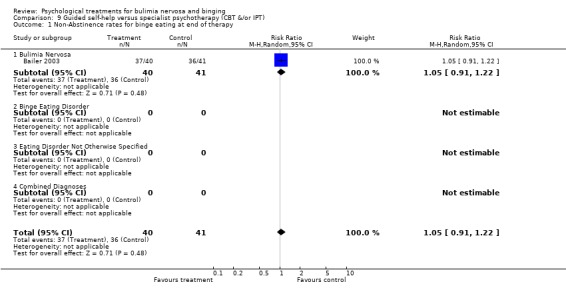
Comparison 9 Guided self‐help versus specialist psychotherapy (CBT &/or IPT), Outcome 1 Non‐Abstinence rates for binge eating at end of therapy.
9.2. Analysis.

Comparison 9 Guided self‐help versus specialist psychotherapy (CBT &/or IPT), Outcome 2 Mean end of trial bulimic symptoms (where possible binge eating frequency).
9.3. Analysis.

Comparison 9 Guided self‐help versus specialist psychotherapy (CBT &/or IPT), Outcome 3 Number of people who dropped out for any reason.
9.4. Analysis.
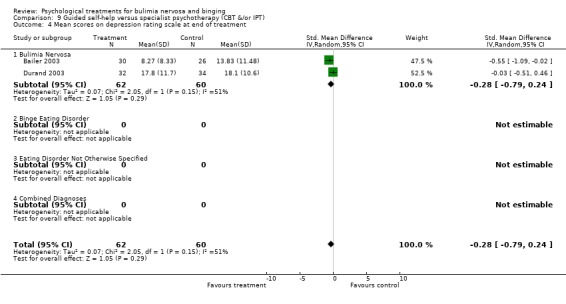
Comparison 9 Guided self‐help versus specialist psychotherapy (CBT &/or IPT), Outcome 4 Mean scores on depression rating scale at end of treatment.
9.5. Analysis.
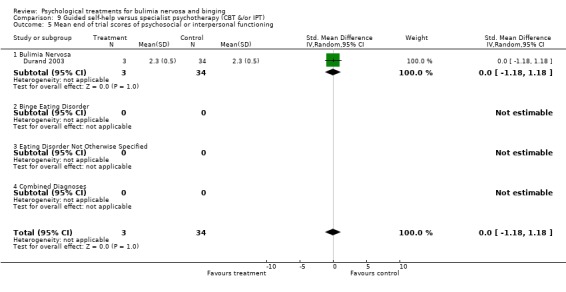
Comparison 9 Guided self‐help versus specialist psychotherapy (CBT &/or IPT), Outcome 5 Mean end of trial scores of psychosocial or interpersonal functioning.
9.6. Analysis.
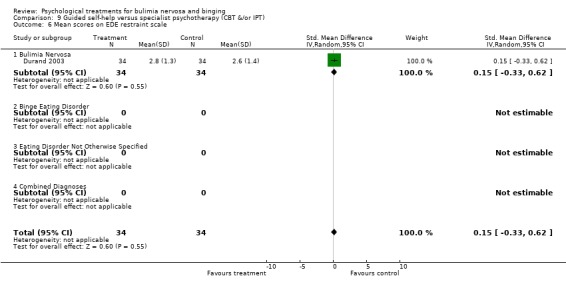
Comparison 9 Guided self‐help versus specialist psychotherapy (CBT &/or IPT), Outcome 6 Mean scores on EDE restraint scale.
9.7. Analysis.
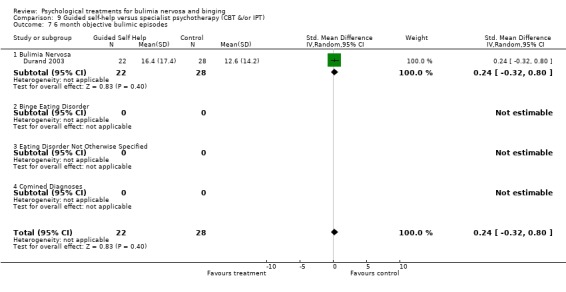
Comparison 9 Guided self‐help versus specialist psychotherapy (CBT &/or IPT), Outcome 7 6 month objective bulimic episodes.
9.8. Analysis.
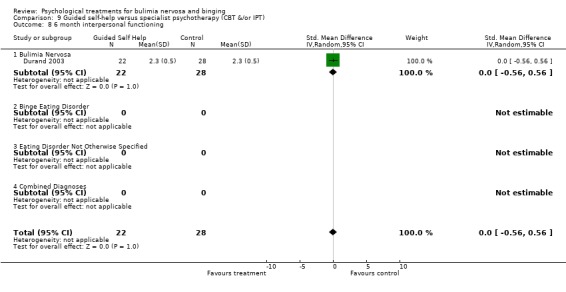
Comparison 9 Guided self‐help versus specialist psychotherapy (CBT &/or IPT), Outcome 8 6 month interpersonal functioning.
9.9. Analysis.
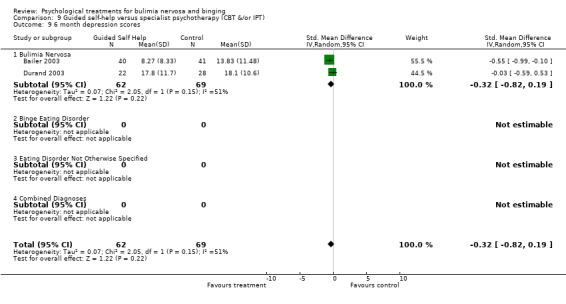
Comparison 9 Guided self‐help versus specialist psychotherapy (CBT &/or IPT), Outcome 9 6 month depression scores.
Comparison 10. Pure self help versus waitlist control group.
| Outcome or subgroup title | No. of studies | No. of participants | Statistical method | Effect size |
|---|---|---|---|---|
| 1 Mean end of trial interpersonal functioning | 1 | 57 | Std. Mean Difference (IV, Random, 95% CI) | 0.15 [‐0.37, 0.67] |
| 1.1 Bulimia Nervosa | 1 | 57 | Std. Mean Difference (IV, Random, 95% CI) | 0.15 [‐0.37, 0.67] |
| 1.2 Binge Eating Disorder | 0 | 0 | Std. Mean Difference (IV, Random, 95% CI) | 0.0 [0.0, 0.0] |
| 1.3 Eating Disorder Not Otherwise Specified | 0 | 0 | Std. Mean Difference (IV, Random, 95% CI) | 0.0 [0.0, 0.0] |
| 1.4 Combined Diagnoses | 0 | 0 | Std. Mean Difference (IV, Random, 95% CI) | 0.0 [0.0, 0.0] |
| 2 Mean end of trial depression scores | 1 | 57 | Std. Mean Difference (IV, Random, 95% CI) | 0.47 [‐0.06, 1.00] |
| 2.1 Bulimia Nervosa | 1 | 57 | Std. Mean Difference (IV, Random, 95% CI) | 0.47 [‐0.06, 1.00] |
| 2.2 Binge Eating Disorder | 0 | 0 | Std. Mean Difference (IV, Random, 95% CI) | 0.0 [0.0, 0.0] |
| 2.3 Eating Disorder Not Otherwise Specified | 0 | 0 | Std. Mean Difference (IV, Random, 95% CI) | 0.0 [0.0, 0.0] |
| 2.4 Combined Diagnoses | 0 | 0 | Std. Mean Difference (IV, Random, 95% CI) | 0.0 [0.0, 0.0] |
| 3 Number of dropouts due to any reason | 3 | 187 | Risk Ratio (M‐H, Random, 95% CI) | 0.75 [0.42, 1.35] |
| 3.1 Bulimia Nervosa | 1 | 57 | Risk Ratio (M‐H, Random, 95% CI) | 0.65 [0.24, 1.74] |
| 3.2 Binge eating disorder | 1 | 48 | Risk Ratio (M‐H, Random, 95% CI) | 0.33 [0.01, 7.80] |
| 3.3 Eating disorder not otherwise specified | 0 | 0 | Risk Ratio (M‐H, Random, 95% CI) | 0.0 [0.0, 0.0] |
| 3.4 Combined diagnoses | 1 | 82 | Risk Ratio (M‐H, Random, 95% CI) | 0.86 [0.41, 1.79] |
| 4 Number of people who did not show remission | 3 | 187 | Risk Ratio (M‐H, Random, 95% CI) | 0.79 [0.53, 1.17] |
| 4.1 Bulimia Nervosa | 1 | 57 | Risk Ratio (M‐H, Random, 95% CI) | 1.04 [0.88, 1.22] |
| 4.2 Binge eating disorder | 1 | 48 | Risk Ratio (M‐H, Random, 95% CI) | 0.41 [0.24, 0.70] |
| 4.3 Eating disorder not otherwise specified | 0 | 0 | Risk Ratio (M‐H, Random, 95% CI) | 0.0 [0.0, 0.0] |
| 4.4 Combined diagnoses | 1 | 82 | Risk Ratio (M‐H, Random, 95% CI) | 0.9 [0.75, 1.09] |
| 5 Mean difference in binge frequency | 3 | 181 | Std. Mean Difference (IV, Random, 95% CI) | ‐0.40 [‐0.73, ‐0.07] |
| 5.1 Bulimia Nervosa | 1 | 57 | Std. Mean Difference (IV, Random, 95% CI) | ‐0.12 [‐0.64, 0.40] |
| 5.2 Binge eating disorder | 1 | 48 | Std. Mean Difference (IV, Random, 95% CI) | ‐0.37 [‐0.95, 0.20] |
| 5.3 Eating disorder not otherwise specified | 0 | 0 | Std. Mean Difference (IV, Random, 95% CI) | 0.0 [0.0, 0.0] |
| 5.4 Combined diagnoses | 1 | 76 | Std. Mean Difference (IV, Random, 95% CI) | ‐0.68 [‐1.17, ‐0.18] |
10.3. Analysis.
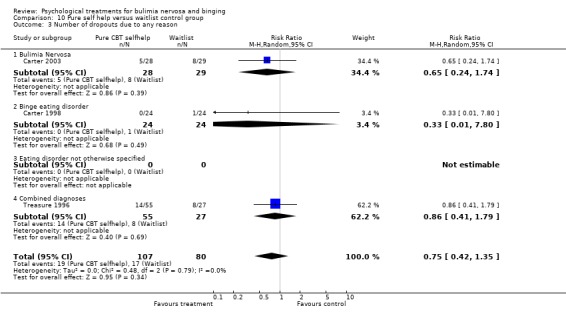
Comparison 10 Pure self help versus waitlist control group, Outcome 3 Number of dropouts due to any reason.
10.4. Analysis.
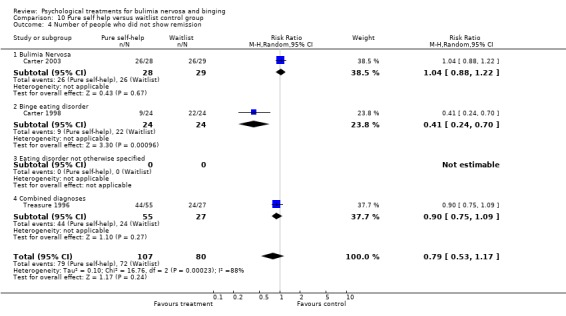
Comparison 10 Pure self help versus waitlist control group, Outcome 4 Number of people who did not show remission.
10.5. Analysis.

Comparison 10 Pure self help versus waitlist control group, Outcome 5 Mean difference in binge frequency.
Characteristics of studies
Characteristics of included studies [ordered by study ID]
Agras 1989.
| Methods | RCT Type of randomisation: correct Concealment of allocation: adequate ITT analysis: no Blinding of assessor: no blinding Dropouts described: yes Baseline comparability: yes Length of follow‐up: 6‐month | |
| Participants | Number randomised: 77 Number of dropouts: 10 Gender: all women (F) Age: 18‐61 years, Method of diagnosis: DSM‐III‐R Diagnosis: Bulimia Nervosa purging type Recruitment: media advertising and referrals Treatment setting: tertiary setting Country: USA | |
| Interventions | Group 1: CBT ‐BN Group 2: waitlist Group 3: self‐monitoring Group 4: CBT& RP | |
| Outcomes | Self‐reported purging; Beck Depression Inventory (BDI); binge frequency not given. Medians and interquartile ranges reported. Effects maintained at follow‐up:yes | |
| Notes | Authors approached and responded to inquiries regarding allocation concealment. | |
| Risk of bias | ||
| Bias | Authors' judgement | Support for judgement |
| Allocation concealment? | Low risk | A ‐ Adequate |
Agras 1994.
| Methods | RCT Type of randomisation: correct Concealment of allocation: B ITT analysis: no Blinding of assessor: yes Dropouts described: no Baseline comparability: yes Length of follow‐up: 3 months | |
| Participants | Number randomised:108 Number of dropouts: 24 Gender: F Age: 22‐65, mean = 45 & SD = 10 Method of diagnosis: DSM‐IV Diagnosis: BED Recruitment: community (advertisements) Treatment setting: tertiary Country: USA | |
| Interventions | Group 1: Weight Loss Therapy (based on LEARN Program for Weight Control) Group 2: CBT followed by Weight Loss Therapy Group 3: CBT followed by Weight Loss Therapy and Desipramine | |
| Outcomes | 1‐week of self‐monitoring (caloric intake and each binge episode recorded by participant and by recall collected by assessor) used for estimating binge days; weight; Beck Depression Inventory (BDI); Three Factor Eating Questionnaire. Maintained at follow‐up: yes | |
| Notes | Binge days included subjective as well as objective bulimic episodes The only data to 12 weeks was used in the analysis in this review as that compared CBT vs behavioral weight loss | |
| Risk of bias | ||
| Bias | Authors' judgement | Support for judgement |
| Allocation concealment? | Unclear risk | B ‐ Unclear |
Agras 2000.
| Methods | RCT ‐ multi‐site Type of randomisation: Efrons Biased Coin Randomization Concealment of allocation: yes ITT analysis: yes Blinding of assessor: yes Dropouts described: yes Baseline comparability: yes A‐priori power analysis: yes Length of follow‐up: 12 months | |
| Participants | Number randomised: 923 responded to the advertisements or were referred from clinics, 220 (24%) participated in study Number of dropouts: 61 Gender: not specified Age: mean 28.1 SD 7.2 Method of diagnosis: DSM‐III‐R Diagnosis: Bulimia Nervosa purging type Recruitment: media advertising and referrals Treatment setting: specialist Country: USA | |
| Interventions | Group 1: Manualized CBT‐BN Group 2: interpersonal psychotherapy (as used in previous studies) | |
| Outcomes | Eating Disorder Examination (EDE) interview ratings of binge frequency, purge frequency; weight (BMI); EDE subscales and global ratings; self‐esteem; general psychiatric symptom severity; social adjustment; interpersonal functioning Follow‐up: one year | |
| Notes | Data was tested by ITT but completer analysis only available from published paper for continuous data. Authors supplied information on ITT analyses. Medians were reported in the published paper and normalised means and SD for continuous data have been supplied. | |
| Risk of bias | ||
| Bias | Authors' judgement | Support for judgement |
| Allocation concealment? | Low risk | A ‐ Adequate |
Bachar 1999.
| Methods | RCT Type of randomisation: unclear Concealment of allocation: B ITT analysis: yes Blinding of assessor: partial Dropouts described:yes Baseline comparability: yes Length of follow‐up: 12 months | |
| Participants | Number randomised: 14 Number of dropouts:0 Gender: F Age:24.1 SD 3.3 Method of diagnosis: DSM‐IV Diagnosis: Bulimia Nervosa Recruitment: specialist referral Treatment setting: specialist Country: Israel | |
| Interventions | Group 1: Self‐psychology psychoanalytic therapy plus nutritional counselling (weekly sessions for one year) Group 2: cognitive orientation therapy plus nutritional counselling (weekly sessions over one year). Group 3: less intensive nutritional counselling. (In this review self‐psychology is compared to nutritional counselling). | |
| Outcomes | Percent patients remitted; Eating Attitudes Test (EAT)‐26; General Symptom Inventory (GSI); DSM‐Symptom Scale; Selves questionnaire Effects maintained at follow‐up:yes | |
| Notes | Intensive therapy, small numbers (n=25) follow‐up at one year | |
| Risk of bias | ||
| Bias | Authors' judgement | Support for judgement |
| Allocation concealment? | Unclear risk | B ‐ Unclear |
Bailer 2003.
| Methods | RCT Type of randomisation: unclear randomisation by group; randomisation procedure not described Concealment of allocation: unclear ITT analysis: yes Blinding of assessor: not clear Dropouts described: yes Baseline comparability: unclear, baseline values used as covariates, CBT group had higher levels of depression Length of follow‐up: 12 months | |
| Participants | Number randomised: 81 of 87 who were enrolled Number of dropouts: 25 Gender: not specified Age: self help mean 23.3 (SD 4.1); CBT mean 24.2 (SD 4.9), all >17 years Method of diagnosis: SCID for DSM‐IV Diagnosis: Bulimia Nervosa Recruitment: primary and secondary referrals Treatment setting: Clinic for Eating Disorders, Department of Psychiatry, University Hospital of Psychiatry Country: Austria | |
| Interventions | Group 1: Guided self help group using CBT for Bulimia Nervosa (CBT‐BN) based on Schmidt & Treasure (18 weekly visits of 20 minutes) Group 2: Group CBT‐BN | |
| Outcomes | Remission; Eating Behaviour‐IV self‐monitoring from for recording binge eating and vomiting; EDI subscales; BDI Follow‐up: one year Effects maintained at follow‐up:yes | |
| Notes | ||
| Risk of bias | ||
| Bias | Authors' judgement | Support for judgement |
| Allocation concealment? | Unclear risk | B ‐ Unclear |
Banasiak 2005.
| Methods | RCT Type of randomisation: computer generated biased coin randomisation Concealment of allocation: yes ITT analysis: yes Blinding of assessor: yes Dropouts described: yes Baseline comparability: yes Length of follow‐up: 6 months | |
| Participants | Number randomised: 109 Number of dropouts: 34 Gender: F Age: Mean age of participants in guided self help was 29.5 (S.D. 8.72) and in case of delayed treatment control was 28.3 (S.D. 8.22) Method of diagnosis: DSM‐IV Diagnosis: Bulimia Nervosa (purging and non‐purging) Recruitment: from community by advertisements in newspapers, media announcements, posters in GP waiting rooms, library and community centres and referral from community based eating disorder information centre Treatment setting: Primary Country: Australia | |
| Interventions | Group 1: Guided self help Group 2: Delayed treatment group | |
| Outcomes | EDE for scores on Restrain, Eating Concern and Global scales assessed eating pathology; EDE Shape Concern and Weight Concern subscales along with BSQ (Body Shape Questionnaire), EDI‐2 (Eating Disorder Inventory‐2) Body Dissatisfaction and Drive for Thinness subscales for assessing body image disturbance; direct weight and height measurements taken and BMI calculated for body size determination; Beck Depression Inventory‐II, Rosenberg Self‐Esteem Scale and three scales from Brief Symptom Inventory, the GLobal severity index, Anxiety and Somatization Symptom subscales for assessing psychological functioning; Satisfaction with Life scale and Overall Adjustment score of modified Social Adjustment Scale ‐ Self‐report for assessing general life satisfaction and social functioning; Satisfaction with Treatment scale, Satisfaction with Treatment Outcome scale and Satisfaction with General Practitioner scale for assessing attitudes towards treatment. Maintained at follow‐up: yes | |
| Notes | Authors approached for data separate for sub‐threshold and full bulimia nervosa participants. | |
| Risk of bias | ||
| Bias | Authors' judgement | Support for judgement |
| Allocation concealment? | Low risk | A ‐ Adequate |
Bossert 1989.
| Methods | RCT Type of randomisation: unclear Concealment of allocation: ITT analysis: yes Blinding of assessor: yes Dropouts described: n.a. Baseline comparability: yes, but higher numbers of past history of AN in non‐specific therapy group Length of follow‐up: follow‐up continuing at time of publication. | |
| Participants | Number randomised: 14 Number of dropouts: 0 Gender: F Age:18‐30 yr Method of diagnosis: DSM‐III Diagnosis: Bulimia Nervosa Recruitment: community Treatment setting: specialist Country: Germany | |
| Interventions | Group 1: self‐ management Group 2: nonspecific therapy | |
| Outcomes | A.M.S. (mood); P.D.S. (paranoid depression scale); inpatient multi‐dimensional psychiatric scale (I.M.P.S.); semi‐structured interview (S.I.A.N.X.) Self‐report; medical records; blinded interview | |
| Notes | small size, self management like CBT | |
| Risk of bias | ||
| Bias | Authors' judgement | Support for judgement |
| Allocation concealment? | Unclear risk | B ‐ Unclear |
Bulik 1998.
| Methods | RCT Type of randomisation: unclear Concealment of allocation: uncertain ITT analysis: yes (no cross over) Blinding of assessor: outcome assessment blind Dropouts described: n.a. Baseline comparability: yes outcome of randomisation is assessed Length of follow‐up: 12 months | |
| Participants | Number randomised: 111 Number of dropouts: 2 dropouts from ERP‐binge cueing and ERP‐purge cueing respectively and one from the relaxation treatment Gender: women Age: 17‐45 yr Method of diagnosis: DSM‐III‐R Diagnosis: Bulimia Nervosa purging type Recruitment: community and primary care recruitment Treatment setting: secondary care level treatment Country: New Zealand | |
| Interventions | Group 1: CBT plus Exposure and Response Prevention (ERP)‐binge cues (8 sessions) Group 2: CBT plus Exposure and Response Prevention ERP‐purge cues (8 sessions) Group 3: CBT plus Exposure and Response Prevention relaxation (8 sessions). (For abstinence rates and dropout rates data for both forms of ERP are combined; for continuous data analyses CBT & relaxation is compared with CBT‐B) | |
| Outcomes | Binge frequency; binge & purging abstinence; EDI subscales; HDRS; GAF scale; Follow‐up: one year Effects maintained at follow‐up:yes | |
| Notes | Predictors of outcome were provided in a second paper. Poor outcome was related to histories of obesity and alcohol dependence and symptom severity. High self‐directedness was a strong predictor of good outcome. | |
| Risk of bias | ||
| Bias | Authors' judgement | Support for judgement |
| Allocation concealment? | Unclear risk | B ‐ Unclear |
Burton 2006.
| Methods | RCT Type of randomisation: not described Concealment of allocation: B ITT analysis: yes Blinding of assessor: yes Dropouts described: yes Baseline comparability: yes Length of follow‐up: 3 months | |
| Participants | Number randomised: 85 Number of dropouts: 16 Gender: Female Age: 18‐55, mean age 21 and S.D. 5.3 Method of diagnosis: DSM‐IV Diagnosis: Bulimia Nervosa Recruitment: using printed advertisements (participants from university 78.8% and community 21.2%) Treatment setting: Tertiary Country: USA | |
| Interventions | Group 1: Healthy Weight Programme (promotes healthy weight control behaviours) Group 2: Waitlist control | |
| Outcomes | Diagnostic items from EDE for binge‐eating frequency and compensatory behavior frequency assessing bulimic symptoms; BMI; Social Adjustment Scale assessed psychological functioning; Health survey Utilization scale for assessing frequency of utilization of health and mental health services. Maintained at follow‐up: yes | |
| Notes | Data not presented for mid‐treatment and end‐treatment social functioning.Authors to be approached for this and also separate data for full bulimia nervosa vs sub‐threshold | |
| Risk of bias | ||
| Bias | Authors' judgement | Support for judgement |
| Allocation concealment? | Unclear risk | B ‐ Unclear |
Carter 1998.
| Methods | RCT Type of randomisation: not described Concealment of allocation: unclear ITT analysis: yes (no cross over) Blinding of assessor: outcome assessment blinded ‐ telephone blinded ascertainment of binge eating frequency. Dropouts described: no Baseline comparability: randomisation outcome was assessed and groups were comparable Length of follow‐up: 6‐month | |
| Participants | Number randomised: 72 Number of dropouts: 9 Gender: women Age: 18‐65 years; mean 39.7 (SD10) Method of diagnosis: operationalised DSM‐IV criteria Diagnosis: Binge Eating Disorder Recruitment: community volunteers through media advertisement Treatment setting: quasi‐primary care Country: UK | |
| Interventions | Group 1: Guided self‐help (6‐8 25 minute sessions over 12 weeks) Group 2: pure self‐help (mailed book) (12 weeks) Group 3: wait list control group, no drug (12 weeks). (Therapists were non specialists without formal training or clinical qualifications). | |
| Outcomes | Global Eating Disorder Examination‐V4 score; Brief Eating Disorder Examination; General Severity Index of the Brief Symptom Inventory (BSI); Rosenberg Self‐Esteem Scale; weight; self‐esteem Folow‐up: six months Effects maintained at follow‐up:yes | |
| Notes | No comment on adverse effects, guided self‐help used as approximation to full CBT for pure vs CBT comparison | |
| Risk of bias | ||
| Bias | Authors' judgement | Support for judgement |
| Allocation concealment? | Low risk | A ‐ Adequate |
Carter 2003.
| Methods | RCT Type of randomisation: restricted randomisation procedure using random permuted blocks of three people Concealment of allocation: yes ITT analysis: yes Blinding of assessor: both outcome and participant Dropouts described: yes Baseline comparability: yes except waitlist had significantly higher frequency of purging which was co‐varied for Length of follow‐up: none | |
| Participants | Number randomised: 85 Number of dropouts: 20 Gender: women Age: mean 27 (8); range 17‐53) Method of diagnosis: DSM‐IV and EDE with behaviour over 1 week Diagnosis: Bulimia Nervosa Recruitment: hospital based clinic wait list Treatment setting: self help clinic at hospital Country: Canada | |
| Interventions | Group 1: Pure self help CBT based (8 weeks) Group 2: Pure self help focused on self assertion skills (8 weeks) Group 3: waitlist (8 weeks) | |
| Outcomes | Eating Disorders Examination (EDE) interview for binges, purges, restraint, eating, shape and weight concern; Beck Depression Inventory (BDI); Beck Anxiety Inventory (BAI); Rosenberg Self Esteem Scale; Inventory of Interpersonal Problems Follow‐up: post treatment only | |
| Notes | ||
| Risk of bias | ||
| Bias | Authors' judgement | Support for judgement |
| Allocation concealment? | Low risk | A ‐ Adequate |
Cooper 1995.
| Methods | RCT Type of randomisation: unclear Concealment of allocation: B ITT analysis: no Blinding of assessor: yes Dropouts described: yes Baseline comparability: not described Length of follow‐up: 12 months | |
| Participants | Number randomised: 31 Number of dropouts: 4 Gender: F Age: 18‐33; mean 23.8 Method of diagnosis: DSM‐III‐R Diagnosis: Bulimia Nervosa purging type Recruitment: from tertiary unit Treatment setting: tertiary unit Country: UK | |
| Interventions | Group 1: CBT (without instruction on dietary restraint) Group 2: Exposure and Response Prevention (of vomiting) Group 3: behaviour therapy. | |
| Outcomes | EDE; PSE; Attitudes on a VAS; BSQ; BDI; STAI Interview based Effects maintained at follow‐up:yes | |
| Notes | concealment uncertain (B), randomisation not described, not ITT, dropouts were described, included in analyses of CBT vs and other psychotherapy | |
| Risk of bias | ||
| Bias | Authors' judgement | Support for judgement |
| Allocation concealment? | Unclear risk | B ‐ Unclear |
Durand 2003.
| Methods | RCT Type of randomisation: stratified block randomisation Concealment of allocation: yes ITT analysis: yes (no crossover) Blinding of assessor: no Dropouts described: no Baseline comparability: yes A‐priori power analysis: yes Length of follow‐up: 6 and 9 months | |
| Participants | Number randomised: 68 Number of dropouts: 18 at 6 months, 14 at 9 months Gender: not specified Age: self‐help mean GP 28.3 (SD 6.5); specialist clinic mean 24.5 (SD 5.2) Method of diagnosis: not stated Diagnosis: Bulimia Nervosa with 48 (71%) purging type (vomiting) at baseline Recruitment: GP specialist referrals Treatment setting: General Practices and specialist eating disorder units Country: UK | |
| Interventions | Group 1: Guided GP self‐help (mean of 4.9 sessions with GP; SD 5.6; range 0‐28) Group 2: Specialist clinic psychotherapy using a combination of CBT and IPT (weekly or fortnightly). | |
| Outcomes | BITE to measure symptoms and severity of Bulimia Nervosa; Eating Disorders Examination; Beck Depression Inventory; Work, Leisure and Life questionnaire which is a self‐report version of the Social Adjustment Scale; self‐reported severity of their eating disorder Follow‐up: nine months Effects maintained at follow‐up:yes | |
| Notes | Only 68 of 209 (32.5%) of referrals were randomised. Nature of specialist psychotherapy was ill‐defined. Cooper "Bulimia nervosa a guide to recovery" book manual was used for guided self‐help. | |
| Risk of bias | ||
| Bias | Authors' judgement | Support for judgement |
| Allocation concealment? | Low risk | A ‐ Adequate |
Esplen 1998.
| Methods | RCT Type of randomisation: table of random numbers Concealment of allocation: B ITT analysis: no Blinding of assessor: yes Dropouts described: yes Baseline comparability: yes Length of follow‐up: n.a. | |
| Participants | Number randomised: 58 Number of dropouts: 8 Gender: 2 men Age: 18‐44, mean 26.6 SD 6 yr Method of diagnosis: DSM‐III‐R Diagnosis: Bulimia Nervosa purging type Recruitment: 51/58 from tertiary referral centre Treatment setting: specialist Country: Canada | |
| Interventions | Group 1:Guided imagery Group 2: self‐monitoring | |
| Outcomes | Self‐report diaries; the Diagnostic Schedule for Eating Disorders (DSED); Eating Disorder Inventory; EAT‐26; BPI; UCLA loneliness scale; Soothing Receptivity Scale | |
| Notes | Not ITT, Authors approached for ITT data. Some patients were on antidepressants which had failed to have an effect prior to the trial. | |
| Risk of bias | ||
| Bias | Authors' judgement | Support for judgement |
| Allocation concealment? | Unclear risk | B ‐ Unclear |
Fairburn 1986.
| Methods | RCT Type of randomisation: restricted randomisation Concealment of allocation: B ITT analysis: no (no cross overs) Blinding of assessor: outcome assessment blind Dropouts described: yes Baseline comparability: randomisation outcome was assessed Length of follow‐up: 12 months | |
| Participants | Number randomised: 24 Number of dropouts: 2 Gender: women Age: >17, mean 22.9 (SD 4.4) Method of diagnosis: Russell 1979 diagnostic criteria Diagnosis: Bulimia Nervosa, ? all purging; no medication Recruitment: primary care Treatment setting: tertiary settings Country: UK | |
| Interventions | Group 1: CBT for Bulimia Nervosa (CBT‐BN) Group 2: short‐term focal psychotherapy | |
| Outcomes | Global (EDE) score; frequency of binge eating (4 weeks); actual weight; Present State Examination (PSE) total symptoms score; MADRS (anxiety and depression rating scale) score; SAS (social adjustment) score Effects maintained at follow‐up:yes | |
| Notes | Authors approached regarding mix of purging/nonpurging, and ITT results. Authors responded to request for ITT analyses. | |
| Risk of bias | ||
| Bias | Authors' judgement | Support for judgement |
| Allocation concealment? | Unclear risk | B ‐ Unclear |
Fairburn 1991.
| Methods | RCT Type of randomisation: not described Concealment of allocation: B ITT analysis: no Blinding of assessor: outcome assessment blind Dropouts described: yes Baseline comparability: randomisation outcome was assessed Length of follow‐up: 5 year | |
| Participants | Number randomised: 66 Number of dropouts: 13 Gender: F Age: 24.2 (all > 18) Method of diagnosis: DSM‐III‐R Diagnosis: Bulimia Nervosa; 9 (12%) were non‐purging type Recruitment: primary and secondary sources Treatment setting: tertiary level therapists Country: UK | |
| Interventions | Group 1: CBT for Bulimia Nervosa CBT‐BN (18‐week) Group 2: Behaviour therapy Group 3: Interpersonal psychotherapy | |
| Outcomes | Eating Disorder Examination subscales and global score; binge eating frequency; BSI score; Beck Depression Inventory (BDI); self‐esteem scale; social adjustment scale; weight Effects maintained at follow‐up:yes | |
| Notes | Data not in publication for ITT analysis because of high dropout rate from behaviour therapy group, authors responded to request for data. | |
| Risk of bias | ||
| Bias | Authors' judgement | Support for judgement |
| Allocation concealment? | Unclear risk | B ‐ Unclear |
Freeman 1988.
| Methods | RCT Type of randomisation: Table of random numbers Concealment of allocation: ITT analysis: yes Blinding of assessor: n.a. Dropouts described: yes Baseline comparability: yes Length of follow‐up: unclear | |
| Participants | Number randomised: 112 Number of dropouts:31 Gender: women Age: mean 24.2 (SD 5.6) Method of diagnosis: DSM‐III‐R Diagnosis: Bulimia Nervosa purging type Recruitment: Treatment setting: secondary but with 'relatively inexperienced' therapists Country: UK | |
| Interventions | Group 1: CBT Group 2: Behaviour Therapy Group 3: psychoeducation Group 4: wait list | |
| Outcomes | BITE; EAT; Eating Disorders Inventory; Self‐esteem; MA depression scale; Snaith scale; weekly bingeing | |
| Notes | Randomization method was by a table of random numbers, concealment unclear, outcome self‐report only non‐blinded, ITT analysis, dropouts described, multiple sources of referral, all purging, Authors very helpfully responded to letter of inquiry and put much effort into trying to extract old data | |
| Risk of bias | ||
| Bias | Authors' judgement | Support for judgement |
| Allocation concealment? | Unclear risk | B ‐ Unclear |
Garner 1993.
| Methods | RCT Type of randomisation: Randomization altered sometimes according to therapist availability Concealment of allocation: C ITT analysis: no Blinding of assessor: none Dropouts described: yes Baseline comparability: yes Length of follow‐up: none | |
| Participants | Number randomised: 50 Number of dropouts: 10 Gender: F Age: 1: 23.7 SD 4.4 2: 24.6 SD 4.0 Method of diagnosis: modified DSM‐III‐R criteria for bulimia nervosa to include those with subjective and objective bulimic episodes (namely some EDNOS) Recruitment: self or doctor referral to specialist program Treatment setting: specialist Country: Canada | |
| Interventions | Group 1: CBT for Bulimia Nervosa (CBT‐BN) Group 2: supportive‐expressive therapy | |
| Outcomes | Eating Disorder Examination Interview; EAT; Eating Disorder Inventory; Symptom check‐list 90 item; Social Adjustment Scale; Beck Depression Inventory (BDI) | |
| Notes | ||
| Risk of bias | ||
| Bias | Authors' judgement | Support for judgement |
| Allocation concealment? | High risk | C ‐ Inadequate |
Ghaderi 2003.
| Methods | RCT Type of randomisation: not described Concealment of allocation: unclear ITT analysis: yes Blinding of assessor: outcome assessment blinded Dropouts described: yes Baseline comparability: yes Length of follow‐up: 6 months | |
| Participants | Number randomised: 31 Number of dropouts: 13 Gender: not specified Age: mean 29 (SD 10.7) Method of diagnosis: DSM‐IV Diagnosis: Bulimia Nervosa, Binge Eating Disorder or Eating Disorder Not Otherwise Specified Recruitment: media advertising Treatment setting: outpatient clinic ‐ hospital or community not stated Country: Sweden | |
| Interventions | Group 1: Pure self help (16 weeks) Group 2: Guided self help (6‐8 individual sessions of 25 minutes over 16 weeks) | |
| Outcomes | Eating Disorders Examination (EDE) Eating Disorders Examination ‐ Questionnaire (EDE‐Q4); Beck Depression Inventory (BDI);Social Adjustment Scale ‐ MOdified (SAS‐M); Self Concept Questionnaire (SCQ); Body Shape Questionnaire (BSQ); Perceived Social Support (PSS); Ways of Coping Questionnaire (WCQ) Follow‐up: six months Effects maintained at follow‐up:yes | |
| Notes | Some may argue the pure self‐help was not 'pure' as questionnaires were posted back weekly to investigators | |
| Risk of bias | ||
| Bias | Authors' judgement | Support for judgement |
| Allocation concealment? | Unclear risk | B ‐ Unclear |
Gorin 2003.
| Methods | RCT Type of randomisation: correct Concealment of allocation: B ITT analysis: yes Blinding of assessor: unclear Dropouts described: yes Baseline comparability: yes Length of follow‐up: 6 months | |
| Participants | Number randomised: 94 Number of dropouts: 32 Gender: Female Age: mean 45.2 and S.D. 10.03 Method of diagnosis: DSM‐IV (SCID) Diagnosis: BED Recruitment: community (by advertisements in local newspapers) Treatment setting: Tertiary Country: USA | |
| Interventions | Group 1: standard group CBT Group 2: group CBT with spouse involvement Group 3: waitlist control | |
| Outcomes | 7‐day calendar recall method, in interview format to assess binge frequency; weight; Three Factor questionnaire; Beck Depression Inventory; Rosenberg Self‐esteem Scale; Dynamic Adjustment Scale; subscales from Stress Appraisal Measure Maintained at follow‐up: yes | |
| Notes | ||
| Risk of bias | ||
| Bias | Authors' judgement | Support for judgement |
| Allocation concealment? | Unclear risk | B ‐ Unclear |
Griffiths 1993.
| Methods | RCT Type of randomisation: unclear Concealment of allocation: ITT analysis: yes Blinding of assessor: outcome assessment not blinded Dropouts described: yes Baseline comparability: yes Length of follow‐up: 9 months; six‐week post‐treatment taken as best post‐treatment outcome period | |
| Participants | Number randomised: 78 Number of dropouts: 15 Gender: F Age: 17‐50; mean 26.9 SD 5.88 Method of diagnosis: DSM‐III‐R Diagnosis: Bulimia Nervosa ‐ purging type Recruitment: media advertising (symptomatic volunteers) and tertiary referrals (83% inclusion rate) Treatment setting: specialist Country: Australia | |
| Interventions | Group 1 : Hypnobehavioural therapy Group 2: CBT Group 3: wait‐list control (Wait list group randomised to treatment so no group specific follow‐up available) | |
| Outcomes | BMI; scores on Eating Disorder Examination subscales; Eating Disorder Inventory; EAT; Frequency binge eating; GHQ; Zung Effects maintained at follow‐up:yes | |
| Notes | All were purging ‐ checked with the author. Intention‐to treat data supplied for abstinence and continuous measure of eating disorder symptoms, namely "days of binging" (checked for normality). | |
| Risk of bias | ||
| Bias | Authors' judgement | Support for judgement |
| Allocation concealment? | Low risk | A ‐ Adequate |
Hsu 2001.
| Methods | RCT Type of randomisation: correct Concealment of allocation: ITT analysis: yes Blinding of assessor: outcome assessment blinded Dropouts described: no Baseline comparability: yes Length of follow‐up: none reported | |
| Participants | Number randomised: 100 Number of dropouts:27 Gender: F Age: 17‐45; mean 24.2 SD 5.6 Method of diagnosis: DSM‐III‐R Bulimia Nervosa ‐ 100% vomiting Recruitment: outpatients Treatment setting: specialist Country: US | |
| Interventions | Group 1: Dismantled CBT (separate cognitive and nutritional components) Group 2: CBT including graded exposure Group 3: support group. | |
| Outcomes | Weekly episodes of binging and vomiting by semi‐structured interview and self‐report; HDRS; Dysfunctional attitudes scale; self‐control scale | |
| Notes | All were purging. Intention‐to‐treat analyses were used. Authors responded to approach for further data. | |
| Risk of bias | ||
| Bias | Authors' judgement | Support for judgement |
| Allocation concealment? | Unclear risk | B ‐ Unclear |
Kenardy 2001.
| Methods | RCT Type of randomisation: random number tables in blocks without knowledge of pre‐treatment status Concealment of allocation: unclear ITT analysis: unclear (no dropouts) Blinding of assessor: unclear Dropouts described: no drop outs Baseline comparability: yes Length of follow‐up: 3 months | |
| Participants | Number randomised: 34 Number of dropouts: 0 Gender: women Age: CBT mean 51.77 (SD 9.59); NPT mean 57.99 (SD 11.35) Method of diagnosis: EDE Diagnosis: EDNOS Recruitment: Diabetes Education Centre at Royal Newcastle Hospital Treatment setting: not stated Country: Australia | |
| Interventions | Group 1: Group CBT (1 session of 1.5 hours a week for 10 weeks) Group 2: group based non prescriptive therapy (10 weeks) non‐directive counselling and 'focused evocative unfolding' (NPT) | |
| Outcomes | Eating Disorders Examination interview modified for diabetes (EDE); EDE objective and subjective binging; Eating Disorders Inventory; The Well Being Questionniare Follow‐up: 12 weeks Effects maintained at follow‐up:yes | |
| Notes | ||
| Risk of bias | ||
| Bias | Authors' judgement | Support for judgement |
| Allocation concealment? | Unclear risk | B ‐ Unclear |
Kirkley 1985.
| Methods | RCT Type of randomisation: unclear Concealment of allocation: B ITT analysis: no Blinding of assessor: none Dropouts described: yes Baseline comparability: yes Length of follow‐up: 3 month | |
| Participants | Number randomised: 28 Number of dropouts: 6 Gender: F Age: 18‐46 Method of diagnosis: DSM‐III Diagnosis: Bulimia Nervosa purging type (vomiting) Recruitment: community Treatment setting: specialist Country: US | |
| Interventions | Group 1: Group CBT Group 2: group based self‐monitoring (non‐directive) | |
| Outcomes | Weekly food diaries; Beck Depression Inventory (BDI); Spielberger State‐Trait personality inventory; The Assertion Inventory; the EAT; the Eating Disorder Inventory Effects maintained at follow‐up:yes | |
| Notes | All were vomiting but those using laxatives were excluded. Not classical CBT‐BN. Published data incomplete. | |
| Risk of bias | ||
| Bias | Authors' judgement | Support for judgement |
| Allocation concealment? | Unclear risk | B ‐ Unclear |
Laessle 1987.
| Methods | RCT Type of randomisation: unclear Concealment of allocation: B ITT analysis: unclear Blinding of assessor: none Dropouts described: n.a. Baseline comparability: yes Length of follow‐up: 3 months | |
| Participants | Number randomised: 17small number Number of dropouts: 0 Gender: not specified Age: 1: 23.5 SD 2.3 2: 23.3 SD 7.8 Method of diagnosis: DSM‐III Diagnosis: Bulimia Nervosa Recruitment: secondary Treatment setting: tertiary Country: Germany | |
| Interventions | Group 1 Group CBT Group 2: waitlist | |
| Outcomes | Self‐reported binge frequency; BDI; Eating Disorder Inventory bulimia Effects maintained at follow‐up:yes | |
| Notes | Published data unable to be used. | |
| Risk of bias | ||
| Bias | Authors' judgement | Support for judgement |
| Allocation concealment? | Unclear risk | B ‐ Unclear |
Laessle 1991.
| Methods | RCT Type of randomisation: unclear Concealment of allocation:B ITT analysis: no Blinding of assessor: unclear Dropouts described: yes Baseline comparability: yes Length of follow‐up: 12 months | |
| Participants | Number randomised: 55 Number of dropouts: 7 Gender: F Age: 18‐35; mean 23.8 SD 3.8 Method of diagnosis: DSM‐III‐R Diagnosis: Bulimia Nervosa ‐ 90% vomiting Recruitment: secondary Treatment setting: tertiary Country: Germany & Australia | |
| Interventions | Group 1: Nutritional Counselling Group 2: stress management. | |
| Outcomes | Self‐report monitoring; Eating Disorder Inventory; EAT; Beck Depression Inventory; STAI; an interview Effects maintained at follow‐up:yes | |
| Notes | ITT analyses but not reported in the published data, authors to be approached | |
| Risk of bias | ||
| Bias | Authors' judgement | Support for judgement |
| Allocation concealment? | Unclear risk | B ‐ Unclear |
Lee 1986.
| Methods | RCT Type of randomisation: unclear Concealment of allocation: ITT analysis: no Blinding of assessor: none Dropouts described: yes Baseline comparability: yes Length of follow‐up: 3.5 months | |
| Participants | Number randomised: 30 Number of dropouts: 4 Gender: F Age: 27.7 SD 5.3 Method of diagnosis: DSM‐III Diagnosis: Bulimia Nervosa Recruitment: community Treatment setting: specialist Country: US | |
| Interventions | Group 1: Group CBT (6 weeks) Group 2: wait list | |
| Outcomes | Self‐reported frequency of binging and purging; Beck Depression Inventory; HRSD Effects maintained at follow‐up:yes | |
| Notes | Authors responded to letter of inquiry with further information and unpublished thesis | |
| Risk of bias | ||
| Bias | Authors' judgement | Support for judgement |
| Allocation concealment? | Unclear risk | B ‐ Unclear |
Leitenberg 1988.
| Methods | RCT Type of randomisation: unclear Concealment of allocation: B ITT analysis: no Blinding of assessor: none Dropouts described: yes Baseline comparability: yes Length of follow‐up: 6 months | |
| Participants | Number randomised: 30 Number of dropouts: 12 Gender: F Age: 18‐45, mean 26 Method of diagnosis: DSM‐III Diagnosis: Bulimia Nervosa Recruitment: community Treatment setting: specialist Country: US | |
| Interventions | Group 1: Exposure and Response Prevention (in single and multiple settings) with behavioural strategies for change Group 2: modified CBT (with emphasis on Behavioural Therapy components) Group 3: wait list | |
| Outcomes | EAT; Beck Depression Inventory; Lawson social self‐esteem scale; Rosenberg self‐esteem scale; body size estimations; eating records; test meals Effects maintained at follow‐up:yes | |
| Notes | Authors responded to inquiry about method of randomisation ‐ most likely was a table of random numbers. | |
| Risk of bias | ||
| Bias | Authors' judgement | Support for judgement |
| Allocation concealment? | Unclear risk | B ‐ Unclear |
Ljotsson 2007.
| Methods | RCT Type of randomisation: used a 'true random number service' Concealment of allocation: B ITT analysis: yes Blinding of assessor: unclear Dropouts described: in part Baseline comparability: yes (differed on EDI‐2 drive for thinness WL>active treatment group) Length of follow‐up: 6 months (treatment group only) | |
| Participants | Number randomised: 73 Number of dropouts: 6 (excluding 11 who competed post‐treatment assessment but not treatment) Gender: 4 (6%) male Age: >/=18, mean Method of diagnosis: DSM‐III Diagnosis: Bulimia Nervosa Recruitment: community Treatment setting: specialist Country: US | |
| Interventions | Group 1: Group CBT‐GSH, guidance by email over 12 weeks (minimum weekly email contacts) Group 2: wait list | |
| Outcomes | Eating Disorders Examination ‐ interview; Eating Disorders Examination ‐ questionnaire; EDI‐2; BSQ; MADRAS; Satisfaction with Life scale; Self‐concept questionnaire Effects maintained at follow‐up: yes | |
| Notes | CBT‐GSH delivered over the internet ITT done but post‐treatment completers only data reported in published paper for continuous variable outcomes | |
| Risk of bias | ||
| Bias | Authors' judgement | Support for judgement |
| Allocation concealment? | Unclear risk | B ‐ Unclear |
Loeb 2000.
| Methods | RCT Type of randomisation: computer generated table Concealment of allocation:B ITT analysis: yes (33% attrition rate, 55% attrition at 6 month follow‐up) Blinding of assessor: none Dropouts described: yes Baseline comparability: yes Length of follow‐up: 6 months | |
| Participants | Number randomised: 40 Number of dropouts: 13 Gender: F Age: 41.5 SD9.42 Method of diagnosis: DSM‐IV Diagnosis: 2 Bulimia Nervosa; 33 Binge Eating Disorder; 5 Eating Disorder Not Otherwise Specified (Bulimia Nervosa not purging and Binge Eating Disorder subthreshold types); mean BMI pre‐treatment 35.77 (SD 9.03) Recruitment: media advertisement Treatment setting: specialist Country: US | |
| Interventions | Group 1: Therapist guided CBT with "Overcoming Binge Eating" book Group 2: "pure" self‐help with the same book (but participants were advised they would be followed‐up, were invited to call the clinic if they had problems and were then offered further CBT as required. ) Therapists were supervised weekly and were a clinical psychologist and an advanced doctoral student in clinical psychology. | |
| Outcomes | Eating Disorders Examination ‐ interview determined binge eating and purging rates; Eating Disorders Examination ‐ questionnaire determined attitude and restraint severity; BDI; Rosenberg self‐esteem; BSI scales Effects maintained at follow‐up:yes | |
| Notes | 58% exclusion rate;15% final inclusion rate; Authors responded to inquiry. | |
| Risk of bias | ||
| Bias | Authors' judgement | Support for judgement |
| Allocation concealment? | Low risk | A ‐ Adequate |
Munsch 2007.
| Methods | RCT Type of randomisation: permuted block randomisation Concealment of allocation: B ITT analysis: yes Blinding of assessor: no Dropouts described: yes Baseline comparability: yes (but statistics not reported & BWLT group slightly older in age) Length of follow‐up: 12 months | |
| Participants | Number randomised: 80 Number of dropouts: 22 Gender: 71 females and 9 males Age: mean age of participants in CBT was 44.4 (S.D. 11.5) and in Behavioral weight loss treatment was 47.8 (S.D. 11.8) Method of diagnosis: DSM‐IV‐TR Diagnosis: BED Recruitment: Community (by newspaper advertisements) Treatment setting: Tertiary Country: Switzerland | |
| Interventions | Group 1: CBT Group 2: Behavioral Weight Loss Treatment | |
| Outcomes | German version of EDE for assessing core symptomatology of BED; patients recorded number of weekly binges by self monitoring (according to DSM‐IV‐TR criteria); Weight and height measured and BMI calculated; German version of BDI and BAI (Beck Anxiety Inventory) assessed depression and anxiety; Life satisfaction and estimates of self‐efficacy assessed by questionnaire on life satisfaction (FLZ) and general self‐efficacy scale (SWE). Maintained at follow‐up: yes | |
| Notes | ||
| Risk of bias | ||
| Bias | Authors' judgement | Support for judgement |
| Allocation concealment? | Unclear risk | B ‐ Unclear |
Nauta 2000.
| Methods | RCT Type of randomisation: unclear Concealment of allocation: B ITT analysis: yes Blinding of assessor: none Dropouts described: yes Baseline comparability: yes Length of follow‐up: 6 months | |
| Participants | Number randomised:37 Number of dropouts: 6 Gender: F Age:18‐50; 38.3 SD 7.1 Method of diagnosis: DSM‐IV Diagnosis: Binge Eating Disorder; all participants obese or overweight Recruitment: community based Treatment setting: specialist Country: Netherlands | |
| Interventions | Group 1: Cognitive therapy that included self‐monitoring of eating and behavioural experiments over 15 weekly sessions Group 2: behaviour treatment that included nutritional counselling | |
| Outcomes | Eating Disorders Examination‐questionnaire supplemented with interview; Beck Depression Inventory; Rosenberg Self‐Esteem Scale (RSE); weight Effects maintained at follow‐up:yes | |
| Notes | Participants without BED were not considered for this review. CT was superior in reducing binge frequency at follow‐up but not end of treatment | |
| Risk of bias | ||
| Bias | Authors' judgement | Support for judgement |
| Allocation concealment? | Unclear risk | B ‐ Unclear |
Ordman 1985.
| Methods | RCT Type of randomisation: not described Concealment of allocation: B ITT analysis: yes Blinding of assessor: no Dropouts described: n.a. Baseline comparability: yes Length of follow‐up: 5 months | |
| Participants | Number randomised:20 Number of dropouts:0 Gender: F Age:>18; mean 19.8 SD 3.2 Method of diagnosis: DSM‐III Diagnosis: Bulimia Nervosa purging type Recruitment: community based Treatment setting: tertiary setting Country: US | |
| Interventions | Group 1: CBT with Exposure Response Prevention Group 2: brief Behaviour Thearpy | |
| Outcomes | Self‐report EAT; binge questionnaire; body cathexis test; EPQ; SCL‐90; Beck Depression Inventory; responses to a standardized snack; family measures | |
| Notes | Authors approached for more data. | |
| Risk of bias | ||
| Bias | Authors' judgement | Support for judgement |
| Allocation concealment? | Unclear risk | B ‐ Unclear |
Palmer 2002.
| Methods | RCT Type of randomisation: not described Concealment of allocation: A ITT analysis: both ITT and completer analyses Blinding of assessor: no Dropouts described: no Baseline comparability: yes Length of follow‐up: open and to 12 months | |
| Participants | Number randomised:121 Number of dropouts:30 Gender: 4 male Age: min:25.8 SD 6.6 max: 27.5 SD9.6 Method of diagnosis: DSM‐IV Diagnosis: Bulimia Nervosa, Binge Eating Disorder and Eating Disorder Not Otherwise Specified Recruitment: outpatients Treatment setting: tertiary Country: UK | |
| Interventions | Group 1: Guided self‐help with minimal (one session) guidance and follow‐up arranged Group 2: Guided self‐help with face‐to‐face guidance Group 3: Guided self‐help with telephone guidance Group 4: wait‐list (At follow‐up participants were offered full therapy as required) | |
| Outcomes | Eating Disorders Examination (percent change on 3 scales ‐ objective bulimic episodes, self‐induced vomiting and the global score); Abstinence (absence of both binging and vomiting for a month before assessment); self‐report measures not reported Effects maintained at follow‐up:yes | |
| Notes | Authors approached for more data and data by diagnostic groups. Some patients were taking an antidepressant. These were randomly allocated to the groups to ensure an even distribution. A sensitivity analysis was conducted of relevant meta‐analyses with this study removed because of possible enhancement of the psychotherapy with medication biasing results. | |
| Risk of bias | ||
| Bias | Authors' judgement | Support for judgement |
| Allocation concealment? | Low risk | A ‐ Adequate |
Peterson 1998.
| Methods | RCT Type of randomisation: randomisation of groups not individuals with intervention group run first then wait‐list group collected at end Concealment of allocation: B ITT analysis: yes (no cross over) Blinding of assessor: no Dropouts described: no Baseline comparability: yes Length of follow‐up: one year | |
| Participants | Number randomised: 61 Number of dropouts: 8 Gender: women Age: 18‐65; mean 42.4 Method of diagnosis: DSM‐IV Diagnosis: Binge Eating Disorder Recruitment: media advertising Treatment setting: secondary referral centre Country: USA | |
| Interventions | Group 1: Group based CBT (therapist was a PhD psychologist trained in CBT) Group 2: partial self‐help with specialist guidance Group 3: structured self‐help with groups lead by participants Group 4: wait list | |
| Outcomes | Self‐report binge frequency Effects maintained at follow‐up:yes | |
| Notes | Authors responded to request for information ‐ randomisation by groups except the first which was a therapist lead group, wait‐list groups were collected at the end predictors of outcome evaluated in separate report (2000) & binge eating frequency at baseline was predictive | |
| Risk of bias | ||
| Bias | Authors' judgement | Support for judgement |
| Allocation concealment? | Unclear risk | B ‐ Unclear |
Porzelius 1995.
| Methods | RCT Type of Randomisation: unclear Concealment of allocation: B ITT analysis: no Blinding of assessor: no Dropouts described: yes Baseline comparability: yes Length of follow‐up: 12 months | |
| Participants | Number randomised: 54 Number of dropouts: 8 Gender: Female (all) Age: 23‐65 mean 38 and SD 8.7 Method of diagnosis: Binge Eating Scale (BES) Diagnosis: Binge Eating Recruitment: Newspaper and radio advertisements for weight loss study (no mention of binge eating was made in advertisements) Treatment setting: Tertiary Country: USA | |
| Interventions | Group 1: Obese Binge Eating Treatment (CBT) Group 2: Standard Behavior Therapy (for weight loss) | |
| Outcomes | Binge Eating Scale; weight; Herman and Polivy's Revised Restrain Scale; Beck Depression Inventory. Maintained at follow‐up: yes | |
| Notes | Only data of those with severe binge eating (20 completed treatment and were assessed), approximating to binge eating disorder and DSM‐III bulimia were used in this review | |
| Risk of bias | ||
| Bias | Authors' judgement | Support for judgement |
| Allocation concealment? | Unclear risk | B ‐ Unclear |
Safer 2001.
| Methods | RCT Type of randomisation: shuffling envelopes and unclear if random numbering used Concealment of allocation: A ITT analysis: no Blinding of assessor: none Dropouts described: yes Baseline comparability: yes Length of follow‐up: none | |
| Participants | Number randomised:31 Number of dropouts:3 Gender: F Age: 18‐65; mean 34 SD 11 Method of diagnosis: Modified DSM‐IV criteria to include those with one binge‐purge episode per week Diagnosis: Bulimia Nervosa purging type Recruitment: range of settings Treatment setting: specialist Country: US | |
| Interventions | Group 1: Dilectical behaviour therapy Group 2: wait list | |
| Outcomes | Eating Disorder Examination interview; Beck Depression Inventory (BDI); Multi‐dimensional personality scale; Positive & Negative Affect Schedule, Rosenberg Self‐Esteem Scale | |
| Notes | Authors responded to questions about clarification of method of randomisation and request for further (and normalized) data. | |
| Risk of bias | ||
| Bias | Authors' judgement | Support for judgement |
| Allocation concealment? | Low risk | A ‐ Adequate |
Sundgot‐Borgen 2002.
| Methods | RCT Type of randomisation: table of random numbers Concealment of allocation: not reported ITT analysis: no Blinding of assessor: no Dropouts described: yes Baseline comparability: yes Length of follow‐up: 18 months | |
| Participants | Number randomised:64 Number of dropouts: 5 Gender: not specified Age: 18‐29 Method of diagnosis: DSM‐IV Diagnosis: Bulimia Nervosa all purging Recruitment: outpatients Treatment setting:specialist Country:Norway | |
| Interventions | Group 1: Group CBT Group 2: nutritional counselling Group 3: physical exercise Group 4: wait list | |
| Outcomes | DSM‐IV bulimic symptoms (interview and self‐report‐ unclear); Eating Disorder Inventory subscale scores Effects maintained at follow‐up:yes | |
| Notes | Authors responded to approach for more information ( the end of treatment data for wait‐list control group not reported in published paper). | |
| Risk of bias | ||
| Bias | Authors' judgement | Support for judgement |
| Allocation concealment? | Unclear risk | B ‐ Unclear |
Telch 1990.
| Methods | RCT Type of randomisation: unclear Concealment of allocation: B ITT analysis: no Blinding of assessor: none Dropouts described: yes Baseline comparability: yes Length of follow‐up: 2.5 months | |
| Participants | Number randomised: 44 Number of dropouts:4 Gender: F Age: 25‐61; mean 42.6 SD 8.4 Method of diagnosis: DSM‐III‐R (would be similar to DSM‐IV Binge Eating Disorder) Diagnosis: Bulimia Nervosa non purging type Recruitment: community Treatment setting: specialist Country: US | |
| Interventions | Group 1: CBT with behavioural focus (10 weekly group sessions) Group 2: wait list | |
| Outcomes | Eating Disorders Inventory; EAT; Three factor eating inventory (TFEI); self‐report 7‐day calender recall; Beck Depression Inventory (BDI) Effects maintained at follow‐up: partial | |
| Notes | Authors to be approached for ITT data and method of randomisation | |
| Risk of bias | ||
| Bias | Authors' judgement | Support for judgement |
| Allocation concealment? | Unclear risk | B ‐ Unclear |
Telch 2001.
| Methods | RCT Type of randomisation: unclear Concealment of allocation: unclear ITT analysis: no Blinding of assessor: no Dropouts described: yes Baseline comparability: yes (but specific details not given) Length of follow‐up: 6 months | |
| Participants | Number randomised: 44 Number of dropouts: 10 Gender: Female Age: mean age 50 and S.D. 9.1 Method of diagnosis: SCID I and II Diagnosis: BED Recruitment: Community (by newspaper advertisements) Treatment setting: Tertiary Country: USA | |
| Interventions | Group 1: group Dialectic Behavior Therapy Group 2: Waitlist control | |
| Outcomes | EDE; SCID I and II to assess diagnosis of both BED and of comorbid psychopathology; Binge Eating Scale; Emotional Eating Scale; Rosenberg self‐Esteem Scale; Beck Depression inventory; Positive and Negative Affect Schedule; Negative Mood Regulation Scale; weight. Maintained at follow‐up: no (abstinence rates reduced to 56% at 6 months follow‐up) | |
| Notes | ||
| Risk of bias | ||
| Bias | Authors' judgement | Support for judgement |
| Allocation concealment? | Unclear risk | B ‐ Unclear |
Thackwray 1993.
| Methods | RCT Type of randomisation: unclear Concealment of allocation: B ITT analysis: unclear Blinding of assessor: no Dropouts described: no Baseline comparability: yes Length of follow‐up: 6 months | |
| Participants | Number randomised: 47 Number of dropouts: 8 Gender: F Age: 15‐62; mean 31.3 SD 10.41, median 30 Method of diagnosis: DSM‐III‐R Diagnosis: Bulimia Nervosa purging type Recruitment: community Treatment setting: specialist Country: US | |
| Interventions | Group 1: CBT Group 2: Behaviour Therapy Group 3: nonspecific therapy | |
| Outcomes | Self‐report of binge frequency Effects maintained at follow‐up:yes | |
| Notes | Authors were written to for data to include in analyses as numbers per group was not provided in the published paper. | |
| Risk of bias | ||
| Bias | Authors' judgement | Support for judgement |
| Allocation concealment? | Unclear risk | B ‐ Unclear |
Treasure 1996.
| Methods | RCT Type of randomisation: odd and even numbers on raffle tickets in an envelope with random envelopes placed by unit administer (not involved in trial) into assessment packs Concealment of allocation: numbers concealed in envelopes in treatment packs; envelopes opened toward end of assessment by psychiatrist ITT analysis: not reported in published paper but obtained for meta‐analysis Blinding of assessor: no Dropouts described: yes Baseline comparability: yes Length of follow‐up: unclear | |
| Participants | Number randomised:110 Number of dropouts:29 Gender: not specified Age: means of 25.9 & 25.6 SDs of 6.3 & 5.5 Method of diagnosis: ICD‐10 Diagnosis: Bulimia Nervosa and atypical Bulimia Nervosa Recruitment: outpatients Treatment setting:tertiary Country:UK | |
| Interventions | Group 1: CBT Group 2: Self help manual only (not "pure self‐help" as they were told their progress would be reviewed at 8 weeks when they were then offered CBT as required). Group 3: wait list (all 8‐week duration; therapists had specialist expertise). | |
| Outcomes | Investigator based rating scale of bulimic symptoms, SCID, and self‐ratings on the BITE Effects maintained at follow‐up: unknown | |
| Notes | Authors responded to letter of inquiry and provided raw data for analyses. Binge frequency was in ordinal data so was rank normalised before being entered in meta‐analysis. | |
| Risk of bias | ||
| Bias | Authors' judgement | Support for judgement |
| Allocation concealment? | Low risk | A ‐ Adequate |
Walsh 1997.
| Methods | RCT Type of randomisation: not described Concealment of allocation: B ITT analysis: yes Blinding of assessor: yes Dropouts described: yes Baseline comparability: yes Length of follow‐up: n.a. | |
| Participants | Number randomised:120 (47 relevant to this review's comparisons) Number of dropouts: unclear Gender: F Age:18‐45 Group 1 25.8 SD 4.4 Group 2 26.9 SD 4.3 Method of diagnosis: DSM‐III‐R Diagnosis: Bulimia Nervosa purging type Recruitment: community Treatment setting:specialist Country: US | |
| Interventions | Group 1: CBT for Bulimia Nervosa (CBT‐BN) & placebo Group 2: supportive psychotherapy & placebo Other groups had active medication | |
| Outcomes | self‐report diary ; BSQ; EAT; BDI; SCL‐90; 3‐factor eating questionnaire (TFEQ); EDE | |
| Notes | ||
| Risk of bias | ||
| Bias | Authors' judgement | Support for judgement |
| Allocation concealment? | Unclear risk | B ‐ Unclear |
Wilfley 1993.
| Methods | RCT Type of randomisation: unclear Concealment of allocation: B ITT analysis: yes Blinding of assessor: no Dropouts described: yes Baseline comparability: yes Length of follow‐up: 12 months | |
| Participants | Number randomised: 56 Number of dropouts: 9 Gender: F Age:27‐64 mean 44.3 SD 8.3 Method of diagnosis: DSM‐III‐R Diagnosis: DSM‐III‐R Bulimia Nervosa non purging type Recruitment: community Treatment setting:specialist Country:US | |
| Interventions | Group 1: Group CBT Group 2: Group IPT | |
| Outcomes | 7‐day calender recall; self‐report BDI, IIP, Rosenberg self‐esteem, TFEQ | |
| Notes | Diagnostic criteria as described more closely resemble DSM‐IV Binge eating disorder | |
| Risk of bias | ||
| Bias | Authors' judgement | Support for judgement |
| Allocation concealment? | Unclear risk | B ‐ Unclear |
Wilfley 2002.
| Methods | RCT Type of randomisation: block randomisation Concealment of allocation: unclear ITT analysis: ITT and completer analyses done (no cross over) Blinding of assessor: not in all cases Dropouts described: yes Baseline comparability: yes Length of follow‐up: 12 months | |
| Participants | Number randomised: 162 Number of dropouts: 16 Gender: 83%F Age: CBT mean 45.6 (SD 9.6); IPT mean 44.9 (SD 9.6) Method of diagnosis: DSM‐IV research criteria Diagnosis: Binge Eating Disorder; BMI 27‐48 (all obese or overweight) Recruitment: media advertising Treatment setting: University Based Eating Disorders Clinics Country: USA | |
| Interventions | Group 1: CBT Group 2: IPT (both groups received twenty 90 minute weekly group sessions and 3 individual sessions) (The integrity of treatment was assessed rigorously) | |
| Outcomes | Eating Disorders Examination (12th ed) for frequency of binge days over 4 weeks, dietary restraint, eating, shape and weight concern; Structured Clinical Interview for DSM‐IIIR (SCID); SCL‐90‐R (GSI and depression subscale score); BMI; Rosenberg Self‐Esteem Questionnaire; Social Adjustment Scale (SAS) Follow‐up: one year | |
| Notes | Study was of people overweight or obese so may not be generalisable to all those with BED. To be accommodated by a sensitivity analysis. Authors approached for further information and ITT data. | |
| Risk of bias | ||
| Bias | Authors' judgement | Support for judgement |
| Allocation concealment? | Unclear risk | B ‐ Unclear |
Wilson 1986.
| Methods | RCT Type of randomisation: not described Concealment of allocation: B ITT analysis: calculated from raw data Blinding of assessor: none Dropouts described: no Baseline comparability: randomisation outcome not assessed Length of follow‐up: 12 months | |
| Participants | Number randomised:17 Number of dropouts: 4 Gender: F Age: group 1 21.9 SD 4.8 group 2 19.2 SD 1.3; 13 College students Method of diagnosis: Fairburn criteria Diagnosis: Bulimia Nervosa purging type Recruitment: community Treatment setting: specialist Country: USA | |
| Interventions | Group 1: Cognitive restructuring Group 2: Exposure Response Prevention‐vomiting with Behavioural Therapy | |
| Outcomes | Self‐monitoring of binge and purging frequency | |
| Notes | USA, community volunteers, tertiary treatment, included in CBT vs CBR‐ERP analyses although not strictly this | |
| Risk of bias | ||
| Bias | Authors' judgement | Support for judgement |
| Allocation concealment? | Unclear risk | B ‐ Unclear |
Wilson 1991.
| Methods | RCT Type of randomisation: not described Concealment of allocation: B ITT analysis: partial only Blinding of assessor: yes Dropouts described: yes Baseline comparability: randomisation outcome was assessed Length of follow‐up: 12‐months | |
| Participants | Number randomised: 22 Number of dropouts: 5 Gender: not specified Age: group 1 19.8 mean group 2 21.6 mean; 14 College students Method of diagnosis: modified criteria Diagnosis: Bulimia Nervosa purging and Eating Disorder Not Otherwise Specified Recruitment: community Treatment setting: specialist Country: US | |
| Interventions | Group 1: CBT with Exposure Response Prevention Group 2: CBT without Exposure Response Prevention | |
| Outcomes | SCL‐90, EDE, EDI, BDI, SAS, ESQ, RSE | |
| Notes | Authors approached for numbers randomised per group | |
| Risk of bias | ||
| Bias | Authors' judgement | Support for judgement |
| Allocation concealment? | Unclear risk | B ‐ Unclear |
Wolf 1992.
| Methods | RCT Type of randomisation: unclear Concealment of allocation: B ITT analysis: no Blinding of assessor: no Dropouts described: yes Baseline comparability: yes Length of follow‐up: <3 months | |
| Participants | Number randomised: 42 Number of dropouts: 1 Gender: F Age:group 1 26.5 SD 8.1 gorup 2 25.1 SD 8.6 waitlist 27.8 SD 6.6 Method of diagnosis: DSM‐III‐R Diagnosis: Bulimia Nervosa Recruitment: community Treatment setting: specialist Country: US | |
| Interventions | Group 1: CBT Group 2: Behavioural Therapy Group 3: Wait list | |
| Outcomes | Eating Disorders Inventory; Symptom Check List (SCL)‐90; BPM | |
| Notes | Not ITT for wait list group, outcome based on self‐report i.e. non blinded, authors approached for abstinence rates | |
| Risk of bias | ||
| Bias | Authors' judgement | Support for judgement |
| Allocation concealment? | Unclear risk | B ‐ Unclear |
Characteristics of excluded studies [ordered by study ID]
| Study | Reason for exclusion |
|---|---|
| Agras 1992 | Trial to be used in pharmacotherapy versus psychotherapy review. |
| Agras 1995 | This study was not truly randomised; in addition, outcome measure was by self‐report only. |
| Bara‐Carril 2004 | Not a randomised controlled study |
| Bergh 2002 | This RCT of a treatment for 19 anorexia nervosa and 13 bulimia nervosa patients incorporating computer supported feedback to participants on satiety ratings. Controls (wait‐list) were however not assessed until they entered the treatment programme so no pre‐treatment comparative data are available. The duration in the control group was variable (7.1‐21.6 months). The treatment approach was predominantly nutritional/behavioural. No comparative data of treatment outcome are presented |
| Berry 1989 | There was not 100% random assignment, outcome was by self‐report only (not blinded) |
| Beumont 1997 | This study of augmentation of nutritional counselling with fluoxetine was not relevant to analyses in this review |
| Blouin 1994 | No control group |
| Blouin 1995 | No control group, not an evaluation of treatment |
| Brambilla 1995 | Not a randomised controlled trial |
| Burton 2007 | A study of prevention not of treatment |
| Chen 2003 | This study compares group and individual CBT ‐ worng comparisons for this review ‐ but would be appropriate to a new review assessing group vs ndividual therapy |
| Crosby 1998 | Comparing differing intensitities of applying CBT; not relevant to aims of this review |
| Davis 1990 | No control group |
| Davis 1992 | No control group |
| Davis 1999 | RCT comparing brief group psychoeducation (PE) followed by, and not followed by, individual cognitive‐behavioural therapy (PE + CBT) in the treatment of bulimia nervosa. PE + CBT produced significantly higher remission rates for binge eating than PE alone but there were no differences in measures of nonspecific psychopathology. The trial did not compare CBT alone with the PE and PE was not compared with a waiting list so the study could not be entered into any of the analyses of this review. If an additional question comparing 'classical' CBT with guided self‐help psychoeducation (the therapy the PE most closely resembles) plus CBT is added to this review then data from this trial may be included |
| Devlin 2000 | No control group; weight loss with combined CBT and pharmacotherapy was not sustained at 18 month follow‐up |
| Devlin 2005 | Wrong question for this review |
| Dixon 1984 | No control group |
| Dunn 2006 | Wrong question for this review: CBT vs enhanced CBT |
| Eldredge 1997 | Control group was from a prior study i.e. not random, analyses were not applicable to this review, were evaluating extending CBT among initial nonresponders |
| Fahy 1993 | This study examined the augmentation of psychotherapy with d‐fenfluramine but its main comparison is not relevant to analyses in this review |
| Fairburn 1992 | A review article |
| Fernandez‐Aranda2000 | Not a randomised study |
| Fichter 1991 | Study evaluates augmentation of CBT with fluoxetine but is not relevant to analyses in this review |
| Fossati 2004 | In this study CBT was compared to CBT combined with a nutritional and a physical activity program in obese BED patients and did not meet inclusion criteria; nevertheless the findings for the additive effects of exercise were interesting |
| Frommer 1987 | No control group |
| Garner 1987 | A review article |
| Garvin 1997 | No control group |
| Ghaderi 2006 | CBT vs individualised enhanced CBT was not an eligible comparison for the current version of this review but may be included in future updates (see text ‐ Discussion) |
| Goldbloom 1997 | Trial to be used in pharmacotherapy review |
| Goodrick 1998 | The study did not use a criterion for binge eating disorder, but a cut‐off score on the Binge Eating Scale; thus it is not certain all participants had a diagnosis of binge eating disorder |
| Gray 1990 | Control group was not random, outcome assessments self‐report only with waitlist control |
| Griffiths 1989 | Not an RCT |
| Griffiths 1990 | Report of non‐completers from an open‐label trial |
| Griffiths 1996 | A review article |
| Grilo 2005a | A well‐conducted study which found that CBT‐gsh resulted in significantly higher remission rates (46%) than either BWL‐gsh (18%) or a control therapy (13%). Weight loss was minimal in all groups. Study was not included in this data of this review as it was not directly relevant to the specific comparisons in the inclusion criteria |
| Grilo 2005b | A well‐conducted study which found that CBT‐BN with placebo and CBT‐BN with fluoxetine treatments were superior to placebo and fluoxtine only treatments in participants with binge eating disorder. Weight loss was modest. The study was not included in this data of this review as it was not directly relevant to the specific comparisons, however the results are conistent with those of the present review supporting the efficacy of CBT‐BN. |
| Herzog 1991a | No control group |
| Hilbert 2004 | A study comparing two forms of enhanced CBT (CBT with body exposure component vs one CBT with cognitive restructuring component focussed on body image). Wrong question for this review |
| Huon 1985 | Control group not randomly allocated |
| Jager 1996 | Only 52% of subjects allocated randomly |
| Jager 1997 | Narrative review ‐ used for identifying trials in reference list (translated with aid of Prof Baune of James Cook University, Australia) |
| Johnson 1984 | Subjects were used as own controls, outcome assessment was not blinded |
| Johnson 1993 | No control group |
| Keefe 1983 | Study was not randomised and treatment was for obesity, not binge eating |
| Kong 2005 | Wrong question for this review |
| Le Grange 2002 | Trial may be included in future reviews if enhanced CBT therapies are added as a comparison group in the review.The results of this study did not support adding ecological momentary assessment to CBT for BED |
| Leitenberg 1994 | Trial to be used in pharmacotherapy review |
| Levine 1996 | Evaluation of exercise, not relevant to current metaanalyses |
| Liedtke 1991 | Not randomised |
| Loro 1981 | Descriptive study, not a treatment study |
| Mitchell 1990 | Trial to be used in pharmacotherapy versus psychotherapy review |
| Mitchell 1991 | A review article |
| Mitchell 2001 | This trial is applicable to a review of pharmacotherapy versus psychotherapy. The trial found no significant difference in efficacy with unguided manual based CBT versus a placebo medication |
| Nevonen 2005 | Comparison of group vs individualised therapy. Wrong question for this review |
| Nevonen 2006 | Comparison of group vs individualised therapy. Wrong question for this review |
| Olmsted 1991 | Not randomised |
| Pendleton 2002 | Wrong question for this review. The results supported enhancement of CBT with an exercise program |
| Reeves 2001 | Study did not use criterion for BED, just a score >20 on Binge Eating Scale |
| Ricca 2001 | Wrong question for this review. Applicable to a review of pharmacotherapy |
| Richards 2006 | Wrong question for this review |
| Romano 2002 | Trial of maintenance of change in continued treatment with pharmacotherapy (fluoxetine) |
| Rossiter 1988 | Non‐randomised group comparisons |
| Russell 1987 | Interesting comparison of individual supportive therapy with family therapy in anorexia nervosa, also included a subgroup of bulimia nervosa. Single study of its type ‐ not relevant therefore to meta analysis |
| Russell 1992 | Review article |
| Schmidt 1989 | The study compares two forms of exposure plus response prevention; does not address the aims or hypotheses of this review |
| Schmidt 2006 | A well‐conducted study supporting the efficacy of providing personalised feedback to bulimia nervosa patients receiving GSH‐CBT; not an eligible comparison for this review |
| Schmidt 2007 | Age of participants too young to meet inclusion criteria for this review. Results indicated that in patients with bulimia nervosa and EDNOS, compared with family therapy CBT guided self‐care had a slight advantage in reducing binge eating, lower cost and greater acceptability |
| Steel 2000 | Uncontrolled naturalistic study addressing the issue of higher rates of non‐completion in "real‐world" settings for CBT in bulimia nervosa. Non‐completers were found to have a significantly higher levels of depression and hopelessness and elevated levels of external locus of control, compared to completers. Study limited by small numbers (n=32) and coming from a single treatment centre. |
| Thiels 1998 | In this study a less therapist intensive CBT was compared with classical CBT. Both were delivered by specialist trained therapists. Findings difficult to interpret findings and not relevant to the questions in this review |
| Treasure 1999 | In this study CBT was enhanced by the inclusion of a motivational enhancement therapy (MET) over four weeks at the beginning of treatment. There were no differences in reduction of bulimic symptoms. This study may be included in future versions of this review as more studies emerge of attempts to enhance CBT |
| Ventura 1999 | A trial testing a modification of CBT utilising a psychobiological model with CBT in women with bulimia nervosa‐purging type. The study supported the modification but is not included as it is not relevant to analyses in this present review. It may be included in future editions if analyses are added of enhancement therapies |
| Walsh 2000 | This is a study of 22 people who relapsed following a trial of psychotherapy, thus not a primary study of psychotherapy efficacy. It found that more people taking fluoxetine reported one month abstinence from binging and purging than those taking placebo (5/13 vs 0/9) |
| Walsh 2004 | This study compared four groups: guided self help plus placebo, fluoxetine, placebo, fluoxetine plus guided self help. Therapy was provided by physicians and nurses. The comparisons do not strictly adhere to those of this review; also, 69% of 91 randomised dropped out of treatment |
| Wilson 1998 | A review article |
| Wilson 2002 | A nonsystematic review |
| Winzelberg 1998 | This RCT used a computer‐mediated self‐help programme for undergraduate students without bulimia nervosa or anorexia nervosa. Suitable for a review of prevention programmes in eating disorders |
| Wiseman 2002 | Not a randomised study |
| Woodside 1995 | Not a controlled study |
| Yates 1984 | This RCT included a comparison between CBT and CBT plus specific behavioural instruction and as such did not meet inclusion criteria for comparisons in the current version of this review |
| Young 2001 | The comparison in this study (individual versus group based CBT) does not meet the review objectives |
| Zabinski 2004 | Study of participants at high risk of an eating disorder. Wrong participant group for this review |
Characteristics of studies awaiting assessment [ordered by study ID]
Castelnuovo 2004.
| Methods | RCT |
| Participants | 104 individuals (Italy) |
| Interventions | Cognitive Behavioral Therapy +// Computerized Experiential Cognitive Therapy +// Nutritional Therapy +// Control Groups// |
| Outcomes | |
| Notes |
Dimcovic 2000.
| Methods | CCT (unclear) |
| Participants | 'Patients with bulimia' (UK) |
| Interventions | 'Two psychotherapeutic approaches' |
| Outcomes | |
| Notes |
Kristeller 2003.
| Methods | RCT |
| Participants | 160 individuals with binge‐eating disorder (USA) |
| Interventions | Mindfulness meditation // Psychoeducation +// Waiting Lists +// |
| Outcomes | |
| Notes |
NIMH 2004.
| Methods | RCT |
| Participants | 60 individuals with binge eating disorders (USA) |
| Interventions | Cognitive Behavioral Therapy +// Computer‐Administered Cognitive Behavioral Therapy +// Waiting Lists// (ten weeks' duration) |
| Outcomes | |
| Notes |
Robinson 2001.
| Methods | RCT |
| Participants | 100 (UK) |
| Interventions | Cognitive Behavioral Therapy +// Therapeutic Writing |
| Outcomes | |
| Notes |
Schmidt 2004.
| Methods | RCT |
| Participants | |
| Interventions | Cognitive Behavioral Therapy +// Computer‐Assisted Therapy +// Waiting Lists// |
| Outcomes | |
| Notes |
Scott Richards 2006.
| Methods | RCT |
| Participants | 122 mixed ED patients (USA) |
| Interventions | Trial had three arms and aimed to determine if a spirituality support group enhanced inpatient therapy vs a cognitive (not CBT for EDs however) support group with a self‐help book vs ‘open’ emotion support group. Arms 1 and 3 could be reconsidered for an update if data on the BN/EDNOS patients available from investigators |
| Outcomes | |
| Notes |
Tasca 2005.
| Methods | RCT |
| Participants | 135 |
| Interventions | Psychodynamic Therapy +// Cognitive Behavioral Therapy +// Waiting Lists// (Canada) |
| Outcomes | |
| Notes |
Characteristics of ongoing studies [ordered by study ID]
Geller 2006.
| Trial name or title | The efficacy of readiness and motivation therapy in individuals with anorexia nervosa and bulimia nervosa |
| Methods | RCT |
| Participants | (100 expected) Individuals with Anorexia Nervosa//Bulimia Nervosa +//Eating Disorders (Canada) |
| Interventions | Readiness and Motivation Therapy// No Treatment +// |
| Outcomes | |
| Starting date | |
| Contact information | |
| Notes |
Robinson 2003.
| Trial name or title | Computers, e‐mail and therapy in eating disorders |
| Methods | |
| Participants | 97 (UK) |
| Interventions | Cognitive Behavioral Therapy ‐ Email// Self‐Directed Writing// Waiting Lists// |
| Outcomes | |
| Starting date | |
| Contact information | |
| Notes |
Striegel‐Moore 2006.
| Trial name or title | Binge eating self‐guided treatment (BEST) |
| Methods | RCT |
| Participants | 200 expected (USA) |
| Interventions | Guided Self‐Help +// Treatment‐as‐Usual +// |
| Outcomes | |
| Starting date | |
| Contact information | |
| Notes |
Tuschen‐Caffier 2004.
| Trial name or title | Mirror exposure compared to cognitive intervention |
| Methods | RCT |
| Participants | 25 expected (Germany) |
| Interventions | Exposure// Cognitive Therapy// |
| Outcomes | |
| Starting date | |
| Contact information | |
| Notes |
Differences between protocol and review
We planned to evaluate whether the treatment setting, namely primary, secondary or tertiary, influences therapeutic outcome. We also aimed to examine the source of participant recruitment and the ratio of inclusions and exclusions, to address the generalisability of results from clinical trials. In addition the following subgroup analyses were proposed:
1. Presence versus absence of co‐morbid major depression 2. Presence versus absence of co‐morbid Axis I ‐ not major depression (APA 1994) disorders 3. Presence versus absence of co‐morbid Axis II (APA 1994) or personality disorders 4. Presence versus absence of obesity (body mass index > 30) 5. Frequency of psychotherapy: less than weekly versus weekly versus more than once weekly
However, insufficient data were available for any of these and they have subsequently been removed.
Contributions of authors
Dr Hay and Dr Bacaltchuk together prepared the protocol for this review. Dr Hay was responsible for the data searches and Dr Bacaltchuk for quality checking of data extraction and entering. The review was written by Dr Hay and Dr Bacaltchuk provided statistical advice and commentary on the findings and the conclusions. Dr Stefano provided advice on the first major updated to the review, including checking of data and commentary on additional new studies. Ms Priyanka Kashyap conducted the search and quality appraisal of studies for this most recent update and was principally responsible for data entry and new and re analyses.
Declarations of interest
None
Edited (conclusions changed)
References
References to studies included in this review
Agras 1989 {published data only}
- Agras WS, Schneider JA, Arnow B, Raeburn SD, Telch CF. Cognitive‐behavioral and response ‐prevention treatments for bulimia nervosa. Journal of Consulting & Clinical Psychology 1989;57:215‐21. [DOI] [PubMed] [Google Scholar]
Agras 1994 {published data only}
- Agras WS, Telch CF, Arnow B, Eldredge K, Wilfey DE, Raeburn SD, Henderson J, Marnell M. Weight loss, cognitive‐behavioral, and desipramine treatments in binge eating disorder. An additive design. Behavior Therapy 1994;25:225‐238. [Google Scholar]
Agras 2000 {published and unpublished data}
- Agras WS, Walsh BT, Fairburn CG, Wilson CT, Kraemer HC. A multicenter comparison of cognitive‐behavioral therapy and interpersonal psychotherapy for bulimia nervosa. Archives of General Psychiatry 2000;54:459‐65. [DOI] [PubMed] [Google Scholar]
- Constantino MJ, Arnow BA, Blasey C, Agras WS. The association between patient characteristics and the therapeutic alliance in cognitive behavioral and interpersonal therapy for bulimia nervosa. Journal of Consulting and Clinical Psychology 2005;73(2):203‐211. [DOI] [PubMed] [Google Scholar]
- Fairburn CG, Agras WS, Walsh BT, Wilson GT, Stice E. Prediction of outcome in bulimia nervosa by early change in treatment. American Journal of Psychiatry 2004;161:2322‐4. [DOI] [PubMed] [Google Scholar]
- Wilson GT, Fairburn CC, Agras WS, Walsh BT, Kraemer H. Cognitive‐behavioral therapy for bulimia nervosa: time course and mechanisms of change. Journal of Consulting & Clinical Psychology 2002;70(2):267‐74. [PubMed] [Google Scholar]
- Wolk SL, Devlin. Stage of change as a predictor of response to psychotherapy for bulimia nervosa. International Journal of Eating Disorders 2001;30:96‐100. [DOI] [PubMed] [Google Scholar]
Bachar 1999 {published data only}
- Bachar E, Latzer Y, Kreitler S, Berry, EM. Empirical comparison of two psychological therapies. Journal of Psychotherapy Practice and Research 1999;8(2):115‐28. [PMC free article] [PubMed] [Google Scholar]
Bailer 2003 {published data only}
- Bailer U, Zwaan M, Leisch F, Strnad A, Lennkh‐Wolfsberg C, El‐Giamal N, Hornik K, Kasper S. Guided self‐help versus cognitive behavioural group therapy in the treatment of bulimia nervosa. International Journal of Eating Disorders 2003;35:522‐537. [DOI] [PubMed] [Google Scholar]
Banasiak 2005 {published and unpublished data}
- Banasiak SJ, Paxton SJ, Hay P. Guided self‐help for bulimia nervosa in primary care : a randomised controlled trial. Psychological Medicine 2005;35:1283‐1294. [DOI] [PubMed] [Google Scholar]
Bossert 1989 {published data only}
- Bossert S, Schnabel E, Krieg JC. Effects and limitations of cognitive‐behavior therapy in bulimia inpatients. Psychotherapy & Psychosomatics 1989;51:77‐82. [DOI] [PubMed] [Google Scholar]
Bulik 1998 {published data only}
- Bulik CM, Sullivan FA, Carter FA, McIntosh VV, Joyce PR. The role of exposure with response prevention in the cognitive‐behavioural therapy for bulimia nervosa. Psychological Medicine 1998;28:611‐23. [DOI] [PubMed] [Google Scholar]
- Bulik CM, Sullivan PF, Carter FA, McIntosh VV, Joyce PR. Predictors of rapid and sustained response to cognitive‐behavioral therapy for bulimia nervosa. International Journal of Eating Disorders 1999;26:137‐44. [DOI] [PubMed] [Google Scholar]
- Bulik CM, Sullivan PF, Joyce PR, Carter FA, McIntosh VV. Predictors of 1‐year treatment outcome in bulimia nervosa. Comprehensive Psychiatry 1998;39(4):206‐14. [DOI] [PubMed] [Google Scholar]
- Carter FA, Bulik CM, McIntosh VV, Joyce P. Cue reactivity as a predictor of outcome with bulimia nervosa. International Journal of Eating Disorders 2002;31:240‐50. [DOI] [PubMed] [Google Scholar]
- Carter FA, McIntosh VVW, Joyce PR, Franpton CMA, Bulik CM. Cue Reacticity in Bulimia Nervosa: A Useful Self‐Report Approach. International Journal of Eating Disorders 2006;39:694‐699. [DOI] [PubMed] [Google Scholar]
Burton 2006 {published data only}
- Burton E, Stice E. Evaluation of a healthy‐weight treatment program for bulimia nervosa : A preliminary randomised trial. Behaviour Research and Therapy 2006;44:1727‐1738. [DOI] [PMC free article] [PubMed] [Google Scholar]
Carter 1998 {published data only}
- Carter J, Fairburn C. Cognitive‐behavioral self‐help for binge eating disorder. Journal of Consulting & Clinical Psychology 1998;66:616‐23. [DOI] [PubMed] [Google Scholar]
Carter 2003 {published data only}
- Carter JC, Olmsted MP, Kaplan AS, McCabe RE, Mills JS, Aime A. Self‐help for bulimia nervosa: a randomized controlled trial. American Journal of Psychiatry 2003;160:973‐978. [DOI] [PubMed] [Google Scholar]
Cooper 1995 {published data only}
- Cooper PJ, Steere J. A comparison of two psychological treatments for bulimia nervosa: Implications for models of maintenance. Behavior Research & Therapy 1995;33:875‐85. [DOI] [PubMed] [Google Scholar]
Durand 2003 {published data only}
- Durand MA, King M. Specialist treatment versus self‐help for bulimia nervosa: a randomised controlled trial in general practice. British Journal of General Practice 2003;53:371‐377. [PMC free article] [PubMed] [Google Scholar]
Esplen 1998 {published data only}
- Esplen MJ, Garfinkel PE, Olmsted M, Gallop RM, Kennedy S. A randomized controlled trial of guided imagery in bulimia nervosa. Psychological Medicine 1998;28:1347‐57. [DOI] [PubMed] [Google Scholar]
Fairburn 1986 {published data only}
- Fairburn CG, Kirk J, O'Connor M, Cooper PJ. A comparison of two psychological treatments for bulimia nervosa. Behavior Research & Therapy 1986;24:629‐43. [DOI] [PubMed] [Google Scholar]
Fairburn 1991 {published and unpublished data}
- Fairburn CG, Jones R, Peveler R, Carr SJ, Solomon RA, O'Connor ME, et al. Three psychological treatments for bulimia nervosa: A comparative trial. Archives of General Psychiatry 1991;48:463‐9. [DOI] [PubMed] [Google Scholar]
- Fairburn CG, Jones R, Peveler RC, Hope RA, O'Connor M. Psychotherapy and bulimia nervosa: Longer‐term effects of interpersonal psychotherapy, behaviour therapy and cognitive behaviour therapy. Archives of General Psychiatry 1993;50:419‐28. [DOI] [PubMed] [Google Scholar]
- Fairburn CG, Jones R, Peveler RC, Hope T, O'Connor M. Predictors of 12 month outcome in bulimia nervosa and the influence of attitudes to shape and weight. Journal of Consulting & Clinical Psychology 1993;61:696‐8. [DOI] [PubMed] [Google Scholar]
- Fairburn CG, Norman PA, Welch SL, O'Connor ME, Doll HA, Peveler RC. A prospective study of outcome in bulimia nervosa and the long term effects of three psychological treatments. Archives of General Psychiatry 1995;52:304‐12. [DOI] [PubMed] [Google Scholar]
- Jones R, Peveler RC, Hope RA, Fairburn CG. Changes during treatment for bulimia nervosa: A comparison of three psychological treatments. Behavior Research & Therapy 1993;31:479‐85. [DOI] [PubMed] [Google Scholar]
Freeman 1988 {published data only}
- Freeman C, Sinclair F, Turnball J, Annandale A. Psychotherapy for bulimia : A controlled study. Journal of Psychiatric Research 1985;19:473‐8. [PubMed] [Google Scholar]
- Freeman CP, Barry F, Dunkeld‐Turnbull J, Henderson. Controlled trial of psychotherapy for bulimia nervosa. BMJ 1988;296:521‐5. [DOI] [PMC free article] [PubMed] [Google Scholar]
Garner 1993 {published data only}
- Garner DM, Rockert W, Davis R, Garner MV, Olmsted M, Eagle M. Comparison of cognitive‐behavioral and supportive‐expressive therapy for bulimia nervosa. American Journal of Psychiatry 1993;150:37‐46. [DOI] [PubMed] [Google Scholar]
Ghaderi 2003 {published data only}
- Ghaderi A, Scott B. Pure and guided self‐help for full and sub‐threshold bulimia nervosa and binge eating disorder. The British Journal of Clinical Psychology 2003;42:257‐269. [DOI] [PubMed] [Google Scholar]
Gorin 2003 {published data only}
- Gorin AA, Grange D, Stone AA. Effectiveness of spouse involvement in cognitive behavioral therapy for binge eating disorder. International Journal of Eating Disorders 2003;33:421‐433. [DOI] [PubMed] [Google Scholar]
Griffiths 1993 {published and unpublished data}
- Griffiths RA, Channon‐Little L. The hypnotizability of patients with bulimia nervosa and partial syndromes participating in a controlled treatment outcome study. Contemporary Hypnosis 1993;10:81‐7. [Google Scholar]
- Griffiths RA, Hadzi‐Pavlovic D, Channon‐Little L. A controlled evaluation of hypnobehavioural treatment for bulimia nervosa: Immediate Pre‐Post Treatmetn effects. European Eating Disorders Review 1994;2:202‐20. [Google Scholar]
- Griffiths RA, Hadzi‐Pavlovic D, Channon‐Little L. The short‐term follow‐up effect of hypnobehavioural and cognitive behavioural treatment for bulimia nervosa. European Eating Disorders Review 1996;4:12‐31. [Google Scholar]
- Griffiths RA, Hazi‐Pavlovic D, Chanon‐Little L. Are there differences in response to psychological treatment for recruited and nonrecruited bulimic patients?. European Eating Disorders Review 1997;5:131‐40. [Google Scholar]
Hsu 2001 {published data only}
- Hsu LK, Rand W, Sullivan S, et al. Cognitive therapy, nutritional therapy and their combination in the treatment of bulimia nervosa. Psychological Medicine 2001;31:871‐9. [DOI] [PubMed] [Google Scholar]
Kenardy 2001 {published data only}
- Kenardy J, Mensch M, Bowen K, Green B, Walton J. Group therapy for binge eating in Type 2 diabetes: a randomized controlled trial. Diabetic Medicine 2002;19:234‐239. [DOI] [PubMed] [Google Scholar]
Kirkley 1985 {published data only}
- Kirkley BG, Schneider JA, Agras WS, Bachman JA. Comparison of two group treatments for bulimia. Journal of Consulting & Clinical Psychology 1985;53(1):43‐8. [DOI] [PubMed] [Google Scholar]
Laessle 1987 {published data only}
- Laessle RG, Waadt S, Pirke KM. A structured behaviorally orientated group treatment for bulimia nervosa. Psychotherapy & Psychosomatics 1987;48:141‐5. [DOI] [PubMed] [Google Scholar]
Laessle 1991 {published data only}
- Laessle RG, Beumont PJ, Butow P, Lennerts W, O'Connor M, Pirke KM, et al. A comparison of nutritional management with stress management in the treatment of bulimia nervosa. British Journal of Psychiatry 1991;159:250‐61. [DOI] [PubMed] [Google Scholar]
Lee 1986 {published and unpublished data}
- Kumetz NC. Bulimia: A descriptive and treatment study. PhD Thesis The University of Texas Health Science Center at Dallas 1983.
- Lee NF, Rush AJ. Cognitive‐behavioural group therapy for bulimia. International Journal of Eating Disorders 1986;5:599‐615. [Google Scholar]
Leitenberg 1988 {published data only}
- Leitenberg H, Rosen J, Gross J, Nudelman S, Vara LS. Exposure plus response‐prevention treatment of bulimia nervosa. Journal of Consulting & Clinical Psychology 1988;56(4):535‐41. [DOI] [PubMed] [Google Scholar]
Ljotsson 2007 {published data only}
- Ljotsson B, Lundin C, Mitsell K, Carlbring P, Ramklint M, Ghaderi A. Remote treatment of bulimia nervosa and binge eating disorder: A randomised trial of Internet‐assisted cognitive behavioural therapy. Behaviour Research and Therapy 2007;45:649‐661. [DOI] [PubMed] [Google Scholar]
Loeb 2000 {published and unpublished data}
- Loeb KL, Wilson GT, GIlbert JS, Labouvie E. Guided and unguided self‐help for binge eating. Behavior Research & Therapy 2000;38:259‐72. [DOI] [PubMed] [Google Scholar]
Munsch 2007 {published data only}
- Munsch S, Biedert E, Meyer A, MIchael T, Schlup B, Tuch A, Margraf J. A randomised comparison of cognitive behavioral therapy and behavioral weight loss treatment for overweight individuals with binge eating disorder. International Journal of Eating Disorders 2007;40(2):102‐113. [DOI] [PubMed] [Google Scholar]
Nauta 2000 {published data only}
- Nauta H, Hospers H, Kok G, Jansen A. A comparison between a cognitive and a behavioral treatment for obese binge eaters and obese non‐binge eaters. Behavior Therapy 2000;31:441‐61. [Google Scholar]
Ordman 1985 {published data only}
- Ordman AM, Kirschenbaum DS. Cognitive‐behavioral therapy for bulimia: An initial outcome study. Journal of Consulting & Clinical Psychology 1985;53:305‐13. [DOI] [PubMed] [Google Scholar]
Palmer 2002 {published data only}
- Palmer RL, Birchall H, McGrain L, Sullivan V. Self‐help for bulimic disorders: a randomised controlled trial comparing minimal guidance with face‐to‐face or telephone guidance. British Journal of Psychiatry 2002;181:230‐5. [DOI] [PubMed] [Google Scholar]
Peterson 1998 {published and unpublished data}
- Peterson CB, Crow SJ, Nugent S, Mitchell JE, Engbloom S, Mussell MP. Predictors of treatment outcome for binge eating disorder. International Journal of Eating Disorders 2000;28(2):131‐8. [DOI] [PubMed] [Google Scholar]
- Peterson CB, Mitchell JE, Engbloom S, Nugent S, Mussell MP, Miller JP. Group cognitive‐behavioral treatment of binge‐eating disorder: A comparison of therapist‐led versus self‐help formats. International Journal of Eating Disorders 1998;24:125‐36. [DOI] [PubMed] [Google Scholar]
- Peterson, Cb, Mitchell JE, Engbloom S, Nugent S, Mussell MP, Crow SJ, Thuras P. Self‐help versus therapist‐led group cognitive‐behavioural treatment of binge eating disorder at follow‐up. International Journal of Eating Disorders 2001;30:363‐374. [DOI] [PubMed] [Google Scholar]
Porzelius 1995 {published data only}
- Porzelius LK, Houston C, Smith M, Arfken C, Fisher E. Comparison of a standard behavioral weight loss treatment and a binge eating weight loss treatment. Behavior Thearpy 1995;26:119‐134. [Google Scholar]
Safer 2001 {published and unpublished data}
- Safer DL, Telch CF, Agras WS. Dialectical behavior therapy for bulimia nervosa. American Journal of Psychiatry 2001;158:632‐4. [DOI] [PubMed] [Google Scholar]
Sundgot‐Borgen 2002 {published data only}
- Sundgot‐Borgen J, Rosenvinge JH, Bahr R, Schneider L Sundgot. The effect of exercise, cognitive therapy, and nutritional counselling in treating bulimia nervosa. Medicine & Science in Sports and Exercise 2002;34:190‐5. [DOI] [PubMed] [Google Scholar]
Telch 1990 {published data only}
- Telch CF, Agras WS, Rossiter EM, Wilfley D, Kenardy J. Group cognitive‐behavioral treatment for the nonpurging bulimic: An initial evaluation. Journal of Consulting & Clinical Psychology 1990;58(5):629‐35. [DOI] [PubMed] [Google Scholar]
Telch 2001 {published data only}
- Safer DL, Lively TJ, Telch CF, Agras WS. Predictors of relapse following successful dialectical behavior therapy for Binge Eating Disorder. International Journal of Eating Disorders 2002;32:155‐163. [DOI] [PubMed] [Google Scholar]
- Telch CF, Agras WS, Linehan MM. Dialectical Behavior Therapy for Binge Eating Disorder. Journal of Consulting and Clinical Psychology 2001;69(6):1061‐1065. [DOI] [PubMed] [Google Scholar]
Thackwray 1993 {published data only}
- Thackwray DE, Smith MC, Bodfish JW, Meyers AW. A comparison of behavioral and cognitive‐behavioral interventions for bulimia nervosa. Journal of Consulting & Clinical Psychology 1993;61:639‐45. [DOI] [PubMed] [Google Scholar]
Treasure 1996 {published and unpublished data}
- Treasure J, Schmidt U, Troop N, Tiller J, Todd G, Turnbull S. Sequential treatment for bulimia nervosa incorporating a self‐care manual. British Journal of Psychiatry 1996;168:94‐8. [DOI] [PubMed] [Google Scholar]
- Treasure J, Schmidt, Troop N, Tiller J, Todd G, Keilen M, et al. First step in managing bulimia nervosa: Controlled trial of a therapeutic manual. BMJ 1994;308:686‐9. [DOI] [PMC free article] [PubMed] [Google Scholar]
- Troop N, Schmidt U, Tiller J, Todd G, Keilen M, Treasure J. Complience with a self‐care manual for bulimia nervosa: Predictors and outcome. British Journal of Clinical Psychology 1996;35:435‐8. [DOI] [PubMed] [Google Scholar]
- Turnball SJ, Schmidt U, Troop NA, Tiller J, Todd G, Treasure JL. Predictors of outcome for two treatments for bulimia nervosa. International Journal of Eating Disorders 1997;27:17‐22. [DOI] [PubMed] [Google Scholar]
Walsh 1997 {published data only}
- Walsh BT, Wilson GT, Loeb KL, Devlin MJ, Pike KM, Roose SP, et al. Medication and psychotherapy in the treatment of bulimia nervosa. American Journal of Psychiatry 1997;154:523‐31. [DOI] [PubMed] [Google Scholar]
Wilfley 1993 {published data only}
- Wilfley DE, Agras WS, Telch CF, Rossiter EM, Schneider JA, Cole AG, et al. Group cognitive behavioural and group interpersonal psychotherapy for the nonpurging bulimic individual: a controlled comparison. Journal of Consulting and Clinical Psychology 1993;61:296‐305. [DOI] [PubMed] [Google Scholar]
Wilfley 2002 {published data only}
- Wilfley DE, Welch RR, Stein RI, Spurrell EB, Cohen LR, Saelens BE, et al. A randomized comparison of group cognitive‐behavioral therapy and group interpersonal psychotherapy for the treatment of overweight individuals with binge‐eating disorder. Archives of General Psychiatry 2002;59:713‐21. [DOI] [PubMed] [Google Scholar]
Wilson 1986 {published data only}
- Wilson GT, Rossiter E, Kleifield EI, Lindholm L. Cognitive‐behavioural treatment of bulimia nervosa: A controlled evaluation. Behavior Research & Therapy 1986;24:277‐88. [DOI] [PubMed] [Google Scholar]
Wilson 1991 {published data only}
- Wilson GT, Eldredge KL, Smith D, Niles B. Cognitive behavioral treatment with and without response prevention for bulimia. Behavior Research & Therapy 1991;29:575‐83. [DOI] [PubMed] [Google Scholar]
Wolf 1992 {published data only}
- Wolf EM, Crowther JH. An evaluation of behavioral and cognitive‐behavioral group interventions for the treatment of bulimia nervosa in women. International Journal of Eating Disorders 1992;11:3‐15. [Google Scholar]
References to studies excluded from this review
Agras 1992 {published data only}
- Agras WS, Rossiter EM, Arnow B, Schneider JA, Telch CF, Raeburn SD, et al. Pharmacologic and cognitive‐behavioural treatment for bulimia nervosa: A controlled comparison. American Journal of Psychiatry 1992;149:82‐7. [DOI] [PubMed] [Google Scholar]
Agras 1995 {published data only}
- Agras WS, Telch CF, Arnow B, Eldredge K. Detzer MJ, HendersonJ, et al. Does interpersonal therapy help patients with binge eating disorder who fail to respond to cognitive‐behavioral therapy?. Journal of Consulting & Clinical Psychology 1995;63:356‐60. [DOI] [PubMed] [Google Scholar]
Bara‐Carril 2004 {published data only}
- Bara‐Carril N, Williams CJ, Pombo‐Carril MG, Reid Y, Murray K, Aubin S, Harkin PJR, Treasure J, Schmidt U. A preliminary investigation into the feasibility and efficacy of a CD‐ROM‐based cognitive‐behavioral self‐help intervention for bulimia nervosa. International Journal of Eating Disorders 2004;35:538‐548. [DOI] [PubMed] [Google Scholar]
Bergh 2002 {published data only}
- Bergh C, Brodin U, Lindberg G, Sodersten P. Randomized controlled trial of a treatment for anorexia and bulimia nervosa. Proceedings of the National Academy of Sciences of the USA 2002;99(14):9486‐91. [DOI] [PMC free article] [PubMed] [Google Scholar]
Berry 1989 {published data only}
- Berry DM, Abramowitz SI. Educative/supportive groups and subliminal psychodynamic activation for bulimic college women. International Journal of Eating Disorders 1989;8:75‐85. [Google Scholar]
Beumont 1997 {published data only}
- Beumont PJ, Russall JD, Touyz SW, Buckley C, Lowinger K, Talbot P, et al. Intensive nutritional counselling in bulimia nervosa: a role for supplementation with fluoxetine?. Australian & New Zealand Journal of Psychiatry 1997;31:514‐24. [DOI] [PubMed] [Google Scholar]
Blouin 1994 {published data only}
- Blouin JH, Carter JC, Blouin AG, Tener L, Schnare‐Hayes K, Zuro C, et al. Prognostic indicators in bulimia nervosa treated with cognitive‐behavioral group therapy. International Journal of Eating Disorders 1994;15:113‐23. [DOI] [PubMed] [Google Scholar]
Blouin 1995 {published data only}
- Blouin J, Schnarre K, Carter J, Blouin A, Tener L, Zuro C, et al. Factors affecting dropout rate from cognitive‐behavioral group treatment for bulimia nervosa. International Journal of Eating Disorders 1995;17:323‐9. [DOI] [PubMed] [Google Scholar]
Brambilla 1995 {published data only}
- Brambilla F, Draisci A, Peirone A, Brunetta M. Combined cognitive‐behavioural, psychopharmacological and nutritional therapy in bulimia nervosa. Neuropsychobiology 1995;32:68‐71. [DOI] [PubMed] [Google Scholar]
Burton 2007 {published data only}
- Burton E, Stice E, Bearman SK, Rhode P. Experimental test of the affect‐regulation theory of bulimic symptoms and substance use: a randomised trial. International Journal of Eating Disorders 2007;40:27‐36. [DOI] [PMC free article] [PubMed] [Google Scholar]
Chen 2003 {published data only}
- Chen E, Touyz SW, Beumont PJV, Fairburn CG, Griffiths R, Butow P, Russell J, Schotte DE, Gertler R, Basten C. Comparison of group and individual cognitive behavioral therapy for patients with bulimia nervosa. International Journal of Eating Disorders 2003;33:241‐254. [DOI] [PubMed] [Google Scholar]
Crosby 1998 {published data only}
- Crosby RD, Mitchell JE, Raymond N, Specker S, Nugent SM, Pyle RL. Survival analysis of response to group psychotherapy in bulimia nervosa. International Journal of Eating Disorders 1993;4:359‐68. [DOI] [PubMed] [Google Scholar]
- Mitchell JE, Pyle RL, Pomeroy C, Zollman M, Crosby R, Seim H, et al. Cognitive‐behavioral group psychotherapy of bulimia nervosa: Importance of logistical variables. International Journal of Eating Disorders 1993;14:277‐87. [DOI] [PubMed] [Google Scholar]
Davis 1990 {published data only}
- Davis R, Olmsted MP, Rockert W. Brief group psychoeducation for bulimia nervosa. Journal of Consulting & Clinical Psychology 1990;58:882‐5. [DOI] [PubMed] [Google Scholar]
Davis 1992 {published data only}
- Davis R, Olmsted MP, Rockert W. Brief group psychoeducation for bulimia nervosa II. International Journal of Eating Disorders 1992;11:205‐11. [DOI] [PubMed] [Google Scholar]
Davis 1999 {published data only}
- Davis R, McVey G, Heinmaa M, Rockert W, Kennedy S. Sequencing of cognitive‐behavioral treatments for bulimia nervosa. International Journal of Eating Disorders 1999;25:361‐74. [DOI] [PubMed] [Google Scholar]
Devlin 2000 {published data only}
- Devlin MJ, Goldfein JA, Carino JS, Wolk SL. Open treatment of overweight binge eaters with phentermine and fluoxetine as an adjunct to cognitive‐behavioral therapy. International Journal of Eating Disorders 2000;28(3):325‐32. [DOI] [PubMed] [Google Scholar]
Devlin 2005 {published data only}
- Devlin MJ, Goldfein JA, Petkova E, Jiang H, Raizman PS, Wolk S, Mayer L, Carino J, Bellace D, Kamenetz C, Dobrow I, Walsh BT. Cognitive behavioral therapy and fluoxetine as adjuncts to group behavioral therapy for binge eating disorder. Obesity Research 2005;13(6):1077‐1088. [DOI] [PubMed] [Google Scholar]
Dixon 1984 {published data only}
- Dixon KN, Kiecolt‐Glaser J. Group therapy for bulimia. Hillside Journal of Clinical Psychiatry 1984;6:156‐70. [PubMed] [Google Scholar]
Dunn 2006 {published data only}
- Dunn EC, Neighbors C, Larimer ME. Motivational enhancement therapy and self‐help treatment for binge eaters. Psychology of Addictive Behaviors 2006;20(1):44‐52. [DOI] [PubMed] [Google Scholar]
Eldredge 1997 {published data only}
- Eldredge KL, Agras WS, Arnow B, Telch CF, Bell S, Castonguay L, et al. The effects of extending cognitive‐behavioral therapy for binge eating disorder among initial treatment nonresponders. International Journal of Eating Disorders 1997;21:347‐52. [DOI] [PubMed] [Google Scholar]
Fahy 1993 {published data only}
- Fahy TA, Eisler I, Russell GF. A placebo‐controlled trial of d‐fenfluramine in bulimia nervosa. British Journal of Psychiatry 1993;162:597‐603. [DOI] [PubMed] [Google Scholar]
Fairburn 1992 {published data only}
- Fairburn CG. The current status of the psychological treatments for bulimia nervosa. Journal of Psychosomatic Research 1988;32(6):635‐45. [ISSN: 0022‐3999] [DOI] [PubMed] [Google Scholar]
- Fairburn CG. The uncertain status of the cognitive approach to bulimia nervosa. In: Pirke KM, Vandereycken W, Ploog D editor(s). The psychobiology of bulimia nervosa. Berlin: Springer‐Verlag, 1988. [Google Scholar]
- Fairburn CG, Agras WS, Wilson GT. The research on the treatment of bulimia nervosa: Practical and theoretical implications. Biology of feast and famine. Academic Press, 1992:317‐40. [Google Scholar]
Fernandez‐Aranda2000 {published data only}
- Fernandez‐Aranda F. Psychoeducational group therapy in bulimia nervosa [Terapia grupal psicoeducativa en bulimia nerviosa]. Revista Psicologia Contemporanea Ano 7 2000;7(1):16‐25. [Google Scholar]
Fichter 1991 {published data only}
- Fichter MM, Leibl K, Rief W, Brunner E, Schmidt‐Auberger S, Engel RR. Fluoxetine vs placebo: A double blind study with bulimic inpatients undergoing intensive psychotherapy. Pharmacopsychiatry 1991;24(1):1‐7. [DOI] [PubMed] [Google Scholar]
Fossati 2004 {published data only}
- Fossati M, Amati F, Painot D, Reiner M, Haenni C, Golay A. Cognitive behavioral therapy with simultaneous nutritional and physical activity education in obese patients with binge eating disorder. Eating and weight Disorders 2004;9:134‐138. [DOI] [PubMed] [Google Scholar]
Frommer 1987 {published data only}
- Frommer MS, Ames JR, Gibson JW, Davis WN. Patterns of symptom change in the short‐term treatment of bulimia. International Journal of Eating Disorders 1987;6:469‐76. [Google Scholar]
Garner 1987 {published data only}
- Garner DM, Fairburn CG, Davis R. Cognitive‐behavioural treatment of bulimia nervosa A critical appraisal. Behaviour Modification 1987;11:398‐431. [DOI] [PubMed] [Google Scholar]
Garvin 1997 {published data only}
- Garvin V, Striegel‐Moore R, Wells AM. Participant reactions of a cognitive‐behavioural guided self‐help program for binge eating: Developing criteria for program evaluation. Journal of Psychosomatic Research 1998;44:407‐12. [DOI] [PubMed] [Google Scholar]
Ghaderi 2006 {published data only}
- Ghaderi A. Does individualization matter? A randomised trial of standardized (focused) versus individualized (broad) cognitive behavior therapy for bulimia nervosa. Behaviour Research and Therapy 2006;44:273‐288. [DOI] [PubMed] [Google Scholar]
Goldbloom 1997 {published data only}
- Goldbloom DS, Olmsted M, Davis R, Clewes J, Heinmaa M, Rockert W, et al. A randomized controlled trial of fluoxetine and cognitive behavioral therapy for bulimia nervosa. Behavior Research & Therapy 1997;35:803‐11. [DOI] [PubMed] [Google Scholar]
Goodrick 1998 {published data only}
- Goodrick GK, Pendleton VR, Kimball KT, Poston WS, Reeves RS, Foreyt JP. Binge eating severity, self‐concept, dieting self‐efficacy and social support during treatment of binge eating disorder. International Journal of Eating Disorders 1999;26:295‐300. [DOI] [PubMed] [Google Scholar]
- Goodrick GK, Poston WSC, Kimball KT, Reeves RS, Foreyt JP. Non‐dieting vs. dieting treatment for overweight binge‐eating women. Journal of Consulting & Clinical Psychology 1998;66(2):363‐8. [DOI] [PubMed] [Google Scholar]
Gray 1990 {published data only}
- Gray JJ, Hoage CM. Bulimia nervosa: Group behavior therapy with exposure plus response prevention. Psychlogical Reports 1990;66:667‐74. [DOI] [PubMed] [Google Scholar]
Griffiths 1989 {published data only}
- Griffiths RA. Hypnobehavioral treatment for bulimia nervosa: Preliminary findings. Australian Journal of Clinical & Experimental Hypnosis 1989;17:79‐87. [Google Scholar]
- Griffiths RA. Two‐year follow‐up findings of hypnobehavioural treatment for bulimia nervosa. Australian Journal of Clinical & Experimental Hypnosis 1995;23:135‐44. [Google Scholar]
Griffiths 1990 {published data only}
- Griffiths RA. Characteristics of dropouts and completers from hypnobehavioral treatment for bulimia nervosa. International Journal of Eating Disorders 1990;9:217‐9. [Google Scholar]
Griffiths 1996 {published data only}
- Griffiths RA, Channon‐Little L. Psychological treatments and bulimia nervosa: An update. Australian Psychologist 1996;31:79‐96. [Google Scholar]
Grilo 2005a {published data only}
- Grilo CM, Masheb RM. A randomized controlled comparison of guided self help cognitive behavioral therapy and behavioral weight loss for binge eating disorder. Behaviour Research and Therapy 2005;43:1509‐1525. [DOI] [PubMed] [Google Scholar]
Grilo 2005b {published data only}
- Grilo CM, Masheb RM, Wilson GT. Efficacy of cognitive behavioral therapy and fluoxetine for the treatment of binge eating disorder: a randomised double‐blind placebo‐controlled comparison. Biological Psychiatry 2005;57:301‐309. [DOI] [PubMed] [Google Scholar]
Herzog 1991a {published data only}
- Herzog T, Hartmenn A, Sandholz A, Stammer H. Prognostic factors in outpatient psychotherapy of bulimia. Psychotherapy & Psychosomatics 1991;56:48‐55. [DOI] [PubMed] [Google Scholar]
Hilbert 2004 {published data only}
- Hilbert A, Tuschen‐Caffier B. Body image interventions in cognitive‐behavioural therapy of binge‐eating disorder: a component analysis. Behaviour Research and Therapy 2004;42:1325‐1339. [DOI] [PubMed] [Google Scholar]
Huon 1985 {published data only}
- Huon GF. An initial validation of a self‐help program for bulimia. International Journal of Eating Disorders 1985;4:573‐88. [Google Scholar]
Jager 1996 {published data only}
- Jager B, Liedtke JB, Kunsbeck HW, Lempa W, Kersting A, Seide L. Psychotherapy and bulimia nervosa: evaluation and longterm follow‐up of two conflict orientated treatment conditions. Acta Psychiatrica Scandinavica 1996;93:268‐78. [DOI] [PubMed] [Google Scholar]
- Jager B, Liedtke R, Lamprecht F, Freyberger H. Social and health adjustment of bulimic women 7‐9 years following therapy. Acta Psychiatrica Scandinavica 2004;110:138‐145. [DOI] [PubMed] [Google Scholar]
Jager 1997 {published data only}
- Jager B, Wietersheim J. Psychoanalytically‐based treatment of bulimia nervosa [Die tiefenpsychologisch fundierte Behandlung der Bulimia nervosa]. Psychotherapie, Psychosomatik, Medizinische Psychologie 1997;47(9‐10):322‐31. [PubMed] [Google Scholar]
Johnson 1984 {published data only}
- Johnson WG, Schlundt DG, Kelley ML, Ruggiero L. Exposure with response prevention and energy regulation in the treatment of bulimia. International Journal of Eating Disorders 1984;3:37‐46. [Google Scholar]
Johnson 1993 {published data only}
- Johnson Cl, Sansone RA. Integrating the twelve‐step approach with traditional psychotherapy for the treatment of eating disorders. International Journal of Eating Disorders 1993;14:121‐34. [DOI] [PubMed] [Google Scholar]
Keefe 1983 {published data only}
- Keefe PH, Wyshogrod D, Weinberger E, Agras WS. Binge eating and outcome of behavioural treatment of obesity: A preliminary report. Behaviour Research & Therapy 1984;22:319‐21. [DOI] [PubMed] [Google Scholar]
Kong 2005 {published data only}
- Kong S. Day treatment programme for patients with eating disorders: randomized controlled trial. Journal of Advanced Nursing 2005;51(1):5‐14. [DOI] [PubMed] [Google Scholar]
Le Grange 2002 {published data only}
- Grange D, Gorin A, Dymek M, Stone A. Does ecological momentary assessment improve cognitive behavioral therapy for binge eating disorder? A pilot study. European Eating Disorders Review 2002;10:361‐328. [Google Scholar]
Leitenberg 1994 {published data only}
- Leitenberg H, Rosen JC, Wolf J, Vara LS, Detzer MJ, Srebnik D. Comparison of cognitive‐behaviour therapy and desipramine in the treatment of bulimia nervosa. Behavior Research & Therapy 1994;32:37‐45. [DOI] [PubMed] [Google Scholar]
Levine 1996 {published data only}
- Levine MD, Marcus MD, Moulton P. Exercise in the treatment of binge eating disorder. International Journal of Eating Disorders 1996;19:171‐7. [DOI] [PubMed] [Google Scholar]
Liedtke 1991 {published data only}
- Liedtke R, Jager B, Lempa W, Kunsbeck HW, Grone M, Freyberger H. Therapy outcome of two treatment models for bulimia nervosa. Psychotherapy & Psychosomatics 1991;56:56‐63. [DOI] [PubMed] [Google Scholar]
Loro 1981 {published data only}
- Loro AD, Orleans CS. Binge eating in obesity: Peliminary findings and guidelines for behavioral analysis and treatment. Addictive Behaviors 1981;6:155‐6. [DOI] [PubMed] [Google Scholar]
Mitchell 1990 {published data only}
- Keel PK, Mitchell JE, Davis TL, Crow SJ. Long‐term impact of treatment in women diagnosed with bulimia nervosa. International Journal of Eating Disorders 2002;31:151‐8. [DOI] [PubMed] [Google Scholar]
- Keel PK, Mitchell JE, Miller KB, Davis TL, Crow SJ. Long‐term outcome of bulimia nervosa. Archives of General Psychiatry 1999;56:63‐9. [DOI] [PubMed] [Google Scholar]
- Mitchell J, Fletcher L, Pyle R, Eckert E, Hatsukami D, Pomeroy C. The impact on meal patterns in patients with bulimia nervosa. International Journal of Eating Disorders 1989;8:167‐72. [Google Scholar]
- Mitchell JE, Pyle RL, Eckert ED, Hatsukami D, Pomeroy C, Zimmerman R. A comparison study of antidepressants and structured intensive group psychotherapy in the treatment of bulimia nervosa. Archives of General Psychiatry 1990;47:149‐57. [DOI] [PubMed] [Google Scholar]
- Mitchell JE, Pyle RL, Eckert ED, Pomeroy C, Hatsukami C, Zimmerman R. Antidepressants vs group therapy in the treatment of bulimia. Psychopharmacology Bulletin 1987;23:41‐4. [PubMed] [Google Scholar]
Mitchell 1991 {published data only}
- Mitchell JE. A review of the controlled trials of psychotherapy for bulimia nervosa. Journal of Psychosomatic Research 1991;35:23‐31. [DOI] [PubMed] [Google Scholar]
Mitchell 2001 {published data only}
- Mitchell JE, Fletcher L, Hanson K, et al. The relative efficacy of fluoxetine and manual‐based self‐help in the treatment of outpatients with bulimia nervosa. Journal of Clinical Psychopharmacology 2001;21:298‐304. [DOI] [PubMed] [Google Scholar]
Nevonen 2005 {published data only}
- Nevonen L, Broberg AG. A comparison of sequenced individual and group psychotherapy for eating disorder not otherwise specified. European Eating Disorders Review 2005;13:29‐37. [DOI] [PubMed] [Google Scholar]
Nevonen 2006 {published data only}
- Nevonen L, Broberg AG. A comparison of sequenced individual and group psychotherapy for patients with bulimia nervosa. International Journal of Eating Disorders 2006;39:117‐127. [DOI] [PubMed] [Google Scholar]
Olmsted 1991 {published data only}
- Olmsted MP, Davis R, Rockert W, Irvine MJ, Eagle M, Garner DM. Efficacy of a brief group psychoeducational intervention for bulimia nervosa. Behavior Research & Therapy 1991;29:71‐83. [DOI] [PubMed] [Google Scholar]
Pendleton 2002 {published data only}
- Pendleton VR, Goodrick GK, Carlos Poston WS, Reeves RS, Forey JP. Exercise augments the effects of cognitive‐behavioural therapy in the treatment of binge eating. International Journal of Eating Disorders 2002;31:171‐84. [DOI] [PubMed] [Google Scholar]
Reeves 2001 {published data only}
- Reeves RS, McPherson RS, Nichaman MZ, Harrist RB, Foreyt JP, Goodrick GK. Nutrient intake of obese female binge eaters. Journal of the American Dietetic Assosiation 2001;101:209‐215. [DOI] [PubMed] [Google Scholar]
Ricca 2001 {published data only}
- Ricca V, Mannucci E, Mezzani B, Moretti S, Bernardo M, Bertelli M, et al. Fluoxetine and fluvoxamine combined with individual cognitive‐behaviour therapy in binge eating disorder: A one‐year follow‐up study. Psychotherapy & Psychosomatics 2001;70:298‐306. [DOI] [PubMed] [Google Scholar]
Richards 2006 {published data only}
- Richards PS, Berrett ME, Hardman RK, Eggett DL. Comparative efficacy of spirituality, cognitive, and emotional support groups for treating eating disorder inpatients. Eating Disorders 2006;14:401‐415. [DOI] [PubMed] [Google Scholar]
Romano 2002 {published data only}
- Romano SJ, Halmi KA, Sarker NP, Koke SC, Lee JS. A placebo‐controlled study of fluoxetine in continued treatment of bulimia nervosa. American Journal of Psychiatry 2002;159:96‐102. [DOI] [PubMed] [Google Scholar]
Rossiter 1988 {published data only}
- Rossiter EM, Agras WS, Losch M, Telch CF. Dietary restraint of bulimic subjects following cognitive‐behavioral or pharmacological treatment. Behavior Research & Therapy 1988;26:495‐8. [DOI] [PubMed] [Google Scholar]
Russell 1987 {published data only}
- Russell GFM, Szmulker GI, Dare C, Eisler I. An evaluation of family therapy in anorexia nervosa and bulimia nervosa. Archives of General Psychiatry 1987;44:1947‐56. [DOI] [PubMed] [Google Scholar]
Russell 1992 {published data only}
- Fettes PA, Peters JM. A meta‐analysis of group treatments for bulimia nervosa. International Journal of Eating Disorders 1992;11:97‐110. [Google Scholar]
- Russell GF, Szmulker GI, Dare C, Eisler MA. An evaluation of family therapy in anorexia nervosa and bulimia nervosa. Archives of General Psychiatry 1987;44:1047‐56. [DOI] [PubMed] [Google Scholar]
Schmidt 1989 {published data only}
- Schmidt U, Marks IM. Exposure plus prevention of bingeing vs exposure plus prevention of vomiting in bulimia nervosa. Journal of Nervous & Mental Disease 1989;177:259‐66. [DOI] [PubMed] [Google Scholar]
Schmidt 2006 {published data only}
- Schmidt U, Landau S, Pombo‐Carril MG, Bara‐Carril N, Reid Y, Murray K, Treasure J, Katzman M. Does personalized feedback improve the outcome of cognitive‐behavioural guided self‐care in bulimia nervosa? A preliminary randomized controlled trial. British Journal of Clinical Psychology 2006;45:111‐121. [DOI] [PubMed] [Google Scholar]
Schmidt 2007 {published data only}
- Schmidt U, Lee S, Beecham J, Perkins S, Treasure J, Yi I, Winn S, Robinson P, Murphy R, Keville S, Johnson‐Sabine E. A randomized controlled trial of family therapy and cognitive behavior therapy guided self‐care for adolescents with bulimia nervosa and related disorders. American Journal of Psychiatry 2007;164:591‐8. [DOI] [PubMed] [Google Scholar]
Steel 2000 {published data only}
- Steel Z, Jones J, Adcock S, Clancy R, Bridgeford‐West L, Austin J. Why the high rate of dropout from individualized cognitive‐behavior therapy for bulimia nervosa. International Journal of Eating Disorders 2000;28(2):209‐14. [DOI] [PubMed] [Google Scholar]
Thiels 1998 {published data only}
- Thiels C, Schmidt U, Treasure J, Garthe R. Four‐year follow‐up of guided self‐change for bulimia nervosa. Eating and Weight Disorders 2003;8:212‐217. [DOI] [PubMed] [Google Scholar]
- Thiels C, Schmidt U, Treasure J, Garthe R, Troop N. Guided self‐change for bulimia nervosa incorporating use of a self‐care manual. American Journal of Psychiatry 1998;155:947‐53. [DOI] [PubMed] [Google Scholar]
- Thiels C, Schmidt U, Treasure J, Garthe R, Troop N. Wie wirksam und akzeptabel ist ein Selbstbeandlungsmanual mit begleitender Kurztherapie bei Bilimia nervosa?. Nervenatzt 1998;69:427‐36. [DOI] [PubMed] [Google Scholar]
- Thiels C, Schmidt U, Troop N, Treasure J, Garthe R. Compliance with a self‐care manual in guided self‐change for bulimia nervosa. European Eating Disorders Review 2001;9:115‐22. [Google Scholar]
Treasure 1999 {published data only}
- Treasure JL, Katzman M, Schmidt U. Engegement and outcome in the treatment of bulimia nervosa: first phase of a sequential design comparing motivation enhancement therapy and cognitive behavioural therapy. Behavior Research & Therapy 1999;37:405‐18. [DOI] [PubMed] [Google Scholar]
Ventura 1999 {published data only}
- Ventura M, Bauer B. Empowerment of women with purging type bulimia nervosa through nutritional rehabilitation. Eating & Weight Disorders 1999;4:55‐62. [DOI] [PubMed] [Google Scholar]
Walsh 2000 {published data only}
- Agras WS, Crow SJ, Halmi KA, Mitchell JE, Wilson GT, Kraemer HC. Outcome predictors for cognitive behavior treatment of bulimia nervosa: Data from a multisite study. American Journal of Psychiatry 2000;157:1302‐8. [DOI] [PubMed] [Google Scholar]
- Walsh BT, Agras WS, Devlin MJ, et al. Fluoxetine for bulimia nervosa following poor response to psychotherapy. American Journal of Psychiatry 2000;157:1332‐4. [DOI] [PubMed] [Google Scholar]
Walsh 2004 {published data only}
- Walsh BT, Fairburn CG, Mickley D, Sysko R, Parides MK. Treatment of bulimia nervosa in a primary care setting. American Journal of Psychiatry 2004;161:556‐561. [DOI] [PubMed] [Google Scholar]
Wilson 1998 {published data only}
- Wilson GT, Fairburn CG. Treatments for eating disorders. In: Nathan PE, Gorman JM editor(s). A guide to treatments that work. Oxford: Oxford University Press, 1998:501‐530. [Google Scholar]
Wilson 2002 {published data only}
- Wilson GT, Fairburn CG. Treatments for eating disorders. In: Nathan PE, Gorman JM editor(s). A guide to treatments that work. 2nd Edition. New York, NY: Oxford University Press, 2002:559‐92. [Google Scholar]
Winzelberg 1998 {published data only}
- Winzelberg AJ, Taylor CB, Sharpe T, Eldredge KL, Dev P, Constantinou PS. Evaluation of a computer‐mediated eating disorder intervention program. International Journal of Eating Disorders 1998;24:339‐49. [DOI] [PubMed] [Google Scholar]
Wiseman 2002 {published data only}
- Wiseman CV, Sunday SR, Klapper F, Klein M, Halmi KA. Short‐term group CBT versus psycho‐education on an inpatient eating disorder unit. Eating Diorders 2002;10:313‐320. [DOI] [PubMed] [Google Scholar]
Woodside 1995 {published data only}
- Woodside DB, Shekter‐Wolfson L, Garfinkel PE, Olmsted MP, Kaplan AS, Maddocks SE. Family interactions in bulimia nervosa. International Journal of Eating Disorders 1995;17:105‐15. [DOI] [PubMed] [Google Scholar]
Yates 1984 {published data only}
- Yates AJ, Sambrailo F. Bulimia nervosa: a descriptive and therapeutic study. Behaviour Research and Therapy 1984;22(5):503‐17. [DOI] [PubMed] [Google Scholar]
Young 2001 {unpublished data only}
- Young M. A comparison study of the clinical effectiveness of guided self‐help for bulimia nervosa delivered either on an individual basis: does guided self‐help work in a group setting?. National Research Register 2001.
Zabinski 2004 {published data only}
- Zabinski MF, Wilfley DE, Calfas KJ, Winzelberg AJ, Taylor CB. An interactive psychoeducational intervention for women at risk of developing an eating disorder. Journal of consulting and Clinical Psychology 2004;72(5):914‐919. [DOI] [PubMed] [Google Scholar]
References to studies awaiting assessment
Castelnuovo 2004 {unpublished data only}
- Castelnuovo G, Baccetta M, Cesa G, Conti S, Gaggioli A/Mantovani F, Molinari E, Riva G. Virtual reality in the treatment and rehabilitation of eating disorders: A controlled study. 35th International Meeting of the Society for Psychotherapy Research. Rome: International Meeting of the Society for Psychotherapy Research, 2004 June 16 ‐ 19.
Dimcovic 2000 {unpublished data only}
- Dimcovic N. The comparison of two psychotherapeutic approaches for patients with bulimia. National Research Register. National Research Register 2000.
Kristeller 2003 {unpublished data only}
- Kristeller JL, Quillian‐Wolever RE. The use of mindfulness meditation techniques in treatment of binge eating disorder. International Conference on Eating Disorders. Denver CO: International Conference on Eating Disorders, 2003 (May 29‐31).
NIMH 2004 {unpublished data only}
- Anonymous. Cognitive therapy via CD‐rom for binge‐eating disorder. ClinicalTrials.gov 2004.
Robinson 2001 {unpublished data only}
- Robinson P. Using the internet as a vehicle for treatment of bulimia nervosa: a randomised control trial of cognitive behaviour therapy versus therapeutic writing. National Research Register 2001.
Schmidt 2004 {unpublished data only}
- Schmidt U. A preliminary randomised controlled trial of the efficacy of a CD‐ROM based cognitive‐behavioural self‐help intervention for bulimia nervosa. National Research Register 2004.
Scott Richards 2006 {published data only}
- Scott Richards P, Berrett ME, Hardman RK, Eggett DL. Comparative efficacy of spirituality, cognitive, and emotional support groups for treating eating disorder inpatients. Eating Disorders 2006;14(5):401‐5. [DOI] [PubMed] [Google Scholar]
Tasca 2005 {published data only}
- Abelian ME. Group Psychodynamic Interpersonal Psychotherapy: Summary of a treatment model and outcomes for depressive symptoms. In: Tasca GA, Mikail SF, Hewitt PL editor(s). Focus on psychotherapy research. Hapuppauge NY, USA: Nova Science Publishers, 2005:159‐88. [Google Scholar]
- Tasca GA, Ritchie K, Conrad G, Balfour L, Gayton J, Lybanon V, Bissada H. Attachment scales predict outcome in a randomized controlled trial of two group therapies for binge eating disorder: an aptitude by treatment interaction. Psychotherapy Research 2006;16(1):106‐21. [Google Scholar]
References to ongoing studies
Geller 2006 {unpublished data only}
- Geller J. The efficacy of readiness and motivation therapy in individuals with anorexia nervosa and bulimia nervosa. controlled‐trials.com 2000.
Robinson 2003 {unpublished data only}
- Robinson P, Serfaty M. Computers, e‐mail and therapy in eating disorders. European Eating Disorders Review 2003;11(3):201‐21. [Google Scholar]
Striegel‐Moore 2006 {unpublished data only}
- Striegel‐Moore RH. Binge eating self‐guided treatment (BEST). www.controlled‐trials.com 2006.
Tuschen‐Caffier 2004 {unpublished data only}
- Tuschen‐Caffier B, Schüssel C. How to improve body dissatisfaction; Mirror exposure compared to cognitive intervention. 32nd Congress of the British Association for Behavioural and Cognitive Psychotherapies (jointly with the European Association of Behavioural and Cognitive Therapies) 2004 (September 7 ‐ 11). Manchester, UK: British Association for Behavioural and Cognitive Psychotherapies, 2004.
Additional references
APA 1994
- American Psychiatric Association. Diagnostic and Statistical Manual of Mental Disorders (DSM‐IV). 4th Edition. Washington, DC: American Psychiatric Association, 1994. [Google Scholar]
Bacaltchuk 1999
- Bacaltchuk J, Trefiglio RP, Oliveira IR, Lima MS, Mari JJ. Antidepressants versus psychotherapy for bulimia nervosa: a systematic review. Journal of Clinical Pharmacy and Therapeutics 1999;24:23‐31. [DOI] [PubMed] [Google Scholar]
Bacaltchuk 2000
Bruch 1973
- Bruch H. Eating disorders: Obesity, anorexia nervosa and the person within. New York: Basic Books, 1973. [Google Scholar]
Bushnell 1990
- Bushnell JA, Wells JE, Hornblow AR, Oakley‐Brown MA, Joyce P. Prevalence of three bulimic syndromes in the general population. Psychological Medicine 1990;20:671‐80. [DOI] [PubMed] [Google Scholar]
Carter 2002
- Carter FA, Bulik CM, McIntosh VV, Joyce P. Cue reactivity as a predictor of outcome with bulimia nervosa. International Journal of Eating Disorders 2002;31:240‐50. [DOI] [PubMed] [Google Scholar]
Cooper 1994
- Cooper PJ, Coker S, Fleming C. Self‐help for bulimia nervosa: A preliminary report. International Journal of Eating Disorders 1994;16:401‐4. [DOI] [PubMed] [Google Scholar]
Darby 2007
- Darby A, Hay PJ, Mond J, Rodgers B, Owen C 31. Disordered Eating Behaviours and Cognitions in Young Obese Women: relationship with psychological status. International Journal of Obesity 2007;31(5):876‐82. [DOI] [PubMed] [Google Scholar]
Dare 1995
- Dare C, Crowther C. Living dangerously: psychoanalytic psychotherapy of anorexia nervosa. In: Szmulker G, Dare C, Treasure J editor(s). Handbook of Eating Disorders: Theory, treatment and research. Chichester: John Wiley & Sons, 1995:125‐49. [Google Scholar]
Derogatis 1983
- Derogatis LR, Melisaratos N. The brief symptom inventory: an introductory report. Psychological Medicine 1983;13:595‐605. [PubMed] [Google Scholar]
Fairburn 1989
- Fairburn CG, Cooper PJ. Eating disorders. In: Hawton K, Salkovskis PM, Kirk J, Clark DM editor(s). Cognitive behaviour therapy for psychiatric problems. A practical guide. Oxford: Oxford University Press, 1989:277‐314. [Google Scholar]
Fairburn 1993a
- Fairburn CG, Hay PJ, Welch SL. Binge eating and bulimia nervosa: Distribution and determinants. In: Fairburn CG, Wilson GT editor(s). Binge eating: Nature, assessment and treatment. New York, NY: Guilford Press, 1993a:123‐43. [Google Scholar]
Fairburn 1993b
- Fairburn C, Marcus M, Wilson G. Cognitive‐behavioral therapy for binge eating and bulimia nervosa: a comprehensive treatment manual. In: Fairburn CG, Wilson GT editor(s). Binge eating: Nature, assessment and treatment. New York, NY: Guilford Press, 1993:361‐404. [Google Scholar]
Fairburn 1994
- Fairburn CG, Beglin SJ. Assessment of eating disorders: Interview or self‐report questionnaire?. International Journal of Eating Disorders 1994;16:363‐70. [PubMed] [Google Scholar]
Fairburn 2000
- Fairburn C, Cooper Z, Doll H, Norman P, O'Connor M. The natural course of bulimia nervosa and binge eating disorder in young women. Archives of General Psychiatry 2000;57:659‐65. [DOI] [PubMed] [Google Scholar]
Fairburn 2003
- Fairburn CG, Cooper Z, Shafran R. Cognitive behaviour therapy for eating disorders: a "transdiagnostic" theory and treatment. Behaviour Research and Therapy 2003;41(5):509‐28. [DOI] [PubMed] [Google Scholar]
Fichter 2005
- Fichter, M. M, Quadflieg, N, Georgopoulou, E, Xepapadalos F, Fthenakis E. Time trends in eating disturbances in young Greek migrants. International Journal of Eating Disorders 2005;38:310‐322. [DOI] [PubMed] [Google Scholar]
Garner 1986
- Garner DM, Garfinkel PE, Irvine MJ. Integration and sequencing of treatment approaches for eating disorders. Psychotherapeutics & Psychosomatics 1986;46:67‐75. [DOI] [PubMed] [Google Scholar]
Garner 1997
- Garner DM, Needleman LD. Sequencing and integration of treatments. In: Garner DM, Garfinkel PE editor(s). Handbook of treatment for eating disorders. 2nd Edition. New York: The Guilford Press, 1997:50‐66. [Google Scholar]
Goodsitt 1997
- Goodsitt A. Eating Disorders: A self‐psychological perspective. In: Garner DM, Garfinkel PE editor(s). Handbook of Treatments for Eating Disorders. New York: The Guilford Press, 1997:205‐28. [Google Scholar]
Gormally 1982
- Gormally J, Black S, Daston S, Rardin D. The assessment of binge‐eating severity among obese persons. Addictive Behaviours 1982;7:47‐55. [DOI] [PubMed] [Google Scholar]
Hall 1991
- Hall A, Hay P. Eating disorder patient referrals from a population region 1977‐1986. Psychological Medicine 1991;21:697‐701. [DOI] [PubMed] [Google Scholar]
Hay 1998a
- Hay PJ, Fairburn CG. The validity of the DSM‐IV scheme for classifying bulimic eating disorders. International Journal of Eating Disorders 1998;23:7‐15. [DOI] [PubMed] [Google Scholar]
Hay 1998b
- Hay PJ, Marley J, Lemar S. Covert eating disorders: the prevalence, characteristics and help‐seeking of those with bulimic eating disorders in general practice. Primary Care Psychiatry 1998;4:95‐9. [Google Scholar]
Hay 1998c
- Hay PJ. The epidemiology of eating disorder behaviours: An Australian community‐based survey. International Journal of Eating Disorders 1998;23;23:371‐382. [DOI] [PubMed] [Google Scholar]
Hay 2007
- Hay P, Mond J, Paxton S, Rodgers B, Darby, A, Owen C. What are the effects of providing evidence‐based information on eating disorders and their treatments? A randomized controlled trial in a symptomatic community sample. Early Intervention in Psychiatry 2007;1(4):316‐324. [DOI] [PubMed] [Google Scholar]
Hay 2008a
- Hay P, Mond J, Buttner P, Darby A. Eating disorder behaviors are increasing: Findings from two sequential community surveys in South Australia. PLoS One 2008;3(2):e1541. [DOI] [PMC free article] [PubMed] [Google Scholar]
Hay 2008b
- Hay PJ, Bacaltchuk J. Bulimia nervosa. Clinical Evidence 2008;6:epub. [PMC free article] [PubMed] [Google Scholar]
Hoek 2003
- Hoek HW, Hoeken D. Review of the prevalence and incidence of eating disorders. International Journal of Eating Disorders 2003;34:383‐396. [DOI] [PubMed] [Google Scholar]
Hudson 2007
- Hudson JI, Pope HG Jr, Kessler RC. The Prevalence and Correlates of Eating Disorders in the National Comorbidity Survey Replication. Biological Psychiatry 2007;61:348‐358. [DOI] [PMC free article] [PubMed] [Google Scholar]
Keel 2006
- Keel PK, Heatherton TF, Dorer DJ, Joiner TE, Zalta A. Point prevalence of bulimia nervosa in 1982, 1992, and 2002. Psychological Medicine 2006;36:119‐127. [DOI] [PubMed] [Google Scholar]
King 1989
- King MB. Eating disorders in a general practice population. Prevalence, characteristics and follow‐up at 12 to 18 months. Psychological Medicine Monograph. Vol. Suppl 14, Cambridge: Cambridge University Press, 1989:1‐34. [DOI] [PubMed] [Google Scholar]
NICE 2004
- National Collaborating Centre for Mental Health. Eating Disorders: Core interventions in the treatment and management of anorexia nervosa, bulimia nervosa and related eating disorders. London: The British Psychological Society and Gaskell, 2004. [ISBN 1 85433 398 4] [PubMed] [Google Scholar]
Perkins 2006
- Perkins SJ, Murphy R, Schmidt U, Williams C. Self‐help and guided self‐help for eating disorders. Cochrane Database of Systematic Reviews 2006;3:CD004191. [DOI] [PubMed] [Google Scholar]
Shapiro 2007
- Shapiro JR, Berkman ND, Brownley KA, Sedway JA, Lohr KN, Bulik CM. Bulimia nervosa treatment. A systematic review of randomised controlled trials. International Journal of Eating Disorders 2007;40:321‐336. [DOI] [PubMed] [Google Scholar]
Stefano 2006
- Stefano SC, Bacaltchuk J, Blay SL, Hay P. Self‐help treatments for disorders of recurrent binge eating: A systematic review. Acta Psychiatrica Scandinavica 2006;113:452‐459. [DOI] [PubMed] [Google Scholar]
Sterne 2001
- Sterne JA, Egger M, Smith GD. Investigating and dealing with publication and other biases in meta‐analysis. BMJ 2001;323:101‐5. [DOI] [PMC free article] [PubMed] [Google Scholar]
Sysko 2008
- Sysko R, Walsh BT. A Critical Evaluation of the Efficacy of Self‐HelpInterventions for the Treatment of Bulimia Nervosa and Binge‐Eating Disorder. International Journal of Eating Disorders 2008;41:97‐112. [DOI] [PubMed] [Google Scholar]
Treasure 1995
- Treasure J, Todd G, Brolly M, Tiller J, Nehmed A, Denman F. A pilot study of a randomized trial of cognitive analytical therapy vs educational behavioural therapy for adult anorexia nervosa. Behaviour Research and Therapy 1995;33:363‐7. [DOI] [PubMed] [Google Scholar]
Walsh 1991
- Walsh BT, Hadigan CM, Devlin MJ, Gladis M, Roose SP. Long‐term outcome of antidepressant treatment for bulimia nervosa. American Journal of Psychaitry 1991;148:1206‐12. [DOI] [PubMed] [Google Scholar]
Welch 1994
- Welch SL, Fairburn CG. Sexual abuse and bulimia nervosa: Three integrated case control comparisons. American Journal of Psychiatry 1994;151:402‐7. [DOI] [PubMed] [Google Scholar]
Wells 2006
- Wells JE, Browne MAO, Scott KM, McGee MA, Baxter J, Kokaua J. Prevalence, interference with life and severity of 12 month DSM‐IV disorders in Te Rau Hinengaro: The New Zealand Mental Health Survey. Australian and New Zealand Journal of Psychiatry 2006;40:845‐854. [DOI] [PubMed] [Google Scholar]
Whitehouse 1992
- Whitehouse AM, Cooper PJ, Vize CV, Hill C, Vogel L. Prevalence of eating disorders in three Cambridge general practices: Hidden and conspicuous morbidity. British Journal of General Practice 1992;42:57‐60. [PMC free article] [PubMed] [Google Scholar]
Williams 2003
- Williams C. New technologies in self‐help: another effective way to get better?. European Eating Disorders Review 2003;11:170‐82. [Google Scholar]
Wilson 1993
- Wilson GT, Nonas CA, Rosenblum GD. Assessment of binge eating in obese patients. International Journal of Eating Disorders 1993;13:25‐33. [DOI] [PubMed] [Google Scholar]
Wisniewski 2009
- Wisniewski L, Warren M, Heiden M. Chapter 12. Dialectical Behavioural Therapy in the Treatment of Eating Disorders. In: Paxton S, Hay P editor(s). Interventions for Body Image and Eating Disorders. East Hawthorn, Victoria, Australia: IP Communications, 2009:234‐50. [Google Scholar]
Yanovski 1994
- Yanovski SZ, Sebring NG. Recorded food intake of obese women with binge eating disorder before and after weight loss. International Journal of Eating Disorders 1994;15:135‐50. [DOI] [PubMed] [Google Scholar]