


Fig. 2. Experimental comparison between LIB and SEB and mechanism explanation.
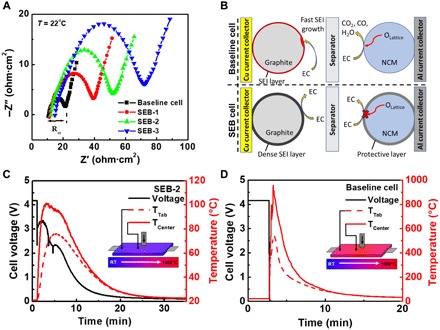
(A) Nyquist plots showing measured charge-transfer resistances of SEB cells versus the baseline LIB cell. (B) Schematic showing the in situ formed interfacial layers on the surface of graphite and NCM particles. The enhanced SEI layer on graphite slows down EC transport though the film and suppresses further SEI growth. The CEI layer hinders EC oxidation with lattice oxygen over the NCM surface at high temperatures or high voltages. (C and D) Cell voltage and temperature evolutions during nail penetration of a SEB cell and the baseline LIB cell along with qualitative temperature distributions. Both cells are 2.8-Ah pouch cells composed of the same graphite anode and NMC622 cathode materials. The baseline LIB cell is filled with a standard electrolyte: 1 M LiPF6 in EC/EMC (3/7 wt) + 2 wt % VC. The SEB cell has the electrolyte of 1 M LiPF6 in EC/EMC (1/9 wt) + 2 wt % VC with TAP as electrolyte additive. RT, room temperature.