


Fig. 2. Solvent and excipient combinations that preserve virus recovery from film matrix maintain optimal pH during drying.
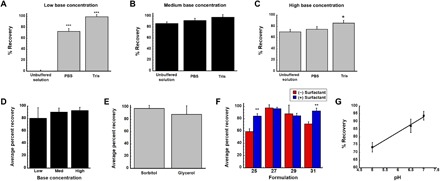
Recovery of virus from films containing 0.5% (low, A), 1.5% (medium, B), and 3.0% (high, C) concentrations of base excipient prepared in three different solvent systems was evaluated using an infectious titer assay. Once an optimal solvent system was selected, stepwise addition of excipients to the film identified an optimal base excipient concentration (D) and binder (E). Additional screening revealed that surfactant further improved recovery of infectious virus from the matrix (F). Analysis of data collected during each phase of screening revealed that formulations that maintained a final dried pH of 7.0 exhibited the highest recovery of infectious virus from the film (G). In each panel (A to G), data represent the average ± SD of a minimum of three films per condition. *P < 0.05, **P < 0.01, ***P < 0.001, two-tailed Student’s t test. Formulations are summarized in the figure according to the numbers assigned in table S1.