


Fig. 1. FESS design rationale, implementation, and application.
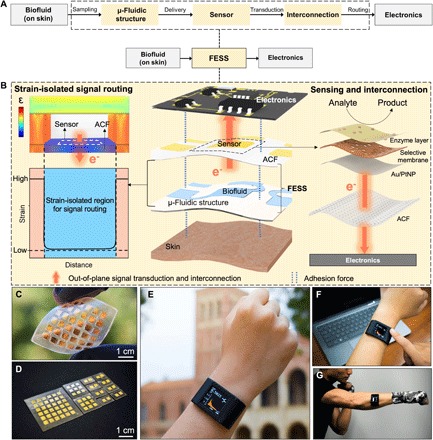
(A) Schematic of the biomarker information delivery pathway enabled by the FESS, illustrating sampling, sensing, and routing of epidermally retrieved biomarker information to readout electronics through a single entity. (B) Design rationale of the FESS. (C) Representative implementation of the FESS, demonstrating flexibility and no in-plane interconnection. (D) Representative family of FESS devices, containing 1 × 2, 3 × 3, and 6 × 6 electrode arrays. (E) Custom-developed and FESS-enabled smartwatch for biomarker monitoring. (F and G) Deployment of the FESS-enabled smartwatch in stationary (F) and high-intensity exercise (G) settings. (Photo credit: Peterson Nguyen, Kaili Chiu, Yichao Zhao, University of California, Los Angeles.)