


Figure 2.
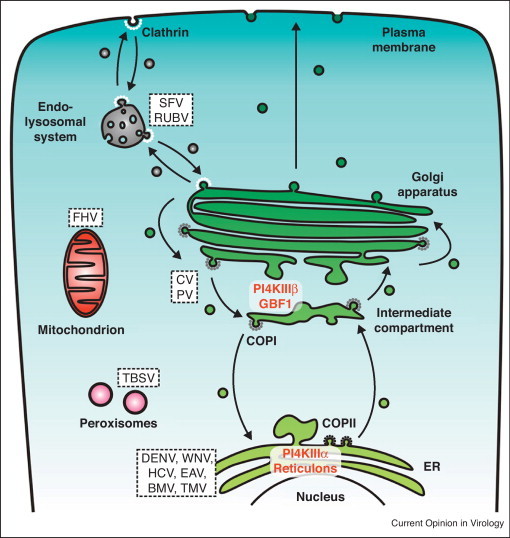
Schematic overview of the secretory pathway and the sites targeted and/or altered by (+)RNA viruses for formation of their membranous replication organelles. For reasons of simplicity, the endocytic pathway and the lysosomes are combined. Secretory pathway transport depends on specific coat complexes that contribute by mediating the bending, deformation and detachment of membranes carriers. Anterograde transport of proteins out of the ER takes place via a COP-II dependent pathway, whereas intra-Golgi transport as well as retrograde transport from the Golgi and intermediated compartment relies on COP-I-coated carries. Endocytosis takes place via clathrin-coated vesicles. The putative sites that are targeted and/or altered by different (+)RNA viruses (Family and Genera names of the viruses are given here below between parenthesis) to form their replication organelles are indicated by their position. Essential host factors and their localization are also indicated. CV, coxsackievirus (Picornaviridae, Enterovirus). DENV, dengue virus (Flaviviridae, Flavivirus). EAV, equine arteritis virus (Arteriviridae, Arterivirus). FHV, flock house virus (Nodaviridae, Alphanodavirus). HCV, hepatitis C virus (Flaviviridae, Hepacivirus). MHV, mouse hepatitis virus (Coronaviridae, Coronavirus). PV, poliovirus (Picornaviridae, Enterovirus). RUBV, rubella virus (Togaviridae, Rubivirus). SARS-CoV, severe acute respiratory syndrome coronavirus (Coronaviridae, Coronavirus). SFV, Semliki Forest virus (Togaviridae, Alphavirus). TBSV, tomato bushy stunt virus (Tombusviridae, Tombusvirus). TMV, tobacco mosaic virus (Virgaviridae, Tobamovirus). WNV, west Nile virus (Flaviviridae, Flavivirus).