


Abstract
Background
For the last few decades urinary human chorionic gonadotrophin (uhCG) has been used to trigger final oocyte maturation in cycles of in vitro fertilization (IVF) and intracytoplasmic sperm injection (ICSI). Recombinant technology has allowed the production of two drugs, recombinant human chorionic gonadotrophin (rhCG) and recombinant luteinising hormone (rLH), that can be used for the same purpose, to mimic the endogenous luteinising hormone (LH) surge. This allows commercial manufacturers to adjust production according to market requirements and to remove all urinary contaminants, facilitating the safe subcutaneous administration of a compound with less batch‐to‐batch variation. However, prior to a change in practice, it is necessary to compare the effectiveness of the recombinant drugs to the currently used urinary human chorionic gonadotrophin (uhCG).
Objectives
To assess the effects of subcutaneous rhCG and high dose rLH versus uhCG for inducing final oocyte maturation in subfertile women undergoing IVF and ICSI cycles.
Search methods
We searched the Cochrane Menstrual Disorders and Subfertility Group Trials Register (April 2015), the Cochrane Central Register of Controlled Trials (CENTRAL) (2015, Issue 3), MEDLINE (1946 to April 2015), EMBASE (1980 to April 2015) and PsycINFO (1806 to April 2015) as well as trial registers at ClinicalTrials.gov on 13 May 2015 and the World Health Organization International Clinical Trials Registry Platform (WHO ICTRP) search portal on 14 May 2015.
Selection criteria
Two review authors independently scanned titles and abstracts and selected those that appeared relevant for collection of the full paper. We included randomised controlled trials comparing rhCG and rLH with urinary hCG for final oocyte maturation triggering in IVF and ICSI cycles for treatment of infertility in normogonadotropic women.
Data collection and analysis
Two authors independently performed assessment for inclusion or exclusion, quality assessment and data extraction. We discussed any discrepancies in the presence of a third author to reach a consensus. The primary review outcomes were ongoing pregnancy/live birth and incidence of ovarian hyperstimulation syndrome (OHSS). Clinical pregnancy, miscarriage rate, number of oocytes retrieved and adverse events were secondary outcomes. We combined data to calculate pooled odds ratios (ORs) and 95% confidence intervals (CIs) and assessed statistical heterogeneity using the I2 statistic. We evaluated the overall quality of the evidence for the main comparisons using GRADE methods.
Main results
We included 18 RCTs involving 2952 participants; 15 compared rhCG with uhCG, and 3 compared rhLH with uhCG. The evidence for different comparisons ranged from very low to high quality: limitations were poor reporting of study methods and imprecision. Pharmaceutical companies funded 9 of the 18 studies, and 5 studies did not clearly report funding source.
Ongoing pregnancy/live birth
There was no conclusive evidence of a difference between rhCG and uhCG (OR 1.15, 95% CI 0.89 to 1.49; 7 RCTs, N = 1136, I2 = 0%, moderate quality evidence) or between rhLH and uhCG (OR 0.95, 95% CI 0.51 to 1.78, 2 RCTs, N = 289, I2 = 0%, very low quality evidence) for ongoing pregnancy/live birth rates.
OHSS
There was no evidence of a difference between rhCG and uhCG in the incidence of OHSS: moderate to severe OHSS (OR 1.76, 95% CI 0.37 to 8.45; 3 RCTs, N = 417, I2 = 0%, low quality evidence), moderate OHSS (OR 0.78, 95% CI 0.27 to 2.27; 1 RCT, N = 243, I2 = 0%, low quality evidence), mild to moderate OHSS (OR 1.00, 95% CI 0.42 to 2.38; 2 RCTs, N = 320, I2 = 0%, low quality evidence) or undefined OHSS (OR 1.18, 95% CI 0.50 to 2.78; 3 RCTs, N = 495, I2 = 0%, low quality evidence). Likewise, there was no evidence of a difference between rhLH and uhCG in OHSS rates for moderate OHSS (OR 0.82, 95% CI 0.39 to 1.69, 2 RCTs, N = 280, I2 = 5%, very low quality evidence).
Other adverse events
There was no evidence of a difference in miscarriage rates between rhCG and uhCG (OR 0.72, 95% CI 0.41 to 1.25; 8 RCTs, N = 1196, I2 = 0%, low quality evidence) or between rhLH and uhCG (OR 0.95, 95% CI 0.38 to 2.40; 2 RCTs, N = 289, I2 = 0%, very low quality evidence). For other adverse effects (most commonly injection‐site reactions) rhCG was associated with a lower number of adverse events than uhCG (OR 0.52, 95% CI 0.35 to 0.76; 5 RCTS, N = 561; I2 = 67%, moderate quality evidence). However, when we used a random‐effects model due to substantial statistical heterogeneity, there was no evidence of a difference between the groups (OR 0.56, 95% CI 0.27 to 1.13). Only one study comparing rLH and uhCG reported other adverse events, and it was impossible to draw conclusions.
Authors' conclusions
We conclude that there is no evidence of a difference between rhCG or rhLH and uhCG for live birth or ongoing pregnancy rates or rates of OHSS.
Plain language summary
Recombinant versus urinary human chorionic gonadotrophin for ovulation induction in assisted reproduction
Review question
Cochrane researchers reviewed the evidence on the effects of two drugs that artificially reproduce the hormones needed for foetal conception: recombinant human chorionic gonadotrophin (rhCG) and recombinant human luteinising hormone (rhLH), comparing them to urinary human chorionic gonadotrophin (uhCG) for subfertile couples undergoing in vitro fertilisation (IVF) or intracytoplasmic sperm injection (ICSI) cycles.
Background
For the last few decades, uhCG has been used to trigger final oocyte maturation in IVF and ICSI cycles. Recombinant technology has allowed the production of two drugs that can be used for the same purpose, to mimic the natural surge of luteinising hormone (LH). This allows commercial manufacturers to adjust production to market requirements and remove all urinary contaminants, facilitating patient safety during drug administration and standardisation of drug batches. However, prior to a change in practice, it is necessary to compare the effectiveness of the recombinant drugs to the currently used uhCG. The primary review outcomes were live birth or ongoing pregnancy, as well as incidence of ovarian hyperstimulation syndrome (OHSS).
Study characteristics
We found 18 studies in 2952 women undergoing IVF or ICSI. Fifteen trials in 2473 women compared rhCG with uhCG, and three trials in 479 women compared rLH with uhCG.
Women in the studies were 18 to 45 years old, with regular menstrual cycles and no history of OHSS. Types of subfertility included tubal disease, endometriosis, unexplained infertility and male factor infertility.
Pharmaceutical companies funded 9 of the 18 studies; 4 studies were free of commercial funding, and the remaining 5 studies did not clearly report a funding source. The evidence is current to April 2015.
Key results
There was no evidence of a difference between rhCG and uhCG or between RhLH and uhCG in rates of live birth/ongoing pregnancy or OHSS.
Studies did not report much evidence on adverse events other than OHSS, and the evidence they did report was inconclusive.
Quality of the evidence
For the comparison 'rhCG versus uhCG', the evidence was of moderate quality for ongoing pregnancy/live birth rate and of low quality for incidence of OHSS. The main limitation of the evidence was lack of precision (i.e. study size was too small to rule out the role of chance). For the comparison 'rLH versus uhCG', the evidence was of very low quality for both ongoing pregnancy/live birth rate and incidence of OHSS. The main limitations of the evidence were lack of precision and poor reporting of study methods.
Summary of findings
Background
Description of the condition
A luteinising hormone (LH) surge is essential in the final stages of oocyte maturation and to trigger follicle rupture, which expels the oocyte from the follicle and precipitates its capture by the fallopian tube. In addition, the LH surge promotes luteinisation, or the formation of an active corpus luteum. These effects of LH are essential in order for conception to occur in both natural and IVF cycles.
Description of the intervention
In assisted conception, human chorionic gonadotrophin (hCG) from urine has traditionally been used to trigger final oocyte maturation. There are considerable structural similarities between hCG and human LH (hLH), and both hormones stimulate the same receptor (Fatemi 2012; Leao 2014; Pierce 1981). HCG is readily available in the urine of pregnant women, whereas only low concentrations of LH are found in the urine of postmenopausal women.
Urinary preparations are, however, associated with a number of disadvantages that include being an uncontrolled source, lack of purity, and batch‐to‐batch variation in activity leading to variable clinical results (Leao 2014; Zegers‐Hochschild 1996). In addition, administration of hCG leads to a higher and more prolonged biological signal than one induced by natural LH. Evidence suggests that this could be a possible contributing factor to the development of ovarian hyperstimulation syndrome (Emperaire 1991, Fatemi 2012; Nastri 2015).
Recombinant hCG (rhCG) and recombinant LH (rLH) preparations are derived from genetically engineered Chinese hamster ovary cells through recombinant DNA technology. The production process begins after growth and expression of the cells from a well‐characterised cell bank. The hCG is secreted into the culture medium and harvested over 30 days. The product is purified by repeated chromatographic steps to yield a product with a high specific activity. The high purity of this product facilitates characterisation and quantitation by physicochemical means, thus reducing the need for animal bioassays. This makes the drug suitable for subcutaneous injection and hence self administration (Chang 2001, Fatemi 2012; Leao 2014).
The pharmacokinetic profile of rhCG is comparable to that of uhCG with linearity over a dose range of 500 IU to 20,000 IU and a terminal elimination half life of approximately 30 h (Trinchard‐Lugan 2002).
Moderate or severe OHSS affects about 3% to 10% of all ART cycles (Nastri 2015). OHSS is characterised by growth of multiple, large follicles with a massive extravascular protein rich fluid shift. This may cause serious complications related to hypovolaemia, haemoconcentration, oliguria, and electrolyte disturbance (Aboulghar 1998).
How the intervention might work
In assisted conception, both urinary human chorionic gonadotrophin (hCG) and recombinant preparations trigger final oocyte maturation by mimicking the endogenous LH surge by reinitiating and completing the first meiotic division from the germinal vesicle stage (prophase) to metaphase II, prompting an accompanying cytoplasmic maturation for fertilisation and early embryonic development (Cha 1998).
Why it is important to do this review
We wanted to assess the safety and efficacy of recombinant hCG and recombinant LH compared to urinary hCG (whose use is well established) for induction of final oocyte maturation and luteinisation in women undergoing IVF and ICSI cycles.
Objectives
To assess the effects of subcutaneous rhCG and high dose rLH versus uhCG for inducing final oocyte maturation in subfertile women undergoing IVF and ICSI cycles.
Methods
Criteria for considering studies for this review
Types of studies
We included randomised controlled trials (RCTs). We excluded non‐randomised studies as they are associated with a high risk of bias.
Types of participants
Subfertile couples undergoing final oocyte maturation triggering as part of IVF or ICSI cycles using either recombinant human chorionic gonadotrophin (rhCG) or a recombinant LH (rLH) preparation versus urinary human chorionic gonadotrophin (uhCG).
Types of interventions
Recombinant human chorionic gonadotrophin (rhCG) or recombinant LH preparation (rLH) versus urinary human chorionic gonadotrophin (uhCG) for final oocyte maturation triggering.
Types of outcome measures
Primary outcomes
Live birth rate per woman randomised (defined as the number of deliveries that resulted in a live birth). If studies did not report live birth rates, then we used the ongoing pregnancy rate per woman or per couple (defined as pregnancy beyond 12 weeks gestation)
Incidence of ovarian hyperstimulation syndrome (OHSS) per woman randomised, or cancelled cycles as a result of high perceived risk of OHSS (as detected by clinical grading of OHSS, laboratory investigations such as haematocrit, haemoglobin, renal function, and imaging techniques such as ovarian and abdominal ultrasound or chest X‐ray)
Secondary outcomes
Clinical pregnancy rate per woman randomised. Clinical pregnancy was defined by: foetal heart activity on ultrasound assessment, trophoblastic tissue on pathologic examination at time of miscarriage or surgery for ectopic pregnancy
Miscarriage rate per woman randomised (defined as a clinical pregnancy that ended in pregnancy loss prior to 20 weeks gestation)
Number of oocytes retrieved per woman randomised
Treatment‐related side effects (e.g. injection site reaction)
Search methods for identification of studies
We looked for all published and unpublished RCTs of rhCG or rLH versus uhCG for final oocyte maturation triggering using the search strategies described below and in the appendices, without language restriction and in consultation with the Menstrual Disorders and Subfertility Group (MDSG) Trials Search Co‐ordinator.
Electronic searches
We searched the following databases in consultation with the Gynaecology and Fertility Group (CGF) Trials Search Coordinator.
Cochrane Menstrual Disorders and Subfertility Group Specialised Register (inception to April 2015): Appendix 1.
Central Register of Controlled Trials (CENTRAL) (2015, Issue 3): Appendix 2.
MEDLINE (1946 to April 2015): Appendix 3.
EMBASE (1980 to April 2015): Appendix 4.
PsycINFO (1906 to April 2015): Appendix 5.
-
Trial registers for ongoing and registered trials
ClinicalTrials.gov (inception to April 2015): Appendix 6.
The World Health Organization International Clinical Trials Registry Platform search portal, http://apps.who.int/trialsearch/ (inception to April 2015): Appendix 7.
Citation indexes and conference abstracts on the ISI Web of Knowledge, http://wokinfo.com/ (inception to April 2015).
PubMed, www.ncbi.nlm.nih.gov/pubmed/ (inception to April 2015).
For MEDLINE and EMBASE, we used search strategies with different filters for identifying randomised trials. We combined the MEDLINE search with the Cochrane highly sensitive search strategy for identifying randomised trials, as described in section 6.4.11 of the Cochrane Handbook for Systematic Reviews of Interventions (Higgins 2011). We combined the EMBASE and CINAHL searches with trial filters developed by the Scottish Intercollegiate Guidelines Network (SIGN) (www.sign.ac.uk/methodology/filters.html#random).
Searching other resources
We searched the reference lists of all known primary studies, review articles, citation lists of relevant publications, abstracts of major scientific meetings (for example the European Society of Human Reproduction and Embryology, ESHRE, and the American Society for Reproductive Medicine, ASRM).
We contacted experts and other professionals from our personal networks regarding any unpublished material, and we also reached out to pharmaceutical manufacturers to enquire about unpublished trials. When important information was lacking from the original publications, we followed up by contacting the authors or pharmaceutical companies.
Data collection and analysis
Selection of studies
Two review authors (MY, WSL) were responsible for selecting studies, and a third author (MA or HA) helped to resolve disagreements. We first reviewed the titles and abstracts of studies using pre‐specified criteria for inclusion. We obtained the full texts of studies for the records considered potentially eligible for inclusion. We contacted authors when papers contained insufficient information to make a decision about eligibility (Abdelmassih 2005; Farrag 2008; Kovacs 2008; Manau 2002; Study 21447). Subsequently, we constructed a detailed Characteristics of excluded studies table for those studies that did not satisfy the inclusion criteria. We also created a similar Characteristics of included studies table for studies considered suitable for inclusion. We documented the selection process with a PRISMA flow chart (Figure 1).
1.

Study flow diagram.
Data extraction and management
We developed and piloted a standardised data extraction form for consistency and completeness. Two review authors (MY, WSL) independently extracted data and then compared the two sets of extracted data in order to resolve discrepancies. Where studies had multiple publications, we collated reports of the same study, so that each study rather than each report was the unit of interest in the review. These studies have a single study ID with multiple references. When required, we requested additional information about the methodological quality of studies from study authors. We received some data about methodology and clinical outcomes from the authors of the following studies: Kovacs 2008, Madani 2013, Manau 2002, and Study 21447.
Assessment of risk of bias in included studies
Two review authors (MY, WSL) independently assessed the included studies for risk of bias using the Cochrane 'Risk of bias' assessment tool (Higgins 2011). This tool assessed: allocation (random sequence generation and allocation concealment); blinding of participants, personnel and outcome assessors; incomplete outcome data; selective reporting; and other bias. We assigned a 'low', 'high' or 'unclear' risk to each domain and for every study. Below, we discuss the conditions necessary to merit a low risk assessment; when studies reported methods that differed meaningfully from these criteria, we assigned a high risk for that domain. When studies did not describe their methods in enough detail to permit a judgement, we assigned an unclear risk. We resolved disagreements by discussion and, when necessary, by arbitration from a third review author. We described all judgements fully and have presented the conclusions in the 'Risk of bias' table (Characteristics of included studies).The risks of bias were incorporated into the interpretation of the review findings by means of sensitivity analyses (Sensitivity analysis).
Sequence generation
We allocated a low risk of bias if the investigators described a random component in the sequence generation such as:
using a computerised random number generator;
using a random numbers table.
Allocation concealment
We allocated a low risk of bias if the participants and investigators enrolling participants could not foresee assignment because one of the following, or an equivalent method, was used to conceal allocation:
central computer randomisation;
serially numbered, sealed opaque envelopes.
Blinding
We allocated a low risk of bias if investigators ensured blinding of participants, scientists and clinicians or nurses.
Completeness of outcome data
We allocated a low risk of bias if there were no missing data and investigators carried out an intention‐to‐treat analysis.
Selective outcome reporting
We assessed within‐trial selective reporting, for example trials failing to report obvious outcomes, or reporting them in insufficient detail to allow inclusion. We sought published protocols and compared outcomes of the protocol with the final published study. Where identified studies failed to report the primary outcome of live birth, but reported interim outcomes such as pregnancy, we informally assessed whether the interim values (e.g. pregnancy rates) were similar to those reported in studies that also reported live birth, as a discrepancy might be indicative of selective outcome reporting.
We allocated a low risk of bias if the study pre‐specified all primary, secondary, and additional outcomes of interest to the review. We considered that reporting fewer outcome measures than planned to be a source of bias.
Other potential sources of bias
We considered baseline equality and use of randomisation before starting fertility treatment, as this can lead to participant loss.
Measures of treatment effect
For dichotomous data, we generated 2 x 2 tables for each trial and expressed the measure of effect as a Mantel‐Haenszel odds ratio (OR) with 95% confidence interval (CI). For continuous data, we calculated the mean difference (MD) between groups for all outcomes.
Unit of analysis issues
The primary analysis was per woman randomised (for example, ongoing pregnancy rate per randomised woman: defined as the number of women who were pregnant for more than 12 weeks divided by the number of women who received the intervention). We counted multiple live births (e.g. twins or triplets) as one live birth event.
Dealing with missing data
Where data were missing, we planned to impute individual values for the primary outcome only. We assumed that live births did not occur in participants without a reported outcome. For other outcomes, we only analysed the available data. We planned to subject any imputation to a sensitivity analysis (Sensitivity analysis).
Assessment of heterogeneity
We considered whether the clinical and methodological characteristics of the included studies were sufficiently similar for meta‐analysis to provide a clinically meaningful summary. We assessed statistical heterogeneity using the I2 statistic. We interpreted an I2 value greater than 50% to indicate substantial heterogeneity (Higgins 2003; Higgins 2011). In that case, we planned to explore possible explanations in sensitivity analyses. We took any statistical heterogeneity into account when interpreting the results, especially if there were any variation in the direction of effect.
Assessment of reporting biases
In view of the difficulty of detecting and correcting for publication bias and other reporting biases, the authors aimed to minimise their potential impact by ensuring a comprehensive search for eligible studies and by being alert for duplication of data. If there were 10 or more studies in an analysis, we planned to use a funnel plot to explore the possibility of small study effects (a tendency for estimates of the intervention effect to be more beneficial in smaller studies).
Data synthesis
We combined the data from primary studies using the fixed‐effect model in the following comparisons.
Recombinant human chorionic gonadotrophin (rhCG) versus urinary human chorionic gonadotrophin (uhCG).
Recombinant human luteinising hormone (hLH) versus urinary human chorionic gonadotrophin (uhCG).
We stratified OHSS into four different severity subgroups: moderate to severe, moderate, mild to moderate, and undefined.
We combined odds ratios (OR) for meta‐analysis with Review Manager (RevMan) 5 software using the Peto‐modified Mantel‐Haenszel method (RevMan 2014). Where possible, we extracted data to allow for an intention‐to‐treat analysis, defined as including all randomised participants in the denominator.
In the graphical display of the meta‐analyses, we considered rhCG to be the experimental treatment. An increase in the odds of an outcome with rhCG is displayed graphically to the right of the centre line. For an outcome such as pregnancy, an increase in odds is considered a benefit of the intervention, thus a benefit would be displayed to the right of the centre line. For an outcome such as OHSS, an increase in the odds is a detrimental effect of the intervention, and this is also displayed to the right of the centre line. Readers should keep this in mind when examining the summary graphs to assess the relative beneficial and detrimental effects of each intervention.
Subgroup analysis and investigation of heterogeneity
We planned to conduct subgroup analyses according to the IVF protocol utilised.
Long gonadotrophin‐releasing hormone (GnRH) agonist protocol.
GnRH antagonist protocol.
If we detected substantial heterogeneity, we planned to use subgroup analyses to explore any clinical differences between the studies. We planned to take any substantial statistical heterogeneity into account when interpreting the results, especially if there were any variation in the direction of effect.
Sensitivity analysis
We conducted sensitivity analyses for the primary outcomes to determine whether the conclusions were robust to arbitrary decisions made regarding eligibility and analysis. These analyses included consideration of whether conclusions would have differed if we had:
excluded studies at high risk of bias;
adopted a random‐effects model;
used alternative imputation strategies.
Summary of findings table
We prepared 'Summary of findings' tables using GRADEpro software (GRADEpro). This allows evaluation of the overall quality of the body of evidence for the main review outcomes (live birth rate/ongoing pregnancy rate, OHSS rate, miscarriage, adverse effects), using GRADE criteria. These consider study limitations (i.e. risk of bias), consistency of effect, imprecision, indirectness and publication bias. We justified and documented our judgements about evidence quality (high, moderate or low) and incorporated them into reporting of results for each outcome.
Results
Description of studies
Results of the search
Searches prior to 2015
Prior to the searches in 2015, we identified and critically appraised 52 studies that used rhCG or rLH to trigger final oocyte maturation. We included 14 studies and excluded 38.
April 2015 searches
We retrieved 72 discrete articles during the search in April 2015. After screening, we discarded 64 as clearly irrelevant. We assessed the full text of the other eight articles, finally including and excluding four each.
This update of the review therefore includes 18 eligible studies in total. We excluded 36 studies (Excluded studies).
See Figure 1 for the PRISMA flow chart.
Included studies
Study characteristics
We included 18 parallel‐group RCTs involving 2952 randomised women: 15 RCTs compared rhCG with uhCG (N = 2473), and 3 compared rLH with uhCG (N = 479). Details of each study are provided in Characteristics of included studies. Publication dates ranged from 2000 to 2013, and sample size varied between 30 in Manau 2002 to 310 in Schoolcraft 2002.
Twelve trials were published as full papers (Abdelmassih 2005; Bellavia 2013; Chang 2001; Driscoll 2000; Eftekhar 2012; ERHCG Group 2000; ERLH Group 2001; Farrag 2008; Kovacs 2008; Madani 2013; Manau 2002; Papanikolaou 2010). One study was unpublished (Study 21447), and five studies appeared as abstracts (Borges 2004; Goswami 2007; Jie 2005; Schoolcraft 2002; Vidal 2005).
Seven trials were multicentre trials (Bellavia 2013; ERHCG Group 2000; ERLH Group 2001; Chang 2001; Driscoll 2000; Jie 2005; Study 21447), while 11 trials took place in a single centre (Abdelmassih 2005; Borges 2004; Eftekhar 2012; Farrag 2008; Goswami 2007; Kovacs 2008; Madani 2013; Manau 2002; Papanikolaou 2010; Schoolcraft 2002; Vidal 2005).
All trials were designed as non‐inferiority trials to show that the efficacy of recombinant drug is not clinically inferior to the current care, which is urinary gonadotrophins.
Pharmaceutical companies funded nine studies (Abdelmassih 2005; Bellavia 2013; Chang 2001; Driscoll 2000; ERHCG Group 2000; ERLH Group 2001; Jie 2005; Manau 2002; Study 21447). Investigators reported four studies as being free of commercial funding (Borges 2004; Goswami 2007; Kovacs 2008; Vidal 2005). The other studies did not report funding sources clearly.
Six studies reported performing an a priori power calculation to determine sample size (Bellavia 2013; Chang 2001; Driscoll 2000; ERHCG Group 2000; Madani 2013; Papanikolaou 2010). Three studies did not describe any sample size calculation (Abdelmassih 2005; Borges 2004; Kovacs 2008), and the rest made no clear statement in that respect.
Participants
All trials included healthy female partners from subfertile couples, and the inclusion and exclusion criteria were very similar. The main common inclusion criteria were: aged 18 to 45 years, regular menstrual cycles ranging from 24 to 35 days, follicle stimulating hormone (FSH) < 12 IU/L during the early follicular phase, and no prior history of OHSS. All trials involved IVF and ICSI cycles (see Characteristics of included studies).
The categories of infertility usually included tubal disease, endometriosis, unexplained infertility and male factor infertility.
One study included donor women (Vidal 2005).
Heterogeneity could stem from differences between the studies in ICSI use, means of GnRH agonist administration (nasal or by injection), and reason for infertility. However, subgroup analysis comparing the outcomes within the various categories of subfertility was not possible because sufficiently detailed data were not available.
Interventions
All trials performed pituitary down regulation using a long protocol of GnRH agonist administration, except Papanikolaou 2010, which used a GnRH antagonist protocol. GnRH agonist was started in the mid‐luteal phase (cycle day 21 to 24) by either daily intranasal or subcutaneous administration, except in Madani 2013 where GnRH agonist was started on cycle day 17 to 19. Ovarian stimulation was started after two weeks if pituitary down regulation was established (serum estradiol level < 50 pg/mL). Both treatment groups started ovarian stimulation with a daily dose of 75 to 450 IU recombinant FSH (follitrophin alpha, or Gonal‐f Serono) or highly purified FSH for the first five stimulation days. Thereafter, physicians adapted the dose of gonadotrophin to the ovarian response as monitored via ultrasonography.
Nine trials used recombinant FSH (follitrophin alpha) (Abdelmassih 2005; Borges 2004; Driscoll 2000; Eftekhar 2012; ERHCG Group 2000; Jie 2005; Madani 2013; Manau 2002; Papanikolaou 2010). Two trials used highly purified FSH (Bellavia 2013; Chang 2001), and it was unclear what type of rFSH was used in six trials (Farrag 2008; Goswami 2007; Kovacs 2008; Schoolcraft 2002; Study 21447; Vidal 2005).
Fifteen trials used rhCG (Abdelmassih 2005; Bellavia 2013; Borges 2004; Chang 2001; Driscoll 2000; Eftekhar 2012; ERHCG Group 2000; Farrag 2008; Goswami 2007; Jie 2005; Kovacs 2008; Madani 2013; Papanikolaou 2010; Schoolcraft 2002; Vidal 2005), and three trials used rhLH (ERLH Group 2001; Manau 2002; Study 21447).
Women were randomised to receive either 250 µg rhCG or 10,000 IU uhCG in Abdelmassih 2005, Bellavia 2013, Borges 2004, Chang 2001, Eftekhar 2012, Farrag 2008, Goswami 2007, Jie 2005, Madani 2013, Papanikolaou 2010, Schoolcraft 2002 and Vidal 2005; 7500 IU in Kovacs 2008; or 5000 IU in Driscoll 2000, ERHCG Group 2000, ERLH Group 2001 and Manau 2002. It was unclear what dose was used in Study 21447.
The urinary hCG used was Profasi in Abdelmassih 2005,Borges 2004,Chang 2001, Driscoll 2000, ERHCG Group 2000, and Manau 2002; Choriomon in Bellavia 2013 and Madani 2013; Pregnyl in Eftekhar 2012 and Papanikolaou 2010; and Choragon in Farrag 2008. It was unclear what three trials used (Kovacs 2008; Study 21447; Vidal 2005). The rhCG used in Abdelmassih 2005, Bellavia 2013, Borges 2004, Chang 2001, Driscoll 2000, Eftekhar 2012, ERHCG Group 2000, Jie 2005 and Schoolcraft 2002 was Ovidrel, while Madani 2013 and Papanikolaou 2010 used Ovitrelle. It was unclear what the other studies used.
All trials performed oocyte pick‐up 30 to 38 hours after triggering, followed by IVF or ICSI, with no more than three embryos being replaced two to five days thereafter.
Participants started luteal‐phase support no later than the day after embryo transfer, as per the clinic's routine practice.
Physicians performed a pregnancy test 15 to 21 days after hCG if no menstruation had occurred, then ultrasound was done on day 42.
There was no indication of co‐intervention in any of the trials (i.e. no study used a combination of uhCG + rhCG or rhLH).
Outcomes
Three studies reported live birth rate (Bellavia 2013; Chang 2001; Papanikolaou 2010), and six reported ongoing pregnancy (Abdelmassih 2005; Driscoll 2000; ERHCG Group 2000; ERLH Group 2001; Manau 2002; Schoolcraft 2002).
Ten studies reported incidence of ovarian hyperstimulation syndrome (OHSS), with three studies reporting moderate to severe OHSS (Bellavia 2013; Chang 2001; Driscoll 2000), three studies reporting moderate OHSS (ERLH Group 2001; Goswami 2007; Manau 2002), two studies reporting mild to moderate OHSS (Eftekhar 2012; Madani 2013), and three studies reporting undefined OHSS (Chang 2001; ERHCG Group 2000; Papanikolaou 2010).
Fourteen trials reported clinical pregnancy rates for rhCG versus uhCG (Abdelmassih 2005; Bellavia 2013; Borges 2004; Chang 2001; Driscoll 2000; Eftekhar 2012; ERHCG Group 2000; Farrag 2008; Goswami 2007; Jie 2005; Kovacs 2008; Madani 2013; Papanikolaou 2010; Vidal 2005) and two studies for rhLH versus uhCG (ERLH Group 2001; Manau 2002).
Nine trials reported the miscarriage rate for rhCG versus uhCG (Abdelmassih 2005; Borges 2004; Chang 2001; Driscoll 2000; Eftekhar 2012; ERHCG Group 2000; Farrag 2008; Jie 2005; Papanikolaou 2010) and two studies for rhLH versus uhCG (ERLH Group 2001; Manau 2002).
Thirteen studies reported the number of oocytes retrieved for rhCG versus uhCG (Bellavia 2013; Borges 2004; Chang 2001; Driscoll 2000; Eftekhar 2012; ERHCG Group 2000; ERLH Group 2001; Farrag 2008; Jie 2005; Kovacs 2008; Madani 2013; Manau 2002; Papanikolaou 2010; Schoolcraft 2002; Vidal 2005) and two studies for rhLH versus uhCG (ERLH Group 2001; Manau 2002).
Side effects were reported in seven studies: injection site pain, reaction, inflammation, nausea, vomiting, abdominal pain (Abdelmassih 2005; Bellavia 2013; Chang 2001; Driscoll 2000; ERHCG Group 2000; ERLH Group 2001; Vidal 2005). Five studies did not report on adverse events (Borges 2004; Eftekhar 2012; Kovacs 2008; Madani 2013; Papanikolaou 2010), and six studies did not report them clearly (Farrag 2008; Goswami 2007; Jie 2005; Manau 2002; Schoolcraft 2002; Study 21447).
Excluded studies
We excluded 37 studies from the analysis as they did not meet our inclusion criteria. We list our reasons for excluding these studies in Characteristics of excluded studies.
Risk of bias in included studies
2.

Methodological quality graph: review authors' judgements about each methodological quality item presented as percentages across all included studies.
3.

Methodological quality summary: review authors' judgements about each methodological quality item for each included study.
Allocation
Sequence generation
We assigned a low risk of bias for sequence generation to 11 trials that used a computer‐generated randomisation list to allocate participants (Abdelmassih 2005; Bellavia 2013; Chang 2001; Driscoll 2000; Eftekhar 2012; ERHCG Group 2000; ERLH Group 2001; Farrag 2008; Manau 2002; Papanikolaou 2010; Study 21447). We rated two other studies as having a low risk of bias for this domain as well: Madani 2013 used a permuted block method generated by a statistician for randomisation, and Vidal 2005 used a random numbers table. Kovacs 2008 used block randomisation (blocks of 2) for allocation; however, investigators did not report the method of sequence generation, so we rated it as being at an unclear risk of bias. In three trials the participants were randomised, but authors did not report the method of randomisation and so were at unclear risk of this bias (Goswami 2007; Jie 2005; Schoolcraft 2002).
Allocation concealment
Allocation concealment refers to whether the randomisation sequence was adequately concealed from participants, operators and investigators until interventions were assigned. Among the 11 trials that used a central computer to generate randomisation, allocation concealment appeared to be adequate in 5 (Chang 2001; Driscoll 2000; ERLH Group 2001; Manau 2002; Study 21447). We detected a high risk of selection bias related to concealment in Papanikolaou 2010 since there was no concealment. In the remaining trials there was not enough information to determine whether allocation concealment was adequate, hence they were at unclear risk of bias.
Blinding
We did not consider that blinding was likely to influence findings for the primary review outcomes (live birth rate/ongoing pregnancy rate and incidence of OHSS).
Five trials used double blinding (Driscoll 2000; ERHCG Group 2000; ERLH Group 2001; Study 21447; Vidal 2005), and three trials used single blinding: Abdelmassih 2005 for participants, and Bellavia 2013 and Papanikolaou 2010 for investigators. Two trials were open (Chang 2001; Madani 2013), and the remaining trials did not clearly report on blinding (Borges 2004; Eftekhar 2012; Farrag 2008; Goswami 2007; Jie 2005; Kovacs 2008; Manau 2002; Schoolcraft 2002).
Incomplete outcome data
Twelve studies analysed all or most (> 90%) of the women randomised, and we judged them to be at low risk of attrition bias (Abdelmassih 2005; Bellavia 2013; Chang 2001; Driscoll 2000; Eftekhar 2012; ERLH Group 2001; Goswami 2007; Jie 2005; Kovacs 2008; Madani 2013; Manau 2002; Papanikolaou 2010). Five studies were at high risk of attrition bias: studies either did not clearly report the number of women randomised (Borges 2004; Schoolcraft 2002), did not clearly report the number of women analysed (Vidal 2005), or both (Study 21447); in addition, Farrag 2008 only analysed 89% of randomised women. We judged ERHCG Group 2000 to be at unclear risk of bias since randomisation was done before starting fertility treatment.
Six studies performed an intention‐to‐treat analysis (Bellavia 2013; Chang 2001; Driscoll 2000; Kovacs 2008; Manau 2002; Papanikolaou 2010), while six others did not (Abdelmassih 2005; ERHCG Group 2000; ERLH Group 2001; Farrag 2008; Goswami 2007; Jie 2005). The rest of the studies did not specify one way or the other. Borges 2004 performed analyses per cycle, and we could not obtain per woman data. We contacted investigators of the following studies via email for additional information about study methodology and in order to perform analyses on an intention‐to‐treat basis: Abdelmassih 2005, Borges 2004, Farrag 2008, Goswami 2007, Kovacs 2008, Manau 2002 and Study 21447.
In Bellavia 2013, 147 women were randomised. Investigators excluded nine participants due to poor ovarian response, two due to study medication being out of stock and one due to poor estradiol increment. Physicians also withdrew two participants due to risk of OHSS.
Farrag 2008 excluded eight protocol violators in group 1 (rhCG) and three in group 2 (uhCG). Thus, there were 89 women in the overall patient population, with 42 and 47 participants in the rhCG and uhCG groups, respectively.
In Chang 2001, 275 participants were randomised: investigators excluded 16 due to poor ovarian response, and 5 women withdrew before randomisation.
In ERLH Group 2001, 259 participants were enrolled and randomised. Of these, 258 entered the clinical phase of the study and underwent ovarian stimulation treatment, and 250 received rhLH (129 participants) or uhCG (121 participants). Nine participants did not receive rhLH or uhCG treatment: one was discontinued before starting rhFSH treatment because she was found to be pregnant, five presented a risk of OHSS, and three failed to develop a follicle with a mean diameter of at least 17 mm. These participants were equally distributed over the different rhLH groups as well as over the control groups. Of the 250 participants who received rhLH or uhCG treatment, 231 had at least one embryo transferred, and 243 completed the mid‐luteal phase assessment.
In ERHCG Group 2000, 205 participants were randomised to receive rFSH and hCG. Following treatment with rFSH, 190 women received hCG (97 rhCG; 93 uhCG) ('all participants population'). Fifteen participants did not receive hCG. The most common reason for not receiving hCG was poor response to ovarian stimulation (four rhCG; two uhCG). After elimination of major protocol violators, 172 participants who received hCG constituted the 'evaluable participants population' (88 rhCG; 84 uhCG).
Selective reporting
The protocols were not available for all of the studies, but it was clear that the published reports included all expected outcomes, and we considered these studies to be at low risk of bias. Five studies were at a low risk of selective reporting bias because outcome measures were reported in a pre‐specified manner (Abdelmassih 2005; Chang 2001; Driscoll 2000; ERHCG Group 2000; ERLH Group 2001). The remaining studies were at unclear risk of reporting bias even though outcomes were reported as pre‐specified, since they did not report several important outcomes. Nine studies did not clearly report live birth/ongoing pregnancy (Borges 2004; Eftekhar 2012; Farrag 2008; Goswami 2007; Jie 2005; Kovacs 2008; Madani 2013; Study 21447; Vidal 2005), and 12 did not report adverse events (Bellavia 2013; Borges 2004; Eftekhar 2012; Farrag 2008; Goswami 2007; Jie 2005; Kovacs 2008; Madani 2013; Manau 2002; Papanikolaou 2010; Schoolcraft 2002; Study 21447).
Other potential sources of bias
Six studies were at unclear risk of other bias due to lack of detail on the methods and study conduct. Study 21447 was unpublished, and five other studies were only available as abstracts (Borges 2004; Goswami 2007; Jie 2005; Schoolcraft 2002; Vidal 2005).
Effects of interventions
Summary of findings for the main comparison. RhCG compared to uhCG for final oocyte maturation triggering in IVF and ICSI cycles.
| RhCG compared to uhCG for final oocyte maturation triggering in IVF and ICSI cycles | ||||||
| Population: women undergoing final oocyte maturation triggering in IVF and ICSI cycles Setting: ART Intervention: recombinant hCG (rhCG) Comparison: urinary human chorionic gonadotrophin (uhCG) | ||||||
| Outcomes | Illustrative comparative risks* (95% CI) | Relative effect (95% CI) | No of participants (studies) | Quality of the evidence (GRADE) | Comments | |
| Assumed risk | Corresponding risk | |||||
| UhCG | RhCG | |||||
| Ongoing pregnancy/live birth rate per woman | 367 per 1000 | 396 per 1000 (344 to 454) | OR 1.15 (0.89 to 1.49) | 1136 (7 studies) | ⊕⊕⊕⊝ Moderatea | — |
| OHSS per woman ‐ moderate to severe OHSS | 10 per 1000 | 17 per 1000 (11 to 84) | OR 1.76 (0.37 to 8.45) | 417 (3 studies) | ⊕⊕⊝⊝ Lowb,c | — |
| Clinical pregnancy rate per woman | 330 per 1000 | 343 per 1000 (300 to 388) | OR 1.06 (0.87 to 1.29) | 1806 (13 studies) | ⊕⊕⊕⊝ Moderatea | — |
| Miscarriage rate per woman | 51 per 1000 | 37 per 1000 (21 to 63) | OR 0.72 (0.41 to 1.25) | 1347 (9 studies) | ⊕⊕⊝⊝ Lowa,b | — |
| Adverse events per woman | 331 per 1000 | 179 per 1000 (112 to 406) | OR 0.52 (0.35 to 0.76) | 561 (5 studies) | ⊕⊕⊕⊝ Moderateb | Adverse events included: injection site pain, reaction, inflammation, nausea, vomiting, abdominal pain |
| *The basis for the assumed risk (e.g. the median control group risk across studies) is provided in footnotes. The corresponding risk (and its 95% confidence interval) is based on the assumed risk in the comparison group and the relative effect of the intervention (and its 95% CI). ART: assisted reproduction therapy; CI: confidence interval; hCG: human chorionic gonadotrophin; ICSI: intracytoplasmic sperm injection; IVF: in vitro fertilisation; OR: odds ratio; rhCG: recombinant hCG; uhCG: urinary hCG | ||||||
| GRADE Working Group grades of evidence High quality: Further research is very unlikely to change our confidence in the estimate of effect. Moderate quality: Further research is likely to have an important impact on our confidence in the estimate of effect and may change the estimate. Low quality: Further research is very likely to have an important impact on our confidence in the estimate of effect and is likely to change the estimate. Very low quality: We are very uncertain about the estimate. | ||||||
aThe pooled effect included both the line of no effect and appreciable benefit or harm. bTotal number of events is less than 300. cThe pooled effect included both the line of no effect and appreciable benefit and harm.
Summary of findings 2. RhLH compared to uhCG for final oocyte maturation triggering in IVF and ICSI cycles.
| RhLH compared to uhCG for final oocyte maturation triggering in IVF and ICSI cycles | |||||
| Population: women undergoing final oocyte maturation triggering in IVF and ICSI cycles Setting: ART Intervention: rhLH (recombinant luteinising hormone) Comparison: urinary human chorionic gonadotrophin (uhCG) | |||||
| Outcomes | Illustrative comparative risks* (95% CI) | Relative effect (95% CI) | No of participants (studies) | Quality of the evidence (GRADE) | |
| Assumed risk | Corresponding risk | ||||
| UhCG | RhLH | ||||
| Ongoing pregnancy/live birth rate per woman | 371 per 1000 | 359 per 1000 (231 to 512) | OR 0.95 (0.51 to 1.78) | 289 (2 studies) | ⊕⊝⊝⊝ Very lowa,b,c |
| OHSS per woman ‐ Moderate OHSS | 126 per 1000 | 107 per 1000 (55 to 197) | OR 0.83 (0.40 to 1.70) | 289 (2 studies) | ⊕⊝⊝⊝ Very lowa,b,c |
| Clinical pregnancy rate per woman | 407 per 1000 | 392 per 1000 (270 to 530) | OR 0.94 (0.54 to 1.64) | 289 (2 studies) | ⊕⊝⊝⊝ Very lowa,b,c |
| Miscarriage rate per woman | 36 per 1000 | 34 per 1000 (14 to 82) | OR 0.95 (0.38 to 2.40) | 280 (2 studies) | ⊕⊝⊝⊝ Very lowa,b,c |
| Adverse events per woman | 1 study reported this outcome in this comparison; event numbers were similar in both groups. | 259 (1 study) | — | ||
| *The basis for the assumed risk (e.g. the median control group risk across studies) is provided in footnotes. The corresponding risk (and its 95% confidence interval) is based on the assumed risk in the comparison group and the relative effect of the intervention (and its 95% CI). ART: assisted reproduction therapy; CI: confidence interval; hCG: human chorionic gonadotrophin; ICSI: intracytoplasmic sperm injection; IVF: in vitro fertilisation; OR: odds ratio; rhLH: recombinant luteinising hormone; uhCG: urinary hCG. | |||||
| GRADE Working Group grades of evidence High quality: Further research is very unlikely to change our confidence in the estimate of effect. Moderate quality: Further research is likely to have an important impact on our confidence in the estimate of effect and may change the estimate. Low quality: Further research is very likely to have an important impact on our confidence in the estimate of effect and is likely to change the estimate. Very low quality: We are very uncertain about the estimate. | |||||
aThe pooled effect included both the line of no effect and appreciable benefit or harm. bTotal number of events is less than 300. c1 of the 2 included studies did not provide information about methods of randomisation, allocation concealment or blinding.
1. Recombinant hCG versus urinary hCG
1.1 Ongoing pregnancy/live birth rate per woman randomised
There was no evidence of a difference in live birth rate/ongoing pregnancy rate between the groups (OR 1.15, 95% CI 0.89 to 1.49; 7 RCTs, N = 1136, I2 = 0%, moderate quality evidence) (Analysis 1.1; Figure 4).
1.1. Analysis.
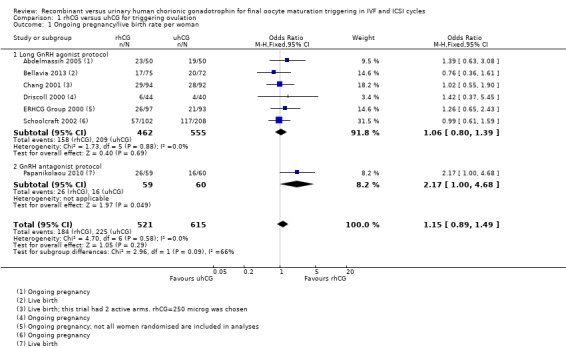
Comparison 1 rhCG versus uhCG for triggering ovulation, Outcome 1 Ongoing pregnancy/live birth rate per woman.
4.

Forest plot of comparison: 1 rhCG versus uhCG for triggering ovulation, outcome: 1.1 Ongoing pregnancy/live birth rate per woman.
1.1.1 Long GnRH agonist protocol
There was no evidence of a difference between the groups with the long GnRH agonist protocol in live birth rate/ongoing pregnancy rates (OR 1.06, 95% CI 0.80 to 1.39; 6 RCTs, N = 1017; I2 = 0%; Analysis 1.1; Figure 4).
1.1.2 GnRH antagonist protocol
Papanikolaou 2010 reported both live birth rate (named as delivery rate in the study) and ongoing pregnancy rate; we reported the data for live birth rate. There was a higher live birth rate in the rhCG group (OR 2.17, 95% CI 1.00 to 4.68, 1 RCT, N = 119; Analysis 1.1; Figure 4).
1.2 Ovarian hyperstimulation syndrome (OHSS) incidence per woman randomised
1.2.1 Moderate to severe OHSS
Pooling the results from three trials showed no evidence of a difference between the groups (OR 1.76, 95% CI 0.37 to 8.45; 3 RCTs, N = 417, I2 = 0%, low quality evidence; Analysis 1.2; Figure 5).
1.2. Analysis.

Comparison 1 rhCG versus uhCG for triggering ovulation, Outcome 2 OHSS per woman.
5.
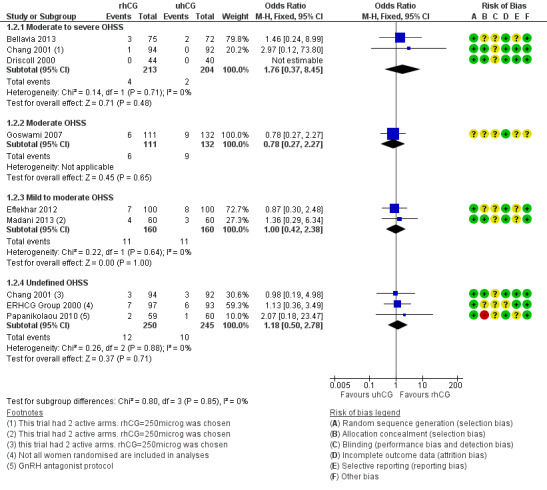
Forest plot of comparison: 1 rhCG versus uhCG for triggering ovulation, outcome: 1.2 OHSS per woman.
1.2.2 Moderate OHSS
One trial reported moderate OHSS (Goswami 2007). There was no evidence of a difference between the groups (OR 0.78, 95% CI 0.27 to 2.27, 1 RCT, N = 243; Analysis 1.2; Figure 5).
1.2.3 Mild to moderate OHSS
Pooling the results from two trials showed no evidence of a difference between the groups (OR 1.00, 95% CI 0.42 to 2.38; 2 RCTs, N = 320, I2 = 0%, low quality evidence; Analysis 1.2; Figure 5).
1.2.4 Undefined OHSS
Pooling the results from three trials showed no evidence of a difference between the groups (OR 1.18, 95% CI 0.50 to 2.78; 3 RCTs, N = 495, I2 = 0%, low quality evidence; Analysis 1.2; Figure 5)
1.3 Clinical pregnancy rates
There was no evidence of a difference between the groups in clinical pregnancy rates (OR 1.06, 95% CI 0.87 to 1.29, 13 RCTs, N = 1806, I2 = 0%, moderate quality evidence; Analysis 1.3; Figure 6).
1.3. Analysis.

Comparison 1 rhCG versus uhCG for triggering ovulation, Outcome 3 Clinical pregnancy rate per woman.
6.

Forest plot of comparison: 1 rhCG versus uhCG for triggering ovulation, outcome: 1.3 Clinical pregnancy rate per woman.
1.3.1 Long GnRH agonist protocol
There was no evidence of a difference between the groups in clinical pregnancy rates (OR 1.01, 95% CI 0.82 to 1.24, 12 RCTs, N = 1687, I2 = 0%; Analysis 1.3; Figure 6).
1.3.2 GnRH antagonist protocol
Papanikolaou 2010 found no evidence of a difference between the groups in clinical pregnancy rates (OR 1.97, 95% CI 0.93 to 4.18, 1 RCT, N = 119; Analysis 1.3; Figure 6). Two women from the uhCG group had clinical pregnancies but not ongoing pregnancies owing to first trimester miscarriage.
1.4 Miscarriage
There was no evidence of a difference between the groups in the miscarriage rate (OR 0.72, 95% CI 0.41 to 1.25, 8 RCTs, N = 1196, I2 = 0%, low quality evidence; Analysis 1.4; Figure 7).
1.4. Analysis.

Comparison 1 rhCG versus uhCG for triggering ovulation, Outcome 4 Miscarriage rate per woman.
7.

Forest plot of comparison: 1 rhCG versus uhCG for triggering ovulation, outcome: 1.4 Miscarriage rate per woman.
1.4.1 Long GnRH agonist protocol
Pooling results from seven trials showed no evidence of a difference in miscarriage rate between groups (OR 0.73, 95% CI 0.41 to 1.29; 7 RCTs; N = 1077; I2 = 0%; Analysis 1.4; Figure 7).
1.4.2 GnRH antagonist protocol
Papanikolaou 2010 found no evidence of a difference between the groups (OR 0.50, 95% CI 0.04 to 5.67, one RCT, N = 119; Analysis 1.4; Figure 7).
1.5 Number of oocytes
Pooling the results from 12 trials showed no evidence of a difference between the groups in number of retrieved oocytes (MD −0.11, 95% CI −0.70 to 0.47, 12 RCTs, N = 1744, I2 = 0%; Analysis 1.5).
1.5. Analysis.

Comparison 1 rhCG versus uhCG for triggering ovulation, Outcome 5 No of oocytes retrieved per woman.
1.5.1 Long GnRH agonist protocol
Pooling the results from 11 studies showed no evidence of a difference between the groups (MD −0.14, 95% CI −0.73 to 0.45, 11 RCTs; N = 1625; I2 = 0%; Analysis 1.5).
1.5.2 GnRH antagonist protocol
Papanikolaou 2010 found no evidence of a difference between the groups (MD 1.20, 95% CI −3.14 to 5.54, 1 RCT, N = 119; Analysis 1.5).
1.6 Adverse events
RhCG was associated with a lower number of adverse events than uhCG (OR 0.52, 95% CI 0.35 to 0.76; 5 RCTS, N = 561; I2 = 67%, moderate quality evidence; Analysis 1.6). The most commonly reported event was injection site reaction.
1.6. Analysis.

Comparison 1 rhCG versus uhCG for triggering ovulation, Outcome 6 Adverse events per woman.
However, when we used a random‐effects model due to substantial statistical heterogeneity, there was no evidence of a difference between the groups (OR 0.56, 95% CI 0.27 to 1.13; 5 RCTs, N = 561, I2 = 67%; Analysis 1.6).
One trial recorded 12/44 mild or moderate adverse events (such as pain at the injection site) in the rhCG group compared to 17/40 in the uhCG group (Driscoll 2000). In another trial 22/97 women receiving rhCG reported adverse events compared to 42/93 in the uhCG group (ERHCG Group 2000). In a third trial 23% of women receiving rhCG reported adverse events compared to 45% in the uhCG group (Abdelmassih 2005).
Chang 2001, an open RCT, reported no evidence of a difference between drugs in terms of tolerability of the injections. Adverse events were reported by 46.3%, 57.3% and 38.5% of women in the 250 µg rhCG, 500 µg rhCG and 200 µg uhCG groups, respectively. Bellavia 2013 reported no evidence of differences in adverse events or reaction at the injection site between drugs. Adverse events were rare at 11.1% and 18.7% in the highly purified hCG and rhCG groups, respectively. Jie 2005 and Kovacs 2008 reported that the safety was good. Vidal 2005 reported that there were no adverse events for either drug group.
2. Recombinant hLH versus urinary hCG
2.1 Ongoing pregnancy/live birth rate
Pooling the data of the ongoing pregnancy/live birth rate from the two trials with available data showed no evidence of a difference between the groups (OR 0.95, 95% CI 0.51 to 1.78; 2 RCTs, N = 289, I2 = 0%, very low quality evidence; Analysis 2.1; Figure 8).
2.1. Analysis.

Comparison 2 rhLH versus uhCG for triggering ovulation, Outcome 1 Ongoing pregnancy/live birth rate per woman.
8.

Forest plot of comparison: 2 rhLH versus uhCG for triggering ovulation, outcome: 2.1 Ongoing pregnancy/live birth rate per woman.
2.2 Moderate ovarian hyperstimulation syndrome (OHSS) incidence per woman randomised
Pooling the results from the two trials with available data showed no evidence of a difference between the groups (OR 0.83, 95% CI 0.40 to 1.70; 2 RCTs, N = 289, I2 = 6%, very low quality evidence; Analysis 2.2; Figure 9).
2.2. Analysis.

Comparison 2 rhLH versus uhCG for triggering ovulation, Outcome 2 OHSS per woman.
9.
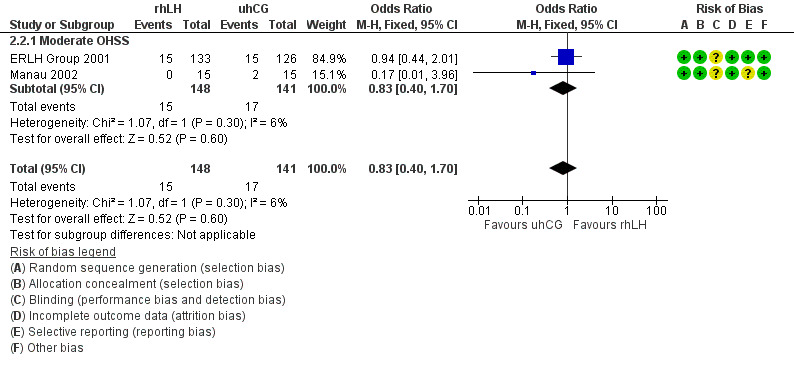
Forest plot of comparison: 2 rhLH versus uhCG for triggering ovulation, outcome: 2.2 OHSS per woman.
2.3 Clinical pregnancy rate
Pooling the results from the two trials with available data showed no evidence of a difference between the groups (OR 0.94, 95% CI 0.54 to 1.64; 2 RCTs, N = 2890, I2 = 0%, very low quality evidence; Analysis 2.3).
2.3. Analysis.

Comparison 2 rhLH versus uhCG for triggering ovulation, Outcome 3 Clinical pregnancy rate per woman.
One of the studies comparing rhLH and uhCG reported that pregnancy rates and clinical pregnancy rates were significantly lower in the rhLH group than in the uhCG group (P = 0.018 and P = 0.023, respectively) (Study 21447). We received this information from the pharmaceutical company that was conducting the trial after contacting them for additional data.
2.4 Miscarriage
Pooling the results from the two trials with available data showed no evidence of a difference between the groups (OR 0.95, 95% CI 0.38 to 2.40; 2 RCTs, N = 289, I2 = 0%, very low quality evidence; Analysis 2.4).
2.4. Analysis.

Comparison 2 rhLH versus uhCG for triggering ovulation, Outcome 4 Miscarriage rate per woman.
2.5 Number of oocytes
Two studies reported the number of oocytes retrieved.
The number of retrieved oocytes was 10.23 ± 4.70 versus 11.74 ± 6.27 in participants receiving 5000 IU of rLH versus uhCG; 11.84 ± 7.53 versus 11.78 ± 6.75 in participants receiving 15,000 IU of rLH versus uhCG; and 12.62 ± 6.22 versus 10.82 ± 5.70 in participants receiving 30,000 IU of rLH versus uhCG (ERLH Group 2001). The mean number of oocytes retrieved was 11.56 in the rhCG group and 11.44 in the uhCG group.
The number of oocytes was 10.2 ± 4.64 in the uhCG group versus 9.1± 3.4 in the rLH group (Manau 2002).
Pooling the results of the arm using 5000 IU of rLH in ERLH Group 2001 with Manau 2002 showed no evidence of a difference between the groups (MD −1.33, 95% CI −3.26 to 0.60; 2 RCTs, N = 103, I2 = 0%, very low quality evidence; Analysis 2.5).
2.5. Analysis.

Comparison 2 rhLH versus uhCG for triggering ovulation, Outcome 5 No of oocytes retrieved per woman.
2.6 Adverse events
One trial reported tolerability (ERLH Group 2001). The most frequent non‐serious adverse events were abdominal enlargement (n = 29), abdominal pain (n = 19), injection site pain (n = 14), diarrhoea (n = 10), and nausea (n = 7). There was no evidence of a difference between the groups: over the trial, 158 events occurred in 71 women treated with rhLH (55%) and 171 events in 77 women treated with uhCG (63.6%) (OR 0.73, 95% CI 0.44 to 1.19; Analysis 2.6).
2.6. Analysis.

Comparison 2 rhLH versus uhCG for triggering ovulation, Outcome 6 Adverse events per woman.
Three serious adverse events (excluding OHSS) requiring hospitalisation occurred in the uhCG treatment group: back pain, missed abortion and an ectopic pregnancy. In the rhLH group, six women experienced serious adverse events requiring hospitalisation: retention of foetal placenta, abdominal pain, suspected ovarian torsion, diarrhoea (two women), and pre‐eclampsia.
Discussion
Summary of main results
In subfertile women undergoing controlled ovarian hyperstimulation, the use of human chorionic gonadotrophins to trigger final oocyte maturation is well established. Urinary hCG (uhCG) has been used for more than 30 years, but recombinant technology allows for the production of recombinant hCG with high purity and batch‐to‐batch consistency.
This updated review includes 18 randomised controlled trials involving 2952 women.
There was no evidence of a difference between rhCG and uhCG regarding the ongoing pregnancy/live birth rate (moderate quality evidence), clinical pregnancy rate (high quality evidence), miscarriage (low quality evidence), or incidence of OHSS (low quality evidence); rhCG was associated with an increase in the number of retrieved oocytes (high quality evidence) and a reduction in the incidence of local site reactions and other minor adverse effects (moderate quality evidence).
There was no evidence of a difference between rLH and uhCG regarding ongoing pregnancy/live birth rates (very low quality evidence), clinical pregnancy rate (very low quality evidence), miscarriages (very low quality evidence), incidence of OHSS (very low quality evidence) or number of retrieved oocytes (very low quality evidence).
Overall completeness and applicability of evidence
All trials recruited relevant participants (i.e. healthy female partners from subfertile couples) using similar inclusion and exclusion criteria, and all studies involved IVF and ICSI cycles. Only one study included donor women (Vidal 2005). All studies utilised relevant interventions: 14 trials used recombinant hCG, and 3 trials used recombinant LH. All 18 studies used urinary hCG. One study performed the analysis per cycle, and we could not obtain per woman data to enter into meta‐analysis (Borges 2004). For another unpublished study, we had no data to analyse (Study 21447). Although we were able to analyse 16 studies comparing rhCG or rhLH versus uhCG, only 3 studies reported the primary outcome (live birth rate). However, data on the ongoing pregnancy rate were available for six trials providing additional evidence. Ten studies reported OHSS, also providing adequate evidence.
Abdelmassih 2005 reported the mean number of retrieved oocytes, but standard deviations were not available, so those data were not usable for the review. According to the study, there was no evidence of a difference in the mean number of retrieved oocytes between the groups (250 μg rhCG = 15.6 versus 10,000 IU uhCG = 17.3, P > 0.355). Chang 2001 reported adverse events, but the data were not usable since the number of women analysed included women before randomisation, and the data given in percentages might include women who suffered from more than one adverse event.
Quality of the evidence
The present systematic review update included seven randomised controlled trials with more or less similar inclusion and exclusion criteria, design and methodology. All were at unclear or high risk of bias in at least one of the domains assessed (Figure 2; Figure 3). Only 13 of the studies clearly reported using a proper method of random sequence generation, and only 6 trials out of these 13 described use of adequate allocation concealment. Only eight studies were blinded, and only two of these eight were at low risk of performance and detection bias due to proper methods of blinding. Just 6 trials performed sample size calculations, and the analysis was not by intention‐to‐treat in 12 of the included studies. Moreover, there were available data on the live birth rate in three studies only. Outcomes were reported in a pre‐specified manner in 14 studies. Nine trials had received commercial support from pharmaceutical companies.
The patient profiles in the trials included in this systematic review were relatively similar, and the IVF and ICSI procedures used were standard. Moreover, there was no difference in the type of gonadotrophin preparation administered. These factors have eliminated heterogeneity to a large extent, as seen in the graphs.
None of the individual trials demonstrated evidence of a difference in clinical outcomes between recombinant and urinary hCG, especially live birth or ongoing pregnancy rate and OHSS incidence, apart from Papanikolaou 2010, which suggested a better delivery rate in favour of rhCG. However, the authors admitted that adequately powered randomised controlled trials need to confirm whether this difference is true. Pooling the results of these trials showed similar outcomes, except that rhCG was associated with more retrieved oocytes (high quality evidence), and local injection site adverse effects were significantly less frequent with rhCG than with uhCG (moderate quality evidence).
We assessed quality of the evidence for all outcomes for the comparison 'rhCG versus uhCG'. The main limitation we found was imprecision. For ongoing pregnancy/live birth rate, evidence was of moderate quality since the 95% confidence interval around the pooled effect included both the line of no effect and line of appreciable benefit (relative risk reduction (RRR) > 25%). Thus, further research is likely to have an important impact on our confidence in the estimate of effect and may change the estimate. For incidence of OHSS, evidence was of low quality since the total number of events was less than 300 and the 95% confidence interval around the pooled effect included both the line of no effect and line of appreciable benefit (RRR > 25%) and harm (relative risk increase (RRI) > 25%). Thus, further research is very likely to have an important impact on our confidence in the estimate of effect and is likely to change the estimate. Evidence for clinical pregnancy rate and number of oocytes retrieved was of high quality since generally there was no risk of bias, inconsistency, indirectness, imprecision or publication bias identified. Hence, further research is very unlikely to change our confidence in the estimate of effect. Evidence for miscarriage rate was of low quality since the 95% confidence interval around the pooled effect included both the line of no effect and line of appreciable benefit (RRR > 25%), and the total number of events was less than 300. Thus, further research is very likely to have an important impact on our confidence in the estimate of effect and is likely to change the estimate. Evidence of adverse events was of moderate quality since there were less than 300 total events. Therefore, further research is likely to have an important impact on our confidence in the estimate of effect and may change the estimate.
We assessed quality of the evidence for all outcomes for the comparison 'rLH versus uhCG'. The main limitations found were poor reporting of study methods leading to risk of bias and imprecision. Evidence for all outcomes was of very low quality, mainly because there were too few studies. Thus we are very uncertain about the estimates. For all outcomes, we downgraded quality of evidence by two points due to the total number of events being less than 300, and one of the two included studies did not provide information about methods of randomisation, allocation concealment, or blinding. For ongoing pregnancy rate, miscarriage rate and incidence of OHSS, the pooled effect included both the line of no effect and appreciable benefit and harm. For the clinical pregnancy rate, the pooled effect included both the line of no effect and appreciable harm. For number of oocytes retrieved, the total population size was less than 400, and the pooled effect included both the line of no effect and minimal important difference (0.5 pooled standard deviation).
Potential biases in the review process
We identified all relevant studies but were unable to obtain all relevant data because Study 21447 was unpublished. Five other studies only appeared as abstracts, and not all authors responded to requests for additional information (Borges 2004; Goswami 2007; Jie 2005; Schoolcraft 2002; Vidal 2005).
Agreements and disagreements with other studies or reviews
There has been extensive research on the efficacy of rhCG and uhCG in IVF and intracytoplasmic sperm injection (ICSI) procedures (Al‐Inany 2005). Overall, we did not find any differences in these studies between the two drugs with regard to the number of oocytes retrieved and the pregnancy rate. Moreover, the dose of 250 µg rhCG has been shown to provide the optimal dose for final follicular maturation in treatment cycles for IVF/ICSI (Ludwig 2003). Results of one trial showed that increasing the dose of recombinant hCG (single 500 µg dose of rhCG) may lead to a higher rate of ovarian hyperstimulation syndrome compared with a 250 µg dose (this difference was not statistically significant, perhaps due to small sample size, but trial authors interpreted it as being clinically important) with no significant improvement in pregnancy rate. Accordingly, based on efficacy and safety data, the dose of 250 µg of rhCG seems to provide the optimal dose for final follicular maturation in treatment cycles for timed intercourse and intrauterine insemination (IUI), as well as IVF and ICSI.
Results of the two trials comparing rhLH and uhCG showed evidence of a difference in clinical outcomes. Due to the results of the unpublished trial (Study 21447), Serono (the pharmaceutical company producing rhLH) has decided not to register high dose recombinant LH for clinical use. The results of this trial demonstrated to the company that to prevent OHSS, the dose of recombinant drug needed to be increased to a level that resulted in a decrease in the pregnancy rate.
Our results are in agreement with other reviews. The first review included three trials that met the inclusion criteria and involved 460 randomised women (235 allocated to recombinant hCG and 225 to urinary hCG) (Daya 2002). There was no significant heterogeneity of treatment effect across the trials. The primary outcome event of interest was single pregnancy confirmed by ultrasonography. Secondary outcomes were rates of live birth and multiple pregnancy. The overall pregnancy rates were also calculated by crudely aggregating the data. The pooled results on live birth rate were 26.0% (61/235) versus 23.6% (53/225). Another review included three trials and randomised 447 enrolled women (Ludwig 2003). It concluded that a single 250 µg dose of rhCG was at least as effective as single doses of 5000 or 10,000 IU uhCG but offered the advantages associated with use of a recombinant product; local injection site adverse effects were significantly less with rhCG than with uhCG.
Recently, a large retrospective study has been published (Sneeringer 2008). The study enrolled 9328 assisted reproductive technology (ART) cycles and compared the efficacy of rhCG versus uhCG in triggering final oocyte maturation. The total number of oocytes retrieved (10.4 ± 6.7 versus 9.8 ± 6.2), metaphase II oocytes (83.5% versus 82.9%) and 2PN (6.1 ± 4.7 versus 5.8 ± 4.2) and a higher implantation rate (21.3% versus 19.6%) showed statistical differences in favour of rhCG; however, an equivalent clinical pregnancy rate was achieved in both groups.
Authors' conclusions
Implications for practice.
We conclude that there is no evidence of a difference between rhCG or rhLH and uhCG in live birth/ongoing pregnancy rates or rates of OHSS.
Implications for research.
Although rhCG and rLH as the final oocyte maturation trigger do not seem to be better than uhCG on reproductive outcomes of IVF or ICSI cycles, further large randomised studies need to evaluate their use for other indications, such as in vitro maturation in patients at high risk of OHSS, in combination with FSH as an exogenous source for LH in controlled ovarian hyperstimulation, or for luteal phase support in GnRH antagonist‐GnRH agonist triggered cycles.
In addition, most studies included in this review compared uhCG with rhCG or rhLH in GnRH agonist down regulated cycles. More studies may be needed to evaluate them in GnRH antagonist cycles.
What's new
| Date | Event | Description |
|---|---|---|
| 31 August 2016 | Review declared as stable | Further evidence is unlikely to change the conclusions of this review. |
History
Protocol first published: Issue 3, 2002 Review first published: Issue 2, 2005
| Date | Event | Description |
|---|---|---|
| 4 August 2016 | Feedback has been incorporated | Direction of effect in analysis 1.4 (Figure 7) corrected |
| 21 April 2016 | New search has been performed | 4 new studies added at this update (Bellavia 2013; Eftekhar 2012; Madani 2013; Papanikolaou 2010) |
| 21 April 2016 | New citation required but conclusions have not changed | The addition of 4 new studies has not led to any change in the conclusions of this review |
| 10 March 2011 | New citation required but conclusions have not changed | The citation has been edited. |
| 20 January 2010 | Amended | Title was changed |
| 20 January 2010 | Amended | Co‐author added |
| 20 January 2010 | New search has been performed | Results and conclusion were changed |
| 20 January 2010 | Amended | Nine RCTs were included |
| 6 November 2008 | Amended | Converted to new review format. |
| 16 February 2005 | New citation required and conclusions have changed | Substantive amendment |
Acknowledgements
We would like to thank Cindy Farquhar, Ruth Buist, and Sue Hall from the Cochrane Menstrual Disorders and Subfertility Group, University of Auckland, New Zealand for contributions to previous version of this review. We would also like to thank Ladan Mohammadi Yeganeh (Madani 2013); Beatrice DeMoustier (Study 21447); and the authors of Borges 2004 and Kovacs 2008 for supplying information. We would like to thank Michelle Proctor for her great efforts; she was an author on the first published version of this review.
The authors of the 2016 update thank Ragaa Mansour for contributions to previous versions of this review. They also thank Prof Hesham G Al‐Inany and Prof Mohamed Aboulghar for their contributions to all previous versions of this review.
Appendices
Appendix 1. MDSG specialised register
HA413 Search string MDSG database 28.01.10
Keywords CONTAINS "recombinant HCG"or "recombinant LH"or "rh‐LH"or"rhCG"or"rhLH"or "r‐HCG"or"r‐hLH"or "r‐LH "or"rLH" or "Luveris" or "lutropin alfa" or "Lh recombinant" or Title CONTAINS "recombinant HCG"or "recombinant LH"or "rh‐LH"or"rhCG"or"rhLH"or "r‐HCG"or"r‐hLH"or "r‐LH "or"rLH" or "Luveris" or "lutropin alfa" or "Lh recombinant"
AND
Keywords CONTAINS "urinary HCG"or"u‐HCG "or "uHCG"or "Profasi" or "Pregnyl" or Title CONTAINS "urinary HCG"or"u‐HCG "or "uHCG"or "Profasi" or "Pregnyl"
Appendix 2. Cochrane Central Register of Controlled Trials (CENTRAL)
Database: EBM Reviews ‐ Cochrane Central Register of Controlled Trials <March 2015> 1 recombinant human chorionic gonadotropin$.tw. (21) 2 recombinant HCG.tw. (53) 3 rhCG.tw. (31) 4 r‐HCG.tw. (20) 5 rec hcg.tw. (2) 6 recombinant luteinizing hormone$.tw. (24) 7 recombinant luteinising hormone$.tw. (0) 8 recombinant LH.tw. (66) 9 rh‐LH.tw. (15) 10 rhLH.tw. (19) 11 r‐hLH.tw. (19) 12 r‐LH.tw. (16) 13 rLH.tw. (44) 14 Luveris.tw. (9) 15 lutropin alfa.tw. (5) 16 Lh recombinant.tw. (4) 17 recombinant human chorionic gonadotrophin$.tw. (10) 18 Luverisis.tw. (0) 19 LHadri.tw. (0) 20 recombinant human luteini?ing hormone$.tw. (23) 21 or/1‐20 (232) 22 urinary human chorionic gonadotropin$.tw. (11) 23 urinary human chorionic gonadotrophin$.tw. (4) 24 urinary HCG.tw. (30) 25 u‐HCG.tw. (11) 26 uHCG.tw. (11) 27 Profasi.tw. (9) 28 Pregnyl.tw. (3) 29 ovidrel.tw. (10) 30 Novarel.tw. (0) 31 choriogonadotropin alfa.tw. (1) 32 Follutein.tw. (0) 33 or/22‐32 (63) 34 21 and 33 (32) 35 limit 34 to yr="2010 ‐Current" (5)
Appendix 3. MEDLINE
Database: Ovid MEDLINE(R) <1946 to April 2015> 1 recombinant human chorionic gonadotropin$.tw. (47) 2 recombinant HCG.tw. (122) 3 rhCG.tw. (159) 4 r‐HCG.tw. (40) 5 rec hcg.tw. (1) 6 recombinant luteinizing hormone$.tw. (50) 7 recombinant luteinising hormone$.tw. (3) 8 recombinant LH.tw. (132) 9 rh‐LH.tw. (56) 10 rhLH.tw. (50) 11 r‐hLH.tw. (35) 12 r‐LH.tw. (52) 13 rLH.tw. (286) 14 Luveris.tw. (10) 15 lutropin alfa.tw. (22) 16 Lh recombinant.tw. (3) 17 recombinant human chorionic gonadotrophin$.tw. (23) 18 Luverisis.tw. (0) 19 LHadri.tw. (0) 20 recombinant human luteini?ing hormone$.tw. (42) 21 or/1‐20 (849) 22 urinary human chorionic gonadotropin$.tw. (75) 23 urinary human chorionic gonadotrophin$.tw. (28) 24 urinary HCG.tw. (247) 25 u‐HCG.tw. (38) 26 uHCG.tw. (17) 27 Profasi.tw. (29) 28 Pregnyl.tw. (44) 29 ovidrel.tw. (11) 30 Novarel.tw. (1) 31 choriogonadotropin alfa.tw. (8) 32 Follutein.tw. (1) 33 or/22‐32 (438) 34 21 and 33 (56) 35 randomized controlled trial.pt. (392496) 36 controlled clinical trial.pt. (89281) 37 randomized.ab. (317233) 38 placebo.tw. (165709) 39 clinical trials as topic.sh. (172346) 40 randomly.ab. (228938) 41 trial.ti. (136816) 42 (crossover or cross‐over or cross over).tw. (63710) 43 or/35‐42 (975081) 44 (animals not (humans and animals)).sh. (3933222) 45 43 not 44 (898007) 46 34 and 45 (27) 47 (2010$ or 2011$ or 2012$ or 2013$ or 2014$ or 2015$).ed. (5221872) 48 (2010$ or 2011$ or 2012$ or 2013$ or 2014$ or 2015$).dp. (4991743) 49 47 or 48 (5869811) 50 46 and 49 (10)
Appendix 4. EMBASE
Database: Ovid MEDLINE(R) <1980 to 2015 Week 16> 1 recombinant human chorionic gonadotropin$.tw. (72) 2 recombinant HCG.tw. (211) 3 rhCG.tw. (272) 4 r‐HCG.tw. (72) 5 rec hcg.tw. (10) 6 recombinant luteinizing hormone$.tw. (59) 7 recombinant luteinising hormone$.tw. (2) 8 recombinant LH.tw. (176) 9 rh‐LH.tw. (47) 10 rhLH.tw. (56) 11 r‐hLH.tw. (41) 12 r‐LH.tw. (75) 13 rLH.tw. (379) 14 Luveris.tw. (181) 15 lutropin alfa.tw. (27) 16 Lh recombinant.tw. (8) 17 recombinant human chorionic gonadotrophin$.tw. (27) 18 Luverisis.tw. (0) 19 LHadri.tw. (0) 20 recombinant human luteini?ing hormone$.tw. (50) 21 or/1‐20 (1273) 22 urinary human chorionic gonadotropin$.tw. (75) 23 urinary human chorionic gonadotrophin$.tw. (28) 24 urinary HCG.tw. (269) 25 u‐HCG.tw. (49) 26 uHCG.tw. (32) 27 Profasi.tw. (1323) 28 Pregnyl.tw. (1511) 29 ovidrel.tw. (223) 30 Novarel.tw. (49) 31 choriogonadotropin alfa.tw. (9) 32 Follutein.tw. (12) 33 or/22‐32 (3209) 34 21 and 33 (153) 35 Clinical Trial/ (842527) 36 Randomized Controlled Trial/ (367335) 37 exp randomization/ (65848) 38 Single Blind Procedure/ (19963) 39 Double Blind Procedure/ (119481) 40 Crossover Procedure/ (42297) 41 Placebo/ (254175) 42 Randomi?ed controlled trial$.tw. (113895) 43 Rct.tw. (16570) 44 random allocation.tw. (1394) 45 randomly allocated.tw. (22018) 46 allocated randomly.tw. (2008) 47 (allocated adj2 random).tw. (720) 48 Single blind$.tw. (15540) 49 Double blind$.tw. (149086) 50 ((treble or triple) adj blind$).tw. (437) 51 placebo$.tw. (211679) 52 prospective study/ (285117) 53 or/35‐52 (1445709) 54 case study/ (31132) 55 case report.tw. (278480) 56 abstract report/ or letter/ (919367) 57 or/54‐56 (1222810) 58 53 not 57 (1406796) 59 34 and 58 (71) 60 (2010$ or 2011$ or 2012$ or 2013$ or 2014$ or 2015$).em. (6866092) 61 (2010$ or 2011$ or 2012$ or 2013$ or 2014$ or 2015$).dp. (1071015) 62 60 or 61 (6895856) 63 59 and 62 (30)
Appendix 5. PsycINFO
Database: PsycINFO <1806 to April Week 2 2015> 1 luteini?ing hormone$.tw. (1291) 2 rh‐LH.tw. (10) 3 rhLH.tw. (1) 4 r‐LH.tw. (2) 5 recombinant.tw. (2451) 6 or/1‐5 (3751) 7 urinary.tw. (6226) 8 Pregnyl.tw. (1) 9 Follutein.tw. (2) 10 7 or 8 or 9 (6229) 11 6 and 10 (28) 12 exp reproductive technology/ (1401) 13 in vitro fertili?ation.tw. (572) 14 ivf‐et.tw. (17) 15 (ivf or et).tw. (101628) 16 icsi.tw. (51) 17 intracytoplasmic sperm injection$.tw. (42) 18 (blastocyst adj2 transfer$).tw. (4) 19 assisted reproduct$.tw. (601) 20 artificial insemination.tw. (228) 21 iui.tw. (24) 22 intrauterine insemination$.tw. (19) 23 ovulation induc$.tw. (22) 24 (ovari$ adj2 stimulat$).tw. (49) 25 ovarian hyperstimulation.tw. (10) 26 COH.tw. (75) 27 superovulat$.tw. (5) 28 infertil$.tw. (2641) 29 subfertil$.tw. (65) 30 (ovari$ adj2 induction).tw. (5) 31 or/12‐30 (105238) 32 11 and 31 (2)
Appendix 6. Clinicaltrials.gov search strategy
Database: clinicaltrials.gov <search done on 13th May 2015>
1. rhcg and uhcg (8) 2. recombinant human chorionic gonadotropin and urinary human chorionic gonadotropin (20) 3. recombinant human chorionic gonadotrophin and urinary human chorionic gonadotrophin (20) 4. r‐hcg and u‐hcg (8) 5. recombinant hcg and urinary hcg (16) 6. rec hcg and urinary hcg (2) 7. recombinant luteinizing hormone and urinary human chorionic gonadotrophin (5) 8. rLH and hCG (5) 9. rhlh and uhcg (1) 10. rh‐lh and uhcg (0) 11. recombinant luteinizing hormone and urinary human chorionic gonadotropin (5) 12. rec lh and hCG (4) 13. lh recombinant and hcg urinary (5) 14. r‐lh and u‐hcg (1)
Appendix 7. WHO ICTRP search strategy
Database: WHO ICTRP <search done on 14th May 2015>
1. rhcg and uhcg (4) 2. recombinant human chorionic gonadotropin and urinary human chorionic gonadotropin (0) 3. recombinant human chorionic gonadotrophin and urinary human chorionic gonadotrophin (1) 4. r‐hcg and u‐hcg (266) 5. recombinant hcg and urinary hcg (5) 6. rec hcg and urinary hcg (1) 7. recombinant luteinizing hormone and urinary human chorionic gonadotrophin (1) 8. rLH and hCG (4) 9. rhlh and uhcg (0) 10. rh‐lh and uhcg (0) 11. recombinant luteinizing hormone and urinary human chorionic gonadotropin (0) 12. rec lh and hCG (1) 13. lh recombinant and hcg urinary (0) 14. r‐lh and u‐hcg (21)
Data and analyses
Comparison 1. rhCG versus uhCG for triggering ovulation.
| Outcome or subgroup title | No. of studies | No. of participants | Statistical method | Effect size |
|---|---|---|---|---|
| 1 Ongoing pregnancy/live birth rate per woman | 7 | 1136 | Odds Ratio (M‐H, Fixed, 95% CI) | 1.15 [0.89, 1.49] |
| 1.1 Long GnRH agonist protocol | 6 | 1017 | Odds Ratio (M‐H, Fixed, 95% CI) | 1.06 [0.80, 1.39] |
| 1.2 GnRH antagonist protocol | 1 | 119 | Odds Ratio (M‐H, Fixed, 95% CI) | 2.17 [1.00, 4.68] |
| 2 OHSS per woman | 8 | Odds Ratio (M‐H, Fixed, 95% CI) | Subtotals only | |
| 2.1 Moderate to severe OHSS | 3 | 417 | Odds Ratio (M‐H, Fixed, 95% CI) | 1.76 [0.37, 8.45] |
| 2.2 Moderate OHSS | 1 | 243 | Odds Ratio (M‐H, Fixed, 95% CI) | 0.78 [0.27, 2.27] |
| 2.3 Mild to moderate OHSS | 2 | 320 | Odds Ratio (M‐H, Fixed, 95% CI) | 1.0 [0.42, 2.38] |
| 2.4 Undefined OHSS | 3 | 495 | Odds Ratio (M‐H, Fixed, 95% CI) | 1.18 [0.50, 2.78] |
| 3 Clinical pregnancy rate per woman | 13 | 1806 | Odds Ratio (M‐H, Fixed, 95% CI) | 1.06 [0.87, 1.29] |
| 3.1 Long GnRH agonist protocol | 12 | 1687 | Odds Ratio (M‐H, Fixed, 95% CI) | 1.01 [0.82, 1.24] |
| 3.2 GnRH antagonist protocol | 1 | 119 | Odds Ratio (M‐H, Fixed, 95% CI) | 1.97 [0.93, 4.18] |
| 4 Miscarriage rate per woman | 8 | 1196 | Odds Ratio (M‐H, Fixed, 95% CI) | 0.72 [0.41, 1.25] |
| 4.1 Long GnRH agonist protocol | 7 | 1077 | Odds Ratio (M‐H, Fixed, 95% CI) | 0.73 [0.41, 1.29] |
| 4.2 GnRH antagonist protocol | 1 | 119 | Odds Ratio (M‐H, Fixed, 95% CI) | 0.5 [0.04, 5.67] |
| 5 No of oocytes retrieved per woman | 12 | 1744 | Mean Difference (IV, Fixed, 95% CI) | ‐0.11 [‐0.70, 0.47] |
| 5.1 Long GnRH agonist protocol | 11 | 1625 | Mean Difference (IV, Fixed, 95% CI) | ‐0.14 [‐0.73, 0.45] |
| 5.2 GnRH antagonist protocol | 1 | 119 | Mean Difference (IV, Fixed, 95% CI) | 1.20 [‐3.14, 5.54] |
| 6 Adverse events per woman | 5 | 561 | Odds Ratio (M‐H, Fixed, 95% CI) | 0.52 [0.35, 0.76] |
Comparison 2. rhLH versus uhCG for triggering ovulation.
| Outcome or subgroup title | No. of studies | No. of participants | Statistical method | Effect size |
|---|---|---|---|---|
| 1 Ongoing pregnancy/live birth rate per woman | 2 | 289 | Odds Ratio (M‐H, Fixed, 95% CI) | 0.95 [0.51, 1.78] |
| 2 OHSS per woman | 2 | 289 | Odds Ratio (M‐H, Fixed, 95% CI) | 0.83 [0.40, 1.70] |
| 2.1 Moderate OHSS | 2 | 289 | Odds Ratio (M‐H, Fixed, 95% CI) | 0.83 [0.40, 1.70] |
| 3 Clinical pregnancy rate per woman | 2 | 289 | Odds Ratio (M‐H, Fixed, 95% CI) | 0.94 [0.54, 1.64] |
| 4 Miscarriage rate per woman | 2 | 289 | Odds Ratio (M‐H, Fixed, 95% CI) | 0.95 [0.38, 2.40] |
| 5 No of oocytes retrieved per woman | 2 | 103 | Mean Difference (IV, Fixed, 95% CI) | ‐1.33 [‐3.26, 0.60] |
| 6 Adverse events per woman | 1 | Odds Ratio (M‐H, Fixed, 95% CI) | Subtotals only |
Characteristics of studies
Characteristics of included studies [ordered by study ID]
Abdelmassih 2005.
| Methods | RCT, single centre, pilot study, duration not stated | |
| Participants | 100 women undergoing IVF, age ≤ 35 years Inclusion and exclusion criteria: not stated Baseline characteristics: patients were similar in terms of age (31.0 versus 29.9), infertility factor, total dose of rhFSH, E2 level on the day of hCG administration and number of previous IVF attempts Study setting: clinic |
|
| Interventions |
|
|
| Outcomes | Mean number of retrieved oocytes, MII oocytes, implantation rate, fertilisation rate, pregnancy rate, abortion rate, injection site reaction and adverse events | |
| Notes | Supported by a grant from Serono International | |
| Risk of bias | ||
| Bias | Authors' judgement | Support for judgement |
| Random sequence generation (selection bias) | Low risk | Computer‐generated list "Each patient was randomized blindly (using a computer‐generated list)" |
| Allocation concealment (selection bias) | Unclear risk | "Each patient was randomized blindly . . . by a nurse" |
| Blinding (performance bias and detection bias) All outcomes | Low risk | "Physicians responsible for ovarian stimulation follow‐up, oocyte retrieval, and embryo transfer, as well as biologists involved in laboratory procedures, were not aware of the group to which each patient belonged." |
| Incomplete outcome data (attrition bias) All outcomes | Low risk | All randomised participants included in analysis |
| Selective reporting (reporting bias) | Low risk | All expected outcomes reported in a pre‐specified way |
| Other bias | Low risk | No other potential source of bias detected |
Bellavia 2013.
| Methods | RCT, multicentre trial conducted between August 2005 and October 2007 | |
| Participants | 147 participants Inclusion criteria: regular ART patients (IVF or ICSI), aged 18–39 years whose BMI was between 18 and 30 kg/m2 who had < 3 prior ART attempts. All participants had FSH < 10 mIU/mL, regular menstrual cycles and both ovaries present. When the cause was known, infertility was either attributable to tubal, ovulation or male factor or endometriosis (rAFS stage I‐II). Study setting: clinic |
|
| Interventions |
|
|
| Outcomes | Number of oocytes retrieved, fertilisation rate, implantation rate, clinical pregnancy rate, live birth rate, number of OHSS cases, number of adverse events | |
| Notes | Sponsored and monitored by IBSA Institut Biochimique SA, Pambio‐Noranco, Switzerland | |
| Risk of bias | ||
| Bias | Authors' judgement | Support for judgement |
| Random sequence generation (selection bias) | Low risk | Computer‐generated list "Final inclusion and randomisation into the treatment or control group took place when the pre‐set criteria for hCG administrating were fulfilled, using a computer‐generated list (SAS® 8.2) in blocks of four (stratified by study centre)." |
| Allocation concealment (selection bias) | Unclear risk | Method of allocation not stated in the study |
| Blinding (performance bias and detection bias) All outcomes | Unclear risk | "During the study course, the investigators – clinicians and biologists – were blinded to the type of hCG received." The single blind design is acceptable since it is unlikely to affect measurement of outcomes. |
| Incomplete outcome data (attrition bias) All outcomes | Low risk | All 147 randomised women included in analysis |
| Selective reporting (reporting bias) | Unclear risk | All expected outcomes reported but data for adverse events incomplete |
| Other bias | Low risk | No other potential source of bias detected |
Borges 2004.
| Methods | RCT, 2‐arm, single centre study, duration not stated | |
| Participants | 127 women (151 cycles) ages 28‐41 years Study setting: clinic |
|
| Interventions |
|
|
| Outcomes | Egg retrieved, mature eggs, fertilised eggs, embryos transferred, fertilisation % and rate, implantation rate, pregnancy rate | |
| Notes |
|
|
| Risk of bias | ||
| Bias | Authors' judgement | Support for judgement |
| Random sequence generation (selection bias) | Unclear risk | "Participants were randomized using a 1:1 scheme" ‐ method of sequence generation not described |
| Allocation concealment (selection bias) | Unclear risk | Method of allocation concealment not described |
| Blinding (performance bias and detection bias) All outcomes | Unclear risk | Single blind |
| Incomplete outcome data (attrition bias) All outcomes | High risk | States that 127 women were evaluated, but does not state how many were randomised. |
| Selective reporting (reporting bias) | Unclear risk | Does not report live birth or adverse events. |
| Other bias | Unclear risk | Lack of detail on methods and study conduct, as only the abstract is available |
Chang 2001.
| Methods | RCT, multicentre open trial, duration not stated | |
| Participants | 297 infertile women between 18‐38 years
Inclusion criteria: both ovaries present, regular cycles of 25‐35 d. Either > 2 years infertility or had tubal disease. BMI ≤ 30 kg/m2), have undergone no more than 1 previous ART attempt Baseline characteristics: the 2 treatment groups were generally comparable for demographic and baseline characteristics Study setting: clinic |
|
| Interventions |
|
|
| Outcomes |
Primary: number of oocytes retrieved per patient who received hCG Secondary: number of oocytes retrieved per follicle identified on the day of hCG. Number of 2PN fertilised oocytes. Number of 2PN or cleaved embryos, implantation rate per embryo transferred. SP and hCG concentrations on the day of oocyte retrieval, embryo transfer, day 6‐7 post hCG. Pregnancy rate, pregnancy outcome. Incidence and severity of adverse events, local tolerance at injection sites. Pathologic changes in clinical laboratory variables. Antibodies to hCG. |
|
| Notes |
|
|
| Risk of bias | ||
| Bias | Authors' judgement | Support for judgement |
| Random sequence generation (selection bias) | Low risk | "Randomization, stratified for each center, was performed according to a computer generated list provided by Serono Inc." |
| Allocation concealment (selection bias) | Low risk | "Investigators were provided with sealed envelopes containing the treatment assignment for each patient; these envelopes were labeled in numerical sequence and were to be opened by the investigator in ascending order." |
| Blinding (performance bias and detection bias) All outcomes | Unclear risk | Not blinded |
| Incomplete outcome data (attrition bias) All outcomes | Low risk | 275/297 (93%) included in efficacy analysis; 280/297 (94%) in safety analysis |
| Selective reporting (reporting bias) | Low risk | Reports all expected outcomes |
| Other bias | Low risk | No other potential source of bias detected |
Driscoll 2000.
| Methods | RCT, part of a large multicentre trial, double dummy, phase III, duration not stated | |
| Participants | 84 women who had undergone pituitary down regulation and ovulation induction for ICSI or IVF
Exclusion criteria: no systemic diseases, BMI < 30 kg/m2; no PCOS or previous H/O severe OHSS; no medical condition that might interfere with the absorption, distribution, metabolism, or excretion of the drug. No prior or poor response to gonadotrophin therapy. No H/O intolerance to FSH, GnRH‐agonist, or hCG. Non‐smoking or consuming < 20 cigarettes/day. Not more than 3 previous AR attempts. No infertility treatment in the last 2 menstrual cycles. Males, no leukospermia or bacterial infection in semen analysis within the last 3 months Baseline characteristics: there were no differences between the 2 treatment groups for any demographic criteria; the mean age was 32 ± 4 years, mean weight was 63.2 ± 9.5 kg and mean BMI was 23.3 ± 3.1 kg/m2 Study setting: clinic |
|
| Interventions |
|
|
| Outcomes |
Primary: number of oocytes retrieved per patient Secondary: number of participants with at least 1 oocyte retrieved. Number of oocytes retrieved/number of follicles aspirated. Number of mature oocytes. Number of normally fertilised oocytes. Number of cleaved embryos. Endocrine profile. Ultrasound endometrial thickness. Obstetric outcome. Adverse events. Local tolerance to injection. OHSS and severity |
|
| Notes | Sponsored by Ares ‐ Serono | |
| Risk of bias | ||
| Bias | Authors' judgement | Support for judgement |
| Random sequence generation (selection bias) | Low risk | Computer‐generated randomisation list |
| Allocation concealment (selection bias) | Low risk | Computerised allocation |
| Blinding (performance bias and detection bias) All outcomes | Unclear risk | Double blind but it was not clear who was blinded |
| Incomplete outcome data (attrition bias) All outcomes | Low risk | All 84 randomised women were included in analysis |
| Selective reporting (reporting bias) | Low risk | All expected outcomes reported as pre‐specified |
| Other bias | Low risk | No other potential source of bias detected |
Eftekhar 2012.
| Methods | RCT, single centre study, conducted from January 2009 to July 2010. | |
| Participants | 200 participants Inclusion criteria: women with regular menstrual cycles, age < 38 years old, FSH < 10 IU/L and BMI < 30 kg/m2 were included in this study. Exclusion criteria: history of metabolic or endocrine disorder, history of pelvic surgery and severe male factor infertility, which was defined as severe oligospermia (< 5 million sperm/mL), asthenospermia (5% progressive motility) or teratospermia (4% normal forms by strict criteria) Study setting: clinic |
|
| Interventions |
|
|
| Outcomes | Number of retrieved oocyte and mature oocyte, maturation rate of oocyte, fertilisation rate and clinical pregnancy rate | |
| Notes | — | |
| Risk of bias | ||
| Bias | Authors' judgement | Support for judgement |
| Random sequence generation (selection bias) | Low risk | Computerised randomisation "The study was a prospective randomized study and allocation of the patients into two groups was done alongside by using packets which included computerized randomization." |
| Allocation concealment (selection bias) | Unclear risk | "[A]llocation of the patients into two groups was done alongside by using packets which included computerized randomization". The study did not state whether or not the packets were sequentially numbered, sealed, opaque or safeguarded. |
| Blinding (performance bias and detection bias) All outcomes | Unclear risk | Blinding of either study personnel or outcome assessors was not described, but is unlikely to affect measurement of outcomes. |
| Incomplete outcome data (attrition bias) All outcomes | Low risk | "[N]one of these patients excluded from the final analysis." All 200 randomised women included in analysis. |
| Selective reporting (reporting bias) | Unclear risk | All outcomes reported except live birth rate and adverse events. |
| Other bias | Low risk | No other potential source of bias detected. |
ERHCG Group 2000.
| Methods | RCT, multicentre, double dummy trial, conducted from February 1995 to October 1996. | |
| Participants | 205 pre‐menopausal women Inclusion criteria: non‐pregnant. Age: 20‐38 years. Infertility due to: tubal factor, AFS stage I or II endometriosis, severe male factor (ICSI participants), or unexplained infertility. Male with acceptable semen analysis (within last 6 months) or severe male factor (ICSI participants). < 3 previous ART attempts, last at least > 2 full menstrual cycles. Regular, spontaneous menstrual cycles of 25‐35 d. Acceptable follicular phase serum FSH, LH, PRL, testosterone. BMI < 30 kg/m2. Presence of both ovaries and normal uterine cavity Exclusion criteria: CC or gonadotrophins in the 2 months. Extra‐uterine pregnancy in the last 3 months. Previous IVF or GIFT failure due to poor response or failure of fertilisation. PCO. H/O severe OHSS. Abnormal bleeding of unknown origin. Males: leukospermia or bacterial infection in semen analysis within the last 2 months. H/O intolerance to any agent used in the study. Clinically significant disease or active substance abuse. Hormonal treatments, anti‐inflammatory drugs, psychotropic agents with a known effect on ovulation (e.g. neuroleptics) to be avoided. Participants requiring these medications were only permitted to continue in the trial at the investigator's discretion. Baseline characteristics: the 2 treatment groups were generally comparable for demographic and baseline characteristics 205 participants were randomised while only 190 participants were included in the analysis. Study setting: clinic |
|
| Interventions |
|
|
| Outcomes |
Primary: number of oocytes retrieved per patient. Secondary: number of participants with at least 1 oocyte retrieved. Number of oocytes retrieved/number of follicles > 10 mm diameter on the day of hCG. Number of mature oocytes. Number of 2PN fertilised oocytes. Number of 2PN cleaved embryos. Serum progesterone and hCG concentrations on day 1 post‐hCG, on the day of oocyte retrieval, on the day of embryo transfer and on day 6‐7 post‐hCG. Implantation rate per embryo transferred. Luteal phase endometrial thickness. Number of biochemical, clinical pregnancies. Number of multiple pregnancies. Abortion rate. Number of live births |
|
| Notes | Supported by Ares‐Serono Patient withdrawal:
210 participants were recruited into the study, all of whom received at least 1 dose of nafarelin. Down regulation was achieved in 205 participants who were then randomised to receive rFSH and hCG. Following treatment with rFSH, 190 women received hCG (97, rhCG; 93, uhCG) ('all participants population'). 15 participants did not receive hCG. The most common reason for not receiving hCG was poor response to ovarian stimulation (4 rhCG; 2 uhCG). After elimination of major protocol violators, 172 participants who received hCG constituted the 'evaluable participants population' (88 rhCG; 84 uhCG) |
|
| Risk of bias | ||
| Bias | Authors' judgement | Support for judgement |
| Random sequence generation (selection bias) | Low risk | Computer‐generated randomisation list |
| Allocation concealment (selection bias) | Unclear risk | Method of allocation concealment not described |
| Blinding (performance bias and detection bias) All outcomes | Unclear risk | Double blind. Unclear whether outcome assessment was blinded |
| Incomplete outcome data (attrition bias) All outcomes | Unclear risk | 205 women randomised, 190 analysed (93%) ‐ attrition partly because randomisation was performed before starting fertility treatment |
| Selective reporting (reporting bias) | Low risk | Reports all expected outcomes |
| Other bias | Low risk | No other potential source of bias detected |
ERLH Group 2001.
| Methods | RCT, multicentre trial, study duration not stated. | |
| Participants | 259 premenopausal women 18‐39 years Inclusion criteria: BMI < 32, have a menstrual cycle lasting 21‐35 d, have serum hormone levels of FSH 12 IU/L or less, PRL 1040 mIU/L or less, TSH within the normal range of 0.3‐4.1 mIU/L; show normal results in pre‐treatment haematology, clinical chemistry, or urinalysis parameters. Infertility due to at least 1 of the following causes: tubal factor, mild endometriosis (AFS classification stage I or II), unexplained (with a history of at least 3 years of infertility, a postcoital test showing at least 1 forward progressive sperm/HPF), male factor (only if an oocyte fertilisation rate of > 50% had been observed during a previous IVF attempt, or if donor sperm was used), severe male factor (only if ICSI was performed). Both ovaries present. Patients have undergone no more than 3 previous ART cycles. No CC treatment or gonadotrophins for at least 1 month before screening, a normal uterine cavity confirmed by hysteroscopy, or hysterosalpingography or an ultrasound scan performed within the past 5 years. Baseline characteristics: There was no differences between the 2 treatment groups for any demographic criteria, the mean age was 31.8 ± 3.6 years, mean BMI 22.6 ± 3.2 kg/m2 Study setting: clinic |
|
| Interventions |
|
|
| Outcomes |
Primary: the number of oocytes retrieved in the different study arms. Secondary: follicular and oocyte development. Number of embryos. Implantation rate. Pregnancy rates. Number of cryopreserved embryos and their fate. The course of different hormone levels |
|
| Notes |
|
|
| Risk of bias | ||
| Bias | Authors' judgement | Support for judgement |
| Random sequence generation (selection bias) | Low risk | Computer‐generated in balanced blocks of 4. |
| Allocation concealment (selection bias) | Low risk | "rhLH/placebo vials and u‐hCG/placebo ampoules were labeled with unique patient identification numbers. On the day of rhLH or u‐hCG injection, the patient was given the rhLH or u‐hCG medication carrying the identification number received when rhFSH treatment was started" |
| Blinding (performance bias and detection bias) All outcomes | Unclear risk | Double blind (investigators and participants). Unclear whether outcome assessment was blinded. |
| Incomplete outcome data (attrition bias) All outcomes | Low risk | 250/259 women randomised were included in analysis (97%) |
| Selective reporting (reporting bias) | Low risk | Reports all expected outcomes in a pre‐specified way |
| Other bias | Low risk | No other potential source of bias detected |
Farrag 2008.
| Methods | RCT, single centre, conducted from January to December 2003. | |
| Participants | 100 women undergoing ICSI due to male factor infertility Inclusion criteria: regular menstrual cycle 26‐39 years, aged < 42 years, FSH ≤ 10 IU/L, E2 < 60 pg/mL, BMI ≤ 30 kg/m2. Both ovaries present with normal uterine activity and no ART attempts for at least 2 menstrual cycles Exclusion criteria: PCOS, previous history of severe OHSS, abnormal gynaecological bleeding, history of intolerance to any product used in the study Baseline characteristics: there were no statistically significant differences between groups in demographic criteria, mean age (35.5 ± 4.9 versus 36.8 ± 4.4), BMI (21.5 ± 5.9 versus 23.3 ± 5.9), baseline FSH (7.5 ± 2.4 versus 6.9 ± 2.5) Study setting: clinic |
|
| Interventions |
|
|
| Outcomes | Oocyte nuclear and cytoplasm maturity, number of retrieved oocytes, MII oocytes, fertilisation rate, injected oocytes, transferred embryos, B‐hCG positive, implantation rate, abortion rate | |
| Notes | 8 participants in group 1 and 3 participants in group 2 were protocol violators and excluded from the study | |
| Risk of bias | ||
| Bias | Authors' judgement | Support for judgement |
| Random sequence generation (selection bias) | Low risk | Computer‐generated sequence |
| Allocation concealment (selection bias) | Unclear risk | Method of allocation concealment not described |
| Blinding (performance bias and detection bias) All outcomes | Unclear risk | Blinding not reported |
| Incomplete outcome data (attrition bias) All outcomes | High risk | 89/100 women randomised were included in analysis (89%) |
| Selective reporting (reporting bias) | Unclear risk | Outcomes reported in a pre‐specified way; however live birth rate, OHSS and adverse events not reported |
| Other bias | Low risk | No other potential source of bias detected |
Goswami 2007.
| Methods | RCT, single centre, conducted from January to June 2006. | |
| Participants | 243 participants undergoing ART Inclusion criteria: aged 26‐34 years, regular menstrual cycle , BMI 18‐25 kg/m2, FSH < 10 and PCO on baseline ultrasound. All partners normospermic Baseline characteristics: there was no statistically significant difference between groups regarding participants' age (30.23± 3.3 versus 30.03 ± 3.4) Study setting: clinic |
|
| Interventions |
|
|
| Outcomes | OHSS, number of retrieved oocytes, number of grade 1 embryos, clinical pregnancy rate | |
| Notes | Published as an abstract | |
| Risk of bias | ||
| Bias | Authors' judgement | Support for judgement |
| Random sequence generation (selection bias) | Unclear risk | Method of sequence generation not described |
| Allocation concealment (selection bias) | Unclear risk | Method of allocation concealment not described |
| Blinding (performance bias and detection bias) All outcomes | Unclear risk | Blinding not mentioned |
| Incomplete outcome data (attrition bias) All outcomes | Low risk | All women randomised were included in analysis |
| Selective reporting (reporting bias) | Unclear risk | Outcomes reported in a pre‐specified way; however, live birth rate and adverse events not reported |
| Other bias | Unclear risk | Lack of detail on methods and study conduct, as only the abstract is available |
Jie 2005.
| Methods | RCT, multicentre study, duration not stated | |
| Participants | 217 participants undergoing ART Inclusion criteria: aged 21‐35 years, BMI < 25 kg/m2, with regular cycles (25‐35 d) Study setting: clinic |
|
| Interventions |
|
|
| Outcomes | Total number of retrieved oocytes, number of transferred embryos, implantation rate, clinical pregnancy rate, miscarriage rate | |
| Notes |
|
|
| Risk of bias | ||
| Bias | Authors' judgement | Support for judgement |
| Random sequence generation (selection bias) | Unclear risk | Method of sequence generation not described |
| Allocation concealment (selection bias) | Unclear risk | Method of allocation concealment not described |
| Blinding (performance bias and detection bias) All outcomes | Unclear risk | Blinding not mentioned |
| Incomplete outcome data (attrition bias) All outcomes | Low risk | All women randomised were included in analysis |
| Selective reporting (reporting bias) | Unclear risk | Does not report live birth, OHSS or adverse events |
| Other bias | Unclear risk | Lack of detail on methods and study conduct, as only the abstract is available |
Kovacs 2008.
| Methods | RCT, single centre study, conducted between December 2006 and April 2007. | |
| Participants | 60 participants Inclusion criteria: < 40 years old with regular menstrual cycle and FSH < 12 IU/L. normal uterine cavity Excusion criteria: severe male factor, couples with previous poor response, > 2 failed previous IVF cycles Baseline characteristics: there was no statistically significant difference between groups, mean age (31.6± 0.6 versus 32.1± 0.6, baseline FSH 6.7 ± 0.3 versus 7.2 ± 0.3) Study setting: clinic |
|
| Interventions |
|
|
| Outcomes | Serum and follicular fluid P4, E2, hCG, T, clinical pregnancy rate, MII oocytes, number of retrieved oocytes, number of available embryos, number of transferred and cryopreserved embryos | |
| Notes | — | |
| Risk of bias | ||
| Bias | Authors' judgement | Support for judgement |
| Random sequence generation (selection bias) | Unclear risk | Block randomisation (block of 2). Method of sequence generation not reported |
| Allocation concealment (selection bias) | Unclear risk | Method of allocation concealment not reported |
| Blinding (performance bias and detection bias) All outcomes | Unclear risk | Blinding not mentioned |
| Incomplete outcome data (attrition bias) All outcomes | Low risk | All randomised women included in analysis |
| Selective reporting (reporting bias) | Unclear risk | Does not report live birth, OHSS and adverse events |
| Other bias | Low risk | No other potential source of bias detected |
Madani 2013.
| Methods | RCT, single centre study conducted between October 2010 and February 2012. | |
| Participants | 180 participants Inclusion criteria: Indication for ICSI procedures and long protocol; aged 20–37 years old; BMI ≤ 30 kg/m2; normal ovarian reserve based on antral follicle count > 5 and baseline FSH < 12 IU/L; regular spontaneous menstrual cycles (25–35 d); male or tubal factor; presence of 2 functional ovaries and no previous ovarian surgery; normal uterine cavity based on recent hysterosalpingographic or hystroscopic evaluation; no clinically current serious systemic disease; ≤ 2 previous ART attempts; no ovarian stimulation treatment in the preceding 2 months Exclusion criteria: contraindications to any type of gonadotrophin agents; polycystic ovarian syndrome; poor ovarian response to controlled ovarian hyperstimulation (COH) in recent cycle; previous history of poor ovarian response to COH; underwent conventional IVF cycles Study setting: clinic |
|
| Interventions |
|
|
| Outcomes | Number of oocytes retrieved, number of mature oocytes, the number and quality of generated embryos, fertilisation rate, implantation rate, chemical and clinical pregnancy rates and OHSS occurrence rate. | |
| Notes | Additional information received from trial contact author on 24 May 2015 | |
| Risk of bias | ||
| Bias | Authors' judgement | Support for judgement |
| Random sequence generation (selection bias) | Low risk | "A permuted block method was used for randomization which was generated by the statistician and applied by a midwife in clinic. The block size was considered equal to six." |
| Allocation concealment (selection bias) | Low risk | Secret codes generated by computer based on blocking randomisation method were used. Patients provided the medicine from the pharmacy of the centre with submission of their code. Therefore the person who recruited participants was not aware of the allocation until interventions were assigned. |
| Blinding (performance bias and detection bias) All outcomes | Unclear risk | Blinding of either study personnel or outcome assessors was not described but is unlikely to affect measurement of outcomes. |
| Incomplete outcome data (attrition bias) All outcomes | Low risk | All 180 randomised women included in analysis |
| Selective reporting (reporting bias) | Unclear risk | All expected outcomes reported in a pre‐specified way. However, live birth rates/ongoing pregnancy rates and adverse events not reported |
| Other bias | Low risk | No other potential source of bias detected |
Manau 2002.
| Methods | RCT, single centre, open study, duration not stated | |
| Participants | 30 participants
Inclusion criteria: primary infertility, aged 27‐37, years, baseline FSH concentration of < 12 IU/L. No patient had polycystic ovary disease or had undergone more than 2 previous IVF/ICSI attempts Study setting: clinic |
|
| Interventions |
|
|
| Outcomes |
Primary: number of oocytes retrieved, haemodynamic changes Secondary: pregnancy, OHSS |
|
| Notes | Supported by grants from the Fondo de Investigacion Sanitaria | |
| Risk of bias | ||
| Bias | Authors' judgement | Support for judgement |
| Random sequence generation (selection bias) | Low risk | Computer‐generated |
| Allocation concealment (selection bias) | Low risk | Allocation was done using sealed envelopes |
| Blinding (performance bias and detection bias) All outcomes | Unclear risk | Blinding not mentioned |
| Incomplete outcome data (attrition bias) All outcomes | Low risk | All randomised women included in analysis |
| Selective reporting (reporting bias) | Unclear risk | Does not report adverse events |
| Other bias | Low risk | No other potential source of bias detected |
Papanikolaou 2010.
| Methods | RCT conducted between October 2005 and January 2007. | |
| Participants | 119 participants Inclusion criteria: female age < 36 years; rank trial ≤ 2; FSH on day 3 of the cycle ≤ 12 IU/mL; male or tubal infertility; 1 embryo at the blastocyst stage to be transferred in each group Study setting: clinic |
|
| Interventions |
|
|
| Outcomes | Blastulation rate, fertilisation rate, clinical pregnancy rate, delivery rate, miscarriage rate, and OHSS rate | |
| Notes | NCT00954265 | |
| Risk of bias | ||
| Bias | Authors' judgement | Support for judgement |
| Random sequence generation (selection bias) | Low risk | "Randomisation was performed by a research nurse after the final consultation at the outpatient clinic. An unconcealed computer‐generated list was used." |
| Allocation concealment (selection bias) | High risk | No concealment: "An unconcealed computer‐generated list was used." |
| Blinding (performance bias and detection bias) All outcomes | Unclear risk | "The consulting physician was blinded as to the randomization arm of the patient." Not specified whether there was blinding of outcome assessment, but it is unlikely to affect measurement of outcomes. |
| Incomplete outcome data (attrition bias) All outcomes | Low risk | All 119 randomised women included in analysis |
| Selective reporting (reporting bias) | Unclear risk | All pre‐specified outcomes and expected outcomes of interest are reported. However, adverse events not reported |
| Other bias | Low risk | No other potential source of bias detected |
Schoolcraft 2002.
| Methods | RCT, single centre, conducted from January to August 2001. | |
| Participants | 310 IVF participants analysed, age 25‐45 years undergoing IVF/ICSI Study setting: clinic |
|
| Interventions |
|
|
| Outcomes | Number of retrieved oocytes, MII oocytes, fertilisation rate, embryo quality, implantation rate, ongoing pregnancy rate | |
| Notes | Published as an abstract | |
| Risk of bias | ||
| Bias | Authors' judgement | Support for judgement |
| Random sequence generation (selection bias) | Unclear risk | Method of sequence generation not reported |
| Allocation concealment (selection bias) | Unclear risk | Method of allocation concealment not reported |
| Blinding (performance bias and detection bias) All outcomes | Unclear risk | Blinding not mentioned |
| Incomplete outcome data (attrition bias) All outcomes | High risk | Not entirely clear how many women were randomised |
| Selective reporting (reporting bias) | Unclear risk | Does not report OHSS, live birth or adverse events |
| Other bias | Unclear risk | Lack of detail on methods and study conduct, as only the abstract is available |
Study 21447.
| Methods | Multicentre, international, double blind, double dummy, duration not stated | |
| Participants | 190 pre‐menopausal women
Inclusion criteria: aged 18‐39 years; menstrual cycle lasting 21‐35 d; serum hormone levels of FSH ≤ 12 IU/L; PRL ≤ 1040 mIU/L; TSH within the normal range of 0.3‐4.1 mIU/L; normal results in pre‐treatment haematology, clinical chemistry, or urinalysis parameters; infertility due to at least 1 of the following causes: tubal factor, mild endometriosis (AFS classification stage I or II), unexplained (with a history of at least 3 years of infertility, a postcoital test showing at least 1 forward progressive sperm/HPF), male factor (only if an oocyte fertilisation rate of > 50% had been observed during a previous IVF attempt, or if donor sperm was used), severe male factor (only if ICSI was performed); both ovaries present; undergone ≤ 3 previous ART cycles; no CC treatment or gonadotrophins for at least 1 month before screening; normal uterine cavity confirmed by hysteroscopy, hysterosalpingography or ultrasound scan performed within the past 5 years Study setting: clinic |
|
| Interventions |
|
|
| Outcomes |
Primary: pregnancy rate per woman Secondary: number of oocytes; number of embryos; number of cryopreserved embryos and their fate |
|
| Notes | Sponsored by Serono International | |
| Risk of bias | ||
| Bias | Authors' judgement | Support for judgement |
| Random sequence generation (selection bias) | Low risk | Computer‐generated randomisation list |
| Allocation concealment (selection bias) | Unclear risk | Unclear |
| Blinding (performance bias and detection bias) All outcomes | Low risk | Double blind |
| Incomplete outcome data (attrition bias) All outcomes | High risk | Unclear how many women randomised and analysed |
| Selective reporting (reporting bias) | Unclear risk | Unclear |
| Other bias | Unclear risk | Unclear |
Vidal 2005.
| Methods | RCT, single centre, 3‐arm study, conducted from November 2003 to June 2004. | |
| Participants | 60 egg donors randomised into 1 of 3 treatment arms Inclusion criteria: BMI < 32, age 18‐35 years Baseline characteristics: no statistically significant difference between groups in age or BMI Study setting: clinic |
|
| Interventions |
|
|
| Outcomes | Mean number of retrieved oocytes, number of MII oocytes, number of zygotes, implantation rate and pregnancy rate. Serum E2 and P4 levels on day of oocyte retrieval and 5 days after hCG injection. Follicular fluid P4 level | |
| Notes | Published as an abstract | |
| Risk of bias | ||
| Bias | Authors' judgement | Support for judgement |
| Random sequence generation (selection bias) | Low risk | Random number table |
| Allocation concealment (selection bias) | Unclear risk | Method of allocation concealment not reported |
| Blinding (performance bias and detection bias) All outcomes | Unclear risk | Double blind, but unclear whether outcomes assessment blinded |
| Incomplete outcome data (attrition bias) All outcomes | High risk | Results reported as percentages ‐ unclear how many women included in analysis |
| Selective reporting (reporting bias) | Unclear risk | Does not report live birth/ongoing pregnancy rate and OHSS |
| Other bias | Unclear risk | Lack of detail on methods and study conduct, as only the abstract is available |
2PN, 4PN, etc.: 2 pronuclear; AFS: American Fertility Society; AR: assisted reproduction; ART: assisted reproduction therapy; BMI: body mass index; CC: clomiphene citrate; COH: controlled ovarian hyperstimulation; E2: estradiol; ET: embryo transfer; GIFT: gamete intrafallopian transfer; GnRH: gonadotrophin‐releasing hormone; hCG: human chorionic gonadotrophin; H/O: history of; HPF: high power field; HP‐FSH: highly purified follicle stimulating hormone; ICSI: intracytoplasmic sperm injection;im: intramuscularly; IU: international unit; IUI: intrauterine insemination; IVF: in vitro fertilisation; LH: luteinising hormone; LPS: lipopolysaccharide; MII: metaphase II; OHSS: ovarian hyperstimulation syndrome; OI: ovulation induction; OPU: ovum pick‐up; P4: serum progesterone; PCO: polycystic ovary(s); PCOS: polycystic ovary syndrome; PG: prostaglandin; PRL: prolactin; RCT: randomised controlled trial; rh(FSH, LH, hCG, etc.): recombinant human; sc: subcutaneously; T: testosterone; TSH: thyroid‐stimulating hormone; uhCG: urinary hCG.
Characteristics of excluded studies [ordered by study ID]
| Study | Reason for exclusion |
|---|---|
| Abdelmassih 2004 | Prospective observational, comparative study |
| Acosta 2003 | Retrospective analysis comparing urinary versus recombinant hCG in IUI cycles |
| Adeniya 2004 | Retrospective analysis and incomplete data |
| Aleyasin 2012 | No indication that study was randomised |
| Allamaneni 2005 | Retrospective analysis |
| Antoine 1997 | Non‐randomised controlled trial |
| Balasch 2003 | Case report |
| Daya 2002 | Meta‐analysis |
| Emperaire 1994 | Non‐randomised controlled trial |
| Forghani 2012 | RCT, IUI |
| Gardella 2003 | Retrospective case control study in donor cycles |
| Gill 2004 | Observational non‐comparative study |
| Hreinsson 2003 | Research for in vitro maturation of oocytes rather than for triggering ovulation |
| Hugues 2004 | Review article |
| IRHCG Group 2001 | RCT. Insemination was by IUI or timed intercourse |
| Kaplan 2020 | Prospective, randomised trial of subcutaneous versus intramuscular urinary hCG for ovulation induction |
| Kim 2014 | RCT compares GnRH agonist plus recombinant hCG versus recombinant hCG only |
| Klipstein 2003 | Retrospective analysis, recombinant human chorionic gonadotrophin (rhCG): a comparison of 250 versus 400 µg doses |
| Kolibianakis 2007 | RCT, compared different doses of hCG for final oocyte maturation triggering |
| Krotz 2008 | Retrospective analysis |
| Littman 2003 | Used combination of urinary and recombinant hCG for final oocyte maturation |
| Lorusso 2008 | RCT, IUI treatment |
| Ludwig 2003 | Review article |
| Mendez 2006 | Non‐randomised study compared im with sc injection of hCG in IVF cycles |
| Penarrubia 1999 | Non‐randomised controlled trial |
| Pierson 2014 | RCT, IUI |
| Retzloff 2002 | Retrospective case controlled series compared rhCG versus uhCG |
| Revelli 2006 | RCT, timed intercourse |
| Ryley 2005 | Retrospective study |
| Sakhel 2007 | RCT, IUI |
| Sidhmalswamy 2012 | Not randomised |
| Sneeringer 2008 | Retrospective analysis |
| Sulit 2006 | Retrospective study |
| Uhler 2006 | Retrospective analysis in fresh non‐donor IVF cycles |
| Zelinski‐Wooten 1997 | Animal study |
| Zreik 1999 | RCT, cross‐over study, IUI |
GnRH: gonadotropin‐releasing hormone; hCG: human chorionic gonadotrophin; im: intramuscularly; IUI: intrauterine insemination; RCT: randomised controlled trial; rhCG: recombinant hCG; sc: subcutaneously; uhCG: urinary hCG.
Characteristics of studies awaiting assessment [ordered by study ID]
NCT01081756.
| Methods | All subjects underwent pituitary down regulation per each centre's normal practice prior to and during stimulation of multiple follicular development. The subjects were randomised into 2 groups. 1 group received rhCG 250 µg and the other group received urinary hCG (Profasi) 10,000 IU. Each subject in both groups received a single injection of hCG when the follicular development was judged to be adequate. Oocytes were retrieved 36‐38 h after the hCG injection and fertilised in vitro. Not more than 3 embryos or 2 blastocysts were to be replaced. Progesterone was administered daily according to centre's normal practice, starting after the oocyte pick up and continuing until a negative pregnancy test or for the first 3 weeks of pregnancy if the subject was pregnant. The subject was followed up and the treatment outcome (negative pregnancy test or pregnancy) was recorded. |
| Participants | 200 Chinese female subjects undergoing superovulation Inclusion criteria: infertility regular ovulatory menstrual cycles; early luteal phase serum levels: FSH ≤ 10 IU/L, LH ≤ 10 IU/L, PRL ≤ 30 ng/mL, T ≤ 50 pg/mL; haematology, blood chemistry, urinalysis normal; both ovaries present; < 3 previous ART cycles, no ART cycles for 2 menstrual cycles Exclusion criteria: poor response to gonadotrophin stimulation, such as ≤ 3 oocytes collected in any previous IVF cycle; any medical condition may interfere with the absorption, distribution, metabolism or excretion of the drug; previous severe ovarian hyperstimulation syndrome (OHSS); BMI > 25 kg/m2; contraindication to being pregnant or carrying a pregnancy to term; extra‐uterine pregnancy within the last 3 months; clinically significant systemic disease; known infection with HIV, Hepatitis B or C virus; abnormal gynaecological bleeding of undetermined origin; known allergy or hypersensitivity to human gonadotrophin preparations; simultaneous participation in another clinical trial |
| Interventions |
|
| Outcomes | Number of oocyte retrieved |
| Notes | ― |
NCT01735422.
| Methods | This is a single centre, open‐label, randomised, parallel group, dose finding study to evaluate safety and efficacy of recombinant human luteinising hormone (rhLH, LHadi), compared with urinary human chorionic gonadotrophin (uhCG, Profasi), both given subcutaneously, in inducing ovulation in infertile women undergoing stimulation of follicular growth with recombinant human follicle stimulating hormone (rhFSH, Gonal‐f). |
| Participants |
Inclusion criteria: Infertile women wishing to conceive and justifying ovarian stimulation treatment with gonadotrophins for in vivo conception; aged 20‐40 years (inclusive); male partner with acceptable semen analysis for intrauterine insemination, according to centre's standard practice; have the following hormone serum levels measured locally during early (day 2‐4) follicular phase (if menstruating) or at anytime (if not menstruating): follicle stimulating hormone (FSH) < 12 IU/L, PRL < 800 mIU/L, luteinising hormone (LH), P4, testosterone (T) and dehydroepiandrosterone sulphate (DHEA‐S) for documentation purposes; at least 1 patent tube, as assessed with hysterosalpingography (HSG), ultrasound or laparoscopy performed within 3 years prior to beginning rhFSH treatment; uterine cavity without abnormalities which, in the Investigator's opinion, could impair embryo implantation or pregnancy evolution as assessed with HSG, hysteroscopy (HSC) or ultrasound performed within 3 years prior to beginning rhFSH treatment; BMI of 18‐35 kg/m2; negative serum or urinary pregnancy test prior to beginning rhFSH treatment; willing and able to comply with the protocol for the duration of the study; written informed consent, prior to any study‐related procedure not part of normal medical care, with the understanding that consent may be withdrawn by the patient at any time without prejudice to their future medical care Exclusion criteria: contraindication to being pregnant or carrying a pregnancy to term; clinically significant systemic disease (screening for HIV and Hepatitis B and C surface antigens had to be performed to confirm eligibility, unless data obtained within 1 year prior to beginning r‐hFSH treatment was available); any medical condition which in the judgment of the investigators and sponsor may have interfered with the absorption, distribution, metabolism or excretion of the study drug; persistent ovarian cyst with a mean diameter larger than 20 mm or ovarian endometrioma, as assessed with ultrasound performed prior to beginning rhFSH treatment; severe endometriosis (American Fertility Society Classification Stage III or IV); WHO Group I anovulation; pelvic inflammatory disease within 1 year prior to beginning r‐hFSH treatment; treatment with clomiphene citrate or gonadotrophins within 1 month prior to beginning rhFSH treatment; abnormal undiagnosed gynaecological bleeding; known allergy or hypersensitivity to human gonadotrophins preparations; known or current substance abuse; previous participation in this study or simultaneous participation in another clinical trial |
| Interventions |
|
| Outcomes | Ovulation rate, ratio of ruptured follicles per follicle with diameter ≥ 15 mm, number of follicles with diameter ≥ 11 mm, ratio of ruptured follicles per follicle with diameter ≥ 11 mm, percentage of participants with mono‐follicular ovulation, number of participants with biochemical pregnancy, serum estradiol (E2) levels, serum androstenedione levels, serum total renin levels, serum vascular endothelial growth factor (VEGF) levels, endometrial thickness, number of participants with clinical pregnancy, serum progesterone (P4) levels |
| Notes | ― |
ART: assisted reproduction therapy; E2: estradiol; FSH: follicle‐stimulating hormone; hCG: human chorionic gonadotrophin; IU: international unit; LH: luteinising hormone; OHSS: ovarian hyperstimulation syndrome; PRL: prolactin; rhCG: recombinant hCG; T: testosterone; uhCG: urinary hCG.
Characteristics of ongoing studies [ordered by study ID]
ChiCTR‐TRC‐12002072.
| Trial name or title | Ovarian response in poor ovarian responder: a randomised controlled trial on the effect of mid‐follicular phase recombinant luteinising hormone versus low dose urinary human chorionic gonadotrophin supplement on in‐vitro fertilisation cycles |
| Methods | ― |
| Participants |
Inclusion criteria: women aged 18‐45; history of 2 episodes of poor ovarian response (less than 3 mature follicles on ovulatory dose of hCG or less than 3 mature oocytes retrieved) despite maximal stimulation; or participants have 2 out of 3 of the following features: aged ≥ 40; history of ovarian surgery, salpingectomy or chemotherapy; presence of ovarian endometrioma Exclusion criteria: BMI > 30kg/m2; missing 1 ovary; history of polycystic ovarian disease; presence of uterine abnormalities; presence of endocrine/metabolic/autoimmune disease; incompetence or refused informed consent. |
| Interventions |
Group 1: sc injection of rLH or uhCG injection since day 6 of ovarian stimulation in IVF cycles until the day of ovulatory dose of hCG administration (the duration of participation depends on the ovarian response) Group 2: no treatment |
| Outcomes | Number of mature oocytes retrieved on day of oocyte pick‐up; clinical pregnancy rates (defined as presence of intrauterine gestational sac with cardiac activity); implantation rates (defined as number of gestational sacs/transferred embryos); ongoing pregnancy rates (defined as pregnancy more than 12 weeks of gestation); live birth rates (defined as delivery of live baby > 24 weeks of gestation) |
| Starting date | 2014 |
| Contact information | Dr Cathy Hoi Sze Chung, Study Leader 1/F, Block F, Department of Obstetrics & Gynaecology, Prince of Wales Hospital +852 26322583 cathychung@cuhk.edu.hk |
| Notes | ― |
NCT01653743.
| Trial name or title | Open‐label, parallel‐group, randomized, multicenter phase III trial to compare the efficacy and safety of a 250 μg SC dose of MSJ‐0011 to a 5,000 IU IM dose of urinary chorionic gonadotrophin in inducing ovulation in Japanese women diagnosed with anovulation or oligo‐ovulation secondary to hypothalamic‐pituitary dysfunction or polycystic ovarian syndrome, and who are undergoing ovulation induction with follitrophin alpha |
| Methods | This is an open‐label, parallel‐group, randomised, multicentre phase III trial to compare the efficacy and safety of a single 250 μg sc dose of MSJ‐0011 to a single 5000 IU im dose of urinary hCG in inducing ovulation in Japanese women diagnosed with anovulation or oligo‐ovulation. Ovulation induction therapy will be undertaken with follitrophin alpha. The primary objective is to show that MSJ‐0011 is non‐inferior to urinary hCG, as assessed by the ovulation rate. |
| Participants |
Inclusion criteria: premenopausal women aged 20‐39 years wishing to conceive; BMI of 17.0 to 29.0 kg/m2 inclusive (value up to first decimal place); no clinically significant abnormalities in serum TSH, DHEA‐S, 17‐OHP, PRL and FSH levels in the early follicular phase; anovulation or oligo‐ovulation; any of the following: spontaneous menstruation (at least twice per year) or a positive response to progestin as evidenced by menstruation; eligible for ovarian stimulation with gonadotrophins (e.g. documented failure to ovulate or achieve pregnancy with anti‐estrogenic therapy such as clomiphene citrate); male partner with normal semen analysis, as defined by WHO standards, within 12 months prior to date of informed consent; normal cervical smear results (PAP score ≤ II) taken within 12 months prior to date of informed consent; if not available a cervical smear will be performed as part of screening; full comprehension of the trial and voluntary consent obtained in writing prior to participation in this trial. Exclusion criteria: infertility involving gynaecological factors other than anovulation or oligo‐ovulation secondary to hypothalamic‐pituitary dysfunction (Grade 1 amenorrhoea, oligomenorrhoea or anovulatory cycles) or PCOS, and for whom OI therapy is contraindicated; known surgical/histological diagnosis of endometriosis greater than Stage II (American Fertility Society classification), or endometriosis requiring treatment; infertility secondary to amenorrhoea of uterine cause; infertility secondary to primary or premature ovarian failure; infertility secondary to known adrenal or thyroid dysfunction, or hyperprolactinaemia; failure of ovulation in 2 or more consecutive previous cycles with any gonadotrophins; contraindication for pregnancy, e.g. malformations of sexual organs or fibroid tumours of the uterus incompatible with pregnancy; extrauterine pregnancy in the previous 3 months; history or presence of intracranial tumour (e.g. hypothalamic or pituitary tumour); presence of or suspected gonadotrophin‐ or oestrogen‐dependent malignancy (e.g. ovarian, uterine or mammary carcinoma); untreated endometrial hyperplasia; abnormal haemorrhage of the reproductive tract of unknown origin; history of severe ovarian hyperstimulation syndrome (OHSS) (Classification of OHSS Severity, Japan Reproductive/Endocrine Working Group); clinically significant systemic disease (e.g. insulin‐dependent diabetes, epilepsy, severe migraine, intermittent porphyria, hepatic, renal or cardiovascular disease, severe corticosteroid‐dependent asthma); participation in another clinical trial within 3 months prior to date of informed consent or simultaneous participation in another clinical trial; gonadotrophin treatment within 2 months prior to date of informed consent; legal incapacity or limited legal capacity. |
| Interventions |
|
| Outcomes | Percentage of participants who ovulated, defined as mid‐luteal serum progesterone levels of ≥ 5 ng/mL or a clinical pregnancy; percentage of participants who ovulated, defined as mid‐luteal serum progesterone levels of ≥ 9.4 ng/mL or a clinical pregnancy; mid‐luteal endometrial thickness; percentage of participants who had a biochemical pregnancy; percentage of participants who had a clinical pregnancy |
| Starting date | September 2012 |
| Contact information | Yukito Kuwahara, Clinical Trial Leader +81‐3‐6853‐8511 yukito.kuwahara@merckgroup.com |
| Notes | — |
17‐OHP: 17‐hydroxyprogesterone; BMI: body mass index; DHEA‐S: dehydroepiandrosterone sulphate; FSH: follicle‐stimulating hormone; hCG: human chorionic gonadotrophin; im: intramuscularly; IVF: in vitro fertilisation; OHSS: ovarian hyperstimulation syndrome; OI: ovulation induction; PRL: prolactin; sc: subcutaneously; TSH: thyroid‐stimulating hormone.
Differences between protocol and review
2016 update: We added mild to moderate OHSS, moderate OHSS and undefined OHSS as outcomes and severity as a subgroup. Subgroup analysis was conducted according to the IVF protocol utilised: long GnRH agonist protocol and GnRH antagonist protocol.
Contributions of authors
Mohamed AFM Youssef: performed data extraction and quality assessment of the included trials; was responsible for statistical analysis and interpretation of the data.
Ahmed M Abou‐Setta: contributed to drafts of the review.
Wai Sun Lam: screened and selected studies and entered data for the 2016 update and revised the draft text.
Sources of support
Internal sources
University of Auckland, New Zealand.
External sources
No sources of support supplied
Declarations of interest
Previous author Hesham Al‐Inany contributed to one of the trials included in this review (Study 21447).
No current author has any interest to declare.
Stable (no update expected for reasons given in 'What's new')
References
References to studies included in this review
Abdelmassih 2005 {published data only}
- Abdelmassih V, Oliveira FG, Goncalves SP, Varella AD, Diamond MP, Abdelmassih R. A prospective randomized and blinded comparison between urinary and recombinant HCG for oocyte maturation in IVF cycles. [Abstract]. Fertility and sterility 2003;80(Suppl 3):69‐70. [Google Scholar]
- Abdelmassih V, Oliveira FG, Goncalves SP, Varella AD, Diamond MP, Abdelmassih R. A prospective, randomized and blinded comparison between 10,000 IU urinary and 250 µg recombinant human chorionic gonadotropin for oocyte maturation in in vitro fertilization cycles. Journal of Assisted Reproduction and Genetics 2005;22(4):149‐53. [DOI] [PMC free article] [PubMed] [Google Scholar]
Bellavia 2013 {published data only}
- Bellavia M, Geyter C, Streuli I, Ibecheole V, Birkhauser MH, Cometti BPS, Ziegler D. Randomized controlled trial comparing highly purified (HP‐hCG) and recombinant hCG (r‐hCG) for triggering ovulation in ART. Gynecological Endocrinology 2013;29(2):93‐7. [DOI] [PubMed] [Google Scholar]
- NCT00335569. Clinical tolerance and equivalence of hCG‐IBSA vs recombinant human chorionic gonadotrophin in women undergoing in vitro fertilisation. https://clinicaltrials.gov/ct2/show/NCT00335569 (accessed 20 May 2015).
Borges 2004 {published data only}
- Borges E Jr, Iaconelli A Jr, Bonetti TC, Maldonado LG, Bibancos M, Busato WC. The effectiveness of recombinant versus urinary human chorionic gonadotropin in IVF. Fertility and Sterility 2004;82(Suppl 2):35. [Google Scholar]
Chang 2001 {published data only}
- Chang P, Kenley S, Burns T, Denton G, Currie K, DeVane G, et al. Recombinant human chorionic gonadotropin (rhCG) in assisted reproductive technology: results of a clinical trial comparing two doses of rhCG (Ovidrel) to urinary hCG (Profasi) for induction of final follicular maturation in in vitro fertilization‐embryo transfer. Fertility and Sterility 2001;76(1):67‐74. [DOI] [PubMed] [Google Scholar]
Driscoll 2000 {published data only}
- Driscoll GL, Tyler JP, Hangan JT, Fisher PR, Birdsall MA, Knight DC. A prospective, randomized, controlled, double‐blind, double‐dummy comparison of recombinant and urinary HCG for inducing oocyte maturation and follicular luteinization in ovarian stimulation. Human Reproduction 2000;15(6):1305‐10. [DOI] [PubMed] [Google Scholar]
Eftekhar 2012 {published data only}
- Eftekhar M, Khalili MA, Rahmani E. The efficacy of recombinant versus urinary HCG in ART outcome. Iran Journal of Reproductive Medicine 2012;10(6):543‐8. [PMC free article] [PubMed] [Google Scholar]
ERHCG Group 2000 {published data only}
- Mills J, Maislisch L, Warne D. Induction of final follicular maturation and early luteinization in women undergoing ovulation induction for assisted reproduction: recombinant human chorionic gonadotrophin (Ovidrel®) versus urinary HCG (Profasi®). Human Reproduction 2000;15(A1):46. [PubMed] [Google Scholar]
- The European Recombinant Human Chorionic Gonadotrophin Study Group. Induction of final follicular maturation and early luteinization in women undergoing ovulation induction for assisted reproduction treatment ‐ recombinant HCG versus urinary HCG. Human Reproduction 2000;15(7):1446‐51. [PubMed] [Google Scholar]
- Warne D, Hughes JN, Durnerin IC, Decosterd G, Loumaye E. The efficacy and safety of recombinant‐ versus urinary‐human chorionic gonadotrophin in ovulation induction: results of a double‐blind clinical study. Abstract of the annual meeting of ESHRE 2000;15 Suppl(A1):87. [Google Scholar]
ERLH Group 2001 {published data only}
- The European Recombinant LH Study Group. Recombinant human luteinizing hormone is as effective as, but safer than, urinary human chorionic gonadotropin in inducing final follicular maturation and ovulation in in vitro fertilization procedures: results of a multicenter double‐blind study. Journal of Clinical Endocrinology and Metabolism 2001;86(6):2607‐18. [DOI] [PubMed] [Google Scholar]
Farrag 2008 {published data only}
- Farrag A, Costantini A, Manna C. Recombinant HCG for triggering ovulation increases the rate of mature oocytes in women treated for ICSI. Journal of Assisted Reproduction and Genetics 2008;25(9‐10):461‐6. [DOI] [PMC free article] [PubMed] [Google Scholar]
Goswami 2007 {published data only}
- Goswami K, Ghosh S, Chattopadhyay R, Sharma S, Chakravarty BN. Can recombinant human chorionic gonadotropin (r‐hCG) lower the incidence of ovarian hyperstimulation syndrome (OHSS) in PCO?. Fertility and Sterility 2007;88(Suppl 1):150. [Google Scholar]
Jie 2005 {published data only}
- Jie Q, Guijin Z, Guoning H. A randomized study of recombinant versus urinary human chorionic gonadotrophin in Chinese women undergoing assisted reproductive technology cycles. Fertility and Sterility 2005;84(Suppl 1):301. [Google Scholar]
- NCT01081756. A Study Using Recombinant Human Chorionic Gonadotrophin (rhCG, Ovidrel®) in the Induction of Final Follicle Maturation and Early Luteinization in Chinese Women Undergoing in Vitro Fertilization and Embryo Transfer (IVF/ET). https://clinicaltrials.gov/ct2/show/NCT01081756 (accessed 20 May 2015).
Kovacs 2008 {published data only}
- Kovacs P, Kovats T, Bernard A. Comparison of serum and follicular fluid hormone levels with recombinant and urinary human chorionic gonadotropin during in vitro fertilization. Fertility and Sterility 2008;90(6):2133‐7. [DOI] [PubMed] [Google Scholar]
Madani 2013 {published data only}
- Madani T, Yeganeh LM, Ezabadi Z, Hasani F, Chehrazi M. Comparing the efficacy of urinary and recombinant hCG on oocyte/follicle ratio to trigger ovulation in women undergoing intracytoplasmic sperm injection cycles: a randomized controlled trial. Journal of Assisted Reproduction and Genetics 2013;30(2):239‐45. [DOI] [PMC free article] [PubMed] [Google Scholar]
- NCT01507376. Comparing the efficacy of urinary and recombinant human chorionic gonadotropin (hCG) on oocyte maturity. https://clinicaltrials.gov/ct2/show/NCT01507376 (accessed 20 May 2015).
Manau 2002 {published data only}
- Manau D, Fabregues F, Arroyo V, Jimenez W, Vanrell JA, Balasch J. Hemodynamic changes induced by urinary human chorionic gonadotropin and recombinant luteinizing hormone used for inducing final follicular maturation and luteinization. Fertility and Sterility 2002;78(6):1261‐7. [DOI] [PubMed] [Google Scholar]
Papanikolaou 2010 {published data only}
- NCT00953628. Endometrial advancement after Rec or u‐HCG triggering. https://clinicaltrials.gov/ct2/show/NCT00953628 (accessed 20 May 2015).
- NCT00954265. Pregnancy rates in IVF after ovulation triggering with recombinant or urinary human chorionic gonadotrophin (HCG). https://clinicaltrials.gov/ct2/show/NCT00954265 (accessed 20 May 2015).
- Papanikolaou EG, Fatemi H, Camus M, Kyrou D, Nikos PP, Humaidan P, et al. Higher birth rate after recombinant hCG triggering compared with urinary‐derived hCG in single‐blastocyst IVF antagonist cycles: a randomized controlled trial. Fertility and Sterility 2010;94(7):2902‐4. [DOI] [PubMed] [Google Scholar]
Schoolcraft 2002 {published data only}
- Schoolcraft W, Surrey E, Gardner D, Adams C, Stevens J. Recombinant hCG (Ovidrel®) for ovulation triggering in ART. Fertility and Sterility 2000;77(Suppl 3):20. [Google Scholar]
Study 21447 {unpublished data only}
- [No authors listed]. Study 21447: Luverisis (r‐hLH) compared to u‐hCG. Serono (unpublished data).
Vidal 2005 {published data only}
- Vidal C, Zuzuarregui J, Epifanio R, Simon C, Remohi J, Pellicer A. Urinary human chorionic gonadotropin (hCG), intramuscular or subcutaneously administered, yields higher hCG serum and follicular levels than recombinant hCG in egg donors. [Abstract]. Fertility and sterility 2005;84(Suppl 1):296‐7. [Google Scholar]
References to studies excluded from this review
Abdelmassih 2004 {published data only}
- Abdelmassih V, Abdelmassih R. Confirmatory results on efficacy of recombinant human chorionic gonadotropin (r‐hCG) for final follicular maturation in patients undergoing controlled ovarian hyperstimulation (COH) for assisted reproductive technologies (ART). An observational study. [Abstract]. Fertility and sterility 2004;82(Suppl 2):239. [Google Scholar]
Acosta 2003 {published data only}
- Acosta M, Mukherjee T, Grunfeld L, Sandler B, Bergh P, Copperman A. Use of subcutaneous HCG (Ovidrel) for final follicular maturation does not change reproductive outcome. Fertility and Sterility 2003;80(Suppl 3):246‐7. [Google Scholar]
Adeniya 2004 {published data only}
- Adaniya G, Bonaventura L, Colver R, Bopp B, Reuter L. Effect of recombinant versus urinary human chorionic gonadotropin administration on assisted reproductive technology cycles. Fertility and Sterility 2004;81(Suppl 3):276. [Google Scholar]
Aleyasin 2012 {published data only}
- Aleyasin A, Mahdavi A, Agha Hosseini AH, Safdarian L, Fallahi P, Bahmaee F. Comparison of two doses of recombinant human chorionic gonadotropin and urinary human chorionic gonadotropin during intracytoplasmic sperm injection cycles. Human Reproduction 2012;27(Suppl 2):P‐324. [Google Scholar]
Allamaneni 2005 {published data only}
- Allamaneni SS, Pasqualotto EB, Ogliari KS, Fritsch M, Agarwal A, Pasqualotto FF. Recombinant versus urinary hCG for ovulation induction in assisted reproduction. Fertility and Sterility 2005;84(Suppl 1):299. [Google Scholar]
Antoine 1997 {published data only}
- Antoine JM, Loumaye E, Alvarez S, Merviel P, Cornet D, Mandelbaum J. Clinical use of recombinant gonadotropins (FSH, LH, hCG) [L'utilisation en clinique des hormones gonadotropes recombinantes (FSH, LH, hCG)]. Contraception, Fertilite, Sexualite 1997;25(2):141‐6. [PubMed] [Google Scholar]
Balasch 2003 {published data only}
- Balasch J, Fabregues F. Pregnancy after administration of high dose recombinant human LH alone to support final stages of follicular maturation in a woman with long‐standing hypogonadotrophic hypogonadism. Reproductive Biomedicine Online 2003;6(4):427‐31. [DOI] [PubMed] [Google Scholar]
Daya 2002 {published data only}
- Daya S, Gunby J. Singleton pregnancy resulting from recombinant versus urinary human chorionic gonadotropin?a meta‐analysis. Fertility and Sterility 2002;78(Suppl 1):147‐8. [Google Scholar]
Emperaire 1994 {published data only}
- Emperaire JC. Therapeutic induction of ovulation: towards the replacement of hCG with LH. Contraception, Fertilite, Sexualite 1994;22(7‐8):459‐67. [PubMed] [Google Scholar]
Forghani 2012 {unpublished data only}
- Forghani F. Comparison of urinary and recombinant human chorionic gonadotropin during ovulation induction in intrauterine insemination cycles. International Journal of Fertility and Sterility 2012;6(Suppl 1):109. [DOI] [PubMed] [Google Scholar]
Gardella 2003 {published data only}
- Gardella JR, Lesser CB, Penzias AS, Alper MM. Recombinant human chorionic gonadotropin (R‐HCG) and urinary HCG (U‐HCG) are equally effective with controlled ovarian stimulation in egg donors. Fertility and Sterility 2003;80(Suppl 3):245‐6. [Google Scholar]
Gill 2004 {published data only}
- Gill M, Marchetti J, Martinez J, Rosenwaks Z. Efficacy and ease of use of a new liquid formulation of recombinant human chorionic gonadotropin (r‐hCG) utilized for final follicle maturation in an ovum donation (OD) program. Fertility and Sterility 2004;82(Suppl 2):336. [Google Scholar]
Hreinsson 2003 {published data only}
- Hreinsson J, Rosenlund B, Friden B, Levkov L, Ek I, Suikkari AM, et al. Recombinant LH is equally effective as recombinant hCG in promoting oocyte maturation in a clinical in‐vitro maturation programme: a randomized study. Human Reproduction 2003;18(10):2131‐6. [DOI] [PubMed] [Google Scholar]
Hugues 2004 {published data only}
- Hugues JN. Comparative use of urinary and recombinant human chorionic gonadotropins in women. Treatments in Endocrinology 2004;3:371‐9. [DOI] [PubMed] [Google Scholar]
IRHCG Group 2001 {published data only}
- Hugues JN. Induction of ovulation in World Health Organization group II anovulatory women undergoing follicular stimulation with recombinant human follicle‐stimulating hormone: a comparison of recombinant human chorionic gonadotropin (rhCG) and urinary hCG. Fertility and Sterility 2001;75(6):1111‐8. [DOI] [PubMed] [Google Scholar]
- NCT01735422. A study to evaluate safety and efficacy of recombinant human luteinizing hormone (r‐hLH) compared with urinary human chorionic gonadotrophin (u‐hCG) to trigger ovulation in infertile women. https://clinicaltrials.gov/ct2/show/NCT01735422 (accessed 20 May 2015).
- The International Recombinant Human Chorionic Gonadotropin Study Group. Induction of ovulation in World Health Organization group II anovulatory women undergoing follicular stimulation with recombinant human follicle‐stimulating hormone: a comparison of recombinant human chorionic gonadotropin (rhCG) and urinary hCG. Fertility and Sterility 2001;75(6):1111‐8. [DOI] [PubMed] [Google Scholar]
Kaplan 2020 {published data only}
- Kaplan PF, Austin DJ, Keobounnam M, Patton PE. A prospective, randomized trial of subcutaneous versus intramuscular urinary hCG for ovulation induction. Fertility and Sterility 2002;77(3):S12‐S13. [Google Scholar]
Kim 2014 {published data only}
- Kim CH, Ahn JW, You RM, Kim SH, Chae HD, Kang BM. Combined administration of gonadotropin‐releasing hormone agonist with human chorionic gonadotropin for final oocyte maturation in GnRH antagonist cycles for in vitro fertilization. The Journal of Reproductive Medicine 2014;59(1‐2):63‐8. [PubMed] [Google Scholar]
Klipstein 2003 {published data only}
- Klipstein S, Alper MM. Recombinant human chorionic gonadotropin (RHCG): a comparison of 250 versus 400 µg doses. Fertility and Sterility 2003;80(Suppl 3):181. [Google Scholar]
Kolibianakis 2007 {published data only}
- Kolibianakis EM, Papanikolaou EG, Tournaye H, Camus M, Steirteghem AC, Devroey P. Triggering final oocyte maturation using different doses of human chorionic gonadotropin: a randomized pilot study in patients with polycystic ovary syndrome treated with gonadotropin‐releasing hormone antagonists and recombinant follicle‐stimulating hormone. Fertility and Sterility 2007;88(55):1382‐8. [DOI] [PubMed] [Google Scholar]
Krotz 2008 {published data only}
- Krotza SP, Bhagavatha B, Hacketta R, Pagidasa K, Carsona SA, Robins J. Comparison of IVF retrieval and clinical outcomes in 744 patients using recombinant versus urinary human chorionic gonadotropins to trigger ovulation. Fertility and Sterility 2008;80(Suppl 1):224‐5. [Google Scholar]
Littman 2003 {published data only}
- Littman ED, Milki AA. The combination of urinary and recombinant HCG improves outcome in patients with decreased oocyte/follicle ratio in previous cycles. European Journal of Obstetrics, Gynecology, and Reproductive Biology 2003;109(1):60‐2. [DOI] [PubMed] [Google Scholar]
Lorusso 2008 {published data only}
- Lorusso F, Palmisano M, Serrat G, Bassi E, Lamanna G, Vacca M, et al. Intrauterine insemination with recombinant or urinary human chorionic gonadotropin: A prospective randomized trial. Gynecological Endocrinology 2008;24(11):644‐8. [DOI] [PubMed] [Google Scholar]
Ludwig 2003 {published data only}
- Ludwig M, Doody KJ, Doody KM. Use of recombinant human chorionic gonadotropin in ovulation induction. Fertility and Sterility 2003;79(5):1051‐9. [DOI] [PubMed] [Google Scholar]
Mendez 2006 {published data only}
- Mendez V, Pinillos M, Rubio M, Gonzalez FS. Intramuscular (IM) vs subcutaneous (SC) human chorionic gonadotropin (hCG) administration to trigger LH peak in controlled ovarian stimulation (COS) cycles for IVF. Fertility and Sterility 2006;86(Suppl 1):154. [Google Scholar]
Penarrubia 1999 {published data only}
- Penarrubia J, Balasch J, Fabregues F, Creus M, Civico S, Vanrell JA. Recurrent empty follicle syndrome successfully treated with recombinant human chorionic gonadotrophin. Human Reproduction 1999;14(7):1703‐6. [DOI] [PubMed] [Google Scholar]
Pierson 2014 {published data only}
- Pierson RA, Olatunbosun OA, Chizen DR, Sundersd H, Loumaye E, Moustier B. Recombinant human luteinizing hormone to trigger ovulation: randomized, controlled, dose‐finding pilot study in ovulation induction. Journal of Reproductive Medicine 2014;59(7‐8):355‐66. [PubMed] [Google Scholar]
Retzloff 2002 {published data only}
- Retzloff MG, Jackson KV, Fox JH, Ginsburg ES, Racowsky C. Use of recombinant hCG results in reduced IVF pregnancy rates compared to non‐recombinant u‐hCG. Fertility and Sterility 2002;78(Suppl):44. [Google Scholar]
Revelli 2006 {published data only}
- NCT00415766. Comparison between recombinant versus urinary hCG for ovulation induction. https://clinicaltrials.gov/ct2/show/NCT00415766 (accessed 20 May 2015).
- Revelli A, Poso F, Gennerelli G, Moffa F, Grassi G, Massobrio M. Recombinant versus highly‐purified, urinary follicle‐stimulating hormone (r‐FSH vs. HP‐uFSH) in ovulation induction: a prospective, randomized study with cost‐minimization analysis. Reproductive Biology and Endocrinology 2006;4:38. [DOI] [PMC free article] [PubMed] [Google Scholar]
Ryley 2005 {published data only}
- Ryley DA, Imon A, Wald T, Ezcurra D, Alper MM. Comparing the efficacy of recombinant human chorionic gonadotropin (r‐hCG) versus urinary hCG (u‐hCG) in achieving final follicular maturation in patients undergoing assisted reproductive technologies (ART). [Abstract]. Fertility and sterility 2005;84 Suppl(1):309. [Google Scholar]
Sakhel 2007 {published data only}
- Sakhel K, Khedr M, Schwark S, Ashraf M, Fakih MH, Abuzeid M. Comparison between urinary and recombinant hCG during ovulation induction in IUI cycles: a prospective randomized clinical trial. Fertility and Sterility 2004;82(Suppl 2):238. [DOI] [PubMed] [Google Scholar]
- Sakhel K, Khedr M, Schwark S, Ashraf M, Fakih MH, Abuzeid M. Comparison of urinary and recombinant human chorionic gonadotropin during ovulation induction in intrauterine insemination cycles: a prospective randomized clinical trial. Fertility and Sterility 2007;87(6):1357‐62. [DOI] [PubMed] [Google Scholar]
Sidhmalswamy 2012 {published data only}
- Sidhmalswamy GSA, Srinivas MS, Dipika K, Anu K, Rao KA, Mekhala D. Comparing the efficacy of urinary hCG vs recombinant hCG for final maturation of oocyte in GnRH antagonist IVF/ICSI cycle. International Journal of Infertility and Fetal Medicine 2012;3(3):92‐6. [Google Scholar]
Sneeringer 2008 {published data only}
- Sneeringera R, Alpera MM, Ezcurraa D. Comparing the efficacy of recombinant human chorionic gonadotropin versus urinary hCG in achieving final follicular maturation in 9328 patients undergoing assisted reproductive technologies (ART). Fertility and Sterility 2008;90(Suppl 1):233. [Google Scholar]
Sulit 2006 {published data only}
- Sulit MT, Ezcurra D, Rosenwaks Z. Comparing the efficacy of recombinant human chorionic gonadotropin (r‐hCG) versus urinary hCG (u‐hCG) in patients who underwent controlled ovarian hyperstimulation (COH)/IUI cycles. Fertility and Sterility 2006;86(3):92‐3. [Google Scholar]
Uhler 2006 {published data only}
- Uhler ML, Beltsos AN, Grotjan HE, Lederer KJ, Lifchez AS. Age‐matched comparison of recombinant and urinary HCG for final follicular maturation. Reproductive Biomedicine Online 2006;13(3):315‐29. [DOI] [PubMed] [Google Scholar]
- Uhler ML, Beltsos AN, Lederer KJ, Lifchez AS. Comparison of recombinant and urinary human chorionic gonadotropin (hCG) for induction of final follicular maturation in a large IVF program. Fertility and Sterility 2004;82 Suppl 2:238. [Google Scholar]
Zelinski‐Wooten 1997 {published data only}
- Zelinski‐Wooten MB, Hutchison JS, Trinchard‐Lugan I, Hess DL, Wolf DP, Stouffer RL. Initiation of periovulatory events in gonadotrophin‐stimulated macaques with varying doses of recombinant human chorionic gonadotrophin. Human Reproduction 1997;12(9):1877‐85. [DOI] [PubMed] [Google Scholar]
Zreik 1999 {published data only}
- Zreik TG, García‐Velasco JA, Habboosh MS, Olive DL, Arici A. Prospective, randomized, crossover study to evaluate the benefit of human chorionic gonadotropin‐timed versus urinary luteinizing hormone‐timed intrauterine inseminations in clomiphene citrate‐stimulated treatment cycles. Fertility and Sterility 1999;71(6):1070‐4. [DOI] [PubMed] [Google Scholar]
References to studies awaiting assessment
NCT01081756 {published data only}
- NCT01081756. A study using recombinant human chorionic gonadotrophin (rhCG, Ovidrel®) in the induction of final follicle maturation and early luteinization in Chinese women undergoing in vitro fertilization and embryo transfer (IVF/ET). https://clinicaltrials.gov/ct2/show/NCT01081756 (accessed 20 May 2015). [IMP‐25346; NCT01081756 ]
NCT01735422 {published data only}
- NCT01735422. A phase II, single center, open, randomized, parallel group, dose finding study to assess the safety and efficacy of recombinant human luteinizing hormone (r‐hLH), compared with urinary human chorionic gonadotrophin (u‐hCG), in inducing ovulation in infertile women undergoing stimulation of follicular development with recombinant human follicle stimulating hormone (Gonal F®). https://clinicaltrials.gov/ct2/show/NCT01735422 (accessed 20 May 2015). [21321; NCT01735422]
References to ongoing studies
ChiCTR‐TRC‐12002072 {published data only}
- ChiCTR‐TRC‐12002072. Ovarian response in poor ovarian responder: a randomized controlled trial on the effect of mid‐follicular phase recombinant luteinizing hormone versus low dose urinary human chorionic gonadotrophin supplement on in‐vitro fertilization cycles. http://www.chictr.org.cn/showproj.aspx?proj=7477 (accessed 20 May 2015).
NCT01653743 {published data only}
- NCT01653743. Trial to Assess the Clinical Efficacy and Safety of MSJ‐0011 in Inducing Ovulation in Anovulatory or Oligo‐ovulatory Japanese Women. https://clinicaltrials.gov/ct2/show/NCT01653743 (accessed 20 May 2015).
Additional references
Aboulghar 1998
- Aboulghar MA, Mansour RT, Serour GI, Amin YM. Moderate ovarian hyperstimulation syndrome complicated by deep cerebrovascular thrombosis. Human Reproduction 1998;13(8):2088‐91. [DOI] [PubMed] [Google Scholar]
Al‐Inany 2005
- Al‐Inany H, Aboulghar MA, Mansour RT, Proctor M. Recombinant versus urinary gonadotrophins for triggering ovulation in assisted conception. Human Reproduction 2005;20(8):2061– 2073. [DOI] [PubMed] [Google Scholar]
Cha 1998
- Cha KY, Chian RC. Maturation in vitro of immature human oocytes for clinical use. Human Reprodtion Update 1998;4(2):103‐20. [DOI] [PubMed] [Google Scholar]
Emperaire 1991
- Emperaire JC, Ruffie A. Triggering ovulation with endogenous luteinizing hormone may prevent the ovarian hyperstimulation syndrome. Human Reproduction 1991;6(4):506‐10. [DOI] [PubMed] [Google Scholar]
Fatemi 2012
- Fatemi HM, Blockeel C, Devroey P. Ovarian stimulation: today and tomorrow. Current Pharmaceutical Biotechnology 2012;13(3):392‐7. [DOI] [PubMed] [Google Scholar]
GRADEpro [Computer program]
- McMaster University. GRADEpro. Version 2016. Available from www.gradepro.org: McMaster University, 2014.
Higgins 2003
- Higgins JPT, Thompson SG, Deeks JJ, Altman DG. Measuring inconsistency in meta‐analyses. BMJ 2003;327(7414):557–60. [DOI] [PMC free article] [PubMed] [Google Scholar]
Higgins 2011
- Higgins JPT, Green S (editors). Cochrane Handbook for Systematic Reviews of Interventions Version 5.1.0 [updated March 2011]. The Cochrane Collaboration, 2011. The Cochrane Collaboration, Available from www.cochrane‐handbook.org.
Leao 2014
- Leao RB, Esteves SC. Gonadotropin therapy in assisted reproduction: an evolutionary perspective from biologics to biotech. Clinics 2014;69(4):279‐93. [DOI] [PMC free article] [PubMed] [Google Scholar]
Nastri 2015
- Nastri CO, Teixeira DM, Moroni RM, Leitao VMS, Martins WP. Ovarian hyperstimulation syndrome: pathophysiology, staging, prediction and prevention. Ultrasound in Obstetrics and Gynecology 2015;45(4):377‐93. [DOI] [PubMed] [Google Scholar]
Pierce 1981
- Pierce JG, Parsons TF. Glycoprotein hormones: structure and function. Annual Review of Biochemistry 1981;50:465‐95. [DOI] [PubMed] [Google Scholar]
RevMan 2014 [Computer program]
- The Nordic Cochrane Centre, The Cochrane Collaboration. Review Manager (RevMan). Version 5.3. Copenhagen: The Nordic Cochrane Centre, The Cochrane Collaboration, 2014.
Trinchard‐Lugan 2002
- Trinchard‐Lugan I, Khan A, Porchet HC, Munafo A. Pharmacokinetics and pharmacodynamics of recombinant human chorionic gonadotrophin in healthy male and female volunteers. Reproductive Biomedicine Online 2002;4(2):106‐15. [DOI] [PubMed] [Google Scholar]
Zegers‐Hochschild 1996
- Zegers‐Hochschild F, Fernandez E, Mackenna A, Fabres C, Altieri E, Lopez T. The empty follicle syndrome: a pharmaceutical industry syndrome. Human Reproduction 1996;10(9):2262‐5. [DOI] [PubMed] [Google Scholar]
References to other published versions of this review
Youssef 2005
- Youssef MAFM, Al‐Inany HG, Aboulghar M, Mansour R, Proctor M. Recombinant versus urinary human chorionic gonadotrophin for final oocyte maturation triggering in IVF and ICSI cycles. Cochrane Database of Systematic Reviews 2005, Issue 2. [DOI: 10.1002/14651858] [DOI] [PubMed] [Google Scholar]