


Table 1.
Promiscuous compounds from virtual and high-throughput screening
| Structure | Type of screen | IC50 (μM) versus target | Experimental evidence for promiscuity | Reference |
|---|---|---|---|---|
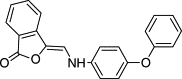 |
Virtual screen | 5 β-Lactamase | • Decreased inhibition with detergent | 23, 24 |
| • Decreased inhibition with increased enzyme concentration | ||||
| • Inhibition of diverse enzymes | ||||
| • Time-dependent inhibition | ||||
| • Particles observed by DLS | ||||
 a a
|
Virtual screen | 5 PMM/PGMb | • Decreased inhibition with detergent | 28 |
| • Decreased inhibition with increased enzyme concentration | ||||
| • Time-dependent inhibition | ||||
| • Particles observed by DLS | ||||
 |
Virtual screen | 25 Edema factor | • Decreased inhibition with increased enzyme concentration | 29 |
| • Time-dependent inhibition | ||||
 |
Cell-based HTS | NDc EF-CaM | • Inhibition of diverse enzymes | 31 |
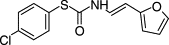 |
FRET-based HTS | 7.4 Coronavirus proteinase | • Decreased inhibition with BSA | 30 |
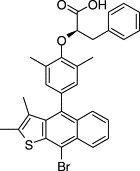 |
Phase II clinical triald | 1.6 PTP1b | • Decreased inhibition with detergent | 32 |
| • Decreased inhibition with increased enzyme concentration | ||||
| • Time-dependent inhibition |
a
Disperse Blue.
b
PMM/PGM, phosphomannomutase/phosphoglucomutase.
c
Not determined, compound observed to inhibit edema toxin-induced change in cellular morphology.
d
The compound, ertiprotafib, had been studied in phase II trials prior to evaluation for promiscuity.32