


Figure 3.
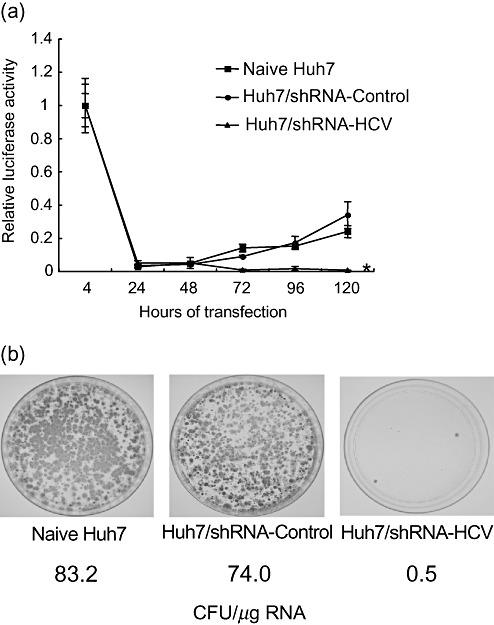
HCV replication can be inhibited by shRNA‐HCV which was stably transfected into cells. Huh7/shRNA‐HCV and Huh7/shRNA‐Control stably express shRNA‐HCV or shRNA‐Control, respectively, following retroviral transduction. (a) Transient replication assay. An HCV replicon RNA, pRep‐Fluc, was transfected into naive Huh7, Huh7/shRNA‐HCV and Huh7/shRNA‐Control cells. Luciferase activities of the cell lysates were measured serially at the times indicated, and the values were plotted as ratios relative to luciferase activities at 4 h. The luciferase activities at 4 h represent transfected replicon RNA. The data are mean ± SD. An asterisk denotes a P‐value of less than 0.001 compared with the corresponding value of the naive Huh7 cells. (b) Stable colony formation assay. The HCV replicon, pRep‐BSD, was transfected into naive Huh7, Huh7/shRNA‐HCV and Huh7/shRNA‐Control cells. The cells were cultured in the presence of blasticidin S (BSD) in the medium for ∼3 weeks, and the BSD‐resistant colonies were counted. These assays were repeated twice. The colony‐forming units per microgram RNA (CFU/μg RNA) are shown at the bottom.