


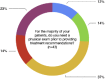
Table 2.
Role of in-person physical exam for radiation treatment planning during consultation
| Scenario and disease site represented | Provider count | Example comments | |
|---|---|---|---|
 |
 Physical examination by radiation oncologist is preferred Physical examination by radiation oncologist is preferred
|
11 3 6 1 |
“For […] neurological symptoms that cannot be localized to a single source, we cannot wait until simulation to do the physical exam.” “Consider prioritizing … for in-person visit [if there is] no clear radiographic target…” “If they have some active neurologic symptoms, ie, ataxia, double vision, that’s just hard to evaluate by video. Then I would want to do a full exam … getting a baseline.” “It’s important to assess response to treatment and keep an eye on their skin.” “We have an MRI scan and other people's exams, but designing radiation for people sometimes requires your own exam.” “It can be difficult to see the extent of the tumor, which definitely informs stage of cancer and treatment approach.” |
 Physical examination from other providers can be used Physical examination from other providers can be used
|
3 1 2 |
“For patients with T1 laryngeal cancer, it is routine to do a scope exam. Most patients have had a scope exam done by a referring surgeon with photos taken.” “The primary team can give real-time and reliable physical exam findings. [It may be] harder to evaluate in the outpatient setting.” “Patients have talked to the skin doctors, who have taken multiple photographs. They’ve already communicated with me. What I will do will not be dependent on my own physical examination. It’s helpful but not critical.” “Photos from dermatology are likely sufficient.” |
|
 Visually inspecting patients through video suffices Visually inspecting patients through video suffices
|
8 5 1 |
“[Radiation] treatment is almost always adjuvant, so it can be helpful to verify the healing process to decide on positioning for simulation (prone vs. supine).” “Visually inspect ROM … [and] infections [to decide] whether or not to proceed with treatment” “Almost everything can be captured through imaging, vital signs, and functional tests. The physical exam very rarely dictates management.” “Everything is external, so [disease can be evaluated through video].” |
|
 Physical examination can be deferred until day of treatment Physical examination can be deferred until day of treatment
|
4 |
“I could conduct the consultation because they [treatment recommendations] are primarily based on pathology and other aspects of the patient’s disease.” “A lot of the GYN treatments may be intravaginally only; you’d have to measure the vaginal width and length for an appropriate vaginal cylinder.” |
|
 Mostly relying on updated and good quality imaging Mostly relying on updated and good quality imaging
|
12 3 2 |
“Even for in-person visits, treatment planning relies mostly on imaging and relevant labs (PSA level, etc). PE is almost irrelevant, even though it's technically used for clinical staging.” “Head and neck cancer patients typically get more imaging done (CT, PET, and MRI) than other types of cancers.” |