


Figure 1. Fitness landscape of tRNA synthetase production shows growth optimization near a fitness cliff.
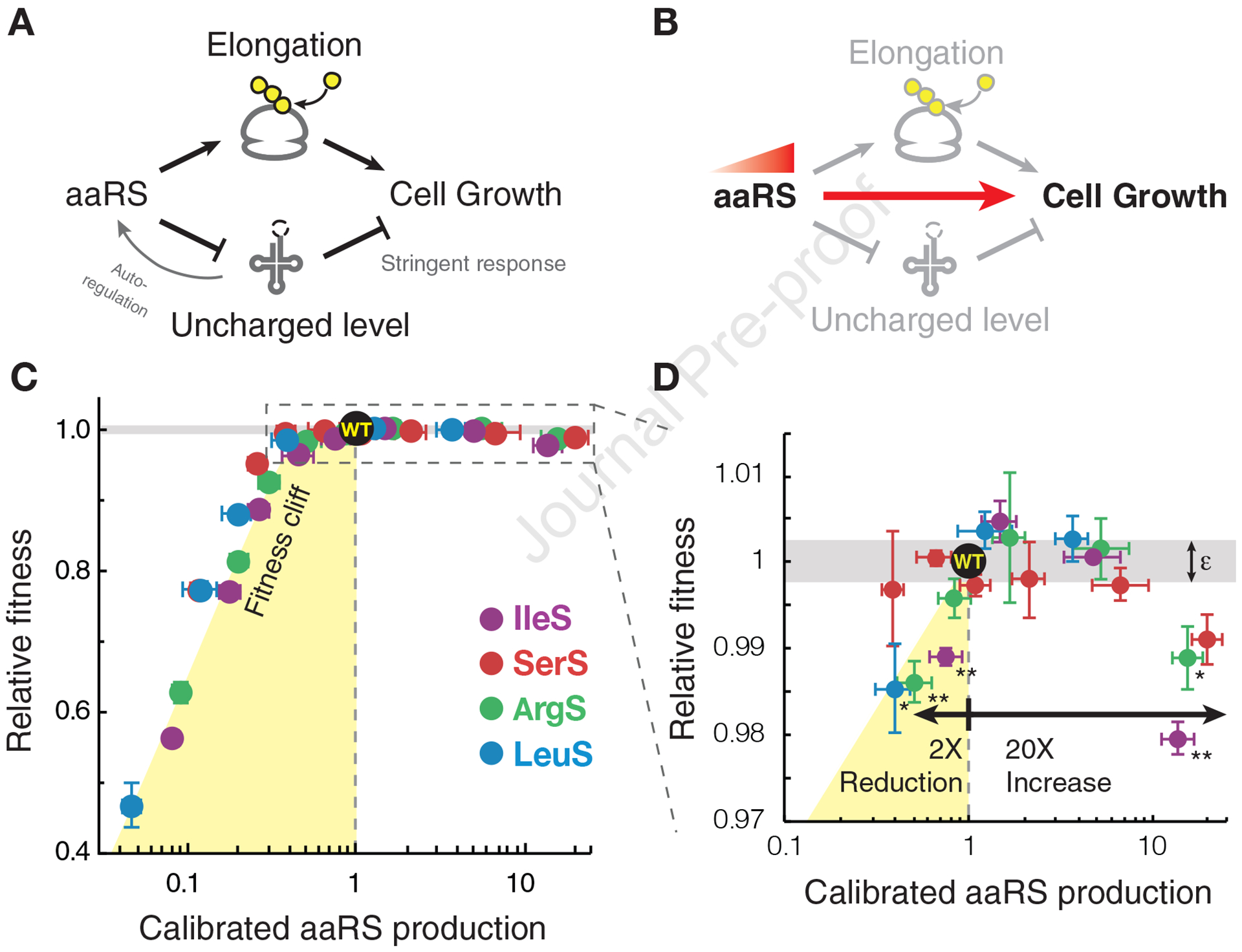
(A) Model describing the dual roles of aminoacyl-tRNA synthetase (aaRS) concentrations and their relation to the cellular growth rate (black lines). The production of aaRS is subject to negative feedback regulation by uncharged tRNAs in Bacillus subtilis (grey line). (B) Fitness landscape defined as the effective relationship between aaRS production and exponential-phase population growth rate. To measure the fitness landscape, we removed the negative feedback regulation to allow direct control of aaRS production. (C-D) Empirical fitness landscape of aaRS production. For each aaRS, gene expression is tuned by IPTG and the effective protein production is calibrated to its native levels using a method based on ribosome profiling (STAR Methods). Relative fitness is defined as the relative growth rate compared to barcoded control strains in pooled competition experiments. Yellow shaded regions indicate the approximate location of the fitness cliff. Data near wildtype fitness levels (dashed box) are depicted in (D). Error bars indicate standard error of fitness measurements for individually barcoded, biological replicates. Grey area indicates experimental uncertainty in fitness values relative to wildtype (ε=0.5%). Asterisks indicate p-value <0.05 (one asterisk) and <0.01 (two asterisks) from two-sample one-tailed Student’s t test comparing barcoded replicates between control and aaRS induction experiment. See also Figure S1.