


Figure 2. aaRS overproduction reduces uncharged tRNA levels.
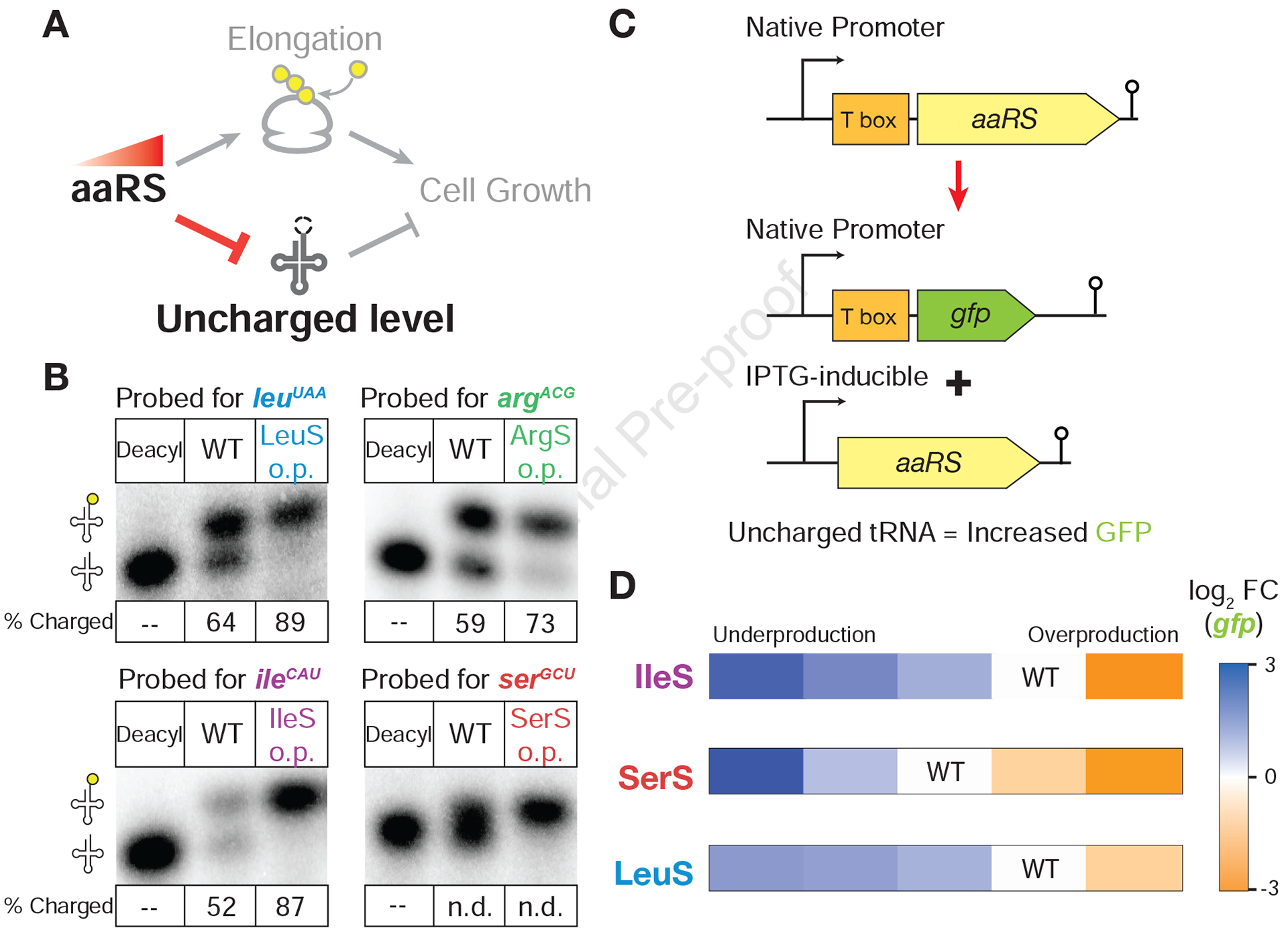
(A) Simplified relationship between aaRS production and uncharged tRNA levels. In practice, overproduction of aaRS may not reduce uncharged tRNA levels if there is already excess charging capacity at native levels of aaRS production. (B) Representative northern blots to determine tRNA charging levels in wildtype and aaRS overproduction strains. A control sample of deacylated tRNA was used to determine location of uncharged tRNAs. The middle lane of each blot contains tRNA extracted from wildtype cells (strain 168), and the final lane (o.p.) contains tRNA from aaRS induction strains with 500 μM IPTG (3.7x, 16x, 14x, and 20x overproduction for LeuS, ArgA, IleS, and SerS, respectively). Fraction of charged tRNA was calculated as the ratio between the lower band and the sum of the upper and lower band. Due to a lack of sufficient separation of aminoacylated serine tRNA, quantification was not determined (n.d.). (C) Schematic of reporter used to measure changes in uncharged tRNA levels. The native copy of the aaRS gene was replaced with a gfp gene and moved under the control of an IPTG-inducible promoter (pSpankHy) at the amyE locus in the genome. (D) T box reporter activity over range of aaRS production. For each inducible aaRS strain, the change in uncharged tRNA levels was reported by the fold change (FC) of gfp compared to induction conditions with near native aaRS production (indicated). Induction conditions with both under and over native production was tested and gfp mRNA measured by qRT-PCR. The native argS locus does not contain a T box and therefore was not tested in this assay. See also Figure S2.