



Abstract
The sustainability of rural sanitation includes the long-term welfare of both rural and urban societies. As a commonly used rural sanitation technology, operation of intermittent sand filters (ISF) is impacted by biofilm clogging inside the ISF. In this study ISF performance is studied at low hydraulic loading rates (HLR) to explore the interaction between biofilm growth and wastewater treatment efficiency. CW2D/HYDRUS, a simulation model which does not include media hydraulic property changes caused by biofilm growth, is utilized as a numerical control to contrast the effects of biofilm growth inside an experimental ISF. A paired experiment with simulation demonstrate that biofilm clogging comprised dominantly of heterotrophs occurred in the top layers of the ISF. Lowered HLR slows clogging development but not final clogging extent. The biofilm clogging development zone offers adequate removal of applied biodegradable COD and NH4+ − N. However, the spatial distribution of heterotrophs and biodegradable COD does not match the denitrification requirement of the resulting NO3− − N. A simultaneous nitrification and denitrification (SND) potential is manifested in the clogging development zone, but lowered HLR reduces media moisture level to a less favorable level for denitrification. Furthermore, slowed water movement under lower HLR aggravates the accumulation of NO3− − N, which can potentially result in counterproductive salt accumulation. Since biofilm growth is a natural and self-adaptive response to wastewater application, this study suggests accepting limited, managed biofilm growth and clogging in ISFs. In addition, this study calls for further research to manage biofilm growth and clogging for long-term ISF sustainability.
Keywords: Biofilm, Clogging, CW2D, HYDRUS, Intermittent sand filters (ISF), Modelling
Graphical abstract

1. Introduction
Soil-based onsite wastewater treatment systems (OWTS) have a wide application in rural areas of the world due to their relatively low capital investment and energy input (Jantrania and Gross, 2006; Murphy et al., 2020). However, OWTS system overload has been recognized as a significant nonpoint pollution source that can lead to public health risk (Guyader et al., 2018). Despite the long-term social and economic imbalance between urban and rural regions, ignoring rural sanitation needs will only harm urban areas in need of rural inputs (Ji et al., 2018). Furthermore, access to sanitation has been recognized as a human right by the United Nations (G.A., 2010), and later placed on an equal footing with safe drinking water (G.A., 2015). The recent outbreak of viral pneumonia (COVID-19) further highlights the need for safe disposal of household wastewater from both urban and rural areas (Yeo et al., 2020). Consequently, the on-going global campaign for rural revitalization demands a more targeted focus on rural sanitation facilities, specifically their economic and environmental sustainability (Dickin et al., 2018; Xu et al., 2019).
Intermittent sand filters (ISFs), as a common type of OWTS, are capable of alternating soil redox potentials to facilitate both aerobic and anoxic reactions (Jantrania and Gross, 2006). The rhythmic phases of “flood” and “drain” act as a passive pump to expel and draw air into the drain field. As a consequence, system oxygen supply and consumption for biological processes essential for wastewater treatment are substantially improved (Zhi and Ji, 2014; Egea-Corbacho et al., 2019; Sabogal-Paz et al., 2020).
However, like other porous media-based wastewater treatment processes, system clogging is a major limitation for ISF operation (de Matos et al., 2018). The two major factors that cause clogging in an ISF are suspended solids carried with the wastewater and biofilm generated within the ISF. While suspended soils can be controlled by engineering methods such as pre-sedimentation and coarse filtration (de Matos et al., 2018), biofilm growth is inevitable as the driving force in mass recycle and energy flow in an ISF wastewater treatment ecosystem (Ahmad and Husain, 2017). In many biofilm based wastewater treatment systems, substrate diffusion and bacterial stratification within the biofilm can result in different organic carbon and nitrogen usage efficiencies that are essential for effective system performance (Henze et al., 2008; Pan et al., 2019). Thus, the traditional negative viewpoint toward biofilm clogging should be re-evaluated in terms of long-term ISF sustainability.
Achieving ISF sustainability requires balancing the pros and cons of biofilm growth inside the ISF. Since biological clogging is directly related to both hydraulic and organic loads to the system (Leverenz et al., 2009), lowering the hydraulic loading rate (HLR) or resting the system is normally considered an effective means to limit biological clogging (de Matos et al., 2018). In addition, low HLR have a better retention of virus than higher HLR (Leverenz et al., 2009). Therefore, it is worthwhile to explore the lower HLR range for ISF sustainability in terms of biological clogging development and wastewater treatment efficiencies. To this end, the performance of pilot ISFs in terms of wastewater treatment efficiencies and bioclogging (hereafter referred to as clogging) are evaluated under low HLR levels. Hydraulically calibrated CW2D/HYDRUS models with no mechanistic clogging algorithms are used as a numerical control to contrast the effect of biofilm growth inside an ISF. In addition, the model is used to explore interactions between clogging development and wastewater treatment that cannot be monitored easily by experimental methods. It is necessary to highlight that the ultimate purpose of this study is to call for research on advanced strategies to manage the positive and negative aspects of biofilm clogging for ISF sustainability.
2. Materials and methods
2.1. Pilot ISF experiment
Wastewater (influent) was drawn daily from a local wastewater retention pond that serves approximately 180 suburban residences in the city of Wuhan, in the province of Hubei, China (E113°50′37.56″, N30°30′21.04″). After sedimentation and coarse filtration, the wastewater was evenly distributed into the top of a pilot ISF experiment using a nozzle sprayer pressurized by a timer-controlled peristaltic pump. Leachate effluent was collected from the bottom. A schematic of the pilot ISF is illustrated in Fig. S1. The fill media is local quartz sand with a porosity of 39% and an average grain size of 1.2 mm.
The quartz sand was first washed and then aged inside the ISF with tap water for approximately 2 months before the experiment. The ISFs were then charged using three doses per day (8 am–9 am, 11 am–12 pm, 7 pm–8 pm) to mimic daily wastewater flows from rural villages. A total of three pilot ISFs were operated in parallel with each ISF receiving a unique hourly hydraulic loading rate (HLR) equivalent to 0.02, 0.05, and 0.1 times the hourly saturated hydraulic conductivity of the quartz sand (Ks = 27.6 cm/h), namely 0.02Ks, 0.05Ks and 0.1Ks. The theoretical daily HLR (0.016, 0.041, 0.083 m/d) are lower than the suggested daily HLR range for ISF which is 0.10–0.24 m/d (US EPA, 1999).
During the experiment, the influent and effluent COD, NH4 + − N, and NO3 − − N were measured daily per standard methods (APHA, 1998). Water phase COD, NH4 + − N, and NO3 − − N profiles along the ISF column were regularly sampled during the experiment for 0.1Ks ISF, except for the 0.02Ks and 0.05Ks since the ISF column was not sufficiently moisturized for water sampling. Effluent COD was fractionized into soluble biologically inert COD (CI), soluble readily biodegradable COD (CR) and soluble slowly biodegradable COD (CS) per Melcer et al. (2003). At the end of the experiment, quartz sand media within the ISF column was analyzed for bacterial composition and biomass quantity. Bacterial composition of the sand media was analyzed for heterotrophic and nitrifying bacteria. Heterotrophic bacteria (X H) were enumerated by the plate counting procedure (Verhagen and Laanbroek, 1991), while ammonium oxidizing bacteria (X AOB) and nitrite oxidizing bacteria (X NOB) were enumerated by the most probable number (MPN) procedure (Donaldson and Henderson, 1989; Verhagen and Laanbroek, 1991). Biomass grown on the sand media was quantified by the ignition loss method of Rodgers et al. (2004).
2.2. Model setup
The model domain is set as a 1-meter long sand column with 10-cm diameter (Fig. S2). Wastewater is set to uniformly enter the ISF from the top boundary at prescribed intensity and time intervals. The bottom boundary is set to free drainage and the two side boundaries are set to no-flux. The CW2D module in HYDRUS (PC-Progress, Czech) is used for ISF simulation. CW2D is specially suited for constructed wetland (CW) scenarios with transient variably-saturated flows and thereby suitable for ISFs characterized by intermittent hydraulic loadings (Martí et al., 2018; Pucher et al., 2017). The variably saturated water flows in the porous medium of the ISF is described using the Richard's equation (Eq. (1)), and the soil hydraulic property is described using the single porosity van Genuchten-Mualem model (Eq. (2)).
| (1) |
| (2) |
where h is the pressure head (L); θ w is the water content (L3/L3); t is the time (T); z is the vertical coordinate (L); θ s is the saturated water content; θ r is the residual water content; α, n and m are fitting parameters unique to the porous media, which in this study is sand. K is the unsaturated hydraulic conductivity (L/T) of the porous media.
The reactive transport of the soluble components of CW2D within the ISF is described by a classic advection and diffusion equation (ADE) (Eqs. (3), (4)):
| (3) |
| (4) |
where i = 1, …, N (N is the number of components), c i is the concentration in the aqueous phase (M L −3), s i is the concentration in the solid phase (M M−1), θ is the volumetric water content (L3 L −3), ρ is the soil bulk density (M L−3), D i is the effective dispersion tensor (L2 T−1), q is the volumetric flux density (L3 L−2 T−1), S is the source-sink term (L3 L−3 T−1); c s,i is the concentration of the source-sink (M L−3), and r i is the reaction term (M L−3 T−1), ri is the reaction rate of the component which is defined by the CW2D framework.
The CW2D framework includes eight dissolved components (including three COD fractions, NH4 + − N, NO3 − − N, etc.) and three types of bacteria (X H, X AOB, X NOB) with nine major biological processes common to biological wastewater treatment under aerobic and anoxic conditions. Details of the CW2D model framework can be referenced in Langergraber and Šimůnek (2005).
Soil hydraulic parameters (α = 0.057, n = 3.19, m = 1–1/n, and K = 27.6 cm/h) for soil water movement were obtained using a laboratory soil retention curve fit by RETC (PC-Progress, Czech). The experimental measurement on influent quality and the designed HLR were used as the model input. Stoichiometric and kinetic parameters utilized default values within CW2D, as suggested by Langergraber (2017) which are also detailed in Langergraber and Šimůnek (2005).
3. Results and discussion
3.1. System performance
3.1.1. HLR influence on ISF clogging development
The influence of clogging development on ISF performance is normally reflected as surface ponding in an ISF. Typically, clogging development reduces hydraulic conductivity of the top layers to below the transient HLR of the applied wastewater which causes temporal water surface ponding (Texp or Tsim on Fig. 1 ). Temporal surface ponding often dissipates before the next hydraulic dosing. However, extended water surface ponding which does not dissipate before the next hydraulic dosing will occur if further clogging develops. Both temporal and extended surface ponding was observed under 0.05Ks and 0.1Ks ISF operation, but only temporal surface ponding was observed under 0.02Ks ISF operation.
Fig. 1.

Experimental and simulated daily ISF effluent COD (A, D, G), NH4+ − N (B, E, H), and NO3− − N (C, F, I) for the three ISF operations. ((A), (B), (C) are for the 0.02KS ISF; (D), (E), (F) are for the 0.05KS ISF; (G), (H), (I) are for the 0.1KS ISF. Initial 30-day startup period not shown for COD. Initial 10-day startup period not shown for NH4+ − N and NO3− − N. CR: readily biodegradable COD; CS: slowly biodegradable COD; CI: biologically inert COD).
Because clogging caused soil hydraulic property change is not included in the CW2D/HYDRUS model, simulations indicate delayed temporary water surface ponding in the 0.1Ks and 0.05Ks ISFs compared to field experiments. During the experiment, hydraulic flux into the ISFs was reduced by clogging development, which resulted in increased residence time and utilization of applied substrates by the bacteria in surface layers. Extended water surface ponding was observed during 0.05Ks and 0.1Ks ISF operation when the extent of surface layer clogging reached approximately 66% and 60%, respectively. The reason to see no complete clogging of the surface layer was likely caused by slowed biofilm growth inside ISFs as a result of gradually restrained substrate diffusion into the biofilm (Wanner et al., 2006) and corresponding physiological adaptation of the bacteria to restrained substrate supplies (Friedrich et al., 2015).
Depth profiles of experimental and simulated biomass quantity (Fig. 2 ) demonstrate that the clogging zone occurred in the top 5 cm which determines the hydraulic sustainability of the ISF (Leverenz et al., 2009). The three experimental ISFs had similar extents of surface layer clogging (71% for 0.02Ks ISF, 66% for 0.05Ks ISF, 60% for 0.1Ks ISF), while corresponding simulated clogging extents were 53%, 100%, and 100%. The unexpected high clogging extent during experimental 0.02Ks ISF operation was caused by the limited substrate supply to the surface layers only under this low hydraulic impact to the ISF.
Fig. 2.

Experimental (A, B, C) and simulated (D, E, F) depth profiles of biomass growth and bacterial composition at the end of the three ISF operations. ((A) and (D) are for the 0.02KS ISF; (B) and (E) are for the 0.05KS ISF; (C) and (F) are for the 0.1KS ISF.)
Overall, the comparison between simulated and experimental results indicates that clogging development at any specific location is not a linear process. Rather, biofilm clogging is an interactive process dependent upon media microbial utilization rate and the supply rate of utilizable biodegradable substances supplied by the wastewater. In other words, a low HLR can reduce clogging development speed, but will not necessarily lead to a lower extent of surface layer clogging.
3.1.2. HLR influence on ISF effluent quality
Experimental and simulated ISF effluent compositions are compared in Fig. 1. Both sets of data demonstrate that lowered HLR operation requires a longer startup time to achieve a stable effluent COD. Stabilized effluent COD indicated no impact from influent COD fluctuations as biologically inert COD (CI) gradually became the main composition of effluent COD. This outcome is mainly due to enhanced biological consumption of readily biodegradable COD (CR) and slowly biodegradable COD (CS) by the growing biofilm within the clogging development zone. At the same time, CI is continually being contributed inside the ISF by biologically inert leftovers from cell lysis. Experimental and simulated CI under 0.02Ks ISF operation is higher than under 0.05Ks and 0.1Ks ISF flow condition. Higher CI under 0.02Ks ISF operation is the result of increased hydraulic residence time (HRT) of applied wastewater within the ISF that exerts a hydraulic accumulative effect on CI. In fact, effluent from 0.02Ks and 0.05Ks ISFs have to be accumulated for 5 days before there is enough substrate for chemical analysis.
Both the experiment and the simulation demonstrate that there is negligible effluent NH4 + − N for the three ISF flow rates tested, but effluent NO3 − − N is maintained at notable levels. Effluent NO3 − − N indicates effective nitrification of applied NH4 + − N and lack of denitrification inside the ISF. This outcome is reasonable since air suction by water infiltration in an ISF can normally create aeration sufficient to meet the nitrification requirement of applied NH4 + − N (Healy et al., 2007; Pan et al., 2016), but denitrification of the formed NO3 − − N is often limited by lack of an available carbon source (Healy et al., 2007; Pan et al., 2016; Petitjean et al., 2016). By referring to experimental and simulated effluent COD profiles, it is obvious that biodegradable organic carbon (CS and CR) are not sufficiently available for denitrification.
Furthermore, experimental effluent NO3 − − N gradually decreases over time to levels below influent NH4 + − N levels, while simulated effluent NO3 − − N fluctuates at levels higher than influent NH4 + − N. This difference between experimental versus simulated data is ascribed to a more intense reducing environment inside experimental ISFs caused by biofilm growth (i.e., thicker biofilm conducive for denitrification). Because of model limitations, simulated ISF operation does not include biofilm-specific denitrification of formed NO3 − − N. Even so, experimental and simulated effluent NO3 − − N levels are negatively related to HLR increase. Stated differently, increasing HLR enhances the supply of organic carbon for denitrification as well as enhanced biofilm growth, but decreasing HLR leads to decreased soil (media) moisture content inside the ISF that favors nitrification over denitrification. Furthermore, decreasing the HLR in an ISF increases the hydraulic retention time (HRT) of applied wastewater inside the ISF which consequently enhances the hydraulic accumulative effect on NO3 − − N and thus delivers an increased effluent NO3 − − N.
Overall, the comparison between experimental and simulated effluent quality demonstrates that effluent quality is influenced by the interplay of soil (media) biofilm development, wastewater strength, and HLR that will impact water movement inside the ISF.
3.1.3. Interactive profiles between ISF biofilm and wastewater
The interplay of media biofilm development and applied wastewater are further illustrated by comparing the depth profiles of clogging extent and biofilm microbial composition (Fig. 2) with soil (media) water quality profiles (Fig. 3 ). Both the experiment and simulation demonstrate that heterotrophs dominate the clogging zone, and nitrifiers flourish at the lower end of the clogging zone at quantities significantly lower than heterotrophs. The presence of nitrifiers in the clogging development zone explains the occurrence of nitrification in that zone and confirm that heterotrophs are the major force for organic removal as well as biofilm formation (Bassin et al., 2012). Data further confirm that heterotrophs can outcompete nitrifiers by functioning at a higher oxygen utilization efficiency when organic substrates are sufficient (Strauss and Lamberti, 2000; Zhang et al., 2015). However, the observed spatial distribution of heterotrophs and nitrifiers does not match the expected denitrification requirement, which will be explained below.
Fig. 3.

Experimental and simulated depth profiles of COD (A, D, G), NH4+ − N (B, E, H), and NO3− − N (C, F, I) on the last day of three ISF operations. ((A), (B), (C) are for the 0.02KS ISF; (D), (E), (F) are for the 0.05KS ISF; (G), (H), (I) are for the 0.1KS ISF.CR: readily biodegradable COD; CS: slowly biodegradable COD; CI: biologically inert COD. No experimental profile data is available for 0.02Ks and 0.05Ks ISF due to insufficient water volume to sample experimental columns).
Experimental and simulated results indicate that during 0.1Ks ISF operation, CR was depleted within the clogging zone, but CS was carried to deeper layers. Media water NH4 + − N was sufficiently removed within the clogging zone, which matches expected NO3 − − N generation (Fig. 3). However, media water NO3 − − N continued to increase below the clogging zone with no evidence of NH4 + − N available for nitrification (Fig. 3), indicating that a hydraulic accumulative effect was also manifested during 0.1Ks ISF operation.
Furthermore, experimental NO3 − − N leftover from the clogging zone is lower than influent NH4 + − N, but the simulated NO3 − − N leftovers from the clogging zone does not differ noticeably from influent NH4 + − N (Fig. 3). This comparison suggests a simultaneous nitrification and denitrification (SND) potential within the biofilm, which further highlights the beneficial role of biofilm growth in an ISF. Numerous studies have reported that SND can occur in biofilm systems due to biofilm stratification as well as diffusion differences between electron donors and acceptors (Nancharaiah and Kiran Kumar Reddy, 2018; Pan et al., 2019; Liu et al., 2020). This result is reasonable since aeration efficiencies in CW are normally low (Rous et al., 2019) and thus DO deficiencies created inside the biofilm can be conducive to the occurrence of SND (Yan et al., 2019).
Because insufficient enough water was available for sampling along the depth of 0.02Ks and 0.05Ks ISFs, only simulated spatio-temporal profiles of media microbial composition and media water quality between the three ISFs were compared. Decreasing HLR leads to slower biofilm development in the surface layer which is dominated by heterotrophs, and also allows nitrifiers to grow closer to the surface layer (Fig. 4 ). This is because lower HLR brings less organic carbon to the surface layer and thus less competitive pressure on nitrifiers. Slowed biofilm growth subsequently results in a longer system startup characterized by CR leaching to deeper layers (Fig. 5 ). CS hydrolysis can be adequately carried out within a limited distance from the surface, but lower HLR results in a shallower depth due to lowered ISF organic load. Overall, media microbial and COD profiles indicate that lowering HLR will require a longer system startup period.
Fig. 4.

Simulated spatio-temporal media microbial profiles of the three ISF operations. ((A), (B), (C) are for the 0.02KS ISF; (D), (E), (F) are for the 0.05KS ISF; (G), (H), (I) are for the 0.1KS ISF.)
Fig. 5.

Simulated spatio-temporal COD profiles of the three ISF operations. ((A), (B), (C) are for the 0.02KS ISF; (D), (E), (F) are for the 0.05KS ISF; (G), (H), (I) are for the 0.1KS ISF. CR: readily biodegradable COD; CS: slowly biodegradable COD; CI: biologically inert COD).
Media water NH4 + − N is adequately nitrified soon after entering the ISF, but at a higher HLR there is a slightly higher, although environmentally negligible, media water NH4 + − N plume that enters the drain field (Fig. 6 ). This is because higher HLR results in a higher biofilm growth extent which in turn proportionally leads to higher NH4 + − N release due to cell lysis. In contrast, lowering HLR leads to higher ISF media water NO3 − − N due to the increased hydraulic accumulative effect (Fig. 6). However, under all three HLR levels, media water NO3 − − N decreases as biofilm develops due to enhanced biological utilization of NO3 − − N as dictated by the CW2D simulation. Above results again suggest the potential of simultaneous nitrification and denitrification (SND) inside the biofilm. However, because lowering HLR leads to reduced media moisture level (Fig. 6), nitrification but not SND would be favored.
Fig. 6.

Simulated spatio-temporal profiles of NH4+ − N (A, D, G), NO3− − N (B, E, H) and water content (C, F, I) of the three ISF operations. ((A), (B), (C) are for the 0.02KS ISF; (D), (E), (F) are for the 0.05KS ISF; (G), (H), (I) are for the 0.1KS ISF.)
Furthermore, the accumulation of media water NO3 − − N suggests the potential for salt accumulation, although no direct evidence can be shown that salt accumulation in ISF is harmful or counterproductive, nor whether it may only be a temporary condition. Since irrigation normally aims to conserve water, the irrigation leaching depth required to alleviate soil salt accumulation is often inadequately considered (Duan and Fedler, 2013). In this study, media water content levels are low in all three ISFs (Fig. 6), and in fact were too low for media water sampling under 0.02Ks and 0.05Ks ISF operation. Therefore, ISF sustainability will be significantly discouraged under low HLR levels if they cannot meet the leaching requirement for soil salt management in the ISF or wastewater disposal drain field.
Overall, both experimental and simulated results indicate that wastewater application promoted biofilm growth in the upper layers of an ISF, and that a self-adaptive clogging development zone in turn carries the major burden for organic carbon and NH4 + − N removal. However, the spatial distribution of heterotrophs and biodegradable carbon fails to match the denitrifying requirement of formed NO3 − − N resulting in NO3 − − N leaching issue. In addition, lowered HLR will require a longer time system startup period and intensify ISF NO3 − − N accumulation.
3.2. Model implications for ISF operation
The simulated impact of influent COD and HLR on achievable maximum clogging extent are illustrated in Fig. 7(A). Here it can be seen that increasing influent COD or HLR enhance the extent of surface layer clogging which conforms to common ISF operation experience (Leverenz et al., 2009; Grace et al., 2016), as non-complete clogging scenarios demand an extremely low HLR and low influent COD levels. The required times to reach the maximum clogging extent with respect to influent COD and HLR levels are illustrated in Fig. 7(B). It is shown here that infinite hydraulic operation is not a realistic pursuit for ISF sustainability since low HLR operation defeats the engineered purpose of the ISF.
Fig. 7.
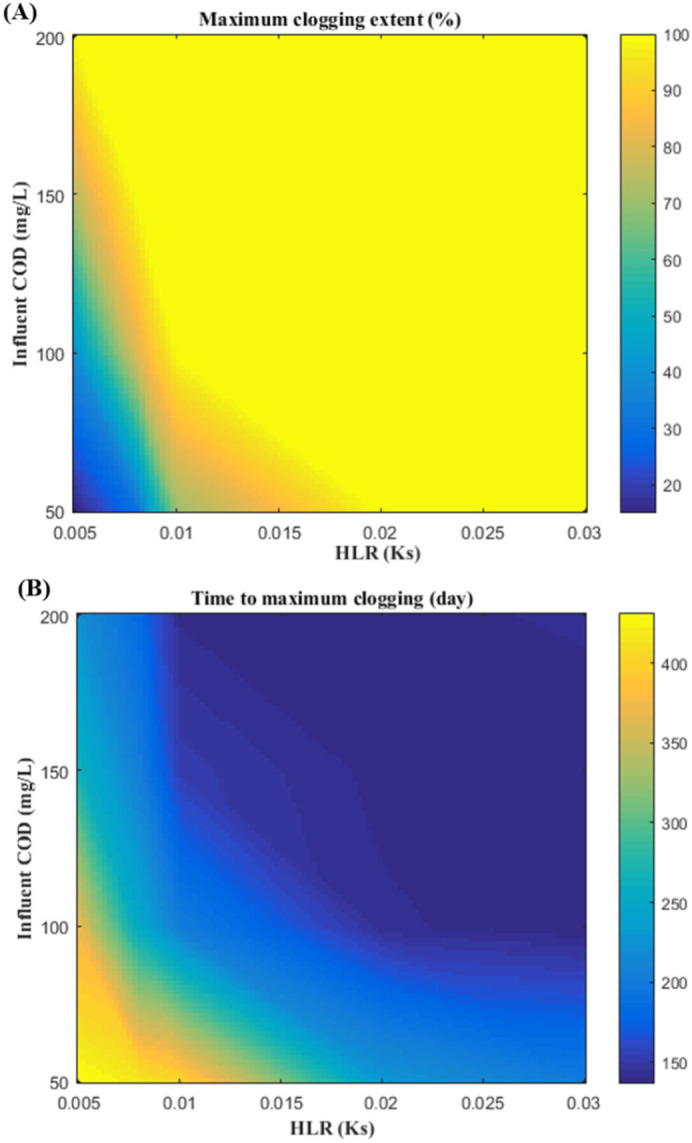
The maximum clogging extent (%) and the required time (day) to reach maximum clogging under different HLR and influent COD levels.
Using a normal strength domestic wastewater and commonly adopted HLR, complete hydraulic clogging is inevitable for an ISF. In order to alleviate clogging development in ISF applications, pre-treatments that reduce influent organic strength are highly recommended (Leverenz et al., 2009; US EPA, 1999), however the method depends on resources available. For example, use of an ISF in conjunction with a retention pond might be a solution if high inputs from energy and technology are cost prohibition to owners (Li et al., 2019; Schönach et al., 2018).
Although this study only demonstrates ISF effluent NO3 − − N under low HLR levels, the impact of high HLR on effluent NO3 − − N has already been demonstrated by Magalhães et al. (2016). Their ISF effluent NO3 − − N was also shown to be negatively correlated with HLR as HLR increased from 0.1 m/d to 0.8 m/d, similar to the trend observed in this study which was conducted with HLR levels below 0.1 m/d. In their study, once HLR was above 0.5 m/d the applied NH4 + − N was not adequately nitrified due to reduced HRT and reduced oxygen replenishment caused by reduced intervals between wastewater applications. Therefore, combing the observations of this study and the work of Magalhães et al. (2016), it is obvious that an optimum HLR range exists under which pros and cons incurred by HLR adjustment (e.g. effluent quality, system footprint, clogging extent) can be balanced. Although clogging is accepted under the US EPA recommended HLR range (0.1– 0.2 m/d) for ISF, engineering design and management options are available such as using sequential operation of multiple filter cells to make use of growth and decay, by scraping and replacing the surface clogging layer, or even by injecting chemicals for biofilm attenuation (Leverenz et al., 2009; de Matos et al., 2018; Yu et al., 2010). Therefore, it is not necessary to exclusively prohibit biofilm growth clogging as undesirable for ISF operation, rather to seek advanced control and management strategies that balance the pros and cons of biofilm growth for ISF sustainability.
4. Conclusions
Biofilm growth inside an ISF is a natural biological adaptive strategy to respond wastewater applications. Although excessive biofilm growth causes clogging unfavorable to hydraulic sustainability in an ISF, clogging is an acceptable tradeoff that helps achieve adequate wastewater treatment efficiencies. The clogging development zone as described in this paper, is shown to carry the major burden of biodegradable COD and NH4 + − N removal. In addition, biofilm clogging development favors the occurrence of SND.
Lowering HLR, on the other hand, although it may extend the hydraulic duration and performance of ISF operation, will not reduce the extent of surface layer clogging. Rather, lowering HLR will require a longer system startup time and provide lower denitrifcation potential due to lowered media moisture levels. Furthermore, lowered media moisture levels are unfavorable for SND occurrence and further increase the hydraulic accumulation of NO3 − − N inside the ISF. Based on the experimental observations and simulation results, ISF sustainability should not be solely focused on hydraulic sustainability, but to achieve an optimal system performance that jointly considers effluent quality, system footprint, clogging extent, system duration, etc. based on adequate understanding on the interplay of biofilm development, wastewater strength, and HLR.
Overall, this study recommends acceptance of biofilm clogging in an ISF by highlighting the merit of managed biofilm growth. Authors call for continued research on advanced strategies to manage the positive and negative aspects of biofilm clogging for ISF sustainability.
Credit author statement
Siqi Chen executed all the data treatment from simulation and carried lab work.
Zhongbing Chen contributed in field work and helped in simulation.
Mark Dougherty contributed in manuscript draft and proof read.
Xingtao Zuo contributed in field work.
Jiajie He is responsible for the entire project as the PI.
Declaration of competing interest
The authors declare that they have no known competing financial interests or personal relationships that could have appeared to influence the work reported in this paper.
Acknowledgments
This research is supported by the CRSRI Open Research Program (Program SN: CKWV2016397/KY). We also want to express our thanks to the anonymous reviewers for their precious time and valuable comments on our manuscript.
Editor: Jan Vymazal
Footnotes
Supplementary data to this article can be found online at https://doi.org/10.1016/j.scitotenv.2020.142477.
Appendix A. Supplementary data
Supplementary figures
References
- Ahmad I., Husain F.M. Wiley-Blackwell; USA: 2017. Biofilms in Plant and Soil Health. [Google Scholar]
- American Public Health Association (APHA) American Public Health Association (APHA); Washington: 1998. Standard Methods for the Examination of Water and Wastewater. [Google Scholar]
- Bassin J.P., Kleerebezem R., Rosado A.S., van Loosdrecht M.C.M., Dezotti M. Effect of different operational conditions on biofilm development, nitrification, and nitrifying microbial population in moving-bed biofilm reactors. Environ. Sci. Technol. 2012;46:1546–1555. doi: 10.1021/es203356z. [DOI] [PubMed] [Google Scholar]
- de Matos M.P., von Sperling M., de Matos A.T. Clogging in horizontal subsurface flow constructed wetlands: influencing factors, research methods and remediation techniques. Rev. Environ. Sci. Bio. 2018;17:87–107. doi: 10.1007/s11157-018-9458-1. [DOI] [Google Scholar]
- Dickin S., Dagerskog L., Jiménez A., Andersson K., Savadogo K. Understanding sustained use of ecological sanitation in rural Burkina Faso. Sci. Total Environ. 2018;613-614:140–148. doi: 10.1016/j.scitotenv.2017.08.251. [DOI] [PubMed] [Google Scholar]
- Donaldson J.M., Henderson G.S. A dilute medium to determine population size of ammonium oxidizers in forest soils. Soil Sci. Soc. Am. J. 1989;53:1608–1611. doi: 10.2136/sssaj1989.03615995005300050056x. [DOI] [Google Scholar]
- Duan R., Fedler C.B. Salt management for sustainable degraded water land application under changing climatic conditions. Environ. Sci. Technol. 2013;47(18):10113. doi: 10.1021/es403619m. [DOI] [PubMed] [Google Scholar]
- Egea-Corbacho A., Gutiérrez S., Quiroga J.M. Removal of emerging contaminants from wastewater through pilot plants using intermittent sand/coke filters for its subsequent reuse. Sci. Total Environ. 2019;646:1232–1240. doi: 10.1016/j.scitotenv.2018.07.399. [DOI] [PubMed] [Google Scholar]
- Friedrich M., Takács I., Tränckner J. Physiological adaptation of growth kinetics in activated sludge. Water Res. 2015;85:22–30. doi: 10.1016/j.watres.2015.08.010. [DOI] [PubMed] [Google Scholar]
- General Assembly of the United Nations . 2010. The Human Right to Water and Sanitation. Aug. 3. (RES. 64/292) [Google Scholar]
- General Assembly of the United Nations . 2015. The Human Rights to Safe Drinking Water and Sanitation. Dec. 17. (Res. 70/169) [Google Scholar]
- Grace M.A., Healy M.G., Clifford E. Performance and surface clogging in intermittently loaded and slow sand filters containing novel media. J. Environ. Manag. 2016;180:102–110. doi: 10.1016/j.jenvman.2016.05.018. [DOI] [PubMed] [Google Scholar]
- Guyader M.E., Warren L.D., Green E., Bertram R., Proudian A.P., Kiesling R.L., Schoenfus H.L., Higgins C.P. Trace organic contaminant (TOrC) mixtures in Minnesota littoral zones: effects of on-site wastewater treatment system (OWTS) proximity and biological impact. Sci. Total Environ. 2018;626:1157–1166. doi: 10.1016/j.scitotenv.2018.01.123. [DOI] [PubMed] [Google Scholar]
- Healy M.G., Rodgers M., Mulqueen J. Treatment of dairy wastewater using constructed wetlands and intermittent sand filters. Bioresour. Technol. 2007;98:2268–2281. doi: 10.1016/j.biortech.2006.07.036. [DOI] [PubMed] [Google Scholar]
- Henze M., van loosdrecht M.C.M., Ekama G.A., Brdjianovic D. IWA Publishing; UK: 2008. Biological Wastewater Treatment: Principles, Modelling and Design. [DOI] [Google Scholar]
- Jantrania A.R., Gross M.A. CRC Press; USA: 2006. Advanced Onsite Wastewater Systems Technologies. [Google Scholar]
- Ji X., Ren J.Y., Ulgiati S. Towards urban-rural sustainable cooperation: models and policy implication. J. Clean. Prod. 2018;213:892–898. doi: 10.1016/j.jclepro.2018.12.097. [DOI] [Google Scholar]
- Langergraber G. Applying process-based models for subsurface flow treatment wetlands: recent developments and challenges. Water. 2017;9:5. doi: 10.3390/w9010005. [DOI] [Google Scholar]
- Langergraber G., Šimůnek J. Modeling variably saturated water flow and multicomponent reactive transport in constructed wetlands. Vadose Zone J. 2005;4:924. doi: 10.2136/vzj2004.0166. [DOI] [Google Scholar]
- Leverenz H.L., Tchobanoglous G., Darby J.L. Clogging in intermittently dosed sand filters used for wastewater treatment. Water Res. 2009;43(3):695–705. doi: 10.1016/j.watres.2008.10.054. [DOI] [PubMed] [Google Scholar]
- Li D., Zheng B., Chu Z., Liu Y., Huang M. Seasonal variations of performance and operation in field-scale storing multipond constructed wetlands for nonpoint source pollution mitigation in a plateau lake basin. Bioresour. Technol. 2019;280:295–302. doi: 10.1016/j.biortech.2019.01.116. [DOI] [PubMed] [Google Scholar]
- Liu T., He X., Jia G., Xu J., Quan X., You S. Simultaneous nitrification and denitrification process using novel surface-modified suspended carriers for the treatment of real domestic wastewater. Chemosphere. 2020;247:125831. doi: 10.1016/j.chemosphere.2020.125831. [DOI] [PubMed] [Google Scholar]
- Magalhães T.M., Tonetti A.L., Bueno D.A.C., Tonon D. Nitrification process modeling in intermittent sand filter applied for wastewater treatment. Ecol. Eng. 2016;93:18–23. doi: 10.1016/j.ecoleng.2016.05.003. [DOI] [Google Scholar]
- Martí A.C., Pucher B., Hernández-Crespo C., Monerris M.M., Langergraber G. Numerical simulation of vertical flow wetlands with special emphasis on treatment performance during winter. Water Sci. Technol. 2018;78:2019–2026. doi: 10.2166/wst.2018.479. [DOI] [PubMed] [Google Scholar]
- Melcer H., Dold P.L., Jones R.M., Bye C.M., Takacs I., Stensel H.D., Wilson A.W., Sun P., Bury S. Water Environ. Res. Foundation (WERF); Alexandria, VA: 2003. Methods for wastewater characterization in activated sludge modelling. [Google Scholar]
- Murphy H.M., McGinnis S., Blunt R., Stokdyk J., Wu J., Cagle A., Denno D.M., Spencer S.K., Firnstahl A., Borchardt M.A. Septic systems and rainfall influence human fecal marker and indicator organism occurrence in private wells in southeastern Pennsylvania. Environ. Sci. Technol. 2020 doi: 10.1021/acs.est.9b05405. In Press. [DOI] [PubMed] [Google Scholar]
- Nancharaiah Y.V., Kiran Kumar Reddy G. Aerobic granular sludge technology: mechanisms of granulation and biotechnological applications. Bioresour. Technol. 2018;247:1128–1143. doi: 10.1016/j.biortech.2017.09.131. [DOI] [PubMed] [Google Scholar]
- Pan J., Yuan F., Yu L., Huang L., Fei H., Cheng F., Zhang Q. Performance of organics and nitrogen removal in subsurface wastewater infiltration systems by intermittent aeration and shunt distributing wastewater. Bioresour. Technol. 2016;211:774–778. doi: 10.1016/j.biortech.2016.03.133. [DOI] [PubMed] [Google Scholar]
- Pan Y., Liu Y., Peng L., Ngo H.H., Guo W., Wei W., Wang D., Ni B.J. Substrate diffusion within biofilms significantly influencing the electron competition during denitrification. Environ. Sci. Technol. 2019;53:261–269. doi: 10.1021/acs.est.8b05476. [DOI] [PubMed] [Google Scholar]
- Petitjean A., Forquet N., Boutin C. Oxygen profile and clogging in vertical flow sand filters for on-site wastewater treatment. J. Environ. Manag. 2016;170:15–20. doi: 10.1016/j.jenvman.2015.12.033. [DOI] [PubMed] [Google Scholar]
- Pucher B., Ruiz H., Paing J., Chazarenc F., Langergraber G. Using numerical simulation of a one stage vertical flow wetland to optimize the depth of a zeolite layer. Water Sci. Technol. 2017;75:650–658. doi: 10.2166/wst.2016.545. [DOI] [PubMed] [Google Scholar]
- Rodgers M., Mulqueen J., Healy M.G. Surface clogging in an intermittent stratified sand filter. Soil Sci. Soc. Am. J. 2004;68:1827. doi: 10.2136/sssaj2004.1827. [DOI] [Google Scholar]
- Rous V., Vymazal J., Hnátková T. Treatment wetlands aeration efficiency: a review. Ecol. Eng. 2019;136:62–67. doi: 10.1016/j.ecoleng.2019.06.006. [DOI] [Google Scholar]
- Sabogal-Paz L.P., Campos L.C., Bogush A., Canales M. Household slow sand filters in intermittent and continuous flows to treat water containing low mineral ion concentrations and Bisphenol A. Sci. Total Environ. 2020;702:135078. doi: 10.1016/j.scitotenv.2019.135078. [DOI] [PubMed] [Google Scholar]
- Schönach P., Nygrén N.A., Tammeorg O., Heikkinen M., Holmroos H., Massa I., Niemistö J., Tapio P., Horppila J. The past, present, and future of a lake: interdisciplinary analysis of long-term lake restoration. Environ. Sci. Pol. 2018;81:95–103. doi: 10.1016/j.envsci.2017.12.015. [DOI] [Google Scholar]
- Strauss E.A., Lamberti G.A. Regulation of nitrification in aquatic sediments by organic carbon. Limnol. Oceanogr. 2000;45(8):1854–1859. doi: 10.4319/lo.2000.45.8.1854. [DOI] [Google Scholar]
- US EPA . U. S. Environ. Prot. Agency, Off. Water, [Rep.] EPA; Washington, DC: 1999. Wastewater Technology Fact Sheet Intermittent Sand Filters. EPA 932-F-99-067. [Google Scholar]
- Verhagen F.J., Laanbroek H.J. Competition for ammonium between nitrifying and heterotrophic bacteria in dual energy-limited chemostats. Appl. Environ. Microbiol. 1991;57(11):3255–3263. doi: 10.1128/AEM.57.11.3255-3263.1991. [DOI] [PMC free article] [PubMed] [Google Scholar]
- Wanner O., Eberl H., Morgenroth E., Noguera D.R., Picioreanu C., Rittmann B.E., van Loosdrecht M.C.M. IWA Scientific and Technical Report 18. IWA Publishing; London: 2006. Mathematical modeling of biofilms. [Google Scholar]
- Xu M., Zhu S., Zhang Y., Wang H., Fan B. Spatial-temporal economic analysis of modern sustainable sanitation in rural China: resource-oriented system. J. Clean. Prod. 2019;233:340–347. doi: 10.1016/j.jclepro.2019.06.103. [DOI] [Google Scholar]
- Yan L., Liu S., Liu Q., Zhang M., Liu Y., Wen Y., Chen Z., Zhang Y., Yang Q. Improved performance of simultaneous nitrification and denitrification via nitrite in an oxygen-limited SBR by alternating the DO. Bioresour. Technol. 2019;275:153–162. doi: 10.1016/j.biortech.2018.12.054. [DOI] [PubMed] [Google Scholar]
- Yeo C., Kaushal S., Yeo D. Enteric involvement of coronaviruses: is faecal-oral transmission of SARS-CoV-2 possible? Lancet Gastroenterol. Hepatol. 2020;5(4):335–337. doi: 10.1016/S2468-1253(20)30048-0. [DOI] [PMC free article] [PubMed] [Google Scholar]
- Yu Y., Gong S., Xu D., Wang J., Ma X. Effects of Treflan injection on winter wheat growth and root clogging of subsurface drippers. Agr. Water Manage. 2010;97(5):723–730. doi: 10.1016/j.agwat.2010.01.003. [DOI] [Google Scholar]
- Zhang X., Zhang J., Hu Z., Xie H., Wei D., Li W. Effect of influent COD/N ratio on performance and N2O emission of partial nitrification treating high-strength nitrogen wastewater. RSC Adv. 2015;5:61345–61353. doi: 10.1039/C5RA08364H. [DOI] [Google Scholar]
- Zhi W., Ji G. Quantitative response relationships between nitrogen transformation rates and nitrogen functional genes in a tidal flow constructed wetland under C/N ratio constraints. Water Res. 2014;64:32–41. doi: 10.1016/j.watres.2014.06.035. [DOI] [PubMed] [Google Scholar]
Associated Data
This section collects any data citations, data availability statements, or supplementary materials included in this article.
Supplementary Materials
Supplementary figures