



Abstract
Background and Purpose:
Cardiovascular risk factors, which are overall more prevalent in men, are considered the major risk factors for strokes amongst young adults. However, recent European data found the incidence of strokes to be higher in young women. Using a large U.S. claims sample, we examined sex differences in the index stroke rate of young adults.
Methods:
We performed a retrospective cohort study of enrollees in a 10% random sample of PharMetrics, a nationally representative claims database of insured Americans from 2001 to 2014. Outcomes were index ischemic stroke events, based on inpatient admissions using ICD-9 codes. The index stroke rate was estimated from Poisson rate models with time varying covariates for two-year periods, stratified by sex and age groups.
Results:
We identified 20,554 index strokes(50.4% women; mean age 63) including 5,198 in young adults ages 15-54. There was no difference by sex in the index stroke rate in the extremes of age groups 15-24 and ≥75 years old. However, in the 25-34 and 35-44 year age groups, more women had strokes than men (Incidence Rate Ratio(IRR) men:women 0.70, 95%CI:0.57-0.86; 0.87, 95%CI:0.78-0.98, respectively). In contrast, in the 45-54, 55-64 ,and 65-74 year age groups, more men had strokes(IRR 1.25 95%CI:1.16-1.33; 1.41 95%CI:1.18-1.34; 1.18 95%CI:1.12-125, respectively).
Conclusions:
More young women than men have strokes, suggesting possible importance of sex-mediated etiologies of stroke. Understanding these drivers is critical to stroke treatment and prevention efforts in young adults.
Keywords: Young Adult, Women, Incidence, Ischemic Stroke
INTRODUCTION
While stroke incidence in older adults has declined dramatically, stroke in young adults continues to rise.1 The social and economic burden of strokes in young adults are substantial due to loss of prime productive years, longer time spent with disability, and increased mortality.2 Despite the severity of these long-term consequences, etiologies of strokes in the young remain poorly understood.
Cardiovascular risk factors are considered the major drivers of strokes amongst young adults,3, 4 and prior studies found cardiovascular risk factors to be more prevalent among young adults with strokes than their peers in the general population.5 However, data from Europe suggests that despite having fewer cardiovascular risk factors, young women have more strokes than men.6, 7 More recently, a Dutch cohort of young adults found that women had strokes at a younger age with fewer vascular risk factors.6 Studying stroke in young adults is challenging because the incidence is relatively low and additional studies are necessary to verify these novel findings.
Using a large U.S. longitudinal administrative sample, we examine whether sex-based differences in young adult stroke incidence also exist in the U.S. and whether these differences changed over time.
METHODS
This retrospective cohort study includes a 10% randomly selected sample of a large commercial health insurance database, PharMetrics, including all paid medical and pharmacy claims for more than 70 million members across the U.S. Subjects were included in this study if they were (1)at least 15 years old and (2)enrolled continuously for at least six consecutive months between January 1, 2001 and December 31, 2014. This study protocol, which relied on a pre-existing, de-identified database, was ‘exempt’ by the University of Colorado Institutional Review Board and patient consent was waived. The data that support the findings of this study are available from the corresponding author upon reasonable request.
Outcomes and Variables
Stroke was defined as an inpatient admission with acute ischemic stroke as the primary diagnosis(using ICD-9 codes 433.x1, 434.x1, and 436).6 The first inpatient admission for stroke was considered the index stroke event. Patients with a previous outpatient or inpatient diagnosis of any cerebrovascular disease were excluded. We were only interested in the index stroke event to estimate the incidence of stroke, which reduces confounding from stroke recurrence by sex.
Statistical Approach
The index stroke rate was estimated from Poisson rate models with time varying covariates for two-year periods by age group. Comparisons between index stroke rates were estimated using incident rate ratios(IRR) of men:women. Interactions between sex and calendar year were tested for changes overtime. Statistical significance was determined as p<0.05. All analyses were performed with SAS 14.2(SAS Institute, Cary NC).
RESULTS
Approximately 5.8 million enrollees, including 20,554 index strokes(5,198 in young adults <55) were identified(Table). Half of all strokes(50.4%) occurred in women. The average age for both women and men with index stroke was approximately 63 years(SD 13.8). The index stroke rate increased with age in both men and women.
Table:
Index Stroke per 100,000 enrollees by Age and Sex, 2001-2014
| Women, N=3,051,211 | Men, N=2,778,041 | ||||
|---|---|---|---|---|---|
| Age Group | Index Strokes N |
Index Stroke Rate Per 100,000(95% CI) |
Index Strokes N |
Index Stroke Rate Per 100,000(95% CI) |
P value† |
| 15-24 | 103 | 6.7(5.5-8.1) | 82 | 5.4(4.3-6.7) | 0.14 |
| 25-34 | 244 | 16.9(14.9-19.2) | 150 | 11.9(10.1-14.0) | <0.01 |
| 35-44 | 694 | 39.9(37.0-43.0) | 547 | 34.9(32.0-43.0) | 0.02 |
| 45-54 | 1610 | 79.8(76.2-83.9) | 1788 | 99.4(94.9-104.1) | <0.01 |
| 55-64 | 2397 | 146.2(140.4-152.2) | 3010 | 206.6(199.3-214.1) | <0.01 |
| 65-74 | 2434 | 386.4(371.1-402.4) | 2557 | 456.0(438.3-474.4) | <0.01 |
| 75+ | 2880 | 841.8(811.1-873.7) | 2058 | 835.3(799.5-872.8) | 0.79 |
CI=confidence intervals.
P value comparing index stroke rate in women versus men.
As shown in the Figure, the IRR indicated more strokes among women than men(i.e. <1) in the youngest age group(15-24), but this difference did not reach statistical significance. The IRR indicated more strokes among women in both the 25-34 and 35-44 year age groups. In the next three older age groups(45-54, 55-64, and 65-74), the trend reverses with more strokes among men. The sex differences disappear for patients ≥75 years.
Figure:
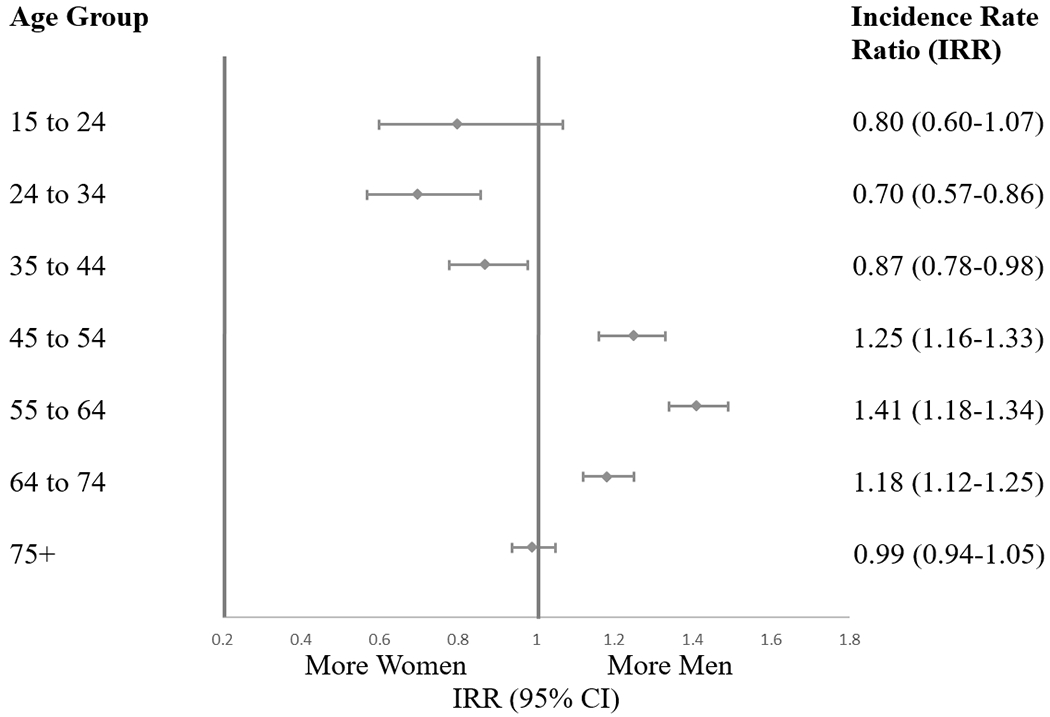
Forest Plot of Incidence Rate Ratio(IRR) Men:Women by Age Group. Diamond is IRR of index stroke rate. 95%Confidence Interval(CI) in bars. CI crossing 1 indicates non-significant difference between men and women.
The IRR varied across the age groups(Supplemental Table I). The IRR in the younger age groups for each 2-year interval, were not statistically different. In contrast, the IRRs for the 2-year intervals between the 45-74 year age groups are statistically significant, with men consistently having more strokes. Statistically significant temporal trends in IRR were not detected in any age group.
DISCUSSION
In this large, retrospective cohort of insured Americans, strokes occurred more often in young women ages 25-44 years than in young men. This is the first study to our knowledge to report higher stroke rates among young women in the U.S. Previous studies in the U.S. using the National Inpatient Sample found that young men ages 15-44 had higher stroke hospitalization rates than young women.5, 8 One possible explanation for this discrepancy is that the denominator in the prior study was the number of inpatient admissions, which may underestimate the true incidence. Young women, in general, have more hospitalizations than men due to child bearing, thereby diluting stroke hospitalization rates in women. In contrast, the European 15 Cities Young Stroke Study found a female predominance among those younger than age 34 years by a male to female ratio of 0.7, meaning 30% more strokes occurred in young women. Moreover, compared to men, women had strokes at a younger age with fewer vascular risk factors. Unfortunately, this study did not have a reliable population size in which to calculate an incidence and IRR. Most recently, a Dutch study estimated the incidence of strokes among young adults using a nationwide cohort and found more strokes among young women, ages 18-44. The IRR of ischemic stroke in women compared to men declined with age from 2.04 in ages 18-24 to 1.20 in ages 40-44. These results are consistent with our findings.
There are many potential hypotheses regarding the higher incidence of stroke among young women. Endogenous estrogen may serve a preventative role for cardiovascular events in pre-menopausal women.9 This is true for acute myocardial infarction, where incidence is much lower in young women.10 However, we found the opposite for ischemic strokes. With the exception of obesity, the prevalence of cardiovascular risk factors are higher among young men in the U.S.11 Hence, there may be non-cardiovascular risk factors, which are unique or more prevalent in women, leading to strokes. Some possible explanations include pregnancy, oral contraception, and other female-predominant risk factors including migraine headaches and autoimmune disorders.12, 13 A better understanding of the etiologies and risk factors of strokes in young women is needed in future research and an important step towards prevention.
There are some limitations to this study. First, our study sample was drawn from an administrative, commercial database. Few Medicaid and Medicare patients were included and uninsured and self-pay patients are not included. Second, we were unable to study race or ethnicity using this database. Previous studies have shown that the incidence of stroke in young adults is higher among Blacks and Hispanics and future studies examining race/ethnicity differences by age and sex are warranted.14 Last, due to the administrative nature of this dataset, we do not know the etiology of ischemic stroke nor its severity. Future work linking administrative to clinical data would provide a fuller understanding.
CONCLUSION
We found that stroke incidence is higher in young women than young men, suggesting the importance of sex-mediated risk factors. Understanding these factors is critical to stroke treatment and prevention efforts in young adults.
Supplementary Material
Acknowledgments
Source of Funding: Dr. Daugherty is funded by NIH(R01HL133343).
Disclosures: Dr. Leppert is supported by AHA/Bugher Foundation(14BFSC17680001). Dr. Ho is supported by NHLBI, VA HSR&D, and University of Colorado School of Medicine. He has a research agreement with Bristol-Myers Squibb through the University of Colorado. He serves as the Deputy Editor for Circulation: Cardiovascular Quality and Outcomes. Dr. Madsen is supported by NHLBI(K23HL140081). Dr. Sillau is support by NIH, PCORI, Alzheimer’s Association, CDPHE, Davis Phinney Foundation, Hewitt Foundation, and RMADC.
Nonstandard Abbreviations and Acronyms:
- ICD
International Classification of Diseases
- IRR
Incidence Rate Ratio
- CI
Confidence Interval
- SAS
Statistical Analysis System
References
- 1.Bejot Y, Delpont B, Giroud M. Rising stroke incidence in young adults: More epidemiological evidence, more questions to be answered. J Am Heart Assoc. 2016;5(5):e003661. [DOI] [PMC free article] [PubMed] [Google Scholar]
- 2.Ekker MS, Verhoeven JI, Vaartjes I, Jolink WMT, Klijn CJM, de Leeuw FE. Association of stroke among adults aged 18 to 49 years with long-term mortality. JAMA. 2019;321(21):2113–2123. [DOI] [PMC free article] [PubMed] [Google Scholar]
- 3.Aigner A, Grittner U, Rolfs A, Norrving B, Siegerink B, Busch MA. Contribution of established stroke risk factors to the burden of stroke in young adults. Stroke. 2017;48:1744–1751 [DOI] [PubMed] [Google Scholar]
- 4.Putaala J, Metso AJ, Metso TM, Konkola N, Kraemer Y, Haapaniemi E, Kaste M, Tatlisumak T. Analysis of 1008 consecutive patients aged 15 to 49 with first-ever ischemic stroke: The helsinki young stroke registry. Stroke. 2009;40:1195–1203 [DOI] [PubMed] [Google Scholar]
- 5.George MG, Tong X, Bowman BA. Prevalence of cardiovascular risk factors and strokes in younger adults. JAMA Neurol. 2017;74:695–703 [DOI] [PMC free article] [PubMed] [Google Scholar]
- 6.Ekker MS, Verhoeven JI, Vaartjes I, van Nieuwenhuizen KM, Klijn CJM, de Leeuw FE. Stroke incidence in young adults according to age, subtype, sex, and time trends. Neurology. 2019;92:e2444–e2454 [DOI] [PubMed] [Google Scholar]
- 7.Putaala J, Yesilot N, Waje-Andreassen U, Pitkaniemi J, Vassilopoulou S, Nardi K, Odier C, Hofgart G, Engelter S, Burow A, et al. Demographic and geographic vascular risk factor differences in european young adults with ischemic stroke: The 15 cities young stroke study. Stroke. 2012;43:2624–2630 [DOI] [PubMed] [Google Scholar]
- 8.George MG, Tong X, Kuklina EV, Labarthe DR. Trends in stroke hospitalizations and associated risk factors among children and young adults, 1995–2008. Ann Neurol. 2011;70:713–721 [DOI] [PubMed] [Google Scholar]
- 9.Bushnell CD, Chaturvedi S, Gage KR, Herson PS, Hurn PD, Jimenez MC, Kittner SJ, Madsen TE, McCullough LD, McDermott M, et al. Sex differences in stroke: Challenges and opportunities. J Cereb Blood Flow Metab. 2018;38:2179–2191 [DOI] [PMC free article] [PubMed] [Google Scholar]
- 10.Gupta A, Wang Y, Spertus JA, Geda M, Lorenze N, Nkonde-Price C, D’Onofrio G, Lichtman JH, Krumholz HM. Trends in acute myocardial infarction in young patients and differences by sex and race, 2001 to 2010. J Am Coll Cardiol. 2014;64:337–345 [DOI] [PMC free article] [PubMed] [Google Scholar]
- 11.Leppert MH, Poisson SN, Sillau SH, Campbell JD, Ho PM, Burke JF. Is prevalence of atherosclerotic risk factors increasing among young adults? It depends on how you ask. J Am Heart Assoc. 2019;8:e010883. [DOI] [PMC free article] [PubMed] [Google Scholar]
- 12.Kamel H, Navi BB, Sriram N, Hovsepian DA, Devereux RB, Elkind MS. Risk of a thrombotic event after the 6-week postpartum period. N Engl J Med. 2014;370:1307–1315 [DOI] [PMC free article] [PubMed] [Google Scholar]
- 13.Gillum LA, Mamidipudi SK, Johnston SC. Ischemic stroke risk with oral contraceptives: A meta-analysis. JAMA. 2000;284:72–78 [DOI] [PubMed] [Google Scholar]
- 14.Jacobs BS, Boden-Albala B, Lin IF, Sacco RL. Stroke in the young in the northern Manhattan stroke study. Stroke. 2002;33:2789–2793 [DOI] [PubMed] [Google Scholar]
Associated Data
This section collects any data citations, data availability statements, or supplementary materials included in this article.