


Fig. 1. Both female and male rats used for molecular studies exhibit oxycodone conditioned place preference (CPP).
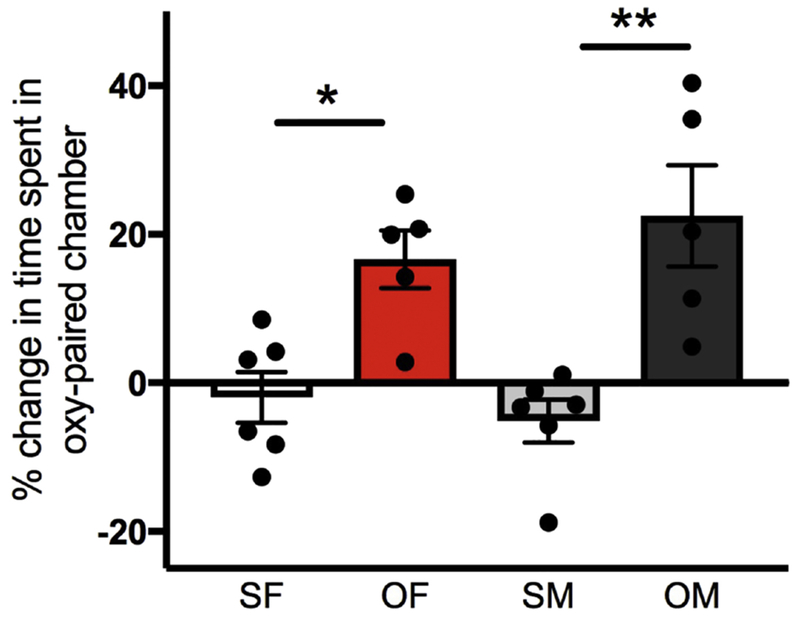
During the preconditioning phase, individual rats had a compartmental bias. Thus, oxycodone was administered on the less-preferred side for the animal. Preference score is the amount of time spent in the Oxy-paired chamber over the sum of time spent in Oxy- and Saline-paired chambers, calculated as a percent. The percent change in preference score, shown in the graph, is the pre-test preference score (of the side that would later be paired with oxycodone) subtracted from the post-test preference score of the Oxy-paired side. Saline-injected rats showed no significant change in preference score by sex. However, preference was significantly greater for Oxy-injected rats compared to their Saline-injected counterparts. SF, Sal-female; OF, Oxy-female; SM, Sal-male; OM, Oxy-male; * p < 0.05, ** p < 0.01.