



Abstract
The incorporation of succinic acid (SA) in the lattice of L-Lysine monohydrochloride (LM) has opened the new avenue in the field of production and application of scintillator materials such as LED and antifungal drug. Crystalline trait and monoclinic structure were scanned by XRD. The existence of carbonyl, carboxylate and protonated amine group were confirmed through FTIR and UV spectra predicted the transmittance of SA: LM crystal. Polychromatic luminescence behaviour had achieved through the incorporation of SA instead of blue luminescence, which is a new result. Also SA: LM exhibited good response towards pathogenic fungi which causes numerous types of infections and diseases in both humans and animals. The high inhibitory zone at 16 mm was formed by the grown SA: LM crystal against the life threatening fungi like Candida albicans. Also fungal inhibition against candida parapsilosis and Aspergillus flaves, respectively, were tuned by the inclusion of succinic acid.
Keywords: Succinic acid, Monoclinic, Transmittance, Candida albicans, LED
1. Introduction
L-lysine is one of the acentric crystal because the basic chain is made with optically active carbon atom. Also the specular character of this L-Lysine is due to its phonon subsystem with hydrogen bonds (Krishnakumar et al., 2010). Natural characteristic cationic lysine is the electro optic material likewise it has wide potential character like pharmacologic movement, nonlinear optical impact, strong electrostatic interaction and optical parametrical effect as well as it is an indispensable amino acid to the human body especially in the formation of collagen (Rubin et al., 1960, Ozga et al., 2008, Lasser et al., 1960, Dousa et al., 2011, Wang et al., 2018, Cao et al., 2016). Succinic acid is come under the category of metabolite and biologically dynamic carboxylic acids (Kondratenko et al., 2020) formed by microorganisms, animals and plants (Juliet and Subramanian, 2018). Complexes of succinic acid plays a vital role to deliver inhibitory action against microorganism and utilized in pharmaceutical industry (Demir et al., 2010a, Demir et al., 2010b, Lin et al., 2008, Ahn et al., 2016). Furthermore, it can be utilized in the creation of infrared (IR) MALDI analytical methods (Krishnan et al., 2008).
Our environment consists of very diverse microorganisms that include all bacteria, virus and fungus so on. It can be found in rock surfaces, soil, inside rocks, toxic waste, buried mites under the earth and almost in every parts of the atmosphere. The property of toxin production and penetration causes various types of infections, diseases in both humans and animals. Among all microorganism, fungus and bacteria possess greatest thread to all lives because they could cause illness in them (Boehlke et al., 2020, Calzavara-Pinton et al., 2005). The synthesis of antifungal and antibacterial drugs is lower in contrast to the rate of spreading of disease by both fungus and bacteria. So with basic characterization here, concentration given to magnify the optical, luminescence, chemical and biological activities of the grown crystals.
2. Material and methods
2.1. Materials
Sigma Aldrich Chemicals delivered the analytical grade materials such as L-Lysine monohydrochloride (C6H15ClN2O2) and Succinic acid (C4H6O4). Deionised water was used as solvent.
2.2. Growth method of crystals
To grow the crystal under atmospheric condition, slow evaporation is the finest method. This method was used to grow SA doped LM single crystal in the molecular ratio 0.02: 0.98. Enumerate amount of L-Lysine monohydrochloride and succinic acid was used to prepare supersaturated solution. Filtered saturated solution was lidded and kept for slow evaporation. Colourless crystals were obtained nearly after 20 days. Fig. 1. shows the grown SA: LM crystal.
Fig. 1.
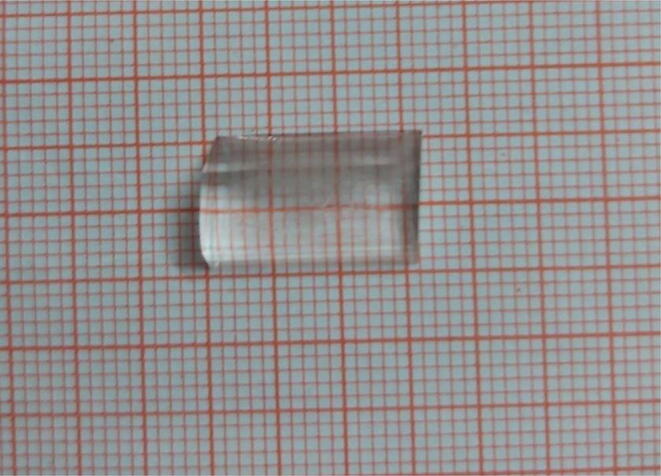
Photograph of SA: LM crystal.
2.3. Characterization of crystals
The structure was found by ENRAF NONIUS CAD4 X-ray diffractometer and the powder XRD of the sample were recorded with the help of XPert Pro- PAnalytic powder diffractometer. Using Thermo Nicolet avatar 370 spectrometer, vibrational studies was carried out in the middle infrared region (400–4000 cm−1). Optical property of SA: LM crystals were assessed in the UV–Visible region by means of Perkin Elmer (Lamda 35) spectrometer. Polychromatic light emission of sample was appraised by make use of Varian Cary Eclipse Photo Luminescence Spectrophotometer. Fungal activity test was undertaken by disk diffusion method.
3. Results
Crystalline quality of the grown samples are identified from the sharp narrow diffractions peaks obtained by powder XRD analysis (Fig. 2) and Phase analysis demonstrate that crystal SA: LM is monoclinic. The various vibrational analysis of the samples are obtained from Fig. 3 and the peculiar vibration of amino acid due to NH3 stretching is obtained in the range 2924, 1585 and 1506 cm−1. The synthesized crystals exhibit good inhibitory action against the life threatening pathogens which are shown in Fig. 4. SA: LM crystal shows a notable action against Candia species such as Candida albicans, candida parapsilosis, and Aspergillus flaves by forming 16 mm, 14 mm, and 16 mm diameter zone. The transmittance behaviour of SA doped LM crystal is depicted in Fig. 5. The SA doped LA crystal shows 67 percentage of transmittance. At 345 nm wavelength the sample is excited and the emission spectrum was recorded, it is given in Fig. 6. Also it revealed the various luminescence property at different wavelength.
Fig. 2.

Powder XRD pattern of SA: LM crystal.
Fig. 3.

Vibrational spectra of SA: LM crystal.
Fig. 4.

Zone of inhibition of SA: LM against (a) candida parapsilosis (b) Candida albicans and (c) Aspergillus flaves.
Fig. 5.

Transmittance spectra of SA: LM crystal.
Fig. 6.

Pholuminescence spectrum of SA: LM crystal.
4. Discussion
4.1. X-Ray diffraction analysis
The structure of L- Lysine monohydrochloride was not affected by the small amount of SA doping undoubtedly cleared from the phase analysis which does not shows any secondary phases. Phase analysis demonstrate that crystal SA: LM is monoclinic with unit cell dimensions a = 5.88 Å, b = 13.32 Å, c = 7.49 Å, α = γ = 900, β = 97.790 and V = 581.271 Å3 (Ramesh Babu et al., 2006). This is in agreement with the SP2 space group. The successful incorporation of SA ion in LM is recognised from the shrinkage in the lattice parameter, subtle shift in intensity of peaks and diffraction angle.
4.2. Vibrational analysis
The C—C—N symmetric stretching obtained at the wave number 862 cm−1 (Robert et al., 2010). The absorption peak at 3171 cm−1is assigned to N-H bond stretching (Petrosyan and Ghazaryan, 2009). According to Kalaiselvi et al the COO− asymmetric stretching and NH3 rocking were observed in the region 1619 and 1182 cm−1 (Kalaiselvi et al., 2007). In SA: LM also same vibration obtained at 1619 and 1182 cm−1. C—N vibration imputed in the wave numbers 1348 and 1320 cm−1(Ozga et al., 2008) and C—C stretching is noticed in the wave number 997 cm−1. 3422 cm−1 is assigned to stretching vibration of water molecule. Krishnakumar et al reported that at 3450–3250 cm−1 stretching vibration of H2O molecule take place. C—O stretching vibration is noticed at 1216 cm−1 (Krishnakumar et al., 2010). These wave numbers slightly shifted from the reference values which is due to the addition of SA.
4.3. Fungal activity
The Candida species are unicellular fungi which is present in humans at gastrointestinal, mucosal surfaces of the oral cavity, skin, vagina and urogenital tracts (Tsai et al., 2013). But on the other hand it is also a threat to human health by causing oropharyngeal candidiasis (OPC) and vulvovaginal candidiasis (VVC) (Coleman et al., 1993, Vargas and Joly, 2002, Sanchez et al., 1993, Hosseini et al., 2020). Furthermore VVC is a major threat for women infected with HIV. In United States by substantiation, the candida infection is the fourth most nosocomial infection and ranked second in death due to that infection (Pfaller et al., 1998, Trofa et al., 2008). Aspergillosis is an infection brought about by sort of fungi in particular Aspergillus flaves ordinarily trouble the respiratory framework (Smith and Denning, 2010, Ramirez-Camejo et al., 2012). Due to these infections on humans by fungi the curiosity to find antifungal drug is aroused.16 mm extent of inhibitory zone was formed in opposition to Candida albicans by SA: LM which is more than that of antifungal activity of Nystatin. This Nystatin is used to patients who is affected by fungal infection (Ma et al., 2007, Monteiro et al., 2013, Zahabi et al., 2020). Moreover SA: LM material exhibit inhibitory action against candida parapsilosis and Aspergillus flaves by forming 14 mm and 16 mm diameter zone, respectively, compared to Candida albicans in the diameter 9 mm reported by other authors (Kalaiselvi et al., 2018). Nano silver (Tantyani and Taufikurohmah, 2020) also showed less inhibitory zone than SA: LM crystal. These resisting activity of the sample against fungi leads to the development of effective anti-fungal drugs for wide range of applications.
4.4. Optical analysis
Depending on defects, orientation, optically active functional groups the range of transmittance varied (Anis et al., 2019, Senthil Pandian et al., 2011). The SA doped LM crystal shows about 67 percentage of transmittance and it is less than pure LM which shows 70 percentage transmittance (Aneeba et al., 2020). Because the concentration of doping reduced the transmittance of the crystal due to the creation of extra defects (Zhou et al., 2019). This defects opened the way to SA: LM crystal towards polychromatic luminescence.
optical material:
L-lysine hydrochloride dihydrate
D. Kalaiselvi, R. Mohan Kumar, R. Jayavel
*
Crystal Growth Centre, Anna University, Chennai 600025, India
Received 8 May 2007; received in revised form 22 June 2007; acc
5. nti-microbial activities
5.1. Photoluminescence study
The typical approach for characterizing defects and other imperfection present in the sample is studied by using Photoluminescence Spectroscopic (PL) technique. It enables to examine the electronic transition and optically active intrinsic defect densities occurs due to absorption of light (Alexandar et al., 2017, Rajesh et al., 2017, Shejwal et al., 2016). The sample LM has a sturdy luminescence behaviour, which itself has its potential to act as a scintillator substance (Chen et al., 2016, Rani et al., 2013). The PL of SA: LM yields information about multiple energy levels existing between VB and CB which is accountable for radioactive recombination. The high intense PL emission of SA: LM is at 535 and 544 nm which are accountable for the powerful green luminescence. The first two peaks shows indigo and blue emission in the relative wavelength 459 and 494 nm and the rest shows yellow and orange emission at 572, 582 and 595 nm. The blue emission is due to the presence of NH2 and Cl ions present in the sample. Chen et al depicted the luminescence behaviour of lysine, which is in the wavelength range 490 nm corresponding to blue emission (Chen et al., 2016). Notwithstanding in addition to above emission, SA: LM emitted the following colours like violet, indigo, yellow, orange owing to the inclusion of succinic acid. Because many of the literature showed the effect of SA in the luminescence property (Zhang et al., 2008, Wang et al., 2009, Cui et al., 2005, Demir et al., 2010a). The enhancement of polychromatic emission of lysine is due to the doping of succinic acid.
6. Conclusion
The antifungal and high photo luminescence crystal SA: LM was synthesised and its crystalline properties were examined by XRD, FTIR, UV and photoluminescence spectroscopy. The monoclinic structure and functional groups are identified from XRD and FTIR. The formation of defects in grown crystal were identified from the transmittance graph. The intense responsive action against these pathogens proved that the succinic acid doped L-Lysine monohydrochloride could act as a potential antifungal drug in the field of medicine. The UV visible spectrum reveals that the crystals transmittance percentage was reduced by the defects present in them. The Photoluminescence characterisation shows the reinforced emission of violet, indigo, blue, green, yellow and orange colours due to polychromatic luminescence. These leading properties in SA: LM crystal opens the way in the field of antifungal drugs and also an effective supernumerary in the fabrication of scintillator materials.
Declaration of Competing Interest
The authors declare that they have no known competing financial interests or personal relationships that could have appeared to influence the work reported in this paper.
Acknowledgements
The authors wish to thank STIC, Cochin, SAIF, IIT, Chennai, and St. Joseph College, Tiruchirappalli for the help in taking various analysis. The authors would like to extend their sincere appreciation to the Researchers Supporting Project Number (RSP-2020/24), King Saud University, Riyadh, Saudi Arabia.
Footnotes
Peer review under responsibility of King Saud University.
Contributor Information
B. Aneeba, Email: aneebaanu@gmail.com.
S. Vinu, Email: vinusnist@gmail.com.
References
- Alexandar A., Lakshmanan A., Sakthy Priya S., Surendran P., Rameshkumar P. Growth, structural, optical, piezoelectric and etching analysis of L-lysine p-nitrophenolate monohydrate single crystals. Int. J. Mod. Phys. B. 2017;31(23):1750174. [Google Scholar]
- Aneeba, B., Ashvin Santhia, S.V., Vinu, S., Sheela Christy, R., Dunia A. Al Farraj., Noorah A. Alkubaisi., 2020. Inflence of most reactive inorganic cation in the optical and biological activities of L-Lysine monohydrochloride crystal. Saudi J. Biolog. Sci. 27 (2020) 2961–2967, https://doi.org/10.1016/j.sjbs.2020.07.018. [DOI] [PMC free article] [PubMed]
- Anis M., Baig M.I., Muley G.G., AlFaify S., Khan M.A. Impact of increasing concentration of L-alanine environment on structural, UV-visible, SHG efficiency, luminescence and dielectric traits of zinc thiourea chloride (ZTC) crystal. Optik. 2019;185:317–324. [Google Scholar]
- Boehlke C., Rupf S., Tenniswood M., Chittur S.V., Hannig C., Zierau O. Caries and periodontitis associated bacteria are more abundant in human saliva compared to other great apes. Arch. Oral Biol. 2020;111 doi: 10.1016/j.archoralbio.2020.104648. [DOI] [PubMed] [Google Scholar]
- Calzavara-Pinton P.G., Venturini M., Sala R. A comprehensive overview of photodynamic therapy in the treatment of superficial fungal infections of the skin. J. Photochem. Photobiol. B. 2005;78(1):1–6. doi: 10.1016/j.jphotobiol.2004.06.006. [DOI] [PubMed] [Google Scholar]
- Cao J., Ding L., Zhang Y., Wang S., Fang Y. A ternary sensor system based on pyrene derivative-SDS assemblies-Cu2+ displaying dual responsive signals for fast detection of arginine and lysine in aqueous solution. J. Photochem. Photobiol. A. 2016;314:66–74. [Google Scholar]
- Chen Y., Bao Y., Wang X. Green Emission of Tb-doped Mg-Al Layered Double Hydroxide Response to L-lysine. J. Fluoresc. 2016;26(3):813–820. doi: 10.1007/s10895-016-1769-4. [DOI] [PubMed] [Google Scholar]
- Coleman D.C., Bennett D.E., Sullivan D.J., Gallagher P.J., Henman M.C., Shanley D.B. Oral Candida in HIV infection and AIDS: new perspectives/new approaches. Crit. Rev. Microbiol. 1993;19(2):61–82. doi: 10.3109/10408419309113523. [DOI] [PubMed] [Google Scholar]
- Cui G.-H., Li J.-R., Zhang R.-H., Bu X.-H. Hydrothermal synthesis, crystal structures and luminescent properties of two new Ln (III)–succinate (Ln=Eu, Tb) complexes exhibiting three dimensional networks. J. Mol. Struct. 2005;740(1–3):187–191. [Google Scholar]
- Trofa D., Gacser A., Nosanchuk J.D. Candida parapsilosis, an emerging fungal pathogen. Clin. Microbiol. Rev. 2008;21(4):606–625. doi: 10.1128/CMR.00013-08. [DOI] [PMC free article] [PubMed] [Google Scholar]
- Demir S., Yilmaz V.T., Sariboga B., Buyukgungor O., Mrozinski J. Metal (II) Nicotinamide Complexes Containing Succinato, Succinate and Succinic Acid: Synthesis, Crystal Structures, Magnetic, Thermal, Antimicrobial and Fluorescent Properties. J. Inorg. Organomet. Polym. Mater. 2010;20(2):220–228. [Google Scholar]
- Dousa M., Brichac J., Gibala P., Lehnert P. Rapid hydrophilic interaction chromatography determination of lysine in pharmaceutical preparations with fluorescence detection after postcolumn derivatization with o-phtaldialdehyde. J. Pharmaceut. Biomed. 2011;54(5):972–978. doi: 10.1016/j.jpba.2010.11.026. [DOI] [PubMed] [Google Scholar]
- Hosseini S.S., Joshaghani H., Shokohi T., Ahmadi A., Mehrbakhsh Z. Antifungal Activity of ZnO Nanoparticles and Nystatin and down regulation of SAP1-3 Genes Expression in Fluconazole-Resistant Candida albicans Isolates from Vulvovaginal Candidiasis. Infect. Drug Resist. 2020;13:385–394. doi: 10.2147/IDR.S226154. [DOI] [PMC free article] [PubMed] [Google Scholar]
- Juliet sheela, K., Subramanian, P., 2018. Influence of VO 2+ ions on Structural and optical properties of potassium succinate-succinic acid single crystal for non-linear optical applications. Physica B. 534, 156–162
- Ahn Jung Ho, Jang Yu-Sin, Yup Sang. Lee Production of succinic acid by metabolically engineered microorganisms. Curr. Opin. Biotech. 2016;42:54–66. doi: 10.1016/j.copbio.2016.02.034. [DOI] [PubMed] [Google Scholar]
- Kalaiselvi D., Mohankumar R., Jayavel R. Crystal growth, thermal and optical studies of semiorganic nonlinear optical material: L-lysine hydrochloride dehydrate. Mater. Res. Bull. 2007;43:1829–1835. [Google Scholar]
- Kalaiselvi V., Mathammal R., Vijayakumar S., Vaseeharan B. Microwave assisted green synthesis of Hydroxyapatite nano rods using Moringa oleifera flower extract and its antimicrobial applications. I.j.v.s.m. 2018;6(2):286–295. doi: 10.1016/j.ijvsm.2018.08.003. [DOI] [PMC free article] [PubMed] [Google Scholar]
- Kondratenko Yu.A., Nikonorova A.A., Zolotarev A.A., Ugolkov V.L., Kochina T.A. Tris (hydroxymethyl) methyl ammonium salts of biologically active carboxylic acids. Synthesis, properties and crystal structure. J. Mol. Struct. 2020;1207 [Google Scholar]
- Krishnakumar V., Nagalakshmi R., Manohar S., Ozga K., Claudet B., Piasecki M., Pisarek J. Elastooptical spectra of novel l-lysine monohydrochloride dehydrate single crystals. Int. J. Mod. Phys. B. 2010;24(05):629–645. [Google Scholar]
- Krishnan S., Justin Raj C., Das S.J. Growth and characterization of novel ferroelectric urea–succinic acid single crystals. J. Cryst. Growth. 2008;310(14):3313–3317. [Google Scholar]
- Lasser R.P., Schoenfeld M.R., Friedberg C.K. L-Lysine Monohydrochloride: A clinical study of its action as a chloruretic acidifying adjuvant to mercurial diuretics. N. Engl. J. Med. 1960;263(15):728–733. doi: 10.1056/NEJM196010132631504. [DOI] [PubMed] [Google Scholar]
- Ma C.-M., Kully M., Khan J.K., Hattori M., Daneshtalab M. Synthesis of chlorogenic acid derivatives with promising antifungal activity. Bioorg. Med. Chem. 2007;15(21):6830–6833. doi: 10.1016/j.bmc.2007.07.038. [DOI] [PubMed] [Google Scholar]
- Monteiro D.R., Silva S., Negri M., Gorup L.F., de Camargo E.R., Oliveira R., Henriques M. Antifungal activity of silver nanoparticles in combination with nystatin and chlorhexidine digluconate against Candida albicans and Candida glabrata biofilms. Mycoses. 2013;56(6):672–680. doi: 10.1111/myc.12093. [DOI] [PubMed] [Google Scholar]
- Ozga K., Krishnakumar V., Kityk I.V., Jasik- Slezak J. L-lysine monohydrochloride dihydrate as novel elasto- and electrooptical materials. Mater. Lett. 2008;62:4597–4600. [Google Scholar]
- Petrosyan A.M., Ghazaryan V.V. Vibrational spectra of l-lysine monohydrochloride dihydrate and its two anhydrous forms. J. Mol. Struct. 2009;917(1):56–62. [Google Scholar]
- Pfaller M.A., Jones R.N., Messer S.A., Edmond M.B., Wenzel R.P. National Surveillance of Nosocomial Blood Stream Infection Due to Species of Candida Other than Candida albicans: Frequency of Occurrence and Antifungal Susceptibility in the SCOPE Program. Diagn. Micr. Infec. Dis. 1998;30(2):121–129. doi: 10.1016/s0732-8893(97)00192-2. [DOI] [PubMed] [Google Scholar]
- Rajesh P., Rao G.B., Ramasamy P. Effect of Rochelle salt on growth, optical, photoluminescence, photoconductive and piezoelectric properties of the triglycine sulphate single crystal. J. Cryst. Growth. 2017;468:340–344. [Google Scholar]
- Ramesh Babu R., Vijayan N., Gopalakrishnan R., Ramasamy P. Growth and characterization of L-lysine monohydrochloride dihydrate (L-LMHCl) single crystal. Cryst. Res. Technol. 2006;41(4):405–410. [Google Scholar]
- Ramirez-Camejo L.A., Zuluaga-Montero A., Lazaro-Escudero M., Hernandez-Kendall V., Bayman P. Phylogeography of the cosmopolitan fungus Aspergillus flavus: is everything everywhere? Fungal Biol. 2012;116(3):452–463. doi: 10.1016/j.funbio.2012.01.006. [DOI] [PubMed] [Google Scholar]
- Rani N., Vijayan N., Thukral K., Maurya K.K., Haranath D., Bhagavannarayana G., Wahab M.A. Crystalline perfection, optical and third harmonic generation analyses of non-linear optical single crystal of L-lysine acetate. Spectrochim Acta A Mol Biomol Spectrosc. 2013;105:192–199. doi: 10.1016/j.saa.2012.12.030. [DOI] [PubMed] [Google Scholar]
- Robert R., Raj C.J., Das S.J. Growth and characterization of pure and doped L-Lysine monohydrochloride dihydrate (L-LMHCl) nonlinear optical single crystals. Curr. Appl. Phys. 2010;10(2):670–675. [Google Scholar]
- Rubin A.L., Spritz N., Mead A.W., Herrmann R.A., Braveman W.S., Luckey E.H. The Use of L-Lysine Monohydrochloride in Combination with Mercurial Diuretics in the Treatment of Refractory Fluid Retention. Circulation. 1960;21(3):332–336. doi: 10.1161/01.cir.21.3.332. [DOI] [PubMed] [Google Scholar]
- Sanchez V., Vazquez J.A., Barth-Jones D., Dembry L., Sobel J.D., Zervos M.J. Nosocomial acquisition of Candida parapsilosis: An epidemiologic study. Am. J. Med. Sci. 1993;94(6):577–582. doi: 10.1016/0002-9343(93)90207-6. [DOI] [PubMed] [Google Scholar]
- Selcuk Demir., Veysel, T., Yilmaz., Bahtiyar Sariboga., Orhan Buyukgungor., Jerzy Mrozinski., 2010.Metal (II) Nicotinamide Complexes Containing Succinato, Succinate and Succinic Acid: Synthesis, Crystal Structures, Magnetic, Thermal, Antimicrobial and Fluorescent Properties. J. Inorg. Organomet. Polym. 20(2), 220–228.
- Senthil Pandian M., Pattanaboonmee N., Ramasamy P., Manyum P. Studies on conventional and Sankaranarayanan-Ramasamy (SR) method grown ferroelectric glycine phosphite (GPI) single crystals. J. Cryst. Growth. 2011;314(1):207–212. [Google Scholar]
- Shejwal N.N., Anis M., Hussaini S.S., Shirsat M.D. Ab-initio UV–vis., SHG efficiency, photoluminescence, dielectric, thermal and mechanical studies of pure and l -glutamine doped ZTS crystal for optoelectronics device applications. Optik. 2016;127(16):6525–6531. [Google Scholar]
- Smith N.L., Denning D.W. Underlying conditions in chronic pulmonary aspergillosis including simple aspergilloma. Eur. Respir. J. 2010;37(4):865–872. doi: 10.1183/09031936.00054810. [DOI] [PubMed] [Google Scholar]
- Lin Sze Ki Carol, Chenyu Du., Koutinas Apostolis, Wang Ruohang, Webb Colin. Substrate and product inhibition kinetics in succinic acid production by Actinobacillus succinogenes. Biochem. Eng. J. 2008;41:128–135. [Google Scholar]
- Tantyani T.A., Taufikurohmah T. Antibacterial and antifungal activity of silver nanoparticles against neisseria gonorrhoeae and candida albicans. Diagn Micr Infec Dis. 2020;8(6):179–187. [Google Scholar]
- Tsai P.W., Chen Y.T., Hsu P.C., Lan C.Y. Study of Candida albicans and its interactions with the host: A mini review. Bio Medicine. 2013;3(1):51–64. [Google Scholar]
- Vargas K.G., Joly S. Carriage frequency, intensity of carriage, and strains of oral yeast species vary in the progression to oral candidiasis in human immunodeficiency virus-positive individuals. J Clin Microbiol. 2002;40(2):341–350. doi: 10.1128/JCM.40.2.341-350.2002. [DOI] [PMC free article] [PubMed] [Google Scholar]
- Wang C.-G., Xing Y.-H., Li Z.-P., Li J., Zeng X.-Q., Ge M.-F., Niu S.-Y. Synthesis, crystal structures and properties of a series of three-dimensional lanthanide coordination polymers with the rigid and flexible mixed dicarboxylate ligands of 1, 4-benzene dicarboxylic acid and succinic acid. J. Mol. Struct. 2009;921(1–3):126–131. [Google Scholar]
- Wang X.R., Huang Z., Du J., Wang X.Z., Gu N., Tian X., Ding B. Hydrothermal Preparation of Five Rare-Earth (Re = Dy, Gd, Ho, Pr, and Sm) Luminescent Cluster-Based Coordination Materials: The First MOFs-based Ratiometric Fluorescent Sensor for Lysine and Bifunctional Sensing Platform for Insulin and Al3+ Inorg. Chem. 2018;57(20):12885–12899. doi: 10.1021/acs.inorgchem.8b02123. [DOI] [PubMed] [Google Scholar]
- Zahabi Z.F., Sharififar F., Almani P.G.N., Salari S. Antifungal activity of different fractions of Salvia rhytidea Benth as a valuable medicinal plant against various species of Candida in Kerman Province (southeast Iran) Gene Rep. 2020;19 [Google Scholar]
- Zhang X.-J., Xing Y.-H., Han J., Zeng X.-Q., Ge M.-F., Niu S.-Y. A Series of Novel Ln−Succinate−Oxalate Coordination Polymers: Synthesis, Structure, Thermal Stability, and Fluorescent Properties. Cryst. Growth Des. 2008;8(10):3680–3688. [Google Scholar]
- Zhou G., Li G., Lü Y., Ma Y., Sun X., Deng X., Wang X. Growth and characterization of L-phenylalanine doped KDP crystals. Mater. Res. Bull. 2019;113:146–151. [Google Scholar]