


Figure 2.
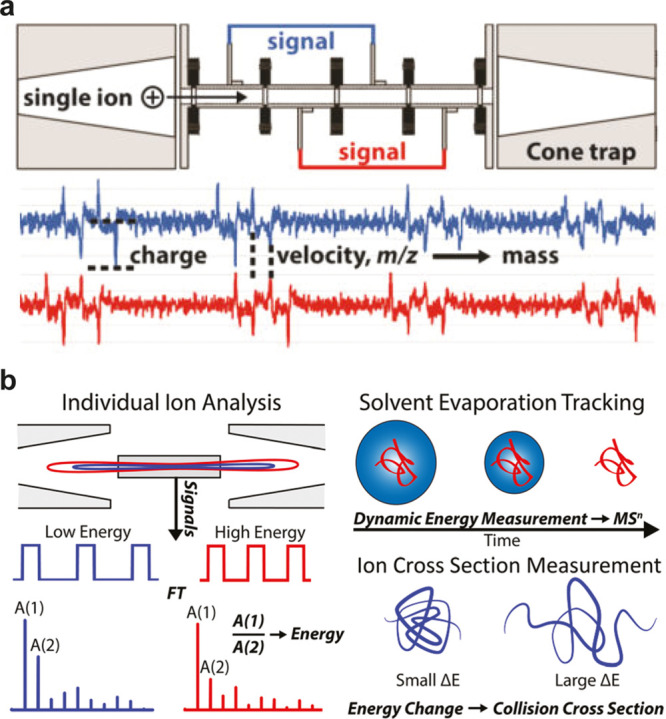
Ion trap charge detection mass analyzers and dynamic ion energy calibrations. (a) Schematic diagrams of CDMS mass analyzers using an ion trap and detector array with below the recorded transient for an oscillating single ion. The amplitude of the pulse signal indicates the charge and the measured velocity of the ion indicates its m/z. With both measured parameters it is possible to calculate each ions mass directly. (b) Alternative CDMS setup, using a conductive tube instead of a detector array. The m/z is derived here from the fundamental frequency of the pulse signal calculated by using a Fourier transform. The ratio of the fundamental frequency and second harmonic (HAR) depends on the ion energy, which is an essential parameter for measuring ion mass in CDMS. The HAR is determined dynamically over the entire trapping period, making it possible to observe the change in ion energy that takes place as solvent evaporates from the ion due to collisions with the background gas. The rate of change in ion energy correlates also with the collision cross section (CCS) of the analyzed particle. Reprinted from Int. J. Mass Spectrom.414, Elliott, A. G.; Merenbloom, S. I.; Chakrabarty, S.; Williams, E. R. Single Particle Analyzer of Mass: A Charge Detection Mass Spectrometer with a Multi-Detector Electrostatic Ion Trap, pp. 45–55 (ref (44)). Copyright 2017, with permission from Elsevier. Reprinted with permission from Harper, C. C.; Elliott, A. G.; Lin, H. W.; Williams, E. R. 2018 Determining Energies and Cross Sections of Individual Ions Using Higher-Order Harmonics in Fourier Transform Charge Detection Mass Spectrometry (FT-CDMS). J. Am. Soc. Mass Spectrom.29(9): 1861–1869 (ref (45)). Copyright 2018 American Chemical Society.