


Table 1.
Optimization of the reaction conditions.
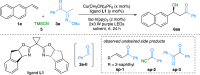 | |||||
|---|---|---|---|---|---|
| Entry | x/y/z (mol%) | Solvent | sp-1/sp-2/sp-3 (%)a | Yield (%)a | ee (%)b |
| 1 | 0.5/0.6/1.0 | DMA (0.05 M) | 6/4/4 | 41 | 88 |
| 2 | 0.5/0.6/1.0 | DMF (0.05 M) | 2/5/1 | 39 | 89 |
| 3 | 0.5/0.6/1.0 | CH3CN (0.05 M) | 1/11/– | 6 | 90 |
| 4 | 0.5/0.6/1.0 | THF (0.05 M) | 1/9/– | 15 | 90 |
| 5 | 0.5/0.6/1.0 | CH2Cl2 (0.05 M) | 1/14/– | 9 | 90 |
| 6 | 0.5/0.6/0.8 | DMA (0.05 M) | 7/3/2 | 64 | 88 |
| 7c | 0.5/0.6/0.8 | DMA (0.05 M) | 6/7/3 | 51 | 85 |
| 8d | 0.5/0.6/0.8 | DMA (0.05 M) | 8/2/2 | 69 | 81 |
| 9e | 0.5/0.6/0.8 | DMA (0.05 M) | 10/1/6 | 16 | 68 |
| 10 | 1.5/2.25/0.8 | DMA (0.05 M) | 6/12/1 | 78 | 90 |
| 11 | 1.5/2.25/0.8 | DMA (0.04 M) | 3/3/2 | 88 (74) | 90 |
| 12 f | 1.5/2.25/0.8 | DMA (0.04 M) | 5/33/1 | 41 | 90 |
| 13 g | 1.5/2.25/0.8 | DMA (0.04 M) | 6/31/2 | 39 | 90 |
Reaction conditions: 1a (0.1 mmol), 3a (0.3 mmol), TMSCN (0.3 mmol), Cu(CH3CN)4PF6 (x mol%), ligand L1 (y mol%), fac-Ir(ppy)3 (z mol%), solvent (2.0–2.5 mL), 2 × 3 W purple LEDs, at room temperature.
CFL compact fluorescent lamp, ppy 2-phenylpyridine, DMA N,N-dimethylacetamide, DMF N,N-dimethylformamide.
aYields were determined by GC analysis, with isolated yield in parentheses.
bDetermined by HPLC analysis on a chiral stationary phase.
cWith CuCl.
dWith CuI.
eWith Cu(OTf)2.
fUnder the irradiation of 2 × 3 W blue LEDs (λmax = 460 nm) at room temperature.
gUnder the irradiation of CFL (40 W) at room temperature.