



Abstract
Crohn disease (CD) may be complicated by contiguous, metastatic, or associated inflammatory cutaneous lesions. Vulvar CD is a rare phenomenon characterized by granulomatous genital inflammation that occurs independently from fistulizing CD. Left untreated, vulvar CD can result in debilitating lymphedema, disfiguring anatomic changes, secondary abscesses, cellulitis, and squamous cell carcinoma. We present a series of cases to highlight the clinical presentation of vulvar CD, the diagnostic testing required to distinguish complicating conditions, the asynchronous courses of skin and intestinal disease, and the complexities in the management of this disease and associated conditions. We review our multidisciplinary approach to care, aimed at reducing morbidity and improving patient quality of life.
Keywords: Vulvar Crohn disease, Metastatic Crohn disease, Anogenital granulomatosis, Inflammatory bowel disease
Introduction
The prevalence of inflammatory bowel disease is increasing worldwide with Crohn disease (CD), affecting >780,000 Americans each year (Kurtzman et al., 2014, Molodecky et al., 2012). Recurrent inflammation frequently results in abscesses, bowel strictures, and fistulae (van Loo et al., 2012). Cutaneous involvement may complicate up to 44% of CD cases as contiguous, metastatic, or associated inflammatory lesions (Albuquerque et al., 2011, Burgdorf, 1981, Kurtzman et al., 2014, Marotta and Reynolds, 1996) Metastatic CD (MCD) is a rare and likely underrecognized phenomenon characterized by granulomatous inflammation of the skin, discontinuous from the gastrointestinal tract (Albuquerque et al., 2011, Farhi et al., 2007, Marotta and Reynolds, 1996). Vulvar CD (anogenital granulomatosis) is a variant of MCD and defined by granulomatous genital inflammation independently from fistulizing CD.
Vulvar CD may present clinically with erythema, edema, knife-cut ulceration, and fissuring that may involve the labia, clitoris, mons pubis, or entire anogenital region, including the genitocrural folds, vagina, and buttocks (Alexakis et al., 2017, Duhra and Paul, 1988, Kurtzman et al., 2014). Vulvar CD may precede a diagnosis of intestinal disease in 20% to 36% of patients, either due to quiescent intestinal symptoms that go unnoticed or delayed onset of enteropathy (Andreani et al., 2010, Laftah et al., 2015, Zhang et al., 2015). A subset of patients may manifest vulvar CD in the absence of gastrointestinal CD (Leu et al., 2009). If left untreated, vulvar CD can result in recurrent abscesses and cellulitis, with or without hidradenitis suppurativa, and result in debilitating lymphatic destruction and secondary lymphedema, lymphangiectasia, and lymphangiomas (Núñez et al., 2014, Papalas et al., 2010). Perianal tags frequently develop secondary to chronic lymphatic obstruction and are recognized as a classic harbinger of CD (Kurtzman et al., 2014, Moreno et al., 2019). Disfiguring anatomic distortion and squamous cell carcinoma may also occur and impart significant morbidity and impact on quality of life (Alexakis et al., 2017, Kesterson et al., 2008). The treatment of vulvar CD requires multidisciplinary efforts involving gynecologists, gastroenterologists, infectious disease specialists, and dermatologists to achieve disease control and improve patient quality of life.
The following three cases highlight the clinical presentation of vulvar CD, the diagnostic testing required to distinguish complicating conditions (e.g., infections), the asynchronous courses of skin and intestinal disease, and the complexities of the management of the disease and associated conditions.
Case 1
A 31-year-old female patient with a longstanding history of CD presented for evaluation of worsening biopsy-proven vulvar CD. Her intestinal disease was well controlled after a colectomy and end ileostomy. However, treatment with certolizumab pegol, adalimumab, infliximab, and mercaptopurine prior to surgery had failed. The patient complained of vaginal discharge, vulvar erythema, erosions, and pruritus with associated fissuring, cracking, and weeping of the labia majora, which had been previously managed with courses of oral prednisone, intralesional triamcinolone, topical pimecrolimus 1% cream, clobetasol 0.05% ointment, and metronidazole 0.75% gel without improvement. Her cutaneous disease resolved with the initiation of oral metronidazole but discontinuation was necessitated due to the development of peripheral neuropathy.
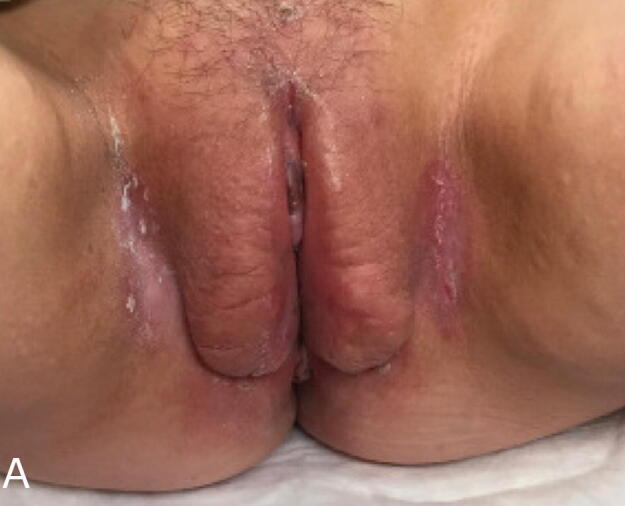
A physical examination revealed an erythematous, scaly plaque studded with pustules on the mons pubis. Edematous, verruciform plaques of the labia majora (Fig. 1A), deep knife-cut ulcerations in the inguinal folds and intergluteal cleft, and erythema with woody induration of the medial buttocks were noted (Fig. 1B). A vaginal examination revealed diffuse erythema and copious yellow discharge. A vaginal saline wet mount showed sheets of white blood cells. A skin culture grew methicillin-resistant Staphylococcus aureus (MRSA) and group A Streptococcus. The patient was started on doxycycline and rifampin for MRSA treatment, as well as a short course of amoxicillin (500 mg twice daily for 5 days for coverage of streptococcus) while awaiting the culture susceptibilities. She was subsequently tailored to doxycycline (100 mg twice daily) in combination with a topical regimen (tacrolimus 0.1% ointment, topical metronidazole 0.75% gel, mupirocin 2% ointment, and bleach baths) leading to sustained improvement.
Fig. 1.

(A) Hypertrophied and edematous plaques of the labia majora, and (B) erythematous, verrucous plaques of the medial buttocks with perianal tags.
At the follow-up visit, the vulvar fissuring, pustules, and erythema had resolved. The induration of the medial buttocks had softened and the swelling of the labia majora had improved. The patient continued a month-long course of oral doxycycline with continued resolution. Unfortunately, the patient only returned for two follow-up visits due to insurance changes (6-week intervals) with sustained clearance on mupirocin ointment 5 days per month, tacrolimus ointment weekly, and bleach baths twice weekly.
Case 2
A 31-year-old female patient with CD and systemic lupus erythematous, treated with adalimumab and hydroxychloroquine, presented with a 1-year history of worsening vulvar pain, edema, fissuring, and pruritus. She reported prior vulvar abscesses and cellulitis of the vulva and buttocks, which resolved with antibiotic therapy. A physical examination revealed pink, scaly plaques involving the genitocrural folds and mons pubis. The labia majora were grossly enlarged and indurated, and an exophytic nodule was present on the right periclitoral skin (Fig. 2). An internal examination was deferred due to pain. Rapid plasma reagin and herpes simplex virus reverse-transcription polymerase chain-reaction testing were negative. Cultures grew methicillin-susceptible Staphylococcus aureus (MSSA) and group B Streptococcus. Tests of biopsy tissues of the periclitoral skin demonstrated psoriasiform and lichenoid dermatitis, perivascular and interstitial lymphoplasmacytic infiltrate, and mixed dermal inflammation with histiocytes and giant cells, which is consistent with vulvar CD. Tissue cultures confirmed the presence of MSSA.
Fig. 2.
(A) Labia majora with gross edema and erythema, and (B) scaly plaques of the genitocrural folds and linear ulceration of the anterior labial commissure.
The patient was started on cephalexin (500 mg every 6 hours for 14 days), topical metronidazole 0.75% cream, and bleach baths. A compression garment was recommended for the edema. The patient exhibited an initial resolution with antibiotic treatment and subsequently stopped taking adalimumab because she thought the drug exacerbated her vulvar symptoms. At the follow-up dermatology visit, repeat skin cultures grew MSSA and group B Streptococcus. Mupirocin and chlorhexidine wash were added and intralesional kenalog (1 ml of 20 mg/ml) injections were performed into the indurated areas. Persistently low vitamin D levels were noted despite daily supplementation, and a high-dose vitamin D supplement was initiated. The patient did not return for follow-up visits, but a subsequent primary care physician note (5 months after the last dermatology appointment) documents that the vulvar symptoms improved and the patient reported doing well.
Case 3
A 15-year-old female patient with well-controlled CD treated with infliximab presented with a 1-year history of persistent erythema, edema, and desquamative inflammatory vaginitis (DIV) with discharge from the perianal and vulvar skin. A physical examination showed edematous, lichenified plaques involving the labia majora and mons pubis (Fig. 3A). She was started on methotrexate (25 mg subcutaneous injection per week), with significant disease progression despite compliance and continued treatment with infliximab. The methotrexate was discontinued and the patient was treated with serial intralesional triamcinolone, weekly bleach baths, and topical treatments (clobetasol 0.05% ointment mixed with tacrolimus 0.1% ointment and metronidazole 1% cream), with short-term improvement.
Fig. 3.

(A) Edematous, lichenified plaques involving the labia majora and mons pubis with associated discharge, and (B) abscess of the left labium majus.
She subsequently developed an abscess of the left labium majus that grew MSSA on tissue culture (Fig. 3B). Fistulizing CD was excluded via magnetic resonance enterography. Her disease course was complicated by multiple MSSA and group A streptococcal infections. The patient had been treated with incision and drainage, intermittent courses of oral metronidazole, topical metronidazole cream mixed with clobetasol and tacrolimus, weekly bleach baths, and serial intralesional triamcinolone (1 ml of 20 mg/ml). Flaring was consistently noted with the discontinuation of oral metronidazole. Rising inflammatory markers, persistently elevated fecal calprotectin, and worsening gastrointestinal symptoms prompted a switch in therapy to ustekinumab. A nutritional assessment revealed a vitamin D deficiency, which was corrected with supplementation, resulting in significant improvement in DIV with decreased discharge, but no change in vulvar CD.
Discussion
As illustrated in our case series, the clinical presentation of vulvar CD can be highly variable, representing a diagnostic challenge. The diagnosis of vulvar CD should be considered when patients present with aphthous ulcerations, vulvar edema, lymphedema or lymphangiectasia, knife-cut ulcers, recurrent aphthous ulcerations, perianal tags or fistulae, and suppurative nodules (Table 2). Included in the differential of vulvar CD are other inflammatory and infectious processes as outlined in Table 1. Awareness of these imitating conditions should guide a thorough history, review of systems, and targeted physical and laboratory evaluation. The diagnosis of vulvar CD rests on a clinical–pathologic correlation; however, wide-ranging histological presentations of CD have been reported (Aberumand and Howard, 2017). Although noncaseating granulomas and chronic lymphocytic inflammation represent classic histopathologic features, they are identified in <50% of cases (Bhoyrul and Lyon, 2018). Intralymphatic granulomas with dilated lymphatic channels, edema, and epidermal change are suggestive of vulvar CD (Alexakis et al., 2017). Hidradenitis suppurativa can mimic vulvar CD both clinically and with histopathology. When present, suppurative granulomatous inflammation that predominantly affects the follicles, as well as keratin plugging, may point to hidradenitis suppurativa and help distinguish from MCD (Siroy and Wasman, 2012).
Table 2.
Genital manifestations of Crohn disease.
| Aphthous ulcerations |
| Edema |
| Erosions |
| Erythema |
| Fissures |
| Lymphangiectasia |
| Lymphangioma |
| Lymphedema |
| Perianal tags |
| Verrucous, condyloma-like papules and plaques |
| Knife-cut ulcerations |
Table 1.
Differential diagnosis of vulvar Crohn disease and common imitatorsa.
| Differential diagnosis of metastatic Crohn disease | |
|---|---|
| Category | Subtype |
| Inflammatory | Hidradenitis suppurativa |
| Pyoderma gangrenosum | |
| Atopic dermatitis | |
| Psoriasis | |
| Sarcoidosis | |
| Irritant contact dermatitis | |
| Allergic contact dermatitis | |
| Medication reaction | |
| Infectious | Bacterial:
Spirochete:
Viral:
Fungal:
|
| Nutritional | Zinc deficiency |
| Malignant | Squamous cell carcinoma Paget disease High-grade squamous intraepithelial lesions Differentiated vulvar intraepithelial neoplasia |
Vulvovaginal symptoms, including vulvar and vaginal discomfort, vaginal discharge, and vulvovaginal pain, are commonly reported in women with inflammatory bowel disease (IBD) and may correlate with intestinal disease severity in a subset of patients (Ona et al., 2020). Vaginitis requires vaginal microscopy and testing for sexually transmitted infections, such as Chlamydia trachomatis and Neisseria gonorrhoeae (Granese et al., 2018). Bacterial cultures, often with tissue culture, should be considered when fluctuant lesions do not improve. Patients frequently develop recurrent streptococcal cellulitis that goes unrecognized, resulting in worsening edema, lymphatic destruction, and lymphangiectasia. Imaging, specifically ultrasonography and magnetic resonance enterography, can also be helpful in identifying abscesses or fistulae (Moreno et al., 2019). Given the increased risk of squamous cell carcinoma in this population, biopsy tissue testing to exclude malignancy should not be delayed. However, repetitive biopsy testing of the genital skin can result in wounds that are challenging to heal in the setting of underlying lymphedema.
Each of our patients developed recurrent Staphylococcus aureus infections that eventuated in cyclical worsening of their vulvar CD. Well-described in atopic dermatitis, cutaneous dysbiosis and the emergence of S. aureus as a dominant skin colonizer both predisposes to infection and modifies disease severity (Di Domenico et al., 2019, Paller et al., 2019). The host-vulvar microbiome may play a similar role in driving vulvar CD.
Staphylococcal colonization may be the result of increased contact with the health care system because patients with CD are more than twice as likely to require emergency room and outpatient clinical visits, hospital admissions, and home health care assistance than the general population (Longobardi et al., 2004). Hospitalized patients with IBD have an increased risk of MRSA colonization compared with patients with non-IBD gastrointestinal disease and general medicine inpatients (Nguyen et al., 2010).
S. aureus proliferation on the skin has been postulated to result from the prolonged use of immunosuppressive medications (Leung et al., 2012). More than two-thirds of patients with CD require corticosteroid treatment, and almost 15% of patients are treated with other immunomodulatory agents (Brown et al., 2014, Hutfless et al., 2007). An alteration of the vulvar microbiome by medication, inflammation, or immunosuppression may predispose to more severe vulvar CD.
Nutritional deficiencies are often overlooked but routinely described in patients with IBD (Weisshof and Chermesh, 2015). These deficiencies may result from malabsorption or immunosuppressive therapies (Molodecky et al., 2012). Vitamin D and zinc have emerged as particularly important in both intestinal and cutaneous function. Vitamin D has been shown to regulate the gastrointestinal microbiota, enhance barrier protection, and aid in antiinflammatory responses (Fletcher et al., 2019). Vitamin D is also known to upregulate antimicrobial peptides at the cutaneous surface and promote epithelial immunity (Wang et al., 2015). As such, children with a vitamin D deficiency or insufficiency are at an increased risk of recurrent S. aureus skin and soft tissue infections (Wang et al., 2015). Furthermore, vitamin D supplementation has been shown to reduce S. aureus skin colonization (Udompataikul et al., 2015).
Desquamative inflammatory vaginitis is a poorly reported but well-known clinical entity associated with CD. DIV is a chronic condition characterized by vaginal discharge, burning, pruritus, and dyspareunia. DIV has been reported in association with CD and vitamin D deficiency and, in a case series of these patients, optimization of 25-hydroxyvitamin D to levels >50 ng/ml for a minimum of 12 weeks led to the complete resolution of DIV (Peacocke et al., 2010). Unfortunately, limited additional evidence exists in support of the use of vitamin D in the treatment of DIV. The vulvar and vaginal surfaces may require adequate vitamin D stores for normal function, which suggests that vitamin D replacement may be a beneficial adjunct to CD-associated vulvovaginal disease.
As exemplified in our series, the treatment of vulvar CD is often individualized. Clinical trials are lacking and therapeutic guidelines have not been established for children or adults (Aberumand and Howard, 2017, Guest and Fink, 2000, Hackzell-Bradley et al., 1996, Molodecky et al., 2012). Topical, intralesional, and oral corticosteroid treatments have exhibited a favorable response and are often used as first-line modalities (Aberumand and Howard, 2017, Chen et al., 1996, Hackzell-Bradley et al., 1996). Corticosteroid treatments are very helpful for limited periods of time, but prolonged use should be avoided to minimize side effects. Balancing the treatment of inflammation with the risk of immunosuppression and cutaneous infection in patients with IBD remains one of the challenges in therapy. Topical calcineurin inhibitors can serve as a nonsteroid alternative option for maintenance treatment (Sánchez et al., 2014). Superpotent topical corticosteroid agents may be used to gain disease control, followed by a transition to a topical calcineurin inhibitor as maintenance therapy. Intralesional triamcinolone can be very helpful for persistent inflammatory lesions and areas of edema.
Multiple antibiotic drugs have been reported as adjunct therapies in the treatment of MCD. Oral metronidazole (10–20 mg/kg/day) has the best evidence and has been successful in treating MCD even after patients have failed on corticosteroid treatments (Duhra and Paul, 1988). Metronidazole has previously resulted in response rates of >87% when used alone or in combination with systemic corticosteroid treatments, but typically does not result in disease remission. Topical metronidazole may represent a safe alternative to oral therapy in patients who develop side effects. Tetracyclines, cephalexin, and ciprofloxacin have been used with mixed results (Guest and Fink, 2000, Kurtzman et al., 2014, Miller et al., 2001).
Unfortunately, refractory disease is common and necessitates the addition of other antiinflammatory and immunosuppressive medications. Cyclosporine, azathioprine, methotrexate, mycophenolate mofetil, dapsone, and sulfasalazine have shown efficacy but lack consistency or long-term follow-up data (Aberumand and Howard, 2017). Infliximab, certolizumab, golimumab, and adalimumab have shown promising results in select patients and are often used as second- or third-line treatments in refractory disease (Aberumand and Howard, 2017, Boxhoorn et al., 2017, Kiuru et al., 2015, Miller et al., 2001). These treatments are ideally used in patients with active CD who may require tumor necrosis factor (TNF) inhibition for intestinal disease control simultaneously. Prior studies report a complete clearance of vulval CD in 53% of patients requiring TNF-alpha inhibition and partial clearance in 33% of patients (Bhoyrul and Lyon, 2018). As in our first and second cases, intestinal disease may be well controlled with a TNF-inhibitor, but vulvar CD may continue to flare, representing a further challenge to therapy. Ustekinumab binds the p40 subunit of interleukin-12/23 and mediates Th1 and Th17 signaling, and has recently emerged as beneficial in the treatment of both intestinal and metastatic CD (Phillips et al., 2020).
Other rarely employed treatment modalities include hyperbaric oxygen, curettage with simultaneous oral zinc sulfate, mesalamine, and surgical debridement or excision (Aberumand and Howard, 2017). Importantly, the surgical removal of areas of the intestine affected by CD does not improve MCD elsewhere nor does the removal of metastatic lesions prevent future development (Cockburn et al., 1980, Ploysangam et al., 1997). Kurtzman et al. (2014) proposed the first therapeutic approach to MCD dependent on localization and the number of lesions present. Randomized controlled trials are ultimately needed to shed light on effective treatment modalities given the often asynchronous courses of skin and intestinal disease.
Conclusion
Awareness of vulvar CD and common clinical mimickers and an approach to diagnosis and therapy are critical to the care of patients with CD. A multidisciplinary management model should be employed in refractory cases. Infections can complicate vulvar CD; thus, cultures should be considered routinely with a low threshold for imaging to exclude abscesses or fistulae. The evaluation and treatment of nutritional deficiencies may serve as an adjunct to therapy. Treatment should be individualized to ensure optimization of both intestinal and cutaneous disease and improve patient quality of life.
Conflicts of Interest
None.
Funding
None.
Study Approval
The author(s) confirm that any aspect of the work covered in this manuscript that has involved human patients has been conducted with the ethical approval of all relevant bodies.
References
- Aberumand B., Howard J. Metastatic Crohn's disease: an approach to an uncommon but important cutaneous disorder. Biomed Res Int. 2017;2017:8192150. doi: 10.1155/2017/8192150. [DOI] [PMC free article] [PubMed] [Google Scholar]
- Albuquerque A., Magro F., Rodrigues S., Lopes J., Lopes S., Dias J.M. Metastatic cutaneous Crohn's disease of the face: A case report and review of the literature. Eur J Gastroenterol Hepatol. 2011;23(10):954–956. doi: 10.1097/MEG.0b013e328348d706. [DOI] [PubMed] [Google Scholar]
- Alexakis C., Gordon K., Mellor R., Chong H., Mortimer P., Pollok R. Ano-genital granulomatosis and Crohn's disease: A case series of males presenting with genital lymphoedema. J Crohns Colitis. 2017;11(4):454–459. doi: 10.1093/ecco-jcc/jjw173. [DOI] [PubMed] [Google Scholar]
- Andreani S.M., Ratnasingham K., Dang H.H., Gravante G., Giordano P. Crohn's disease of the vulva. Int J Surg. 2010;8(1):2–5. doi: 10.1016/j.ijsu.2009.09.012. [DOI] [PubMed] [Google Scholar]
- Barret M., de Parades V., Battistella M., Sokol H., Lemarchand N., Marteau P. Crohn's disease of the vulva. J Crohn's Colitis. 2014;8(7):563–570. doi: 10.1016/j.crohns.2013.10.009. [DOI] [PubMed] [Google Scholar]
- Bhoyrul B., Lyon C. Crohn’s disease of the vulva: a prospective study. J Gastroenterol Hepatol. 2018;33(12):1969–1974. doi: 10.1111/jgh.14291. [DOI] [PubMed] [Google Scholar]
- Boxhoorn L., Stoof T.J., de Meij T., Hoentjen F., Oldenburg B., Bouma G. Clinical experience and diagnostic algorithm of vulval Crohn’s disease. Eur J Gastroenterol Hepatol. 2017;29(7):838–843. doi: 10.1097/MEG.0000000000000879. [DOI] [PubMed] [Google Scholar]
- Brown A.F., Leech J.M., Rogers T.R., McLoughlin R.M. Staphylococcus aureus colonization: Modulation of host immune response and impact on human vaccine design. Front Immunol. 2014;4:507. doi: 10.3389/fimmu.2013.00507. [DOI] [PMC free article] [PubMed] [Google Scholar]
- Burgdorf W. Cutaneous manifestations of Crohn's disease. J Am Acad Dermatol. 1981;5(6):689–695. doi: 10.1016/s0190-9622(81)70130-0. [DOI] [PubMed] [Google Scholar]
- Chen W., Blume-Peytavi U., Goerdt S., Orfanos C.E. Metastatic Crohn's disease of the face. J Am Acad Dermatol. 1996;35(6):986–988. doi: 10.1016/s0190-9622(96)90126-7. [DOI] [PubMed] [Google Scholar]
- Cockburn A.G., Krolikowski J., Balogh K., Roth R.A. Crohn disease of penile and scrotal skin. Urology. 1980;15(6):596–598. doi: 10.1016/0090-4295(80)90376-3. [DOI] [PubMed] [Google Scholar]
- Di Domenico E.G., Cavallo I., Capitanio B., Ascenzioni F., Pimpinelli F., Morrone A. Staphylococcus aureus and the cutaneous microbiota biofilms in the pathogenesis of atopic dermatitis. Microorganisms. 2019;7(9):301. doi: 10.3390/microorganisms7090301. [DOI] [PMC free article] [PubMed] [Google Scholar]
- Duhra P., Paul C.J. Metastatic Crohn's disease responding to metronidazole. Br J Dermatol. 1988;119(1):87–91. doi: 10.1111/j.1365-2133.1988.tb07107.x. [DOI] [PubMed] [Google Scholar]
- Farhi D., Duriez P., Aractingi S., Cosnes J., Khosrotehrani K. Misleading pustular plaques of the lower limbs during Crohn's disease: two case reports. J Med Case Rep. 2007;1:109. doi: 10.1186/1752-1947-1-109. [DOI] [PMC free article] [PubMed] [Google Scholar]
- Fletcher J., Cooper S.C., Ghosh S., Hewison M. The role of vitamin D in inflammatory bowel disease: Mechanism to management. Nutrients. 2019;11(5) doi: 10.3390/nu11051019. [DOI] [PMC free article] [PubMed] [Google Scholar]
- Granese R., Calagna G., Morabito G., Carriero C., Perino A., Tonni G., Romano C. Vulvar involvement in pediatric Crohn’s disease: a systematic review. Arch Gynecol Obstet. 2018;297(1):3–11. doi: 10.1007/s00404-017-4539-x. [DOI] [PubMed] [Google Scholar]
- Guest G.D., Fink R.L. Metastatic Crohn's disease: case report of an unusual variant and review of the literature. Dis Colon Rectum. 2000;43(12):1764–1766. doi: 10.1007/BF02236866. [DOI] [PubMed] [Google Scholar]
- Hackzell-Bradley M., Hedblad M.A., Stephansson E.A. Metastatic Crohn's disease. Report of 3 cases with special reference to histopathologic findings. Arch Dermatol. 1996;132(8):928–932. doi: 10.1001/archderm.132.8.928. [DOI] [PubMed] [Google Scholar]
- Hutfless S.M., Weng X., Liu L., Allison J., Herrinton L.J. Mortality by medication use among patients with inflammatory bowel disease, 1996–2003. Gastroenterology. 2007;133(6):1779–1786. doi: 10.1053/j.gastro.2007.09.022. [DOI] [PubMed] [Google Scholar]
- Kesterson J.P., South S., Lele S. Squamous cell carcinoma of the vulva in a young woman with Crohn's disease. Eur J Gynaecol Oncol. 2008;29(6):651–652. [PMC free article] [PubMed] [Google Scholar]
- Kiuru M., Camp B., Adhami K., Jacob V., Magro C., Wildman H. Treatment of metastatic cutaneous Crohn disease with certolizumab. Dermatol Online J. 2015;21(11) [PubMed] [Google Scholar]
- Kurtzman D.J.B., Jones T., Lian F., Peng L.S. Metastatic Crohn's disease: a review and approach to therapy. J Am Acad Dermatol. 2014;71(4):804–813. doi: 10.1016/j.jaad.2014.04.002. [DOI] [PubMed] [Google Scholar]
- Laftah Z., Bailey C., Zaheri S., Setterfield J., Fuller L.C., Lewis F. Vulval Crohn's Disease: a clinical study of 22 patients. J Crohns Colitis. 2015;9(4):318–325. doi: 10.1093/ecco-jcc/jjv037. [DOI] [PubMed] [Google Scholar]
- Leu S., Sun P.K., Collyer J., Smidt A., Stika C.S., Schlosser B. Clinical spectrum of vulva metastatic Crohn's disease. Dig Dis Sci. 2009;54(7):1565–1571. doi: 10.1007/s10620-008-0448-y. [DOI] [PubMed] [Google Scholar]
- Leung W., Malhi G., Willey B.M., McGeer A.J., Borgundvaag B., Thanabalan R. Prevalence and predictors of MRSA, ESBL, and VRE colonization in the ambulatory IBD population. J Crohns Colitis. 2012;6(7):743–749. doi: 10.1016/j.crohns.2011.12.005. [DOI] [PubMed] [Google Scholar]
- Loftus E.V. Clinical epidemiology of inflammatory bowel disease: incidence, prevalence, and environmental influences. Gastroenterology. 2004;126(6):1504–1517. doi: 10.1053/j.gastro.2004.01.063. [DOI] [PubMed] [Google Scholar]
- Longobardi T., Jacobs P., Bernstein C.N. Utilization of health care resources by individuals with inflammatory bowel disease in the United States: a profile of time since diagnosis. Am J Gastroenterol. 2004;99(4):650–655. doi: 10.1111/j.1572-0241.2004.04132.x. [DOI] [PubMed] [Google Scholar]
- Marotta P.J., Reynolds R.P. Metastatic Crohn's disease. Am J Gastroenterol. 1996;91(2):373–375. [PubMed] [Google Scholar]
- Miller A.M., Elliott P.R., Fink R., Connell W. Rapid response of severe refractory metastatic Crohn's disease to infliximab. J Gastroenterol Hepatol. 2001;16(8):940–942. doi: 10.1046/j.1440-1746.2001.02439.x. [DOI] [PubMed] [Google Scholar]
- Molodecky N.A., Soon I.S., Rabi D.M., Ghali W.A., Ferris M., Chernoff G. Increasing incidence and prevalence of the inflammatory bowel diseases with time, based on systematic review. Gastroenterology. 2012;142(1) doi: 10.1053/j.gastro.2011.10.001. 46–54.e42; quiz e30. [DOI] [PubMed] [Google Scholar]
- Moreno A.C., Goje O., Piliang M.P., Batur P. Vulvar and gluteal manifestations of Crohn disease. Cleve Clin J Med. 2019;86(10):645–646. doi: 10.3949/ccjm.86a.19062. [DOI] [PubMed] [Google Scholar]
- Nguyen G.C., Patel H., Chong R.Y. Increased prevalence of and associated mortality with methicillin-resistant Staphylococcus aureus among hospitalized IBD patients. Am J Gastroenterol. 2010;105(2):371–377. doi: 10.1038/ajg.2009.581. [DOI] [PubMed] [Google Scholar]
- Núñez E.C., Peñaranda J.M., Alonso M.S., Ortiz-Rey J.A. Acquired vulvar lymphangioma: a case series with emphasis on expanding clinical contexts. Int J Gynecol Pathol. 2014;33(3):235–240. doi: 10.1097/PGP.0b013e31829655cb. [DOI] [PubMed] [Google Scholar]
- Ona S., James K., Ananthakrishnan A.N., Long M.D., Martin C., Chen W. Association between vulvovaginal discomfort and activity of inflammatory bowel diseases. Clin Gastroenterol Hepatol. 2020;18(3) doi: 10.1016/j.cgh.2019.05.018. 604–11.e1. [DOI] [PubMed] [Google Scholar]
- Paller A.S., Kong H.H., Seed P., Naik S., Scharschmidt T.C., Gallo R.L. The microbiome in patients with atopic dermatitis. J Allergy Clin Immunol. 2019;143(1):26–35. doi: 10.1016/j.jaci.2018.11.015. [DOI] [PMC free article] [PubMed] [Google Scholar]
- Papalas JA, Robboy SJ, Burchette JL, Foo WC, Selim MA. Acquired vulvar lymphangioma circumscriptum: A comparison of 12 cases with Crohn's associated lesions or radiation therapy induced tumors. J Cutan Pathol 2010;37(9):958–65. [DOI] [PubMed]
- Peacocke M., Djurkinak E., Tsou H.C., Thys-Jacobs S. Desquamative inflammatory vaginitis as a manifestation of vitamin D deficiency associated with Crohn disease: case reports and review of the literature. Cutis. 2010;86(1):39–46. [PubMed] [Google Scholar]
- Phillips F.M., Verstockt B., Sebastian S., Ribaldone D.G., Vavricka S., Katsanos K. Inflammatory cutaneous lesions in inflammatory bowel disease treated with vedolizumab or ustekinumab: an ECCO CONFER multicentre case series. J Crohns Colitis. 2020 doi: 10.1093/ecco-jcc/jjaa078. [Epub ahead of publication] [DOI] [PubMed] [Google Scholar]
- Ploysangam T., Heubi J.E., Eisen D., Balistreri W.F., Lucky A.W. Cutaneous Crohn's disease in children. J Am Acad Dermatol. 1997;36(5 Pt 1):697–704. doi: 10.1016/s0190-9622(97)80320-9. [DOI] [PubMed] [Google Scholar]
- Siroy A., Wasman J. Metastatic Crohn disease: a rare cutaneous entity. Arch Pathol Lab Med. 2012;136(3):329–332. doi: 10.5858/arpa.2010-0666-RS. [DOI] [PubMed] [Google Scholar]
- Sánchez L., Cabanillas M., Alvarez J.C., Echarri A. Topical tacrolimus for recurrent penile Crohn's disease. J Crohns Colitis. 2014;8(10):1145–1146. doi: 10.1016/j.crohns.2014.04.006. [DOI] [PubMed] [Google Scholar]
- Udompataikul M., Huajai S., Chalermchai T., Taweechotipatr M., Kamanamool N. The effects of oral vitamin D supplement on atopic dermatitis: a clinical trial with Staphylococcus aureus colonization determination. J Med Assoc Thai. 2015;98(Suppl 9):S23–S30. [PubMed] [Google Scholar]
- van Loo E.S., Dijkstra G., Ploeg R.J., Nieuwenhuijs V.B. Prevention of postoperative recurrence of Crohn's disease. J Crohns Colitis. 2012;6(6):637–646. doi: 10.1016/j.crohns.2011.12.006. [DOI] [PubMed] [Google Scholar]
- Wang J.W., Hogan P.G., Hunstad D.A., Fritz S.A. Vitamin D sufficiency and Staphylococcus aureus infection in children. Pediatr Infect Dis J. 2015;34(5):544–545. doi: 10.1097/INF.0000000000000667. [DOI] [PMC free article] [PubMed] [Google Scholar]
- Weisshof R., Chermesh I. Micronutrient deficiencies in inflammatory bowel disease. Curr Opin Clin Nutr Metab Care. 2015;18(6):576–581. doi: 10.1097/MCO.0000000000000226. [DOI] [PubMed] [Google Scholar]
- Zhang A.-J., Zhan S.-H., Chang H., Gao Y.-Q., Li Y.-Q. Crohn Disease of the Vulva without Gastrointestinal Manifestations in a 16-Year-Old Girl. J Cutan Med Surg. 2015;19(1):81–83. doi: 10.2310/7750.2014.14005. [DOI] [PubMed] [Google Scholar]