


Table 1.
Preferred surgical treatment and necessary echocardiographic information according to Carpentiers' classification of primary mitral regurgitation, with representative cases for each type by transoesophageal echocardiography.
| Carpentiers' type | Examples | Surgical treatment | Echocardiographic information |
|---|---|---|---|
| Type 1 | Annulus dilation, Leaflet perforation or cleft |
Annuloplasty | - Annulus dimensions (to confirm its dilation as mechanism of MR) |
Normal leaflet motion
|
Pericardial patch repair | - Tricuspid annulus measure (prediction of residual functional TR) | |
| Type 2 | Chordal rupture | Gortex neo-chordae | - Accurately identify the scallops involved in the prolapse (multiplanar TEE) |
MV prolapse
|
Chordal elongation | Chordal transfer | - Coaptation-septum distance and |
| Papillary rupture | Triangular resection | Length of PL (to avoid post-operative SAM) | |
| Quadrangular resection Resection and sliding plasty (recommended if PL >2 cm) |
- LV dimensions and EF | ||
| Type 3 Restricted leaflet motion 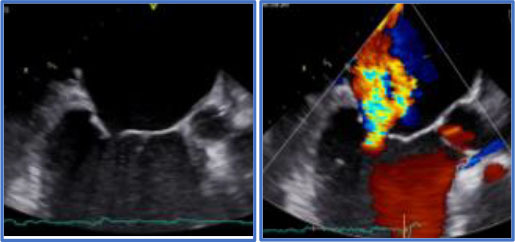
|
Restricted leaflet opening Commissural or chordal fusion Leaflet thickening Leaflet calcification |
Chordal division |
Identify affected chorda/ae Coaptation depth Tenting area |
| Restricted leaflet closure Chordal thickening Chordal shortening |
Annuloplasty | EROA |
EF, ejection fraction; EROA, effective regurgitant orifice area; LV, left ventricular; MR, mitral regurgitation; PL, posterior leaflet; TEE, transesophageal echocardiography; TR, tricuspid regurgitation.