


Figure 3.
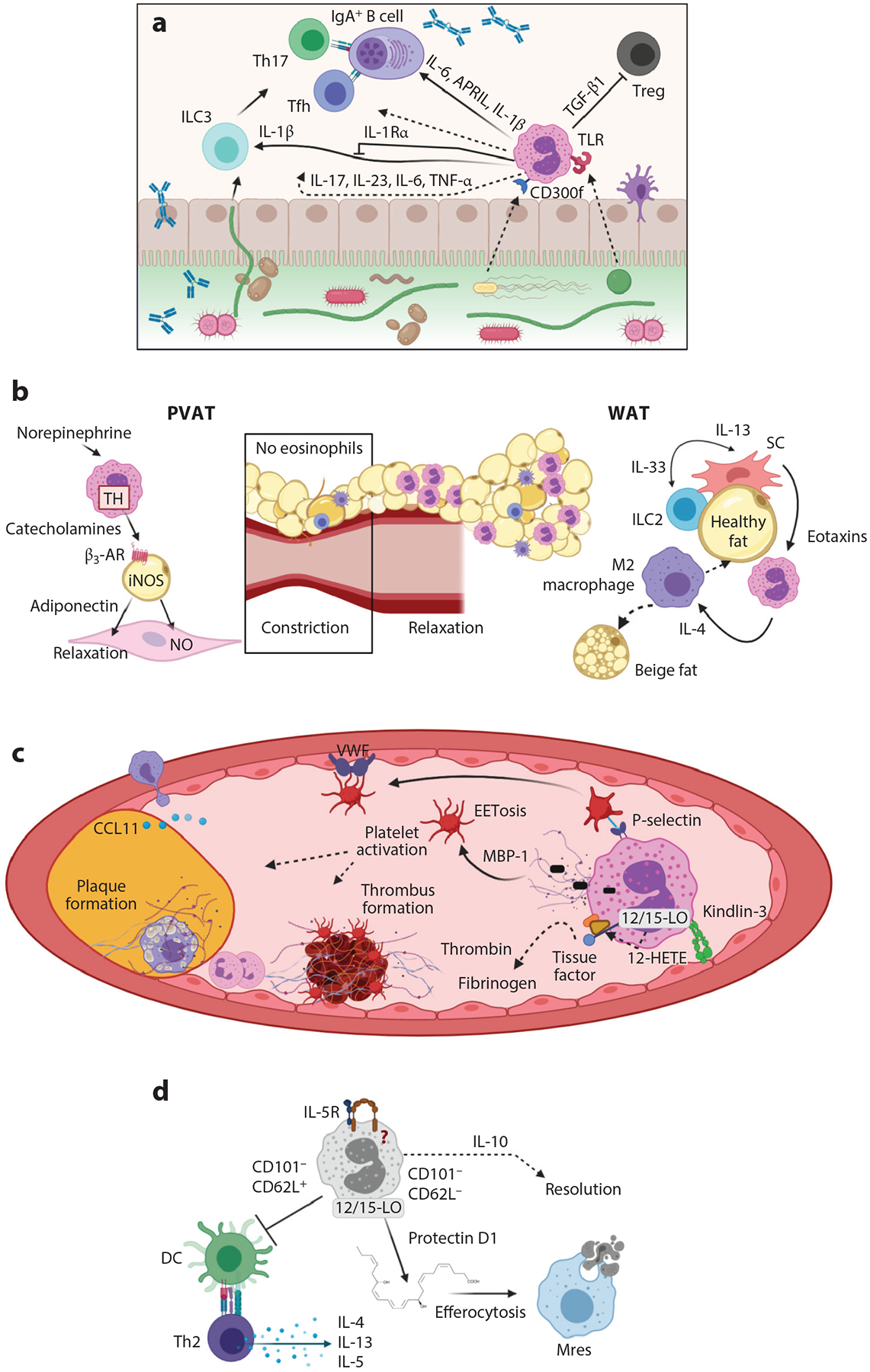
Eosinophil activities in homeostasis in mice. (a) Eosinophil activities with the microbiome, B cells, and Th17 responses in the gastrointestinal tract. Eosinophils express receptors such as TLRs and CD300f that recognize bacterial components to signal for immune responses. Eosinophils release the cytokines IL-6, APRIL, and IL-1β to influence B cell IgA production. This may happen through Tfh cells or Th17 cells, which express IL-17. Eosinophil release of IL-1β increases the activity of ILC3s; TGF-β1, which inhibits Tregs; and IL-17, IL-23, IL-6, and TNF-α, which may directly participate in the above responses. (b) Eosinophil functions in metabolic and vascular health. Eosinophils induce relaxation of blood vessels in PVAT through use of TH to release catecholamines that bind β3-AR, which stimulates iNOS in adipocytes to make NO that results in smooth muscle cell relaxation. In WAT, ILC2s produce IL-13 in response to the IL-33 produced by SCs. The IL-13 induces production of eotaxins that recruit eosinophils into fat. These eosinophils release IL-4 to polarize macrophages into alternatively activated M2 macrophages that contribute to transformation of white to beige fat cells, which are thermogenic cells that aid in metabolic health. (c) Eosinophils have multiple functions in vascular health. Eosinophils release a 12-hydroxyeicosatetraenoic acid (HETE) product that is generated from 12/15-LO and ultimately aids in tissue factor activation and development of thrombi through thrombin and fibrinogen activation. Eosinophils activate platelets through P-selectin promoting platelet binding to VWF in endothelial cells, which also aids in clot and plaque formation. Through integrin kindlin-3 binding of the endothelium, eosinophils are activated to undergo EETosis, releasing MBP-1 that further activates platelets and promotes atherosclerotic inflammation. (d) Eosinophils as lung-resident cells. Resident lung eosinophils are different from inflammatory recruited eosinophils due to their differential expression of CD101. CD101− cells that are CD62L+ suppress DC activation, which in turn inhibits Th2 cell release of cytokines IL-4, IL-13, and IL-5. CD101− eosinophils that are CD62L− are reported as important in resolution of inflammation in that they produce protectin D1 through 12/15-LO activity. Protectin D1 promotes efferocytosis, whereby Mres phagocytose dead neutrophils. Eosinophil-derived IL-10 is also important in resolution functions of eosinophils in the lung. Dashed arrows indicate either less-defined or indirect pathways of eosinophils in the roles presented. Abbreviations: APRIL, a proliferation-inducing ligand; β3-AR, beta 3 adrenergic receptor; CCL, C-C motif chemokine ligand; DC, dendritic cell; ILC2, group 2 innate lymphoid cell; iNOS, inducible nitric oxide synthase; MBP-1, major basic protein 1; Mres, resolution macrophage; NO, nitric oxide; PVAT, perivascular adipose tissue; SC, stromal vascular cell; Tfh, T follicular helper; TGF-β1, transforming growth factor beta 1; Th, T helper; TH, tyrosine hydroxylase; TLR, Toll-like receptor; TNF-α, tumor necrosis factor alpha; Treg, regulatory T cell; 12/15-LO, 12/15 lipoxygenase; VWF, Von Willebrand factor; WAT, white adipose tissue. Figure adapted from images created with BioRender.com.