


Table 1.
Briquetting machine with their features, merits, and demerits
| Machine type | Image | Features | Merits | Demerits | References |
|---|---|---|---|---|---|
| Piston press |

|
Feedstock is compressed into a die by a to and fro moving ram Extrusion is done by the reciprocating piston Produced briquettes are usually with a concentric hole High-pressure type |
Efficient and uniform combustion due to larger surface area Robust with a reputation of long working life They are simply maintained Less wear and tear Power consumption is minimal |
Require frequent maintenance Cannot be used to manufacture carbonized briquettes Produced briquettes are not homogeneous |
Sharma et al. (2015), Young and Khennas (2003), Ghaffar et al. (2015) |
| Screw press |
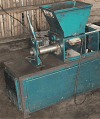
|
Continuously extrude feedstock via an externally heated taper dye Extrusion is done using a specially designed screw Produced briquettes are completely solid Regular, homogeneous, and can withstand greater impact force without crumble High-pressure type |
Generate less noise Used for both carbonized and non-carbonized briquettes Produced briquettes of high quality Briquettes are homogeneous and suitable for gasifier |
High tear and wear High power consumption Required specific feedstock properties |
Tuates et al. (2016a), Grover and Mishra (1996a), Young and Khennas (2003), Ghaffar et al. (2015) With permission |
| Hydraulic piston press |
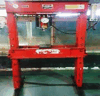
|
Driven by an electric motor via a hydraulic system low-pressure type |
Light and compacted It can briquettes feedstock with higher moisture content |
Slower with lower outputs Usually have a smaller bulk density |
Grover and Mishra (1996a), Young and Khennas (2003), Shuma and Madyira (2019) |