


Figure 2. Chronic social defeat stress blunts social cFos activation in Crh+ aCMT cells.
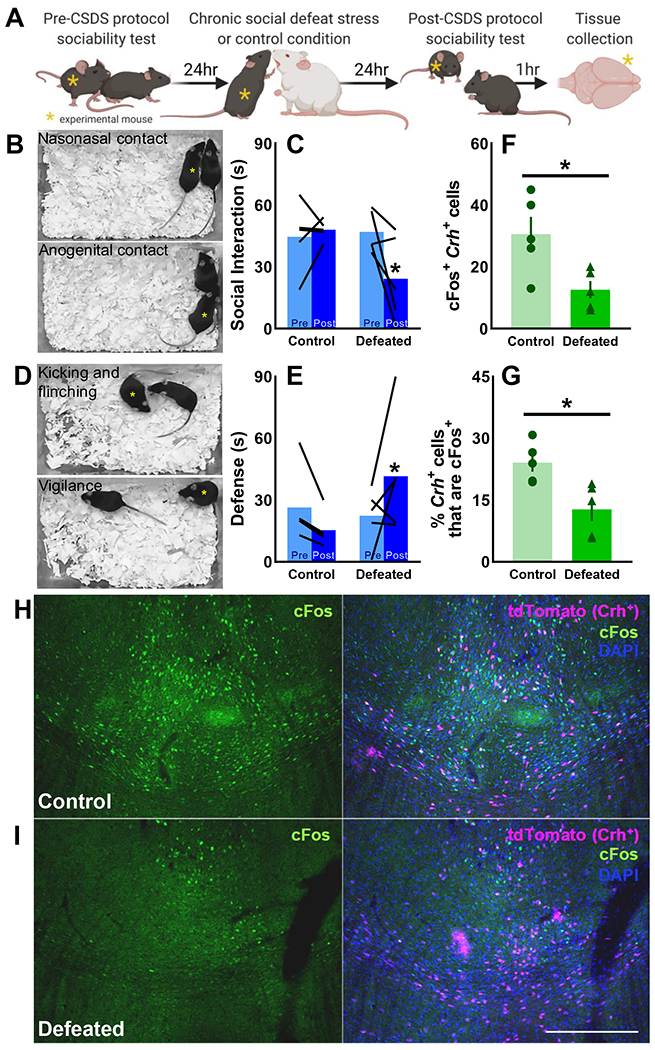
(A) Female CRH-ires-Cre/Ai9 mice were tested for baseline sociability toward a safe social partner, then exposed to either 10-day chronic social defeat stress (CSDS; n=5 Defeated) or the 10-day control condition (n=5 Control. Sociability was retested the day after 10-day CSDS/control protocol; tissue was collected one hour later to examine colocalization of cFos with the endogenous Crh reporter protein, tdTomato, in anterior central medial thalamic (aCMT) cells. (B, C) CSDS reduced sociability, measured as cumulative nasonasal and anogenital contact time [F(1,8)=5.37, p=0.049] and (D, E) increased defensiveness, measured as total time spent kicking, flinching, and maintaining a vigilant-like pose [F(1,8)=5.56, p=0.046]. (B, D) Yellow asterisks indicate CRH-ires-Cre/Ai9 mice as they engage in representative social and defensive behaviors. (F) Colocalization of cFos and tdTomato in the aCMT was suppressed by CSDS [t(8)=2.87, p=0.021]. (G) A greater percentage of Crh+ aCMT cells were activated by safe social interactions in (H) control mice compared to (I) defeated individuals [t(8)=3.19, p=0.013]; (H, I) representative images taken at 10x magnification of (left panels) cFos (green) and (right panels) cFos colocalization with tdTomato (magenta) and DAPI counterstaining (blue); 200 μm scale bar. Data shown as individual values and as the group Mean ± SEM; *p<0.05 control vs. defeated