


Figure 6.
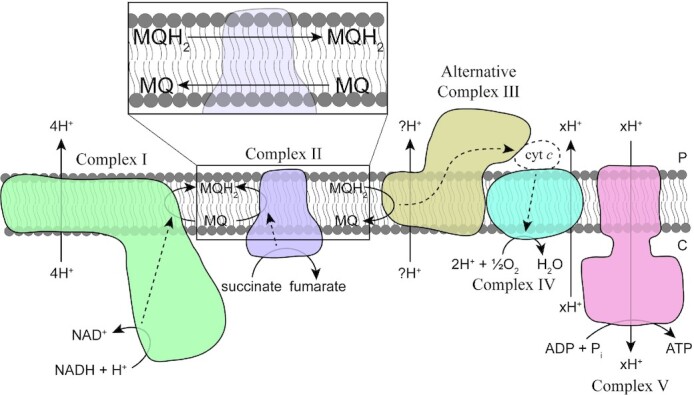
Schematic overview of the typical electron transport chain of verrucomicrobial methanotrophs. NADH generated through catabolic processes is oxidised by the NADH:quinone oxidoreductase (Complex I), transferring electrons to menaquinone (MQ) to form menaquinol (MQH2) while translocating protons across the membrane to generate a proton motive force. The succinate dehydrogenase (Complex II) oxidises succinate to fumarate as a part of the tricarboxylic acid cycle and transfers electrons to MQ to form MQH2. Alternative complex III oxidises MQH2 back to MQ, transferring electrons to a cytochrome c oxidase (Complex IV), either via an external periplasmic cytochrome c protein (cyt c) or directly. Whether protons are translocated during this electron transfer is unknown. Ultimately, electrons are used to reduce O2 to water, while protons are translocated over the membrane, contributing to the proton motive force that is used by an ATP synthase (Complex V) to synthesise ATP. Dashed lines indicate electron flow. Inset: transfer of oxidized and reduced quinones inside the bilayer (the quinone pool). C: cytoplasmic side of the membrane; P: periplasmic side of the membrane.