


FIGURE 1.
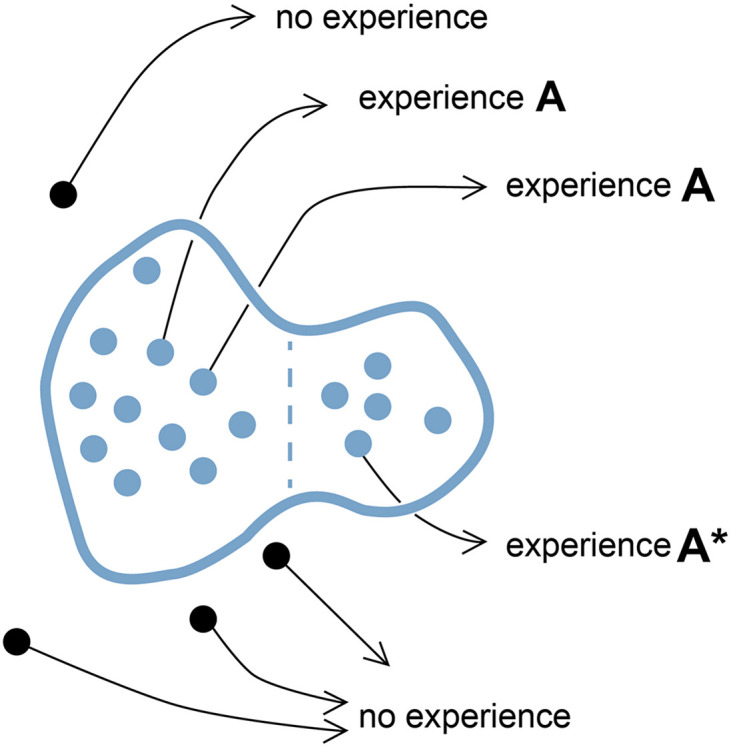
A point cloud in SC-space. The diagram represents a configuration space where distance measures incremental differences in the way a related set of neural circuits (variants) can be configured or, for the case of neural events, incremental differences in variables chosen to represent those events. Each point within the domain bounded in blue represents a selector circuit (SC), defined as a neural circuit or neural event that acts to evoke a particular experiential quale (the As in this case). Black points outside the domain represent circuit or event variants that fail to evoke that quale, or in this case, any experience at all. For an individual brain, the quale in question could theoretically be evoked by many SCs acting in concert, represented here by a point cloud, or few, or only one. Individual brains could thus vary both quantitatively (how many variants are active and effective) and qualitatively (how tightly clustered they are in SC-space). Experience A* is included to indicate that there may be differences in the experience evoked at different points within the domain, i.e., that experience A* may be qualitatively different than A. For example, the domain as a whole might include SCs for both fear (A) and panic (A*), so a point cloud clustered predominantly on the left would evoke fear, on the right, panic, or both feelings together if the SCs are evenly distributed. How gradual the transition might be from fear to panic along trajectories in SC-space is not specified, nor how abruptly either experience is degraded for SCs located near the domain boundary, which could for that reason be “fuzzier” than shown here. The domain could also be more cloud-like in being diffuse and full of holes representing SCs inside the domain that happen not to produce an experience. Indeed, the term point cloud would typically be employed topologically to refer to the domain itself, so as to include the total set of all possible SCs of a specified type, but is here used in a more restricted sense, to refer to only those SCs realized in real brains at either the individual or population level. The diagram is highly schematic in reducing the high-dimensional space required to represent the complexities of real neural circuits and events to a two-dimensional surface, and is intended to apply only to the most fundamental units of experience, i.e., qualia.