


FIGURE 2.
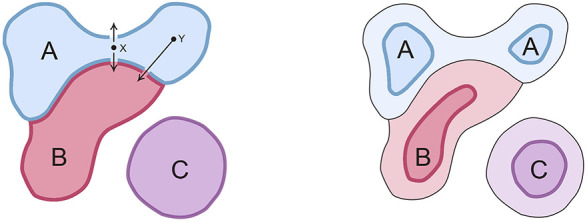
How evolution acts to select the subset of SCs realized in real brains. Consider hypothetical domains A and B within whose boundaries the respective SCs evoke two distinguishable experiences, A and B. For SCs in real brains, and assuming SCs change location from generation to generation due to genetic and developmental variability, short trajectories that change or abolish an experience (e.g., X in the figure) are more likely to occur than longer ones (Y). Subjective experiences are therefore less robust in evolutionary terms when the SCs that evoke them are close to domain boundaries. Hence, over evolutionary time, the region within which point clouds are realized (bounded domains on the left hand diagram) will progressively shrink and separate from one another (right hand diagram) as the SCs in intervening regions of SC-space (paler colors) are eliminated from real brains. Domain C is included as a reminder that multiple domains can act together, as ensembles, so that, for example, experience A might only be evoked if both A and C (plus any number of additional domains) act in concert, or A and C might together evoke an entirely different experience.