


Figure 1: Biofilm formation and dispersion.
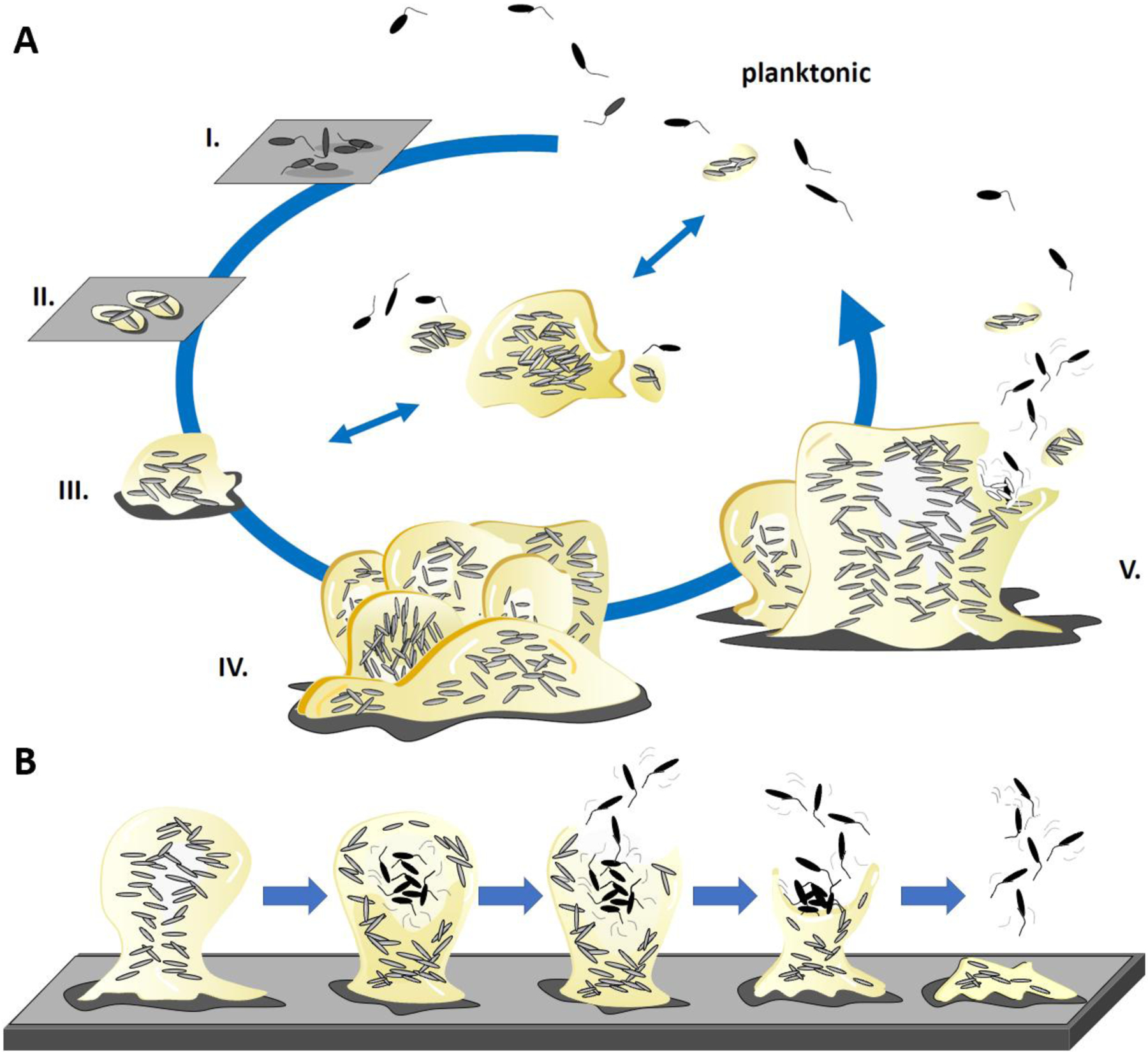
a) The schematic is based on the in vitro analysis of single species Pseudomonas aeruginosa biofilms. The formation of biofilms is a cyclic process that occurs in a stage-specific and progressive manner. The process is initiated following surface contact by single planktonic cells. Several developmental steps are discernable as reversible attachment (step I), irreversible attachment (step II) and biofilm maturation (steps III-IV)6,26. During the initial event in biofilm development, bacteria attach to substratum at the cell pole or via the flagellum (step I). Cells are cemented to the substratum and form nascent cell clusters with all cells in contact with the substratum. Transition to this stage coincides with loss of flagella gene expression and the production of biofilm matrix components (step II). Cell clusters mature and are several cells thick, embedded in the extracellular polymeric substances matrix (step III). Biofilms fully mature, which is apparent by clusters and microcolonies having reached maximum thickness (step IV). The biofilm life cycle comes full circle when biofilms disperse (step V). This stage is characterized by cells evacuating the interior portions of cell clusters, forming void spaces. Recent reports describe the formation of aggregates that exhibit biofilm-like features in the absence of surfaces (middle panel)174. Based on in vivo observations, these aggregates can attach to surfaces or disperse174 (indicated by the arrows). However, it is unclear if aggregate formation requires the same biofilm formation pathways and dispersion events. b) The schematic shows the discernable events that lead to biofilm dispersion. During dispersion, the inside of a biofilm becomes fluid, and cells within this zone begin to show signs of agitation and movement. Subsequently, cells escape the biofilm via a disruption in the microcolony wall through which cells evacuate, entering the bulk liquid as single bacteria. This leaves behind biofilms with central voids. If the dispersion response is extensive, the biofilm structure may further erode.