


Fig 1. Motor-type seizures and SWD bursts in adulthood.
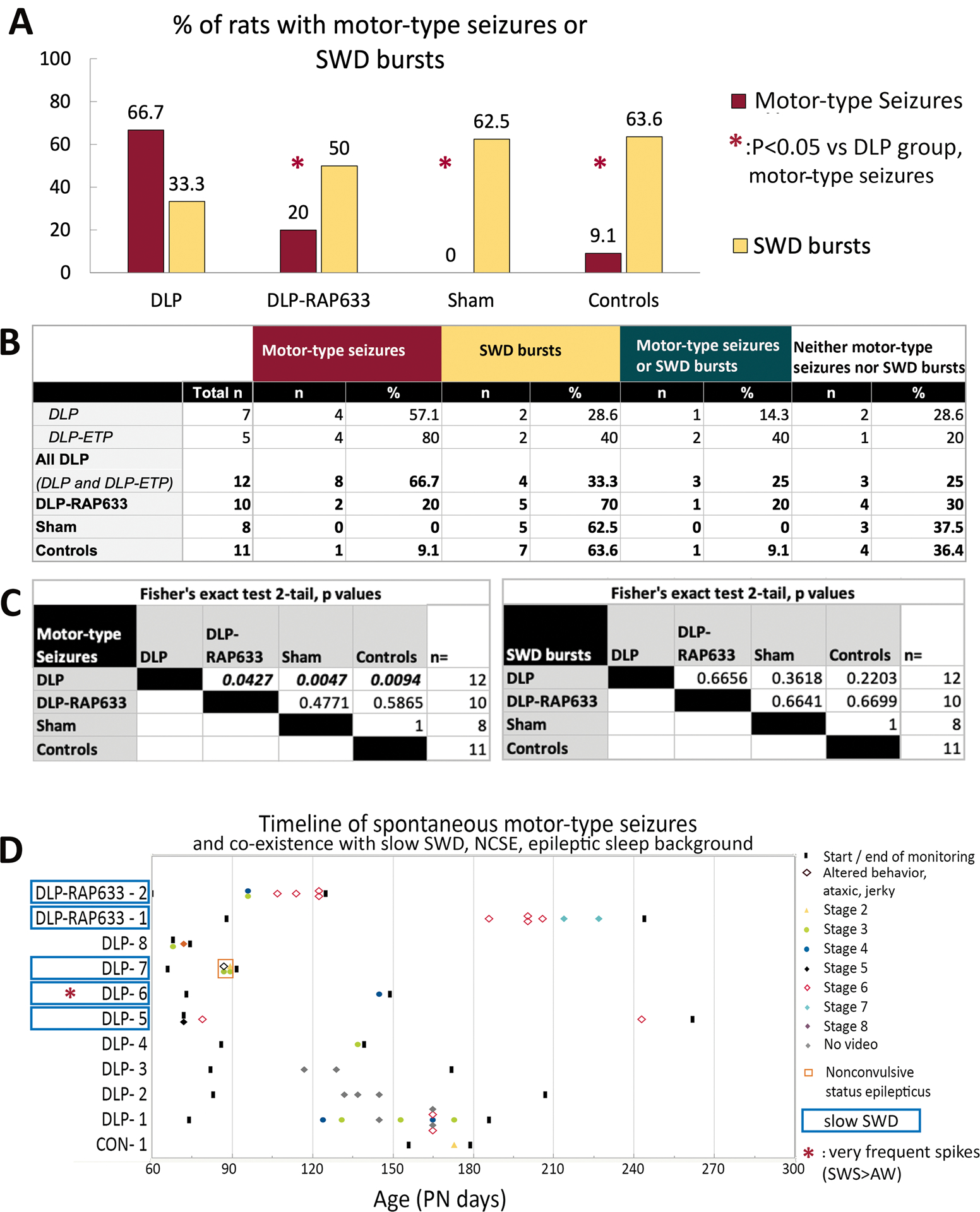
Panel A. DLP rats have a significantly higher incidence of motor-type seizures in adulthood than each of the other groups. Pulse rapamycin (DAP-RAP633) given on PN4–6 prevents the expression of motor-type seizures in adulthood suggesting an antiepileptogenic effect. SWD bursts are seen in all groups.
Panel B. Summary of incidence of motor-type seizures, SWD bursts in adult rats across the various studied groups.
Panel C. The matrices present the p values of the across-groups comparisons in motor-type seizure or SWD bursts incidences, using Fisher’s exact test.
Panel D. Timeline of spontaneous motor-type seizures and co-existence of motor-type seizures with slow-SWD burst phenotype (rats in cyan boxes), nonconvulsive status epilepticus (NCSE, red square frame) and very frequent spikes in SWS vs AW interictally (red asterisk). Only rats with spontaneous motor-type seizures are included in this panel. Three DLP rats and 2 DLP-RAP633 rats with motor-type seizures had slow-SWD bursts. DLP-7 rat with both slow-SWD and motor-type seizures had NCSE and eventually expired. DLP-6 rat with slow-SWD and motor-type seizures also had chronically epileptic background with bilateral spikes, mostly frontal, almost continuous in SWS, throughout the monitoring period.