


Abstract
Introduction:
The surgical approach for treating ventral hernia is still under debate, as well as the optimal devices to be used for such treatment. For small size defects, the tendency is to use the open approach, due to the lower cost/efficiency ratio. However, for medium-size defects, even though costlier, laparoscopy provides better results. The present study analyzes the results of a simple and effective laparoscopic technique for mesh repairing of small and medium size ventral defects using Ventralex® ST patch.
Method:
Between January 1, 2015 and January 31, 2020, 93 patients with ventral primary nonobstructive abdominal wall defects (up to 3 cm) treated laparoscopically using the intraperitoneal onlay mesh repair technique with Ventralex® patch (22 patients) and Ventralex® ST patch (71 patients). Results were prospectively analyzed based on postoperative complications, postoperative pain, recurrent hernia, and quality of life.
Results:
The technique was used in 60 patients with umbilical hernia (64.5%), 18 patients with juxta-umbilical hernia (19.3%), and 15 patients with epigastric hernia (16.1%). Out of these, 22 patients had nonreducible (nonobstructive) hernia. The median operating time was 55 minutes (range 40–80 min). Minor complications were recorded in 15 cases (16.1%). The mean hospitalization time was 1.24 days (range 1–2). After a median follow-up of 39 months (range 20–81), the recurrence rate was 11.1% and nil (p = 0.010), and other complaints were recorded in 11.1% and 3.3% of patients (p = 0.293), for Ventralex® patch and Ventralex® ST patch, respectively.
Conclusions:
In conclusion, the use of Ventralex® ST patch for laparoscopic intraperitoneal onlay mesh repair of small and medium size ventral hernia is simpler and more cost-effective than standard laparoscopic patches, with superior results when compared to Ventralex® patch.
Keywords: Ventral hernia, Ventralex® ST patch, Ventralex® patch, Laparoscopic treatment of ventral hernia, Intraperitoneal onlay mesh repair
INTRODUCTION
Ventral hernia affects approximately 25% of all individuals.1 About one-third of all hernia repairs in the United States (US) are performed for ventral hernia, two-thirds are primary hernias and one-third incisional hernia.2 Most small abdominal wall defects are asymptomatic, but even so, often the appropriate treatment is surgery, in order to avoid acute life-threatening complications, namely acute incarceration or strangulation. The treatment cost is very high; in the US alone, approximately 3.5 billion dollars is spent annually to repair ventral hernias.3
Currently, mesh reinforcement is commonly used for hernia repair and is recommended for repair of hernias larger than 2 cm4 and strongly recommended for hernias larger than 4 cm.5 For small size defects, the tendency is to use the open approach, due to the lower cost/efficiency ratio. However, for medium size defects, even though costlier, laparoscopy provides better results. There is no consensus on the mesh type, component separation technique, and management of complex patients with such hernias.4
In recent years, several types of prostheses have become available for the treatment of small and medium abdominal wall defects, being designed to strengthen the wall and, at the same time, to prevent adhesions to the intraperitoneal viscera.6 Ventralex® and Ventralex ST meshes (Bard®, Davol Inc., CR Bard Inc., RI, USA) are such type of mesh, designed for intra-abdominal placement in open approach.6,7
In open approach, placing the mesh behind the defect, without an incision exceeding the size of the defect, is difficult if not impossible. On the contrary, in laparoscopic approach, this placement is much easier, with minimal incisions, reduced postoperative complications and hospitalization time, and low recurrence rate.8
This study reports our results with a simple and effective laparoscopic technique for mesh repairing of small and medium size ventral defects using Ventralex® and Ventralex® ST patch.
MATERIALS AND METHODS
Study Group
Between January 1, 2015 and January 31, 2020, 153 patients underwent surgery for small and medium (up to 3 cm) primary ventral hernias, using intraperitoneal onlay mesh repair (IPOM) with Ventralex® or Ventralex Sepra Technology (ST) (Bard®, Davol Inc., CR Bard Inc., RI, USA), performed by a single surgeon, were enrolled in this prospective study.
The inclusion criteria were: (1) ventral (umbilical, paraumbilical, or epigastric) nonobstructed primary hernia; (2) parietal defect up to 3 cm; (3) operated using IPOM technique; (4) with Ventralex® or Ventralex Sepra Technology (ST) (Bard®, Davol Inc., CR Bard Inc., RI, USA). The exclusion criteria were: (1) additional concomitant surgery; (2) patients with relative contraindications to elective repair, such as: severe obesity (body mass index [BMI] over 35 kg/m2), poorly controlled diabetes mellitus (HbA1c ≥ 8%);4 (3) severe comorbidities, such as: chronic pulmonary diseases, ascites, and advanced neoplasms; (4) repeated prior surgery.
Out of the 153 patients, 8 patients underwent other concomitant additional surgeries, 11 patients had relative contraindications to elective repair, 23 patients had severe associated conditions, and 18 patients had repeated prior surgery. Consequently, 93 patients met the criteria for our study.
Immediate postoperative follow-up consisted in visits at 10, 30, and 90 days, respectively. The short-term results of the procedure were assessed based on postoperative complications, pain, recurrent hernia, and the quality of life. The visits included satisfaction level, recurrence of symptoms, the scale of postoperative pain. Chronic pain was evaluated using the Carolinas Comfort Scale and Visual Analog Scale. For long-term analysis, a survey was conducted based on the referral of recurrent hernia, chronic pain, and quality of life; 25 patients were lost during follow-up (13 patients with Ventralex® patch, and 12 patients with Ventralex® ST patch).
Material
For ventral hernia repair we used Ventralex® or Ventralex Sepra Technology (ST)® (Bard®, Davol Inc., CR Bard Inc., RI, USA) mesh, designed for intra-abdominal placement in open approach (Figure 1). We used patch sizes either 6.4 cm or 8 cm. The largest size currently available on the market (8 cm) limited the indication for defects to up to 3 cm, as the remaining 5 cm were necessary to insure to optimal overlapping. The sides of these meshes have different purposes: the side that comes in contact with the abdominal wall is made up of polypropylene, for improving tissue integration, while the other (the visceral side) is made up of expanded polytetrafluoroethylene (ePTFE) (Ventralex®) or hydrogel barrier (Ventralex ST®), resorbable within 30 days, for minimizing tissue attachment and to protect the viscera during the healing process.6,7 For laparoscopic approach, the two strips provided for open surgery (used for fixing the edges of the defect) were removed, as they were no longer necessary for mesh placement.
Figure 1.
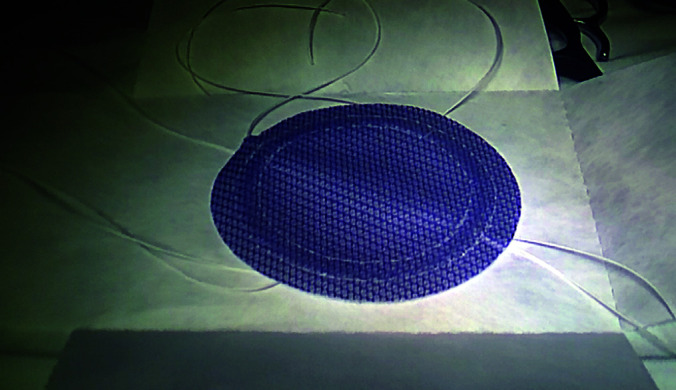
Preparing the Ventralex® ST Patch.
Surgical Technique
The mesh was placed using intraperitoneal onlay repair technique with defect suture (IPOM plus technique) was used in all patients, except in the ones with defect under 1 cm, where intraperitoneal onlay mesh repair (IPOM technique) was considered sufficient.9,10
The trocars were placed according to the IPOM technique. The working pressure was reduced to 8–10 mm Hg in certain stages of the intervention (before defect closure for tension-free suture, and during mesh placement and suturing). After the reintegration of the hernial content and adhesiolysis, a fascial area of 4–5 cm from the edge of the abdominal wall defect was exposed by excising the tissue that would prevent the smooth application of the mesh (the round ligament and the adipose, that is particularly rich in overweight patients). A mesh was chosen accordingly so it overlapped the defect at least for 5 cm (at least 2.5 cm overlap around the defect)11,12 (Figure 2). Defects larger than 1 cm were closed using a transfascial suturing device, with nonabsorbable monofilament 1 suture passed in “X”. Nonabsorbable monofilament 2.0 surgical threads were preplaced externally in “cardinal points” of the mesh,13 and the mesh was introduced into the abdomen (Figure 3).
Figure 2.

Abdominal wall defect measurement.
Figure 3.

Intraperitoneal view of the mounted Ventralex® ST patch.
Statistical analyses
Continuous variables were represented as median and range. Categorical variables were described in frequencies and percentages and compared using the Chi-Square test. A p value ≤ 0.5 was considered significantly.
RESULTS
The age of the patients in our study ranged from 25 to 78 years (median 53), with a male/female ratio of 35/58 and a BMI ranging 18.5 – 43.7 kg/m2 (median 28.7). Only one patient with a BMI above 35 kg/m2 (43.7 kg/m2) was included in the study group because of significant abdominal pain. All other similar patients were advised to lose weight prior to surgery.
The topography of the ventral hernia was mainly umbilical (60 cases; 64.5%). Patients with parietal defects up to 3 cm were included in our study; 15.1% (14 patients) with defect ≤ 1 cm, 84.9% (79 patients) with defect between 1–3 cm (Figure 4).
Figure 4.
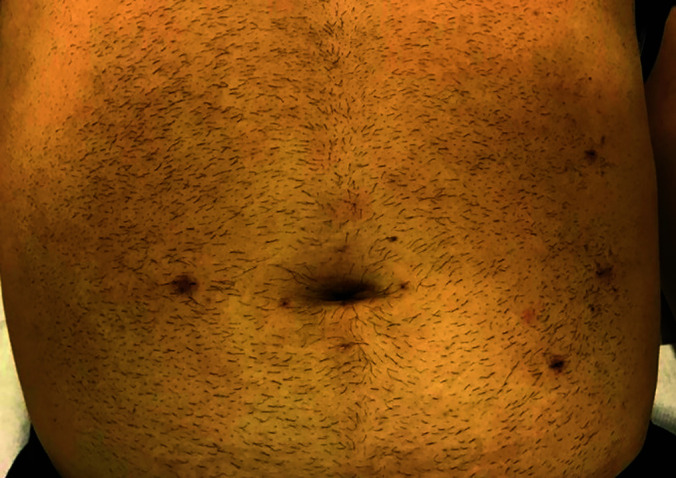
Postoperative results at 10 days in a 52-year old male after 3 cm umbilical hernia repair with Ventralex® ST patch. Trocar and suture sites are visible.
The main comorbity was hypertension (28 cases; 30.1%). Regarding the mesh size, 79 (84.95%) of large size (8 cm), 14 patches (15.05%) were medium size (6.4 cm), and no small size patches were used. The median operating time was 55 minutes (range 40–80 min). The mean hospitalization time was 1.24 days (ranging 1–2) (Table 1).
Table 1.
Clinical, Pathological, and Operative Data of the Patients
| Clinical Characteristics | Number (Percent) |
|---|---|
| Topography of ventral hernia | |
| Umbilical | 60 (64.5%) |
| Juxta-umbilical | 18 (19.3%) |
| Epigastric | 15 (16.1%) |
| Hernia reduction | |
| Reducible | 71 (76.3%) |
| Non-reducible, nonobstructed | 22 (23.7%) |
| Associated pathologies | |
| Well-controlled diabetes | 7 (7.52%) |
| Hypertension | 28 (30.1%) |
| Chronic constipation | 24 (25.8%) |
Postoperative complications were recorded in 15 cases (16.1%): 6 cases with seroma (necessitating evacuation in 2 cases, while the other were treated conservatively), 9 cases with superficial hematoma (treated conservatively). There were no late postoperative complications.
The postoperative pain was directly proportional to the degree of satisfaction. At the 90 day visit, no patient referred any pain or discomfort related to the procedure. There was no significant difference in terms of scale of patient satisfaction and the scale of pain were correlated with the location of the abdominal wall defect or with the size of the patch used. (Table 2).
Table 2.
Visual Analog Scale Score and Carolinas Comfort Scale Score on the 10-30-90 Postoperative Day Visits
| Visit 1–day 10 | Visit 2–day 30 | Visit 3–day 90 | |
|---|---|---|---|
| Visual Analog Scale Score | N = 93 | ||
| No pain, number (%) | 71 (76.3%) | 82 (88.1%) | 91 (97.8%) |
| Mild pain, number (%) | 8 (8.6%) | 9 (9.7%) | 2 (2.1%) |
| Moderate pain, number (%) | 14 (15.1%) | 2 (2.1%) | 0 |
| Severe pain, number (%) | 0 | 0 | 0 |
| Carolinas Comfort Scale Score | N = 93 | ||
| Very satisfied, number (%) | 68 (73.1%) | 73 (78.5%) | 92 (98.9%) |
| Satisfied, number (%) | 21 (22.6%) | 18 (19.3%) | 1 (1.1%) |
| Neutral, number (%) | 4 (4.3%) | 2 (2.15%) | 0 |
| Unsatisfied, number (%) | 0 | 0 | 0 |
After a median follow-up of 39 months (range 20–81), the recurrence rate was 11.1% (1 out of 9 patients) and nil (p = 0.010), for Ventralex® patch and Ventralex® ST patch, respectively. Other complaints were recorded in 11.1% (1 out of 9) and 3.3% (2 out of 59) of patients (p = 0.293), for Ventralex® patch and Ventralex® ST patch.
DISCUSSIONS
In terms of cost/efficiency ratio, when comparing the laparoscopic approach with the open one, even though the laparoscopic instruments are relatively expensive, the balance still tilts in favor of laparoscopy, due to faster postoperative recovery, fewer complications, shorter hospitalization, and faster socioprofessional reintegration.14
Using laparoscopic approach to repair abdominal wall defects, even small ones, is safe and efficient, presenting a series of advantages when compared to open approach: complete exploration of the peritoneal cavity, better visualization of the abdominal wall defect and identification of other potential wall defects, complete dissection of the properitoneal tissue, mesh mounting under direct vision, intraperitoneal mesh placement, without extensive tissue dissection of the abdominal wall layers, and with consequent low postoperative complication rate, especially in obese patients or patients with associated comorbidities.15 However, this approach involves the use of more expensive patches when compared to the open approach.
The ventral hernias were classified according to the guidelines for treatment of umbilical and epigastric hernias from the European Hernia Society and Americas Hernia Society into small (0 – 1 cm), medium (more than 1 cm up to 4 cm), and large (over 4 cm).11 Our procedure was limited to defects up to 3 cm due to the largest size available for Ventralex (8 cm), as at least 5 cm of mesh was necessary for overlapping to avoid hernia recurrence. In defects larger than 3 cm (not part of our present study) we used dedicated mesh that are available only in larger sizes, starting with 11 cm. However, they are more expensive and necessitate tackers that involve increased risk of postoperative pain and additional costs. These were the main reasons why we favored Ventralex® whenever feasible.
Many authors report a lower rate of recurrences or late complications after using transfascially passed threads compared to tackers.16,17 For defects less than 1cm, mesh fixing only is sufficient (IPOM), while for larger defects, associating the defect suture to the mesh fixing (IPOM plus) seems to be the procedure with the lowest recurrence rate.21 Regarding postoperative pain, there are studies that report a postoperative discomfort associated with pain at the transfascial passage of threads between 1–6%.22 In our study, at the 90-day visit, no patient felt any pain or discomfort related to the procedure.
Initially, we used the Ventralex® patch in open approach, in 41 patients, as it was designed. However, also using the laparoscopic approach for hernia repair with dedicated meshes, we have come to the conclusion that Ventralex® is more appropriate for laparoscopic than open approach. The IPOM repair with ePTFE mesh, with transfascial fixation is safer and more economical, especially in obese patients.16,17 In 22 patients, we used the Ventralex® patch, that was significantly more difficult to maneuver during surgery when compared to Ventralex® ST, often resulting in suboptimal placement. Indeed, the long-term recurrence rate for Ventralex® patch was 11.1%, significantly higher when compared to Ventralex® STpatch (p = 0.010). Therefore, we recommend the use Ventralex® ST instead of Ventralex® patch. However, studies on larger study groups are needed in order to confirm our findings.
To the best of our knowledge, the use of Ventralex® patch for IPOM was previously reported by a limited number of studies.18,19 The only paper that analyzed the long-term follow-up, reporting inferior results in case of incisional hernias.19 In what the use of Ventralex® ST patch is concerned, we found only one paper, which recently reports a clinical case.20
In conclusion, the use of Ventralex® ST patch for laparoscopic intraperitoneal onlay mesh repair of small and medium size ventral hernia is simpler and more cost-effective than standard laparoscopic patches, with superior results when compared to Ventralex® patch.
Footnotes
Disclosure: none.
Funding sources: none.
Conflict of interests: none.
Informed consent: Dr. Florin Botea declares that written informed consent was obtained from the patient/s for publication of this study/report and any accompanying images.
Contributor Information
Razvan Catalin Popescu, Department of General Surgery, Emergency Hospital of Constanta, Constanta, Romania.; Ovidius University, Faculty of Medicine and Pharmacy Constanta, Constanta, Romania.
Cristina Dan, Department of General Surgery, Emergency Hospital of Constanta, Constanta, Romania.; Ovidius University, Faculty of Medicine and Pharmacy Constanta, Constanta, Romania. Dan Setlace Center of General Surgery and Liver Transplantation, Fundeni Clinical Institute, Bucharest, Romania.
Ionut-Eduard Iordache, Department of General Surgery, Emergency Hospital of Constanta, Constanta, Romania.; Ovidius University, Faculty of Medicine and Pharmacy Constanta, Constanta, Romania.
Andrei Ghioldis, Department of General Surgery, Emergency Hospital of Constanta, Constanta, Romania.; Ovidius University, Faculty of Medicine and Pharmacy Constanta, Constanta, Romania.
Nicoleta Leopa, Department of General Surgery, Emergency Hospital of Constanta, Constanta, Romania.; Ovidius University, Faculty of Medicine and Pharmacy Constanta, Constanta, Romania.
References
- 1.Bedewi MA, El-Sharkawy MS, Al Boukai AA, Al-Nakshabandi N. Prevalence of adult paraumbilical hernia. Assessment by high-resolution sonography: a hospital-based study. Hernia. 2012;16(1):59–62. Epub 2011 Jul 28. [DOI] [PubMed] [Google Scholar]
- 2.Rutkow IM. Demographic and socioeconomic aspects of hernia repair in the United States in 2003. Surg Clin North Am. 2003;83(5):1045–1051, v–vi. [DOI] [PubMed] [Google Scholar]
- 3.Poulose BK, Beck WC, Phillips SE, Sharp KW, Nealon WH, Holzman MD. The chosen few: disproportionate resource use in ventral hernia repair. Am Surg. 2013;79(8):815–818. [PubMed] [Google Scholar]
- 4.Liang MK, Holihan JL, Itani K, et al. Ventral hernia management: expert consensus guided by systematic review. Ann Surg. 2017;265(1):80–89. [DOI] [PubMed] [Google Scholar]
- 5.Christoffersen MW, Helgstrand F, Rosenberg J, Kehlet H, Bisgaard T. Lower reoperation rate for recurrence after mesh versus sutured elective repair in small umbilical and epigastric hernias. A nationwide register study. World J Surg. 2013;37(11):2548–2552. [DOI] [PubMed] [Google Scholar]
- 6.Iversen E, Lykke A, Hensler M, Jorgensen LN. Abdominal wall hernia repair with a composite ePTFE/polypropylene mesh: clinical outcome and quality of life in 152 patients. Hernia. 2010;14(6):555–560. [DOI] [PubMed] [Google Scholar]
- 7.Tollens T, Den Hondt M, Devroe K, et al. Retrospective analysis of umbilical, epigastric, and small incisional hernia repair using the Ventralex™ hernia patch. Hernia. 2011;15(5):531–540. [DOI] [PubMed] [Google Scholar]
- 8.Wright BE, Beckerman J, Cohen M, Cumming JK, Rodriguez JL. Is laparoscopic umbilical hernia repair with mesh a reasonable alternative to conventional repair? Am J Surg. 2002;184(6):505–508; discussion 508–509. [DOI] [PubMed] [Google Scholar]
- 9.Voeller GR, Chin AK, LeBlanc KA. Novel technique for full-thickness abdominal wall closure in laparoscopic ventral hernia repair. Surg Technol Int. 2019;10;35:123–128. [PubMed] [Google Scholar]
- 10.Bernardi K, Olavarria OA, Holihan JL, et al. Primary fascial closure during laparoscopic ventral hernia repair improves patient quality of life: a multicenter, blinded randomized controlled trial. Ann Surg. 2020;271(3):434–439. [DOI] [PubMed] [Google Scholar]
- 11.Henriksen NA, Montgomery A, Kaufmann R, et al. Guidelines for treatment of umbilical and epigastric hernias from the European Hernia Society and Americas Hernia Society. Br J Surg. 2020;107(3):171–190. [DOI] [PubMed] [Google Scholar]
- 12.Vychnevskaia K, Mucci-Hennekinne S, Casa C, et al. Intraperitoneal mesh repair of small ventral abdominal wall hernias with a Ventralex hernia patch. Dig Surg. 2010;27(5):433–435. [DOI] [PubMed] [Google Scholar]
- 13.Bschor M, Sahm M, Pross M. Laparoscopic repair for incisional hernias. 3rd Edition, 2006, Endo Press GMBH, Berlin, Germany. ISBN 978-3-89756-876-1, 8–11. [Google Scholar]
- 14.Beldi G, Ipaktchi R, Wagner M, Gloor B, Candinas D. Laparoscopic ventral hernia repair is safe and cost effective. Surg Endosc. 2006;20(1):92–95. [DOI] [PubMed] [Google Scholar]
- 15.Turner PL, Park AE. Laparoscopic repair of ventral incisional hernias: pros and cons. Surg Clin North Am. 2008;88(1):85–100, viii. [DOI] [PubMed] [Google Scholar]
- 16.Joels CS, Matthews BD, Kercher KW, et al. Evaluation of adhesion formation, mesh fixation strength, and hydroxyproline content after intraabdominal placement of polytetrafluoroethylene mesh secured using titanium spiral tacks, nitinol anchors, and polypropylene suture or polyglactin 910 suture. Surg Endosc. 2005;19(6):780–785. [DOI] [PubMed] [Google Scholar]
- 17.Eid GM, Prince JM, Mattar SG, Hamad G, Ikrammudin S, Schauer PR. Medium-term follow-up confirms the safety and durability of laparoscopic ventral hernia repair with PTFE. Surgery. 2003;134(4):599–603; discussion 603–604. [DOI] [PubMed] [Google Scholar]
- 18.Nicolau AE, Vasile R, Haiducu C. Laparoscopic repair of small ventral hernias using the “Ventralex™ Hernia Patch". Chirurgia (Bucur). 2019;114(1):95–102. [DOI] [PubMed] [Google Scholar]
- 19.Baker JJ, Öberg S, Rosenberg J. Reoperation for recurrence is affected by type of mesh in laparoscopic ventral hernia repair: a nationwide cohort study. Ann Surg. [published online ahead of print, 2021 Sep 13]. [DOI] [PubMed] [Google Scholar]
- 20.Tazaki T, Okamoto N, Sasaki M, et al. Laparoscopy-assisted repair with Ventralex ST Hernia Patch for a small subcostal hernia: a case report. Asian J Endosc Surg. 2021. Jan;14(1):132–135. [DOI] [PubMed] [Google Scholar]
- 21.Awad ZT, Puri V, LeBlanc K, et al. Mechanisms of ventral hernia recurrence after mesh repair and a new proposed classification. J Am Coll Surg. 2005;201(1):132–140. [DOI] [PubMed] [Google Scholar]
- 22.Heniford BT, Park A, Ramshaw BJ, Voeller G. Laparoscopic repair of ventral hernias: nine years' experience with 850 consecutive hernias. Ann Surg. 2003;238(3):391–399; discussion 399–400. [DOI] [PMC free article] [PubMed] [Google Scholar]